- 01Run paid video through a creator's own ad account
- 02Bid on the exact anxious phrase your buyer types before they know your brand
- 03Open with a fake dismissal before the real pitch
- 04Seed named, personal discount codes instead of a generic storefront link
01 Snapshot
The one-glance read on who they are and how they grow. Each point is verifiable from the receipts above.
Patented magnetic, leakproof, TSA-compliant travel capsules and organization accessories for skincare/toiletries, with 6,000+ 5-star reviews and a 50% repeat sales rate per an Inc. feature (March 2026).
Paid-led, run on top of a heavy creator-UGC and TikTok Shop layer.
~140,291 estimated monthly visits (+3.4% over the last 3 months); 80 active Meta ads (of 102 sampled) and a Google ad library of roughly 200 (123 sampled, 66 active) as of 2026-07-29; estimated ~$7.4M in annual revenue (RocketReach, 2026, unverified third-party estimate).
As of 2026-07-29, the newest Meta and Google creative pushes the translucent "Jelly Collection" launch alongside fresh text-ad variants that have been live roughly 1-60 days.
Cadence pairs an evergreen Google search cohort (running up to four years, targeting plain compliance queries) with paid creator-whitelisted video, using the "boring but permanent" search ad to catch buyers who already know they have a problem while the paid social layer builds the awareness that sends them there.
02 How it unfolded
The order the channels came online. Sequence is strategy: what they did first, and what they layered on once demand existed.
03 Traffic & channel mix
Estimated demand, the channel split behind it, and the keywords and referrers doing the work. Directional modeling, not audited analytics.
Cadence draws an estimated ~140,291 monthly visits, up 3.4% over the last 3 months. No channel-level breakdown, keyword list, or referrer/competitor data is available for this domain in the pulled data, so the mix behind that number can't be broken out here. Given the scale of the paid footprint documented below (56+ Meta ads, a ~200-ad Google library), it is reasonable to read a meaningful share of that traffic as ad-driven rather than purely organic, but that split is not independently confirmed.
04 Channel map
Not traffic share. How much weight the growth system actually puts on each channel, with a one-line read on the role it plays.
What drove growth
05 The creative doing the work
Each exhibit shows the actual asset, an X-ray of why it works, a status, and a play you can adapt. This is the heart of the teardown.
Cadence's Google library runs roughly 200 ads (66 sampled active as of 2026-07-29), while Meta shows 80 active ads of 102 sampled in rotation over the same window. Longevity is genuinely uneven across platforms: the Google search cohort is a true proven winner set, with ads running 876 to 1,468 days, while almost the entire visible Meta library dates only to May-July 2026, meaning most of what's live there is a current push rather than a proven bet. One Meta exception clears the bar.
Hook: "Cadence Official Site - Explore The Parcel System," a plain-text search headline; a companion product shot in the same cohort shows a hand holding six open hexagonal capsules filled with pills, jewelry, and cream. Why it works: It's a plain-text search ad sitting on branded and near-branded queries, catching shoppers who already know the brand and are searching to buy, with the product shot doing the work of proving "one system holds everything" in a single glance. Run this play: expanded as Play 2 below.
Hook: "Concert ready. No spills, just vibes." 🎶 Why it works: Run through a whitelisted creator's own Meta page (summernwinter_skynstars) rather than the brand account for 89 days as of 2026-07-29, the ad borrows that creator's page trust while widening the use case from "travel" to "going out," making it feel native in a feed built on paid trust-transfer. Run this play: expanded as Play 1 below.
Their newest tests, the glittery Jelly Collection reveal ("cadence We reimagined the travel container in Jelly") and a fresh problem-agitation hook ("Stressed packing?..."), sit at roughly 1-60 days old, a genuine current push rather than proven, next to the "Cadence Official Site" search ad that has quietly run for four years.
The ad landing pages route by intent rather than to one generic homepage. The "Your routine isn't one-size-fits-all" ad lands variably on the single Large Capsule page ($38), the Bestseller Set page ($164 for the set, with $8-$100 add-ons), and the general Capsules category page, which stacks individual prices ($15-$38) against bundle pricing ($14-$33.60) and 10-20% off, suggesting a dynamic product-catalog ad rather than one fixed lander. The "Giving myself the time I deserve" ad sends traffic to the "Build Your Capsule System" configurator ($12-$100, free shipping), a build-your-own tool that pushes cart size up by letting shoppers assemble a personal kit piece by piece. The "My life, with Cadence" video lands on a general lifestyle page anchored at a $100 price point with free shipping, functioning as a broader top-of-funnel catch-all. Across the sampled landers (three of five show explicit free-shipping/bundle signals; the single Large Capsule page shows neither), bundle pricing and free shipping are the recurring conversion levers, nudging single-capsule buyers ($15-$38) toward multi-piece sets ($100-$164).
- Running
- 19 days (longevity = it's converting)
- Hook
- Visual: A hand reaches into a clear container filled with pink, modular capsules. Several smaller white squares with images of the capsules are arranged around the main image. Audio: [no audio]
- Audience
- The aesthetic and functional presentation of modular, stackable containers for various personal care items (medication, toner, cleanser, serum) targets individuals who value organization, portability, and a minimalist aesthetic for their daily essentials or travel.
Why it works. Opens on a hand digging into loose colorful capsules, using the chaos-to-order visual to sell the modular system without any narration.
Visual demonstration of modularity and stackability (0:00-0:08) Demonstrate a modular product being assembled and disassembled by hand so the mechanism is obvious without an explainer voiceover.
- Running
- 19 days (longevity = it's converting)
- Hook
- 0:00-0:03, a woman with dark, wavy hair and a pink and purple tie-dye tank top is in a car, looking directly at the camera and speaking. She holds a small white packet in her left hand and scissors in her right. Audio: "Let me de-influence you from these cute little travel"
- Audience
- Individuals who travel frequently or desire an organized home routine for toiletries and small items, indicated by the focus on travel-sized products and daily routine organization.
Why it works. Leads with a de-influencing hook that criticizes trendy travel bottles before pivoting to modular capsules, borrowing anti-recommendation credibility.
Problem agitation and solution introduction (0:00-0:06, 0:13-0:14): The creator starts by 'de-influencing' viewers from common travel toiletries, then introduces Cadence capsules as a superior alternative. Open by naming a popular product in your category and why it falls short, then introduce your own product as the better alternative.
- Running
- 19 days (longevity = it's converting)
- Hook
- Visual: A white rectangular tray with various travel-sized items, including small white containers, a blue bikini top, a straw hat, and makeup brushes, is pushed forward on a black surface. Audio: A sound of something being pushed.
- Audience
- The display of organized travel essentials, including cosmetics, skincare, and accessories, targets individuals who travel frequently or value organized packing, particularly those interested in beauty and fashion.
Why it works. Rapid-cuts through a tray of travel items pushed toward camera, using kinetic motion instead of narration to show the full kit in one shot.
Rapid visual sequence of organized trays (0:00-0:08) Create a short video showcasing your product in 3-5 distinct use cases, using quick cuts under two seconds per scene to keep the energy high.
Show 7 more exhibits
- Running
- 19 days (longevity = it's converting)
- Hook
- Visual: A person's hands are shown filling a small, light-colored cylindrical container with a pink substance using a small spatula. Audio: Upbeat, electronic music plays.
- Audience
- Individuals who travel or need to organize small personal care items, indicated by the TSA-compliant travel capsules and various toiletries being packed.
Why it works. Shows the product being decanted with a small spatula from a full-size bottle, making the transfer process concrete instead of an abstract portability claim.
Product demonstration of decanting: At 0:00-0:09, the video shows various liquids and solids being transferred from larger containers into the smaller Cadence Capsules. Film the exact moment of transferring product from a full-size bottle into your travel container, showing the before-and-after size difference.
- Running
- 19 days (longevity = it's converting)
- Hook
- "I've officially entered the everybody's having babies era and this is my go-to gift." A woman in a pink and white striped shirt is speaking directly to the camera, gesturing with her hands.
- Audience
- New mothers or those buying gifts for new mothers, indicated by phrases like "everybody's having babies era," "new moms juggling travel, diaper bags, or even just daycare drop-offs," and "everything a new parent needs."
Why it works. Uses a relatable life-stage confession to position the capsules as a default baby-shower gift, aimed at millennial women buying for friends having kids.
Relatable problem statement and solution introduction (0:00-0:04): "I've officially entered the everybody's having babies era and this is my go-to gift." Have your spokesperson name a specific, current life stage your buyers are in before mentioning the product, so the right audience self-identifies first.
- Running
- 19 days (longevity = it's converting)
- Hook
- "How I pack my shampoo" + A woman with long dark hair holds a white shampoo bottle in her left hand and a small, light-colored, square-shaped container with a lid in her right hand, looking at the camera.
- Audience
- The focus on packing shampoo into a small, portable container suggests the ad targets travelers or individuals seeking compact and leak-proof solutions for toiletries.
Why it works. Uses a UGC how-to format built around one everyday item, shampoo, so viewers register a relatable packing tip before recognizing it's an ad.
Problem/solution demonstration (0:00-0:07): The video starts with the on-screen text "How I pack my shampoo" and then shows the process of pouring shampoo from a large bottle into a smaller, travel-friendly container. Name a specific packing pain point in your headline, then show your product solving it within the first few seconds.
- Hook
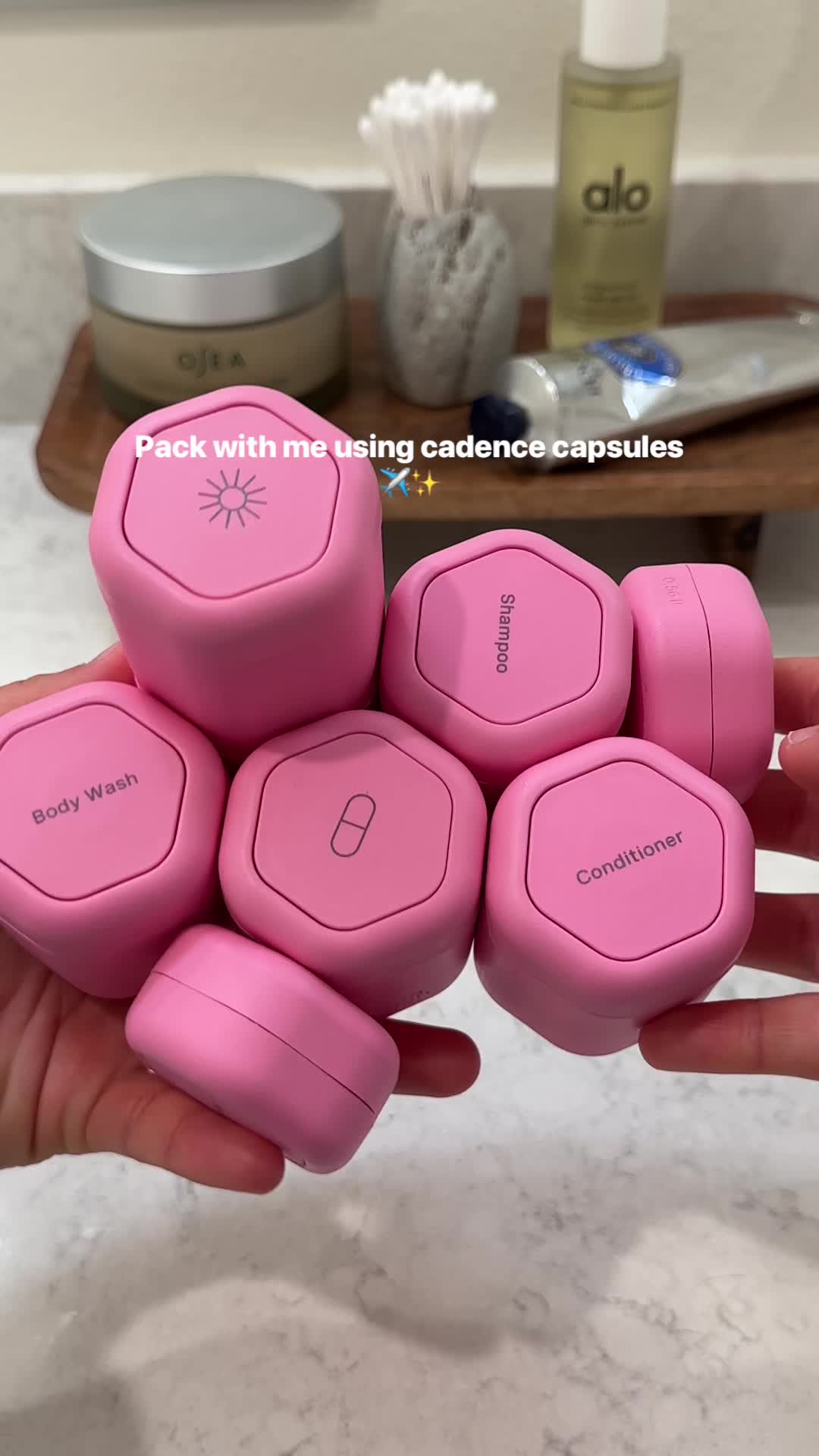
- On-screen text: "Pack with me using cadence capsules ✈️✨". Visual: A hand holding seven pink hexagonal capsules, some with text labels like "Body Wash", "Shampoo", "Conditioner", and one with a sun icon.
- Audience
- Individuals who travel frequently or desire organized, portable storage for personal care items, indicated by the focus on TSA approval and 'on-the-go' use.
Why it works. Uses the established pack with me genre to show all seven labeled capsules in one packing routine, letting the system sell itself.
Feature demonstration with on-screen text overlays (0:03-0:06, "the capsules are TSA approved, hold a lot of product & are leakproof"). Film your product inside a genre your audience already searches for, like packing or morning routines, instead of a straight ad.
- Hook
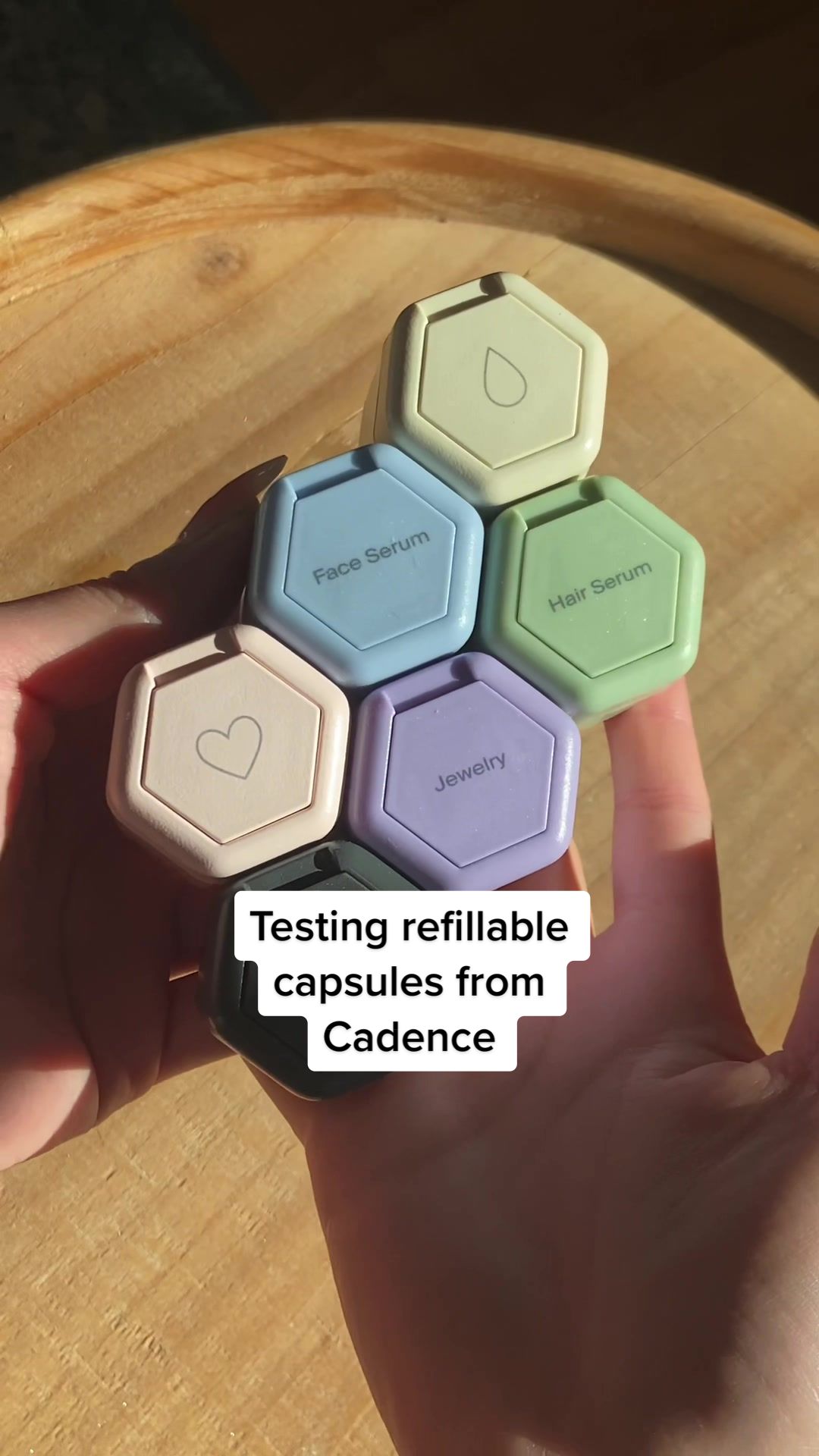
- 0:00-0:03, a person's hands are shown holding and manipulating several hexagonal, pastel-colored containers, which are connected together magnetically. Audio: "These modular refillable containers made from recycled plastic by Cadence are a huge hit with our Thingdrop community."
- Audience
- Individuals interested in travel, organization, skincare, hair care, and sustainable products, indicated by the product's function and the review content.
Why it works. Borrows credibility from a named niche community's endorsement while leading with the recycled-plastic angle for eco-conscious buyers.
Personalized product demonstration and review (0:00-0:26) Have your reviewer name the specific community or group that already uses your product instead of a generic everyone loves this line.
- Reach
- 449 upvotes · 228 comments · r/HerOneBag
A community is already discussing this in r/HerOneBag. Show up there authentically and answer the thread before a competitor does.
Who amplifies them
The clearest organic amplifiers are individual creators posting under their own handles: @jungle4eva, @maz_usup, and Thingtesting for reviews, plus a limited-edition design collaboration with @LarissaMills ("Jelly Capsule Collection," launched July 28, 2026). Discount-code creators distribute individually named codes (a Kelsey-tagged KELSEY15, and SHANNON15 shared within creator jungle4eva's post) that function as informal affiliates tied to a $125 cart minimum. Paid amplification runs through a separate set of whitelisted ad accounts (summernwinter_skynstars, Retrodenverfinds, samfbruno) that are creators lending their pages to Cadence's media spend, not organic fans. The founder, Steph Hon, appears directly in brand content (a founder-to-camera ad and an Instagram reel explaining the Original Capsule retirement) but is not shown posting from a separate personal account in this data. Community-wise, r/HerOneBag is the most active unpaid forum, with threads both defending and questioning the product.
06 Organic & video
The organic content engine: the videos, creator posts, and community presence earning attention without paid spend.
The brand's own TikTok account (@keepyourcadence) posts modestly, in the 243-1,152 engagement range, while creator content dwarfs it: jungle4eva's packing video pulled 1.79M engagement ("my fave features are that they're magnetic, leakproof, TSA approved"), maz_usup's price-scrutiny review hit 13,812, and Thingtesting's early "honest review" post reached 47,714. The format that consistently performs is the UGC talking-head packing demo, often opening with a relatable problem ("I'm running really late for work right now") before the product resolves it, alongside at least one "de-influence me" opening (see Play 3) that subverts skepticism into endorsement.
07 Affiliate & partners
How the brand turns creators and partners into a tracked, variable-cost acquisition channel, and how the program is structured.
Cadence runs a formal referral program at keepyourcadence.com/pages/refer, and a personalized referral link (share.keepyourcadence.com/donnaliu) was found circulating in r/referralcodes offering 15% off. That sits alongside a ShopMy affiliate link used by creator @patrianasonia and an active TikTok Shop listing for the Starter Travel Set (103,800 engagement), plus individually named discount codes (KELSEY15, SHANNON15) distributed by creators outside any single formal platform. Together this is a multi-layered affiliate motion: one owned program, one shop-platform integration, and an ad hoc layer of creator-specific codes.
08 The playbook
The channels are not separate. They are one system where each stage feeds the next. Here is the read, then the plays to run tomorrow.
The inferred playbook
Cadence's loop starts with a search ad built to last years, gets amplified by paid creator-page video and heavy organic TikTok UGC, and converts through bundle-forward landing pages, but the public reviews expose a repeat-purchase risk the funnel doesn't address.
The Google cohort running 876 to 1,468 days active sits on branded and problem-aware queries like "TSA Approved Containers," a low-maintenance, high-intent capture layer that doesn't need fresh creative to keep converting.
Meta ads run through creator-owned pages (summernwinter_skynstars, Retrodenverfinds, samfbruno) rather than only the brand account, blending paid reach with the algorithmic and social trust of an individual's page.
Dig deeper+3▾
Every analyzed lander routes toward the Bestseller Set or the Build Your Capsule System configurator, using free shipping and 10-20% bundle discounts to move buyers off the $15-$38 single-capsule price point toward $100-$164 kits.
Trustpilot reviews describe capsules leaking and cracking within a year even after free replacements, a friction point that sits directly against the Inc.-reported 50% repeat sales rate and isn't visibly addressed anywhere in the ad creative or landers reviewed.
the retail/wholesale contribution from The Container Store, MoMA Design Store, and REI relative to direct e-commerce, the referral program's share of total sales, and the repeat-purchase rate specifically among capsule-refill buyers versus first-time bundle buyers.
Run paid video through a creator's own ad account
The proofCadence's one Meta ad that has cleared genuine proven-winner status (89 days active as of 2026-07-29) ran through a creator's page, summernwinter_skynstars, rather than the brand account, with the lifestyle hook "Concert ready. No spills, just vibes."
The adaptationFind one micro-creator already talking about your product category, pay a flat fee for a single UGC clip, and ask them to grant ad-account access so the same paid budget runs from their page instead of yours (Meta's partnership-ads/whitelisting setting). Run the identical script from both the brand page and the creator's page as two ad sets to see whether the borrowed-trust version outperforms the brand-page version.
Cost: under $500 · Time to signal: weeks · Works pre-PMF: conditional, only if a relevant creator with an existing audience will license their page.
Bid on the exact anxious phrase your buyer types before they know your brand
The proofCadence's Google search cohort runs 876 to 1,468 days active as of 2026-07-29, and its plain-text ads target generic compliance queries like "TSA Approved Containers" rather than only branded terms.
The adaptationStart by writing one plain-text search ad targeting the specific compliance or capability worry a first-time buyer searches before they've heard of you (Cadence's version was a literal TSA-legality question), then leave it running untouched for months instead of cycling creative weekly. The value is in the ad's staying power against a stable, evergreen query, not in creative freshness.
Cost: under $500 · Time to signal: weeks · Works pre-PMF: yes.
Open with a fake dismissal before the real pitch
The proofOne of Cadence's proven-winner UGC ads opens "Let me de-influence you from these cute little travel..." before pivoting into a genuine endorsement.
The adaptationScript a 15-second phone video that opens by talking yourself out of your own product category (naming the real objection a skeptic would raise), then pivot to the specific reason you still use or sell it, and post it natively so it reads as an unpaid opinion rather than an ad. The dismissal-then-pivot structure is what earns the extra two seconds of attention before the scroll.
Cost: $0 · Time to signal: days · Works pre-PMF: yes, provided the pivot lands as a genuine reversal rather than a gimmick.
Seed named, personal discount codes instead of a generic storefront link
The proofCadence creators distribute individually named codes (KELSEY15, SHANNON15) tied to a minimum cart size, layered on top of its formal /refer program and a ShopMy link.
The adaptationRecruit 5-10 people already in your niche's orbit directly by DM, give each one a code carrying their own name above a minimum order value, and track which name-code actually converts before deciding who to invest further in. The personal-name code is what makes it trackable and gives the creator a reason to keep mentioning it.
Cost: $0 · Time to signal: weeks · Works pre-PMF: conditional, needs an initial base of buyers or an audience to recruit codes from. Not transferable at an earlier stage: the four-year-old search ad and the retail placements at The Container Store, MoMA Design Store, and REI are compounding advantages built over years and existing distribution relationships; a reader starting now can adapt the mechanics (evergreen compliance-keyword bidding, creator-page whitelisting) but shouldn't expect Cadence's current scale or retail access on day one.
You just read how Cadence Capsules does it. Tomorrow it is someone else.
Every morning we take one company that is actually growing and break down where its customers come from: the ads still running after a year, the channel doing the real work, and the play you can run this week.
Systemaic · directional intelligence. Traffic, spend, and reach figures are SimilarWeb-style estimates and qualitative reads of public data, not audited numbers. Built on real public receipts.
// teardowns with a similar GTM motion
sources & receipts (8)
Live ad libraries: meta ad library · google ad library
Community threads: Trustpilot: Trustpilot reviewer says replacement capsules leaked too and calls the product · Substack (independent product-review newsletter): Newsletter reviewer who bought the $143 · Substack (independent product-review newsletter): A skeptical buyer who tested the capsule · TikTok: An organic TikTok reviewer (not the brand account) posts a hashtagged Cadence Caps · Pack Hacker (gear review site): Pack Hacker's gear-review verdict frames the core tradeoff · CNN Underscored: CNN Underscored flags the per-capsule price ($14-16 each) as the main hes
Traffic, spend, and revenue figures are estimates as noted in the report; the links above are the primary public artifacts.