- 01Run an always-on branded-plus-category text ad and leave it alone
- 02Turn a new retail placement into a same-day local giveaway
- 03Pay creators in personalized discount codes, not flat fees
- 04Brief creators to react to your retail placement, not your product
01 Snapshot
The one-glance read on who they are and how they grow. Each point is verifiable from the receipts above.
A Provo, Utah elastic-wallet and everyday-carry brand (wallets, bags, lanyards) sold direct and through wholesale, projecting ~$19M revenue for 2026 after ~$16M in 2025.
Paid-led on Search, refreshed constantly on Meta, and amplified by a TikTok/Instagram creator-UGC flywheel.
~163,000 monthly visits (-16.4% over the trailing 3 months) as of 2026-07-31; 374,000 verified Instagram followers across 3,050 posts; 100+ active Meta ads and 77 active Google Search ads (of a ~200-ad library) as of 2026-07-31.
As of 2026-07-31, the newest Meta creative pushes a Thread x Diet Coke co-branded collection and Target retail-availability messaging, alongside a 29-day-old Google video test.
Thread sells a product durable enough that customers report a decade of daily use, so its growth math leans on constant new-demand creation, an 836-day-old Google Search ad bet plus retail-partner news cycles (Target, Diet Coke), rather than repeat-purchase frequency.
02 How it unfolded
The order the channels came online. Sequence is strategy: what they did first, and what they layered on once demand existed.
03 Traffic & channel mix
Estimated demand, the channel split behind it, and the keywords and referrers doing the work. Directional modeling, not audited analytics.
Thread Wallets pulls an estimated ~163,000 monthly visits across all channels, down 16.4% over the trailing 3 months as of 2026-07-31. A channel-level breakdown (search vs. direct vs. social vs. paid) and referrer/competitor data were not available in the traffic pull for this teardown, so the acquisition read here leans on the paid-ad, organic-page, and social evidence detailed below rather than a modeled channel split.
04 Organic content
The specific pages earning their organic search traffic, and the pattern behind why they rank. Adapt the format, not the topic.
Thread's organic search traffic concentrates on category and collection pages rather than blog content: the homepage, the wristlet-keychains collection, the neck-lanyards collection, and the all-wallets collection together account for roughly 60% of the tracked organic share, alongside one standout product page, the color-block Adventure Pouch Wallet, pulling its own double-digit share. That pattern, plus #1 rankings for "thread wallets," "thread wallet," and the generic term "lanyard," and a #2 for "wallets," points to a brand-and-category-authority SEO play: Thread wins on its own name and on the exact accessory categories it sells (lanyards, keychains, wallets) rather than on discovery content like buying guides. The single hero product page ranking well on its own suggests Thread also optimizes individual bestseller SKUs, not just collection hubs.
Top pages by organic traffic
05 Channel map
Not traffic share. How much weight the growth system actually puts on each channel, with a one-line read on the role it plays.
What drove growth
06 The creative doing the work
Each exhibit shows the actual asset, an X-ray of why it works, a status, and a play you can adapt. This is the heart of the teardown.
Thread runs 100+ active Meta ads alongside a Google Search library of roughly 200 ads (a directional, capped sample), of which 77 were still active as of 2026-07-31. The two platforms tell different longevity stories: Google Search holds genuine proven winners, with the longest active ad running 836 days, while the visible Meta rotation tops out at 65 days, so it reads as a current push, not a proven-winner set, since the longevity signal simply hasn't accumulated yet there.
The Google Search winners:
- Hook: "The Best Tote Bag - Shop Thread®" (Sponsored text ad). Why it works: It matches a high-intent, bottom-of-funnel category search directly to the brand name, so Thread captures existing demand instead of manufacturing a hook, and plain text creative doesn't fatigue the way video or image ads do, explaining how it has stayed active for 836 days. Run this play: Expanded as Play 1 below.
- Hook: "Cool Bags for Women & Men - Bestselling Utility Tote" (bold-claim, bestseller framing). Why it works: The word "Bestselling" functions as borrowed social proof without a testimonial asset, and gender-neutral phrasing widens the query match to more searchers. Run this play: Pair a bestseller claim with your own top SKU's name directly in a Search headline to borrow proof cheaply, no video shoot required.
- Hook: "Totes to Carry Everything - Essential Tote Bags," shown with three different women each carrying a Thread tote at the beach, at a workout, and on a walk. Why it works: Stacking multiple use-occasions into one image lets a single ad serve beach-day, gym, and errand-running searchers at once instead of needing a separate creative for each scenario. Run this play: Build one multi-scene lifestyle image showing 2-3 distinct use occasions for your product rather than splitting budget across single-scenario ads.
Also in their winning rotation: [text-heavy] · "Functional & Expressive" · [bold-claim] · part of the same 750+ day active Search cohort. [text-heavy] · "Fanny Packs by Thread® - Convenient Bags" · [curiosity] · part of the same 750+ day active Search cohort. [text-heavy] · "Convenient Bags - Thread® Crossbody Bags" · [curiosity] · part of the same 750+ day active Search cohort.
Against those multi-year Search winners, the current Meta push is a retail-and-collab news cycle: "It's official. The Thread x Diet Coke Collection is here" and a Target-aisle "LAUNCHED IN" talking-head video anchor the newest wave, running alongside a scarcity-driven "Final Few Sale, up to 75% off" creative, none of it older than 65 days as of 2026-07-31. Separately, several short-lived Google text ads pointing to threadwallets.com in 2026 were bought under Chinese advertiser names (Sinointeractive Digital Marketing, and others), active only 14-25 days each, a pattern more consistent with third-party resellers or affiliate arbitrage riding Thread's brand traffic than with Thread's own media buys.
The winning ads route to theme-matched collection pages rather than a single generic homepage: the "Function + Form" Adventure Pouch Wallet ad lands on an "Adventure Pouch Wallets for Active Lifestyles" page that repeats the ad's own bullet points (dual zipper pockets, clear ID window, built-in key storage), and the "up to 75% off" scarcity ad lands on a matching "Final Few Sale" collection page, both good examples of message match between ad and landing page. Pricing is consistent across every lander: small accessories at $3.99 to $9.97, wallets and lanyards in the $7.99 to $15.99 range, and bags ranging from small pouches around $24.99 up to fanny packs and crossbody bags near $34.99-$40, with free shipping over $40 flagged explicitly on the Adventure Pouch page. There is no subscription mechanic visible on any lander; this is a one-time-purchase catalog model with sitewide percentage-off promotions (up to 75%) rather than bundle-and-save architecture. The Target-linked ad routes off Thread's own site entirely to target.com's product page, a hand-off outside Thread's own funnel.
- Running
- 30 days (longevity = it's converting)
- Hook
- Visual: A woman with glasses and a white sweater is holding a plaid belt bag, pointing at it with both hands. On-screen text: "THREAD IS DOING" and "final few sale up to 75% OFF Select Styles". Audio: "Thread is doing a sale for up to 75% off select styles."
- CTA / offer
- Up to 75% off select styles
- Audience
- Individuals looking for functional and stylish accessories at a discounted price, likely young adults or those interested in casual fashion. The product shown (belt bag) and the items stored (phone, lip products, camera, wallet) suggest an active, on-the-go lifestyle.
Why it works. A creator states the brand name and the exact discount directly to camera, reading as a personal recommendation rather than a paid promo.
Direct announcement of a large discount at 0:00 with on-screen text "75% OFF". Have the person in your UGC clip say your brand name and the exact discount out loud, not just as on-screen text.
- Running
- 46 days (longevity = it's converting)
- Hook
- On-screen text: "LAUNCHED IN". A blonde woman in a denim jacket stands in a Target aisle, pointing to her right.
- Audience
- The video targets individuals who travel frequently or are looking for organizational solutions for their belongings, indicated by the mention of 'travel section' and 'organizing essentials'. The mention of 'viral cheetah slouchy bag' also targets those aware of current trends and popular products.
Why it works. A UGC aisle walkthrough at Target signals the product is physically stocked and easy to find, reassuring in-person shoppers.
Direct announcement of new retail availability at 0:00-0:03, "Thread just launched in Target, they're in the travel section." Film a short clip of someone walking to the exact shelf or section in-store when announcing a new retail placement.
- Running
- 30 days (longevity = it's converting)
- Hook
- Visual: A woman in a green top and white pants holds a beige and white zebra-print shoulder bag. Her right arm is bent, and her hand is near the bag. On-screen text: "final few sale UP TO 75% OFF Select styles".
- CTA / offer
- UP TO 75% OFF Select styles
- Audience
- Young women interested in fashion and accessories, indicated by the model's age, style of clothing, and the trendy zebra-print bag. The outdoor, scenic setting suggests an active, lifestyle-oriented demographic.
Why it works. Repeats the brand's 'final few sale, up to 75% off' offer on a different product (zebra-print bag) to keep the message fresh across rotations.
Prominent discount overlay from 0:00-0:10: "final few sale UP TO 75% OFF Select styles". Reuse a working discount message across multiple product shots instead of writing new sale copy for every SKU.
Show 7 more exhibits
- Running
- 30 days (longevity = it's converting)
- Hook
- 0:00-0:03: The video opens with a woman holding a red shoulder bag and a plaid laptop sleeve, smiling at the camera. On-screen text reads "DOING A" and then "final raw sale up to 75% OFF Select Styles". The woman says: "Fetti is doing a final few sale up to 75% off with select styles."
- CTA / offer
- final raw sale up to 75% OFF Select Styles
- Audience
- Individuals interested in stylish bags and accessories, likely young adults or those who appreciate trendy and functional items, indicated by the product types (shoulder bag, laptop sleeve, tote) and the casual, friendly presentation.
Why it works. UGC-style direct-to-camera sale announcement featuring two specific products (bag and laptop sleeve) to show the discount's range.
Direct announcement of a high-percentage discount at 0:00-0:03, with on-screen text "final raw sale up to 75% OFF Select Styles" and spoken words "Fetti is doing a final few sale up to 75% off with select styles." Feature two different product types together in one clip so a single sale announcement covers more of your catalog.
- Running
- 30 days (longevity = it's converting)
- Hook
- Visual: A person's hands hold a red elastic wallet with a white 'U' logo, containing cards and cash. Audio: Upbeat, instrumental music begins.
- Audience
- college students
Why it works. Opens on a close-up of cash and cards inside the wallet's elastic band, letting the product's core mechanism sell itself before any branding.
Showcasing multiple related products in quick succession (0:00-0:06) Open your product video on a close-up of the product actually doing its core job before cutting to branding or logos.
- Running
- 3 days (new — still being tested)
- Hook
- On-screen text: "The wallet that's made for adventure". A man in a black t-shirt and shorts holds a small, colorful wallet in his right hand and a light brown surfboard in his left arm.
- Audience
- Individuals with an active, adventurous lifestyle, indicated by the presence of a surfboard and the wallet's compact, durable appearance.
Why it works. Places a compact wallet next to a surfboard to argue durability and portability for an active, outdoors-minded buyer specifically.
On-screen text overlay and visual context at 0:00-0:01: "The wallet that's made for adventure" appears while a man holds a surfboard and the wallet. Pick one prop tightly associated with your target customer's activity (surfboard, gym bag, bike) to visualize a durability claim.
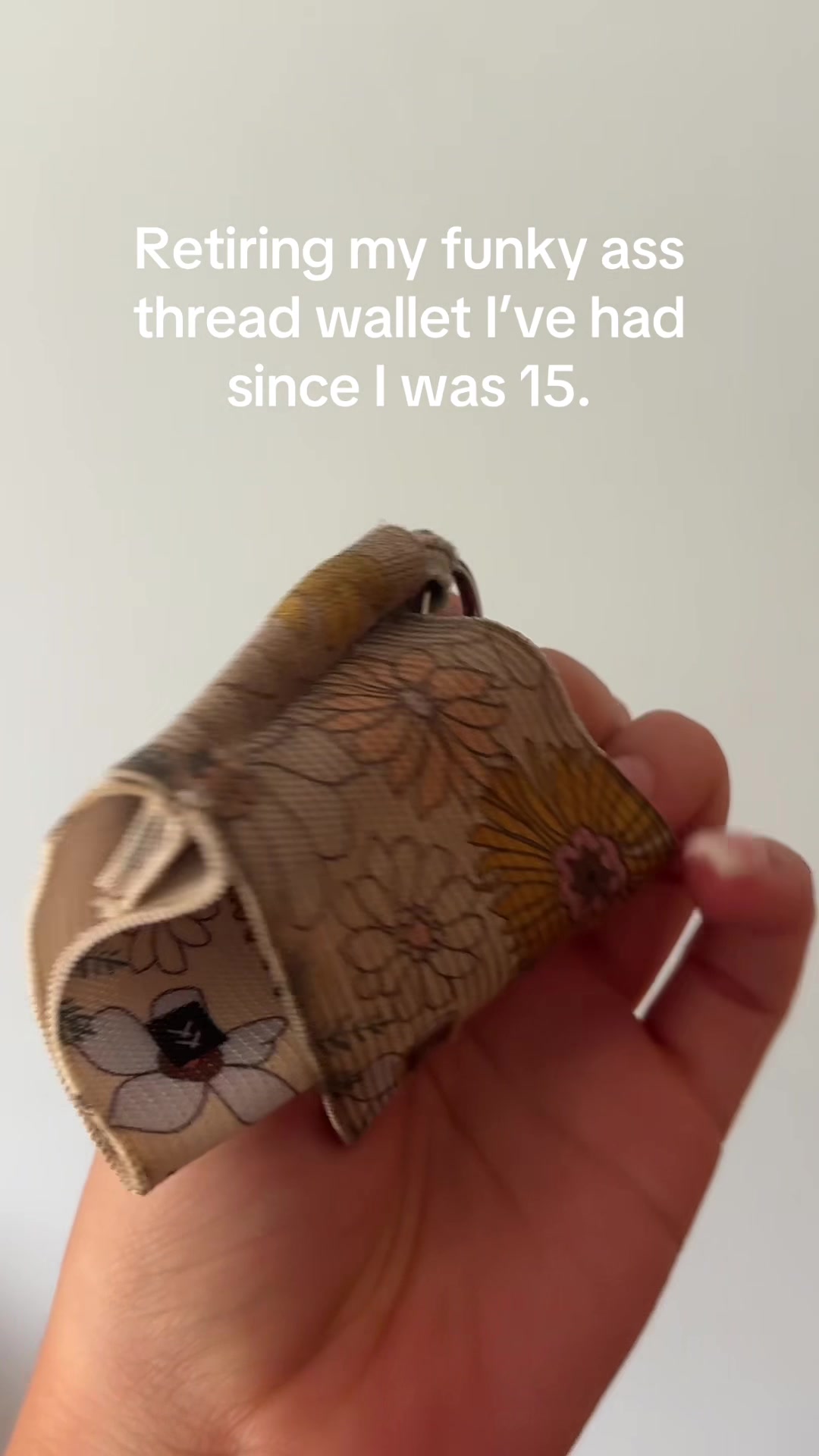
- Hook
- Visual: A hand holds a small, folded fabric wallet with a floral pattern. Text overlay: "Retiring my funky ass thread wallet I've had since I was 15."
- Audience
- People who appreciate durable, long-lasting products and may be looking for a replacement for a beloved, worn-out item. The phrase "funky ass" suggests a younger, casual audience.
Why it works. Proves years of daily use before any pitch, turning visible product durability into the emotional hook for fans who already own one and are due an upgrade.
Relatable problem/transition setup (0:00-0:06): The on-screen text states, "Retiring my funky ass thread wallet I've had since I was 15." Film your own product's oldest, most worn unit and caption it as being retired right before you cut to the new version.
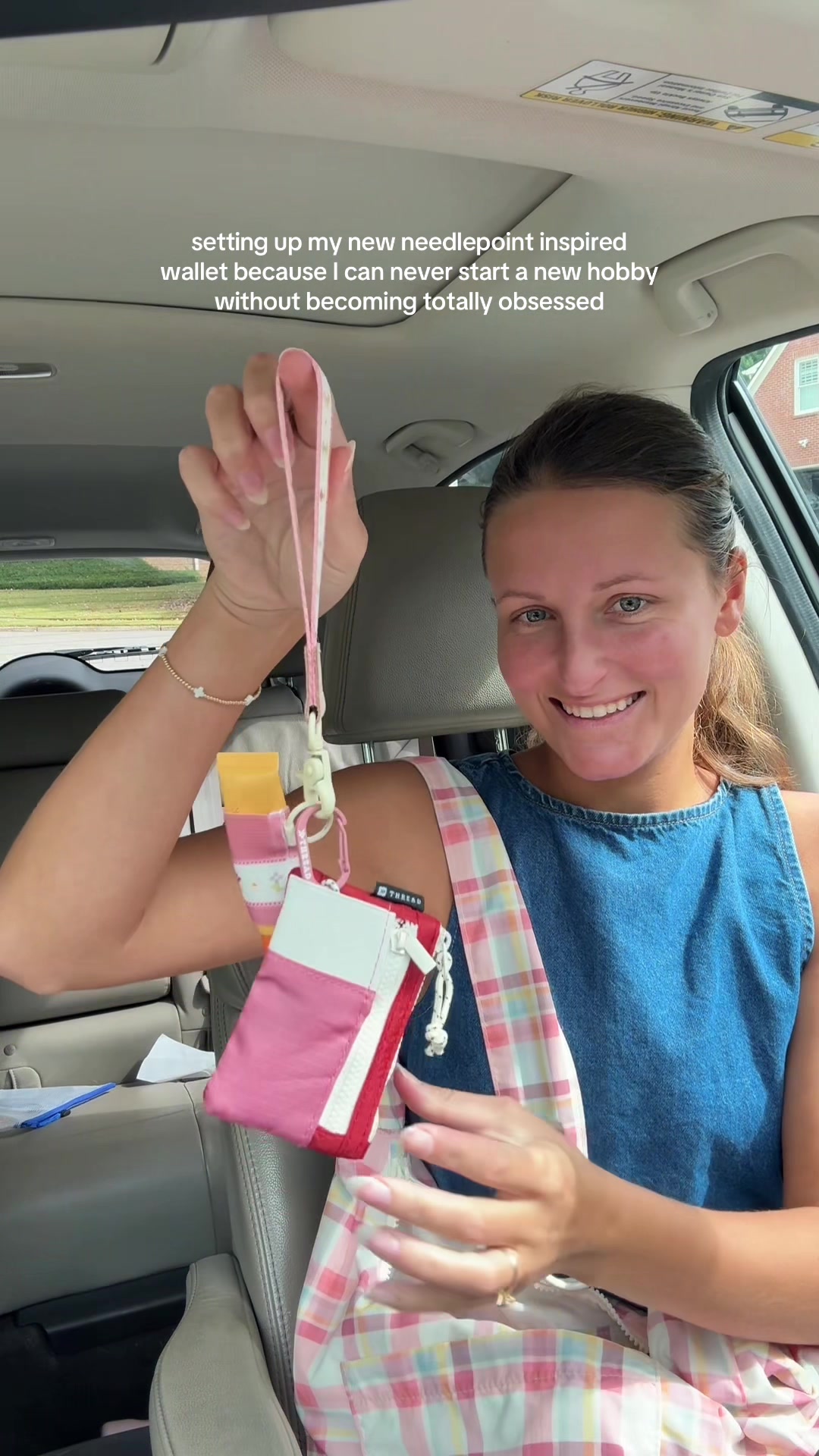
- Hook
- Visual: A woman in a car holds up a colorful lanyard with a small wallet attached. On-screen text: "setting up my new needlepoint inspired wallet because i can never start a new hobby without becoming totally obsessed". Audio: Upbeat, melodic music.
- Audience
- The mention of 'needlepoint inspired' and 'new hobby' targets individuals who enjoy crafts, personalizing their accessories, and those who tend to become passionate about their interests. The casual car setting and simple setup suggest a practical, everyday product for a busy, organized individual.
Why it works. Ties a specific print to a relatable hobby-obsession trait, letting hobbyist viewers self-select into the ad through shared identity rather than a product pitch.
Relatable on-screen text as a hook (0:00-0:03): "setting up my new needlepoint inspired wallet because i can never start a new hobby without becoming totally obsessed" Open your caption with a self-deprecating confession about a habit or personality trait your product satisfies, not a product description.
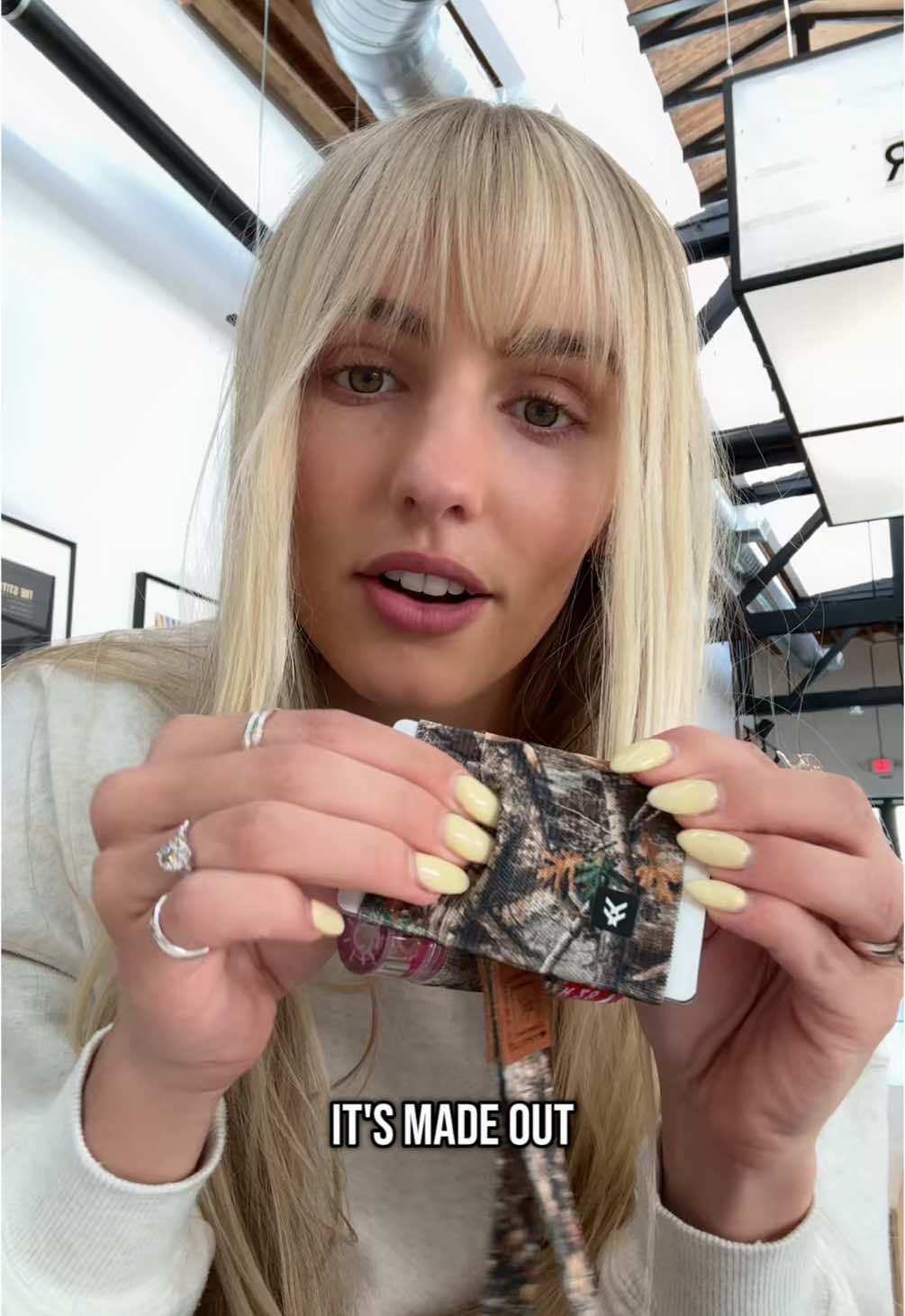
- Hook
- "THIS IS MY NEW WALLET" - A woman with blonde hair and bangs holds up a small, camouflage-patterned wallet.
- Audience
- Individuals seeking a compact, secure, and customizable wallet solution, evidenced by the focus on slimness, elastic capacity, and accessory integration.
Why it works. Fast top-of-funnel product intro that pairs a blunt announcement with an immediate in-hand reveal, no throat-clearing before the item appears.
Direct product introduction and feature highlight at 0:00-0:03, "THIS IS MY NEW WALLET isn't it crazy how slim it is?" Open with your product name in caps as a flat statement, then cut straight to holding the item with no intro.
- Reach
- 4 upvotes · 7 comments · r/EDC
A community is already discussing this in r/EDC. Show up there authentically and answer the thread before a competitor does.
Who amplifies them
The brand account (@thread_wallets on Instagram and TikTok, @thread_wallets on X) posts on-brand campaign content, while co-founder McKenzie Bauer, alongside co-founder Colby Bauer, occasionally posts personally on LinkedIn, noting for example that the flagship Elastic Wallet has stayed close to its original ~$16 price since the brand's 2015 farmers-market days, which functions as founder-voice pricing-trust content distinct from the brand's own feed. Named creators driving reach include ARIEL NICOLE GRAY, who posted a Phoebe-collection haul with her own 15%-off referral code, and a creator posting as noahkahanmusic, who paired a bags feature with a separate 15%-off code, both functioning as informal affiliate sellers rather than one-off reviewers. A creator named Grayson Smith ran a hyper-local activation, filming a single-day, single-store giveaway tied to retailer Tyler's in Round Rock, Texas, turning one retail partnership into its own piece of UGC. On Instagram, creators target_cheer and allthingstarget posted Target-aisle discovery content tagged #threadpartner, while everydayreading ran a disclosed #sponsored bag-price callout, together forming a small but identifiable roster of retail-tie-in creators. Community presence beyond creators is thin: the single r/EDC thread asking "thoughts on Thread wallets?" is the only forum-level discussion in evidence, so Reddit reads as passive discovery rather than a cultivated amplifier.
07 Organic & video
The organic content engine: the videos, creator posts, and community presence earning attention without paid spend.
Thread's own TikTok and Instagram accounts post frequent product-first clips rather than lifestyle-only content, and the brand's top-performing owned TikTok, "I need this in every color," pulls over 100,000 engagements by letting the product's color range carry the caption. Creator content clusters into a few repeatable formats: reveal/unboxing clips where a creator holds up a new pattern to camera, talking-head reaction videos filmed inside a retail aisle, and product-demo clips that show cards or cash going into the elastic pocket. One creator posting under the handle taylorswift racked up over 121,000 engagements on a fall-color haul tagged to the brand, while a creator posting as bell drew roughly 27,600 engagements on a "free sample" hashtag clip, showing that both gifted-product hauls and giveaway-adjacent content outperform straight product demos. A text-overlay montage format also recurs, exemplified by a teen-era nostalgia clip captioned "Retiring my funky ass thread wallet I've had since I was 15," which reframes a worn-out wallet as proof of the product's multi-year lifespan rather than a complaint. Across formats, the throughline is creator-led storytelling that treats the wallet as a personality object (color, pattern, sentimental attachment) more than a utility pitch, which the brand's own paid creative then borrows directly.
08 Affiliate & partners
How the brand turns creators and partners into a tracked, variable-cost acquisition channel, and how the program is structured.
Thread's own site surfaces no public affiliate-program landing page in the homepage links pulled for this teardown, but a functional creator-affiliate layer is visible in the wild: personalized 15%-off codes (ARIEL NICOLE GRAY's, noahkahanmusic's) let the brand track individual creators without a public sign-up page, and the TikTok Shop listing from seller Hey Kerry shows at least one creator-seller transacting directly through TikTok's built-in storefront rather than the brand's own checkout. Public reporting also describes Thread using the Carro platform for influencer and affiliate-partner discovery, which would explain how individual codes get distributed without a visible on-site program. The overall picture is a decentralized, code-based affiliate motion rather than a formalized public program: fitting for a bootstrapped, wholesale-heavy brand that already has 600+ retail doors doing distribution and doesn't need to build its own affiliate storefront to reach new buyers.
09 The playbook
The channels are not separate. They are one system where each stage feeds the next. Here is the read, then the plays to run tomorrow.
The inferred playbook
Thread's loop starts with gifted product seeding creator and retail-staff UGC, gets amplified by evergreen Search ads and retail-news paid pushes, and converts on message-matched collection pages, but has no built-in repeat-purchase mechanic to compound the initial sale.
The 836-day-old Google text ad and its evergreen siblings exist to intercept people already typing Thread's name or category terms, not to create new demand, which explains why the format hasn't needed refreshing.
New stockist and collab moments (Target, the Diet Coke collection) get synchronized creator content and Meta spend at the same time, turning a distribution win into a paid-media asset rather than treating retail and digital as separate motions.
Dig deeper+3▾
Comped product to creators and even retail floor staff, as with the Tyler's giveaway, seeds the talking-head and reveal clips that both organic social and the brand's own ad library recycle, meaning the flywheel depends on continuous outbound gifting rather than inbound requests.
Because the offer is one-time-purchase with sitewide discounts rather than subscription or bundle-and-save architecture, and the product itself is built to last years, Thread's engine has to keep sourcing first-time buyers instead of leaning on repeat orders to compound growth.
the DTC-versus-wholesale revenue split behind the $19M 2026 projection, blended paid-social return on ad spend, and any repeat-purchase or reorder rate for a product built to last multiple years.
Run an always-on branded-plus-category text ad and leave it alone
The proofThread's longest-running Google Search ad has stayed active for 836 days on plain text creative matched to its own brand name and category terms like "tote bag."
The adaptationSet up one small, always-on Google Search campaign bidding on your own brand name plus the 2-3 exact phrases customers already type for your category, mirroring Thread's brand-plus-category pairing, and resist the urge to refresh the copy on a schedule since text ads don't fatigue the way video does. Start by pulling your top 3 branded and category search terms from your own site search or customer language, and launch one tightly-matched text campaign against them.
Cost: under $500. Time to signal: weeks. Works pre-PMF: yes, since it captures existing demand rather than manufacturing it.
Turn a new retail placement into a same-day local giveaway
The proofThread ran a single-day, single-address giveaway tied to retailer Tyler's, telling viewers to show a video to a named store's staff for a free wallet.
The adaptationThe next time your product lands in even one physical store, film a short clip naming that exact store and offering a small giveaway "while supplies last" for anyone who shows the video to staff, which drives a locally-targeted visit and gives that same customer a reason to post their own unboxing afterward. Start by asking your one existing retail contact for a handful of giveaway units and picking a single day to run it.
Cost: under $500. Time to signal: days. Works pre-PMF: conditional, since it requires at least one real retail placement to anchor the activation.
Pay creators in personalized discount codes, not flat fees
The proofCreators ARIEL NICOLE GRAY and a poster known as noahkahanmusic each carry their own named 15%-off codes on organic-feeling haul posts, letting Thread attribute sales per creator without a flat sponsorship.
The adaptationReach out to 5-10 micro-creators in your niche offering free product plus a first-name-based code at a fixed discount instead of cash, so spend only happens against real redemptions. Start by drafting a short DM template offering the product plus a code like Thread's 15%-off structure, and track redemptions in your store's discount-code report to see which creator's audience actually buys.
Cost: $0. Time to signal: weeks. Works pre-PMF: yes.
Brief creators to react to your retail placement, not your product
The proofWhen Thread landed in Target's travel aisle, creators tagged #threadpartner posted "16-year-old me is freaking out" discovery-style reactions aimed at Target's own shoppers, and Thread then paid to amplify that same launch moment on Meta.
The adaptationThe moment you land a new stockist or co-branded SKU, send 2-3 creators the exact store and aisle instead of a spec sheet, and ask for a "have you seen us at ___ yet" discovery reaction rather than a generic review, since that framing rides the retailer's existing foot traffic and search intent. Start by texting your creator list the store name and a one-line prompt as soon as the placement goes live.
Cost: $0 to under $500. Time to signal: days to weeks. Works pre-PMF: conditional, since it requires an actual retail or co-brand placement to react to.
Answer negative reviews on-page with a specific fix, not a canned line
The proofThread's own product-review page shows the brand replying by name to a customer whose cards kept falling out, acknowledging the specific complaint rather than hiding or deleting it.
The adaptationKeep negative reviews visible on your product pages and reply from your real brand account with a concrete next step, such as a sizing fix or replacement path, within a few days of posting, since a visible on-page reply reads as more credible to a researching shopper than an all-five-star page. Start by turning on public replies in whatever review app you use and answering your next negative review with a specific fix instead of an apology.
Cost: $0. Time to signal: weeks. Works pre-PMF: yes. Not transferable at an earlier stage: Thread's 600+ door wholesale footprint and named-retailer collabs like Target and Diet Coke depend on years of trade-show and buyer relationships a reader starting does not yet have, so those specific partnership mechanics should be treated as a later-stage target, not a starting motion.
You just read how Thread Wallets does it. Tomorrow it is someone else.
Every morning we take one company that is actually growing and break down where its customers come from: the ads still running after a year, the channel doing the real work, and the play you can run this week.
Systemaic · directional intelligence. Traffic, spend, and reach figures are SimilarWeb-style estimates and qualitative reads of public data, not audited numbers. Built on real public receipts.
// teardowns with a similar GTM motion
sources & receipts (23)
Live ad libraries: meta ad library · google ad library
Researched facts: Founding date and founders: Thread Wallets was founded in 2015 (incorporated January 2015) · No outside funding / bootstrapped: Thread Wallets has never raised venture capital or outs · Founder quote on staying bootstrapped: CEO Colby Bauer explicitly frames the no-investor a · Initial Kickstarter raise: Thread Wallets launched via an early Kickstarter campaign, cite · Early growth trajectory: Revenue grew from about $140,000 to $4 million in three years (by · Inc. 500 recognition: Thread Wallets appeared on the Inc. 500 (fastest-growing private com · Co-founder Forbes recognition: Co-founder McKenzie Bauer is a Forbes 30 Under 30 alumna. · Flagship product pricing: The original patented Elastic Wallet, Thread's signature product · Retail distribution footprint: By 2023, Thread Wallets products were carried in roughly 2, · Own flagship retail store: Thread opened a company-owned retail storefront at its Provo, U · Heavy reliance on Meta/Facebook paid ads: Thread Wallets has historically depended heavily
Milestone sources: 2015-01: Thread Wallets officially started as a company, after Colby and McKenzie Bauer's · 2015-03: Colby and McKenzie Bauer relaunched their Kickstarter campaign ("Thread Wallets 2 · 2017-03-28: Thread Wallets, LLC was granted U.S. design patent D782,189 ("Wallet"), invent · 2021-09: Thread profiled at Surf Expo as a fast-growing brand with 38 employees, expanding · 2022-06: Thread launched its nonprofit arm, the Carry On Foundation, teaching youth resili · 2022-09: Thread (Thread Wallets) launched a new advisory board as a multi-million-dollar, · 2024-09: Thread Wallets co-founder Colby Bauer, through the Carry On Foundation, opened th
Community threads: Brand site customer reviews: Repeat buyer on Thread's own reviews page says the elastic wa · Brand site warranty page: Thread's own warranty policy explicitly excludes elastic stretch · LinkedIn (founder post): Co-founder McKenzie Bauer notes the flagship Elastic Wallet has k
Traffic, spend, and revenue figures are estimates as noted in the report; the links above are the primary public artifacts.