- 01Launch with a founder story, not a feature list
- 02Pitch with your own product instead of a slide deck
- 03Build a disposable niche demo to grab easy search rankings
- 04Make the founder the launch channel, every time
01 Snapshot
The one-glance read on who they are and how they grow. Each point is verifiable from the receipts above.
A developer API platform for real-time AI video agents and digital-twin avatars, fresh off a $40M Series B led by CRV, announced November 12, 2025.
Launch-led, with flagship model and product drops (its CVI video-agent interface, the PALs AI-human product, and the Sparrow-1 conversation model) each paired with a founder X thread and a paid demand-capture layer.
~183,500 monthly visits as of 2026-07-11; founder Hassaan Raza has 19,465 LinkedIn followers and 3,681 on X; 19 of 44 Google ads and a ~550-ad LinkedIn library active.
On releasing the Sparrow-1 turn-taking model, Hassaan Raza wrote: "Human communication is a dance, a waltz. Responding at just the right time is essential to the art."
As of 2026-07-11, Google tests include competitor-comparison bids ("Try Tavus vs Sora API," "Alternative to Character AI") alongside a fresh "AI Interviewer" angle, while LinkedIn is running variants of a World Cup jersey demo-gift offer.
A side demo, santa.tavus.io, built on their own API now pulls more organic traffic than the company blog, and TikTok has organically adopted Tavus as a Character.AI alternative for roleplay, an audience the company's B2B developer positioning never targeted.
02 How it unfolded
The order the channels came online. Sequence is strategy: what they did first, and what they layered on once demand existed.
03 Traffic & channel mix
Estimated demand, the channel split behind it, and the keywords and referrers doing the work. Directional modeling, not audited analytics.
Traffic sources
Top search keywords
| Keyword | Volume | Weight | CPC |
|---|---|---|---|
| tavus | 17k | $4.16 | |
| tavus ai | 5.4k | $4.48 | |
| heygen | 1.8M | $0.57 | |
| synthesia | 226k | $1.15 | |
| tavus careers | 840 | - |
Top referring sites
Closest competitors by audience
Tavus draws an estimated ~183,500 monthly visits, down 14.6% over the past 3 months. Direct traffic dominates the mix at 49.9%, reflecting a developer audience that navigates straight to docs and dashboards rather than discovering the product through search or social. Search Organic follows at 21.7%, and Search Paid sits at 7.7%, a real but secondary paid-acquisition layer built around bidding on competitor and category terms. The remaining six channels, Social Organic (6.3%), Referrals (5.8%), Gen AI (4.1%), Display Ads (2.6%), Email (1.7%), and Social Paid (0.1%), together account for roughly a fifth of traffic, with the 4.1% Gen AI share notable as a sign that AI-assistant referrals are already a measurable acquisition source for a developer tool.
On keywords, Tavus ranks for its own brand terms ("tavus" at 17,430 searches/month, "tavus ai" at 5,370) while its paid search actively bids into much larger competitor demand pools: "heygen" (1,829,460 searches/month) and "synthesia" (226,480 searches/month) are demand it is trying to intercept, not traffic it owns. Two of its top three referring sites, liquid2.vc and sequoiacap.com, are investor sites (both funding participants) linking to a portfolio company rather than organic press or partnerships; the third, saaspo.com, is a SaaS landing-page showcase, meaning some referral traffic comes from other builders studying the site's design. Its closest competitors by traffic profile are heygen.com, the company it names directly in ad copy ("Alternative to HeyGen"), anam.ai, also directly targeted in ad copy ("Choose Tavus Over Anam.ai"), and d-id.com, another AI-avatar API player competing for the same developer search terms.
04 Organic content
The specific pages earning their organic search traffic, and the pattern behind why they rank. Adapt the format, not the topic.
Tavus's organic footprint is carried by two very different pages, both among its top tracked organic landing pages: the homepage itself (~3,200 visits/month, 58.8% of that tracked set) and a standalone novelty demo, santa.tavus.io (~1,492 visits/month, 27.4%), which ranks #1 for "ai santa," "santa ai," and "ai santa claus." Everything else, careers, a single blog post on AI APIs, and the pricing page, contributes low-single-digit shares.
The pattern is a demo-as-content strategy rather than a publishing strategy: instead of a library of SEO articles, a playful public-facing product built on their own API captured a seasonal keyword cluster and now outperforms their written content combined. It's a strong illustration that a working demo can out-rank a blog for organic pull, but it also means their organic surface has almost no depth beyond two pages, leaving the rest of the keyword space uncontested.
Top pages by organic traffic
05 Channel map
Not traffic share. How much weight the growth system actually puts on each channel, with a one-line read on the role it plays.
What drove growth
06 The motions doing the work
For founder-led SaaS the breakdown shifts from ads to traction: where the first users came from, how the founder grows it in the open, and the compounding organic surface.
Tavus's traction traces two distinct launches five years apart: a 2021 YC debut that seeded its earliest sales-outreach customers, and an August 2024 product reveal that reset the company's entire positioning.
The 2021-08-02 post "Launch HN: Tavus (YC S21), AI-generated personalized videos for sales outreach" landed 57 points and 73 comments, introducing Tavus as sales-video personalization software, a different position than the developer-API platform this teardown otherwise describes.
On 2024-08-15, founder Hassaan Raza's thread unveiled the Conversational Video Interface alongside a live, talkable demo named Carter, and the launch won Product Hunt's Product of the Day the following day.
Dig deeper+2▾
Tavus relaunches around each new model rather than leaning on one big-bang moment, most notably the Sparrow-1 Show HN covered above, treating Hacker News as a recurring technical-credibility channel rather than a single launch event.
A September 2024 post from Hassaan Raza described a fellow YC founder pitching investors with a Tavus-built digital twin instead of a live call, turning the product itself into a referral mechanic inside the company's own investor network.
Build-in-public here runs almost entirely through founder Hassaan Raza's own account, with co-founder Quinn Favret doing occasional support work rather than parallel audience-building.
Hassaan Raza posts technical and milestone threads himself, from the 2024 CVI reveal through the 2026 Sparrow-1 (conversation timing) and Raven-1 (multimodal perception) model releases, each written as a first-person research narrative rather than brand copy.
His posts center on shipping named models rather than MRR updates, each framed around a single thesis on why current AI misses natural conversation ("AI that understands the difference between 'I'm fine.' and 'I'm fine.'").
Dig deeper+2▾
Quinn Favret's account is smaller and used mainly for company milestones, such as the March 2023 seed-round announcement, rather than an independent build-in-public presence.
The @tavus account surfaces only as a tag inside founder posts in this evidence, meaning nearly all organic X distribution runs through Hassaan Raza's personal credibility rather than a company voice.
Tavus's organic-search engine is thin and demo-driven rather than a content library, so paid search fills the demand-capture gap a comparison-page program would otherwise cover.
Search Organic accounts for the roughly one-fifth organic share noted above, but per the top-content data almost none of it flows from written articles, it flows from the homepage and the santa.tavus.io demo.
Competitor comparisons live in paid ad copy, not landing pages, meaning Tavus is renting attention on HeyGen and Anam.ai searches rather than owning ranked pages for them.
Dig deeper+2▾
Google creative bids competitor names directly into the ad text, a demand-generation move that intercepts shoppers already comparing vendors rather than defending Tavus's own brand terms.
The LinkedIn campaign pairs lifestyle jersey creative with a 30-minute-demo requirement, an unusual incentive hook for a B2B API sale that trades a low-cost giveaway for a qualified sales conversation.
07 Paid ads
This founder-led SaaS also runs paid acquisition. Here are the live ads doing the work, each with the X-ray and a play you can adapt.
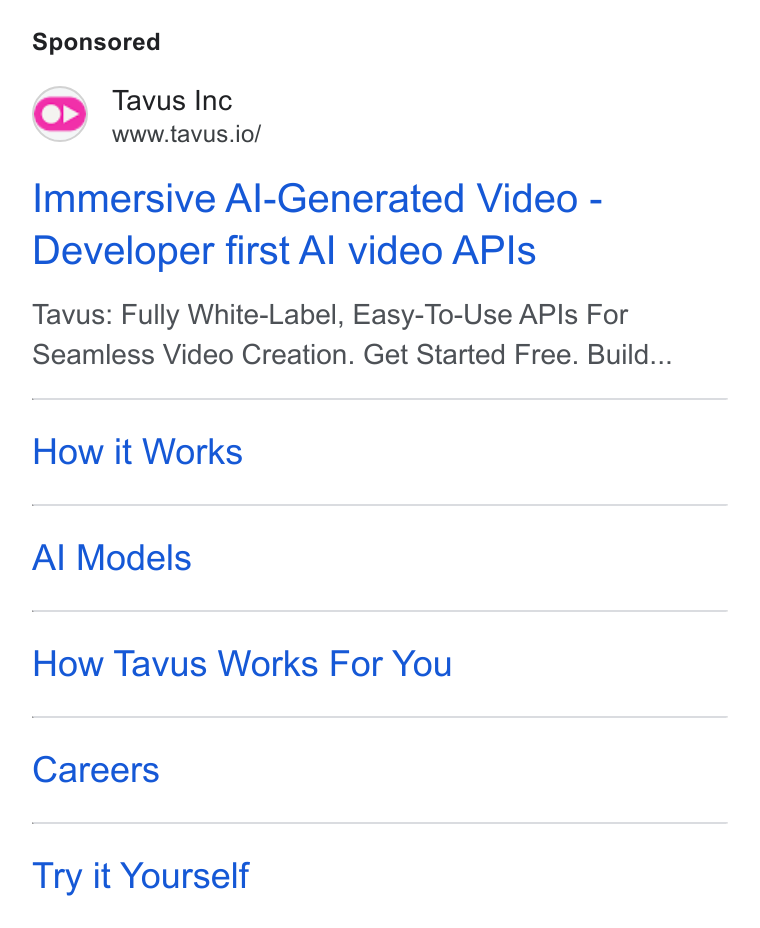
- Running
- 655 days (longevity = it's converting)
- Hook
- Sponsored Tavus Inc www.tavus.io/ Immersive AI-Generated Video - Developer first AI video APIs Tavus: Fully White-Label, Easy-To-Use APIs For Seamless Video Creation. Get Started Free. Build...
- CTA / offer
- Get Started Free. Build...
- Audience
- Developers, businesses seeking white-label solutions, indicated by 'Developer first AI video APIs' and 'Fully White-Label, Easy-To-Use APIs'.
Why it works. Positions the product as both visually immersive and fully white-label for developers, appealing to agencies who resell under their own brand.
Headline: 'Immersive AI-Generated Video - Developer first AI video APIs' If your product serves resellers, state 'white-label' explicitly in your copy since that one word answers their biggest question upfront.
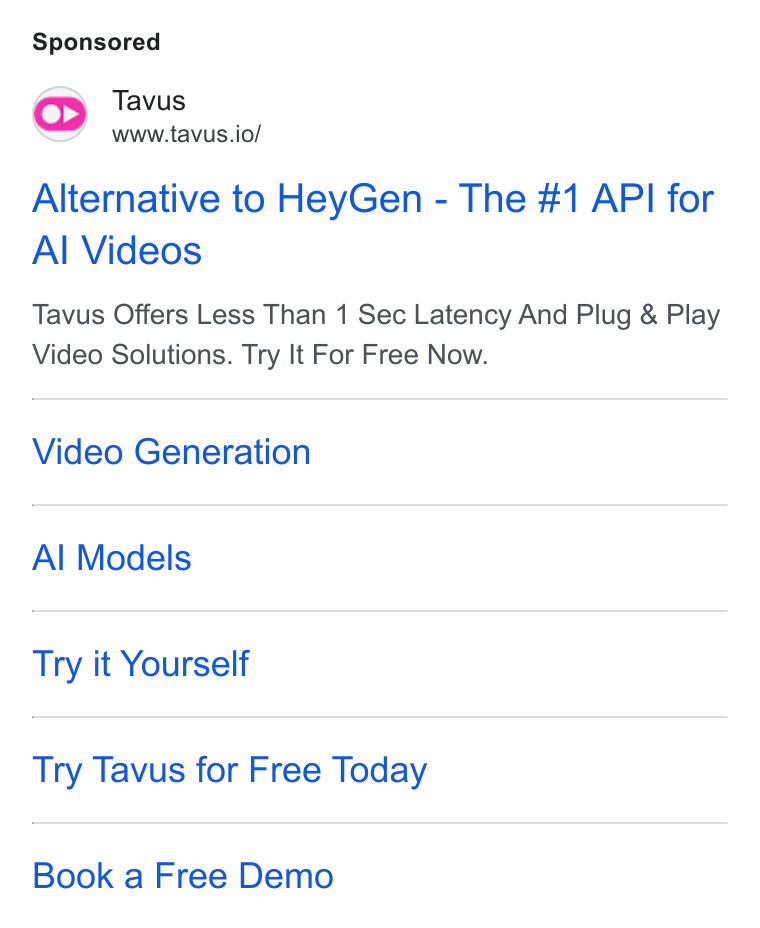
- Running
- 422 days (longevity = it's converting)
- Hook
- Sponsored" and a pink and white play button icon with the text "Tavus www.tavus.io/" next to it. Below this is the headline "Alternative to HeyGen - The #1 API for AI Videos".
- CTA / offer
- Try It For Free Now. / Try Tavus for Free Today / Book a Free Demo
- Audience
- Businesses or individuals seeking AI video solutions, specifically those familiar with or looking for alternatives to 'HeyGen', indicated by the direct comparison in the headline.
Why it works. Captures HeyGen's existing user base actively searching for alternatives, then backs the switch with a #1 API authority claim.
Direct competitive comparison in headline: "Alternative to HeyGen - The #1 API for AI Videos" Bid on your top competitor's 'alternative to' search terms and pair the ad with a specific ranking claim, not just a feature list.
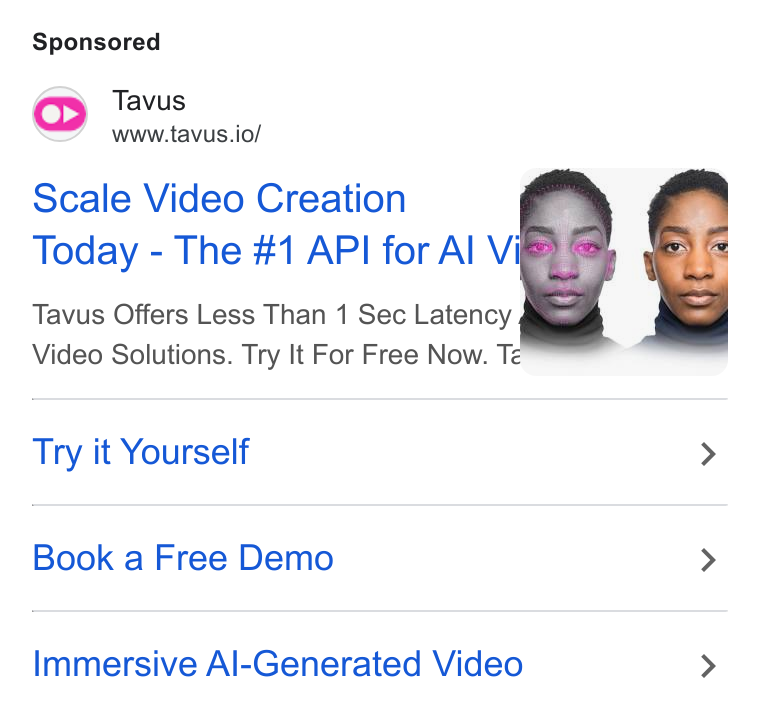
- Running
- 422 days (longevity = it's converting)
- Hook
- "Sponsored" text at the top, followed by the Tavus logo and website "www.tavus.io/".
- CTA / offer
- Try It For Free Now.
- Audience
- Businesses or developers looking for AI video solutions, indicated by "API for Al Vi" and "Video Solutions."
Why it works. Relies on brand and website recognition alone rather than a distinct claim, reading like a retargeting or brand-defense placement.
Clear value proposition in the headline: "Scale Video Creation Today - The #1 API for Al Vi". Use a headline that immediately states the primary benefit and, if applicable, a strong claim of market position or unique selling proposition.
Show 3 more ads
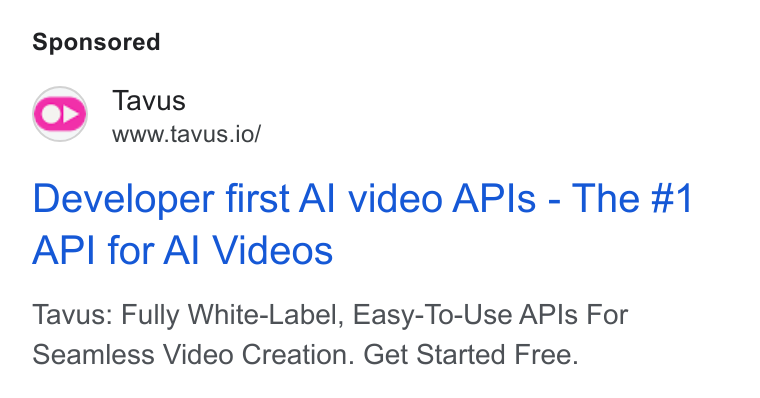
- Running
- 405 days (longevity = it's converting)
- Hook
- Sponsored Tavus www.tavus.io/ Developer first Al video APIs - The #1 API for Al Videos
- CTA / offer
- Get Started Free.
- Audience
- Developers and businesses looking for AI video solutions, indicated by "Developer first AI video APIs" and "Fully White-Label, Easy-To-Use APIs For Seamless Video Creation."
Why it works. Establishes category leadership with a #1 ranking claim aimed at developers already comparing multiple AI video API vendors.
Headline with a bold claim: "Developer first Al video APIs - The #1 API for Al Videos" If you can defend a #1 or top-ranking claim in a specific category, state it plainly in the headline instead of describing features.
- Running
- 401 days (longevity = it's converting)
- Hook
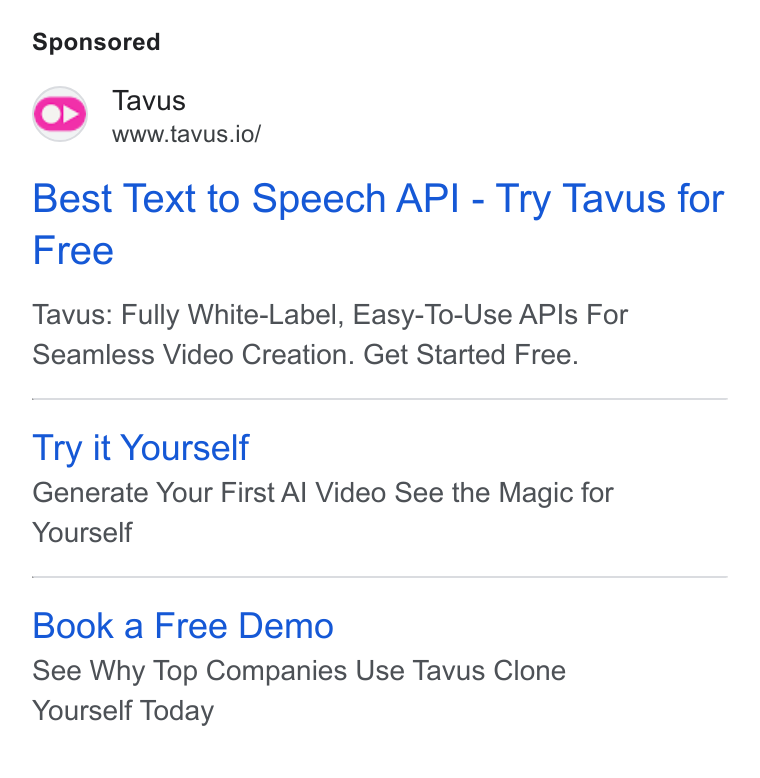
- Sponsored Tavus www.tavus.io/ Best Text to Speech API - Try Tavus for Free
- CTA / offer
- Try Tavus for Free
- Audience
- Businesses or individuals looking for 'Text to Speech API' and 'Seamless Video Creation' solutions, indicated by the technical language and focus on business benefits.
Why it works. Targets a narrower, high-intent search term, text to speech API, than the broad AI video category, then removes cost as a barrier.
Headline: 'Best Text to Speech API - Try Tavus for Free' Create separate ads for each specific sub-feature you offer, like text to speech, instead of one ad for your whole platform.
- Running
- 399 days (longevity = it's converting)
- Hook
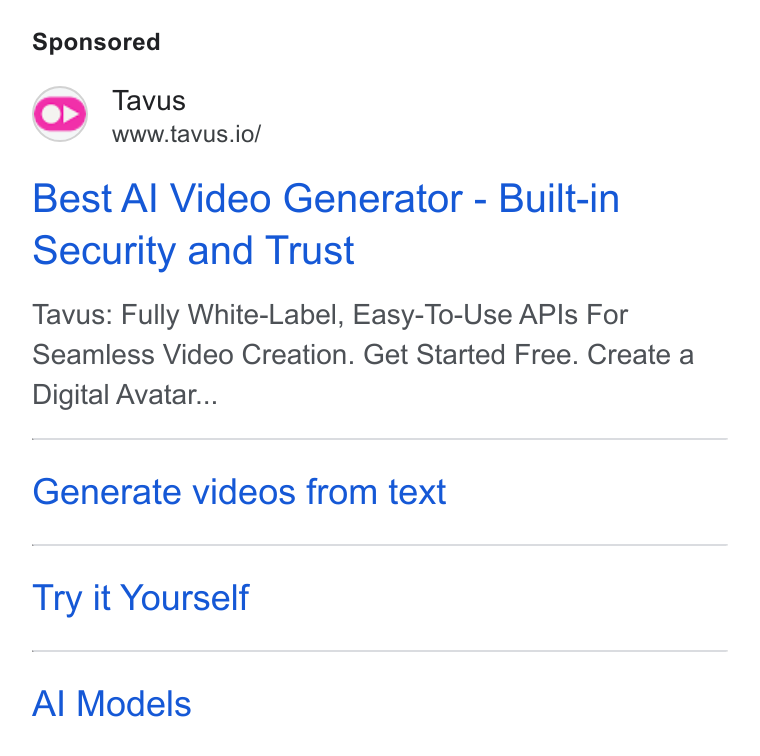
- Sponsored, Tavus, www.tavus.io/, Best AI Video Generator - Built-in Security and Trust
- CTA / offer
- Get Started Free
- Audience
- Businesses or individuals looking for AI video creation tools, indicated by terms like "White-Label," "APIs," and "Digital Avatar."
Why it works. Answers the enterprise buyer's unspoken security objection directly in the headline instead of burying it on a features page.
Headline with a bold claim and key benefits: "Best AI Video Generator - Built-in Security and Trust" Identify the one trust concern, like security or compliance, blocking your enterprise buyers and name it in your ad headline.
08 The playbook
The channels are not separate. They are one system where each stage feeds the next. Here is the read, then the plays to run tomorrow.
The inferred playbook
The loop starts with a founder-voiced release, not a media buy: Hassaan Raza's own account ignites each launch, and paid search exists to catch the comparison-shopping traffic that ignition generates.
Each major model release starts as a Hassaan Raza X thread, which then feeds Hacker News and Product Hunt pickups, compounding one moment across three surfaces at once.
Public interactive demos, Carter for CVI and santa.tavus.io seasonally, double as both press hooks and organic search assets, an efficient loop for a company whose product is video generation itself.
Dig deeper+3▾
Google and LinkedIn ads exist mainly to capture developers already comparing vendors or curious about the category, evidenced by competitor-name bidding and a demo-booking incentive rather than top-of-funnel brand messaging built to generate cold-audience demand.
With organic search at roughly a fifth of a traffic base that shrank over the past quarter and only two pages carrying real organic weight, Tavus lacks the comparison or docs content library that would compound independently of launch moments or paid spend.
free-to-paid conversion, churn, CAC.
Launch with a founder story, not a feature list
The proofThe 2021 Launch HN post covered above introduced Tavus in first person, naming the founders and the problem directly, and pulled 57 points and 73 comments as the company's seed audience.
The adaptationWrite your own Hacker News or niche-forum launch post in first person, naming the founders and the specific problem you personally hit, with one link to a live demo, then answer every comment yourself for the first day. Start by drafting the post as if explaining the product to one skeptical friend rather than a press release, since the format's power comes from the personal voice behind it.
Cost: $0 · Time to signal: days · Works pre-PMF: yes
Pitch with your own product instead of a slide deck
The proofThe YC Demo Day digital-twin pitch and the Carter demo covered above show Tavus using its own output as its highest-converting sales asset.
The adaptationIf your product can generate or demonstrate anything, use the output of your own tool as your pitch deck, cold email, or landing page hero, rather than a written description of it. First step: replace one static screenshot on your landing page with a live, interactive instance of your own product a visitor can try in under 30 seconds.
Cost: $0 · Time to signal: weeks · Works pre-PMF: yes, provided the product's output is genuinely demo-able in seconds; a workflow that takes minutes to show will not survive this format.
Build a disposable niche demo to grab easy search rankings
The proofThe santa.tavus.io demo covered above shows a single niche build outranking the entire owned blog.
The adaptationShip a narrow, single-purpose free tool on a subdomain built around a specific, low-competition search term adjacent to your category, a generator, a checker, a seasonal gimmick, and let it rank on its own rather than folding it into your main site's navigation. First step: pick one keyword with clear intent and under 20,000 monthly searches, then ship the smallest possible working version in a weekend.
Cost: under $500 · Time to signal: weeks · Works pre-PMF: yes
Make the founder the launch channel, every time
The proofEvery major release covered above ships first from founder Hassaan Raza's personal account rather than the brand's.
The adaptationPost every product update from a named founder's personal account first, with any brand account only resharing afterward, written as a first-person thesis on the problem rather than a changelog. First step: before your next release, draft a short thread in the founder's own voice explaining why the old way was broken, and publish it a day ahead of any brand-account mention.
Cost: $0 · Time to signal: days · Works pre-PMF: yes
Bid on your competitors' brand names
The proofThe competitor-bidding search ads covered above intercept HeyGen and Anam.ai searches directly rather than only defending Tavus's own brand terms.
The adaptationOnce you have at least one credible point of differentiation, run a small search-ad budget against your top two competitors' brand names, with copy that names the comparison directly and points to a page or demo that backs the claim. First step: list your two closest competitors, write one honest differentiation line for each, and set a capped daily budget before turning the campaign on.
Cost: under $500 · Time to signal: days · Works pre-PMF: conditional, only once you have a genuine, defensible point of difference to name; without one this reads as an admission of weakness rather than a claim of strength. Not transferable at an earlier stage: the competitor-bidding play requires enough differentiation and budget discipline to defend a public comparison claim, and the disposable-demo play assumes engineering resources to ship a working tool in a weekend, neither available to a true zero-resource, pre-idea founder.
You just read how Tavus does it. Tomorrow it is someone else.
Every morning we take one company that is actually growing and break down where its customers come from: the ads still running after a year, the channel doing the real work, and the play you can run this week.
Systemaic · directional intelligence. Traffic, spend, and reach figures are SimilarWeb-style estimates and qualitative reads of public data, not audited numbers. Built on real public receipts.
// teardowns with a similar GTM motion
sources & receipts (7)
Live ad libraries: linkedin ad library · google ad library
Launch archives: Hacker News: Show HN: Sparrow-1 – Audio-native model for human-level turn · Hacker News: Launch HN: Tavus (YC S21) – AI-generated personalized videos · Hacker News: Phoenix-4: Real-Time Human Rendering with Emotional Intellig · Hacker News: Gen AI video startup Tavus snags $18M to bring face and voic · Hacker News: Perception
Traffic, spend, and revenue figures are estimates as noted in the report; the links above are the primary public artifacts.