- 01Build a free viral tool on your own engine
- 02Turn launch day into a public wager
- 03Publish your ugliest real number
- 04Seed cross-language creators directly
01 Snapshot
The one-glance read on who they are and how they grow. Each point is verifiable from the receipts above.
A natural-language IDE for building AI agents, YC S24, now pivoting toward a related AI workspace product called Sauna.
Launch-led, born from a single viral consumer stunt and amplified by the founder's own X threads.
~36,317 monthly visits (+7.3% over the last 3 months) as of 2026-08-01, a $30M seed closed November 2024, and a 6,356-follower founder X account.
The founder tweeted that beta customers paid $299 on average but cost $1,024 to serve, calling that gap "the AI agent market right now."
Growth came from turning their own product into a free viral toy, the Twitter roast tool, that fed a competitive Product Hunt spectacle, not a compounding SEO or ads engine.
02 How it unfolded
The order the channels came online. Sequence is strategy: what they did first, and what they layered on once demand existed.
03 Traffic & channel mix
Estimated demand, the channel split behind it, and the keywords and referrers doing the work. Directional modeling, not audited analytics.
Wordware pulls ~36,317 estimated monthly visits, up +7.3% over the last 3 months as of 2026-08-01. The available data does not break out a channel-level split for this domain, so the read here leans on the owned-channel, organic-page, and paid evidence covered in the sections below rather than a traffic-tool mix percentage.
04 Organic content
The specific pages earning their organic search traffic, and the pattern behind why they rank. Adapt the format, not the topic.
Wordware's organic footprint is thin and heavily branded: the homepage alone carries 76.6% of the site's organic-search traffic, with the rest split across a handful of pages rather than a content library. The next-largest page is the twitter.wordware.ai/compatibility page, a leftover surface from the 2024 viral roast tool, followed by a /story narrative page and the app's own signup landing page. The ranking keywords reinforce the same pattern: Wordware ranks #1 for its own brand name and for the residual viral-tool terms ("twitter profile analysis," "authorgpt," "twitter personality"), which reads less like an SEO content flywheel and more like brand-search dominance plus the long tail of a single viral moment that never got replaced by a scaled content program.
Top pages by organic traffic
05 Channel map
Not traffic share. How much weight the growth system actually puts on each channel, with a one-line read on the role it plays.
What drove growth
06 The motions doing the work
For founder-led SaaS the breakdown shifts from ads to traction: where the first users came from, how the founder grows it in the open, and the compounding organic surface.
Wordware's first users came almost entirely from a free side-project going viral days before the core product's launch, then rode that spike straight into a public, competitive Product Hunt push.
the Twitter personality "roast" microsite (twitter.wordware.ai) went viral days before the official IDE launch; the founder tweeted "2 MILLION USERS" in 7 days (2024-08-05), then "2.5mm users in 8 days" (2024-08-06), attributing the acceleration to a single prompt tweak.
on launch day (2024-08-02) the founder announced Wordware was launching the same day as a fellow YC batchmate, and that Product Hunt's CEO had turned it into a head-to-head vote battle with a public stakes bet, "whoever gets fewer votes has to eat only beans for a whole week."
Dig deeper+2▾
ten days in, the founder's own recap tweet (2024-08-15) put the run at "7MM people running our AI Agents; 278k users; $100k every 7 days; breaking ProductHunt servers (7000 upvotes)," a self-reported figure, not an independently verified one.
six months later, a Reddit user in r/wordware flagged that the subreddit and template marketplace looked static compared to the advertised user counts, an honest counterweight to the launch-week numbers.
Filip Kozera runs the build-in-public motion almost entirely on his personal X account rather than the brand handle, posting in bursts tied to real milestones rather than on a daily cadence.
Kozera's biggest posts cluster around specific events (the July 2024 launch, the viral roast tool's growth curve, and the November 2024 funding close), each getting far more reach than routine updates, topping out at 643K views for the funding announcement.
an April 2026 tweet baring the beta's negative unit economics, the $299-revenue-versus-$1,024-cost gap referenced above, shows a willingness to publish uncomfortable numbers rather than PR-safe milestones, which is likely why it still drew meaningful engagement over a year after launch.
Dig deeper+1▾
co-founder and CTO Robert Chandler appears in creator-made TikTok content talking through the Y Combinator round and the company's origin, but has no scraped public posting cadence of his own, so the build-in-public load sits on Kozera.
Wordware's search-and-content motion is small and largely defensive rather than a compounding organic engine.
there is no evidence of a blog, comparison, or docs library driving rankings; the organic surface covered above is the homepage plus leftover pages from the 2024 viral tool, which implies someone trying to copy this motion should not expect SEO to be the growth lever.
the owned-site evidence surfaces only social links (X, LinkedIn, Instagram, YouTube), with no referral or partner program detected, so distribution here is not program-driven.
Dig deeper+1▾
the Google ad account shows 2 total ads, 1 active as of 2026-08-01, running roughly 306 days, alongside a second ad that ran 34 days (February to March 2026) before going inactive. The creative set is a plain "Wordware AI" brand-name display and a "Try Our AI Platform For Free" bold-claim unit, both reading as defensive brand-term coverage rather than a demand-generation campaign.
07 Paid ads
This founder-led SaaS also runs paid acquisition. Here are the live ads doing the work, each with the X-ray and a play you can adapt.
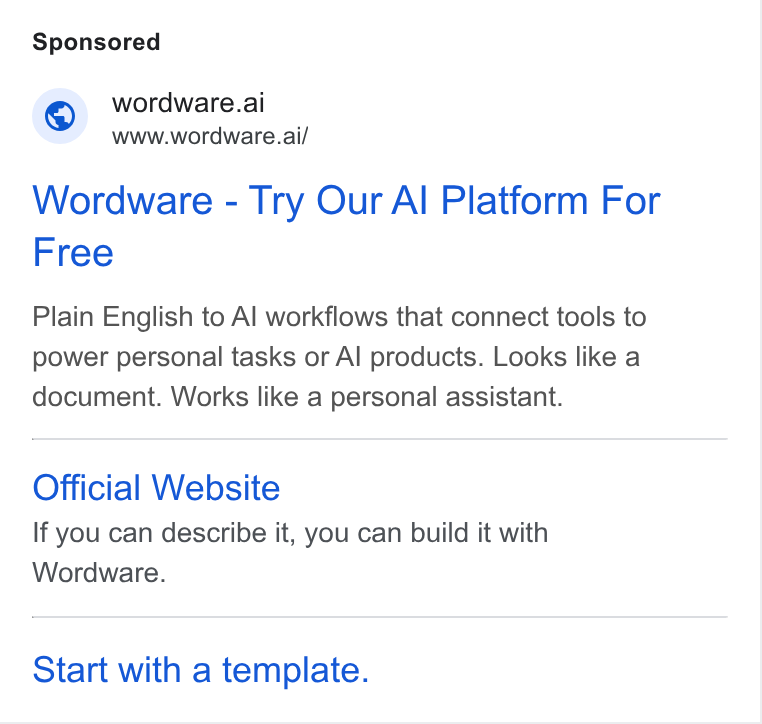
- Running
- 306 days (longevity = it's converting)
- Hook
- Sponsored wordware.ai www.wordware.ai/ Wordware - Try Our Al Platform For Free
- CTA / offer
- Try Our Al Platform For Free
- Audience
- Individuals or businesses interested in AI tools and workflow automation, indicated by phrases like "AI workflows" and "personal tasks or AI products."
Why it works. Direct response ad offering a free trial of an AI platform to generate leads and sign-ups.
Lead with a clear, free offer: The headline states "Wordware - Try Our Al Platform For Free." Start your ad headline with a direct, unambiguous offer of a free product or service to attract immediate attention.

- Running
- 34 days (longevity = it's converting)
- Hook
- www.wordware.ai/ with a blue globe icon to its left. Below it, in large blue text, is "Wordware AI".
- Audience
- The mention of 'AI' and 'future of work' signals a target audience interested in technology, business innovation, and productivity tools.
Why it works. This creative uses a direct brand introduction with a tagline to establish company identity and hint at its value proposition to a professional audience.
Displaying the company website and name prominently at the top: "www.wordware.ai/" and "Wordware AI". Always include your company's website URL and brand name clearly and early in your ad creative to build brand recognition.
08 The playbook
The channels are not separate. They are one system where each stage feeds the next. Here is the read, then the plays to run tomorrow.
The inferred playbook
Wordware's loop starts with a free viral artifact built on its own platform, converts that attention into a launch-day spectacle, and has no visible mechanism to keep either running once the moment passes.
attention starts with a shareable, personal free tool (the roast microsite) rather than paid or search demand, which is a cheap way to generate top-of-funnel interest for a product most people would not otherwise seek out.
that traffic converted through a compressed, high-drama launch window (the Product Hunt wager, the day-by-day founder threads) rather than a nurtured funnel, which works once but is hard to schedule on demand.
Dig deeper+2▾
neither the organic-content footprint nor the paid account shows an ongoing acquisition system, so once the 2024 viral spike faded, the company had no second engine, a gap consistent with its move toward the Sauna product line. Revenue is not publicly verified; given the $199/month Builder and $899/month Company tiers (plus a custom Enterprise plan) and enterprise users like Instacart and Runway alongside self-serve builders, a rough, unconfirmed estimate lands in the low six figures of monthly recurring revenue.
the free tier's conversion rate into the $199 Builder plan, retention among users who signed up during the 2024 viral spike, and current revenue or usage since the shift toward Sauna.
Build a free viral tool on your own engine
The proofWordware's Twitter roast microsite, built on its own IDE, drove founder-claimed user counts in the millions within days, feeding directly into the core product's launch.
The adaptationTake the exact input your core product already processes and turn it into a single-purpose free tool that tells someone something surprising about themselves in one page load, the same personal-callout mechanic behind the roast tool. Ship it on a subdomain, post it from a personal account first, and watch whether it gets unprompted shares before spending on distribution.
Cost: $0 · Time to signal: days · Works pre-PMF: yes, provided the free tool's output is genuinely surprising; a bland result will not travel.
Turn launch day into a public wager
The proofKozera turned Wordware's Product Hunt launch into a head-to-head vote battle with a fellow YC founder, with a public "loser eats only beans for a week" stake.
The adaptationFind a peer founder launching in the same window and propose a specific, silly, public stakes bet tied to a measurable launch-day number, then announce the bet before launch so followers have a reason to check back. Post the running score during the day itself, the same real-time narration that made Wordware's thread work.
Cost: $0 · Time to signal: days · Works pre-PMF: yes, conditional on finding a willing peer founder to launch alongside.
Publish your ugliest real number
The proofKozera's beta-economics tweet, referenced above, disclosed that customers cost more to serve than they paid, framed as market context rather than a complaint.
The adaptationOnce you have even a handful of paying customers, calculate one uncomfortable real number, cost to serve, churn on your worst cohort, or gross margin, and post it as a single tweet framed as an industry observation, not a confession. The framing (context, not complaint) is what earns engagement instead of pity.
Cost: $0 · Time to signal: weeks · Works pre-PMF: conditional, needs at least a few real transactions to have a number worth publishing.
Seed cross-language creators directly
The proofthe roast tool's organic UGC spread across Spanish- and Arabic-language TikTok without any evidence of paid seeding, including a 155-engagement segment from an Argentine outlet.
The adaptationDesign your free tool's output to be inherently reaction-bait (a personal, slightly uncomfortable callout), then message 5 to 10 mid-size creators in adjacent language markets directly with the tool link and a one-line prompt to try it on themselves. The mechanism that carried Wordware across languages was the personal-reveal format itself, not translation, so lead with that.
Cost: $0 · Time to signal: days to weeks · Works pre-PMF: yes.
Reserve your brand name in search once demand exists
The proofWordware's Google ad account, covered above, runs a single active ad bidding on its own brand name rather than competitive or category terms.
The adaptationOnce you see any organic branded search volume in your own search console, not before, put a small budget behind bidding your exact company name and its close misspellings so review sites or competitors cannot capture that intent first.
Cost: under $500 · Time to signal: weeks · Works pre-PMF: no, this only pays off once organic brand-name searches already exist. Not transferable at an earlier stage: the scale of Wordware's viral spike (millions of self-reported users in days) and its $30M seed close are outcomes, not techniques, a reader can adapt the free-tool and launch-wager mechanics without expecting the same magnitude of result.
You just read how Wordware does it. Tomorrow it is someone else.
Every morning we take one company that is actually growing and break down where its customers come from: the ads still running after a year, the channel doing the real work, and the play you can run this week.
Systemaic · directional intelligence. Traffic, spend, and reach figures are SimilarWeb-style estimates and qualitative reads of public data, not audited numbers. Built on real public receipts.
// teardowns with a similar GTM motion
sources & receipts (14)
Live ad libraries: google ad library
Launch archives: Hacker News: Going viral-rate your twitter personality-Wordware (YC S24)- · Hacker News: Wordware raised $30M to build the operating system for AI de · Hacker News: Wordware Secured $30M Seed In 7 Days
Milestone sources: 2024-07-29: Wordware co-founder Filip Kozera posts an AI agent that analyzes a user's Twit · 2024-08-01: Wordware officially launches its IDE platform for building AI agents with natu · 2024-09: Wordware presents as part of Y Combinator's Summer 2024 (S24) batch at Demo Day. · 2024-11-21: Wordware closes a $30 million seed round led by Spark Capital, with Felicis, Y · 2025-04-30: Wordware announces a native Slack integration for its AI agents. · 2025-06: Internally, Wordware's founders observe that every simplification of the product · 2026-04-29: Sauna.ai (by Wordware) officially launches publicly, offering the first 2,000
Community threads: Product Hunt: A Helicone team member's Product Hunt review of Wordware is sharply mixed: p · Product Hunt: A builder reviewing Wordware on Product Hunt credits it with dramatically sp · Dataconomy (tech blog): A tech journalist's first-person writeup captures the genuine surp
Traffic, spend, and revenue figures are estimates as noted in the report; the links above are the primary public artifacts.