- 01Bid on your category leader's brand name, pointed at a comparison page.
- 02Post your next MRR milestone as a personal life outcome, not a dashboard screenshot.
- 03Run a founding-customer offer before your next Product Hunt launch to seed launch-day support.
- 04Recruit LinkedIn ghostwriters as affiliates using a direct outreach sequence.
01 Snapshot
The one-glance read on who they are and how they grow. Each point is verifiable from the receipts above.
AI-powered LinkedIn content creation platform (PostCast, an AI voice interviewer that converts a 15-minute spoken conversation into a week of posts, plus carousel builder, scheduling, and team analytics) priced $19/mo Starter to $139/mo Teams on a freemium model, for creators, ghostwriters, and agencies; TrustMRR-reported ~$79,479 MRR across 2,315 active paying subscribers, though TrustMRR flags an expired Stripe key and last updated the figure February 28, 2026, not June 2026.
Founder-led and launch-led, built on Deven Bhooshan's build-in-public cadence on X and LinkedIn and a one-time $65K lifetime-deal-to-Product-Hunt sequence that seeded the subscriber base.
~123,610 estimated monthly visits, Product of the Day on Product Hunt in February 2024 with 968 upvotes and 287 comments, 8 Google text ads active as of 2026-06-24, and 5,972 followers on founder Deven Bhooshan's X account @devenbhooshan.
Deven Bhooshan on the Product Hunt launch: "Producthunt launch pushed the business above $80K ARR. 300+ new signups. 40 new customers since the launch."
The founders distribute Supergrow on the exact platform it serves, making their personal LinkedIn presence a living proof point and a self-reinforcing loop, but the current traffic decline signals that the launch-led phase is plateauing and no durable inbound engine is yet visible.
02 How it unfolded
The order the channels came online. Sequence is strategy: what they did first, and what they layered on once demand existed.
03 Traffic & channel mix
Estimated demand, the channel split behind it, and the keywords and referrers doing the work. Directional modeling, not audited analytics.
Traffic sources
Top search keywords
| Keyword | Volume | Weight | CPC |
|---|---|---|---|
| supergrow | 11k | $1.41 | |
| supergrow ai | 2.1k | $1.03 | |
| taplio | 35k | $3.05 | |
| super grow | 530 | $0.92 | |
| supergrow linkedin | 510 | - |
Top referring sites
Closest competitors by audience
Supergrow draws an estimated ~123,610 monthly visits, down 24.7% over the last three months. The channel breakdown is unambiguous: Direct at 47.1% and Organic Search at 34.3% account for more than 80% of all traffic combined, meaning the business runs almost entirely on brand recall and search discovery. Referrals contribute 6.4%, Paid Search 4.7%, Social Organic 3.7%, Gen AI 2.7%, Display Ads 1%, and Email 0.1%.
The single most interesting item in the keyword mix is the competitor-term play: "taplio" drives 34,650 monthly web searches across the whole web, far above Supergrow's own branded terms ("supergrow" at 11,350 and "supergrow ai" at 2,080), and Google confirms Supergrow is actively bidding there. That is high-intent, competitor-aware demand at the bottom of the funnel. Top referring domains are launchadda.com, a general AI-tools and SaaS directory, and raindrop.io, a bookmarking tool likely driven by community saves. Closest competitors by traffic overlap: taplio.com, postiz.com, radaar.io, virlo.ai, socialbu.com, postplanner.com, mention.com, and contentdrips.com.
The declining traffic trend combined with a thin paid footprint (4.7% paid search) suggests the current site visits depend heavily on residual brand awareness from the 2024 Product Hunt launch rather than a compounding content or paid engine.
04 Channel map
Not traffic share. How much weight the growth system actually puts on each channel, with a one-line read on the role it plays.
What drove growth
05 The motions doing the work
For founder-led SaaS the breakdown shifts from ads to traction: where the first users came from, how the founder grows it in the open, and the compounding organic surface.
The defining acquisition event was a two-phase sequence: a lifetime deal that seeded a supporter community, then a Product Hunt launch that deployed that community for a Product of the Day win.
RocketHub, a platform that orchestrates lifetime deal campaigns for SaaS products, inbounded the founders and ran the entire $65K campaign on their behalf, requiring them only to keep improving the product; the LTD buyers became the cheerleader network Supergrow activated on launch day (source).
On February 19, 2024, Supergrow launched on Product Hunt as "Grow your audience on LinkedIn," earned 968 upvotes, 287 comments, and Product of the Day; the founder reported 300+ new signups and 40 new customers directly after, with MRR growing from January's $5,124 to $7,313 in February 2024, a 44.8% jump.
Dig deeper+2▾
The $65K LTD cash was reinvested into LinkedIn micro-influencer campaigns targeting creators with 20-50K followers at $300-500 per post, converting the one-time launch spike into a sustained paid acquisition stream running on the product's own platform (source).
There is no Hacker News presence tied to Supergrow; the only result in public data is an unrelated 2011 post about an entirely different company. The first users arrived through LinkedIn, Product Hunt, and the LTD campaign, not a Show HN launch. ---
Deven Bhooshan is the company's primary distribution engine, using his personal X account (@devenbhooshan, 5,972 followers) to post monthly revenue reports and personal milestone stories that consistently reach the indie founder and B2B operator audience who are the product's core buyers.
Monthly reports form the spine of the strategy: Deven posted November 2023 at $1,716 MRR, December 2023 at $2,728 MRR (+58%), February 2024 at $7,313 MRR after Product Hunt, and July 2024 at $11,839 MRR, building a compounding public growth narrative that draws both prospective customers and organic media coverage over time.
Personal-context posts outperform raw number posts by a significant margin: "My AI SaaS paid for my car purchase" earned 468 likes and 44K views, and "I own a software business that makes $230,000 per year with zero employees" (posted May 2025) earned 606 likes and 70K views; the high-performing format pairs a financial milestone with a tangible life outcome rather than a dashboard screenshot.
Dig deeper+1▾
Both Deven Bhooshan and co-founder Utsav Patel (CMO) post actively on LinkedIn, the platform they serve; this creates a direct proof-of-product signal: a creator evaluating Supergrow can see the founders building their own LinkedIn audience with the tool, which is the shortest possible path from awareness to conviction (source). ---
Organic search at 34.3% of traffic (~42K estimated monthly visits) is the largest non-direct channel, sustained by branded keyword demand and an aggressive competitor-term paid play against Taplio the closest competitor by traffic overlap.
"Taplio" (34,650 monthly web searches) is the highest-volume keyword in Supergrow's paid mix by a wide margin, and Google confirms active bidding there; at roughly 247 days of continuous running as of 2026-06-24, this is the longest-running, highest-volume bet in the paid program, a reliable signal of positive ROI on competitor-intent traffic.
All 8 active ads are benefit-led text format: "Grow Your LinkedIn Presence - Create High-Performing Posts - All-in-One Content & Analytics" and "AI tools to write, schedule, and engage on LinkedIn - grow your brand with ease" are the clearest examples; these are category-positioning ads aimed at competitor-aware searchers in the consideration stage, not cold demand generation.
Dig deeper+1▾
The Tolt-powered affiliate program is live at supergrow.ai/affiliate-program, but the contributor count and payout structure are not visible in public data; separately, 2.7% of traffic (~3,300 estimated monthly visits) now arrives via generative AI tools, indicating Supergrow is surfacing in ChatGPT and Perplexity responses to "best LinkedIn content tool" queries, a zero-click discovery surface that requires no additional spend. ---
06 Paid ads
This founder-led SaaS also runs paid acquisition. Here are the live ads doing the work, each with the X-ray and a play you can adapt.
- Running
- 247 days (longevity = it's converting)
- Hook
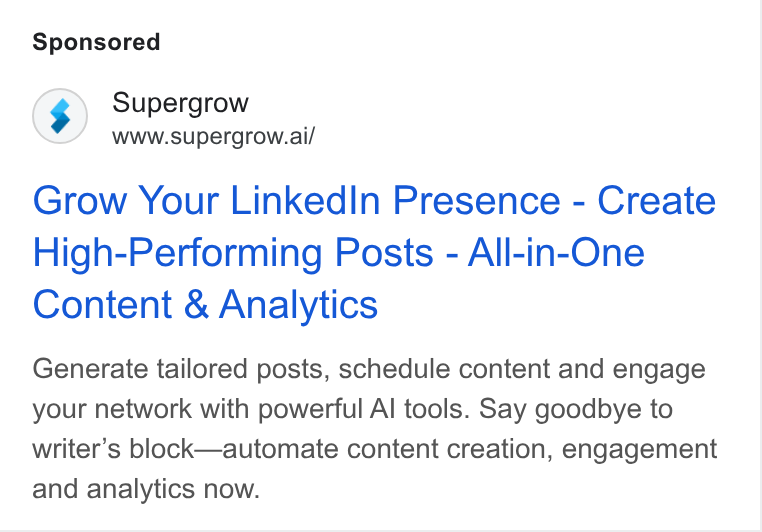
- Sponsored Supergrow www.supergrow.ai/ Grow Your LinkedIn Presence - Create High-Performing Posts - All-in-One Content & Analytics
- CTA / offer
- Automate content creation, engagement and analytics now.
- Audience
- Professionals, marketers, or business owners looking to enhance their LinkedIn presence, indicated by the phrases 'Grow Your LinkedIn Presence' and 'High-Performing Posts'.
Why it works. Search ad targeting professionals who want LinkedIn growth, content creation, and analytics in one place instead of stitching together separate tools.
Headline directly addresses a pain point and offers a comprehensive solution: 'Grow Your LinkedIn Presence - Create High-Performing Posts - All-in-One Content & Analytics'. Combine your product's top three benefits into one headline separated by dashes to cover multiple search intents in a single ad.
- Running
- 217 days (longevity = it's converting)
- Hook
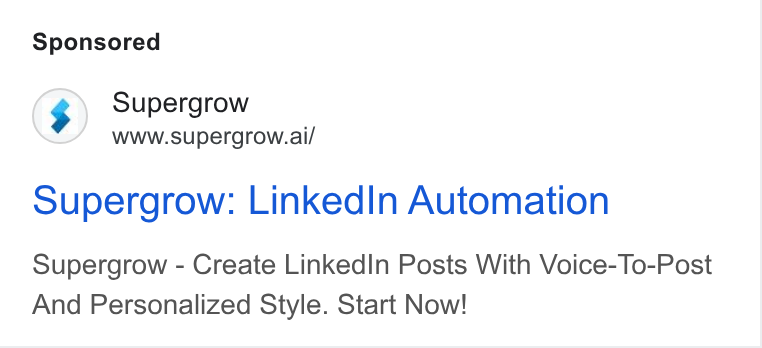
- Supergrow: LinkedIn Automation
- CTA / offer
- Start Now!
- Audience
- Professionals or businesses looking to automate and improve their LinkedIn presence, indicated by 'LinkedIn Automation' and 'Create LinkedIn Posts'.
Why it works. Short, category-matching search ad aimed at users typing LinkedIn automation into Google, built to win the click on exact-match intent.
Headline clearly states the product name and its primary function: 'Supergrow: LinkedIn Automation'. Name your product next to its category term in the headline so it matches the exact phrase your buyers are searching.
- Running
- 100 days (longevity = it's converting)
- Hook
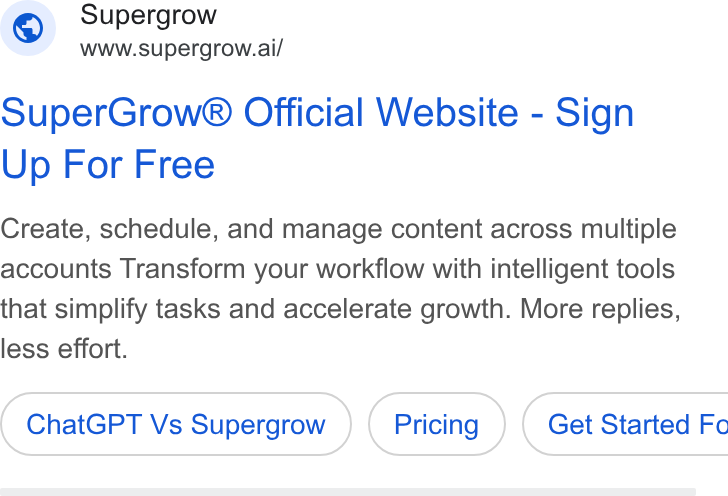
- Supergrow www.supergrow.ai/ SuperGrow® Official Website - Sign Up For Free
- CTA / offer
- Sign Up For Free
- Audience
- Individuals or businesses looking to streamline content creation and management, indicated by phrases like "manage content across multiple accounts" and "simplify tasks and accelerate growth."
Why it works. Defensive brand search ad that reassures searchers they found the real product while removing cost as a barrier to signing up.
Headline with brand name and direct call to action: "SuperGrow® Official Website - Sign Up For Free" On brand-name search ads, pair Official Site with a free signup CTA to reassure clickers and remove friction in one line.
Show 2 more ads
- Running
- 42 days (longevity = it's converting)
- Hook
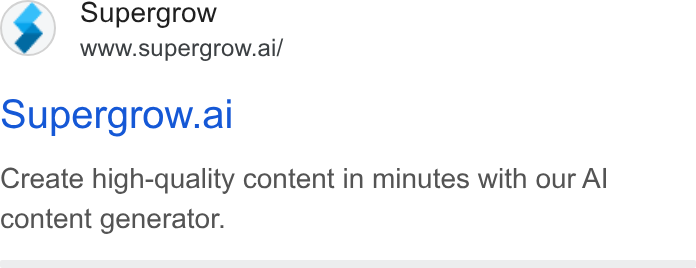
- Supergrow www.supergrow.ai/ Supergrow.ai Create high-quality content in minutes with our AI content generator.
- Audience
- Content creators and businesses needing to generate content quickly, evidenced by the text 'Create high-quality content in minutes with our AI content generator.'
Why it works. Search ad that matches buyer intent by naming the category and promising a fast turnaround, aimed at content creators comparing AI writing tools.
Directly stating the core benefit: 'Create high-quality content in minutes with our AI content generator.' Put your fastest concrete outcome and your product category in the same sentence so search ads match intent-heavy queries.
- Running
- 25 days (longevity = it's converting)
- Hook
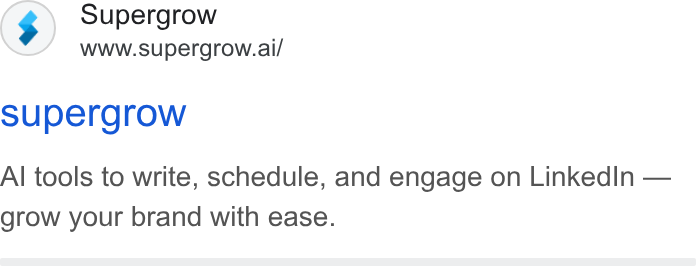
- Visual: A small blue and white icon resembling a stylized 'S' or lightning bolt, next to the word "Supergrow" and the URL "www.supergrow.ai/". Below this, in large blue text, is "supergrow". Below that, in smaller gray text, is "AI tools to write, schedule, and engage on LinkedIn — grow your brand with ease."
- Audience
- Individuals or businesses looking to enhance their presence and growth on LinkedIn, indicated by "AI tools to write, schedule, and engage on LinkedIn" and "grow your brand with ease."
Why it works. Search ad that spells out the exact workflow LinkedIn creators are hunting for, useful for people comparing all-in-one tools against single-feature ones.
Prominent brand name and URL display. (On-screen text: "Supergrow", "www.supergrow.ai/") List your product's core workflow as three verbs in sequence so the ad reads as a complete solution, not a single feature.
07 In their own words
Pulled from interviews and community sessions. The quotes are the angle; the takeaway is what to do with it.
“Don't try to create new market just work on the validated market. Go for products or go for markets which are actually generating revenue.”
Expand
Deven validated Supergrow by studying existing LinkedIn tools, found a gap in the content-creation quality, and built an MVP over a weekend using GPT-3. His growth breakthrough came from a lifetime deal (LTD) on Rocketub, which he used as a cash infusion, validation mechanism, and ambassador-building engine that ultimately fueled a successful Product Hunt launch and subscription transition.
“I realized the demand in the market is so much that even products like these are able to earn revenue. So I realized I can serve this demand really well.”
“LTD buyers actually feel special. They got a deal nobody else will get in future. So this sort of creates an urgency in FOMO that annual plans won't be able to match.”
“We were really obsessed with our LTD customers. We used to spend like one or two hours every day on intercom answering their question helping them through content creation. We sometimes used to help them manually and then used to convert those workflows into features inside supergrow.”
“Launching on LTD is not just for cash. We were able to create 10 to 15 ambassadors for our product that actually helped us make our product product of the week.”
Find a validated market with paying customers, deeply use competitors' products to find the weakest core flow, then build an MVP that is only 1% better on that specific dimension.
Use a lifetime deal platform (e.g. Rocketub) as a zero-audience launch strategy: accept the ~40% platform cut in exchange for their email list, ads, and marketing assets — treat it as paid distribution with a built-in feedback cohort.
Cap the LTD hard on both time (3 days) and seats (300 users) to create genuine urgency and avoid over-burdening your support capacity with non-paying long-term users.
Obsessively support your LTD buyers for the first few months via live chat: manually help them, then turn recurring help patterns directly into product features. Use session recordings (Clarity) and analytics (Mixpanel) to see what they actually use.
Treat your happiest LTD customers as a launch team: activate them to evangelize on LinkedIn, Twitter, and community groups on Product Hunt launch day, so you are not the only voice promoting the product.
The Untapped SaaS Launch Strategy That Made Me $65K in 48 Hours ↗Culture of Code - The Podcast For Indie Hackers · 3.1k views · 24 min▶ Listen“We just used to post our journey on Twitter and LinkedIn, right? So, we used to share our like what we are building, why we are building, what are the like best practices of posting content on LinkedIn.”
Expand
Deven grew Supergrow by building in public on Twitter and LinkedIn until RocketHub inbounded them and ran the entire $65K launch campaign on his behalf, requiring him only to improve the product. He then turned those LTD customers into a cheerleader network that carried his Product Hunt launch, and reinvested the LTD revenue into LinkedIn micro-influencer campaigns (20–50K followers, $300–500/post) that delivered 10x+ ROI. After discovering 25% monthly churn, he shifted focus to B2B customers whose churn was ~5% versus 20%+ for B2C.
“We actually generated $65,000 during that campaign and we actually to be honest with you we actually didn't do anything in the marketing. We just improved the product based on their feedback.”
“If you are starting, this is actually a gold mine for you, right? You have like paying customers for your product who are actually using your product and giving you feedback every day.”
“They were tweeting about us. They were posting a LinkedIn content. They were talking about our launch on Slack communities, WhatsApp communities, right? So this actually gave us lot of boost.”
“Initially lot of people whom we work with they had like followers count in the range of 20 to 50k on LinkedIn — that was the sweet spot we found — and during the initial day we used to pay somewhere around $300 to $500 for a single post and on one campaign sometimes we used to get like 20 customers.”
Build in public daily on LinkedIn and Twitter before you have a product — document what you're building and why; inbound partnership opportunities (like RocketHub) come from this visibility, not outreach.
Cap your LTD at 150–200 seats intentionally: the goal is validation, cheerleaders, and a feedback pool, not maximum revenue — LTD customers who actively use the product become your Product Hunt launch crew.
Start LinkedIn influencer marketing with micro-influencers (20–50K followers) at $300–500/post; vet engagement quality manually before spending, and structure deals as product-for-post, pure affiliate (50% rev share), or a hybrid fixed-fee-plus-affiliate.
Integrate a cancellation-flow tool (Deven used ChurnKey) and separately open a direct LinkedIn/email line to every churned user — the direct conversation surfaces product and pricing issues that the tool dashboard misses.
Segment your customer base by B2B vs. B2C churn rates early; if B2B churn is dramatically lower (~5% vs. 20%+), shift acquisition spend and influencer targeting toward that segment rather than trying to fix B2C retention.
Supergrow Webinar: Your Co-Pilot for LinkedIn Content Creation ↗RocketHub · 758 views · 75 min3rd-party breakdown▶ View source“it wasn't that we just copy from our competitors and build all the features that they had so we we understand the whole person branding space”
Expand
Supergrow grew out of a forced pivot: both founders had Twitter creator tools (tweet Lei for content, Honeypot for cold outreach) that shut down when Elon Musk repriced the API, so they redirected their creator-economy thesis to LinkedIn, a platform they saw as less crowded for AI tooling. Rather than copying competitors, they ran deep user research to identify a content-creation beachhead, then differentiated with LinkedIn-native features — viral templates curated with quantitative thresholds, a post-score checker, and a text-to-carousel generator — while distributing through community webinars and founder-led dogfooding.
“these formats that you see here are based on uh so we picked this formats from the popular creators that create content on LinkedIn and has gone viral... we choosed a particular criteria for each of these format it should have say more than th000 plus likes X Plus comments so this is how we curated all these formats right so it's super specific for LinkedIn”
“you're yourself using super grow for growing your own account that's a testament to you know when a Founder use own own product for his own purposes”
“we are super super super active we hear all to all our users and we work on the features that you submitted here”
“we both were passionate about creators economy we know that building a brand on social media can boost the business and can help us a lot to the founders and other creators”
Pivot expertise, not from scratch: when your market closes (API repricing, platform shutdown), take your domain knowledge sideways into an adjacent platform rather than rebuilding from zero — the Supergrow founders brought Twitter creator-tool instincts directly to LinkedIn.
Pick the narrowest beachhead and ship it before expanding: they explicitly sequenced content creation → engagement → analytics and resisted building all three at once, which let them ship faster and collect real signal.
Make AI defaults data-backed with a quantitative bar: curate your templates or prompts from verified high-performers (e.g., posts with 1,000+ likes, X+ comments) so users get proven formats, not generic output — and say so in your marketing.
Distribute through community partner webinars tied to buying events (BFCM, product launches): partnering with Rocket Hub for a live demo put the product in front of a warm, purchase-ready audience at zero ad spend.
Dogfood publicly and make it visible: the founder actively using the product on his own LinkedIn account serves as live social proof that converts skeptical creators better than feature lists.
SaaS, Startups & LinkedIn – Real Talk With Utsav Patel of Supergrow | The Startup OG Podcast ↗The Startup OG Podcast · 240 views · 41 min3rd-party breakdown▶ Listen“Influencer marketing had worked really well... they were signing up to our platform and then loving the platform and then organically they were sharing it with their audiences — that's how it got started, and then we picked on this channel because it worked really well.”
Expand
Supergrow grew by leveraging the founders' existing LinkedIn networks for an initial semi-viral launch, then systematically doubling down on influencer/creator partnerships as their primary acquisition channel, supplemented by SEO and word-of-mouth. The core insight is that Utsav and co-founder Davin built the product to solve their own writer's block problem on LinkedIn, which gave them authentic credibility with the creator audience they were targeting. They stayed deliberately lean, avoiding fundraising and automation, which kept them compliant with LinkedIn's terms and trusted by users.
“Think about distribution before writing a single line of code. Along with the idea, think how we'll go to market — what sort of channels you will explore, what are the probably marketing tactics, what are the growth hacks.”
“We don't do automation, we don't collect cookies from our users — that's why we are not even able to push some features because of this, but we are happy to stay safe and can commit 100% to our users that if you're using Supergrow you are super safe.”
“I removed all my connections — most of them — then I started from scratch picking very coily who to be in my connection list. Your first connections are who LinkedIn populates your post to first; if they engage, LinkedIn signals the content is valuable and pushes it further.”
“Building in public — we share each and everything we are doing on Supergrow. Being a small team, all you have to do is gain trust from your users.”
Run a semi-viral launch post on the exact platform your product serves: Supergrow's first users came from a LinkedIn announcement that hit their own networks, giving them real signal and an early call-with-every-signup feedback loop before building further.
Make influencer marketing your first paid channel in a creator-adjacent SaaS: start with one test post per creator to filter for real engagement, then lock in longer-term deals only with those who convert — no SOP needed, negotiate per creator.
Curate your own LinkedIn first-connection list ruthlessly: the algorithm seeds distribution to first connections first, so a small, engaged network outperforms a large, passive one for both the product founders and the users they teach.
Split co-founder roles by hard domain (product/tech vs. marketing/sales) with full decision rights in each lane — debate freely, but one person has the final call per domain, which removes bottlenecks without creating conflict.
Define your GTM channels before writing code: map two or three realistic acquisition channels for the specific idea, validate demand by talking to potential paying users first, then build the MVP — distribution is harder than building in 2025.
08 The playbook
The channels are not separate. They are one system where each stage feeds the next. Here is the read, then the plays to run tomorrow.
The inferred playbook
The acquisition loop starts with founder-led build-in-public posts attracting an indie founder audience, converts through a community-seeded Product Hunt launch, and compounds via competitor-search capture, but the traffic decline signals the initial flywheel is losing momentum without a replacement growth driver.
Deven Bhooshan's monthly X reports and milestone posts (reaching 40K-80K views each) create a recurring touchpoint for an audience of aspiring indie founders, the product's sharpest buyer segment; the LinkedIn presence doubles the signal on the platform the product serves.
The LTD-to-Product Hunt sequence was the single largest acquisition event, driving MRR from January's $5,124 to $7,313 in one month and seeding the 47.1% direct traffic share that still dominates the channel mix.
Dig deeper+2▾
Organic search (34.3%) and paid search (4.7%) form a compound capture net: owned brand terms anchor organic, and bidding on competitor terms captures high-intent bottom-of-funnel demand; this is the most scalable channel requiring the least founder time.
The founder posted $230K ARR (roughly $19K MRR) in May 2025; the publicly reported ~$79,479 MRR represents approximately 4x growth from that point, but the driver of that increase is not detailed in any public source, and free-to-paid conversion rate, current churn (11% as of July 2024 per the founder's own post, but not published since), and CAC for the micro-influencer campaigns are not visible in public data. ---
Bid on your category leader's brand name, pointed at a comparison page.
Supergrow has been running this exact play on "taplio" (34,650 monthly web searches) for at least 247 days as of 2026-06-24, the longest-running paid bet in their whole account. First step: open Google Ads Transparency and search the brand name of your closest competitor to confirm they run Google ads, which means their brand term is actively searched; then launch a single ad group with a $10-20/day budget and a headline structured as "[Competitor] alternative for [use case]" pointing to a comparison landing page. This is the most direct path to a competitor's actively shopping audience.
Post your next MRR milestone as a personal life outcome, not a dashboard screenshot.
Supergrow's top two X posts by engagement are both personal-outcome frames: "My AI SaaS paid for my car purchase" (468 likes, 44K views) and "I own a software business that makes $230,000 per year with zero employees" (606 likes, 70K views), each outperforming straight number posts by 3-5x in the evidence. Write one post right away: identify a single concrete thing your current MRR made possible (ended a contract, covered rent, hired a first contractor, bought something specific), and lead with that rather than the MRR figure itself. The number becomes the punchline, not the headline.
Run a founding-customer offer before your next Product Hunt launch to seed launch-day support.
Supergrow turned a $65K lifetime deal campaign into a ready-made PH support army, which earned Product of the Day with 968 upvotes. The first step: six to eight weeks before a planned PH launch, offer a limited founding-customer deal (your own site, an AppSumo waitlist, or a private email to your list) at a one-time price, collect all buyer emails, and send them a direct PH link plus a two-sentence ask on launch morning. Caveat: the LTD model works once per product cycle; repeating it trains buyers to wait for discounts and actively erodes your subscription revenue.
Recruit LinkedIn ghostwriters as affiliates using a direct outreach sequence.
Supergrow's Tolt-powered affiliate program (supergrow.ai/affiliate-program) is live but the recruiter count is unknown. The highest-value recruits are the ghostwriters who already use the product for their clients: search LinkedIn for "LinkedIn ghostwriter" and filter for profiles that mention Supergrow in their bio or experience, then send a three-sentence DM: "I noticed you use [product] with clients. We launched an affiliate program, 30% recurring commission. Here's a personal link you can forward." At Supergrow's ~$34 blended ARPU and a 30% affiliate rate, a single referred subscriber covers a roughly $10/mo payout, payback in three months, with unlimited upside on every renewal.
Build a "vs. competitor" comparison page for each name in the search overlap.
Taplio, postiz.com, radaar.io, and contentdrips.com are all in Supergrow's competitor traffic overlap, and a searcher typing "[Competitor] vs [your product]" is within one decision of buying. The first step: check if your top competitors already publish "alternatives" pages listing tools like yours; if they do, you are missing a direct referral; if they do not, you have a green field. Publish one templated comparison page per competitor, covering pricing, one differentiating feature (PostCast-style differentiation is the clearest possible angle here), and a CTA to the free tier. This is a half-day build that compounds in organic search indefinitely.
You just read how Supergrow does it. Tomorrow it is someone else.
Every morning we take one company that is actually growing and break down where its customers come from: the ads still running after a year, the channel doing the real work, and the play you can run this week.
Systemaic · directional intelligence. Traffic, spend, and reach figures are SimilarWeb-style estimates and qualitative reads of public data, not audited numbers. Built on real public receipts.
// teardowns with a similar GTM motion
sources & receipts (8)
Live ad libraries: google ad library
Launch archives: Hacker News: Cloud My Ass - Supergrowth of Translation Cloud
Founder interviews: How I Made $65K in 3 Days · The Untapped SaaS Launch Strategy That Made Me $65K in 48 Hours · Supergrow Webinar: Your Co-Pilot for LinkedIn Content Creation · SaaS, Startups & LinkedIn – Real Talk With Utsav Patel of Supergrow | · Episode #19 Mastering LinkedIn Content: Insights from Supergrow's Jour · Supergrow 2026: The AI-Powered LinkedIn Content Platform That Captures
Traffic, spend, and revenue figures are estimates as noted in the report; the links above are the primary public artifacts.