- 01Ship one feature that's built to be filmed
- 02Announce from the founder's own account, not the brand's
- 03Convert a competitor's public complaints into a DM funnel
- 04Build a handful of free-tool landing pages that mirror your ad copy
01 Snapshot
The one-glance read on who they are and how they grow. Each point is verifiable from the receipts above.
A free Gen Z and young-millennial event-invite app monetized via Instacart-powered group ordering and a newly launched ticketing feature, named to TIME's 2025 Most Influential Companies list.
Founder-led, organic-led: viral feature launches and creator UGC do the work paid channels usually carry.
~30.2M estimated monthly visits (+13.9% over the last 3 months) as of 2026-07-12; ~500K MAU in Q1 2025 (+400% YoY); 43,527 Instagram followers; $27.3M total raised.
As of 2026-07-12, the newest Google ad tests video creative for the just-launched ticketing feature ("Sell Event Tickets - Modern Event Ticketing").
Partiful ships narrow, meme-able features (Crush, zodiac birthday funds, ticketing) that double as content prompts, and the resulting creator UGC feeds the branded search its own homepage already owns.
02 How it unfolded
The order the channels came online. Sequence is strategy: what they did first, and what they layered on once demand existed.
03 Traffic & channel mix
Estimated demand, the channel split behind it, and the keywords and referrers doing the work. Directional modeling, not audited analytics.
Traffic sources
Top search keywords
| Keyword | Volume | Weight | CPC |
|---|---|---|---|
| partiful | 275k | $2.05 | |
| partyful | 8.5k | $2.02 | |
| partiful login | 5.3k | $3.01 | |
| partiful invite | 3.0k | $2.37 | |
| partifuk | 3.3k | $2.02 |
Top referring sites
Closest competitors by audience
Partiful draws an estimated ~30.2M monthly visits, up 13.9% over the last 3 months. The mix is dominated by three channels: Direct at 73.4%, consistent with an app whose invites travel as raw links shared over text and DM rather than discovered through search or social; Search Organic at 10.5%, almost entirely brand-term recall converting into a homepage search; and Social Organic at 6.8%, in line with the heavy TikTok and Instagram creator activity covered below. The remaining channels, referrals, paid social, email, display, generative-AI referrals, and paid search, together total under 10%.
The keyword data shows a brand moat: "partiful" pulls roughly 275,000 monthly searches with the site ranking #1, while "partyful" (~8,500/mo) and "partiful login" (~5,300/mo) show the company also capturing misspellings and its own returning-user traffic. Top referring sites are wikipedia.org (the company's reference-page presence lending third-party legitimacy), bit.ly (shortened links, consistent with SMS/DM-based invite distribution), and beacons.ai (a link-in-bio tool, tying to the "link in bio" calls-to-action seen across the creator UGC). Among the closest competitors, evite.com is the legacy incumbent Partiful's Gen Z positioning was built to displace, eventbrite.com is the ticketing category it is now encroaching on with its own June 2026 launch, and luma.com competes for the same community-event hosting demand from a more professional angle.
04 Organic content
The specific pages earning their organic search traffic, and the pattern behind why they rank. Adapt the format, not the topic.
Partiful's organic-search footprint is almost entirely the brand name itself: the homepage captures the large majority of the site's page-level organic search traffic and ranks #1 for "partiful," "rsvp website," and "partiful invite." Behind it sit a login page (return-user searches), a help-center RSVP article, and two purpose-built landing pages built for generic, non-branded phrasing like "party invitations online" (also #1) and "free online invitations with rsvp" (#4). The pattern is a brand-term moat protected by minimal supporting content: instead of a blog library or comparison pages, Partiful built two or three narrow, high-intent landing pages that catch people who don't yet know the brand name and hand them straight into the product.
Top pages by organic traffic
05 Channel map
Not traffic share. How much weight the growth system actually puts on each channel, with a one-line read on the role it plays.
What drove growth
06 Who they’re hiring
Open roles read like a roadmap: the functions they’re staffing show where the company is investing next and what stage it’s at.
12 open roles
07 The motions doing the work
For founder-led SaaS the breakdown shifts from ads to traction: where the first users came from, how the founder grows it in the open, and the compounding organic surface.
Partiful's early growth ran on word-of-mouth long before any paid channel, and the traction curve since has been a string of organic breakout moments rather than a single launch event.
In a 2022 post, co-founder and CEO Shreya Murthy described early growth as purely peer-to-peer, "we grew and grew," until a New York Times reporter started seeing Partiful "everywhere" and covered it, ahead of the $20M Series A the company closed in November 2022 led by Andreessen Horowitz and Initialized Capital.
Google named Partiful its Play Store "Best App of 2024" and Apple shortlisted it for a Cultural Impact award the same year, while weekly downloads grew roughly 4x and user activity rose about 600% over 2024, a curve driven by platform recognition rather than a marketing push.
Dig deeper+2▾
When Apple shipped a near-identical Invites app in February 2025, Partiful publicly called it a copycat, a callout that drove the Reddit backlash covered above and likely did more for awareness than any single ad.
By Q1 2025 Partiful was averaging roughly 500,000 monthly active users, up about 400% year over year, and it has since layered on new features, Crush, zodiac-themed birthday funds, and ticketing in June 2026, that each reignite the same organic cycle.
Partiful's real-time distribution channel is a person, not a brand handle: co-founder and CEO Shreya Murthy's personal X account carries the company's news, with no comparable brand-account activity in evidence.
Murthy announces launches directly to her feed, drawing 458,613 views and 247 likes for the June 2026 ticketing announcement ("huge news: you can now sell tickets on partiful") and 350,335 views for an October 2024 post about opening the company's first dedicated marketing hire.
In December 2025, Murthy publicly invited frustrated Eventbrite organizers to DM her directly, "my DMs are open to support," turning a competitor's user complaints into a direct-recruitment channel instead of an ad against the term.
Dig deeper+1▾
Co-founder and CTO Joy Tao maintains a separate X account (141 followers, 218 posts) that is comparatively quiet, so Murthy's feed carries nearly all of the founder-led distribution.
Search plays a real but secondary role behind Partiful's brand-term dominance: organic search is 10.5% of total traffic, and most of it flows through the homepage covered above.
The keyword "partiful" alone draws roughly 275,000 monthly searches, and the company's SEO investment beyond its own name is the small set of generic-intent landing pages covered above rather than a broad content library.
Partiful's Google ads run headlines nearly identical to those landing pages, "100% Free - No Paywalls," "Send Invites & Track RSVPs," so the paid and organic layers reinforce one message on the same non-branded queries instead of splitting budget across two messages.
Dig deeper+1▾
13 Google ads are active as of 2026-07-12 out of a roughly 200-ad library built over time (a directional, sample-capped estimate), with the longest-active creative running about 61 days. Targeting skews toward generic and adjacent-category terms, including a "Free Wedding Websites" ad competing directly in withjoy.com's category, rather than defending the already-#1-ranked brand term.
08 Paid ads
This founder-led SaaS also runs paid acquisition. Here are the live ads doing the work, each with the X-ray and a play you can adapt.
- Running
- 230 days (longevity = it's converting)
- Hook
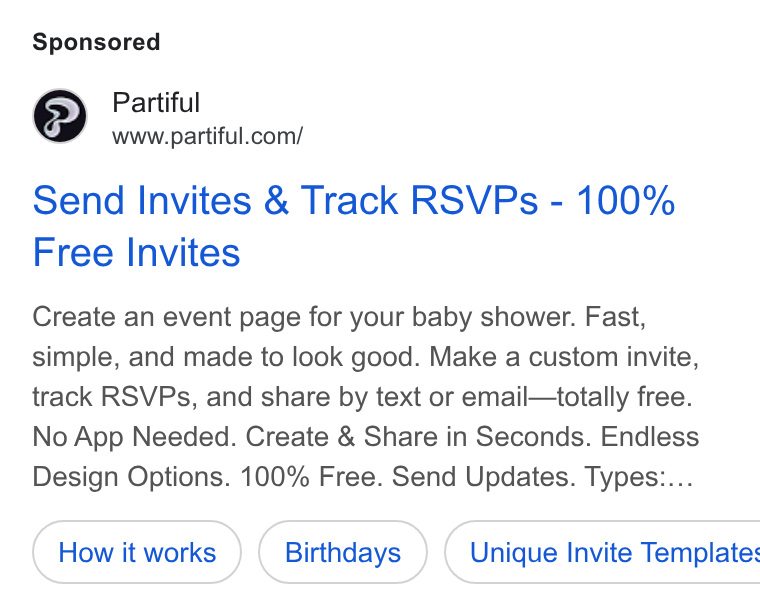
- Sponsored Partiful www.partiful.com/ Send Invites & Track RSVPs - 100% Free Invites
- CTA / offer
- 100% Free Invites
- Audience
- Individuals planning events, specifically mentioned 'baby shower', looking for free, easy-to-use invitation and RSVP tracking services.
Why it works. Narrows the free claim to invites specifically rather than the whole platform, matching searchers looking for free invites exactly.
Headline states 'Send Invites & Track RSVPs - 100% Free Invites'. Scope your free claim to the specific feature searchers want, not your whole product, so it matches their exact query.
- Running
- 173 days (longevity = it's converting)
- Hook
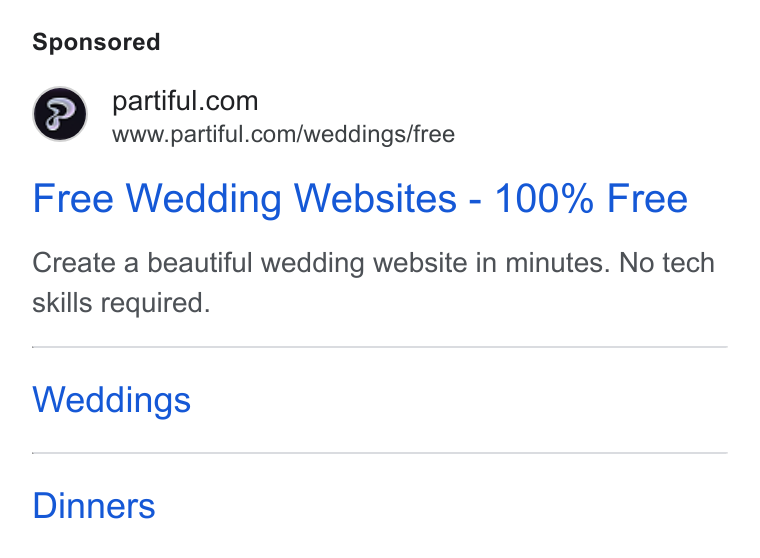
- Sponsored" + "partiful.com" + "www.partiful.com/weddings/free" + "Free Wedding Websites - 100% Free" + "Create a beautiful wedding website in minutes. No tech skills required."
- CTA / offer
- Free Wedding Websites - 100% Free
- Audience
- People planning weddings, indicated by the text "Free Wedding Websites" and the category "Weddings".
Why it works. Targets budget-strapped wedding planners with a doubled free claim plus a no tech skills promise, removing both cost and difficulty objections at once.
Headline with a bold, quantifiable claim: "Free Wedding Websites - 100% Free" State your free claim twice, once in the destination path and once in the headline, and kill the next objection in the same line.
- Running
- 162 days (longevity = it's converting)
- Hook
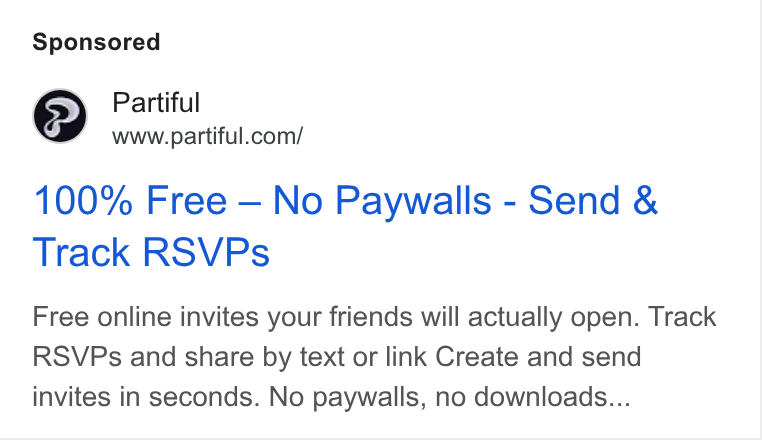
- Sponsored Partiful www.partiful.com/ 100% Free – No Paywalls - Send & Track RSVPs
- CTA / offer
- Free online invites your friends will actually open. Track RSVPs and share by text or link Create and send invites in seconds. No paywalls, no downloads...
- Audience
- People planning events or gatherings, indicated by the focus on 'invites' and 'RSVPs'.
Why it works. Preempts the there's probably a catch skepticism by naming paywalls directly, then closes with the concrete RSVP feature.
Lead with a strong, clear value proposition in the headline: "100% Free – No Paywalls - Send & Track RSVPs". Name the specific catch people expect from your free offer, then explicitly deny it in the same headline.
Show 3 more ads
- Running
- 162 days (longevity = it's converting)
- Hook
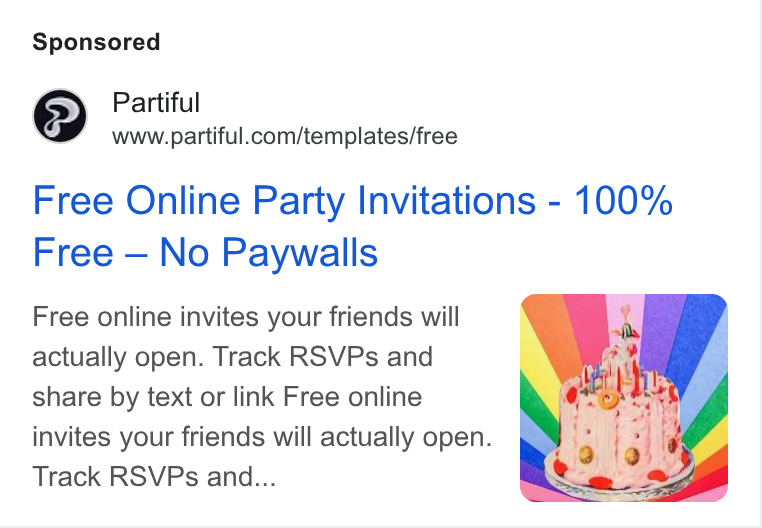
- Sponsored Partiful www.partiful.com/templates/free Free Online Party Invitations - 100% Free – No Paywalls
- CTA / offer
- Free Online Party Invitations - 100% Free – No Paywalls
- Audience
- Individuals planning parties or events who are looking for cost-effective and user-friendly invitation solutions, indicated by 'Free Online Party Invitations' and 'No Paywalls'.
Why it works. Stacks the free claim twice then rules out paywalls, reassuring the exact skeptic Google surfaces for free party invitation searches.
Headline with a strong, clear value proposition: 'Free Online Party Invitations - 100% Free – No Paywalls' Stack your free claim twice in one headline, category-level then emphatic, before naming what you're not charging for.
- Running
- 136 days (longevity = it's converting)
- Hook
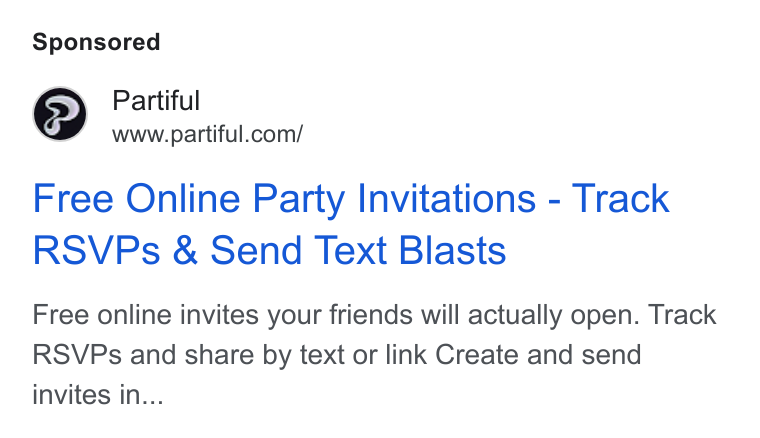
- Partiful logo (black and white stylized 'P' shape) next to the word "Partiful" and the URL "www.partiful.com/". Below this, the headline "Free Online Party Invitations - Track RSVPs & Send Text Blasts" is displayed.
- CTA / offer
- Free Online Party Invitations
- Audience
- Individuals who organize social events and want an easy, effective way to manage invitations and RSVPs, indicated by the phrases "Party Invitations", "Track RSVPs", and "Send Text Blasts".
Why it works. Matches searchers' own phrasing, free online party invitations, then proves it with two concrete features, converting search intent directly.
Lead with a clear, free offer in the headline: "Free Online Party Invitations - Track RSVPs & Send Text Blasts". Open your headline with the literal phrase your buyers type into search, then follow with two named features.
- Running
- 136 days (longevity = it's converting)
- Hook
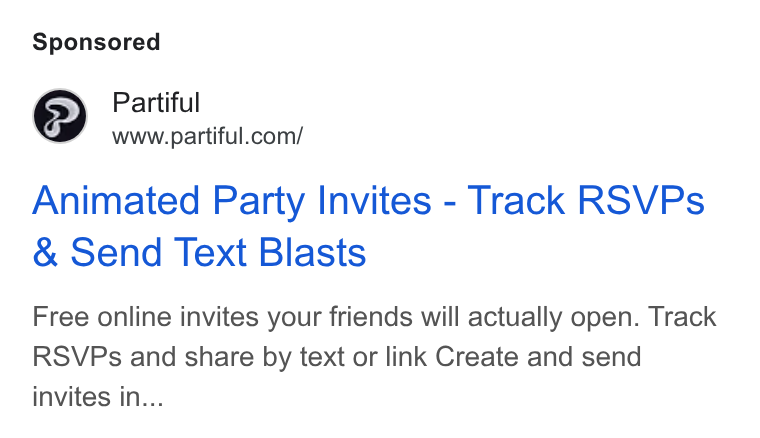
- Sponsored Partiful www.partiful.com/ Animated Party Invites - Track RSVPs & Send Text Blasts
- CTA / offer
- Free online invites
- Audience
- Individuals planning parties or events who want an easy way to manage invitations and RSVPs.
Why it works. Opens with a visual differentiator, animated, that separates it from plain invite templates, then backs it with two utility features.
Headline highlighting key benefits: "Animated Party Invites - Track RSVPs & Send Text Blasts" Lead with the one visual or format detail that makes your product different from the generic version, before your feature list.
09 The playbook
The channels are not separate. They are one system where each stage feeds the next. Here is the read, then the plays to run tomorrow.
The inferred playbook
The 12 open roles skew heavily technical, seven engineering titles including a Head of Engineering, alongside two roles explicitly tied to ticketing business development, showing the company is building both the infrastructure and the sales motion for its new commerce layer rather than adding growth-marketing headcount. Partiful's acquisition loop starts with a free, meme-able feature people can't help but screenshot, not with an ad.
Each new feature ships to Murthy's X feed first, then surfaces in TikTok and Instagram UGC within days, as with the zodiac-fund campaigns covered above, and that UGC drives the branded search that the homepage's #1 ranking then captures.
With the brand term locked down organically, the active Google ads exist to catch people searching generic phrases who haven't heard of Partiful by name yet, a top-of-funnel layer rather than a defensive one.
Dig deeper+2▾
Group Order (via Instacart's group-ordering app, launched as Fizz in May 2025 and since renamed Pantry) and ticketing are the only public monetization levers on a free product. With no reported revenue figures, a rough order-of-magnitude estimate grounded in a delivery-fee-plus-cut model and a still-nascent ticketing rollout puts current annualized revenue at low-single-digit millions at most, an estimate, not a reported number. Both levers are recent enough, the group-order partnership in May 2025, ticketing in June 2026, that neither has public conversion data yet, so the loop compounds attention far faster than it compounds revenue.
free-to-paid (event-to-purchase) conversion, retention/churn, CAC, and take-rate detail on Group Order or ticketing.
Ship one feature that's built to be filmed
The proofPartiful's zodiac-fund campaigns pulled five-figure engagement on TikTok, seeded with a physical flyer-taping bit rather than paid spend.
The adaptationPick one narrow, delightful feature reveal that gives users a built-in reason to record their reaction to it, for a SaaS product that could be a fun, shareable output artifact like a generated report card or stat card. Post the reveal from the founder's own account first with a specific, slightly absurd hook, then send the same clip to a handful of relevant creators to reproduce in their own voice. The mechanism: a feature that is inherently visual and personal gives creators content to make, not just a product to mention.
Cost: $0 · Time to signal: days · Works pre-PMF: yes
Announce from the founder's own account, not the brand's
The proofMurthy's ticketing announcement reached 458,613 views straight from her personal profile, no brand account involved.
The adaptationAnnounce every feature ship from the founder's own account in plain, specific language, no corporate phrasing, and reply to every comment and quote for the first day to keep it circulating.
Cost: $0 · Time to signal: days · Works pre-PMF: yes
Convert a competitor's public complaints into a DM funnel
The proofMurthy publicly invited frustrated Eventbrite organizers to DM her for onboarding help.
The adaptationMonitor public complaints about the closest competitor on Reddit, X, and review sites, then reply or DM offering direct onboarding help. This converts pre-existing dissatisfaction into signups without touching an ad account.
Cost: $0 · Time to signal: days · Works pre-PMF: yes, provided a competitor with visible, active public complaints actually exists
Build a handful of free-tool landing pages that mirror your ad copy
The proofPartiful's generic-intent landing pages rank #1 for terms like "RSVP website" and run near-identical headlines in its Google ads.
The adaptationPick 3 to 5 non-branded, high-intent queries in your category, build one landing page per query using the exact value proposition you'd eventually put in a paid headline, and only turn on paid spend once the organic page is live so both channels validate the same message before budget is committed.
Cost: under $500 · Time to signal: weeks · Works pre-PMF: conditional, needs a working product to point the pages at
Publicly call out a copycat, once
The proofCovered above, Partiful's "copycat" callout of Apple's Invites app drove real Reddit backlash (259 upvotes, 105 comments).
The adaptationIf a larger player visibly clones your core feature, call it out publicly and specifically with a direct comparison, framed as defending your users rather than airing a grievance. This only works once and depends on already having enough of an audience for the callout to be seen, so treat it as a single high-leverage moment, not a repeatable channel.
Cost: $0 · Time to signal: days · Works pre-PMF: no, requires an existing audience and a genuine, visible instance of being copied Not transferable at an earlier stage: the Apple Invites callout only worked because Partiful already had press attention and a large audience for the reply to land with, and the founder-account announcement play assumes a founder with thousands of existing followers, a pre-launch founder running either move cold is more likely to be ignored than amplified.
You just read how Partiful does it. Tomorrow it is someone else.
Every morning we take one company that is actually growing and break down where its customers come from: the ads still running after a year, the channel doing the real work, and the play you can run this week.
Systemaic · directional intelligence. Traffic, spend, and reach figures are SimilarWeb-style estimates and qualitative reads of public data, not audited numbers. Built on real public receipts.
// teardowns with a similar GTM motion
sources & receipts (7)
Live ad libraries: google ad library
Launch archives: Hacker News: Hire Palestine – sftechweek Wednesday 6PM SF, Mission · Hacker News: Open-Source AI Meetup in SF This Friday · Hacker News: Partiful's Response to the Apple Invites App · Hacker News: What Is Partiful Selling? · Hacker News: Wait, Partiful's Founders Worked at Palantir? · Hacker News: Apple Introduces Apple Invites, Partiful and Luma Alternativ
Traffic, spend, and revenue figures are estimates as noted in the report; the links above are the primary public artifacts.