- 01Run your own product as the public case study
- 02Post exact-number milestones instead of vague updates
- 03Buy your own brand name in search, defensively
- 04Seed a "trick" video, not a review, with micro-creators
01 Snapshot
The one-glance read on who they are and how they grow. Each point is verifiable from the receipts above.
An AI Chrome extension that writes LinkedIn posts, topic ideas, and images for individual creators, self-reported as "trusted by 50,000 leading creators."
Founder-led, self-serve, with no outside funding.
~33,806 monthly visits (+68.9% over the last 3 months) and ~$880K in reported annual revenue with an 8-person team, both as of 2025-2026 snapshots.
Founder Ruben Hassid's own tally, "Outside investment: $0," frames the business as bootstrapped by design.
The product's own case study is its main acquisition engine, since the founder and two employees grew their personal LinkedIn accounts using EasyGen itself and then turned those exact numbers into the pitch.
02 How it unfolded
The order the channels came online. Sequence is strategy: what they did first, and what they layered on once demand existed.
03 Traffic & channel mix
Estimated demand, the channel split behind it, and the keywords and referrers doing the work. Directional modeling, not audited analytics.
Traffic sources
Top search keywords
| Keyword | Volume | Weight | CPC |
|---|---|---|---|
| easygen | 2.1k | $1.36 | |
| easygen.tech | 19k | - | |
| easy gen | 450 | - | |
| generate linkedin post with ai like human | 200 | - | |
| ruben hassid easygen | 100 | - |
Closest competitors by audience
EasyGen draws an estimated ~33,806 monthly visits as of the latest snapshot, up 68.9% over the last 3 months. Search Organic is by far the dominant channel at 61.9% of traffic, followed by Direct at 19% and Social Organic at 7.1%; Referrals (6.3%) and Gen AI referral traffic (5.6%) round out the mix, the latter a notable line item for an AI product being surfaced by other AI tools. The top branded query is "easygen" at 2,070 searches/month, but the oddest signal is "easygen.tech" pulling 19,090 searches/month, likely confusion or typo-domain demand rather than intent for easygen.io itself; "ruben hassid easygen" (100/month) confirms some search demand is tied directly to the founder's own name. On competitors, typegrow.com and taplio.com are direct, well-known LinkedIn content tools chasing the same "grow on LinkedIn" searchers, while redactai.io represents a newer entrant in the same narrow AI-writing-for-LinkedIn niche, together showing EasyGen operates in a crowded prosumer category rather than owning it outright.
04 Organic content
The specific pages earning their organic search traffic, and the pattern behind why they rank. Adapt the format, not the topic.
EasyGen's organic footprint is thin by design, a small handful of pages rather than a content library, carrying its search traffic on the strength of its own brand name plus a cluster of core category terms like "LinkedIn post generator," "LinkedIn post creator," and "LinkedIn caption generator." That pattern points to a product that ranks because people search for it by name (driven by the founder's own visibility) and because its landing pages happen to match the exact phrase searchers type, not because of an expanding blog, comparison-page, or guide network. For a reader, the takeaway is that this SEO performance is closer to branded-search capture than a built content engine, a distinction the Content & SEO Engine section below expands on.
Top pages by organic traffic
05 Channel map
Not traffic share. How much weight the growth system actually puts on each channel, with a one-line read on the role it plays.
What drove growth
06 The motions doing the work
For founder-led SaaS the breakdown shifts from ads to traction: where the first users came from, how the founder grows it in the open, and the compounding organic surface.
EasyGen's earliest traction came from turning the product on the founder's own LinkedIn presence and two employees' accounts, then compounding it with public revenue milestones rather than a community launch moment.
Founder Ruben Hassid had two employees run their LinkedIn accounts through EasyGen, reportedly reaching 1.4 million people organically in 35 days, a number then used as the company's core public proof point rather than as pure customer traction.
By a Black Friday-timed post around 195 days after launch (roughly November-December 2024), the founder reported $41,532.86 in MRR and 27,000+ users, following an earlier feature crediting the company with crossing $33,000+ MRR within about 5 months of launch.
Dig deeper+1▾
The founder's public "$0 outside investment" framing turns the bootstrapped story itself into a distribution narrative, the same instinct visible in the Starter Story feature crediting the company's growth to the founder's own account.
Ruben Hassid's own audience, not a company account, is the growth engine, with LinkedIn as the platform he built in public and X as where he posts the underlying business numbers.
Hassid's personal LinkedIn following reportedly grew from about 8,000 to roughly 480,000-493,000 followers over about two years, built using the same product EasyGen sells, so the founder's own growth curve doubles as the product's biggest case study.
On X, Hassid posts exact, unrounded numbers rather than vague updates, the 195-day/$41,532.86 MRR post covered above, followed by a separate update citing 26,000+ weekly users around February 2025.
Dig deeper+1▾
The two employees whose LinkedIn accounts Hassid grew with the tool function as built-in testimonials and word-of-mouth rather than paid influencers or formal partners.
Search accounts for 61.9% of EasyGen's traffic, but the engine behind it is a thin, brand-anchored footprint rather than a built content system.
With only a handful of pages carrying its organic search, EasyGen ranks primarily on its own brand name and core category terms (the branded-term volume covered above) rather than a blog or comparison-page network, meaning search performance rides founder fame more than a scaled SEO program.
The site's embedded Rewardful integration signals a formal affiliate/referral program, but no public recruiting page, commission terms, or named partners are visible, leaving its actual contribution to reported revenue unclear.
Dig deeper+1▾
Of the 2 Google ads EasyGen has ever run, only 1 remains active as of 2026-07-18; the longest-running creative, live for roughly 585 days since November 2024, is a plain "Sponsored / easygen.io" branded listing, a defensive brand-term capture. A second, now-inactive ad tested a "LinkedIn Post Generator - Get More LinkedIn Views" problem-agitation headline before it stopped running after about 243 days, a rare demand-generation experiment rather than the norm.
07 Paid ads
This founder-led SaaS also runs paid acquisition. Here are the live ads doing the work, each with the X-ray and a play you can adapt.
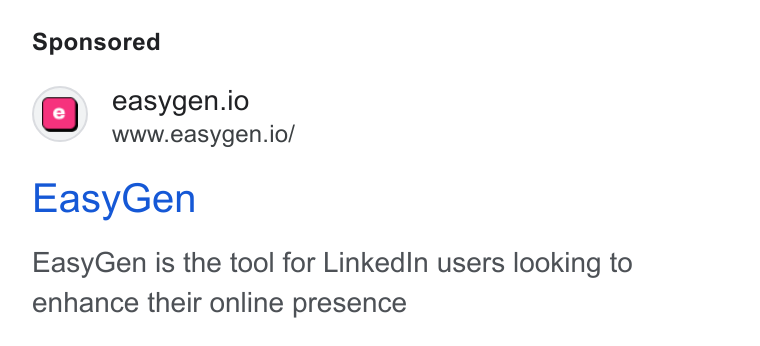
- Running
- 585 days (longevity = it's converting)
- Hook
- Visual: The word "Sponsored" at the top, followed by a small pink square logo with a white 'e' inside, next to the text "easygen.io" and "www.easygen.io/".
- Audience
- LinkedIn users looking to enhance their online presence, indicated by the text: "EasyGen is the tool for LinkedIn users looking to enhance their online presence"
Why it works. Directly state the product's purpose and target audience to attract relevant users seeking professional online enhancement.
Clearly state the brand name and website at the top of the ad: "easygen.io" and "www.easygen.io/". Ensure your brand name and website are prominently displayed and easily readable in the top section of your static ad creative.
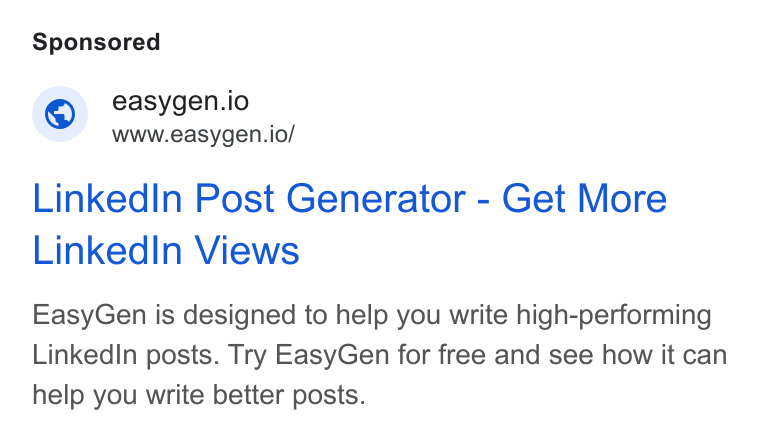
- Running
- 243 days (longevity = it's converting)
- Hook
- Sponsored easygen.io www.easygen.io/ LinkedIn Post Generator - Get More LinkedIn Views
- CTA / offer
- Try EasyGen for free
- Audience
- Individuals or businesses looking to improve their presence and engagement on LinkedIn, indicated by the phrases "LinkedIn Post Generator" and "Get More LinkedIn Views."
Why it works. Direct response ad using a problem-solution framework to drive sign-ups for a free trial of an AI content generation tool.
Headline directly addresses a desired outcome: "LinkedIn Post Generator - Get More LinkedIn Views" Use your ad's headline to directly state the primary benefit or desired outcome your product provides, making it clear and concise.
08 The playbook
The channels are not separate. They are one system where each stage feeds the next. Here is the read, then the plays to run tomorrow.
The inferred playbook
EasyGen's loop starts with Hassid's own LinkedIn authority, converts on a single paid tier gated behind a short trial, and compounds through brand-name search rather than a content or paid-acquisition machine.
The founder's ~480K+-follower personal platform and the two-employee case study (both covered above) send people to easygen.io already convinced the tool works, before any ad or SEO page enters the picture.
Pricing isn't published on EasyGen's own site, but third-party reviews report a single ~$59.99/month plan (~$49.99/month billed annually) gated behind a short free trial, with no free tier, so the founder's own proof-of-concept content has to do the persuading a freemium funnel would otherwise handle.
Dig deeper+3▾
Branded search and the Chrome Web Store listing carry ongoing discovery, but with a thin page count and only two ads ever run, there's little expanding content or paid inventory building on itself over time.
A visible affiliate recruiting motion, a content footprint beyond the core product pages, and any live paid-testing program (zero new ad creatives observed) all point to a growth machine still leaning on one person's audience rather than a diversified system.
the 3-post free trial's conversion rate into the $59.99/month plan, what share of the ~$880K reported revenue flows through the Rewardful affiliate program, and the Chrome extension's install-to-paid-signup rate.
Run your own product as the public case study
The proofHassid grew his personal LinkedIn from about 8,000 to 480K+ followers using EasyGen itself, and put two employees' accounts through the same tool to hit 1.4 million reach in 35 days.
The adaptationPick yourself plus one teammate, use your own product on the exact channel it serves for a fixed 30-35 day window, and publish the specific before/after reach or usage number at the end of that window instead of a vague "it works" claim. The fixed short window and the single hard number are what made EasyGen's version shareable, so copy that structure, not just the idea of "using your own product."
Cost: $0 · Time to signal: weeks · Works pre-PMF: yes.
Post exact-number milestones instead of vague updates
The proofThe founder's Black Friday post cited 195 days since launch, $41,532.86 MRR, and 27,000+ users; a later post cited 26,000+ weekly users.
The adaptationAt your own revenue or user milestones, post the unrounded figure plus days-since-launch in the same sentence ("Day 143: $4,212 MRR, 312 users") rather than a rounded or vague update, and tie posts to real moments (a promo, a launch anniversary) the way the founder timed his to Black Friday. The specificity is what reads as authentic instead of PR.
Cost: $0 · Time to signal: weeks to months · Works pre-PMF: yes, conditional on having a real number to report, even a small one.
Buy your own brand name in search, defensively
The proofEasyGen's longest-running ad, active roughly 585 days since November 2024, is a bare "Sponsored / easygen.io" branded listing (expanded above); a second, shorter-lived ad tested a "Get More LinkedIn Views" problem-agitation headline.
The adaptationOnce your product has any branded search volume, run a small always-on Google text ad on your own brand name plus one demand term, using a "[Category] - Get More [Outcome]" headline structure mirrored from EasyGen's second creative. Start with a single ad group and a few dollars a day; the goal is defending the branded click, not driving new demand.
Cost: under $500 · Time to signal: weeks · Works pre-PMF: conditional, only worth it once someone is actually searching your name.
Seed a "trick" video, not a review, with micro-creators
The proofTikTok creators posted EasyGen as a shareable workaround ("One Gmail, unlimited free trials"), with the strongest post hitting 693 engagements versus 26-37 for straighter mentions.
The adaptationFind a genuine shortcut or lesser-known feature inside your own onboarding flow and pitch it to 2-3 micro-creators in your niche as insider "trick" content rather than a product review, the tips-and-tricks framing is what TikTok's discovery loop rewards over straight testimonials. Caveat: if the trick involves circumventing your own trial limits the way EasyGen's Gmail-alias angle does, that specific mechanic is policy-exposed and can violate your own terms of service, so adapt the shareable-shortcut framing, not literal trial-limit circumvention.
Cost: $0 to under $500 · Time to signal: days to weeks · Works pre-PMF: yes, provided there is a real feature worth the "trick" framing.
Stand up a lightweight affiliate program early
The proofEasyGen's site embeds Rewardful, a plug-and-play affiliate tool, indicating a formal referral program even though its recruiting and reach are not publicly documented.
The adaptationInstall a similar low-lift affiliate tool on your billing stack as soon as you have paying customers, and recruit the same kind of niche micro-creators seen promoting EasyGen (productivity-tool reviewers, virtual-assistant accounts) with a straightforward recurring commission rather than a flat fee.
Cost: under $500 · Time to signal: months · Works pre-PMF: no, this needs paying customers to have something worth commissioning. Not transferable at an earlier stage: the 480K-follower personal platform and the 585-day proven ad run both assume years of prior audience-building or existing brand-search volume that a pre-launch founder will not have on day one; adapt the underlying mechanics, self-as-case-study, exact-number milestone posts, low-lift affiliate setup, without expecting the same reach immediately.
You just read how EasyGen does it. Tomorrow it is someone else.
Every morning we take one company that is actually growing and break down where its customers come from: the ads still running after a year, the channel doing the real work, and the play you can run this week.
Systemaic · directional intelligence. Traffic, spend, and reach figures are SimilarWeb-style estimates and qualitative reads of public data, not audited numbers. Built on real public receipts.
// teardowns with a similar GTM motion
sources & receipts (10)
Live ad libraries: google ad library
Launch archives: Hacker News: EasyGenerator: E-Learning Software made easy
Researched facts: EasyGen has raised no outside investment and is fully bootstrapped: $0 outside investment · EasyGen reached $33K+ MRR within 5 months of launch: $33,000+ MRR in 5 months · Weekly active user count stated by founder in a later update: 26,000+ weekly users (as of · Company founding year and founders: Founded 2024 by Ruben Hassid and Pete Sena; HQ New Yor · Reported annualized revenue and team size (third-party revenue database): ~$880K revenue w · Chrome Web Store listing stats (official store page): 4.9 rating from 25 ratings; 2,000 us · Founder's personal LinkedIn following growth, used as EasyGen proof-of-concept: Ruben Hass · Product positioning / core claim: EasyGen markets itself as a Chrome extension 'AI to writ
Traffic, spend, and revenue figures are estimates as noted in the report; the links above are the primary public artifacts.