- 01Run the "you didn't fail the routine" hook against your current best-performing creative.
- 02Treat a new SKU or bundle launch as a paid creative reset, not just a product announcement.
- 03License your best creator affiliate video and run it as a Meta dark post with the discount code on screen.
- 04Build a "3 reasons you can't [symptom], and none of them are [obvious culprit]" ad for your category.
01 Snapshot
The one-glance read on who they are and how they grow. Each point is verifiable from the receipts above.
Rainbow Dust, a 7-in-1 mushroom-and-adaptogen powder blend positioned as a crash-free coffee alternative, sold DTC on subscription to UK wellness consumers, backed by a £2.5M seed round led by Five Seasons Ventures in January 2024.
paid-led, with Meta as the primary acquisition engine and a creator-affiliate layer that feeds back into paid creative.
~312,504 estimated monthly visits as of 2026-06-27, 113,681 Instagram followers, 75,000+ customers at the time of the seed raise, 400 active Google ads, and retail placement across Tesco, Sainsbury's, Boots, Whole Foods, and Holland & Barrett.
"Launching two new SKUs dropped CAC 50% overnight" (source), the founder's clearest signal that product expansion, not ad spend, was the actual acquisition lever.
Spacegoods reached ~£18M in revenue by running a single hero SKU through paid Meta for two years, keeping CAC flat by deliberately raising AOV, and only expanding product and channel once the core unit economics were proven.
02 How it unfolded
The order the channels came online. Sequence is strategy: what they did first, and what they layered on once demand existed.
03 Traffic & channel mix
Estimated demand, the channel split behind it, and the keywords and referrers doing the work. Directional modeling, not audited analytics.
Traffic sources
Top search keywords
| Keyword | Volume | Weight | CPC |
|---|---|---|---|
| spacegoods | 28k | $0.84 | |
| space goods | 3.8k | $1.05 | |
| spacegoods reviews | 2.6k | $1.20 | |
| spacegood | 1.8k | $1.09 | |
| mushroom coffee | 33k | $1.89 |
Top referring sites
Closest competitors by audience
~312,504 estimated monthly visits as of 2026-06-27, trending down 18% over the prior three months. Paid social at 26% is the single largest acquisition channel, confirming the founder's stated Meta-first model. Direct traffic (19.7%) is second, signaling meaningful brand recall and subscription repeat intent. Search organic accounts for 16.9%, display ads 15%, and paid search 12.9%, together, the paid channels (social paid + display + search paid) represent roughly 54% of all traffic, making this a high-spend, media-bought operation at its core. Referrals represent 4.4%, organic social a modest 2%, affiliate 1.5%, and email 1.2%.
The organic search footprint is almost entirely branded: the homepage captures 82.1% of all organic visits, ranking first for "spacegoods," "space goods," and "spacegoods rainbow dust." The Rainbow Dust Starter Kit product page takes another 9.4%. The broader keyword "mushroom coffee" (33,100 total monthly searches across the web) represents demand they rank for and bid into, but non-branded editorial content is absent from the top organic pages. SEO here is brand-name capture of demand that paid advertising has already created, not an independent content engine. Top referring domains are shopify.com, force.com, and gethookd.ai. Closest competitors in traffic pattern include dirteaworld.com, ankhway.com, shroomex.com, and londonnootropics.com.
04 Organic content
The specific pages earning their organic search traffic, and the pattern behind why they rank. Adapt the format, not the topic.
All five of Spacegoods' top organic pages are navigation or product pages, not editorial content. The homepage, starter kit product page, account login, and two collection pages together account for essentially the entire organic footprint. There are no category or educational content pages ranking in the top results, meaning the brand has built no standalone SEO content engine. The strategic implication: the "spacegoods review" keyword (2,630 monthly searches across the web) representing consideration-stage search intent is left to third-party content to capture, while Spacegoods itself only ranks for its own brand terms. Every point of organic traffic is an artifact of paid-media brand-building, not content-led discovery.
Top pages by organic traffic
05 Channel map
Not traffic share. How much weight the growth system actually puts on each channel, with a one-line read on the role it plays.
What drove growth
06 The creative doing the work
Each exhibit shows the actual asset, an X-ray of why it works, a status, and a play you can adapt. This is the heart of the teardown.
Google runs 400 active ads as of 2026-06-27, with the longest-running proven winner active for approximately 1,115 days. Meta runs a high-volume library of video and image ads across formats. Together these reflect a mature, layered paid-media operation with deep creative iteration history.
- Running
- 61 days (longevity = it's converting)
- Hook
- "Win the morning, win the day ✨" on-screen text with a close-up of hands opening a vibrant purple "spacegoods" bag.
- CTA / offer
- Starter Kit is just £29 + get 20% off with code: EMILYN
- Audience
- Health-conscious morning ritual seekers (evidenced by 'focus | productivity | energy' claims and the aesthetic kitchen setting).
Why it works. Appeals to productivity-minded morning-routine shoppers by tying a drink choice to daily success, closing with a demo and discount code.
ASMR sound design (0:00-0:21) Connect your product to the first decision in your customer's day and frame that one choice as setting up their whole day.
- Running
- 59 days (longevity = it's converting)
- Hook
- "I currently have an offer on the rainbow dust starter kit so you get all of this included." Visual of a hand pointing to a purple bag, pink whisk, purple spoon, and dark blue mug on a wooden board.
- CTA / offer
- 20% off using code ‘LAURA’
- Audience
- Wellness-conscious consumers who value aesthetic 'starter kits' and creator-endorsed discounts.
Why it works. Frames the discount as the creator's own current offer rather than a brand-wide promo, borrowing the trust of a personal recommendation to drive urgency.
Physical Bundle Breakdown (0:03-0:11) Have your creator or UGC talent introduce the discount as something they personally have right now, not as a brand announcement.
- Running
- 59 days (longevity = it's converting)
- Hook
- "I currently have an offer on the rainbow dust starter kit" + visual of a hand pointing at a purple bag of Spacegoods Rainbow Dust, a pink whisk, a purple spoon, and a navy mug on a wooden board.
- CTA / offer
- 20% off using code 'LAURA'
- Audience
- Wellness-conscious consumers looking for a coffee alternative bundle deal.
Why it works. Points to each item in the starter kit on camera alongside an influencer's discount code, making the bundle's contents and value obvious fast.
Visual Inventory Breakdown (0:03-0:11) Film a short point-by-point tour of everything in your bundle before you explain the offer, so viewers see the value before the pitch.
Show 7 more exhibits
- Running
- 39 days (longevity = it's converting)
- Hook
- Visual: A still shot of a black tumbler, a pink frother, and a purple pouch of 'spacegoods' mushrooms & coffee blend, with a vase of dried flowers in the background. Audio: Soft, instrumental music begins.
- CTA / offer
- 20% off discount code: EMILYN
- Audience
- Individuals interested in health supplements and coffee alternatives, indicated by the 'Mushrooms & Coffee' product and 'Focus | Productivity | Energy' claims.
Why it works. Lays out every item in the starter kit in one still shot so affiliate viewers see exactly what they're buying before any pitch starts.
Product display and kit bundling (0:00-0:06, 'This is everything that you get in the Starter Kit!') Photograph your full bundle in one tidy flat-lay shot and use it as the opening frame before any voiceover or text begins.
- Running
- 37 days (longevity = it's converting)
- Hook
- "I'm a material lover" text overlay with a woman in a white tank top and blue jeans dancing in a kitchen while holding a yellow tin.
- Audience
- Health-conscious women interested in aesthetic lifestyle products and morning routines.
Why it works. Frames the product as already part of the creator's routine via an offhand 'of course,' borrowing the credibility of a habit rather than a pitch.
Modified lyric cover (0:00-0:21) 'I'm a material lover'. Caption your UGC clip with an offhand, habit-toned line ('of course I need one for X') instead of a direct sales statement.
- Running
- 5 days (new — still being tested)
- Hook
- No spoken words. Visual of a hand stirring a dark brown powder into a clear glass of water on a light-colored wooden surface.
- Audience
- Health-conscious individuals seeking a mindful morning routine, signaled by the slow preparation ritual and the bright, clean kitchen setting.
Why it works. Uses an influencer's personal code and lifestyle setting so the offer reads as a friend's recommendation instead of a brand promo.
Extended 36-second close-up of product preparation (0:00-0:36). Give each influencer partner a code with their own name so the discount reads as their personal recommendation, not a blanket sale.
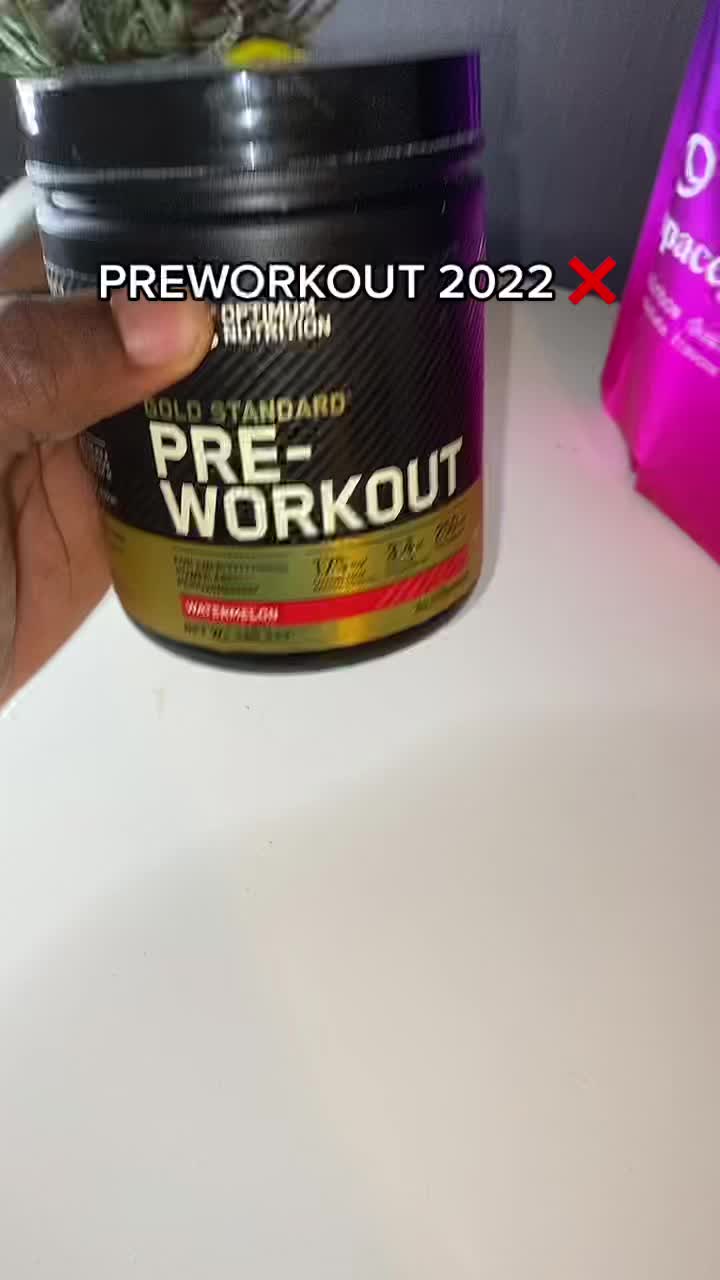
- Hook
- 0:00-0:03: A hand holds a black pre-workout container with a yellow label. Text overlay reads "PREWORKOUT 2022 ❌". The container is then dumped into a toilet.
- Audience
- Individuals interested in fitness, health supplements, and alternative pre-workout options, indicated by the initial focus on 'pre-workout' and the subsequent introduction of a mushroom/adaptogen blend.
Why it works. Uses a reject-and-replace ritual to position the product as the modern upgrade for pre-workout users chasing energy without the crash.
Pattern interrupt and bold claim (0:00-0:03): The video opens with a hand dumping a pre-workout container into a toilet, accompanied by the audio "Hey guys, if you drink pre-workout in 2022, I don't know what's wrong with you." and on-screen text "PREWORKOUT 2022 ❌". Physically discard a competitor-category product on camera before revealing yours, dating the old one to make yours feel current.
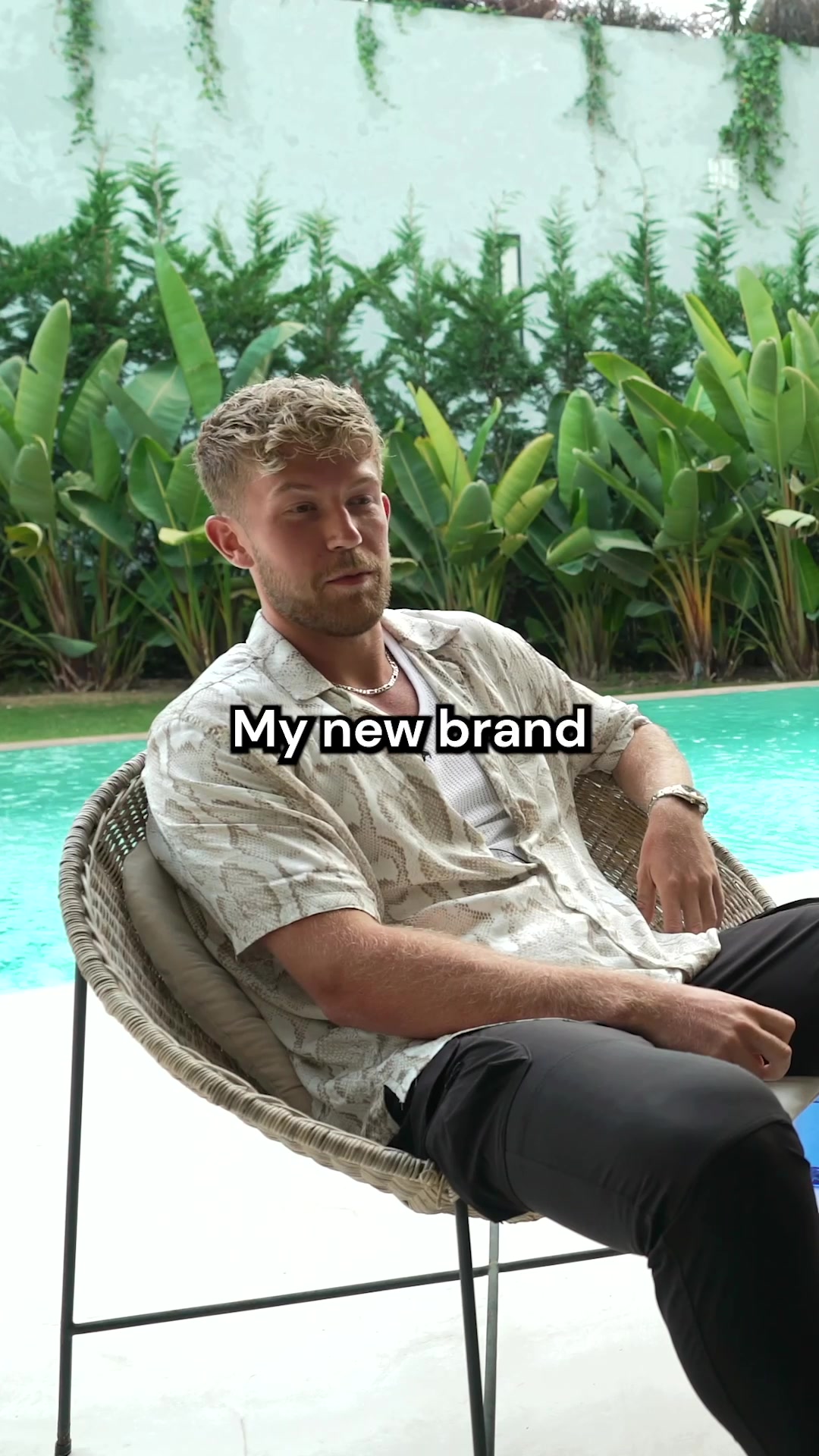
- Hook
- Visual: A man with short blonde hair and a beard, wearing a patterned short-sleeved shirt and dark pants, sits in a woven chair next to a swimming pool with lush green foliage in the background. On-screen text: "Space Goods". Audio: "Money brand Space Goods is what I'm working on now."
- Audience
- Individuals interested in wellness, particularly 'next gen' wellness, mushroom-based products, and potentially psychedelics for mental well-being, as evidenced by the explicit mention of these topics.
Why it works. Uses founder candor about building a business, not a passion project, to build trust with an audience wary of polished brand pitches.
Founder introduction and product reveal (0:00-0:03, 0:08-0:10): The founder states, "Money brand Space Goods is what I'm working on now." and later shows a purple pouch, saying, "Rainbow Dust is the first product." Have your founder state plainly what they're building and why in one candid sentence instead of a scripted brand story.
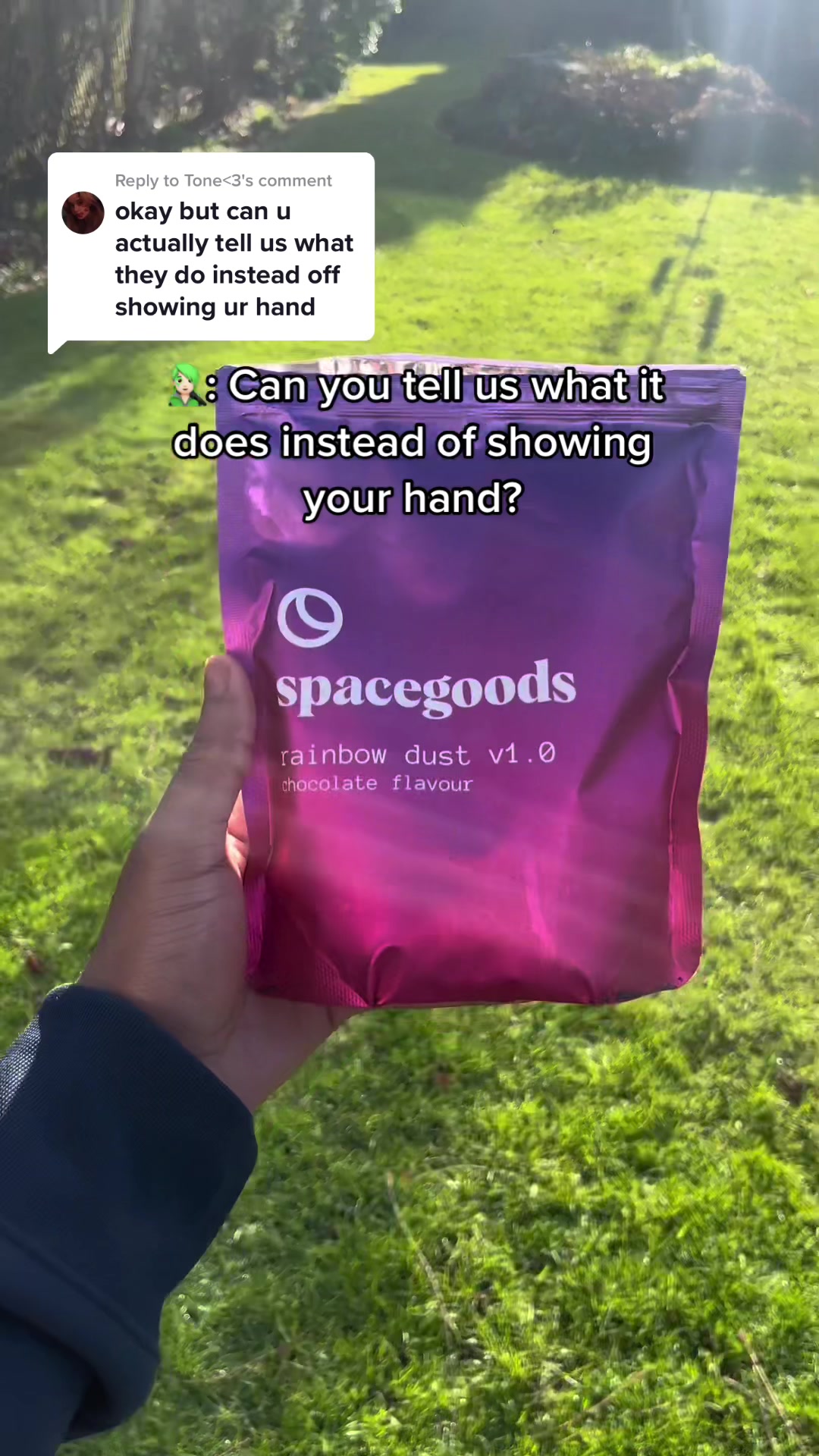
- Hook
- 0:00-0:03, a person's hand is shown in the foreground with a grassy backyard in the background. On-screen text: "okay but can u actually tell us what they do instead off showing ur hand" and below it, a cartoon character with green hair and a speech bubble says ": Can you tell us what it does instead of showing your hand?"
- Audience
- Individuals interested in health supplements, superfoods, and natural remedies, indicated by the product's focus on 'superfoods' and specific ingredients like 'Chaga', 'Cordyceps', 'Ashwagandha', 'Lion's mane', and 'Maca Root'.
Why it works. Answers a real viewer objection, what does it actually do, on screen, which builds trust with skeptics who tune out vaguer ingredient claims.
Directly addressing user comment at 0:00-0:03 with on-screen text: "okay but can u actually tell us what they do instead off showing ur hand" and a cartoon character saying ": Can you tell us what it does instead of showing your hand?" Pull an actual skeptical comment from your posts and answer it word for word as the opening line of your next ad.
- Reach
- 1 upvotes · r/ReferalLinks
A community is already discussing this in r/ReferalLinks. Show up there authentically and answer the thread before a competitor does.
Who amplifies them
Named creators running affiliate codes in the evidence: Laura (Women's Health Creator, code POTTS and separately code LAURA, featured in both organic TikTok content and Meta paid placements), Emily Norris (featured across multiple Meta video ads with gut-health and productivity scripts), Sophie Hawkins (featured in the Meta "cortisol/focus" script), and The Social Mama (featured in Meta image ads). On TikTok, @tommyrichman, @Becky Anne, @thesolutionkitchen, @healthadventuresmeg, @itsdjlevi, @Reganjane, and @xg.official have posted gifted or organic reviews. Third-party commentator @Chris Donnelly produced a 547-engagement breakdown of Spacegoods' marketing strategy, functioning as earned credibility from a business-education audience.
Two creator tiers are visible: gifted/organic TikTok reviewers producing unboxing and honest-review content, and a structured affiliate layer where creators receive named discount codes and their footage is licensed into Meta paid placements. The founder Matthew Kelly posts separately from the brand account under @mattkellymidnightpod, with his 2022 "launching the new brand @tryspacegoods" post (394 and 1,050 engagement on two posts) seeding early awareness via his pre-existing podcast audience.
07 Organic & video
The organic content engine: the videos, creator posts, and community presence earning attention without paid spend.
The founder Matthew Kelly's YouTube channel is the highest-performing organic content surface Spacegoods has. "What The F*ck Is Rainbow Dust?" has 445,752 views, driven by a deliberately provocative title that functions as a pre-qualifier: the audience willing to click is already curious about unconventional wellness products. "Your Glow-Up Starts Within" (55,348 views) and "Spacegoods 2.0, The Journey So Far" (87,955 views) are brand films with cinematic production that double as founder-story assets. The "Documenting the Journey" vlog series ("Finally Hitting £1m per month," "Spacegoods 2023 Numbers in Review") pulls 5,000-8,000 views per episode and functions as transparent build-in-public content that builds trust with a founder-following, DTC-aware audience.
Read the full breakdown+1▾
On TikTok, the highest-engagement format in the evidence is the pattern-interrupt product-replacement clip: the 2022 "Cancel pre workout" video showing a pre-workout container being dumped in a toilet (1,050 engagement) established the brand against an existing behavior. Third-party creator @leadwavemusic's explainer ("What do Spacegoods actually do?", 907 engagement) shows that educational third-party voices outperform pure brand product posts. The most recent TikTok content (mid-2025 and beyond) is unboxing and honest-review format from creator affiliates, consistent with the TikTok Shop launch.
08 Affiliate & partners
How the brand turns creators and partners into a tracked, variable-cost acquisition channel, and how the program is structured.
A referral program is confirmed via personalized customer URLs (spacegoods.com/ROSS49439, spacegoods.com/ELLIOTT33987), offering 20% off a first order. The research brief cites 2,000+ referrals with a 17% conversion rate and 4.3x ROI per referred customer, though the date of that figure is not specified in public sources. Creator affiliate codes (LAURA, EMILYN, POTTS) appear in both organic TikTok posts and as overlays in Meta paid creative, confirming that affiliate content is being actively recycled into paid media, the affiliate is both a distribution channel and a creative production pipeline. Spacegoods joined TikTok Shop in mid-2025, adding a platform-native affiliate-seller layer. The commission structure and free-to-paid conversion rate on referrals are not visible in public data.
09 In their own words
Pulled from interviews and community sessions. The quotes are the angle; the takeaway is what to do with it.
How Matt Kelly Went From Bust to £20 Million Building Spacegoods ↗HappyStack 🥞 · 7.5k views · 58 min▶ View source“flavors has been the biggest lever even in like the past three months... we launched two new flavors and CAC came down at 50% conversion rate went up”
Expand
Kelly spotted a US trend (mushroom adaptogen beverages) with no real UK equivalent, validated unit economics and subscription fit before launching, then scaled almost entirely on Meta ads while keeping the team tiny. His key unlock was expanding flavors rather than marketing tactics — launching two new SKUs dropped CAC 50% overnight. He layers influencer gifting on top of Meta as a content and whitelisting engine, runs inbound retail (Holland & Barrett, Boots) as a margin-positive secondary channel, and is deliberately staying UK-focused to dominate one market before touching the US.
“you cannot outmarket a subpar product range you just can't — like trying to polish a turd, it's never going to work”
“I was running like 25 landing pages for like the past year... I was like all this let's run all our ads to one product page scrap off all the landing pages which I spent like hours tinkering and performance was better overnight — it's like simple scales usually”
“influencers right now is a content and whitelisting machine for meta basically which has definitely brought down CAC”
“better to dominate the UK and be the brand in that space first rather than be you know 2 million in 10 countries — better to be 20 million in one”
Expand SKUs before optimizing ad creative: new flavors drove a 50% CAC reduction with no additional media work — product range is the highest-leverage conversion lever in DTC.
Run influencer gifting as a Meta content machine, not a brand play: spend ~£20k/month on gifting to generate whitelistable UGC, measure it by its impact on paid CAC rather than as a standalone channel.
Consolidate to one product page and kill landing page sprawl: Kelly scrapped 25 landing pages, sent all ads to one page, and saw overnight performance improvement — simplicity scales.
Pivot acquisition and offers entirely around subscribers, not one-time buyers: re-architect your funnel so every touchpoint converts to a subscription, since subscriber LTV dominates one-time purchase economics.
Stay single-market until you dominate it: resist US or EU expansion pressure, keep Europe and America in reserve for a later fundraise narrative, and maximize efficiency in one geography first.
Founder Roundtable: The Truth About Customer Acquisition Nobody Told You… ↗HappyStack 🥞 · 7.2k views · 83 min▶ View source“I've fully realized now that we spent three years being a marketing business and actually we should be a product business.”
Expand
Matt Kelly grew Spacegoods to ~£18M in revenue by treating paid Meta as distribution for a brand and product he believed in on gut instinct, not customer research. He kept CAC flat over three years by deliberately raising AOV alongside it, and recently dropped subscription price from £39 to £29 — cutting CAC ~40% while barely moving AOV — to broaden TAM. He now believes the business ran too long as a marketing machine and that retention, not ad volume, is the real ceiling on growth.
“I didn't do customer research on like rainbow dust. I just like was in immersed in Twitter and stuff and saw that that looked cool.”
“I actually don't think that is the main thing. I think the brand thing is much more important than the ads thing to be honest. Like people either want to buy your product or they don't. An ad can push them to purchase but there has to be some intent especially on Meta.”
“We went from 39 to 29 on subscription and the AOV barely moved. CAC came down like 40%... even if the LTV CAC is net the same, the benefit is that it broadens the TAM because there's more people willing to pay 29 than 39.”
“We've probably launched products in fear of not hitting the budget and then in doing so, you've just complicated and doubled your workload for everyone. And then you piss off your team because they're not clear on what you're trying to do.”
Drop subscription price to expand TAM, not just improve retention: Spacegoods cut from £39 to £29, CAC fell ~40%, and AOV held because subscribers bought more SKUs — net LTV/CAC was roughly flat but the addressable market widened.
Treat Meta purely as distribution for demand that already exists: invest in building brand intent first; ads capture it but can't manufacture it at scale over time.
Use gut + category immersion for early product bets, not customer surveys: customers can only tell you what they've already seen, so early product calls were made from deep category observation, not focus groups.
Resist NPD pressure from investors: launching products to hit budget targets doubles operational complexity, dilutes brand positioning, and demoralizes the team — each new SKU must clear a real ROI hurdle against simply getting better at selling the core product.
Hire SaaS/tech product people for conversion and website, not ecom specialists: Matt paid ~£28K/month for a consultancy from the ex-CPO of Athletic Greens (formerly Rent the Runway) — the level of AB testing and product thinking from software backgrounds far exceeded what ecom hires could deliver.
Matt Kelly Returns to Break Down the Path from £10M to £50M | Episode 41 ↗D2C Diaries · 7.0k views · 63 min▶ View source“The bigger the problem the easier it is to scale. I think that's like you can distill it down to that. That's why fashion is so hard on Facebook now.”
Expand
Kelly built Spacegoods on a single mushroom coffee SKU for roughly two years, running paid social (Facebook/Meta) without improving the product, then raised venture capital and began expanding into a multi-SKU functional powder beverage brand. His core growth thesis is that the size of the consumer problem you solve determines how easy paid acquisition is, and that tight category ownership — not breadth — is what drives both scale and a strategic exit above £50M revenue.
“What category do you own and how clear is the offering?”
“Every market is crowded. You can either solve a problem that's not been solved yet. You can improve a product, which is probably the easiest way to like apply newness... or you can like apply a new angle to an existing niche.”
“Unlock your full potential is the slogan, always has been. We haven't really leaned into it enough. So now I want it to be like basically like fuel for the modern athlete and it doesn't mean sport, it means like the busy mom, the e-com bro scaling, the guy with a shit office job.”
“I thought we're actually a product business. Oh yeah, shit. We should probably figure out products as well. That's basically what happened with me. It was like for like 2 years with one SKU that we never even improved cuz it was like decent from day one.”
Anchor your brand to one tight need state, not a broad wellness umbrella — Kelly is repositioning from 'mushroom coffee brand' to 'fuel for the modern athlete' specifically because diffuse positioning makes paid acquisition harder and strategic buyers harder to attract.
Choose your problem by acquisition size — Kelly's expansion into sleep, hydration, and additional SKUs is driven by a specific thesis: bigger, more specific consumer problems convert better on Facebook/Meta, and you need £50M+ revenue in Europe to attract a strategic buyer at a revenue multiple.
Prove one SKU before building a product system — Kelly ran two years on a single SKU with no improvements before building any product development process; he now sees that as a mistake and warns that most brands need a deliberate NPD pipeline earlier.
A subtle visual rebrand can unlock meaningful performance gains — Kelly cites Perdy and Fig as recent examples where a refined (not radical) brand refresh produced measurable improvements; he is running the same playbook now.
Position for a strategic acquirer, not just PE — investment bankers Kelly spoke to told him that how you package and tell the brand story in a sale room matters as much as the financials; a brand that owns a clear category commands a revenue multiple, while a broad trend-hopping brand is valued on EBITDA at a lower multiple.
The £18M/Year Mushroom Brand—Spacegoods | Matt Kelly | Ep.37 ↗Theo Clarke Podcast · 5.2k views · 69 min▶ Listen“there was no one really doing that in the UK market”
Expand
Matt Kelly grew Spacegoods to £18M/year by entering the UK mushroom supplement market when there was effectively no competition, differentiating through intentional design (standing out in a commodity packaging space), and running Meta ads as the core acquisition engine on a subscription model. He consolidated early around a single hero SKU — mushroom coffee — which now drives ~80% of revenue, and credits timing/category tailwind as the single biggest growth lever, alongside raising venture capital to accelerate hiring.
“I wasn't going to start something that had no margin that would never work on meta for example”
“the fact that it was like design led and pink and purple and all this, it definitely helped”
“we launched as like single skew... we were literally a chocolate flavored mushroom powder at the start... Now, that's like our core product, probably 80% of revenue”
“The answer to almost every problem is the right person. The cause of almost every problem is the wrong person. Hiring is the single hardest part of any business. That's your job as a founder.”
Enter a category before competitors exist in your geography — being first in the UK mushroom space let Spacegoods own the market before incumbents arrived.
Design-differentiate in commodity supplement markets: a branded, visually distinct product (pink/purple palette) stands out when everyone else ships a plain plastic bottle.
Validate Meta-viability before building the brand — Kelly explicitly checked margin and Meta unit economics before committing to the category.
Collapse to one hero SKU early: mushroom coffee became 80% of revenue; expanding too broadly diluted the brand and is now being corrected with a rebrand.
For DTC to scale past a ceiling, you need either a subscription model or high AOV (£150+) — Kelly frames these as the only two viable paths to meaningful paid-acquisition scale.
10 The playbook
The channels are not separate. They are one system where each stage feeds the next. Here is the read, then the plays to run tomorrow.
The inferred playbook
Spacegoods built to ~£18M in revenue by making paid Meta the entire acquisition engine, then layering affiliate, creator UGC, and retail as amplifiers once the core unit economics were locked.
The founder ran one mushroom coffee product on Meta ads for roughly two years before expanding, keeping creative learning tight and the brand proposition undiluted; that hero SKU still drives approximately 80% of revenue (source).
Top-of-funnel ads explain why the customer's brain is failing (cortisol, cellular depletion, the "27 tabs open" feeling), mid-funnel creator social proof normalizes the category switch, and bottom-funnel offers (60-day refund, starter kit pricing, discount codes) remove the purchase barrier, a full funnel built inside one Meta account.
Dig deeper+3▾
The founder kept CAC flat over three years by deliberately raising AOV alongside it, then lowered subscription price from £39 to £29 to cut CAC approximately 40% while broadening the addressable market without collapsing revenue (source).
Adding two new flavors cut CAC 50% overnight by widening the creative surface area and enabling a "try all flavours" starter kit angle that increased conversion on new visitors (source).
Organic social engagement is thin (35 avg engagements per post against 113,681 Instagram followers), the 18% traffic decline over the prior three months suggests the paid-first model is facing efficiency pressure, and there is no editorial SEO content capturing non-branded search demand. The retail push into Tesco, Sainsbury's, and Boots is likely a deliberate hedge against rising paid CAC, but that channel's contribution is not yet visible in the traffic data. The path from the £12M milestone to the ~£18M figure referenced in interviews is not detailed in public sources.
Run the "you didn't fail the routine" hook against your current best-performing creative.
The Meta copy "You've tried everything. The routine. The sleep. The supplements... What you didn't realise is that you didn't fail the routine, it was missing something" converts because it names the customer's exhaustion before the product appears. Write three versions substituting your category's equivalents for "the routine" and "the supplements," pair each with a risk-reversal CTA (money-back guarantee or free trial), and test as both static image and 30-second video. Spacegoods has run variations of this frame across multiple proven-winner ads for 54-61 days, which is a strong positive-ROI signal.
Treat a new SKU or bundle launch as a paid creative reset, not just a product announcement.
The founder reported a new SKU dropping CAC 50% overnight because new variants give the algorithm fresh audiences to optimize toward and give existing customers a repurchase reason. The immediate action: if you have a variant, a new flavor, or a bundle ready, build a campaign brief around a "which one is for you?" quiz or a "try all three" starter kit angle before running a single ad. The product expansion is the creative brief.
License your best creator affiliate video and run it as a Meta dark post with the discount code on screen.
Spacegoods takes creator UGC (Laura's "I have an offer on the rainbow dust starter kit" talking-head, code LAURA on screen) directly into Meta paid placements. The mechanism: the creator's casual, product-pointing format reads as native content and sidesteps the ad-skipping reflex. Find the one creator whose organic post drove your best referral or engagement, license the footage or shoot a clean version with them, overlay the discount code, and run it as a paid dark post. The specific format to replicate is the creator talking to camera while pointing at the product, with the code as on-screen text.
Build a "3 reasons you can't [symptom], and none of them are [obvious culprit]" ad for your category.
The cortisol-focus script is a transferable creative architecture: contradict the conventional culprit your customer blames, teach the real mechanism your product addresses, then introduce the product as the fix. Identify the #1 thing your audience blames for their problem that is not actually the root cause, write a 60-second script following this structure, and shoot it as a talking-head with either a creator or yourself on camera. This format appears across multiple Spacegoods proven winners with different creator voices, confirming it holds across audiences, and it works because it educates before it sells.
Produce a single provocation video titled "What the F*ck Is [Your Product]?" for YouTube.
The founder's 445,752-view video proves that a title that sounds alienating to the wrong customer is magnetic to the right one. Shoot a 3-4 minute video that opens by acknowledging exactly how strange or unconventional your product sounds, walks through the problem it solves in plain language, and ends with a product demo. Lean into the "I don't understand what this is" reaction in the title and thumbnail rather than suppressing it. This is a one-time long-shelf asset, not a repeatable cadence play, and its performance depends almost entirely on the title doing the qualifying work upfront.
You just read how Spacegoods does it. Tomorrow it is someone else.
Every morning we take one company that is actually growing and break down where its customers come from: the ads still running after a year, the channel doing the real work, and the play you can run this week.
Systemaic · directional intelligence. Traffic, spend, and reach figures are SimilarWeb-style estimates and qualitative reads of public data, not audited numbers. Built on real public receipts.
// teardowns with a similar GTM motion
sources & receipts (11)
Live ad libraries: meta ad library · linkedin ad library · google ad library
Launch archives: Hacker News: Spacegoods shakes up functional beverage industry with mushr · Hacker News: Space Goods – The Next Generation Wellness Brand
Founder interviews: How Matt Kelly Went From Bust to £20 Million Building Spacegoods · Founder Roundtable: The Truth About Customer Acquisition Nobody Told Y · Matt Kelly Returns to Break Down the Path from £10M to £50M | Episode · The £18M/Year Mushroom Brand—Spacegoods | Matt Kelly | Ep.37 · How Matt Kelly Built Spacegoods into £3 million D2C Brand in 16 Months · $1 Million/Month To Rock Bottom (To Launching Space Goods) – Matt Kell
Traffic, spend, and revenue figures are estimates as noted in the report; the links above are the primary public artifacts.