- 01Seed micro-influencers at 5,000 followers, not 500,000.
- 02Test the "us vs. the category incumbent" ad format.
- 03Build a care-content page and bid on the question in Google Search.
- 04Turn a customer's 12-month real-use video into a paid creative.
01 Snapshot
The one-glance read on who they are and how they grow. Each point is verifiable from the receipts above.
Non-toxic, PFAS/PTFE-free ceramic-coated cookware, bakeware, and kitchen storage priced from $90 for individual pieces to $595 for full sets, targeting health-conscious home cooks, with an estimated ~$61M in 2024 online revenue (third-party e-commerce estimate, not company-disclosed).
Creator-led and paid-led DTC, stacking channels sequentially rather than launching everything at once.
Approximately 270K-330K estimated monthly visits (down ~20.7% month-over-month), 282 active Meta ads, Google Search ads running continuously since at least May 2023, 155K+ five-star reviews, and a 3,500+ creator ambassador program.
Jordan Nathan, founder and CEO, on the brand's core positioning: aesthetic design is the "marketing vehicle" for the non-toxic message, making the product something people want to leave out and talk about (source).
Creator content generates branded search demand, and that demand is why every paid channel converts at scale: organic search (24.6%) and paid search (16.8%) together are the largest acquisition source, and both are downstream of the creator and ambassador flywheel.
02 How it unfolded
The order the channels came online. Sequence is strategy: what they did first, and what they layered on once demand existed.
03 Traffic & channel mix
Estimated demand, the channel split behind it, and the keywords and referrers doing the work. Directional modeling, not audited analytics.
Traffic sources
Top search keywords
| Keyword | Volume | Weight | CPC |
|---|---|---|---|
| caraway | 49k | $0.93 | |
| caraway home | 10k | $0.72 | |
| caraway cookware | 3.6k | $0.71 | |
| caraway pans | 2.7k | $0.72 | |
| caraway pots and pans | 3.1k | $0.84 |
Top referring sites
Closest competitors by audience
Caraway draws an estimated 270,000-330,000 monthly visits (809.6K over the last three months), down roughly 20.7% month-over-month. The marketing channel mix: Search Organic 24.6%, Search Paid 16.8%, Direct 15.4%, Affiliate 10.8%, Social Paid 10.2%, Referrals 8.5%, Email 8.2%, Display Ads 4.1%, Social Organic 1.2%, Gen AI 0.1%.
Organic and paid search together account for 41.4% of visits, meaning creator and paid-social activity upstream is converting into high-intent branded search at scale. Direct at 15.4% signals strong brand recall built over years of creator and media exposure. The 10.8% affiliate share is unusually high for a DTC brand at this visit volume, consistent with a live, operational ambassador program rather than a cosmetic one.
The top search terms are all branded: "caraway" draws 49,070 total monthly searches across the web, "caraway home" 10,280, "caraway pots and pans" 3,070, "caraway cookware" 3,570, and "caraway pans" 2,670. These are web-wide search volumes forthose terms across the entire web, not visits to carawayhome.com. Top referral sources include Trustpilot and affiliate.watch. Closest competitors for overlapping traffic: madeincookware.com, hexclad.com, misen.com, lecreuset.com, fromourplace.com, greenpan.us, and all-clad.com.
04 Channel map
Not traffic share. How much weight the growth system actually puts on each channel, with a one-line read on the role it plays.
What drove growth
05 The creative doing the work
Each exhibit shows the actual asset, an X-ray of why it works, a status, and a play you can adapt. This is the heart of the teardown.
Caraway is running 282 active Meta ads as of 2026-06-25 across all placements, alongside a Google Search campaign continuously live since at least May 2023. Here are the three longest-running proven winners:
- Running
- 45 days (longevity = it's converting)
- Hook
- "Gas is up." shown over a light blue vintage gas pump on a white background.
- CTA / offer
- $350 OFF Cookware & Minis Set
- Audience
- Home cooks feeling the pressure of inflation, signaled by the direct comparison to rising gas prices.
Why it works. Price-conscious shoppers get a relatable inflation complaint used as a bridge into a cookware discount, borrowing urgency from a cost they already feel.
Economic Anchoring (0:00-0:07 "Gas is up.") Open with a current, widely shared cost complaint unrelated to your product, then pivot in the next beat to your own price offer.
- Running
- 45 days (longevity = it's converting)
- Hook
- "LOWEST P" appearing in white serif font on an orange and peach gradient background with the "Caraway" logo at the top.
- CTA / offer
- "LOWEST PRICES EVER" / "We Made Too Much" clearance sale.
- Audience
- Price-conscious home cooks who recognize the Caraway brand and have been waiting for a discount.
Why it works. Retargeting flash-sale ad for warm Caraway audiences, framing a discount as inventory overflow rather than a plain markdown to feel more credible.
Superlative price claim "LOWEST PRICES EVER" at 0:00. Frame your next discount as a reason, like overstock or overproduction, rather than a bare percent off, so it reads as a real event, not a permanent cut.
- Running
- 45 days (longevity = it's converting)
- Hook
- "I'm super careful about what I eat" + a man in a blue t-shirt and white bucket hat picking up a sage green pan from a kitchen storage rack.
- CTA / offer
- Switch to Caraway
- Audience
- Health-conscious men who meal prep (mentions of "macros", "protein", and "batch cook").
Why it works. Testimonial-style ad for wellness-focused cooks that opens on a personal habit statement before connecting it to switching cookware for health reasons.
Identity-First Hook (0:00 - "I'm super careful about what I eat") Open your video on a first-person habit statement tied to your buyer's identity, then connect it to your product only after establishing the habit.
Show 7 more exhibits
- Running
- 45 days (longevity = it's converting)
- Hook
- "the fact that they're absolutely gorgeous" + woman in a grey tank top and blue jeans holding a white pan in a kitchen.
- Audience
- Health-conscious parents and home cooks who value interior design ("meal for my family", "part of the decor").
Why it works. UGC testimonial for time-strapped home cooks that leads with looks before pivoting to functional ease, the reason it actually wants remembered.
Aesthetic Anchoring (0:00-0:03) Script your testimonial to concede the obvious selling point first, then pivot to the functional benefit you actually want remembered.
- Running
- 45 days (longevity = it's converting)
- Hook
- "What we wish we registered for" + "150,000+ 5-Star Reviews" + Cream cookware set
- Audience
- Newlyweds or engaged couples, indicated by the text "registered for" and the wedding ring/floral icons at the top.
Why it works. Frames the cream cookware set as the registry item you missed, turning wedding-planner regret into purchase intent for that specific buyer.
Quantitative Social Proof (0:00 - "150,000+ 5-Star Reviews") Write a headline framed as a specific regret your target buyer feels about a past purchase decision, then show your product as the fix.
- Running
- 10 days (new — still being tested)
- Hook
- "I finally treated" + woman in a kitchen unboxing a large green Caraway box.
- Audience
- Health-conscious parents (mentions 'intentional' cooking and shows a toddler in a high chair).
Why it works. Unboxing-style ad for shoppers who hesitate on non-essential purchases, framing the cookware as a deserved treat rather than a practical upgrade.
Aspirational 'Treat Yourself' Framing (0:00 - 'I finally treated myself') Open your unboxing video with a permission-to-spend line, like 'I finally treated myself,' before revealing the product inside the box.
- Hook
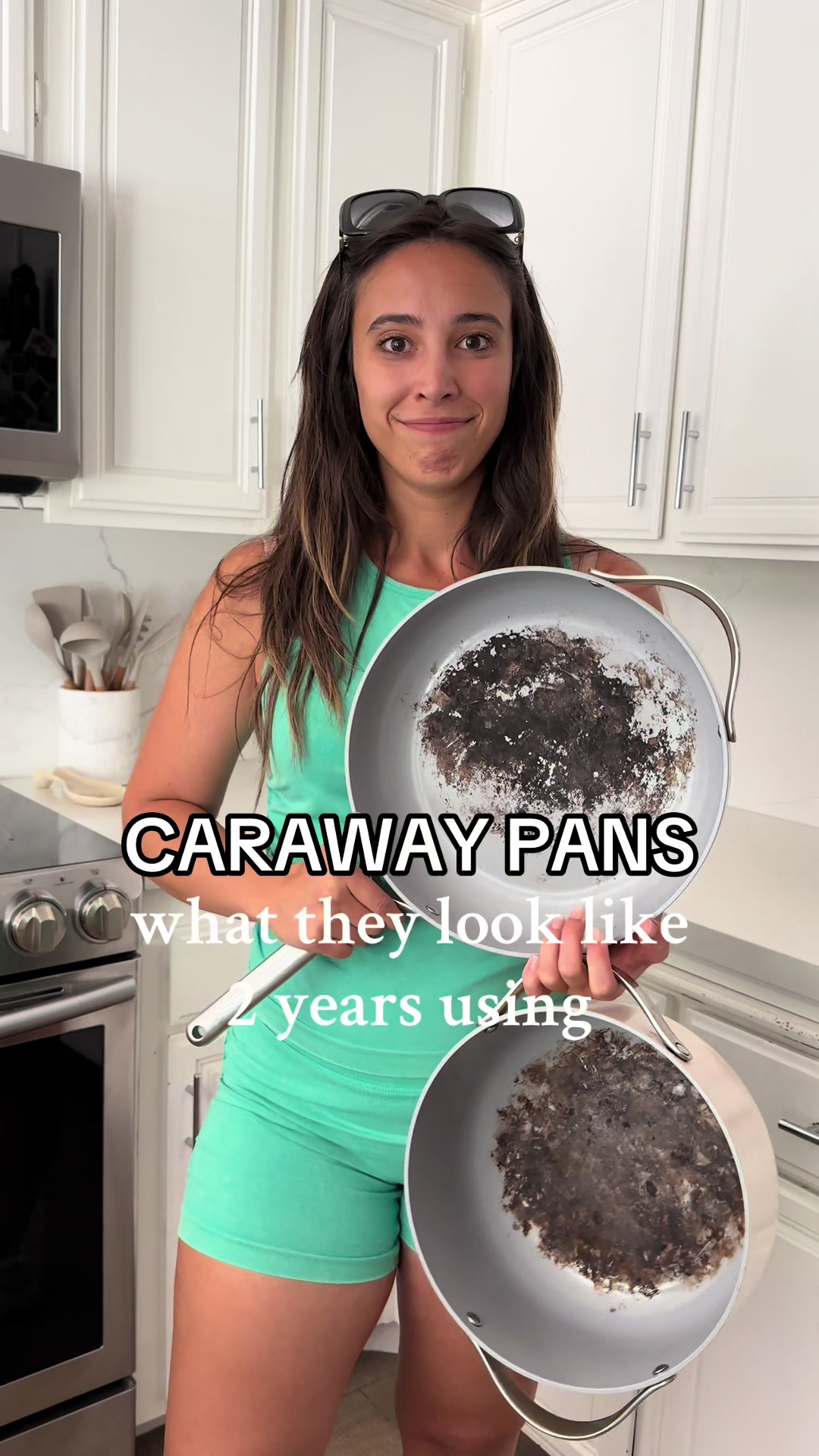
- "I've been using Caraway pans for two years." A woman in a green top and shorts holds two dirty pans, one in each hand, facing the camera. The pans have dark, burnt residue on their cooking surfaces.
- Audience
- Home cooks, particularly those who have invested in Caraway pans or are considering them, and those who struggle with pan maintenance. The mention of a 'TikTok hack' suggests a younger, social media-savvy audience.
Why it works. Pairs a long-ownership claim with honest wear and tear, a durability-transparency move for buyers worried pans won't hold up.
Visual demonstration of product failure at 0:00-0:03, showing two pans with significant burnt-on residue, accompanied by the on-screen text "CARAWAY PANS what they look like 2 years using". Film your product after real heavy use and state the exact duration on camera before showing the wear.
- Hook
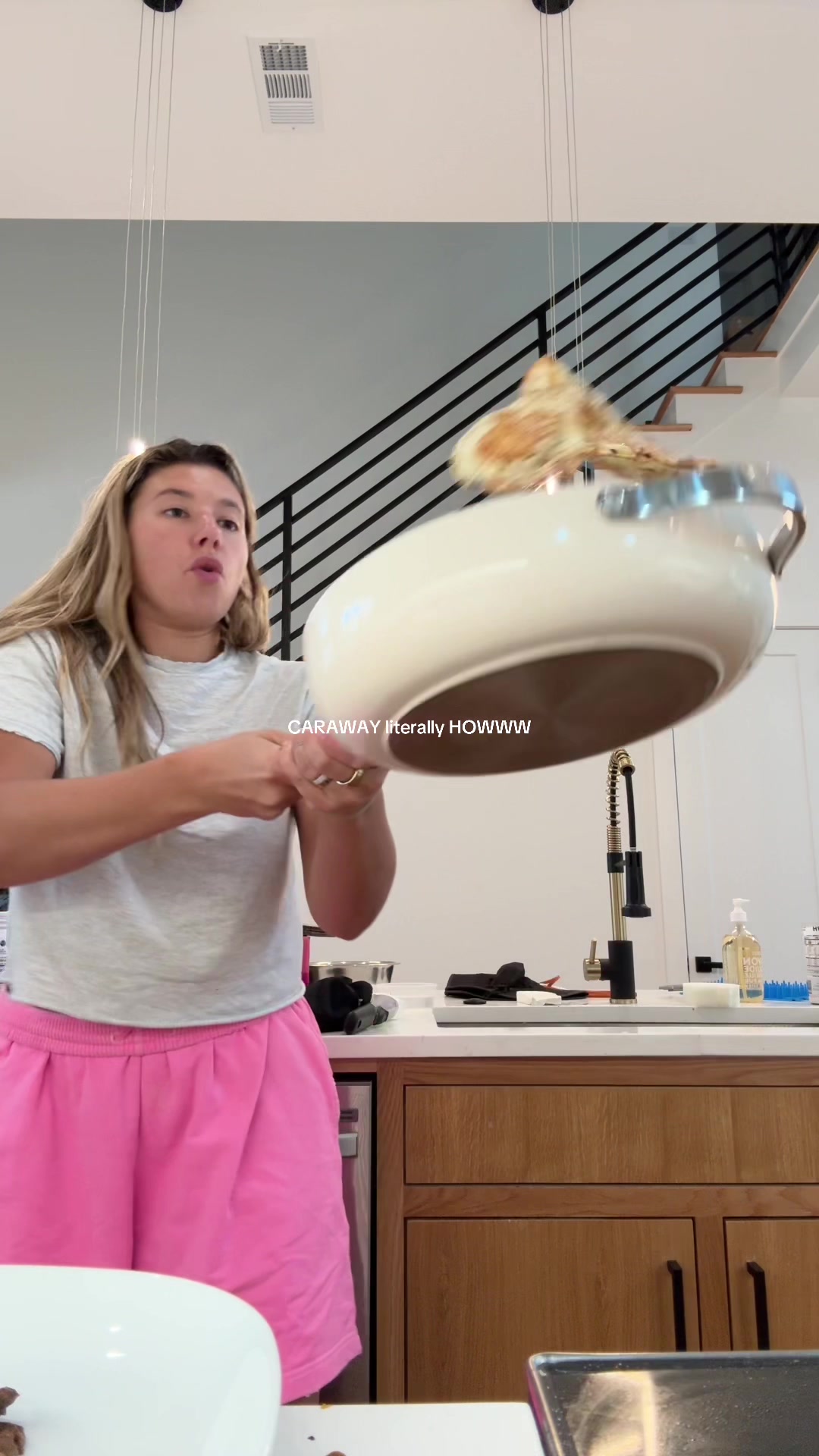
- 0:00-0:03, a woman in a grey t-shirt and pink shorts is in a kitchen, holding a frying pan and flipping something in it. She says, "Hey Caraway, Caraway, look."
- Audience
- People who cook at home, especially those concerned about non-toxic cookware and kitchen organization, indicated by the focus on 'non-toxic' and the organizational accessories.
Why it works. The direct brand callout while cooking turns a routine flip into a mini performance for the brand, pulling in viewers who want to see the outcome.
Problem-solution demonstration with an exaggerated reaction (0:03-0:09, "I don't know what type of crack you've put in your damn non-stick pans, but they're unbelievable.") Address your brand by name on camera mid-demo, so the clip reads as a live report back to the company rather than a scripted pitch.
product demo
- Hook
- A white kitchen cabinet with black handles is shown. The right door of the cabinet is open, revealing light brown shelves inside. A hand reaches in and pulls out a wooden drawer.
- Audience
- Individuals interested in home organization, kitchen storage solutions, and maximizing cabinet space. The presence of specific brands like 'FRIGIDAIRE GALLERY', 'Crockpot', 'Nespresso', and 'Caraway' suggests an audience that values specific kitchen appliances and cookware.
Why it works. Opens on a hand pulling a drawer from a cabinet, the first beat of a kitchen storage before-and-after for organization-minded shoppers.
Demonstrates a clear before-and-after of an organized space by starting with an empty drawer and filling it with items, then showing the final organized cabinet (0:00-0:11, 0:19-0:22). Show a 'before' state (even an empty organizer) then the 'after' in use, so the transformation carries the pitch.
- Reach
- 66 upvotes · r/cookware
A community is already discussing this in r/cookware. Show up there authentically and answer the thread before a competitor does.
Who amplifies them
At the macro level, celebrity creator Jessie James Decker runs active Meta video and DCO ads with the hook "When I tell you I had NO idea about ceramic-coated cookware until Caraway. It makes everything so easy because it's non-stick, and made without PFAS." Lola Ngô runs a testimonial-style DCO ad ("Caraway completely changed my home cooking routine!"). @veganmichele serves as an embedded YouTube collaborator, appearing directly on the CarawayHome channel across multiple recent videos.
The structural engine is the 3,500+ creator ambassador program. Named ambassadors with affiliate codes visible in the evidence: @lrbeats (code LINDS10), Erin at @welpr (code WELPR, negotiated to 15% off), Mary Ellen the Diabetes Dietitian (code MARYELLEN10), and @chefbridgetmaria (code chefbridgetmaria10). The broader tag cohort includes @SierraDallas, @TiannaRobillard, @peggygou, @Marisol, @tanya, @AnnaDaniBrooks, @jung_sanam, @ozgegwaltney, @kellie_atkinson, @lilyacreates, @sweetadjeley, and others across TikTok and Instagram.
Reddit presence is organic, not seeded. The r/cookware subreddit has a pinned mod note grouping Caraway alongside HexClad and Our Place as "heavily marketed brands" that generate excessive questions, which reflects awareness saturation more than community advocacy.
06 Organic & video
The organic content engine: the videos, creator posts, and community presence earning attention without paid spend.
Caraway's YouTube library is anchored by three evergreen brand films. "Meet Caraway" has 5.2M views, "Meet the Bakeware Set" 2M views, and "Meet the Cookware Set" 1.2M views, all under 35 seconds and polished enough to function as paid creative. Recent uploads (2025-2026) shift toward creator collaboration and persona-driven formats: @veganmichele appears in at least four videos covering microplastic-free kitchen walkthroughs, glass storage unboxing, and non-stick comparisons, with view counts in the low hundreds. A "Meet Rachel / Meet Suzanne / Meet Alicia" mom-character series and "Through the Chaos of Motherhood, She Always Has Caraway" (501 views) represent the current persona bet: anchoring the brand in the identity of the health-conscious, time-pressed home cook.
Read the full breakdown+2▾
On TikTok, the standout creator post is @SierraDallas's "what my caraway pans look like after using them for 2 years!" at 518K engagement, a durability check that hits the exact moment of buyer hesitation before a premium purchase. @TiannaRobillard's simpler "@Caraway Home im in love with you ok" reached 149K engagement with zero script. On Instagram, @kellie_atkinson's kitchen organization reveal (marked #gifted) reached 27K engagement. The pattern across high-performing posts: unscripted durability checks and aesthetic organization reveals consistently outperform scripted reviews, and the #CarawayPartner and #carawayambassador tags signal a tracked, structured affiliate layer behind the creator activity.
On X, @CarawayHome posts about new colors, limited editions, and retail launches with most posts under 20 likes, confirming X is not a meaningful acquisition channel.
07 Affiliate & partners
How the brand turns creators and partners into a tracked, variable-cost acquisition channel, and how the program is structured.
Caraway operates a tiered ambassador and affiliate program with individual tracking codes per creator, visible on a platform using the rstr.co affiliate link domain. Discount depth varies by tier: standard ambassadors offer 10% (MARYELLEN10), while higher-performing creators negotiate better rates (WELPR delivers 15%). The program is structured to seed early: Jordan Nathan described approaching creators at 5,000 followers when they are affordable and eager, building loyalty before those creators grow expensive (source). The affiliate channel accounting for 10.8% of total monthly visits confirms this program operates at real scale.
Read the full breakdown+2▾
The per-creator code structure lets Caraway track revenue attribution by individual ambassador, making the program self-optimizing: codes that convert earn better terms, codes that do not can be cut without friction.
No TikTok Shop affiliate sellers are identifiable in the scraped evidence, though TikTok creator volume through the standard ambassador channel is high.
08 In their own words
Pulled from interviews and community sessions. The quotes are the angle; the takeaway is what to do with it.
Cooking up Success ft. Jordan Nathan ↗Chew On This Podcast - Digestible DTC Content · 41k views · 47 min▶ Listen“we built uh I think it was 100 to 150,000 person wait list prior to launch and basically what we did to build that list was uh we were doing a bunch of giveaways with other brands where we'd get five other brands we put up a landing page uh we typically were the host and contributing cash because we didn't have products at that point and essentially getting every brand to blast out the giveaway to Their audience and email list and with the opin everyone gets the shared kind of email list”
Expand
Jordan built Caraway by sequentially stacking channels rather than launching everything at once: a cross-brand giveaway waitlist pre-launch, a coordinated 100-200 influencer blitz at launch, then one new paid channel every 3-6 months. He deliberately avoided food influencers and targeted home/design/lifestyle creators where cookware competitors weren't present, and only launched Amazon in March 2022 after discovering 40,000 monthly brand searches, treating it as demand capture with higher contribution margins than DTC.
“I believe within the first launch week we had about 100 or 200 influencers post and it created this really nice halo effect paired with really strong PR talking about the brand”
“we took a really methodical approach of launching basically one channel every 3 to six months scaling it making sure we saw the impact before adding on a new channel”
“we specially avoided um food influencers for the first couple years we focus more on home design lifestyle um influencers who are really into materials parents um we're now just kind of making our way into the food World um but we really found our Niche by focusing on audiences that some of the other brands were ignoring”
“we found out that about 40 I think it was 40,000 people a month were searching for carway...Amazon actually had better margins for us than our D Toc business particularly because you don't have to spend the same amount of AD spend and contribution margin um would be higher at the end of the day”
Run cross-brand giveaways pre-launch to build a waitlist fast: find 4-5 complementary brands, host a shared landing page, contribute cash (not product you don't have yet), have every brand email their list, and all participants share the opt-in.
Coordinate a launch-week influencer blitz of 100+ posts simultaneously — volume creates a halo effect that compounds with PR coverage and makes the brand feel everywhere at once.
Add one new marketing channel every 3-6 months, fully scaling and measuring each before introducing the next — this isolates what's actually driving growth instead of launching many channels and guessing.
Identify the audience segment your category competitors are ignoring and own it: Caraway skipped food creators (owned by HexClad et al.) and built affiliate/gifting relationships with home, design, and lifestyle influencers instead.
Delay Amazon until brand-search volume proves latent demand exists; then launch with prices 10% higher to test cannibalization before normalizing, and use Amazon's margins (no ad spend required to capture brand searchers) to subsidize DTC spend.
Why Jordan Nathan Launched Caraway to Reinvent the Kitchen ↗Sam Mahmood · 9.9k views · 36 min▶ View source“I probably pitched a thousand investors... it's probably doing 10 pitches a day. And as those came in I'd maybe raise a few hundred k at a time, I take that cash and put it into the R&D and brand.”
Expand
Jordan Nathan built Caraway through a grind of ~1,000 angel pitches to fund early R&D, then pre-sold the retail channel by bringing buyers into the design process before the product existed. He positioned the brand around three gaps he spotted by watching competitors fail — safety, ease, and high design — and rolled out retail deliberately small (10% of store count first) to protect the brand while he scaled.
“We started talking with retailers actually before we even had the product designed... we brought them along the journey of the design of the brand and so by the time we launched they felt like they were kind of a part of the story and the building.”
“We never ask for the full store count. We're typically saying, 'All right, let's go into 10% of stores. Let's test the assortment. Let's make sure this goes successfully for both partners.' And we can always scale up.”
“It was always really important to us to be an omni channel brand. So while we started direct to consumer and then launched Amazon I think two years after launch, retail was always a big piece of the strategy — if the goal is to really create an alternative in the market for PAS, we literally need to go replace those items on shelves.”
“There were maybe six to eight other brands that had actually entered the market before us... watching that and seeing who was successful and who wasn't, we were able to really craft the brand around safety and ease and high design, which we felt like were kind of the missing components within the market.”
Run investor pitches like a sales funnel at volume: Jordan targeted angels with $10–25k checks and did ~10 pitches a day for 6–10 months, recycling each close into the next stage of product development rather than waiting for a large lead.
Warm up retail buyers before you have a product: bring them into the design process so they feel co-authorship by launch day — it converts cold outreach into year-one shelf placements at Crate & Barrel and Zola.
Test into retail at 10% of a chain's doors first, prove velocity, then negotiate expansion — never ask for the full store count upfront, which protects you from operationally overextending and keeps the buyer a motivated partner.
Let competitors move first, then map the white space: Jordan spent 6–18 months watching six-to-eight rivals enter ceramic cookware before locking in Caraway's positioning around the gaps they all missed (safety + ease + design).
Build psychographic personas, not demographic buckets: identify what other brands your buyer shops (Jordan's example: Lululemon, Audi) and what they value, then build USPs wide enough that multiple entry points exist — so different messages convert different slices of the same persona.
E:5 Caraway CEO on Manufacturing Terms, and Building a Brand Investors Want to Acquire ↗Making Cents with Drew Fallon · 7.1k views · 41 min▶ View source“I like to think about like our design as our marketing vehicle, and you know, helps us maybe arbitrage marketing spend.”
Expand
Jordan Nathan built Caraway by treating design as a marketing vehicle to arbitrage ad spend, launching one channel at a time to actually measure what was driving growth, and negotiating favorable payment terms with factories from the very first email so inventory cash converted 2-3x before payment was due. He front-loaded launch with a 150k waitlist built through cross-brand giveaways, 20-30 press placements, and 100 influencers on day one, then maintained momentum through a 24-month marketing calendar anchored on constant newness (collabs, color drops, new products). Profitability on the first purchase — enforced by a hard ROAS floor — was the financial discipline that let everything else compound.
“We've been very thoughtful with only launching one ad channel at a time. What that's enabled us to do is really one, make sure when we launch a channel, it's successful and then two, measure what that channel's actually doing to the business.”
“I credit a lot of our growth to our payment terms with our factories. What that's enabled us to really do is really have an unlimited amount of cash to put into marketing where maybe we're turning it two or three times before we have to pay for the inventory.”
“The best way to do it is when you're kicking off a project, you have to ask for it at the very start in like your first email discussion with a factory. If you get further along in R&D, they've got the leverage.”
“We always ensured we had something new happening to bring awareness to the brand, whether it was a collaboration, color drop, new product, just constant newness has really brought just consistent eyeballs to the brand.”
Build your waitlist before launch using cross-brand giveaway platforms (e.g. DojoMojo): pool email audiences with complementary brands, run a $3k+ prize giveaway, collect shared entrants. Quality is low but volume creates a launchpad.
Negotiate payment terms in your very first factory email, before R&D begins — make it a factory selection filter, not an afterthought. Propose a stepped schedule tied to PO milestones (after PO 3, PO 5, PO 10) so the ask feels earned.
Launch one ad channel at a time. Only expand to the next after the current one is proven and its contribution is measurable in isolation — resist the temptation to run everything at once.
Set a hard ROAS floor that makes the first purchase profitable, then let the team spend as much as they want above it. This keeps growth self-funding without chasing LTV that may never materialize.
Plan a 24-month marketing calendar and schedule constant newness (color drops, collabs, new SKUs) so there is always a reason for press and algorithms to resurface the brand — not just at hero launch moments.
Is Your Cookware Making You Sick? The Truth About Toxins in the Kitchen w/ Jordan Nathan of Caraway ↗Mari Llewellyn · 1.6k views · 24 min▶ View source“ceramic had been on the market for about 10 years before we launched and kind of the gap that we saw that was brands who were selling it were promoting it as eco-friendly but nobody was talking about the non-toxic properties”
Expand
Jordan Nathan identified a gap where ceramic cookware had existed for a decade but no brand was marketing the non-toxic angle, only the eco-friendly one. Caraway's core GTM move was leading with aesthetic design as the 'marketing vehicle' to sell non-toxic, making the product something people wanted to leave out and talk about. He built distribution across DTC, Amazon, and retail (Target, Crate & Barrel, Container Store) while riding consumer education through podcasts and the broader wellness wave.
“I always come back to like I am the caraway consumer and like what would I want”
“if you create something that people want to leave out and buy for the aesthetic and it happens to also be safe to use, we saw that as a big gap in the market”
“we really wanted to pair it back and put that extra cost into improving the materials that you're cooking with”
“you want to focus on putting out the best product and you know I think starting fresh is a great place where you can develop your brand and really educate the consumer on why the price is what it is”
Reframe an existing category on a dimension incumbents ignore: ceramic had been around 10 years but no one owned the 'non-toxic' narrative — Caraway took that unclaimed angle.
Make the product the marketing vehicle: designing for visual appeal (leave-it-on-the-counter aesthetics, signature colors) drives organic word-of-mouth and gifting without paid acquisition.
Simplify the SKU to move cost upstream into materials: stripping 30-piece sets down to 4 essential pieces let Caraway justify a premium price and signal intentionality to the buyer.
Solve the adjacent friction (storage) as a bundled differentiator: the magnetic pan rack/linen organizer addresses a real household pain point and extends perceived product value.
Use founder-as-customer positioning ('I am the Caraway consumer') and podcast education to build trust in a category where the purchase decision is driven by health anxiety and requires explanation.
09 The playbook
The channels are not separate. They are one system where each stage feeds the next. Here is the read, then the plays to run tomorrow.
The inferred playbook
Caraway's acquisition engine is a flywheel where visual product distinctiveness generates creator content, creator content builds branded search demand, and branded search is captured by paid ads and organic rankings, each stage funding the next.
Jordan Nathan built a 150K waitlist through cross-brand giveaways before launch, then coordinated a simultaneous 100-200 influencer blitz alongside 20-30 press placements on day one, establishing branded search volume before any paid campaign ran (source). He then added one new paid channel every 3-6 months to isolate attribution and measure what was actually driving growth, deliberately avoiding food influencers and targeting home/design/lifestyle creators where competitors were absent (source).
The product sits on the stovetop daily, staying visible and prompting organic conversation. Jordan Nathan positioned aesthetic distinctiveness as the "marketing vehicle" for the non-toxic message, a pairing that makes both the design and the safety mission more memorable than either alone (source).
Dig deeper+2▾
3,500+ ambassadors with individual codes create a variable-cost creator layer: commission is incurred only on confirmed revenue, each creator post adds to branded search volume, and the affiliate traffic share at this scale compresses future paid search CPCs by building organic demand alongside them.
CAC by channel, churn, and retention mechanics are not in public data. Jordan Nathan mentioned cohort-based lifecycle flows and a VIP community investment for repeat purchase (source), but those specifics are not public. Revenue from retail partners (Crate & Barrel, Container Store, Macy's, Amazon) is also not broken out in available sources.
Seed micro-influencers at 5,000 followers, not 500,000.
Jordan Nathan's ambassador playbook is explicit: approach creators at 5,000 followers when they are affordable and hungry for partnerships, and build the relationship before they grow expensive. Right away: identify five creators in your category with 3,000-10,000 followers posting about the problem your product solves, DM each with a gifted unit and a custom affiliate code. The investment is product cost plus shipping. If any of those creators reach six-figure audiences over two years, the relationship is already locked in at micro-influencer economics.
Test the "us vs. the category incumbent" ad format.
Caraway is testing a split creative: "No PFAS. No lobbying. Nothing to hide." on a neutral background beside "BIG COOKWARE" in contrasting corporate typography. The mechanism: naming an external enemy puts the buyer on the right side of a real regulatory or industry conflict and makes the brand feel like a protagonist rather than a vendor. Adapt this if you have genuine, provable differentiation against an incumbent's practice (a chemical they use, a fee they charge, a claim they cannot make). Caveat: this frame only works when the underlying conflict is real and substantiated. A manufactured contrast without genuine differentiation will read as posturing. Start with a $300-$500 test against your current best-performing awareness ad before scaling.
Build a care-content page and bid on the question in Google Search.
Two of Caraway's longest-running Google ads drive to care-content pages: "How To Clean Ceramic Pans: 6 Pro Tips | Caraway" and "Safe Pans: Which Cookware Can You Put In the Oven? | Caraway," both live since at least May 2023. These intercept in-category buyers actively researching a specific question, one research session away from a purchase decision. Right away: identify the single most-searched care or safety question in your product category, build a focused 600-word page answering it, and bid on the exact question phrase in Google Search. Conversion intent on these queries is high because the searcher is already invested in the category.
Turn a customer's 12-month real-use video into a paid creative.
The highest-engagement organic creator post in the evidence is @SierraDallas's "what my caraway pans look like after using them for 2 years!" at 518K TikTok engagement. The format works because it answers the top objection for any premium product ("will it last?") with unscripted evidence. Right away: reach out to five customers or ambassadors who have used your product for 12 or more months and ask for an unscripted one-minute video showing the product in its current real-world state and saying whether they would buy again. Run the most honest result as a paid creative with the hook "I've been using this for [X months]." Caveat: only run this if your product holds up. Caraway's mixed Reddit durability reviews show that real-use footage cuts both ways.
Build a registry-occasion creative and target it to life-transition audiences on Meta.
A Caraway proven-winner Meta ad uses the hook "What we wish we registered for" with a wedding-ring visual and cream cookware, and a June 2026 video ad says "Starting a new chapter? Make sure your kitchen's ready too. Add Caraway cookware to your registry." The registry frame removes the "I can't justify spending this on myself" objection by routing the purchase through a gift occasion. If your product sits in the $100-$600 range that makes sense as a registry item, build a creative explicitly naming the life event ("your wedding registry," "your first home"), pair it with a set or collection visual, and target the wedding-planning or new-mover audience in Meta Ads Manager. This is distinct from a discount ad: the occasion justifies the premium so you do not need to cut the price.
You just read how Caraway does it. Tomorrow it is someone else.
Every morning we take one company that is actually growing and break down where its customers come from: the ads still running after a year, the channel doing the real work, and the play you can run this week.
Systemaic · directional intelligence. Traffic, spend, and reach figures are SimilarWeb-style estimates and qualitative reads of public data, not audited numbers. Built on real public receipts.
// teardowns with a similar GTM motion
sources & receipts (12)
Live ad libraries: meta ad library · google ad library
Launch archives: Hacker News: Out with the Caraway, in with the Ginger: 50 Years of Americ · Hacker News: Decoding Perplexing TypeScript by Daria Caraway [video] · Hacker News: Why the CEO of Caraway Sends Himself 20 Emails a Day · Hacker News: Caraway Garners $16.75M in Series A Financing
Founder interviews: How Caraway is Navigating Economic Uncertainty · Cooking up Success ft. Jordan Nathan · Why Jordan Nathan Launched Caraway to Reinvent the Kitchen · E:5 Caraway CEO on Manufacturing Terms, and Building a Brand Investors · Is Your Cookware Making You Sick? The Truth About Toxins in the Kitche · Ceramic v. Teflon Cookware - Which is Better? Answered by Caraway
Traffic, spend, and revenue figures are estimates as noted in the report; the links above are the primary public artifacts.