- 01Write your own milestone announcement
- 02Sync paid search to your announcement, not months later
- 03Bid into a named competitor's brand search
- 04Put a visible credit on every customer-facing surface you power
01 Snapshot
The one-glance read on who they are and how they grow. Each point is verifiable from the receipts above.
POS, payments, and back-office software for independent liquor and spirits retailers, backed by 500%+ YoY growth and $1B+ in processed payment volume disclosed at its Series A (June 2026).
Founder-led and launch-led, with a lean, founder-run paid search layer underneath.
~22,000 estimated monthly visits (+539% over the last 3 months), $30M total raised ($10M seed in Sept/Oct 2025, $20M Series A in June 2026), and 16 active Google ads as of July 11, 2026.
Announcing the Series A, the founder wrote that Scotch set out "to fix something that's been broken for 30 years: the technology running America's 40,000+ independent liquor stores."
A new image-format Google ad went live June 16, 2026 and had run 25 days as of the observation date, the newest live test alongside 15 longer-running proven winners.
Scotch's growth loop runs through funding news rather than a launch platform: the founder's own product-launch and Series A tweets drove more visible reach than any other channel in the evidence, with paid search switched on within days of the launch tweet to catch the resulting demand.
02 How it unfolded
The order the channels came online. Sequence is strategy: what they did first, and what they layered on once demand existed.
03 Traffic & channel mix
Estimated demand, the channel split behind it, and the keywords and referrers doing the work. Directional modeling, not audited analytics.
Traffic sources
Top search keywords
| Keyword | Volume | Weight | CPC |
|---|---|---|---|
| scotch pos | 1.5k | - | |
| scotch ai | 170 | - | |
| powered by scotch pos shopify whiskey | 160 | - | |
| bottlepos | 1.7k | $13.37 | |
| scotch inc | 100 | - |
Scotch pulls an estimated ~22,000 monthly visits, up +539% over the last 3 months, a steep curve off a small base that lines up with the founder's funding-news spikes covered below.
Referrals lead the channel mix at 31%, direct traffic follows at 26.1%, and organic search contributes 16.3%; paid search (10.3%), email (8.1%), and organic social (8.1%) round out the rest. The referral lead is the most interesting number in the mix for a young vertical SaaS: it likely reflects POS-comparison and reseller sites common in this category, though the specific referring domains aren't in the evidence.
Their keyword footprint reveals a named rival: "bottlepos" pulls 1,710 monthly searches across the web, more than their own brand term "scotch pos" (1,470/mo), meaning Scotch operates in a category where a competitor already commands more branded search demand than they do. "scotch ai" (170/mo) suggests some early demand forming around an AI angle to the product.
04 Organic content
The specific pages earning their organic search traffic, and the pattern behind why they rank. Adapt the format, not the topic.
Scotch's organic wedge runs through three vertical operational-guide pages rather than broad POS content: a liquor-store inventory management guide, the homepage, and a profit-margins post. The pattern is narrow, long-tail targeting: they rank #2-#3 for operator pain-point phrases like "liquor store inventory management" and "liquor store inventory management software," but sit further back at #9 for the broader "pos for liquor store" category term. That split is a classic underserved-vertical SEO play: low competition on specific operator questions lets a small blog claim top positions long before the domain has the authority to win the broad category term outright.
Top pages by organic traffic
05 Channel map
Not traffic share. How much weight the growth system actually puts on each channel, with a one-line read on the role it plays.
What drove growth
06 The motions doing the work
For founder-led SaaS the breakdown shifts from ads to traction: where the first users came from, how the founder grows it in the open, and the compounding organic surface.
Scotch's public debut ran through the founder's own X account rather than a launch-platform event, with paid search switched on days later to catch the wave.
Nearly two months before Scotch's January 2024 incorporation, the founder posted in r/POS asking for feedback on "POS Systems for Liquor Stores," drawing 13 replies, early direct-to-buyer research before the product or company formally existed.
On October 13, 2025, the founder announced "the public launch of @ScotchPOS," framing the pitch around a "$250B liquor industry" unchanged "since prohibition was repealed." The post reached roughly 15,200 views on a 376-follower account.
Dig deeper+2▾
The oldest active Google ad began running October 23, 2025, just ten days after the launch tweet, showing paid search launched in lockstep with the public announcement rather than as a separately scaled program.
The June 4, 2026 tweet announcing the $20M Series A (VMG Partners, with First Round, Lerer Hippeau, and Toba Capital participating) reached roughly 70,000 views, more than 4x the launch tweet's reach, making the funding round the larger amplification event of the two.
Jake Bolling's personal X account, not a separate Scotch brand handle, is the entire evidenced public voice of the company.
Every Scotch-specific post in the evidence runs through Jake Bolling's personal handle rather than a company account, concentrating distribution in the founder's own name and network.
Bolling previously co-founded Skupos with Kevin Hodges, now Scotch's co-founder and CRO, before Skupos was acquired by PDI Technologies in 2023; that exit sits behind the account as bio credibility rather than a growth tactic Scotch itself is running.
Dig deeper+2▾
The two evidenced Scotch posts are both major milestones, the product launch and the Series A, not routine behind-the-scenes or lessons-learned content, suggesting the account is used for press-worthy spikes rather than a steady build-in-public drumbeat.
Outside X, the founder's only evidenced social move is the single r/POS thread noted above, a research post rather than an ongoing community presence.
The SEO motion is a narrow vertical wedge under a lean, founder-run paid search layer, well short of a scaled content operation.
Search organic makes up 16.3% of the traffic mix, behind referrals and direct, and the ranking pages above are the entire visible content engine; there's no evidence of a broader library of comparison, integration, or template pages beyond the operator-guide format already covered.
The keyword "powered by scotch pos shopify whiskey" carrying real search volume suggests customer-facing Shopify storefronts display a visible Scotch credit or badge, a mechanic where every new retailer's own site becomes a small discovery surface for the next one.
Dig deeper+1▾
All 16 active Google ads as of the observation date are attributed to co-founder Kevin Hodges as advertiser rather than an agency or ads team, and the longest-running creative has been live roughly 261 days. The strongest creative, "Never enter an invoice again," leads with the actual daily pain of manual distributor invoicing, while another proven winner leans on a cost-savings curiosity hook built around annual savings; both route to a demo subdomain rather than a self-serve signup, and the "bottlepos" keyword volume above suggests some of this spend is competitor conquesting rather than pure demand generation.
07 Paid ads
This founder-led SaaS also runs paid acquisition. Here are the live ads doing the work, each with the X-ray and a play you can adapt.
- Running
- 261 days (longevity = it's converting)
- Hook
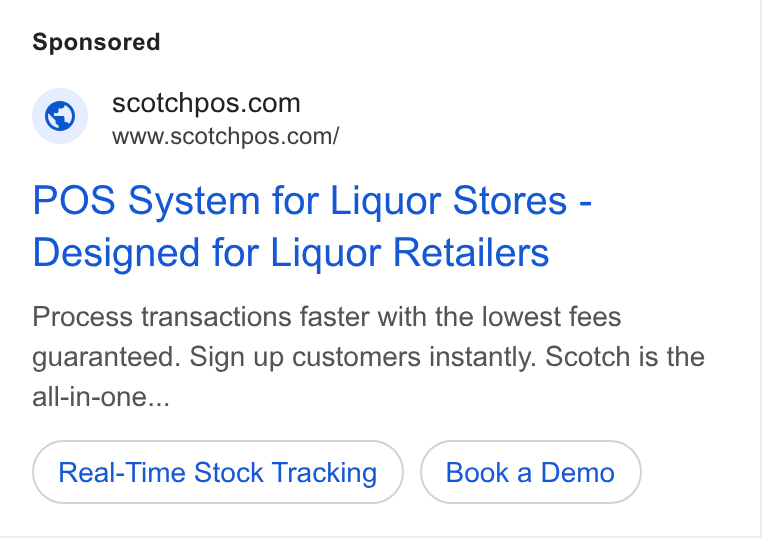
- Sponsored scotchpos.com www.scotchpos.com/ POS System for Liquor Stores - Designed for Liquor Retailers
- CTA / offer
- Book a Demo
- Audience
- The headline "POS System for Liquor Stores - Designed for Liquor Retailers" explicitly targets businesses in the liquor retail industry.
Why it works. Mirrors the searcher's own query back at them so the ad reads as the answer to the specific thing they searched, not a generic pitch.
Specific audience targeting in headline: "POS System for Liquor Stores - Designed for Liquor Retailers" Write your search ad headline using the literal phrase your buyer types into Google, including the industry name twice if it fits naturally.
- Running
- 113 days (longevity = it's converting)
- Hook
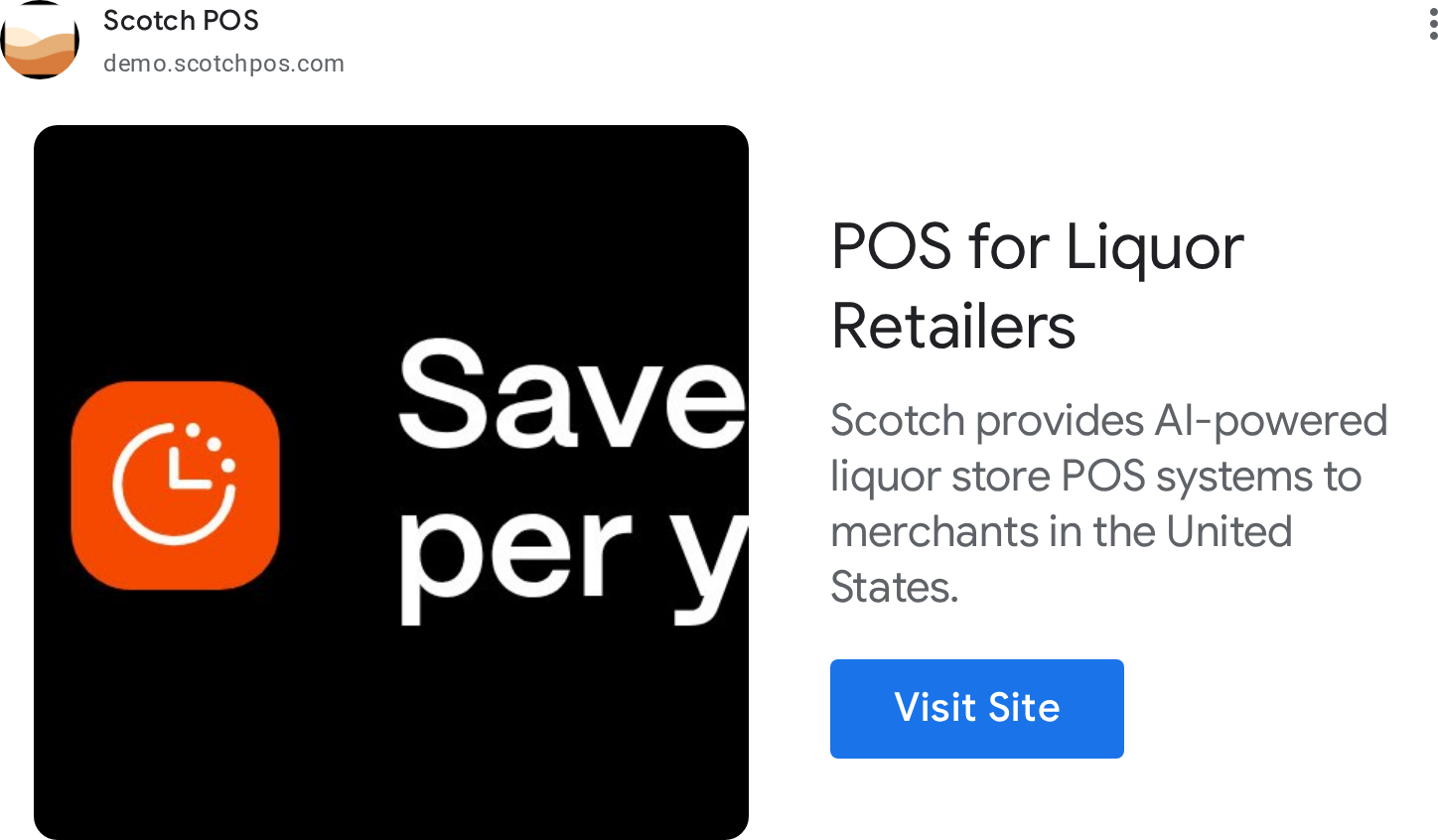
- The top left of the image shows a circular logo with wavy brown and beige shapes, next to the text "Scotch POS" and "demo.scotchpos.com". Below this, a large black rectangle with rounded corners shows an orange square icon with a white clock symbol, and partially visible white text that reads "Save per y".
- CTA / offer
- Visit Site
- Audience
- Liquor store owners/managers in the United States, indicated by "POS for Liquor Retailers" and "liquor store POS systems to merchants in the United States."
Why it works. Pairs a clock icon with a half visible Save per year claim, so liquor retailers have to click through to learn the exact savings promised.
Prominent, partially obscured benefit statement: The large black rectangle on the left features a partially visible text "Save per y" (on-screen text: "Save", "per y"). Crop your top annual savings stat mid sentence in a display ad so the reader has to click to see the full number.
- Running
- 108 days (longevity = it's converting)
- Hook
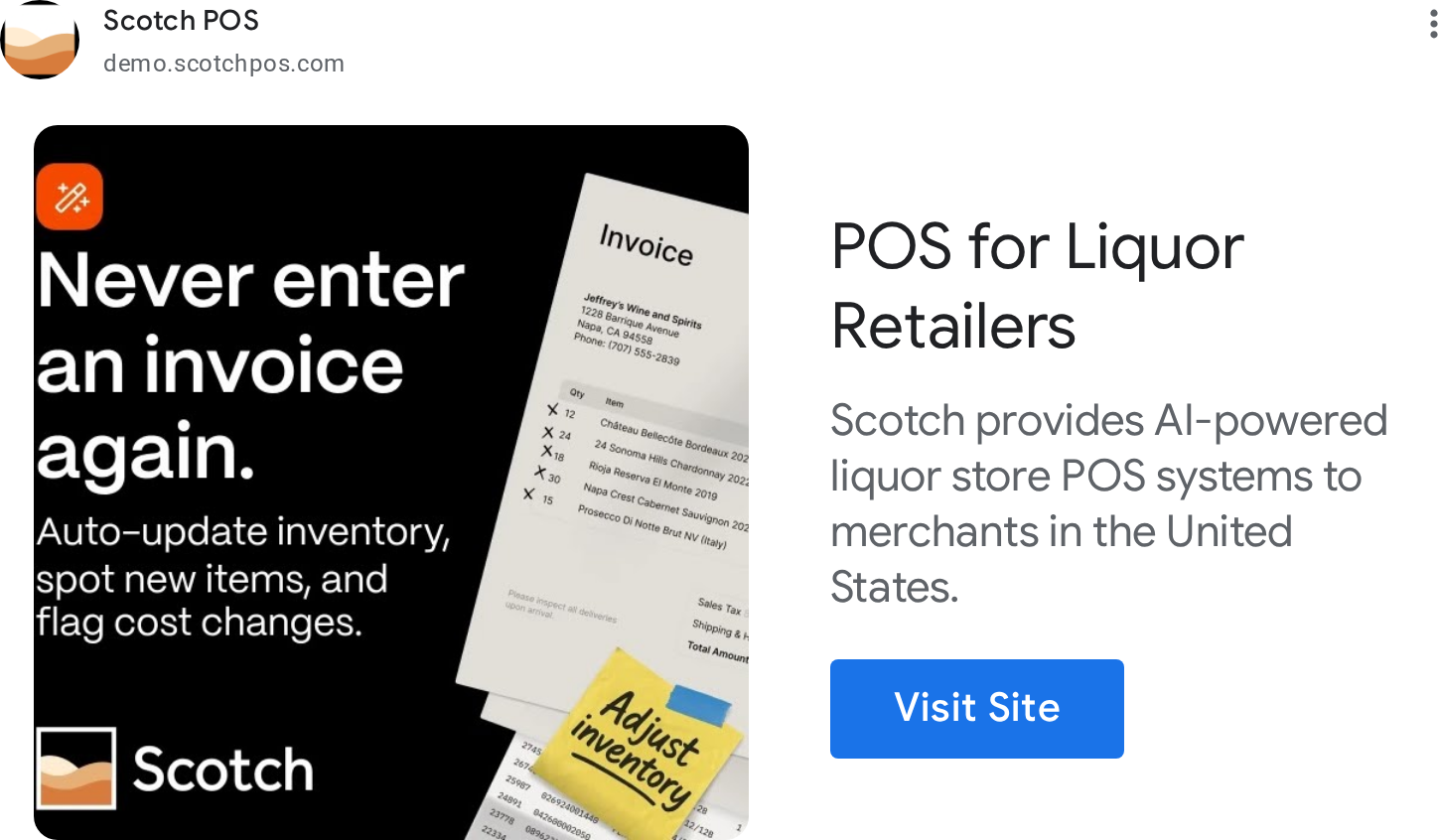
- "Never enter an invoice again." on a black background with an orange icon of a pencil editing a document.
- CTA / offer
- Visit Site
- Audience
- Liquor store owners/managers in the United States, indicated by "POS for Liquor Retailers" and "merchants in the United States."
Why it works. Targets the single most tedious manual task liquor retailers do daily, invoice entry, and promises its complete removal rather than improvement.
Headline directly addressing a pain point: "Never enter an invoice again." Pick the one recurring manual task your customer complains about most and write your headline as a flat promise to eliminate it, not automate it.
08 The playbook
The channels are not separate. They are one system where each stage feeds the next. Here is the read, then the plays to run tomorrow.
The inferred playbook
Attention starts on the founder's own funding and launch news, gets caught by a founder-run paid search layer, and compounds slowly through a narrow SEO wedge, with no evidenced community or creator layer underneath.
The launch and Series A tweets covered above are the largest visible top-of-funnel spikes in the evidence, meaning growth attention depends on having news to announce.
Ads go live within days of a public moment and stay on, turning the demand a funding story generates into captured search traffic rather than letting a competitor win it.
Dig deeper+4▾
The blog and storefront-badge mechanic compound quietly but remain small relative to referral and direct traffic, a long-horizon bet rather than a current driver.
No evidenced brand social presence, creator or UGC layer, or ongoing community channel exists beyond one pre-launch Reddit thread, so the loop reloads on funding cycles more than a self-sustaining organic engine.
No public MRR figure exists for Scotch; grounded in the disclosed $1B+ processed payment volume, 500%+ YoY growth, and a roughly $200/month third-party-reported price point, an order-of-magnitude estimate lands in the mid six figures of monthly recurring revenue, an estimate rather than a confirmed number.
free-to-paid conversion, churn, CAC, and confirmed pricing (only third-party-reported figures exist).
Write your own milestone announcement
The proofScotch's founder-written launch and funding tweets reached roughly 15,200 and 70,000 views on a 376-follower account, well beyond what the follower count alone predicts, through investor and partner amplification.
The adaptationWhen you hit a real milestone (a launch, a funding close, a notable customer win), write it yourself in first person with one concrete number and tag any backers, partners, or notable customers by name so their own networks reshare it. The mechanism: a specific number plus a named tag gives other accounts a reason to reshare, which is what turns a small following into outsized reach. First step: draft the announcement now and post it from your personal account, not a brand account.
Cost: $0 · Time to signal: days · Works pre-PMF: yes.
Sync paid search to your announcement, not months later
The proofScotch's oldest active Google ad started ten days after its public launch tweet, timing paid capture to the earned-attention spike instead of running it as a separate program.
The adaptationSchedule a small Google Search campaign on your own product name and top category term to go live within a week of any public launch or press moment, so paid, not a competitor, catches the branded-search spike your own announcement causes. First step: set a modest daily budget on your brand name and one category keyword, timed to your next public moment.
Cost: under $500 · Time to signal: days · Works pre-PMF: yes.
Bid into a named competitor's brand search
The proofScotch's keyword footprint shows "bottlepos" pulling more monthly search volume than its own brand term, evidence of conquesting a competitor's branded demand rather than only building its own.
The adaptationIdentify the one or two competitor names your prospects actually search for, and point a small campaign at a dedicated comparison landing page rather than your homepage. First step: check search volume on your top competitor's name in a keyword tool, and if it's real, write one comparison page before spending anything.
Cost: under $500 · Time to signal: weeks · Works pre-PMF: conditional, only useful once a real incumbent with visible branded search demand exists in your category.
Put a visible credit on every customer-facing surface you power
The proofA search term referencing "powered by Scotch POS" on customer Shopify storefronts suggests Scotch surfaces its own brand on every retailer's public site, turning each new customer into a discovery surface for the next.
The adaptationIf your product touches any customer-facing artifact, a checkout, an invoice, a storefront, or a widget, add a small branded credit or badge linking back to you, so distribution compounds automatically as your customer base grows rather than depending on you to promote each win. First step: audit what your product outputs publicly and add a one-line credit link anywhere one is missing.
Cost: $0 · Time to signal: months, this compounds slowly with customer count rather than producing an immediate spike · Works pre-PMF: yes.
Validate on the one subreddit where your buyer already asks for help
The proofBefore Scotch was even incorporated, its founder posted a direct "feedback wanted" thread in r/POS and drew 13 replies from the exact buyer the product targets.
The adaptationFind the single subreddit or forum where your prospective customer already asks for advice, and post a genuine, non-promotional feedback-seeking thread before you build, using real replies to shape the roadmap. The mechanism: a niche community that already discusses the problem gives you free, targeted product signal that generic user interviews rarely surface. First step: search for the 2-3 communities your buyer already frequents and post one honest thread now.
Cost: $0 · Time to signal: days · Works pre-PMF: yes, and it's most valuable done before building rather than after. Not transferable at an earlier stage: the founder-news flywheel and competitor-conquesting budget both assume a backer network and category traction Scotch already has behind it. A reader with no funding history or existing competitor category should lean on the announcement and subreddit-validation plays first, and treat paid search as something to add once there's an actual public moment worth catching.
You just read how Scotch does it. Tomorrow it is someone else.
Every morning we take one company that is actually growing and break down where its customers come from: the ads still running after a year, the channel doing the real work, and the play you can run this week.
Systemaic · directional intelligence. Traffic, spend, and reach figures are SimilarWeb-style estimates and qualitative reads of public data, not audited numbers. Built on real public receipts.
// teardowns with a similar GTM motion
sources & receipts (7)
Live ad libraries: google ad library
Launch archives: Hacker News: How to take a photo with scotch tape (lensless imaging) [vid · Hacker News: K-means Clustering 86 Single Malt Scotch Whiskies · Hacker News: How Sherry Became the Secret to Great Scotch · Hacker News: The Man Who Invented Scotch Tape · Hacker News: Scotch as a Diet Hack · Hacker News: Scotch tape found to emit x-rays by behaving like a particle
Traffic, spend, and revenue figures are estimates as noted in the report; the links above are the primary public artifacts.