- 01Mirror your paid queries in owned content
- 02Anchor your price against what it replaces
- 03Build a page for one underserved niche inside your broader audience
- 04Tell the plateau story, not just the milestone
01 Snapshot
The one-glance read on who they are and how they grow. Each point is verifiable from the receipts above.
Motion is an AI work-management platform built on auto-scheduling calendars, now expanded into autonomous "AI Employee" agents for sales, marketing, and project workflows, serving individuals, SMBs, and enterprises.
Paid-search-led, with founder build-in-public amplifying major relaunches.
roughly 668,000 estimated monthly visits (-3.1% over the last 3 months) as of 2026-07-12; a Google Ads library built up since 2022, with 19 ads currently active; a $550M valuation on a $60M raise announced September 8, 2025.
Founder Harry Qi recounted that at $15M ARR, YC's Michael Seibel told them there was "no path to $1B ARR" because Motion was just a "very nice to have," a post that pulled 282,097 views.
Motion's ad account leans almost entirely on text search ads, some running for over 1,100 days; its video experiments have not stuck, with a cluster of new video tests in January 2026 each lasting only a single day.
Motion runs the same long-tail topics (ADHD planning, time blocking, family calendars) through both its blog and its paid search account at once, using paid spend to validate content angles and content to sustain the ones that work.
02 How it unfolded
The order the channels came online. Sequence is strategy: what they did first, and what they layered on once demand existed.
03 Traffic & channel mix
Estimated demand, the channel split behind it, and the keywords and referrers doing the work. Directional modeling, not audited analytics.
Traffic sources
Top search keywords
| Keyword | Volume | Weight | CPC |
|---|---|---|---|
| motion | 166k | $0.56 | |
| motion ai | 22k | $1.34 | |
| motion app | 17k | $2.18 | |
| usemotion | 3.7k | $1.25 | |
| motion calendar | 2.2k | $1.72 |
Top referring sites
Closest competitors by audience
Motion draws an estimated 668,000 monthly visits, down 3.1% over the last 3 months. Direct traffic dominates at 59.6%, consistent with a product people navigate to by habit rather than discover fresh each session; Search Organic follows at 19.9%, and Display Ads sit at 6.9%, an unusually large share for a self-serve SaaS and a sign Motion buys awareness inventory, not just search intent. The rest, Search Paid, Social Organic, Gen AI referrals (traffic arriving through AI answer engines like ChatGPT or Perplexity), Email, Referrals, and Social Paid, together total about 13.6%. The brand-heavy keywords "motion" (166,060 searches/month) and "motion ai" (21,740 searches/month) reflect enormous search demand, though "motion" alone is a generic word shared with dance, video, and legal contexts, so that volume is not a clean read on brand awareness. Top referrers include upwork.com, consistent with Motion's freelancer and solo-professional user segment discovering it through marketplace work, alongside gladly.io, an unusual referrer outside the productivity category that likely reflects a backlink or case-study placement rather than organic browsing. Among named competitors, reclaim.ai and akiflow.com are direct AI-scheduling rivals, while zapier.com's presence signals overlap into workflow automation, relevant now that Motion is repositioning around agentic workflows rather than pure calendaring.
04 Organic content
The specific pages earning their organic search traffic, and the pattern behind why they rank. Adapt the format, not the topic.
Motion's top organic pages skew toward "best X" and category-explainer content rather than product pages alone: guides on AI project-management tools, shared family calendar apps, AI personal assistants, and resource-management tools each pull four-figure monthly visits, while the homepage itself captures 35.9% of the site's organic total. The pattern is a roundup/comparison format that ranks Motion inside adjacent buying conversations (family calendars, resource management) instead of only bidding for its own name, and it likely earns traffic because these are searched far more often than "motion ai" itself and carry less competition from bigger incumbents. Motion also holds the #1 position for "usemotion" and "motion calendar" and #2 for "motion" and "motion ai," a strong brand-term lock that most challengers in this space don't have.
Top pages by organic traffic
05 Channel map
Not traffic share. How much weight the growth system actually puts on each channel, with a one-line read on the role it plays.
What drove growth
06 The motions doing the work
For founder-led SaaS the breakdown shifts from ads to traction: where the first users came from, how the founder grows it in the open, and the compounding organic surface.
Motion's real inflection point wasn't a single launch day, it was a public repricing of the company's own growth story around its September 2025 raise.
Motion went through Y Combinator's Winter 2020 batch on a $150K seed, later raising a $13M Series A in October 2022 with angel participation from Sam Altman, Michael Seibel, and Cyrus Mistry, an early Google Calendar product lead, a bench that gave the calendar-AI positioning early credibility.
Founder Harry Qi has publicly described being told at $15M ARR by Michael Seibel that Motion had "no path to $1B ARR" and was "just a very nice to have," the kind of blunt advisor feedback that reads as the turning point behind Motion's later repositioning.
Dig deeper+2▾
On September 8, 2025, Motion announced $60M in new funding (Series C and C2) at a $550M valuation and repositioned itself as a "fully agentic work suite" with AI agents built into sales, project, and marketing workflows, moving beyond its original auto-scheduling calendar.
The founder's own account carried the announcement, and its most-viewed posts were the vulnerability stories, not the funding numbers: a September 8 thread opening on a 2019 Michael Seibel call reached roughly 1.65M views and a September 12 retelling of the $15M-ARR plateau reached 282,097, each far outrunning his straightforward funding-announcement posts at around 10,000 views, showing the narrative was what traveled.
Motion's build-in-public motion runs through one channel and one voice: founder Harry Qi's personal X account, not a separate brand presence.
Qi posts from a 2,738-follower, 256-post history, distinct from any brand-run account, and his posting cadence is milestone-driven rather than daily.
His highest-visibility posts all landed in the week of the September 2025 raise, and the two biggest were both candid stories about YC's Michael Seibel: a September 8 thread opening on a 2019 "you might not be cut out" call (roughly 1.65M views) and a September 12 retelling of the $15M-ARR plateau (282,097 views, 942 likes). Both far outran his straightforward funding posts, such as a "fully agentic work suite" framing and a thank-you to backers, which drew around 10,000 views each.
Dig deeper+1▾
The vulnerability-plus-resolution format, naming a real number, a real critic, and what changed, dramatically outperformed the straightforward funding-announcement posts, suggesting Motion's founder audience responds to candor about setbacks more than to milestone news itself.
Organic search is Motion's second-largest channel at 19.9% of total traffic, and the blog functions less as a standalone SEO play than as the other half of its paid-search strategy.
The same long-tail themes, ADHD planning, time blocking, family calendars, the Pomodoro technique, and morning routines, show up both as ranking blog posts and as live Google ad headlines, meaning Motion tests and sustains demand-generation topics across two channels simultaneously rather than treating content and paid as separate functions.
With 19 Google ads active out of a library built up since 2022, Motion's top-performing creative reframes price against a human alternative: "AI Calendar That Works Like a $100K Personal Assistant" turns a $19-29/month seat fee into a comparison against a full-time hire's salary. A second proven angle, "ADHD Friendly Planner App," targets a specific underserved audience with a problem-agitation hook rather than a generic productivity pitch. Both have run long enough to qualify as validated bets, not experiments.
Dig deeper+1▾
Motion's creative stays overwhelmingly text. It has dabbled in video, one video ad has run since 2024, but a cluster of fresh video tests in January 2026 each lasted only a single day before pausing, a sign video has not yet earned a steady place next to its long-running text ads.
07 Paid ads
This founder-led SaaS also runs paid acquisition. Here are the live ads doing the work, each with the X-ray and a play you can adapt.
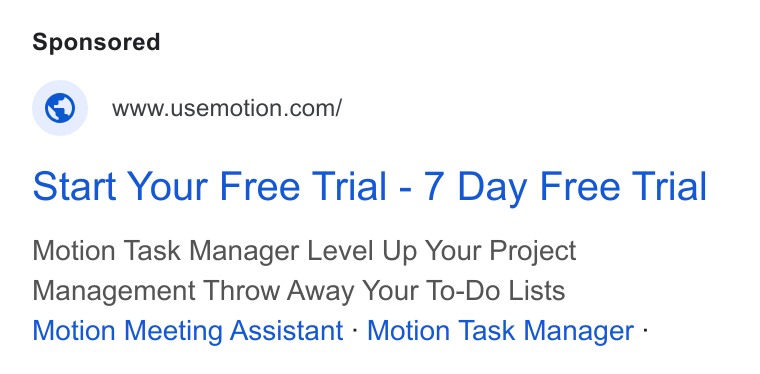
- Running
- 1061 days (longevity = it's converting)
- Hook
- Sponsored - www.usemotion.com/ - Start Your Free Trial - 7 Day Free Trial
- CTA / offer
- Start Your Free Trial - 7 Day Free Trial
- Audience
- Individuals or teams involved in 'Project Management' and those who use 'To-Do Lists' or need a 'Meeting Assistant'.
Why it works. Gives search-intent clickers who are ready to buy a concrete, no-surprises offer with a defined trial window.
Directly states the offer and its duration: 'Start Your Free Trial - 7 Day Free Trial'. Put the specific number of free-trial days in your headline instead of the word free alone.
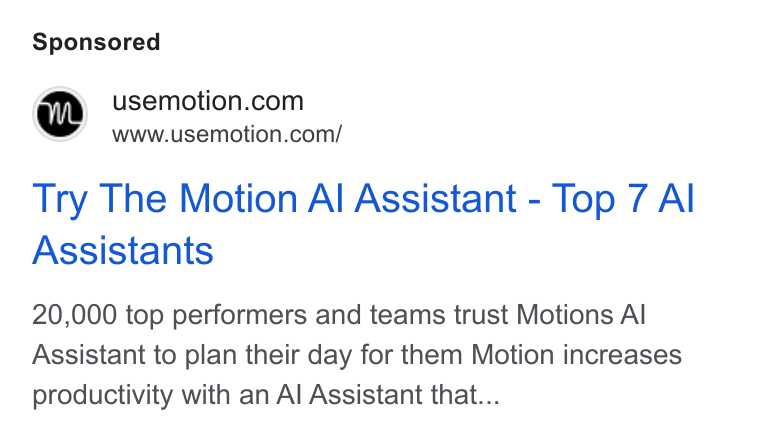
- Running
- 894 days (longevity = it's converting)
- Hook
- Visual: The word "Sponsored" at the top, followed by a logo with an 'M' shape, the text "usemotion.com", and "www.usemotion.com/". Below this, a blue headline reads "Try The Motion Al Assistant - Top 7 Al Assistants".
- CTA / offer
- Try The Motion Al Assistant
- Audience
- Individuals and teams seeking productivity tools, indicated by "20,000 top performers and teams trust Motions Al Assistant" and "Motion increases productivity".
Why it works. Uses an implied third-party ranking to lower the perceived risk of trying an unfamiliar AI assistant.
Headline framing with a direct call to action and a listicle format: "Try The Motion Al Assistant - Top 7 Al Assistants". If you've been listed in any roundup or ranking, fold that mention directly into your ad headline.
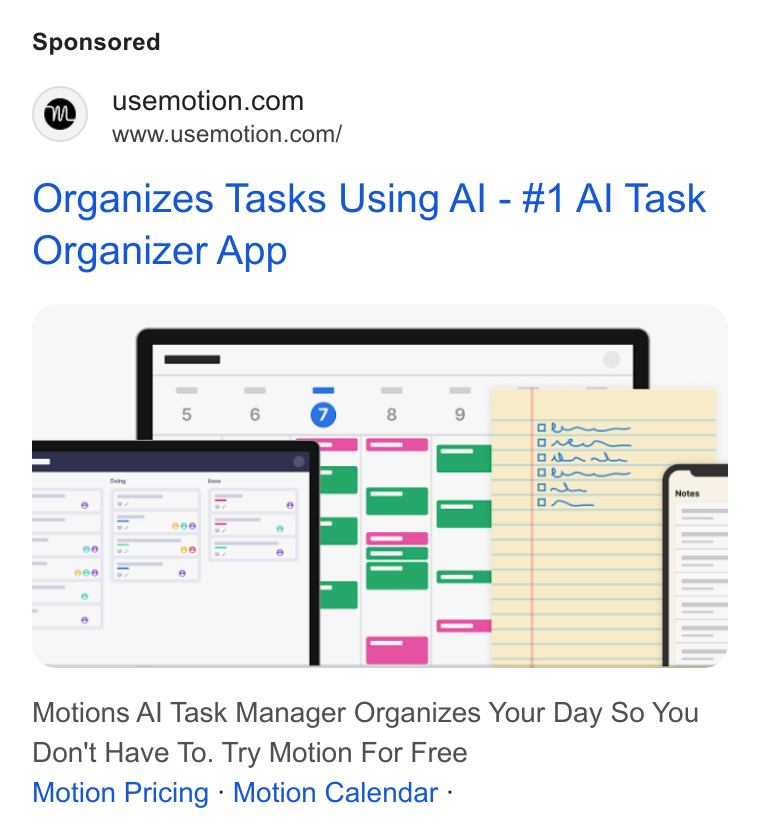
- Running
- 872 days (longevity = it's converting)
- Hook
- Sponsored usemotion.com www.usemotion.com/ Organizes Tasks Using Al - #1 Al Task Organizer App
- CTA / offer
- Try Motion For Free
- Audience
- Individuals seeking to improve personal or professional organization and productivity, indicated by the focus on 'Organizes Tasks' and 'AI Task Manager'.
Why it works. Appeals to searchers comparing task-organizer apps by pairing a clear function statement with a market-leader position.
Headline with a bold claim: 'Organizes Tasks Using Al - #1 Al Task Organizer App' Follow a plain description of what your product does with a specific ranking claim in the same headline.
Show 3 more ads
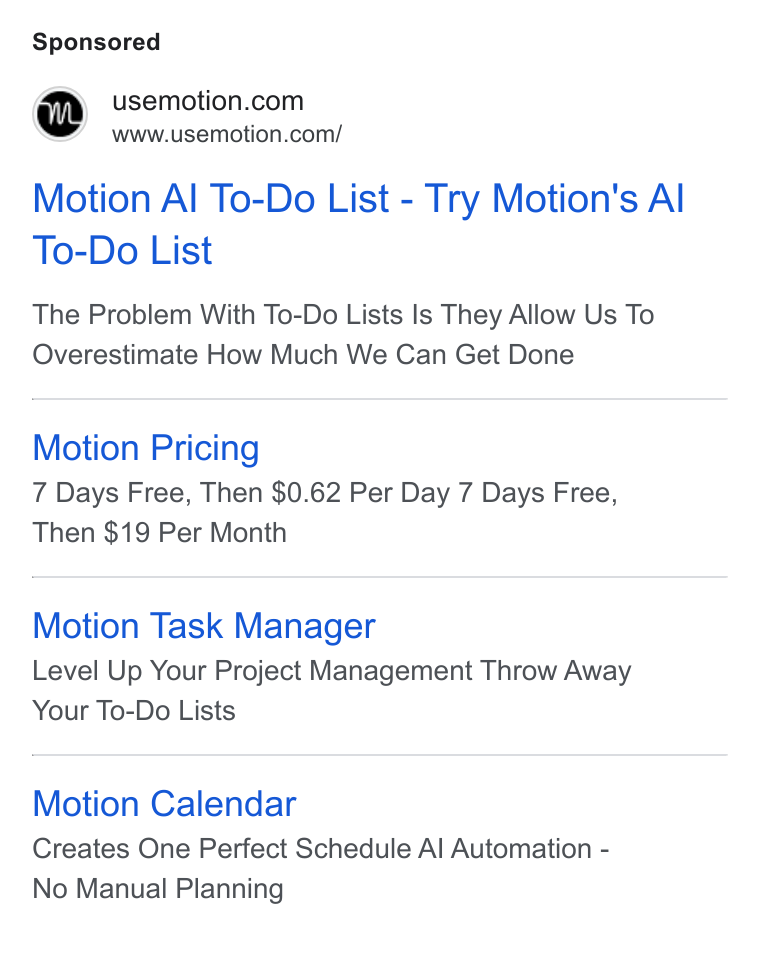
- Running
- 1374 days (longevity = it's converting)
- Hook
- Sponsored usemotion.com www.usemotion.com/ Motion AI To-Do List - Try Motion's AI To-Do List
- CTA / offer
- 7 Days Free, Then $0.62 Per Day 7 Days Free, Then $19 Per Month
- Audience
- Individuals struggling with productivity, project management, and scheduling, indicated by phrases like "Overestimate How Much We Can Get Done" and "No Manual Planning."
Why it works. Matches near-exact-match search queries for 'AI to-do list,' maximizing relevance for that specific keyword.
Problem-agitation headline: "Motion AI To-Do List - Try Motion's AI To-Do List" followed by "The Problem With To-Do Lists Is They Allow Us To Overestimate How Much We Can Get Done." Repeat your target keyword phrase verbatim in both the brand and description portions of a search headline.
- Running
- 1249 days (longevity = it's converting)
- Hook
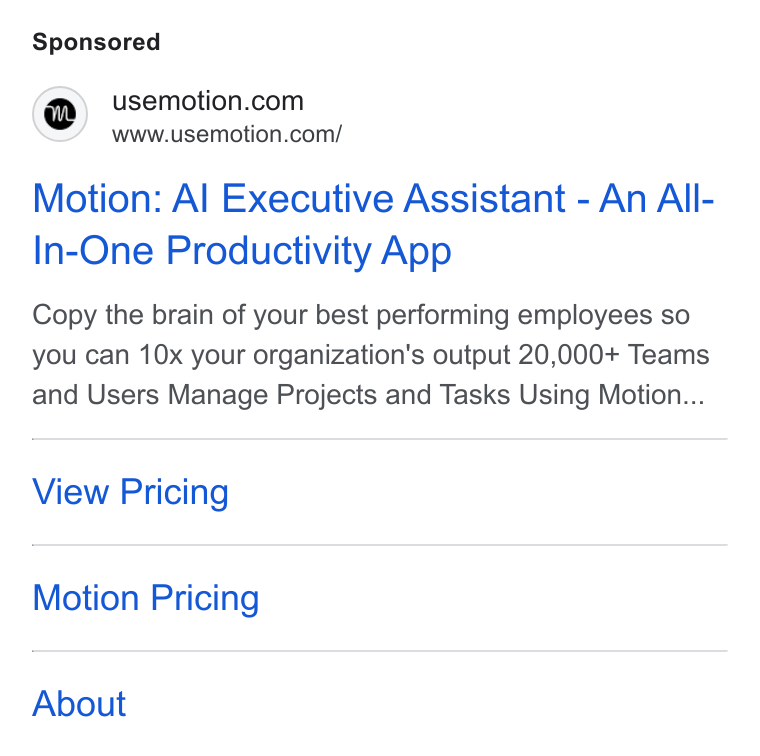
- Sponsored usemotion.com www.usemotion.com/ Motion: AI Executive Assistant - An All-In-One Productivity App
- CTA / offer
- View Pricing
- Audience
- Organizations and individuals seeking to improve productivity and leverage AI, indicated by 'organization's output' and 'Teams and Users'.
Why it works. Positions the tool above competitors by claiming an executive-level role, appealing to professionals who want that support without the cost.
Headline with a bold claim and clear value proposition: "Motion: AI Executive Assistant - An All-In-One Productivity App" Give your product a job title one level above its literal function to signal a bigger scope of value.

- Running
- 1137 days (longevity = it's converting)
- Hook
- usemotion.com www.usemotion.com/ Try Motion For Free Today - Try Motion's AI Calendar
- CTA / offer
- Try Motion For Free Today
- Audience
- Individuals or businesses seeking productivity solutions, specifically those interested in AI-driven tools, indicated by "AI Calendar" and "AI Era".
Why it works. Removes friction for ready-to-buy searchers by pairing a same-day free offer with a clear reminder of what the product is.
Direct call to action and free offer in the headline: "Try Motion For Free Today - Try Motion's AI Calendar". Combine a time-bound free offer with a one-line reminder of your product category in the same headline.
08 The playbook
The channels are not separate. They are one system where each stage feeds the next. Here is the read, then the plays to run tomorrow.
The inferred playbook
Motion's loop starts in paid and organic search around the same set of long-tail topics, converts through a 7-day free trial into a seat-based paid plan, and compounds through blog content that keeps ranking for the exact queries the ad account already validated.
Content that already ranks #1-2 for terms like "usemotion," "motion calendar," and "motion ai" lowers the cost of the queries Motion's Google ads are simultaneously bidding on, effectively subsidizing its own paid acquisition over time.
Total visits are down 3.1% even as the company reports rapid revenue growth off its 2025 AI Employees launch, an unexplained divergence that suggests the current growth is coming from expanding within existing and enterprise accounts rather than from a larger top of funnel.
Dig deeper+2▾
A dedicated r/UseMotion subreddit carries recurring, unanswered churn-and-alternatives conversation, including threads titled "Moving on & alternatives," with no brand-tagged account visible engaging in that community, a retention-defense channel Motion appears to leave unattended.
free-to-paid conversion rate, churn, CAC, and blended ARPU across its paid tiers.
Mirror your paid queries in owned content
The proofMotion's top blog posts and its longest-running Google ads target the same long-tail topics (ADHD planning, family calendars, time blocking), letting organic content subsidize what it already validated in paid.
The adaptationPull the 5-10 search queries closest to your product's use case that aren't your brand name, and write one genuinely useful page per query before you ever pay for a click on it. Start by drafting a single comparison or how-to page targeting the query with the clearest buyer intent and publish it on your own site first. The mechanism: once a topic proves it converts in either channel, the other channel gets cheaper to run on the same topic.
Cost: $0 · Time to signal: weeks · Works pre-PMF: yes
Anchor your price against what it replaces
The proofMotion's best-performing ad headline reframes a $19-29/month seat fee as "works like a $100K personal assistant," selling against the cost of a human alternative instead of against other software.
The adaptationIdentify the manual task, role, or workaround your product replaces and rewrite your homepage headline or top ad copy to compare your price against that cost, not against competitor pricing. First step: draft three headline variants that name the specific human cost or time cost you're replacing, and run them as your landing page's H1 for a week to see which gets more signups.
Cost: $0 · Time to signal: days · Works pre-PMF: yes
Build a page for one underserved niche inside your broader audience
The proofMotion's "ADHD Friendly Planner App" ad targets a narrow subgroup of its broader productivity audience with language and framing specific to that group's actual struggle.
The adaptationPick one specific subgroup within your existing customer base who has a distinct, well-documented pain point, and build a single landing page speaking directly to them, then share it in the communities where that subgroup already gathers (a subreddit, a niche forum, a Discord). First step: write the page and post it yourself in one relevant community, watching for whether that specific audience converts at a different rate than your general traffic.
Cost: $0 · Time to signal: days · Works pre-PMF: yes
Tell the plateau story, not just the milestone
The proofHarry Qi's post recounting a named advisor's blunt "no path to $1B ARR" critique at $15M ARR outdrew his funding-announcement posts by roughly 30x in views.
The adaptationWhen you hit a real growth plateau or get hard feedback from someone credible, write the specific moment down: the number, who said it, what it forced you to change, and post it yourself rather than folding it into a generic update. Start by drafting the one sentence that captures the exact criticism you received, then build a short post around it. Works pre-PMF: yes, provided the setback and resolution are genuinely real; a manufactured "struggle" story reads as hollow and can backfire.
Cost: $0 · Time to signal: days · Works pre-PMF: conditional
Bundle a real milestone into one coordinated founder push
The proofMotion's $60M raise, its repositioning as an "agentic work suite," and Qi's plateau story all landed within one week around September 8-12, 2025, concentrating attention instead of spreading it thin.
The adaptationWhen you have a genuine milestone (a raise, a major pivot, a hard-won metric), plan the founder posts, any press, and product messaging to land in the same short window rather than trickling them out. First step: the next time you have real news, draft all the angles (the news itself, the number behind it, the story behind the number) in advance and post them close together. Works pre-PMF: conditional, this only works if you already have an audience paying attention and a milestone substantial enough to earn it; without either, the coordination has nothing to amplify.
Cost: $0 · Time to signal: days · Works pre-PMF: conditional Not transferable at an earlier stage: Motion's three-year-old, still-active Google ad and a nine-figure-valuation fundraising story depend on years of paid budget and investor access most earlier-stage founders won't have yet. Adapt the content-and-price-framing mechanics above, not the scale of the spend behind them.
You just read how Motion does it. Tomorrow it is someone else.
Every morning we take one company that is actually growing and break down where its customers come from: the ads still running after a year, the channel doing the real work, and the play you can run this week.
Systemaic · directional intelligence. Traffic, spend, and reach figures are SimilarWeb-style estimates and qualitative reads of public data, not audited numbers. Built on real public receipts.
// teardowns with a similar GTM motion
sources & receipts (7)
Live ad libraries: google ad library
Launch archives: Hacker News: A federal court has denied a pre-trial motion to dismiss a G · Hacker News: Show HN: A stop-motion video of an engine · Hacker News: Xfinity using WiFi signals in your house to detect motion · Hacker News: Death Valley National Park: First Observation of Rocks in Mo · Hacker News: Moths in slow motion [video] · Hacker News: Inside a $1 radar motion sensor
Traffic, spend, and revenue figures are estimates as noted in the report; the links above are the primary public artifacts.