- 01Post company news through your own name, not the brand's
- 02Turn one internal metric into a customer-facing case study
- 03Build one feature worth complaining (and joking) about
- 04Bid into your buyer's adjacent search problem, not just your own name
01 Snapshot
The one-glance read on who they are and how they grow. Each point is verifiable from the receipts above.
A global payroll, HR, and Employer-of-Record platform letting companies hire and pay staff across 150+ countries, running at an estimated ~$1.4B in annualized revenue as of February 2026 (third-party estimate, +63% YoY).
Paid-led enterprise demand generation, amplified by the CEO running his own X account as a launch-and-PR channel.
~4.08M monthly visits (+16.4% over the last 3 months), concurrent ad libraries of ~20,000 on Google and ~6,478 on LinkedIn, and a founder X following of 270,763 (as of 2026-07-07).
As of 2026-07-07, Google is running text ads first shown just 4-5 days earlier while LinkedIn tests a Brazil World Cup-themed payroll post alongside its recurring compliance-fear message.
Deel runs its CEO's personal X account as a paid-media-grade press channel, timing product drops (AnyTime Pay), a sports sponsorship (Arsenal), and a $15M startup-pitch contest as tweet-native launches that clear 200K+ views, then backs the same narratives with a three-platform ad library.
02 How it unfolded
The order the channels came online. Sequence is strategy: what they did first, and what they layered on once demand existed.
03 Traffic & channel mix
Estimated demand, the channel split behind it, and the keywords and referrers doing the work. Directional modeling, not audited analytics.
Traffic sources
Top search keywords
| Keyword | Volume | Weight | CPC |
|---|---|---|---|
| deel | 344k | $15.96 | |
| deel login | 25k | $0.64 | |
| deel careers | 19k | $1.83 | |
| h-1b visa | 13k | $1.57 | |
| usvisascheduling | 112k | $2.64 |
Top referring sites
Closest competitors by audience
Deel pulls an estimated ~4,079,211 monthly visits, up 16.4% over the last 3 months. Direct traffic dominates at 52.1%, with organic search (13.3%) and organic social (10.2%) as the next two real levers, a mix consistent with a well-known brand name that people navigate to or search for by name rather than discover cold. Paid search (6.2%), email (7.6%), and referrals (5.5%) are secondary but real; display ads, paid social, and AI-referred traffic together total under 5% and aren't meaningful growth levers on their own. The keyword "deel" itself pulls 344,100 searches/month, dwarfing "deel login" (25,100/mo, a habitual-user signal) and the oddly large "usvisascheduling" (112,240/mo), which points to Deel's immigration/visa content and ads competing for a much bigger, adjacent demand pool it doesn't own outright. Referrer data shows producthunt.com still sending residual directory traffic and letsdeel.com, Deel's earlier owned domain and social handle, forwarding legacy links rather than acting as a true third-party referrer. Among named competitors, rippling.com stands out given the two companies' active corporate-espionage litigation over the same EOR budget, while remote.com and oysterhr.com are the more conventional head-to-head competitors fighting for the same global-hiring search intent.
04 Organic content
The specific pages earning their organic search traffic, and the pattern behind why they rank. Adapt the format, not the topic.
Deel's top organic pages are broad HR/people-ops listicles, "KPI examples," "self-evaluation examples," "recruitment strategies examples," that rank for generic workplace-management searches with no direct connection to payroll or EOR. The KPI examples page alone pulls an estimated 19.1% of tracked organic search traffic to the site, more than the homepage itself, showing the strategy is top-of-funnel content marketing rather than product-term SEO. This works because templated "examples" and "how-to" formats match common, high-volume informational intent from HR generalists and people managers, a much wider net than anyone searching "EOR platform," which then feeds Deel's brand and retargeting funnel downstream.
Top pages by organic traffic
05 Channel map
Not traffic share. How much weight the growth system actually puts on each channel, with a one-line read on the role it plays.
What drove growth
06 The motions doing the work
For founder-led SaaS the breakdown shifts from ads to traction: where the first users came from, how the founder grows it in the open, and the compounding organic surface.
Deel's traction trail in the public record is a chain of funding and acquisition headlines rather than a single viral launch moment.
Hacker News picked up Deel's $300M Series E close at a $17.3B valuation within a day of the raise in October 2025, one of the few non-litigation spikes in an HN presence otherwise dominated by the Rippling lawsuit coverage detailed in Where They Show Up above.
Deel's Capbase purchase (reported January 2023) and Hofy purchase (reported July 2024) each surfaced as their own Hacker News submissions, and the founder's own account later confirmed Sastrify as the 14th acquisition, detailed in Build in Public below, pointing to a steady buy-to-grow cadence rather than one flagship product launch.
Dig deeper+1▾
Neither a Product Hunt debut nor a Show HN post for Deel itself appears in the record, so the visible public trail starts with funding and acquisition press rather than an early-user origin story.
Deel's build-in-public voice belongs almost entirely to CEO Alex Bouaziz's personal X account, not the @deel brand handle linked from Deel's own homepage.
Bouaziz has posted 5,594 times on X to the six-figure following covered in the Snapshot above, a volume that functions as Deel's real press channel far more than the corporate handle it links to.
Announcing the Sastrify acquisition, a SaaS procurement and management platform, as Deel's 14th deal, Bouaziz used the same post to state his own dealmaking rule: don't sign unless it's a "hell yes," since the deals that underperformed were ones he was only "70-85% certain" about.
Dig deeper+2▾
Bouaziz turned Deel's own hiring pipeline into a public case study, citing 1.3 million job applications last year (2 million-plus projected) and a 30% internal hiring-time reduction from tools it built itself, AI Vetted Marketplace and ATS Pro, using the company's own operations as evidence its HR product works.
In December 2025, Bouaziz opened "Deel Founder Hours," 1-on-1 sessions between outside founders and Deel's executive team, positioning leadership as accessible mentors rather than a vendor, and feeding the same startup-pitch contest covered in the Snapshot above.
Organic search is real for Deel but secondary to direct and paid traffic, and the two clearest distribution levers beyond the content itself are a partner program and a paid-search net cast wider than its own product category.
The KPI-examples and other template pages covered above sit inside a broader, continuously published company blog that functions as a top-of-funnel asset earning traffic long after each post goes live, rather than a one-off campaign.
Deel runs a dedicated affiliate/partner page at deel.com/partner/ to recruit referral partners, a distribution channel entirely separate from its paid and content engines, though the public page does not disclose who is recruited or how they are paid.
Dig deeper+2▾
Beyond bidding its own brand terms ("Ask Deel AI"), Google ad creative shows Deel targeting adjacent problems like visa sponsorship ("Sponsor Skilled Worker Visa"), tapping the much larger adjacent search pool flagged in the keyword data above as a demand-generation layer on top of straightforward brand defense.
Alongside the recurring compliance-fear stat covered above, one LinkedIn ad shows a mocked-up product screen, a "Compliant" badge over an "Acme Inc." card spanning five countries, turning an abstract compliance promise into a visualized proof point for enterprise buyers.
07 Paid ads
This founder-led SaaS also runs paid acquisition. Here are the live ads doing the work, each with the X-ray and a play you can adapt.
- Running
- 116 days (longevity = it's converting)
- Hook
- "¿Contratas freelancers fuera de tu país?" + Woman in a beige blazer speaking against a purple background with a world map and hiring icons.
- CTA / offer
- "IC y COR para contratar sin riesgos."
- Audience
- Business owners or HR managers hiring internationally, signaled by the question "¿Contratas freelancers fuera de tu país?" and icons of global connectivity.
Why it works. Opens with a direct Spanish-language question about hiring freelancers abroad, making the compliance risk personal before naming the product.
Qualifying Question (0:00) - "¿Contratas freelancers fuera de tu país?" Open your ad with a direct yes-or-no question about the exact risky behavior your buyer is already engaged in.
- Running
- 950 days (longevity = it's converting)
- Hook
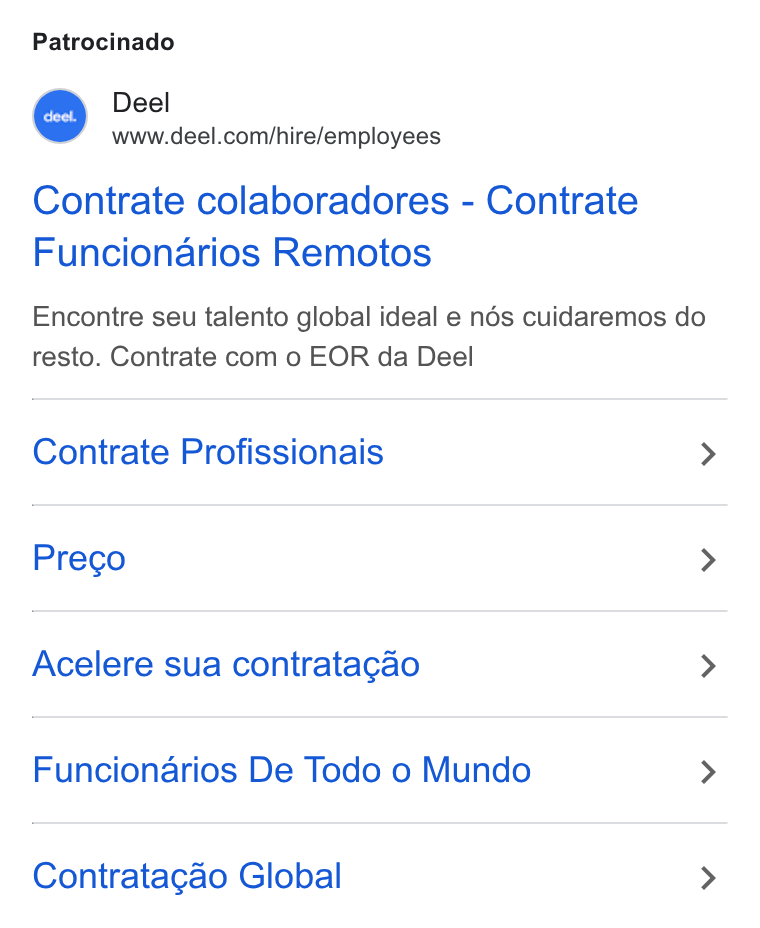
- Patrocinado Deel www.deel.com/hire/employees Contrate colaboradores - Contrate Funcionários Remotos
- CTA / offer
- Contrate com o EOR da Deel
- Audience
- Businesses looking to hire remote employees globally, indicated by phrases like "talento global ideal" and "Funcionários De Todo o Mundo".
Why it works. Matches the literal Portuguese search phrase for hiring remote employees, meeting Brazilian buyers at their exact query.
Headline directly addresses the user's need: "Contrate colaboradores - Contrate Funcionários Remotos" Localize your highest-intent search headline word for word into each target market's language rather than translating your English tagline.
- Running
- 941 days (longevity = it's converting)
- Hook
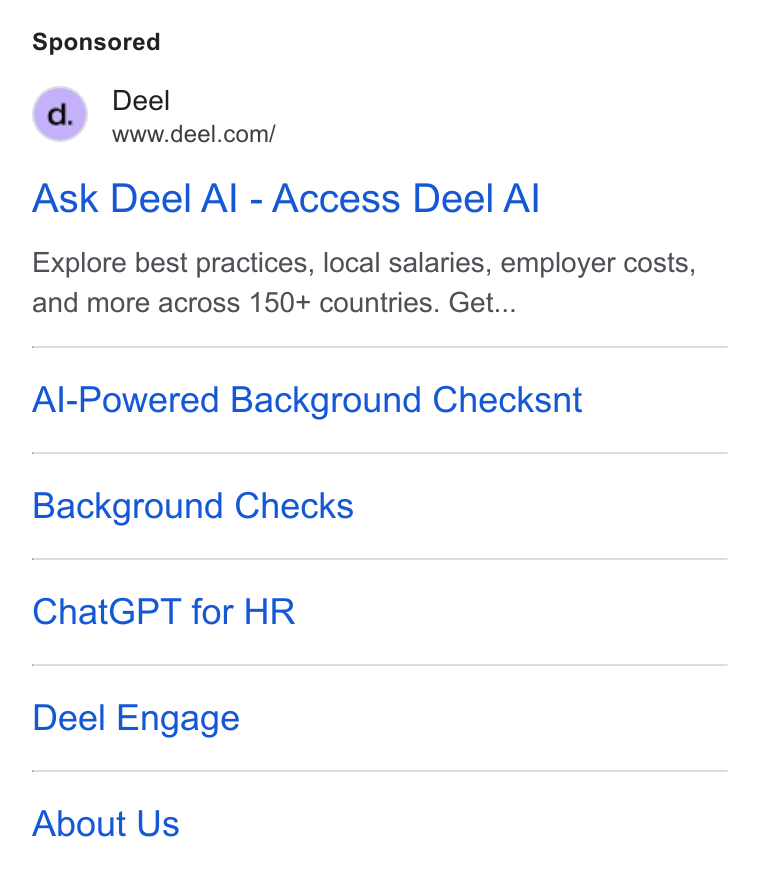
- Sponsored Deel d. www.deel.com/ Ask Deel Al - Access Deel Al
- Audience
- Businesses or HR professionals looking for global employment solutions, indicated by 'employer costs', '150+ countries', 'Background Checks', and 'ChatGPT for HR'.
Why it works. Positions an AI feature as the click reason inside a plain search ad format, catching curiosity from users comparing HR AI tools.
Prominent branding and clear value proposition at the top: 'Ask Deel Al - Access Deel Al' with a description 'Explore best practices, local salaries, employer costs, and more across 150+ countries.' If you've shipped an AI feature, give it its own search ad headline framed as a command, like Ask X AI, instead of folding it into a generic listing.
Show 3 more ads

- Running
- 732 days (longevity = it's converting)
- Hook
- Sponsored d. Deel www.deel.com/immigration Sponsor Skilled Worker Visa - Sponsor Your Employees' Visas
- CTA / offer
- Get a Free Demo
- Audience
- Businesses that employ or plan to employ international workers, indicated by "Sponsor Skilled Worker Visa - Sponsor Your Employees' Visas" and "Hire Workers in 40+ Countries".
Why it works. Uses the precise regulatory term a buyer already searches, so the ad reads as the answer to their query, not marketing language.
Headline directly addresses a complex business need: "Sponsor Skilled Worker Visa - Sponsor Your Employees' Visas" Pull the exact legal or technical term your buyer searches, not your marketing synonym for it, into your headline verbatim.
- Running
- 726 days (longevity = it's converting)
- Hook
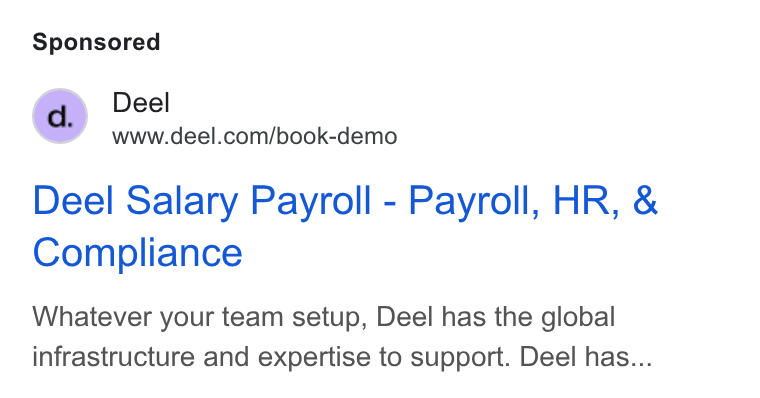
- Sponsored d. Deel www.deel.com/book-demo Deel Salary Payroll - Payroll, HR, & Compliance
- CTA / offer
- www.deel.com/book-demo
- Audience
- Businesses or HR professionals dealing with payroll, HR, and compliance issues, indicated by the ad's direct address of these services.
Why it works. Covers three adjacent search intents in one headline, widening the ad's relevance without diluting the core payroll keyword.
Directly addressing core business functions: "Deel Salary Payroll - Payroll, HR, & Compliance" List two or three adjacent job-to-be-done keywords together in your headline to capture buyers searching under different terms for the same need.

- Running
- 840 days (longevity = it's converting)
- Hook
- Visual: A purple circle with a white 'd.' inside, next to the word 'Deel' and the URL 'www.deel.com/immigration'. Text: 'Hire Non-EU Talent in Germany with the EU Blue Card'
- CTA / offer
- Read our step-by-step guide to discover the eligibility criteria, application process, and fees
- Audience
- Businesses or individuals interested in hiring non-EU talent for Germany, specifically those familiar with or interested in the EU Blue Card. This is indicated by the specific keywords 'Non-EU Talent', 'Germany', and 'EU Blue Card'.
Why it works. Targets a narrow, high-intent legal query, EU Blue Card in Germany, that only serious buyers search, filtering for real demand.
Specific problem/solution headline: The headline 'Hire Non-EU Talent in Germany with the EU Blue Card' directly addresses a niche need. Build a dedicated search ad for your single most specific, jargon-exact use case rather than one broad ad covering every case.
08 The playbook
The channels are not separate. They are one system where each stage feeds the next. Here is the read, then the plays to run tomorrow.
The inferred playbook
Deel's acquisition loop runs brand-scale distribution into a demo-gated enterprise sales motion, not a self-serve product loop.
Paid demand generation across Google, LinkedIn, and Meta, all detailed above, chases branded and adjacent search terms, while Bouaziz's personal account turns funding, M&A, and partnership news into free, press-scale reach.
Nearly every Google ad destination points to a demo-request URL (book-demo, free-demo) rather than a self-serve signup page, so conversion still runs through a sales-assisted demo funnel despite published per-seat pricing across 13 tiers, from $49 per contractor to $899 per employee for enterprise Employer of Record.
Dig deeper+3▾
The always-on blog and the founder's recurring news-jacking cadence, both detailed above, keep producing reach without incremental spend, while the Google and LinkedIn ad libraries require continuous budget to sustain the paid side.
Nothing in this dataset shows a self-serve trial, an in-product referral mechanic, or a usage-based upsell loop; growth here reads as demo-gated and press-amplified rather than product-led.
self-serve conversion rate, churn, CAC, and blended ARPU across Deel's 13 published pricing tiers.
Post company news through your own name, not the brand's
The proofDeel's biggest press wins run through Bouaziz's personal account rather than the brand handle, the mechanic detailed in the Snapshot and Where They Show Up above.
The adaptationTake your next real update, a new feature, a customer win, a hire, and write it as a first-person story from your own account instead of a scripted brand post. Open with the tension or surprise behind the news, not the announcement itself, and publish from the founder's own handle. The mechanism: platforms and readers extend more reach and trust to a named person with a visible posting history than to a company handle.
Cost: $0. Time to signal: days. Works pre-PMF: yes.
Turn one internal metric into a customer-facing case study
The proofBouaziz's ATS Pro story, covered above, turned Deel's own hiring funnel into public proof of its HR product's value.
The adaptationPick one internal operating number your company already tracks, a support response time, a cost you cut, a process you automated, that doubles as proof your product category works. Post it as a specific, dated result with the tool or method named, not a vague "we got more efficient" claim. First step: pull one real number from this month's internal dashboard and write it up.
Cost: $0. Time to signal: days. Works pre-PMF: yes, provided you have at least one real internal number to point to.
Build one feature worth complaining (and joking) about
The proofUnscripted TikTok creators keep making corporate-humor content around Deel's "anytime pay" feature, one clip alone breaking 300K-plus engagements, covered above, without Deel scripting or paying for it.
The adaptationShip or highlight one feature that resolves a specifically felt, slightly embarrassing workplace frustration people already joke about. Then seed it yourself: post about using it, or send a short demo clip to a couple of creators in your niche who already make relatable workplace content.
Cost: under $500 if seeding a couple of creators, otherwise $0. Time to signal: weeks. Works pre-PMF: conditional, this only spreads if the feature is genuinely striking; a routine feature will not get organic jokes made about it.
Bid into your buyer's adjacent search problem, not just your own name
The proofDeel's Google ads bid into visa-sponsorship and immigration searches, adjacent to payroll but not payroll itself, tapping a keyword pool far larger than searches for "Deel" itself, covered above.
The adaptationFind one adjacent problem your buyer searches for that isn't your product category, a regulation, a process, a job-title-specific question, and run a small, tightly scoped search-ad test against it instead of only defending your own brand name. First step: pull your top 20 customer support or sales-call questions, check search volume on the three most common, and test the highest-volume one for two weeks.
Cost: under $500. Time to signal: weeks. Works pre-PMF: conditional, this assumes you already have paying customers funding the test; it is not a zero-budget move.
Offer free 1:1 time before you sell anything
The proofDeel's founder-hosted "Founder Hours" program for outside founders, covered above, functioned as a relationship play rather than a sales pitch.
The adaptationAs the founder, offer a handful of free 30-minute sessions to people in your exact ICP, positioned as genuine advice, not a disguised demo. Post the offer yourself with a real deadline and a simple way to book. First step: publish an offer for three free slots this month and require nothing but an email to book.
Cost: $0. Time to signal: days to weeks. Works pre-PMF: yes. Not transferable at an earlier stage: Deel's tens-of-thousands-deep paid-ad libraries, its Arsenal sponsorship, and its multi-language ad localization all assume a funded, enterprise-scale budget; a pre-PMF founder should adapt the founder-voice, feature-seeding, and free-office-hours mechanics above, not the paid-media scale itself.
You just read how Deel does it. Tomorrow it is someone else.
Every morning we take one company that is actually growing and break down where its customers come from: the ads still running after a year, the channel doing the real work, and the play you can run this week.
Systemaic · directional intelligence. Traffic, spend, and reach figures are SimilarWeb-style estimates and qualitative reads of public data, not audited numbers. Built on real public receipts.
// teardowns with a similar GTM motion
sources & receipts (9)
Live ad libraries: meta ad library · linkedin ad library · google ad library
Launch archives: Hacker News: With companies like Deel and Remote.com, why do employers on · Hacker News: Alleged Deel Spy Confesses to Coordinating with Deel CEO Ale · Hacker News: Rippling sues Deel over spying · Hacker News: Ask HN: How do you deel with loneliness when WFH alone? · Hacker News: Rippling suing Deel for espionage after Slack honeypot worke · Hacker News: Rippling Sues Deel, a Software Rival, over Corporate Spying
Traffic, spend, and revenue figures are estimates as noted in the report; the links above are the primary public artifacts.