- 01Run one always-on branded search ad
- 02Turn earned coverage into ad creative verbatim
- 03Seed a wide creator bench on one hero product
- 04Gate a giveaway behind a multi-platform action
01 Snapshot
The one-glance read on who they are and how they grow. Each point is verifiable from the receipts above.
Clean-ingredient color cosmetics (mascara, blush, highlighter, tinted moisturizer) sold direct and through Sephora, anchored by the Glowy Super Gel highlighter that turned into a recurring TikTok viral moment.
Creator-led and retail-amplified: organic UGC and earned press do the reach-building, while paid spend mostly reinforces demand that already exists.
≈258,000 monthly visits (-2% over the last 3 months), 759,156 Instagram followers across 1,460 posts, a TikTok account that crossed 1 million followers as of a 2026-07-10 giveaway post, 45 active Meta ads and a ~200-ad Google library (48 sampled ads active) as of 2026-07-15. Revenue has no current public figure; the company disclosed $100M+ in 2024 sales with 50%+ year-over-year growth that year, so current revenue is best treated as an estimate in the $100M-150M+ range rather than a confirmed number.
A business-content creator account, Aspire with Emma Grede, quoted founder Laney Crowell saying "We sell one piece of Saie every 4.5 seconds," framing formula quality, not marketing, as the reason customers return.
As of 2026-07-15 the newest Meta creative (0-2 days old) is a fresh wave of video and dynamic-catalog ads split between saiehello.com and sephora.com, run alongside a cluster of Google text ads from unrelated advertiser names bidding on the saiehello.com domain.
Saie routes most paid social traffic to Sephora's product pages rather than its own checkout, using paid channels to reinforce a retail purchase decision instead of to acquire a first-party customer.
02 How it unfolded
The order the channels came online. Sequence is strategy: what they did first, and what they layered on once demand existed.
03 Traffic & channel mix
Estimated demand, the channel split behind it, and the keywords and referrers doing the work. Directional modeling, not audited analytics.
Traffic sources
Top search keywords
| Keyword | Volume | Weight | CPC |
|---|---|---|---|
| saie | 28k | $0.73 | |
| saie beauty | 8.0k | $0.84 | |
| saie glowy super gel | 5.9k | $0.73 | |
| saie makeup | 1.7k | $0.85 | |
| saie bronzer | 2.7k | $0.73 |
Top referring sites
Closest competitors by audience
Saie draws an estimated ≈258,000 monthly visits, down 2% over the last 3 months. The mix is dominated by three channels: search organic at 48.1%, direct at 20.1%, and search paid at 13.7%, together over 80% of all traffic. Referrals (5.2%) and display ads (3.6%) add a further layer; the rest, affiliate, social organic, email, social paid, and emerging AI-assistant traffic, totals under 9% combined. The keywords they rank and bid on are almost entirely their own name: "saie" draws roughly 27,700 monthly searches, "saie beauty" about 8,000, and "saie glowy super gel" close to 5,900, meaning the demand being captured is brand awareness they already generated elsewhere, not category-level search intent. The top referring domains, upwork.com, force.com, and an obscure Heroku-hosted app, read like backend tooling artifacts rather than genuine content partnerships, so referral traffic outside search is thin. Of the listed competitors, sephora.com is actually Saie's own retail partner rather than a rival, appearing here because shoppers research the same products on both sites; meritbeauty.com and kosas.com are the more genuine clean-makeup competitors chasing the same shopper.
04 Organic content
The specific pages earning their organic search traffic, and the pattern behind why they rank. Adapt the format, not the topic.
The five pages earning organic traffic are the homepage plus four hero product pages: the Vanity Case, Glowy Super Gel, Dew Blush, and Slip Tint, each ranking #1 for its own branded product name. There is no blog, comparison, or "best of" content in the top five; the pattern is branded demand capture, not classic content-marketing SEO. That works here because TikTok virality (the Glowy Super Gel especially) already creates the search query before the page has to rank for anything competitive, so the SEO job is simply owning the exact-match product name rather than building topical authority.
Top pages by organic traffic
05 Channel map
Not traffic share. How much weight the growth system actually puts on each channel, with a one-line read on the role it plays.
What drove growth
06 The creative doing the work
Each exhibit shows the actual asset, an X-ray of why it works, a status, and a play you can adapt. This is the heart of the teardown.
As of 2026-07-15, Saie runs 45 active Meta ads (its full library) and draws from a Google account of roughly 200 total ads, of which 48 sampled ads are still active. The two platforms tell different longevity stories. On Google, one plain text ad targeting branded search has been active continuously since October 2021, about 1,722 days, a genuine proven winner even though its creative copy wasn't captured in the sample; a second cluster of roughly 15 Google search and image ads ran for 780-832 days starting in February 2024 but had stopped by the time of this snapshot, so they read as a previous generation of winners rather than current bets. On Meta, every active ad is young: the oldest is only 48 days old, so the entire visible Meta library is better read as a current push than as proven winners, longevity there hasn't had time to prove out yet.
Two creatives worth deconstructing:
Hook: "Sponsored, saiehello.com, Slip Tint, our best-selling and multi award-winning SPF 35 tinted moisturizer." Why it works: It stacks two trust signals, "best-selling" and "award-winning," into a single line so a cold searcher gets social proof before ever seeing the product, killing the "is this a real brand" objection at the headline level. Run this play: expanded as Play 2 below.
Hook: A gray Slip Tint tube badge reading "allure BEST OF BEAUTY AWARD WINNER 2021," paired elsewhere with a Vogue headline, "How Saie Reimagined the Clean Setting Spray." Why it works: Borrowing a third party's masthead does more credibility work than any brand claim could, and pairing it with a specific reinvention narrative (not just "clean setting spray") gives skeptical shoppers a reason this product is different from the category default. Run this play: expanded as Play 2 below.
The split in destination domains is the clearest funnel signal: every active Google search ad lands on saiehello.com, while roughly three-quarters of active Meta ads land on sephora.com product pages instead of the brand's own site. That means paid search is used to protect and convert high-intent, already-decided branded queries directly on Saie's own checkout, while paid social is used to push discovery-stage viewers toward the retailer where reviews, loyalty points, and an existing Sephora account remove friction from a first purchase. The ad copy itself carries the price architecture: Slip Tint is pitched via earned coverage as "less than $40," and a "Bundle & Save" creative promotes multi-product sets rather than single-SKU checkout, suggesting basket-building is pushed through bundles rather than a subscription mechanic. Gift-season creative ("Shop Gifts Before They're Gone") shows seasonal urgency layered onto the same product set rather than a separate funnel.
- Running
- 2 days (new — still being tested)
- Hook
- Visual: A woman in a white top holds a Saie Dew Blush in 'spicy' and opens it. On-screen text: "saie dew blush in spicy will forever be THE blush of the summer". Audio: Upbeat, rhythmic music begins.
- Audience
- The use of a young, attractive woman with a natural makeup look, combined with the claim of a 'summer' blush, targets individuals interested in current beauty trends and achieving a fresh, radiant appearance.
Why it works. Shows the actual product and shade in hand while on-screen text makes a permanent-favorite claim, giving browsers a visual and a memorable line together.
Bold claim as on-screen text at 0:00: "saie dew blush in spicy will forever be THE blush of the summer". Open your video with hands demoing the product while on-screen text names the exact variant and a superlative claim, so viewers get the proof and the promise at once.
- Hook
- On-screen text: "JUICY SUMMER SKIN". A woman holds a translucent bottle with a black cap, showing the brand name "saie" in white text.
- Audience
- The focus on natural-looking, dewy skin and the use of minimal makeup application techniques targets individuals seeking a fresh, effortless aesthetic, likely those interested in 'clean beauty' or 'no-makeup makeup' looks.
Why it works. Leads with the desired skin outcome instead of a product name, using a multi-step routine to reveal how she gets there.
Visual demonstration of product application (0:01-0:25). The video shows the woman applying various Saie products to her face, blending them in to achieve a natural, dewy finish. Open your routine video with a two-to-three word outcome headline before showing which products create it.
- Hook
- Visual: A woman with her hair pulled back, wearing a white tank top, holds a small brown bottle of makeup in front of her face with both hands. On-screen text: "forever the most iconic summer blush shade"
- Audience
- Individuals interested in makeup, particularly blush, and achieving a 'summer' look, indicated by the product application and on-screen text.
Why it works. Has her hold the bottle right up to her face on camera, so the claim of an iconic shade is backed by an immediate real-skin test.
Bold claim as on-screen text at 0:00: "forever the most iconic summer blush shade" Hold your product up against the skin or surface it's meant for on camera while your text claims its category status.
Show 7 more exhibits
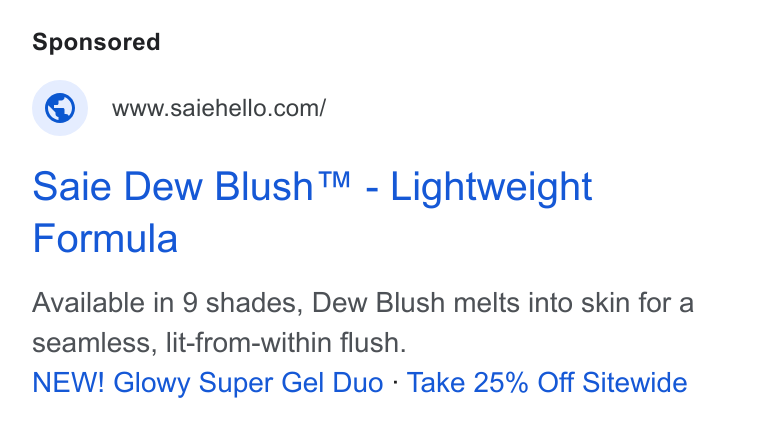
- Running
- 783 days (longevity = it's converting)
- Hook
- Sponsored www.saiehello.com/ Saie Dew Blush ™ - Lightweight Formula
- CTA / offer
- Take 25% Off Sitewide
- Audience
- Individuals interested in beauty products, specifically blush and glowy skin, as indicated by the product name 'Saie Dew Blush' and the description 'lit-from-within flush'.
Why it works. Search ad names the exact product and its lightweight formula benefit so blush shoppers self-select before clicking.
Headline clearly states product name and key benefit: "Saie Dew Blush ™ - Lightweight Formula". Put your product name and its single best feature in the first line of your search ad headline.
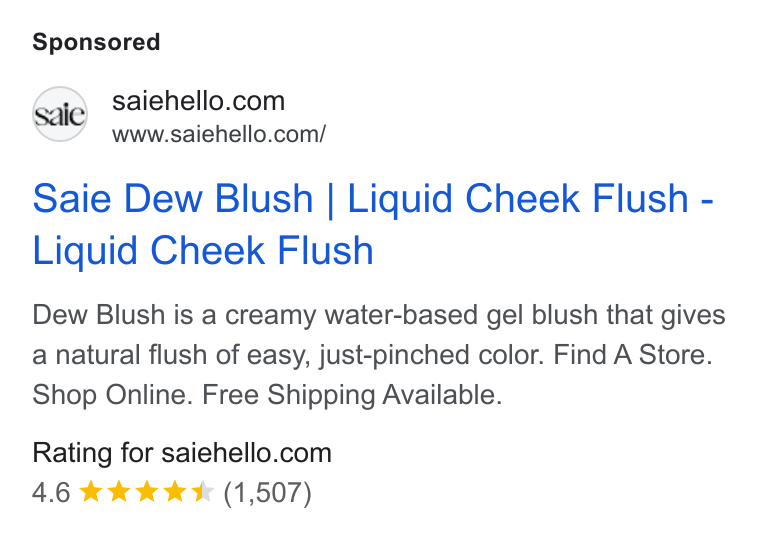
- Running
- 831 days (longevity = it's converting)
- Hook
- Sponsored saiehello.com www.saiehello.com/ Saie Dew Blush | Liquid Cheek Flush - Liquid Cheek Flush
- CTA / offer
- Find A Store. Shop Online. Free Shipping Available.
- Audience
- Individuals interested in makeup, specifically blush, who value natural-looking results and convenience, indicated by the product description 'natural flush of easy, just-pinched color' and 'Free Shipping Available'.
Why it works. Search ad stacks the product name with a specific use case, liquid cheek flush, to match exact-match searchers.
Headline clearly states product and benefit: "Saie Dew Blush | Liquid Cheek Flush - Liquid Cheek Flush" Repeat your product's function in plain terms right after the branded name so search intent matches instantly.
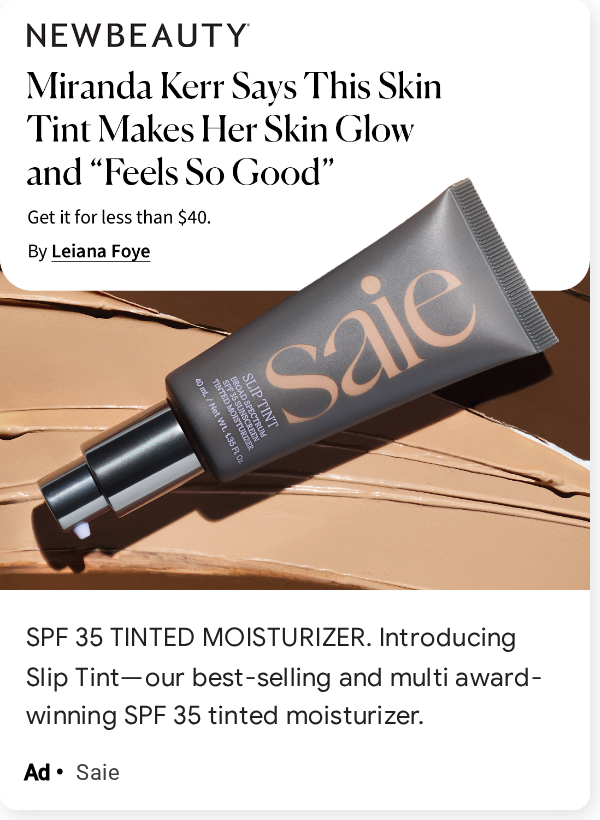
- Running
- 831 days (longevity = it's converting)
- Hook
- NEWBEAUTY Miranda Kerr Says This Skin Tint Makes Her Skin Glow and "Feels So Good" Get it for less than $40. By Leiana Foye - A close-up image of a grey tube of 'saie SLIP TINT' with a pump dispenser, resting on a surface with swatches of various skin-toned liquid makeup.
- CTA / offer
- Get it for less than $40.
- Audience
- Individuals interested in beauty products, celebrity endorsements, and skincare with SPF benefits, indicated by the 'NEWBEAUTY' branding and product description.
Why it works. Runs a celebrity quote as the headline itself so beauty shoppers borrow her trust instead of relying on brand claims.
Celebrity endorsement in headline: "Miranda Kerr Says This Skin Tint Makes Her Skin Glow and "Feels So Good"" If you have a real customer or influencer quote about a specific result, use it verbatim as your headline.
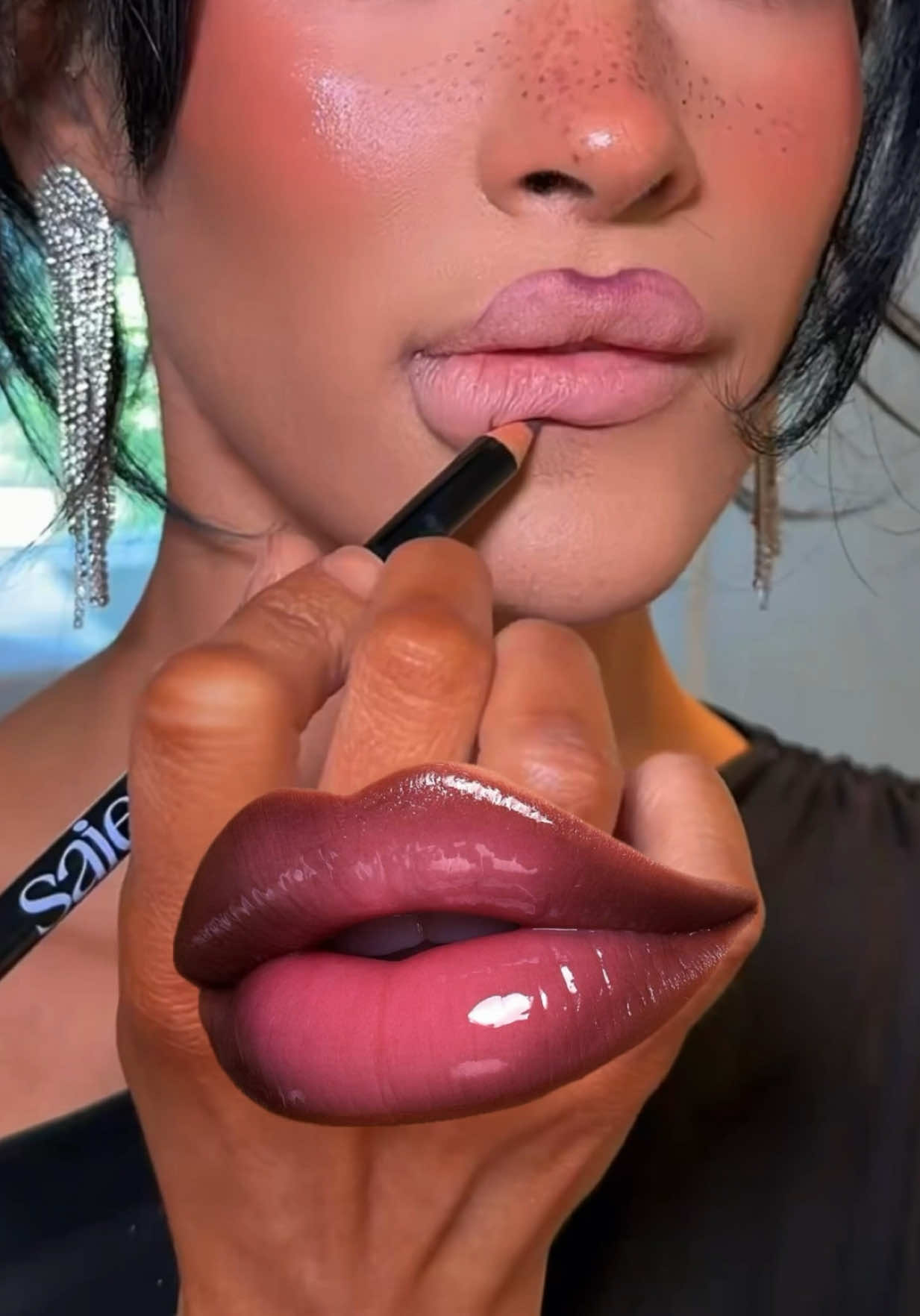
- Hook
- Visual: A woman with dark hair and light eyes is applying a dark pink lip liner to her lips. A large, glossy, dark pink pair of lips is superimposed over her lower face. Audio: Upbeat, rhythmic electronic music.
- Audience
- Individuals interested in makeup, particularly lip products and achieving a glossy, full lip look, indicated by the detailed application of lip liner and gloss.
Why it works. Overlays an exaggerated glossy lip result onto the model mid-application, so viewers see the end result before the routine even finishes.
Superimposed visual of desired outcome at 0:00-0:09. A large, glossy, dark pink pair of lips is superimposed over the model's lower face while she applies lip products. Superimpose a stylized after-effect over the applicator moment so the payoff is visible before the demo ends.
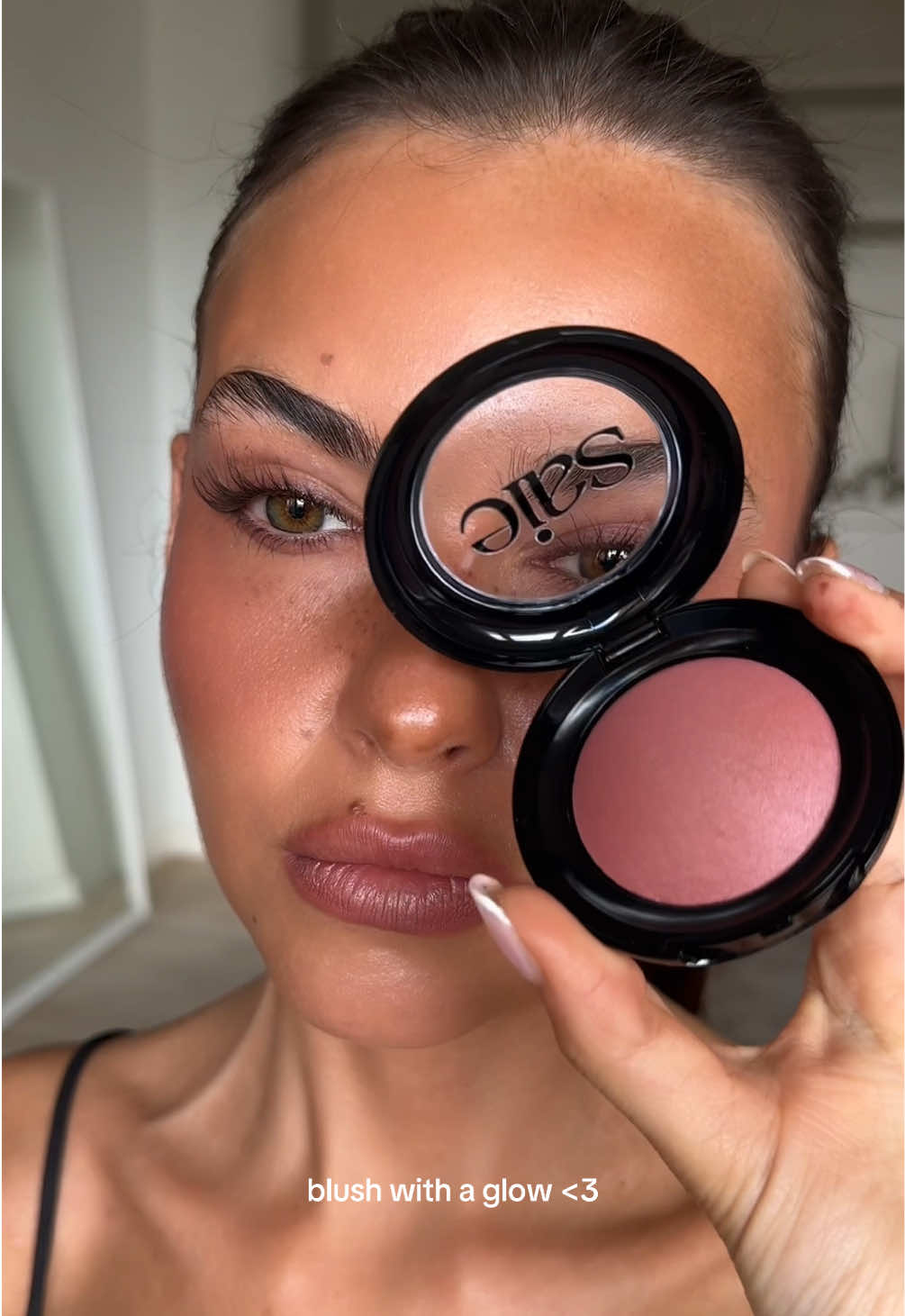
- Hook
- Visual: A woman holds an open compact of blush in front of her face, with the brand name 'saie' visible on the mirror. On-screen text: "blush with a glow <3"
- Audience
- Individuals interested in makeup, specifically blush and glowing skin, indicated by the product demonstration and the model's aesthetic.
Why it works. Opens on the product held against the branded mirror, then the texted-style caption sells the glow benefit like a personal recommendation.
Visual product reveal and application at 0:00-0:08, showing the compact and then the blush being applied to the model's face. Show the product in-hand against a branded surface first, then pair it with a short, lowercase, texted-style caption.
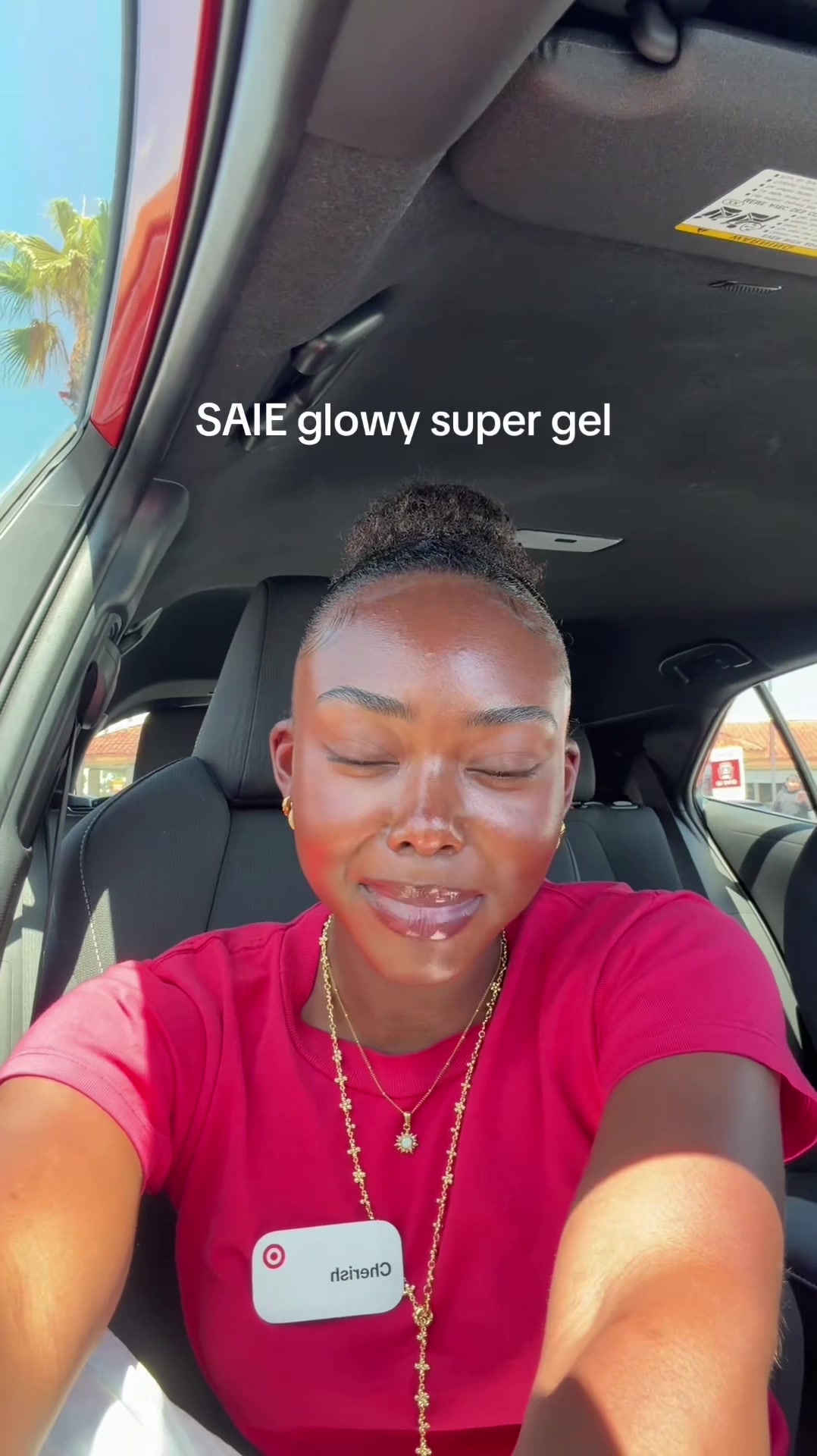
- Hook
- Visual: A woman with dark skin and curly hair, wearing a red t-shirt and gold jewelry, is sitting in a car, looking directly at the camera and smiling. On-screen text: "SAIE glowy super gel". Audio: "Guys, I genuinely don't know what I would do without my say. My say glowy super gel."
- Audience
- Individuals interested in 'no makeup' makeup looks, glowing skin, and lightweight, non-pore-clogging beauty products, as evidenced by the product demonstration and the creator's description of its effects.
Why it works. An unscripted-sounding declaration of daily dependence builds trust for no-makeup-makeup shoppers wary of a paid pitch.
Enthusiastic personal endorsement at 0:00-0:06, "Guys, I genuinely don't know what I would do without my say. My say glowy super gel. Rose glow. Rose glow is like it." Ask UGC creators to state, in their own words, how their routine would change without your product before they name it on camera.
- Reach
- 32 upvotes · 53 comments · r/Sephora
A community is already discussing this in r/Sephora. Show up there authentically and answer the thread before a competitor does.
Who amplifies them
Amplification runs through three distinct lanes. The brand account itself (@Saie on TikTok, @saiebeauty on Instagram) posts founder-fronted previews and milestone giveaways. Founder Laney Crowell is tagged directly in brand and creator content (kenadee mcmullin's post tags both @Saie and @Laney) rather than posting a separate personal channel in this evidence. Third-party creators carry the bulk of organic reach: djscuff (≈2.5 million engagement on one clip), Gunna (≈279,000), cherish marie (≈165,000), margaret kovalcin (≈147,000), and Holly Honeyman (≈127,000), plus a long tail of smaller creators posting reviews and routines. Musician Chappell Roan also posted organically about a Saie liquid bronzer, an unpaid celebrity mention rather than a paid partnership per the evidence. Community sentiment isn't uniformly positive: the single Reddit thread found is a shopper questioning whether the Glowy Super Gel lived up to its TikTok hype, a useful reminder that the same virality driving sales also invites public second-guessing.
07 Organic & video
The organic content engine: the videos, creator posts, and community presence earning attention without paid spend.
Saie's own TikTok account posts founder-fronted and product-drop content rather than pure brand advertising: a 2026-04-07 post shops "@Laney's 5 minute makeup routine" tied to a Sephora sale window, and a 2026-06-21 post previews unreleased blush shades arriving days later, both formats that turn the account into a preview channel rather than a catalog. The standout organic format across creators is straightforward product demo and talking-head reaction, not polished editing: djscuff's clip pairing a lip liner and gloss shade reached roughly 2.5 million engagements, Gunna's blush post ("Can you call this a blushlighter?") drew about 279,000, and cherish marie's Glowy Super Gel post ("truly my babyyyy") pulled around 165,000, plus a long tail of dozens of smaller posts in the 2,500-60,000 engagement range. The giveaway Saie ran to mark its TikTok milestone required entrants to follow both its Instagram and TikTok accounts, comment, and tag a friend, with bonus entries for reposting, a multi-action structure built to multiply reach per prize rather than a simple discount-code giveaway.
08 Affiliate & partners
How the brand turns creators and partners into a tracked, variable-cost acquisition channel, and how the program is structured.
No affiliate program was detected in the evidence, no TikTok Shop tagging, no referral-link structure, and affiliate traffic sits at just 2.9% of total visits per the channel mix. What is visible instead is a cluster of Google ads from unrelated advertiser names (an individual account, an apparel-accessories company, others) all bidding on searches that land on saiehello.com, which looks more like uncoordinated third parties bidding on the brand's domain than an official partner program. At this stage, the growth engine leans on unpaid creator UGC and retail placement rather than a managed affiliate structure.
09 The playbook
The channels are not separate. They are one system where each stage feeds the next. Here is the read, then the plays to run tomorrow.
The inferred playbook
Saie's loop starts with organic creator content on a hero SKU, converts through branded search it protects with a single long-running ad, and compounds through a Sephora retail relationship its paid social spend is built to support.
A Google text ad has run unbroken for about 1,722 days on branded terms like "saie" (≈27,700 monthly searches), a cheap, low-maintenance way to keep the top slot on demand the brand itself created through virality, which is also why unrelated advertisers now bid on the same domain.
Roughly three-quarters of active Meta ads send clicks to Sephora rather than saiehello.com, meaning paid social's job is conversion at a trusted third-party checkout, not direct-to-consumer acquisition.
Dig deeper+2▾
New shades and SKUs surface first through creator posts and the brand's own preview content before any paid push, so paid creative later reuses the same earned press (Vogue, Allure, NewBeauty) and UGC language rather than originating new claims.
the DTC-versus-Sephora revenue split behind the $100M+ 2024 figure, any blended paid-ad return given the size of the Google and Meta libraries, and a repeat-purchase or shade-expansion rate for the customer base once she's bought her first Slip Tint or highlighter.
Run one always-on branded search ad
The proofSaie's single Google text ad has stayed active for about 1,722 days on branded search terms, a near-zero-maintenance defense of its own name.
The adaptationSet up one small, permanent search campaign around your own brand and product names, even a handful of exact-match terms, the moment you have paying customers searching for you by name. Start with a $5-10/day budget and never turn it off; the goal isn't volume, it's making sure a reseller, marketplace listing, or unrelated advertiser never outranks you on your own name the way unnamed advertisers are now doing on Saie's domain.
Cost: under $500 · Time to signal: weeks · Works pre-PMF: yes, provided people are already searching your brand name organically; if nobody searches for you yet, there's nothing to defend.
Turn earned coverage into ad creative verbatim
The proofSaie's ad library reuses a Vogue headline and an Allure Best of Beauty badge as the entire creative, no new copywriting, just a screenshot-level reuse of third-party validation.
The adaptationThe first time any outlet, podcast, or even a mid-size newsletter mentions your product, screenshot the exact language, keep it verbatim, and post it organically to your own channels immediately at no cost. Once you have a small ad budget, run that same screenshot as a static image ad rather than commissioning new lifestyle photography, on the mechanism that a stranger's words about you convert better than your own words about you.
Cost: $0 to start, under $500 to boost as an ad · Time to signal: days · Works pre-PMF: conditional, this only works once at least one credible outside mention exists.
Seed a wide creator bench on one hero product
The proofThe Glowy Super Gel shows up across dozens of unrelated creators over multiple years, from a 2024 post by Hannah Fosbenner to a 2026 post by cherish marie, none of them a single mega-influencer partnership.
The adaptationPick one flagship product and unpaid-seed it to 20-30 small creators in your niche with a simple, specific ask: show how you actually use this, not a scripted read. Track weekly which creators post using a keyword search of your product name (the same mechanic that surfaces Saie's UGC), and only pay to boost the two or three organic clips that already show a repeating angle or hook.
Cost: under $500 (product and shipping) · Time to signal: weeks · Works pre-PMF: yes.
Gate a giveaway behind a multi-platform action
The proofSaie's 1-million-TikTok-follower giveaway required following both its Instagram and TikTok, commenting, and tagging a friend, with bonus entries for reposting, turning one prize into reach across two platforms and multiple actions per entrant.
The adaptationThe next time you cross a round-number follower milestone on any platform, run a giveaway that requires the same combination, follow on two platforms, comment, tag a friend, rather than a single-action entry. Use a product or service you already have on hand as the prize so the cost is near zero, and treat the follow-through rate on each required action as your read on which platform is actually driving new reach.
Cost: $0 · Time to signal: days · Works pre-PMF: conditional, this needs an existing following of at least a few thousand to be worth the entrants' effort.
Split retail and owned-site traffic by intent
The proofSaie sends roughly three-quarters of its active Meta ads to Sephora's product pages while keeping 100% of its Google search ads pointed at its own site.
The adaptationIf you sell through any retail or marketplace partner alongside your own site, route awareness-stage, scroll-stopping paid social toward the retail listing with the most existing reviews and trust, and reserve owned-site paid search for the high-intent, already-decided shopper searching your exact product name. Audit your current ad set's landing destinations first and re-point any discovery-stage creative accordingly.
Cost: dedicated budget or hire · Time to signal: weeks · Works pre-PMF: no, this requires an existing retail placement and live paid spend to split in the first place. Not transferable at an earlier stage: the evergreen five-year Google ad and the Sephora-majority paid social split both assume years of ad history and an established retail partnership a pre-launch or early-stage founder won't have yet. Adapt the underlying mechanics, always-on branded protection and intent-based channel routing, rather than the specific five-year or retail-scale numbers behind them.
You just read how Saie does it. Tomorrow it is someone else.
Every morning we take one company that is actually growing and break down where its customers come from: the ads still running after a year, the channel doing the real work, and the play you can run this week.
Systemaic · directional intelligence. Traffic, spend, and reach figures are SimilarWeb-style estimates and qualitative reads of public data, not audited numbers. Built on real public receipts.
// teardowns with a similar GTM motion
sources & receipts (2)
Live ad libraries: meta ad library · google ad library
Traffic, spend, and revenue figures are estimates as noted in the report; the links above are the primary public artifacts.