- 01Pick one ownable technical claim and repeat it everywhere
- 02Film the objection instead of writing around it
- 03Run search ads against frustration phrases and let winners stay live
- 04Borrow founder credibility inside paid media
01 Snapshot
The one-glance read on who they are and how they grow. Each point is verifiable from the receipts above.
DTC bras engineered specifically for AA, A and B cups, founded in 2017 by co-founders Jaclyn Fu and Lia Winograd out of a Kickstarter launch.
Paid-led, an always-on Google search and Meta ad fleet does the heavy lifting, with a peer-referral layer riding alongside.
$15M+ ARR as of 2026-07-28, ~843,000 monthly visits (+14.5% over the last 3 months), 150+ active Meta ads, and a ~600-ad Google search library whose oldest active ad has run continuously since October 2021.
As of 2026-07-28, Pepper is running fresh creative for a "Zero-G" wirefree lift bra launch and a swim-focused "Hot Tropics" collection on Meta, alongside several new short-lived Google search variants.
Pepper's "community-led" positioning oversells the word-of-mouth: Sitejabber's 1.4/5 aggregate score and recurring Reddit fit-skepticism sit next to an ad fleet that never really turns off, so the paid infrastructure, not evangelism, is what's actually compounding.
02 How it unfolded
The order the channels came online. Sequence is strategy: what they did first, and what they layered on once demand existed.
03 Traffic & channel mix
Estimated demand, the channel split behind it, and the keywords and referrers doing the work. Directional modeling, not audited analytics.
Pepper draws an estimated ~843,000 monthly visits across all channels, up 14.5% over the last 3 months. No channel-by-channel breakdown, keyword list, or referrer data came back for this pull, so the always-on Google search and Meta ad fleets detailed below are the clearest available signal for how that traffic actually arrives.
04 Channel map
Not traffic share. How much weight the growth system actually puts on each channel, with a one-line read on the role it plays.
What drove growth
05 The creative doing the work
Each exhibit shows the actual asset, an X-ray of why it works, a status, and a play you can adapt. This is the heart of the teardown.
Pepper runs 150+ active Meta ads and a Google search library of roughly 600 ads (102 active in the sampled pull as of 2026-07-28). The Google side is where genuine longevity shows up: the oldest active search ad has run since October 2021, nearly 4.8 years, making it a real proven winner. The visible Meta creative set tops out at 48 days of runtime in this pull, so despite the platform's own "winner" tagging, that whole wave reads as the current push, not proven yet by the longevity standard Google's ads clear.
Hook: "Bras Designed for Small Boobs - Perfect Fitting AA, A & B Bras" (Google search headline, active for years). Why it works: It mirrors the literal phrase frustrated searchers type, the same frustration documented verbatim in r/ABraThatFits threads about ill-fitting bras, so it converts existing intent instead of manufacturing it. Run this play: Expanded as Play 3 below.
Hook: "Pepper® Official Site - Zero Gap Bras for Small Boobs" (Google search, active since February 2025, ~524 days). Why it works: "Zero gap" is one specific, ownable technical claim repeated verbatim across search ads, Meta copy ("no cup gaps... just second-skin feel") and YouTube titles ("no bunching, poking"), so every touchpoint reinforces the identical promise rather than rotating taglines. Run this play: Expanded as Play 1 below.
Hook: "PEPPER The strapless bra for small boobs that will NEVER slip" (Meta video, current wave). Why it works: The on-screen claim cuts straight to a woman performing a cartwheel in the bra, a live stress-test that visually resolves the exact skepticism voiced on Reddit ("no shape... I feel squashed"). Structure: bold text claim on white background first, then an immediate cut to the physical proof shot, no narration needed. Run this play: Expanded as Play 2 below.
The proven Google winners lean on years of accumulated search intent; the current Meta wave is testing a Zero-G lift-bra launch and a swim-specific "Hot Tropics" push, alongside two ads whitelisted under the "Jaclyn Fu" advertiser page rather than the brand page, folding founder credibility into paid reach.
Winning ads land directly on product pages carrying a consistent offer stack: free shipping over $125, free returns, and a standing "Buy 2 Cotton Bras, Save $10" promotion. Individual bras sit at $60-65, with swim pieces spanning $48-165 and bundle/trio pricing surfaced near the $125 free-shipping threshold, a deliberate nudge toward a second unit rather than a single-item order. The "A bra so light, you'll forget you're wearing one" ad lands on the Lift Up Bra product page carrying that exact bundle-and-shipping structure, and the swim-focused "A suit you wear Friday. And Saturday. And again on Sunday" ad lands on the Lift Up One Piece and Triangle Bikini product pages with the same $125 threshold and $10-off bundle mechanic. No dedicated email/SMS capture offer surfaced on these landers beyond the site-wide shipping and bundle framing.
- Running
- 27 days (longevity = it's converting)
- Hook
- "Pepper bras I would never get a dupe of as a smaller-chested girl." A woman with long wavy blonde hair, wearing a striped button-down shirt and blue jeans, holds three bras (one white, two black) in her hands and speaks to the camera.
- Audience
- The opening line "Pepper bras I would never get a dupe of as a smaller-chested girl" explicitly targets women with smaller chests (AA to B cups, as stated at 0:39).
Why it works. Uses a creator's own refusal to buy a dupe as social proof, which reads more credible to this audience than a direct product claim.
Problem-solution framing and niche targeting in the hook: "Pepper bras I would never get a dupe of as a smaller-chested girl." (0:00-0:03) Have a creator state on camera which specific competitor or dupe they'd refuse to switch to, and why, instead of just praising your product.
- Running
- 48 days (longevity = it's converting)
- Hook
- "PEPPER The strapless bra for small boobs that will NEVER slip" is displayed as text on a white background, while a woman in a brown strapless bra and white pants performs a cartwheel.
- Audience
- The on-screen text "The strapless bra for small boobs" directly targets women with smaller chests.
Why it works. Pairs an absolute claim with a physically demanding proof visual, so the stunt itself becomes the evidence instead of a testimonial.
Bold, specific claim in on-screen text at 0:00: "The strapless bra for small boobs that will NEVER slip". State your product's toughest, most absolute claim as text, then prove it with the most demanding action that would break a lesser product.
- Running
- 26 days (longevity = it's converting)
- Hook
- "Every once in a while you come across a product" - A woman with long dark hair, wearing a white bra and a light beige open shirt, stands facing the camera and speaks.
- Audience
- The ad targets women who prioritize comfort in their bras but also desire definition and a good fit, particularly those with smaller chests who may experience gapping with traditional bras. This is evidenced by the speaker's direct statements about preferring comfort over traditional bras and the mention of "no gapping" (0:06-0:11, 0:19-0:22).
Why it works. Opens with a deliberately incomplete thought that withholds the product name, using the gap to hold attention into the testimonial.
Direct address and personal endorsement: The creator directly states, "this Limitless Wireless bra by Pepper is one of those products" (0:03-0:06). Open your UGC video with an unfinished sentence that withholds the product name so viewers have to keep watching to find out what you mean.
Show 4 more exhibits
- Running
- 1 day (new — still being tested)
- Hook
- 0:00-0:03: "I am obsessed with these swimsuits." A woman in a black and white gingham one-piece swimsuit stands on a balcony overlooking the ocean, holding a phone to record herself.
- Audience
- Women with small chests, indicated by the on-screen text "the most flattering swimsuits for small boobs >> ✨" and the audio "cups were made just for small-chested women."
Why it works. Uses first-person UGC testimonial format so the swimwear recommendation reads like a friend's find rather than a paid ad.
Directly addressing a specific pain point and offering a solution (0:00-0:06: "I mean, just look how my small boobs look in this.") Open your video with a real customer's unscripted reaction line instead of a product description.
- Running
- 1237 days (longevity = it's converting)
- Hook
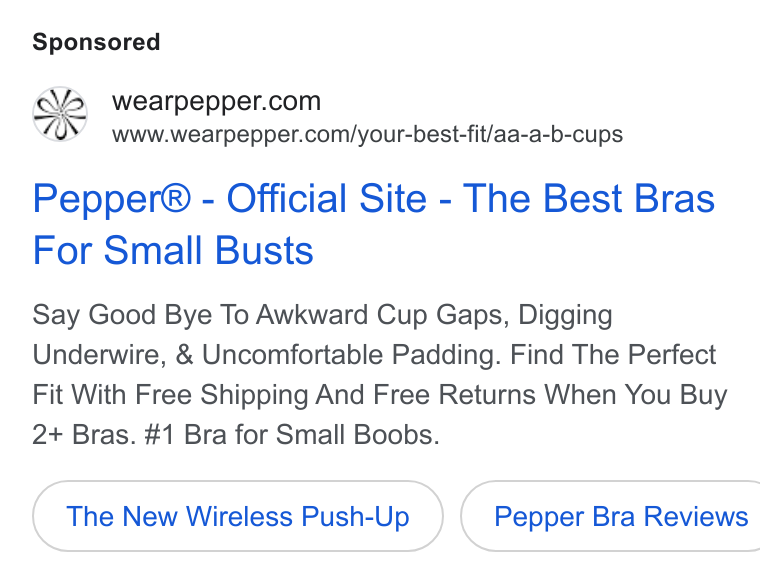
- Sponsored wearpepper.com www.wearpepper.com/your-best-fit/aa-a-b-cups Pepper® - Official Site - The Best Bras For Small Busts
- CTA / offer
- Free Shipping And Free Returns When You Buy 2+ Bras.
- Audience
- Women with small busts, specifically those who wear AA-B cups, indicated by the URL and ad copy "For Small Busts" and "#1 Bra for Small Boobs."
Why it works. Pairs a cup-size-specific URL path with the headline so the searcher sees their exact size represented before clicking.
Headline targeting and problem identification: The ad headline states "Pepper® - Official Site - The Best Bras For Small Busts" and the URL includes "aa-a-b-cups." Build a landing URL path that names your niche's specific sub-segment and reference it in the ad headline.
- Running
- 1736 days (longevity = it's converting)
- Hook
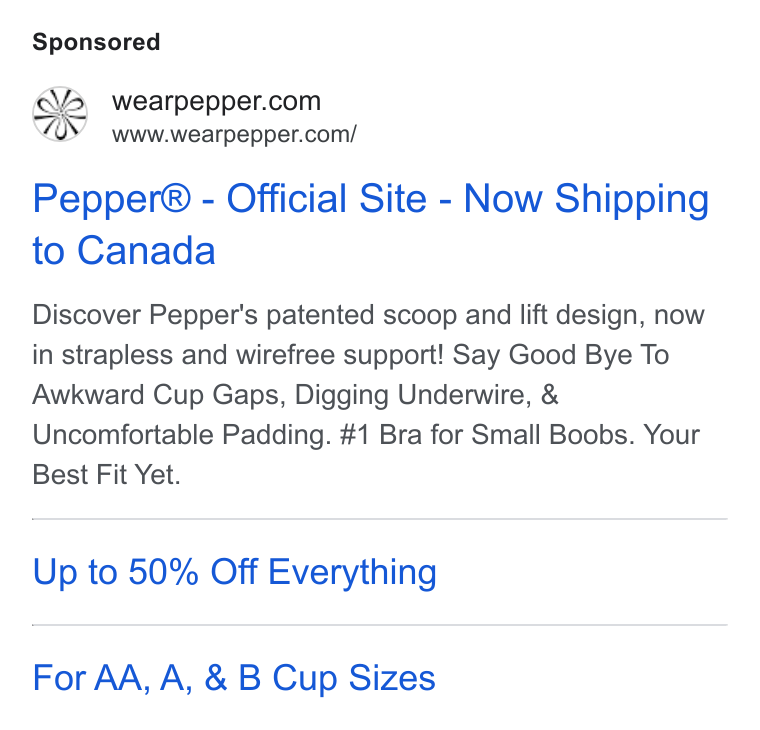
- Sponsored ad with the text "wearpepper.com" and "Pepper® - Official Site - Now Shipping to Canada"
- CTA / offer
- Up to 50% Off Everything
- Audience
- Women with small busts, specifically those wearing AA, A, & B cup sizes, indicated by "#1 Bra for Small Boobs" and "For AA, A, & B Cup Sizes".
Why it works. Combines a trust signal with new-market shipping news, reassuring shoppers in a newly-served region this isn't unavailable or a knockoff.
Directly addresses a common pain point: "Say Good Bye To Awkward Cup Gaps, Digging Underwire, & Uncomfortable Padding." and positions the product as the solution with "#1 Bra for Small Boobs. Your Best Fit Yet." If you've just expanded shipping to a new region, say so directly in your ad headline next to your official-site trust marker.
- Reach
- 164 upvotes · 180 comments · r/ABraThatFits
A community is already discussing this in r/ABraThatFits. Show up there authentically and answer the thread before a competitor does.
Who amplifies them
Amplification runs through unprompted Reddit conversation rather than a named creator roster. r/ABraThatFits has carried recurring Pepper threads since 2019, including a 180-comment 2021 debate ("I finally tried Pepper Bras and I'm...disappointed?", 164 score) that split on fit satisfaction. A 2025 thread in the same subreddit flagged a copycat brand called "Wear Pear," a signal that Pepper's name recognition is strong enough to draw imitators. Separately, a customer posted their own 20% referral code to r/referralcodes in 2024, evidence the referral program gets shared organically rather than only through brand seeding. No named creator or affiliate-seller handles surfaced in the pulled evidence, so this is genuine, if modest, peer conversation, not a TikTok-Shop-style creator army.
06 Organic & video
The organic content engine: the videos, creator posts, and community presence earning attention without paid spend.
The YouTube channel functions less like a subscriber-building organic channel and more like a hosting shelf for the same direct-claim ad format, repeated across roughly 30 near-identical uploads since 2017. "Everyday Bras Perfected for Small Boobs | The Best Bras for AA, A & B Cups" (2022, 70 seconds) pulled ~26 million views; "Small-chested women didn't have bras that actually fit. So we made them." (2021, 55 seconds) pulled ~7.6 million; further down the mix, "Unbox and Review Pepper Bras | Your best fit for AA, A & B Cups" (2022, 68 seconds) pulled ~754,000 as a demo/unboxing format. A lone customer-testimonial short ("Rachael: 'Now there's something that is made for me!'") drew only ~32,000 views, showing individual social proof carries far less reach than the branded bold-claim format.
07 Affiliate & partners
How the brand turns creators and partners into a tracked, variable-cost acquisition channel, and how the program is structured.
Pepper runs a tracked referral/ambassador program: the Reddit-shared code ("LL-1P48HYH9") carries an ll_ref_id tracking parameter and a 20%-off referred-friend discount, consistent with the ambassador program the company describes on its own site.
08 The playbook
The channels are not separate. They are one system where each stage feeds the next. Here is the read, then the plays to run tomorrow.
The inferred playbook
Pepper's growth engine is really an always-on, high-frequency direct-response ad machine wrapped in a single-claim brand story, not the peer-driven community its positioning suggests.
Google text ads matching literal "bras for small boobs"-style queries have run continuously since 2021, converting demand from women already searching out of the exact frustration documented on Reddit.
The 150+-ad Meta rotation cycles formats every few weeks, with the oldest observed creative just 48 days old as of 2026-07-28, so it functions as a constant testing surface rather than a bank of long-proven creative the way the Google search ads do.
Dig deeper+3▾
Two active Meta ads run under the "Jaclyn Fu" advertiser page rather than the brand page, borrowing founder credibility inside paid media rather than leaving it to organic posts.
Sitejabber's 1.4/5 aggregate and recurring Reddit fit-skepticism sit alongside the brand's "your customers evangelize for you" framing, so paid infrastructure is doing more of the acquisition work than word-of-mouth alone could sustain.
blended CAC by channel (Google search versus the much larger Meta spend), the return/exchange rate implied by the free-returns policy and the restocking-fee complaints on Sitejabber, repeat-purchase rate, and what share of orders actually redeem the referral code.
Pick one ownable technical claim and repeat it everywhere
The proofPepper's "zero gap" claim recurs verbatim across Google search ads, Meta copy, and YouTube titles for years, anchored by search ads active since 2021.
The adaptationFind the single most specific, differentiating technical or functional claim about your product, not a vague benefit like "comfortable" but a concrete mechanism like "zero gap." Use that exact phrase as the headline in the next five pieces of content or ads you publish across every channel you're already on, instead of rotating fresh taglines each time. The mechanism: repetition of one specific phrase compounds recognition across touchpoints in a way rotating creative never does.
Cost: $0 · Time to signal: weeks · Works pre-PMF: yes.
Film the objection instead of writing around it
The proofThe cartwheel ad pairs an on-screen durability claim with a live stress-test demo, directly answering the "no shape, feels squashed" skepticism visible in Pepper's own Reddit threads.
The adaptationPull your last 20 negative reviews or community mentions and find the one word or complaint that repeats most (Pepper's was "gap" or "shape"). Film a 15-30 second phone clip, claim on screen first, then an immediate cut to a physical action that visually disproves that exact doubt, structured claim-then-proof like the cartwheel shot.
Cost: $0 · Time to signal: days · Works pre-PMF: yes, provided you already have product in hand to film.
Run search ads against frustration phrases and let winners stay live
The proofPepper's oldest active Google search ad has run without interruption since October 2021, nearly 4.8 years, targeting the literal language of frustrated searchers.
The adaptationSet up a small always-on Google Search campaign bidding on the exact complaint phrases you mined in Play 2 (the same community threads), starting at $5-10 a day. Resist pausing an ad unless its click-through or conversion rate actually drops rather than swapping creative on a schedule.
Cost: under $500 · Time to signal: weeks · Works pre-PMF: conditional, only works if there's enough search volume on the frustration phrase to be worth bidding on.
Borrow founder credibility inside paid media
The proofTwo of Pepper's active Meta ads run under the "Jaclyn Fu" advertiser page rather than the brand page, blending founder identity into paid reach.
The adaptationGet your own (or your founder's) personal page authorized as an ad account in Meta Business Suite, then boost one existing organic founder post that already got real engagement as a paid ad, rather than writing new brand-voice copy from scratch.
Cost: under $500 · Time to signal: weeks · Works pre-PMF: conditional, only works if the founder already has some personal following or credibility to lend.
Give your referral code a life outside your own channels
The proofA Pepper customer independently posted their tracked referral code and link to r/referralcodes in 2024, driven by the brand's ambassador program.
The adaptationStand up a simple trackable referral code (most ecommerce platforms offer this cheaply), mention it in your order-confirmation email and packaging insert, and make it easy for a genuinely happy customer to reshare. Avoid posting the code yourself into code-sharing communities, since brand self-promotion in those subreddits is often against the rules and risks removal; let real customers seed it the way Pepper's did.
Cost: $0 · Time to signal: weeks · Works pre-PMF: yes, though it depends on having at least a few genuinely satisfied customers willing to share first. Not transferable at an earlier stage: the multi-year Google search library and the 150+-ad Meta rotation assume years of iteration budget most early founders don't have. Adapt the underlying mechanics, message consistency, objection-busting demos, and always-on bidding discipline, long before trying to run a fleet at Pepper's current size.
You just read how Pepper does it. Tomorrow it is someone else.
Every morning we take one company that is actually growing and break down where its customers come from: the ads still running after a year, the channel doing the real work, and the play you can run this week.
Systemaic · directional intelligence. Traffic, spend, and reach figures are SimilarWeb-style estimates and qualitative reads of public data, not audited numbers. Built on real public receipts.
// teardowns with a similar GTM motion
sources & receipts (18)
Live ad libraries: meta ad library · google ad library
Researched facts: Founding date, location, founders: Pepper was founded in April 2017 in Denver, CO by Jacly · Kickstarter launch results: April 12-26, 2017 Kickstarter campaign had a $10,000 goal; 952 · CEO's stated positioning/mission for the brand's marketing and community: CEO Jaclyn Fu fr · Series A funding round and investors: Pepper raised a Series A (closed/announced April 202 · Recent revenue run-rate (per company customer-story placement): As of a Gorgias customer s · Product pricing: Individual Pepper bras retail for roughly $60-$65 (e.g., Supima Cotton Li · Retail distribution partnership: Pepper products (bras and bralettes, ~29 SKUs, roughly $4 · Ambassador/community-led growth program: Pepper runs a dedicated customer ambassador progr
Milestone sources: 2018-12: Deming Center Venture Fund (University of Colorado Boulder) invests in Pepper as · 2019-12: Pepper co-founder/CEO Jaclyn Fu is named to Forbes' 30 Under 30 list (2020 Retail · 2020-07-20: Pepper co-founders launch an annual $5K Startup Grant for Black Womxn entrepre · 2021-09: Jaclyn Fu (and co-founder Lia Winograd) are named to Inc.'s Female Founders 100 l · 2023-09-21: Slate publishes a feature on Pepper's ad campaigns becoming a viral, inescapab
Community threads: Trustpilot: A one-star Trustpilot reviewer describes a scam-like experience: poor material · Sitejabber: Sitejabber reviewers (brand rated 1.4/5 across 73 reviews) repeatedly flag pri · AOL (syndicated Cosmopolitan review): On the positive side, a self-described 'Itty Bitty T
Traffic, spend, and revenue figures are estimates as noted in the report; the links above are the primary public artifacts.