- 01Pay a recurring cut to turn users into advertisers
- 02Launch as a lifetime deal to seed a base
- 03Answer comparison threads where buyers already argue about tools
- 04Turn a known product risk into a trust asset
01 Snapshot
The one-glance read on who they are and how they grow. Each point is verifiable from the receipts above.
LinkedIn-first multi-channel outreach automation (LinkedIn, email, X) with a built-in CRM, sold to sales reps, recruiters, and agencies as a seat-priced tool with no free tier.
Paid-led, but the paid engine is run by affiliates, not an in-house growth team.
~108,800 monthly visits as of 2026-07-29 (down 16.4% over 3 months), $2.1M reported 2025 revenue on a 19-person team, and 13 total Google ads found with zero active as of 2026-07-29.
Meet Alfred's real distribution engine has been third-party affiliates bidding on its own brand name in Google Ads to collect a 25% recurring commission, a proxy paid channel that substituted for a founder audience or content flywheel, though every known ad has since gone dark.
02 How it unfolded
The order the channels came online. Sequence is strategy: what they did first, and what they layered on once demand existed.
03 Traffic & channel mix
Estimated demand, the channel split behind it, and the keywords and referrers doing the work. Directional modeling, not audited analytics.
Meet Alfred draws an estimated ~108,800 monthly visits, down 16.4% over the last 3 months. The pull did not return a channel-level breakdown, ranking keywords, or named referrers/competitors for this domain, so this read leans on the ad, affiliate, and review-platform signals covered below rather than a traffic-mix diagnosis.
04 Channel map
Not traffic share. How much weight the growth system actually puts on each channel, with a one-line read on the role it plays.
What drove growth
05 The motions doing the work
For founder-led SaaS the breakdown shifts from ads to traction: where the first users came from, how the founder grows it in the open, and the compounding organic surface.
Meet Alfred's earliest users came through a lifetime-deal launch under a different name, not a founder-driven Product Hunt or Hacker News debut.
A Reddit user recounts buying a lifetime deal for "Meet Leonard" on AppSumo back in 2018, the same product that later became Meet Alfred, placing the true first-launch channel on the AppSumo lifetime-deal marketplace.
The product now operates as Meet Alfred; third-party sources point to platform pressure around LinkedIn's terms of service as a possible trigger for the name change, but that specific cause is not independently confirmed here.
Dig deeper+1▾
A 2026-03-31 Reddit thread shows the company still fielding Meet Leonard lifetime-deal customers years later, offering a 7-day trial rather than honoring the original lifetime terms, a sign the old cohort remains a live, if awkward, touchpoint.
There is no build-in-public engine here: no verified founder social presence and no measurable activity on the brand's own social links.
Founder Martin Martinez has no verified personal LinkedIn or X account in the evidence, and the brand's own Instagram (meetalfredofficial) has been dormant since early 2024, so this does not run on a personal-audience flywheel.
Demand shows up in category comparison threads the company did not initiate, such as the r/LinkedInTips thread referenced above, rather than in owned posts.
Dig deeper+1▾
The Meet Leonard AppSumo cohort covered in Launch & Traction functions as the closest thing to a standing community.
The one real programmatic lever here is the affiliate program, which reads as paid-search arbitrage on the brand's own name rather than an in-house growth motion.
Meet Alfred pays a 25% recurring commission for the lifetime of every referred customer, and the Google ad data shows five distinct third-party advertiser names, including ECOM PRIME LLP, Malaika Khan, Marksurge Marketing Minds Private Limited, Outbound Ventures Pte Ltd, and International Software Licensing Pty Ltd, running search ads pointing to meetalfred.com, the earliest starting October 2024 and the rest appearing across 2025 into 2026. That pattern fits independent affiliates bidding on the brand's own name to capture commission rather than a centralized ad account.
All 13 ads found are inactive as of 2026-07-29, so whatever this affiliate-paid channel was contributing has stopped generating fresh clicks even though several bets ran over a year.
Dig deeper+2▾
Surviving creative is almost entirely branded search text ("Meet Alfred", the bare URL), plus two sharper lines, "Save 10+ hours every week" and "YOU VISITED YOUR LEADS DIDN'T WAIT," the pattern of capturing people already searching the brand name rather than generating new category demand.
The site carries a blog, but the evidence does not show post cadence or top pages, so this teardown cannot confirm whether it is an active SEO investment or a dormant leftover.
06 Paid ads
This founder-led SaaS also runs paid acquisition. Here are the live ads doing the work, each with the X-ray and a play you can adapt.
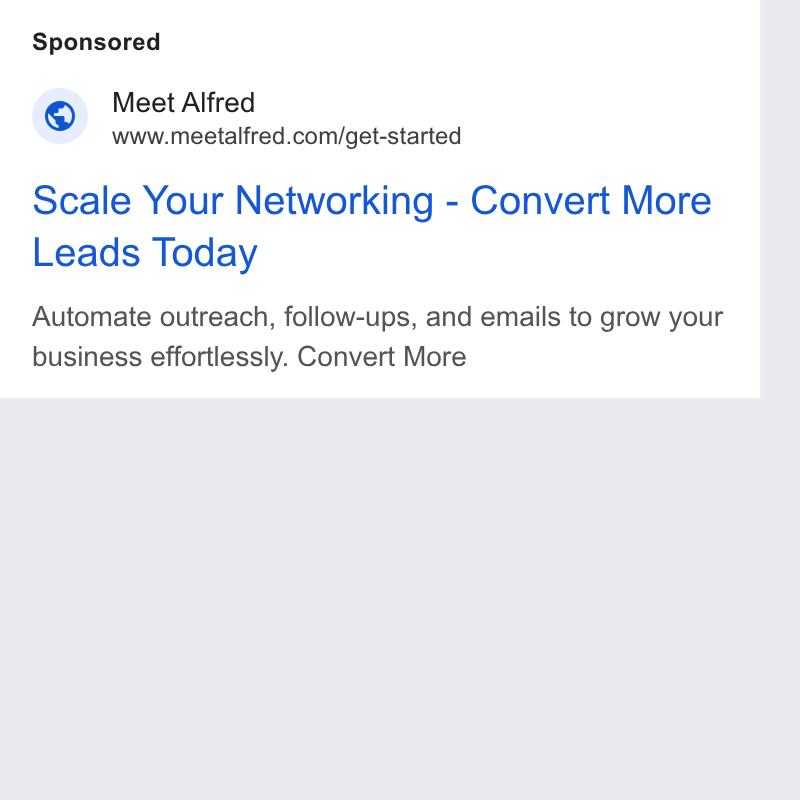
- Running
- 368 days (longevity = it's converting)
- Hook
- Sponsored" text at the top, followed by a blue globe icon and "Meet Alfred" with "www.meetalfred.com/get-started" below it.
- Audience
- Business owners or sales professionals looking to improve lead generation and networking, indicated by phrases like "Scale Your Networking," "Convert More Leads," and "grow your business effortlessly."
Why it works. Direct response ad using a clear value proposition and benefit-driven language to attract business professionals seeking to automate lead generation and networking.
Headline stating a clear benefit: "Scale Your Networking - Convert More Leads Today" Use a headline that directly promises a quantifiable or highly desired outcome for your target audience, focusing on 'what's in it for them' immediately.
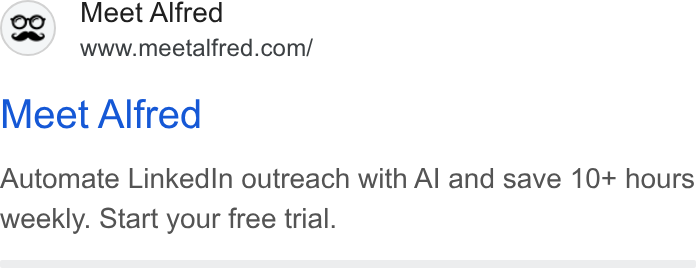
- Running
- 189 days (longevity = it's converting)
- Hook
- "Meet Alfred" with a circular icon showing a black mustache and glasses on a white background, followed by "www.meetalfred.com/"
- CTA / offer
- Start your free trial.
- Audience
- Individuals or businesses looking to optimize LinkedIn outreach, indicated by "Automate LinkedIn outreach with AI" and "save 10+ hours weekly."
Why it works. Direct response ad using a clear value proposition and a free trial offer to acquire new users for a LinkedIn automation tool.
Headline repetition and branding: The name "Meet Alfred" appears twice, once as a title and once as a prominent blue link. Ensure your brand name is prominently displayed and repeated in key areas of your ad creative to build immediate brand recognition.
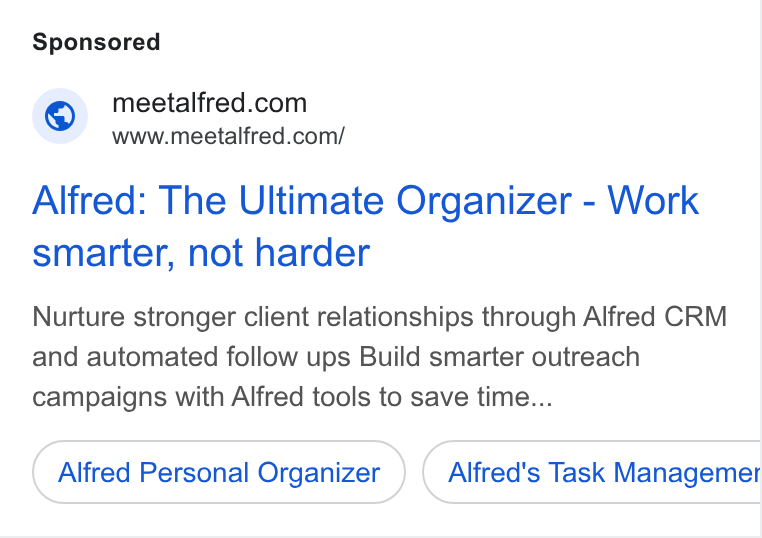
- Running
- 416 days (longevity = it's converting)
- Hook
- Sponsored meetalfred.com www.meetalfred.com/ Alfred: The Ultimate Organizer - Work smarter, not harder
- Audience
- Professionals or businesses looking to improve client relationships, outreach, and task management, indicated by terms like "client relationships," "CRM," "outreach campaigns," and "task management."
Why it works. This creative uses a direct response ad format to highlight a comprehensive organizational solution, aiming to attract users seeking to optimize their work processes.
Headline with a strong benefit claim: "Alfred: The Ultimate Organizer - Work smarter, not harder" Craft a headline that directly addresses a core pain point or aspiration of your target audience, promising a clear and significant benefit.
Show 3 more ads
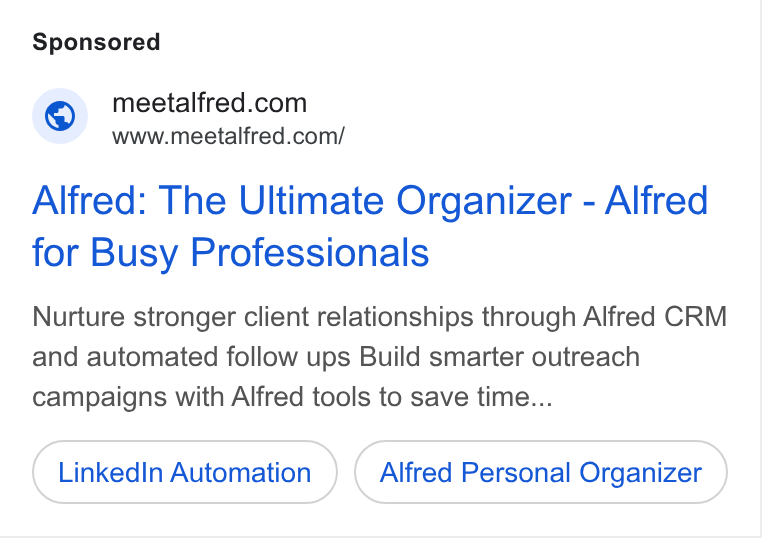
- Running
- 416 days (longevity = it's converting)
- Hook
- Sponsored + a small blue globe icon next to "meetalfred.com" and "www.meetalfred.com/"
- Audience
- The headline "Alfred: The Ultimate Organizer - Alfred for Busy Professionals" and the description mentioning "client relationships" and "outreach campaigns" clearly target professionals and businesses.
Why it works. Direct-response ad highlighting a CRM and automation tool to attract busy professionals seeking efficiency and improved client management.
Headline clearly states the product's core benefit and target audience: "Alfred: The Ultimate Organizer - Alfred for Busy Professionals" Craft a headline that explicitly names your product's primary function and the specific demographic it serves, ensuring instant recognition for your target user.
- Running
- 416 days (longevity = it's converting)
- Hook
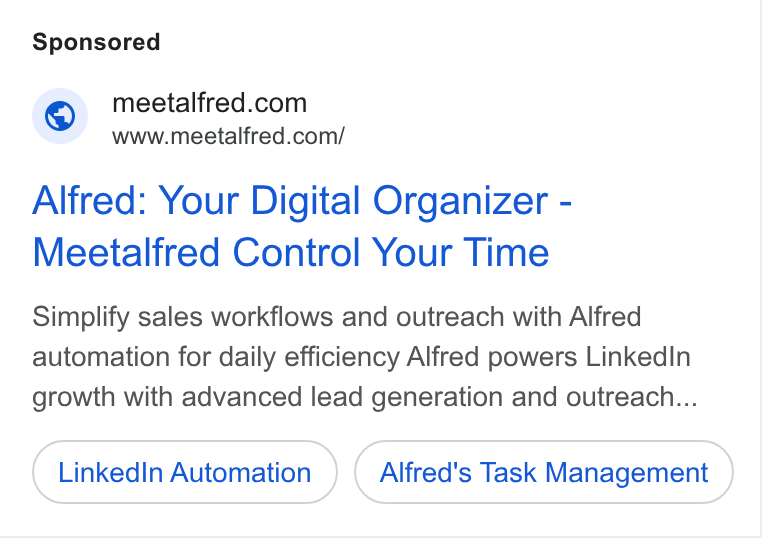
- Sponsored meetalfred.com www.meetalfred.com/ Alfred: Your Digital Organizer - Meetalfred Control Your Time
- Audience
- Professionals and sales teams looking to optimize their LinkedIn presence and sales workflows, indicated by phrases like "Simplify sales workflows and outreach," "LinkedIn growth," and "advanced lead generation."
Why it works. Direct-response ad highlighting a software solution for sales workflow automation and LinkedIn growth to attract professionals seeking efficiency tools.
Headline directly addresses a core need: "Alfred: Your Digital Organizer - Meetalfred Control Your Time" Craft your ad headline to explicitly state the problem your product solves and how it helps the user gain control over that problem.
- Running
- 6 days (new — still being tested)
- Hook
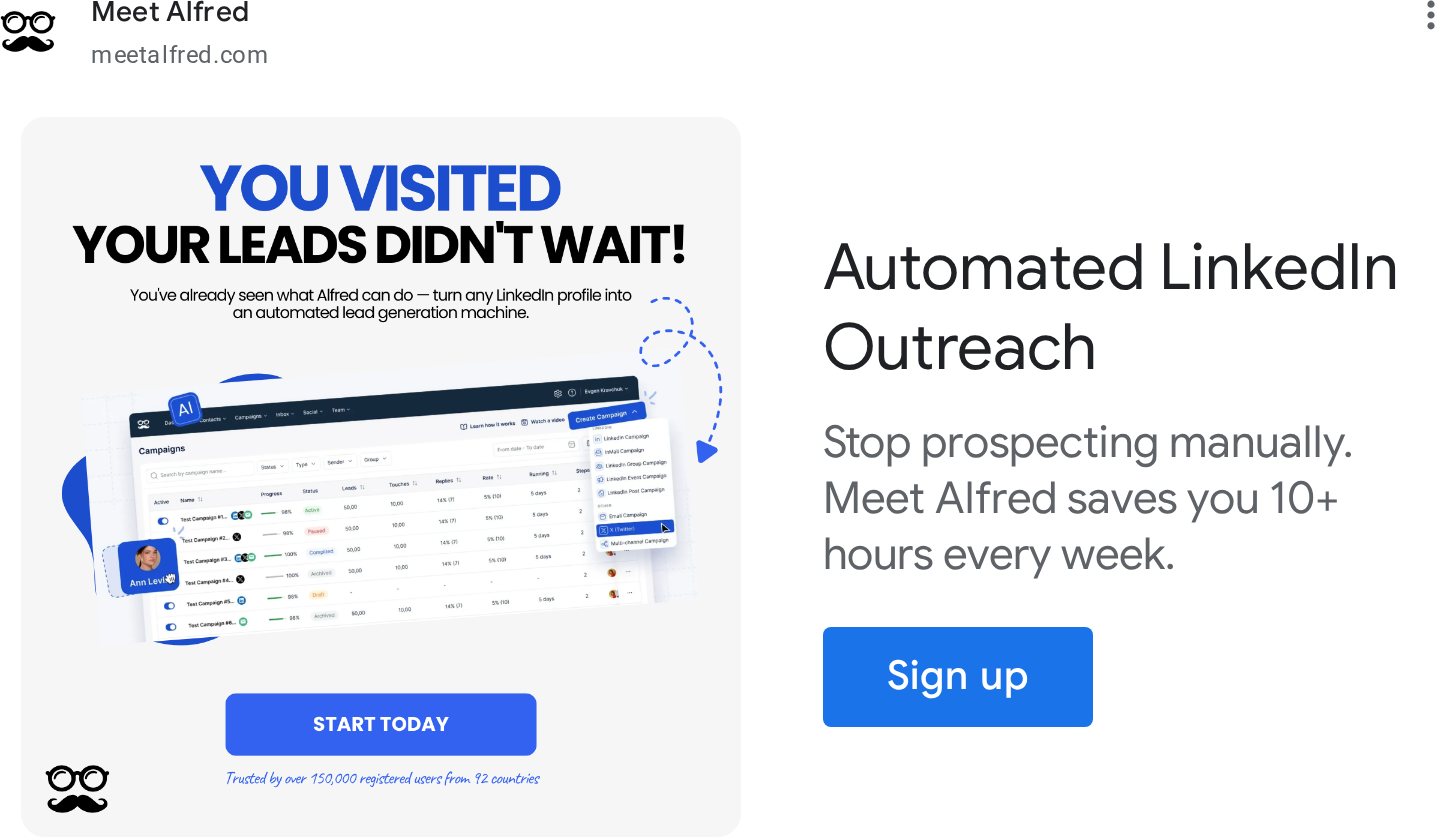
- "YOU VISITED YOUR LEADS DIDN'T WAIT!" with large blue and black text on a white background, above a screenshot of a software interface.
- CTA / offer
- Sign up
- Audience
- Individuals or businesses involved in lead generation and sales, particularly those using LinkedIn for outreach, indicated by the phrases "YOUR LEADS DIDN'T WAIT!", "automated lead generation machine", and "Automated LinkedIn Outreach".
Why it works. Problem-agitation with a solution-oriented value proposition to drive sign-ups for an automated LinkedIn outreach tool.
Direct address and problem agitation in the headline: "YOU VISITED YOUR LEADS DIDN'T WAIT!" Use a bold, direct headline that implies a missed opportunity or a problem the viewer might be experiencing, creating urgency and a desire to understand the context and solution.
07 The playbook
The channels are not separate. They are one system where each stage feeds the next. Here is the read, then the plays to run tomorrow.
The inferred playbook
Attention here mostly arrives through channels the company doesn't run itself, converts into a seat-priced trial, and compounds mainly through a commission incentive rather than owned content.
A prospect searching "Meet Alfred" or a LinkedIn-automation comparison term is as likely to hit an affiliate's Google ad or a Reddit comparison thread as anything the company published itself.
The funnel routes into a 7-day trial and then a seat-priced plan: $59/month Basic (LinkedIn only, 3 campaigns), $99/month Pro (adds email and X, Sales Navigator support), or $79/seat Team with a 3-user minimum (~$237/month floor), with no free tier.
Dig deeper+3▾
The affiliate program is self-reinforcing, since the recurring commission keeps attracting new affiliates hunting for that revenue share, but there is no visible compounding content or community asset sitting underneath it.
There is no founder-led audience, no active organic-content signal, and no launch-surface presence in this evidence, so the whole motion leans on channels the company only partly controls: affiliates, review sites, and word-of-mouth threads.
trial-to-paid conversion rate, seat-expansion or net-revenue-retention per account, and what share of new signups originate from affiliate-driven ads versus direct branded search.
Pay a recurring cut to turn users into advertisers
The proofMeet Alfred's 25% lifetime recurring commission has attracted independent Google advertisers who bid on the brand's own name to earn that cut, effectively outsourcing paid acquisition.
The adaptationSet up a straightforward affiliate program with a generous recurring percentage (20-30%) and a simple signup page, then personally recruit a handful of freelance media buyers or power users in your niche and hand them your own branded search terms as the easiest first campaign to run profitably. Track referrals through a basic affiliate tool rather than building anything custom.
Cost: under $500 · Time to signal: weeks · Works pre-PMF: conditional, needs a working payment and referral-tracking flow before affiliates will bother.
Launch as a lifetime deal to seed a base
The proofMeet Alfred's first real users came from a 2018 AppSumo lifetime deal sold under its earlier name, Meet Leonard, a cohort still surfacing publicly years later.
The adaptationPackage an early, capped lifetime-access offer and list it on a deal marketplace like AppSumo to generate upfront cash and a founding user base while the product is still rough, using the deal page itself as free top-of-funnel exposure. Cap the number of lifetime seats explicitly so the future support and hosting liability stays bounded.
Cost: $0 to list, revenue given up upfront · Time to signal: weeks · Works pre-PMF: yes, but caveat honestly: a lifetime deal is a one-time move that trades future recurring revenue and creates permanent support obligations, so don't repeat it as a recurring channel.
Answer comparison threads where buyers already argue about tools
The proofA 28-comment r/LinkedInTips thread evaluates Meet Alfred by name against competitors without any brand involvement, showing real buyer-intent conversation happening outside owned channels.
The adaptationSet up a saved search or alert for your product category plus "vs" and "alternative to" queries on Reddit, then show up with a specific, non-salesy answer to the actual technical question being asked, disclosing you work on the product if you mention it directly. Start with the two or three subreddits where your category is already being discussed.
Cost: $0 · Time to signal: days · Works pre-PMF: yes.
Turn a known product risk into a trust asset
The proofReviews.io, Capterra, and an AppSumo forum thread all surface unresolved complaints about LinkedIn account restrictions tied to Meet Alfred's automation, a friction point the company has not visibly addressed in its own content.
The adaptationIf your product carries an inherent platform or technical risk (rate limits, account flags, data loss), write a plainspoken page explaining exactly how you mitigate it and bake that explanation into onboarding and support replies, so a prospect finds your answer before they find a review site's version of it.
Cost: $0 · Time to signal: weeks · Works pre-PMF: yes.
Defend your own brand name in search
The proofThe surviving Google ad creative is almost entirely branded search text, "Meet Alfred," the bare URL, capturing people already typing the company's name rather than pitching a new category.
The adaptationOnce your product has a name people actually search, run a small daily budget on your exact brand name and close misspellings; branded CPCs are cheap and the intent is already high, and it keeps competitors or affiliates from being the first paid result on your own name.
Cost: under $500 · Time to signal: days · Works pre-PMF: conditional, only useful once there is a recognizable name people are actively searching for. Not transferable at an earlier stage: the affiliate-as-ad-network dynamic only kicks in once there's a proven per-seat price and payout system to make the commission worth chasing, and the Meet Leonard lifetime-deal cohort is company-specific history, not a motion to repeat.
You just read how meetalfred does it. Tomorrow it is someone else.
Every morning we take one company that is actually growing and break down where its customers come from: the ads still running after a year, the channel doing the real work, and the play you can run this week.
Systemaic · directional intelligence. Traffic, spend, and reach figures are SimilarWeb-style estimates and qualitative reads of public data, not audited numbers. Built on real public receipts.
// teardowns with a similar GTM motion
sources & receipts (17)
Live ad libraries: google ad library
Researched facts: Meet Alfred has raised no external funding (bootstrapped): $0 external funding raised; com · Founder identity: Martin Martinez is the founder of Meet Alfred · Founding origin story: Martin Martinez built the precursor to Alfred out of his consulting · Product was originally launched under a different name: Meet Alfred was previously known a · Current registered user base (company claim): Trusted by over 150,000 registered users fro · Earlier company-stated user count (conflicts with current 150,000 figure): Meet Alfred is · Trustpilot rating: 4.4/5 from ~923 reviews · G2 rating: ~3.3-3.4/5 from around 36 verified reviews · Basic pricing tier: $29/user/month billed annually ($59/month billed monthly); includes 3 · Affiliate/partner program exists with recurring commission: 25% recurring commission for t · Company actively promotes its affiliate/partner program on social: LinkedIn post framing t · Headquarters and company size: Headquartered in Dubai, UAE; 11-50 employees; founded 2017
Community threads: Reviews.io: Reviews.io user reports their LinkedIn account was restricted after using Meet · Capterra: Capterra reviewer titled their post about poor MeetAlfred support, describing un · AppSumo (community Q&A): On an AppSumo community forum thread about LinkedIn automation ri · G2: A positive G2 review shows the core draw: a non-technical user says MeetAlfred let the
Traffic, spend, and revenue figures are estimates as noted in the report; the links above are the primary public artifacts.