- 01Publish a channel audit, not a milestone
- 02Find your 3 super-affiliates before you build affiliate software
- 03Bid on "[competitor] alternative," not broad category terms
- 04Rewrite the hook and resubmit a flat launch post
01 Snapshot
The one-glance read on who they are and how they grow. Each point is verifiable from the receipts above.
A testimonial-collection SaaS (Wall of Love widgets, embeddable social proof, imports from 30+ sources) for creators and SaaS founders, built by a bootstrapped two-person team that crossed $1M ARR in November 2025, though cofounder Wilson Wilson left that year to start another venture and CEO Olly Meakings now runs it.
Founder-led, build-in-public.
~$83K MRR (crossing $1M ARR in November 2025), 3,000 paying customers, ~190,400 monthly visits, and a founder X following of 25,417.
Cofounder Olly Meakings on hitting a plateau: "We have a bunch of marketing channels that work for Senja, but we can't scale any of them," naming paid CAC, a "powered by" badge test, and branded-only SEO signups as the specific dead ends (April 2025 post).
Growth here isn't one viral engine, it's a founder who publicly tests channels to failure and reallocates hard, capping paid the moment CAC breaks and pushing the freed budget into a three-affiliate core that alone has generated over $220,000.
02 How it unfolded
The order the channels came online. Sequence is strategy: what they did first, and what they layered on once demand existed.
03 Traffic & channel mix
Estimated demand, the channel split behind it, and the keywords and referrers doing the work. Directional modeling, not audited analytics.
Traffic sources
Top search keywords
| Keyword | Volume | Weight | CPC |
|---|---|---|---|
| senja | 14k | $1.02 | |
| senja testimonials | 530 | - | |
| senja.io | 860 | - | |
| heygen | 1.8M | $0.57 | |
| testimonials wall of love | 320 | - |
Top referring sites
Closest competitors by audience
Senja pulls an estimated ~190,400 monthly visits, down 11.1% over the last 3 months as of 2026-07-11. Direct traffic dominates at 66.4% of the mix, well ahead of Referrals (14%) and Organic Search (10%); the rest, paid search, email, organic social, generative-AI referrals, display, affiliate, and paid social, together account for the remaining ~9.6%. That direct share is unusually high for a company this size, and it lines up with Senja's own product mechanic: its testimonial widgets embed on customers' own sites, so visitors likely arrive by typing "senja.io" directly after spotting the tool on someone else's page rather than discovering it through search.
The keyword data reinforces the founder's own SEO read: "senja" pulls 14,140 monthly searches and "senja.io" pulls 860, both branded, while the category term "testimonials wall of love" draws only 320. That gap matches Olly Meakings' own admission that SEO signups are mostly branded-term traffic, not category-level demand capture. Among referrers, starterstory.com stands out as an earned-media placement (a startup case-study site), stripe.com plausibly reflects Senja's own Stripe-integration feature rather than a marketing referral, and nmqf.org is a minor, unclear-fit referrer with no obvious tie to the product. On the competitive side, testimonial.to is the direct head-to-head rival referenced throughout public discussion of the category; loox.app is a Shopify-focused review app in an adjacent e-commerce niche rather than a true rival; and yext.com sits in enterprise reputation management, a much larger, differently-priced category, suggesting Senja's keyword competitive set is wider than its actual bootstrapped-micro-SaaS peer group.
04 Organic content
The specific pages earning their organic search traffic, and the pattern behind why they rank. Adapt the format, not the topic.
Senja's top organic pages skew toward bottom-funnel guide and comparison content: a video-testimonial how-to, a roundup of review-page examples, and a "best social proof tools" listicle, alongside a dedicated testimonial-questions page. The pattern is classic programmatic-adjacent content marketing for a tool category: how-to guides and "best of" roundups that a searcher hits while actively evaluating testimonial software rather than top-of-funnel brand awareness pieces. That format ranks well because it matches high-intent, low-competition long-tail queries (Senja holds the #1 spot for "social proof tools" and "video testimonial tool") where a dedicated product blog with real screenshots outcompetes generic SEO content mills.
Top pages by organic traffic
05 Channel map
Not traffic share. How much weight the growth system actually puts on each channel, with a one-line read on the role it plays.
What drove growth
06 The motions doing the work
For founder-led SaaS the breakdown shifts from ads to traction: where the first users came from, how the founder grows it in the open, and the compounding organic surface.
Senja's early traction came less from a single launch spike than from cofounders repeatedly publishing build-in-public essays and milestones until the audience compounded around them.
The first public artifact was "From $0 to $250 MRR. How We Broke Out of Absolute Zero," submitted to Hacker News in November 2022 and drawing 4 points, a modest start that set the recurring build-in-public cadence the founders kept for years.
Cofounder Wilson Wilson resubmitted a "live chat is killing our SaaS" essay to Hacker News twice within about a week in May 2023 (8 points, then 4 points on the retry), persistence that never actually broke through on that channel.
Dig deeper+2▾
The founders' own #buildinpublic tweets tracked the actual growth curve, from 100 to 1,500 paying customers in under 18 months by September 2024, up to 3,000 customers and $1M ARR by November 2025 (605 likes, the highest-engagement post in the evidence), showing X, not Hacker News, as the channel that actually carried the story.
Cofounders also used Product Hunt to launch smaller companion tools like "Spin the Wheel by Senja," an incentive widget for boosting testimonial collection, per their own launch video, though no upvote or comment data for that or any core-product launch is visible in public sources.
Senja's growth voice runs almost entirely through cofounder Olly Meakings' personal X account rather than the brand handle, built on granular, numbers-first transparency rather than generic updates.
The company was originally built by cofounder Wilson Wilson, who departed in 2025 to start another venture; day-to-day and public-facing growth now run through cofounder and CEO Olly Meakings, whose @helloitsolly account (the 25K-plus following noted above) is the verified build-in-public distribution channel, distinct from @SenjaHQ.
His posts favor hard numbers over vague updates, from a $65,000 MRR post in April 2025 (200 likes) admitting real channel plateaus, up through the $1M ARR milestone covered above, each post reading as its own case study rather than a routine update.
Dig deeper+2▾
Rather than cheerleading, he publishes his own attribution audits in public, naming exactly which channels scale (a concentrated affiliate base sending nearly all referrals) and which don't (paid CAC breaking past a certain spend, a "powered by" badge test already run multiple times), turning internal marketing data into the content itself.
A 2023 post about a new pricing page the #buildinpublic crowd initially "hated" pulled 83,285 views, his highest reach in the evidence, showing that publicly defying community consensus drove more attention than any milestone announcement.
Organic search is a small, secondary slice of Senja's channel mix relative to direct and referral traffic (covered above), and the company's investment matches that: a blog aimed at bottom-funnel guides rather than a broad content operation.
The FirstPromoter-powered program at /affiliates, once concentrated in three partners, has generated over $220,000 to date per Olly Meakings' own account, and the cofounders are now shopping for new affiliate software specifically to scale it toward $1,000,000, making this the one distribution channel they're actively reinvesting in.
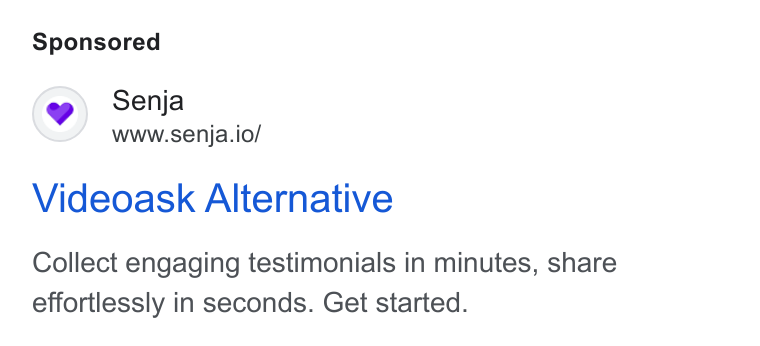
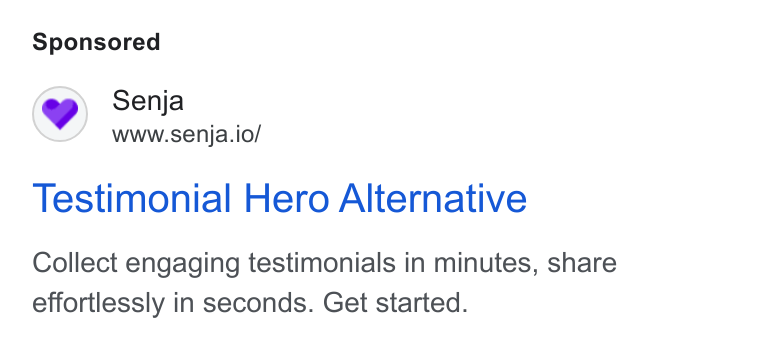
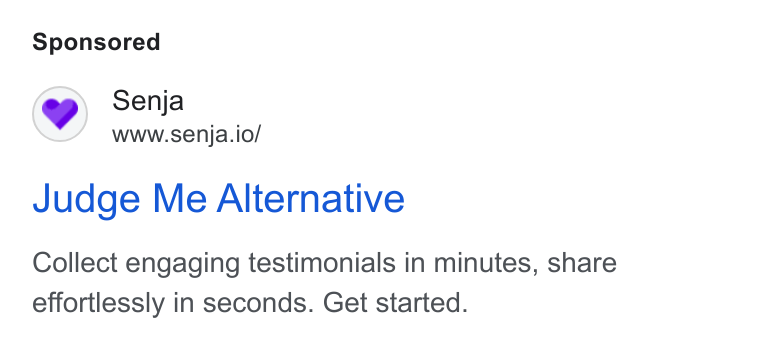
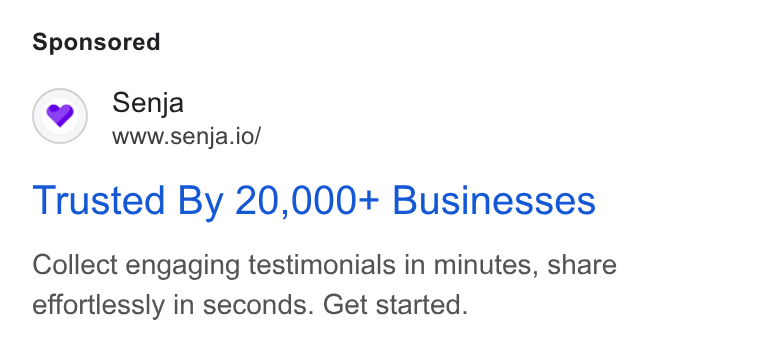
8 of the 11 total Google ads tracked remain active as of 2026-07-11, with the longest-running active ad live roughly 941 days; the creative set pairs a "Trusted By 20,000+ Businesses" trust badge with competitor-alternative capture ads ("Videoask Alternative," "Testimonial Hero Alternative," "Judge Me Alternative"), consistent with the founder's own statement that scaling paid spend breaks their CAC math, so the budget stays parked on bottom-funnel comparison intent instead.
Dig deeper+1▾
Beyond the guide pages covered above, there's no visible programmatic directory, integrations hub, or open-source asset compounding discovery, so a reader trying to adapt this motion should not expect SEO to be the primary lever here, the affiliate and paid-defense plays are.
07 Paid ads
This founder-led SaaS also runs paid acquisition. Here are the live ads doing the work, each with the X-ray and a play you can adapt.
- Running
- 506 days (longevity = it's converting)
- Hook
- Sponsored Senja www.senja.io/ Videoask Alternative
- CTA / offer
- Get started.
- Audience
- Individuals or businesses looking for a tool to collect testimonials, specifically those familiar with or seeking an alternative to 'Videoask'.
Why it works. Captures switching intent from Videoask's own branded search traffic instead of competing on generic keywords.
Direct competitor targeting in headline: 'Videoask Alternative' Buy a search ad on your closest named competitor's brand keyword with the headline '[Competitor] Alternative'.
- Running
- 507 days (longevity = it's converting)
- Hook
- Visual: The word "Sponsored" at the top left, followed by a purple heart icon next to "Senja" and "www.senja.io/". Text: "Testimonial Hero Alternative"
- CTA / offer
- Get started.
- Audience
- Businesses or individuals looking to collect and share testimonials, indicated by the phrase "Testimonial Hero Alternative" and the description of the service.
Why it works. Poaches a named rival's branded search traffic instead of paying for broad, expensive category keywords.
Directly addressing a competitor or existing solution: "Testimonial Hero Alternative" Run a second alternative ad against another named competitor's brand keyword, mirroring your first one.
- Running
- 506 days (longevity = it's converting)
- Hook
- Sponsored Senja www.senja.io/ Judge Me Alternative
- CTA / offer
- Get started.
- Audience
- Businesses or individuals looking to collect and share testimonials, specifically those using or considering 'Judge Me' (implied by 'Judge Me Alternative').
Why it works. Repeats the named-competitor-alternative play across multiple rivals to compound cheap, high-intent switching traffic.
Direct competitor targeting: 'Judge Me Alternative' List every named competitor in your space and set up one '[Competitor] Alternative' search ad for each this week.
Show 1 more ad
- Running
- 331 days (longevity = it's converting)
- Hook
- Sponsored Senja www.senja.io/ Trusted By 20,000+ Businesses
- CTA / offer
- Get started.
- Audience
- Businesses looking to collect and share testimonials, indicated by 'Trusted By 20,000+ Businesses' and the description of collecting testimonials.
Why it works. Turns a search ad into a numbers proof point so testimonial-shy buyers see scale before they see the product.
Displaying a large number of users: 'Trusted By 20,000+ Businesses'. Put your exact customer count in the headline of your Google search ad this week, replacing any generic tagline.
08 The playbook
The channels are not separate. They are one system where each stage feeds the next. Here is the read, then the plays to run tomorrow.
The inferred playbook
The loop starts with Olly Meakings' public numbers on X, converts through the product's own embedded distribution, and compounds through a concentrated affiliate core, with paid spend deliberately capped rather than scaled.
Personal X milestones (the $1M ARR post covered above) create visibility that converts when readers click through to try the actual embed-based product rather than a separate funnel.
A handful of affiliates historically drove nearly all referral volume, an engine now scaled to $220K generated (both covered above), making it the single most actively-optimized channel in the mix.
Dig deeper+3▾
Google ads stay real but capped, functioning as competitor-alternative and brand-defense capture (covered above) rather than scaled acquisition, matching the founder's own stated CAC ceiling.
Public Reddit discussion shows at least one rival builder explicitly mining negative reviews of Senja's free-tier limit (15 testimonials) and pricing to design a competing product, a distribution threat Senja's own metrics can't see coming.
free-to-paid conversion rate, churn rate, CAC, and blended ARPU across the $29 Starter and $59 Pro tiers.
Publish a channel audit, not a milestone
The proofThe April 2025 channel-audit tweet covered above, naming affiliates as the working lever and paid as capped, pulled 79 replies, more engagement than a typical update.
The adaptationWrite your own honest channel-by-channel breakdown instead of a vanity update: list every acquisition channel you tried in the last quarter, one line each on what actually happened, and post it to wherever your build-in-public audience already lives. Readers engage with real attribution data because it's rare and useful, not because it flatters you.
Cost: $0 · Time to signal: days · Works pre-PMF: yes
Find your 3 super-affiliates before you build affiliate software
The proofThree affiliates historically drove nearly all of Senja's referral volume, a concentration now scaled to $220K generated (covered above).
The adaptationSkip the affiliate platform on day one. Identify the 3-5 people already recommending your product unprompted, in DMs, reviews, or community posts, and offer each a direct revenue-share deal by hand before any software is involved. The mechanism: a handful of motivated, aligned partners outperform a wide, unmanaged affiliate network, and you only need infrastructure once a few relationships prove the model.
Cost: $0 to start, dedicated budget or hire once you add software · Time to signal: weeks · Works pre-PMF: conditional, only if you already have a few organic advocates to approach
Bid on "[competitor] alternative," not broad category terms
The proofSenja's longest-running active Google ads (covered above) target searches like "Videoask Alternative" and "Judge Me Alternative" rather than broad category keywords.
The adaptationList your top 3-5 named competitors and run a small, tightly-scoped ad campaign bidding only on "[competitor] alternative" and "[competitor] vs [you]" terms, capping daily spend low since this is bottom-funnel, high-intent traffic rather than demand generation. Start with one campaign, three ad groups, and a comparison page for each competitor.
Cost: under $500 · Time to signal: weeks · Works pre-PMF: conditional, only if you have a genuine point of differentiation to put in the ad copy
Rewrite the hook and resubmit a flat launch post
The proofA cofounder resubmitted a low-traction essay to Hacker News twice within about a week in 2023 (covered above), treating a flat result as a draft rather than a verdict.
The adaptationTake your last low-engagement launch or blog post, change only the headline and opening hook, and repost it to the same or an adjacent community a week or two later. Caveat: some communities flag or penalize repeated resubmissions as spam, so space attempts out and vary the framing meaningfully rather than reposting verbatim.
Cost: $0 · Time to signal: days · Works pre-PMF: yes
Build the one output customers already screenshot into an embed
The proofSenja's testimonial widgets embed on customers' own sites, consistent with the high direct-traffic share covered above.
The adaptationIdentify the single output of your product that customers already screenshot or share (a report, a badge, a small chart, a result), and ship a lightweight embeddable version of it with a visible link back to you. This turns every customer's site into a discovery surface for you without any ad spend.
Cost: under $5k in dev time, or $0 if you build it yourself · Time to signal: months · Works pre-PMF: conditional, needs a product with a visually shareable output Not transferable at an earlier stage: the $220K affiliate program and the 941-day proven Google ad both depend on years of accumulated trust and volume Senja already has; a reader at day one should adapt the seeding mechanics in Plays 2 and 3, not expect the same scale or ad longevity immediately.
You just read how Senja does it. Tomorrow it is someone else.
Every morning we take one company that is actually growing and break down where its customers come from: the ads still running after a year, the channel doing the real work, and the play you can run this week.
Systemaic · directional intelligence. Traffic, spend, and reach figures are SimilarWeb-style estimates and qualitative reads of public data, not audited numbers. Built on real public receipts.
// teardowns with a similar GTM motion
sources & receipts (6)
Live ad libraries: google ad library
Launch archives: Hacker News: Live chat is killing our SaaS. Here's why we're ditching it · Hacker News: From $0 to $250 MRR. How We Broke Out of Absolute Zero · Hacker News: Analyze 1000s of your customer reviews in seconds with AI. B · Hacker News: Launched Senja.io Alternative, Reviewnicely · Hacker News: How Louis uses Testimonials for a B2C app with 10k users
Traffic, spend, and revenue figures are estimates as noted in the report; the links above are the primary public artifacts.