- 01Answer the exact doubt query
- 02Turn your weakest attribute into a concrete number
- 03Run a recurring "can I use this for X" content series
- 04Seed disclosed creator partnerships in adjacent niches
01 Snapshot
The one-glance read on who they are and how they grow. Each point is verifiable from the receipts above.
An electric countertop composter for home food waste, built by sustainability brand Pela, with press and social coverage pegging annual revenue at $30M+ as of June 2026 (unverified, not confirmed by independent metrics).
Paid-search-led with creator-seeding support on Instagram; the brand's actual Meta ad presence couldn't be located, detailed below.
~89,000 monthly visits (essentially flat, +0.2% over the last 3 months); a 51-ad Google Ads library (4 active) as of 2026-07-29, longest active ad running ~1,631 days; a 2021 Indiegogo campaign that raised over $6.8M from 18,000+ backers.
Google's active test slot as of 2026-07-29 is a 69-day-old text ad attributed to an individual advertiser name rather than the corporate entity, alongside a wave of video-ad tests from November 2025 that have since gone inactive.
The durable lever isn't the paid-social scale the brand's own press narrative implies, it's a multi-year Google search-ad library answering literal "what can I compost" questions, while a separate Facebook page that merely shares the Lomi name (not Lomi's real page, facebook.com/meetlomi) runs unrelated air-conditioner creative, meaning Lomi's actual Meta ad presence couldn't be located in this evidence.
02 Traffic & channel mix
Estimated demand, the channel split behind it, and the keywords and referrers doing the work. Directional modeling, not audited analytics.
Lomi draws an estimated ~89,000 monthly visits, roughly flat at +0.2% over the last 3 months. No channel-level breakdown, keyword list, referrer data, or competitor set accompanied this traffic pull, so the mix can't be segmented further, only the aggregate and its trend are verifiable here.
03 Channel map
Not traffic share. How much weight the growth system actually puts on each channel, with a one-line read on the role it plays.
What drove growth
04 The creative doing the work
Each exhibit shows the actual asset, an X-ray of why it works, a status, and a play you can adapt. This is the heart of the teardown.
Lomi's real paid-search footprint is a 51-ad Google library with 4 active as of 2026-07-29; the longest-running active ad has been live for ~1,631 days, a genuine proven winner by longevity even though its creative text wasn't captured. Separately, Google's proven-winner bucket includes text ads whose copy was captured but not individually dated, so the deconstructions below draw on that bucket's longevity as a group rather than claiming a specific day count per creative.
-
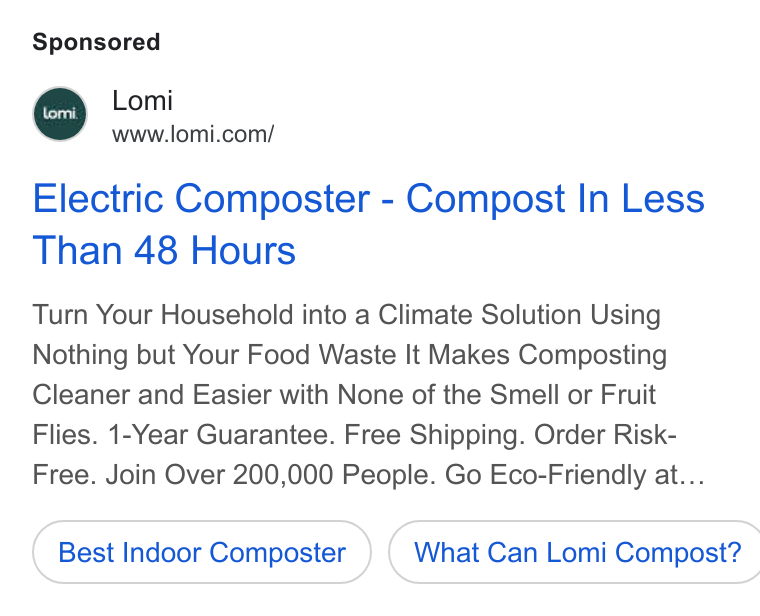
Hook: "Electric Composter - Compost In Less Than 48 Hours." Why it works: Composting's biggest objection is that it takes weeks and smells bad; collapsing that into a specific, concrete "48 hours" kills the objection in the headline itself, before the click. Run this play: expanded as Play 2 below.
-
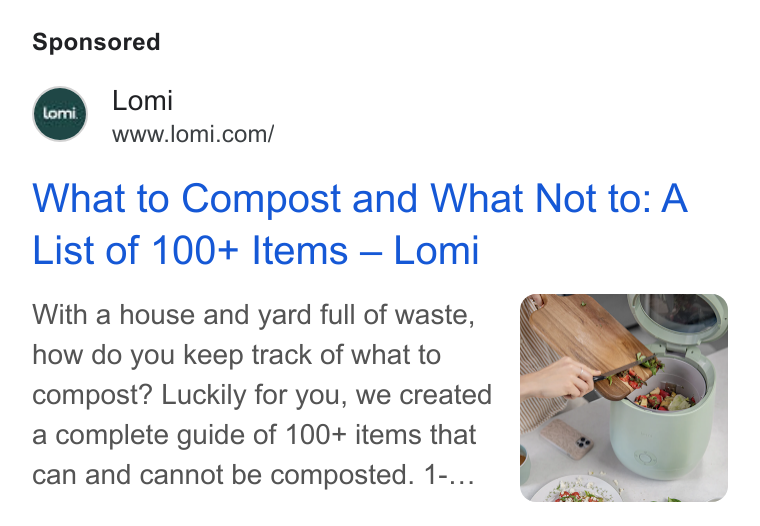
Hook: "What to Compost and What Not to: A List of 100+ Items, Lomi." Why it works: This matches the exact confused-consumer search query ("can I compost X") rather than a generic product pitch, capturing pre-purchase research traffic and using a specific number (100+) to signal thoroughness. Run this play: expanded as Play 1 below.
-
Hook: "40% Off Lomi Today - Thousands of 5-Star Reviews." Why it works: It stacks two objections into one line, price and trust, pairing a discount with a specific (unverified, the ad's own claim) review-count figure to push a hesitant buyer over a $400+ price point. Run this play: Pair a specific discount percentage with a specific social-proof number in the same headline rather than running them as separate messages; the compounding effect works because each claim answers a different hesitation (cost, risk) in the same glance.
Also in their winning rotation (all from Google's long-running search-ad bucket, individual day counts not available):
- [text ad] · "Lomi: Fresh Kitchen Vibes - Smart Trash Solutions" · lifestyle/curiosity angle
- [text ad] · "Kitchen Countertop Food Recycler | Lomi" · category-defining angle
- [text ad] · "Lomi Home Composter - The New Family Pet" · humanizing/curiosity angle
- [text ad] · "How To Speed Up Composting: 15 Ways to Get Faster Results" · educational how-to angle
- [image ad] · "Lomi 2 Home Composter - Space Saving Food Recy..." · product-shot angle
- [image ad] · "YOUR FOOD WASTE'S WORST NIGHTMARE" · bold-claim/problem-agitation angle
Against that long-running library, Google's active test as of 2026-07-29 is a 69-day text ad attributed to an individual advertiser name rather than the corporate entity, a reseller-attribution pattern rather than a new creative concept, while a batch of video-ad tests from November 2025 (37 to 54 days each) have all since gone inactive without graduating to the winner bucket.
- Running
- 663 days (longevity = it's converting)
- Hook
- Sponsored Lomi www.lomi.com/ Electric Composter - Compost In Less Than 48 Hours
- CTA / offer
- 1-Year Guarantee. Free Shipping. Order Risk-Free.
- Audience
- Individuals concerned with environmental impact and household waste, seeking convenient solutions, indicated by phrases like "Climate Solution" and "Go Eco-Friendly".
Why it works. Leads with a specific, checkable speed number to win clicks from shoppers comparing composting timelines.
Headline with a specific, time-bound benefit: "Electric Composter - Compost In Less Than 48 Hours" Swap any vague speed or ease claim in your headline for the exact number of hours or steps involved.
- Running
- 658 days (longevity = it's converting)
- Hook
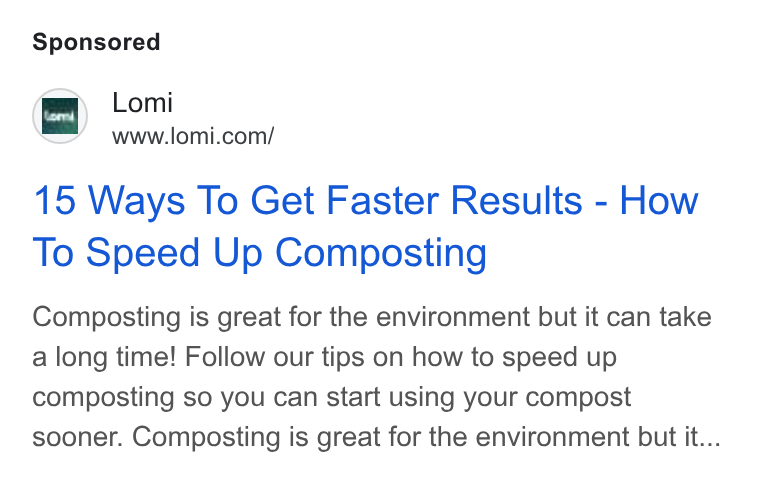
- Sponsored Lomi www.lomi.com/ 15 Ways To Get Faster Results - How To Speed Up Composting
- Audience
- Individuals interested in composting and environmental sustainability, specifically those looking for ways to make the process quicker and more efficient, as indicated by the ad's focus on 'speed up composting' and 'faster results'.
Why it works. Targets people actively searching for composting speed fixes with a listicle headline that mirrors their search intent.
Headline promises specific, actionable advice: '15 Ways To Get Faster Results - How To Speed Up Composting' Turn your product's top troubleshooting question into a numbered listicle headline for search campaigns.
- Running
- 657 days (longevity = it's converting)
- Hook
- Sponsored" with a small circular logo for "Lomi" and the text "Lomi www.lomi.com/" below it. The main headline "What to Compost and What Not to: A List of 100+ Items – Lomi" is partially visible.
- Audience
- Homeowners or individuals concerned with waste reduction and composting, indicated by the text "With a house and yard full of waste" and the topic of composting.
Why it works. Answers the number one beginner question, what's compostable, with a quantified list to draw in undecided searchers.
Headline posing a common problem and promising a solution: "What to Compost and What Not to: A List of 100+ Items – Lomi" Quantify your how-to guide with an exact item count so searchers know the answer is comprehensive before clicking.
Show 6 more exhibits
- Running
- 700 days (longevity = it's converting)
- Hook
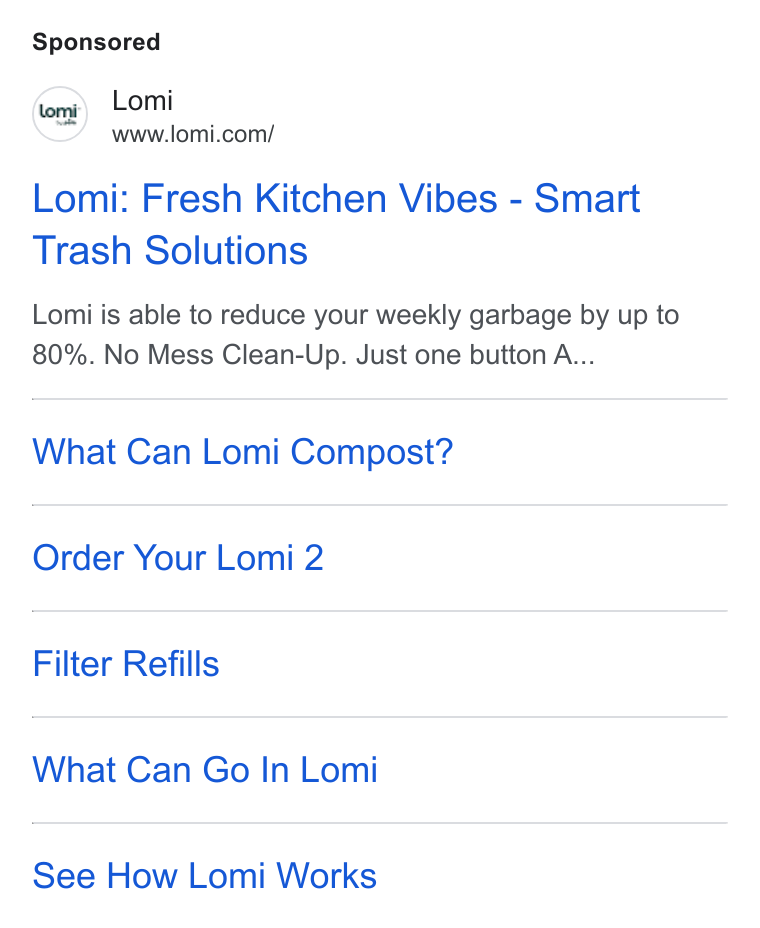
- Sponsored Lomi www.lomi.com/ Lomi: Fresh Kitchen Vibes - Smart Trash Solutions
- Audience
- Individuals interested in reducing household waste and seeking convenient, clean solutions for kitchen waste management, indicated by phrases like 'reduce your weekly garbage by up to 80%' and 'No Mess Clean-Up'.
Why it works. Combines an emotional kitchen-freshness promise with a clear category label so search users know what Lomi is before clicking.
Headline with benefit and product category: 'Lomi: Fresh Kitchen Vibes - Smart Trash Solutions' Pair one sensory benefit word with your plain category label in the same headline so new visitors know what you sell without clicking through.
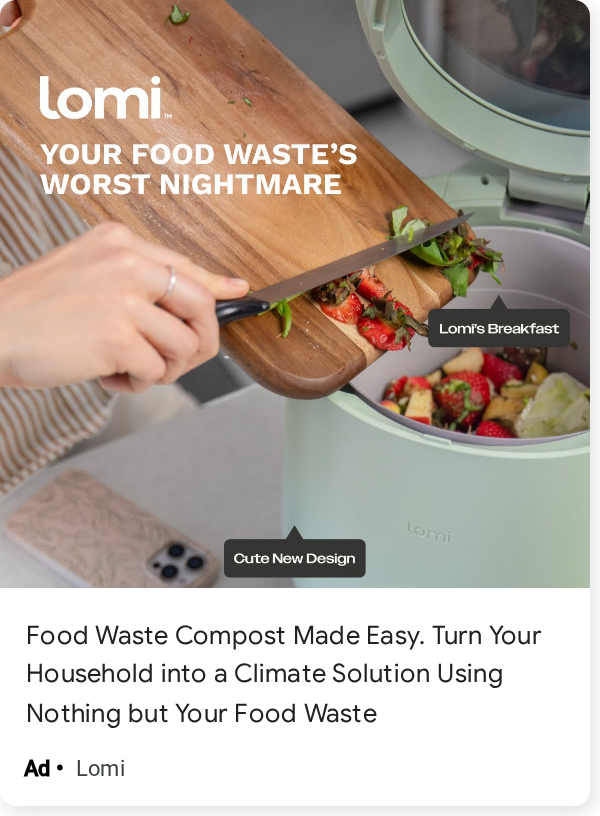
- Running
- 663 days (longevity = it's converting)
- Hook
- "Lomi YOUR FOOD WASTE'S WORST NIGHTMARE" overlaying a hand scraping food scraps from a wooden cutting board into a light green Lomi composter.
- Audience
- Environmentally conscious individuals who generate food waste and are looking for convenient, in-home solutions, indicated by the text "Turn Your Household into a Climate Solution Using Nothing but Your Food Waste."
Why it works. Positions Lomi as a threat to food waste rather than a passive tool, standing out from milder eco messaging in the category.
Bold, provocative headline: "Lomi YOUR FOOD WASTE'S WORST NIGHTMARE" is prominently displayed at the top of the image. Cast your product as the enemy of the exact problem it solves, rather than as a neutral helper, in your primary headline.
b-roll voiceover
- Hook
- Visual: A hand pours chickpeas from a can into a metal strainer over a clear glass bowl, with chickpea water draining into the bowl. Text overlay: "I've transformed chickpea water". Audio: "I've transformed chickpea water."
- Audience
- Individuals concerned with food waste, sustainability, and gardening. The initial examples of creative food waste repurposing suggest an audience interested in DIY and eco-conscious living. The mention of '40% of food in the US ends up in the trash' targets those aware of environmental issues.
Why it works. Speaks to people already saving scraps, showing the leftover chickpea water case those imperfect habits still leave unsolved.
Problem-agitation with relatable examples: The video starts by showing creative ways to repurpose food waste ("I've transformed chickpea water into marshmallows", "mushy berries into fruit leather", "strawberry tops into vinegar" at 0:00-0:10), then immediately pivots to the core problem: "but I still inevitably have some food scraps" (0:10-0:12). Show your audience's current partial fix for the problem first, then reveal the harder leftover case your product still solves.
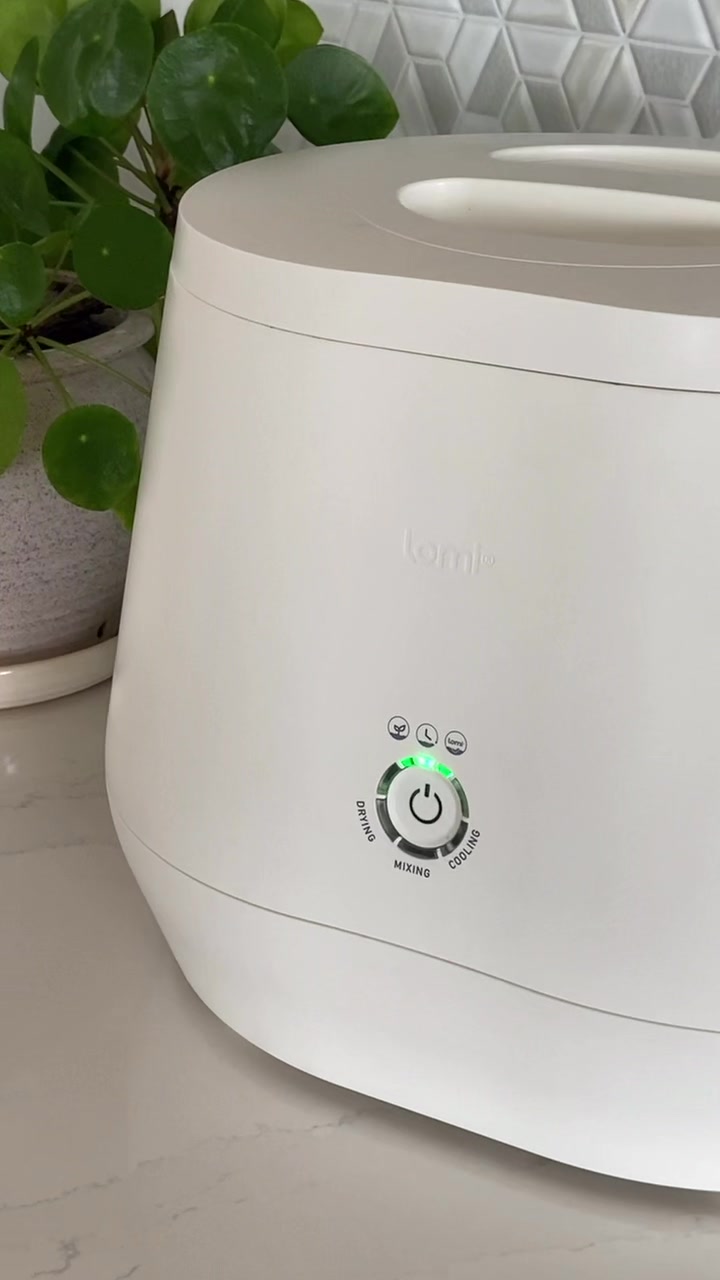
- Hook
- "Show me something that you spent way too much money on, but don't regret it at all because it's freaking sick." A person's feet in slippers walking on a light wood floor, followed by a dog's paws.
- Audience
- The mention of 'way too much money' and 'don't regret it at all' targets individuals who are willing to invest in quality products that provide significant value or convenience, particularly those interested in sustainable living or kitchen gadgets.
Why it works. Piggybacks a trending comment prompt so the ad plays as a real owner's answer instead of a scripted product pitch.
Personal endorsement with a bold claim (0:00-0:03): The video opens with a voice saying, "Show me something that you spent way too much money on, but don't regret it at all because it's freaking sick." Find a comment-prompt trend already circulating in your niche and answer it on camera with your product as the punchline.
product demo
- Hook
- "This is Lomi." A hand drops a banana peel into a white Lomi device.
- Audience
- Individuals concerned about food waste and environmental impact, home gardeners, people seeking convenient composting solutions. Signaled by showing food waste, the composting process, and the use of the resulting dirt for plants.
Why it works. Uses one ordinary action, a banana peel going into the device, to make an unfamiliar appliance instantly legible to anyone who scrapes plates into the trash daily.
Problem-solution demonstration (0:00-0:09): The video starts by showing food waste going into Lomi and then immediately shows the resulting 'nutrient rich dirt'. Open your product video with one ordinary hand movement using the item, no voiceover explanation yet, so viewers watch on to find out what it does.
- Reach
- 7 upvotes · 24 comments · r/ZeroWaste
A community is already discussing this in r/ZeroWaste. Show up there authentically and answer the thread before a competitor does.
Who amplifies them
The highest-performing single piece of content in the evidence is a disclosed sponsored Reel from @plantyou ("Scraps happen... At the push of a button, leftovers become plant food"), pulling ~17,000 engagements, roughly eight times the brand's own best post. Other named creators run smaller but real disclosed partnerships: @sizzlingeats (1,445 engagements, tagged "#Gifted"), @i_am_mariah (305 engagements, tagged "#LomiPartner," a named partner-program hashtag), @behappyfoodie (232), @middle_manda (88), and @tracweaver (16, tied to a Costco Lomi 3 launch bundle). Reddit adds organic, unpaid word-of-mouth in r/ZeroWaste and r/composting, both mention-level and mixed: one thread weighs the purchase before buying, the other asks for alternatives after a bucket broke. No founder personal posting activity appears anywhere in the evidence, everything traced here is either the brand's own account or a named third-party creator.
05 Organic & video
The organic content engine: the videos, creator posts, and community presence earning attention without paid spend.
The brand's own Instagram runs a recurring "can you compost X" myth-busting Reel format, cycling through eggs, mushrooms, cabbage, chicken wings, and watermelon rinds. Its best post ("Not sure what can go in your Lomi?") pulled 2,119 engagements, and its core explainer ("Meet Lomi, the world's first smart waste food recycler") sits at 513. That format, answer a specific "can I put this in Lomi" doubt, repeats often enough across the sample that it's clearly the brand's default content engine, not a one-off. TikTok shows only a single 2022 post (7,896 engagements) with no visible follow-through since. The standout piece of video content in the whole dataset isn't owned at all: a disclosed sponsored creator Reel outperformed everything the brand posted itself, detailed under Who Amplifies Them below.
06 Affiliate & partners
How the brand turns creators and partners into a tracked, variable-cost acquisition channel, and how the program is structured.
The "#LomiPartner" hashtag on @i_am_mariah's post is the clearest signal of a named creator-partner program, alongside the "#Gifted" and "AD" disclosures on other creator posts, indicating a seeding/affiliate motion running through Instagram creators rather than a self-serve program. No dedicated referral-program link (Rewardful, PartnerStack, or similar) was found in the owned-site evidence, only a homepage link to the brand's Instagram profile, so the partner motion looks manually managed rather than platform-run.
07 The playbook
The channels are not separate. They are one system where each stage feeds the next. Here is the read, then the plays to run tomorrow.
The inferred playbook
Lomi's acquisition engine runs on two disconnected tracks: a multi-year Google search-ad library that captures composting intent of doubt, and a creator-seeding motion on Instagram that occasionally produces breakout organic reach, while the brand's actual Meta ad presence couldn't be located in this evidence (the only Lomi-named ad page found is an unrelated name-twin).
The 51-ad Google library, with an active ad running ~1,631 days, is built almost entirely around answering specific composting questions ("what to compost," "how to speed up composting") rather than brand awareness, suggesting Lomi wins on matching literal search intent more than on creative novelty.
The plantyou sponsored Reel's ~17,000 engagements against the brand's own 2,119-engagement ceiling show that disclosed creator partnerships, not the owned Instagram account, are the actual reach engine.
Dig deeper+3▾
Independent reviews (Trustpilot, Thingtesting, the Better Business Bureau) describe an undisclosed-feeling quarterly subscription and slow warranty response on a broken unit, friction that sits underneath the top-of-funnel content and could be quietly working against retention and referral even while search and creator content perform.
The only Lomi-named Meta ad page located serves unrelated air-conditioner creative and is a name-twin, not Lomi's page (facebook.com/meetlomi), so the "Meta + TikTok" scaling story in outside coverage can't be verified or deconstructed from this evidence.
the renewal/attach rate on the LomiPod and filter subscription that reviewers flag as a friction point, the blended CAC across DTC versus retail (Costco, Walmart per third-party reporting) versus the unreadable Meta channel, and genuine paid-social performance given the account anomaly noted above.
Answer the exact doubt query
The proofLomi's "What to Compost and What Not to: A List of 100+ Items" ad matches the literal pre-purchase research query instead of pitching the product.
The adaptationWrite down the single most common "can I even use this for X" doubt your own prospects search before buying, then build one search ad and one landing page around that exact phrase, using a specific number (a count of items, use cases, or scenarios covered) the way Lomi used "100+ items" to signal thoroughness. Launch it as a narrow, single-query campaign rather than a broad brand campaign so you can read intent-matched clicks separately from awareness clicks.
Cost: under $500 · Time to signal: weeks · Works pre-PMF: yes, provided you already know the specific objection query from support tickets or sales calls; guessing at the query wastes the spend.
Turn your weakest attribute into a concrete number
The proofLomi's "Compost In Less Than 48 Hours" ad reframes composting's biggest perceived downside (it takes forever) into a specific, falsifiable time claim.
The adaptationIdentify the one attribute of your product prospects are most skeptical about (too slow, too complicated, too expensive to run) and rewrite your top ad or landing headline around a specific, verifiable number that answers that exact skepticism, not a vague superlative. Test it as a straight headline swap against your current best-performing ad copy so you can isolate whether the number-based claim moves clicks.
Cost: $0 · Time to signal: days · Works pre-PMF: yes.
Run a recurring "can I use this for X" content series
The proofgetlomi's Instagram Reels repeatedly answer narrow doubts (eggs, mushrooms, cabbage, chicken wings) in the same short format, and it's the brand's most consistent content engine even though its ceiling (2,119 engagements) is far below a good creator partnership.
The adaptationList the five to ten most common "does this work for X" questions your own support inbox or reviews surface, then film one short vertical video per question using the same repeatable structure (state the doubt, show the answer, one-line payoff). Post them as a numbered or hashtagged series so they compound as a searchable FAQ library rather than one-off posts.
Cost: $0 · Time to signal: weeks (a single post rarely proves the format; the series needs several entries to show whether it compounds) · Works pre-PMF: yes.
Seed disclosed creator partnerships in adjacent niches
The proofA single disclosed sponsored post from a plant-based food creator outperformed everything on Lomi's own account, the gap covered under Who Amplifies Them above.
The adaptationIdentify three to five creators in a niche adjacent to your product, not your exact category, who already talk about the problem your product solves, and offer them the product plus a flat fee or affiliate code in exchange for one disclosed post shot in their own format (not brand-scripted). Prioritize creators whose recent posts already get organic engagement in the low thousands over larger accounts with weak engagement, since Lomi's outperformer was a mid-size, content-relevant creator, not a mega-influencer.
Cost: under $500 (product cost plus a modest flat fee) · Time to signal: weeks · Works pre-PMF: conditional, it depends on having a physical or demoable product a creator can film honestly.
Fund a first production run with a rewards-crowdfunding launch
The proofLomi's 2021 Indiegogo campaign raised over $6.8M from 18,000+ backers, funding initial production without a priced equity round.
The adaptationIf you're bringing a new physical product to market, build a preorder crowdfunding page with a fixed early-bird discount off eventual retail price (early-bird backers got a discount off eventual retail) and a clear ship date, then drive traffic to it from your existing audience and relevant online communities before committing to a full production run. Treat the campaign as validation and inventory funding, not an ongoing channel, since this only works once per product launch and depends on already having some audience or community to seed the initial pledges.
Cost: dedicated budget or hire (campaign production, fulfillment logistics, and platform fees add up) · Time to signal: months · Works pre-PMF: yes, but only as a one-time launch mechanic, not a repeatable acquisition channel. Not transferable at an earlier stage: the year-long Google search-ad library and its ~1,631-day proven winner took years of sustained spend to build, a reader can adapt the objection-matching tactic starting now, but can't shortcut the longevity signal itself, and the crowdfunding play works once per product, not as an ongoing motion.
You just read how Lomi does it. Tomorrow it is someone else.
Every morning we take one company that is actually growing and break down where its customers come from: the ads still running after a year, the channel doing the real work, and the play you can run this week.
Systemaic · directional intelligence. Traffic, spend, and reach figures are SimilarWeb-style estimates and qualitative reads of public data, not audited numbers. Built on real public receipts.
// teardowns with a similar GTM motion
sources & receipts (27)
Live ad libraries: meta ad library · google ad library
Researched facts: Lomi is the food-waste composting appliance business created by Pela, the compostable-phon · Pela CEO & co-founder Matt Bertulli publicly framed Lomi's launch as Pela's entry into the · Lomi was funded primarily by crowdfunding, not a priced institutional VC round: Indiegogo · Lomi's crowdfunding campaign was widely covered at launch for surpassing $3M almost immedi · Lomi's flagship product (Lomi 3) launched nationally at Costco with the brand's first nati · Ad agency Raindrop produced the Costco launch campaign for Lomi: Rom-com style hero videos · Lomi 3 retail price at Costco: $399.99, tracked at 105 Costco locations as of an April 202 · Lomi worked with growth-marketing vendor Proxima to scale Meta ad spend profitably beyond · The name 'Lomi' derives from 'loam' soil and was originally spelled 'Loami': Company blog
Milestone sources: 2021-04-20: Lomi launches as a crowdfunding preorder campaign on Indiegogo (pre-orders fro · 2022-05-17: Lomi enters mainstream big-box retail, becoming available for purchase at Best · 2022-11-01: Organic grocer Erewhon adds the Lomi composting appliance to its shelves, a ch · 2023-05: Lomi begins in-store product demos inside Costco locations in select California a · 2023-09-30: Lomi launches its second-generation device, the Lomi Bloom (later renamed Lomi · 2023-12: A Costco-haul TikTok tying Lomi to Los Angeles's incoming food-waste disposal law · 2024-01: A 'deinfluencing' TikTok/Instagram video calling out Lomi as a regretted purchase · 2024-05-01: Lomi becomes the first home appliance approved under a new Gold Standard metho
Community threads: Trustpilot: Long-time Trustpilot reviewer describes a Lomi unit breaking two months in and · Thingtesting: A Thingtesting reviewer pushes back on Lomi's eco-positioning, flagging the · Thingtesting: Enthusiastic Thingtesting buyer with two kids credits daily Lomi use with cu · Blog / independent review: A sustainability-credentialed reviewer who used the Lomi for a · Media review site: Homes and Gardens' reviewer concludes the Lomi works exactly as adverti · Review site: Reviewopedia commenter specifically calls out Pela (Lomi's parent) for defaul · Forum (BackyardChickens.com): On a backyard-chicken forum debating home composting options · Better Business Bureau: A BBB complaint against Lomi's Kelowna-based maker describes being
Traffic, spend, and revenue figures are estimates as noted in the report; the links above are the primary public artifacts.