- 01Pause paid until retention proves itself
- 02Make the product page the content
- 03Turn a shelf or search-results war into the ad itself
- 04Run a values-first interview format that barely mentions the product
01 Snapshot
The one-glance read on who they are and how they grow. Each point is verifiable from the receipts above.
Low-net-carb, high-protein, plant-based instant ramen sold DTC (shop.immieats.com) and through retail grocery, reporting $42M ARR as of July 10, 2026 after a retention-first reset.
Creator-led organic TikTok engine now layering paid social back in after a deliberate multi-month pause.
~99,400 monthly site visits, CAC cut from $68 to $41 (a 40% drop), 74% subscription retention at month 6, and 13 active Meta ads as of July 17, 2026.
immi didn't grow by spending more, it grew by refusing to spend until the subscription math (Klaviyo and Recharge flows, 74% month-6 retention) justified the ad dollar, then restarted its entire visible Meta library inside the last 18 days.
02 How it unfolded
The order the channels came online. Sequence is strategy: what they did first, and what they layered on once demand existed.
03 Traffic & channel mix
Estimated demand, the channel split behind it, and the keywords and referrers doing the work. Directional modeling, not audited analytics.
Traffic sources
Top search keywords
| Keyword | Volume | Weight | CPC |
|---|---|---|---|
| immi ramen | 3.1k | $0.96 | |
| immi | 37k | $2.23 | |
| protein ramen | 1.9k | $0.85 | |
| immieats | 800 | $1.41 | |
| immi collabs | 210 | - |
Closest competitors by audience
immi pulls an estimated ~99,400 monthly visits, down 1.2% over the last 3 months. Display advertising is the single largest channel at 21.4%, ahead of organic search (16.3%) and direct traffic (15.7%), together over half of all visits. The rest splits across social paid ads (12.8%), referrals (12.6%), paid search (12%), and email (7.7%), with organic social a rounding error at 1.5%.
The single-word term "immi" carries roughly 36,500 monthly searches, but at one word it likely absorbs unrelated queries; the more precise "immi ramen" (≈3,100/mo) and the category term "protein ramen" (≈1,900/mo, a term they also rank #3 for organically) are the more reliable demand signals. Their closest tracked competitors span two different fights: nissinfoods.com and its European arm represent the conventional instant-ramen incumbent they're positioned against, while shop.momofuku.com is a premium chef-brand instant-noodle rival competing for the same "elevated ramen" search intent.
04 Organic content
The specific pages earning their organic search traffic, and the pattern behind why they rank. Adapt the format, not the topic.
immi's organic traffic is carried almost entirely by product pages, not blog content. Three flavor and bundle pages, the variety pack plus two cup-ramen SKUs, account for the large majority of their tracked organic visits, and one educational page targeting a health condition (diabetes) sits alongside them. The product page functions as the content asset: descriptive, keyword-forward naming ("spicy red miso cup ramen," "creamy chicken cup ramen") lets the SKU pages themselves rank for both branded terms ("immi ramen," "immi noodles," both #1) and the non-branded category term "high protein ramen" (#2), collapsing the usual separation between a blog funnel and the purchase page into one URL.
Top pages by organic traffic
05 Channel map
Not traffic share. How much weight the growth system actually puts on each channel, with a one-line read on the role it plays.
What drove growth
06 The creative doing the work
Each exhibit shows the actual asset, an X-ray of why it works, a status, and a play you can adapt. This is the heart of the teardown.
immi runs 13 active Meta ads as of July 17, 2026, and every one of them is 18 days old or younger. That's not a mature winning rotation, it's the visible evidence of the paid-social resumption described in their own retention-first reset: the entire library was rebuilt from zero once CAC dropped to $41. Call this the current push, not proven winners, since the longevity signal doesn't exist yet.
-
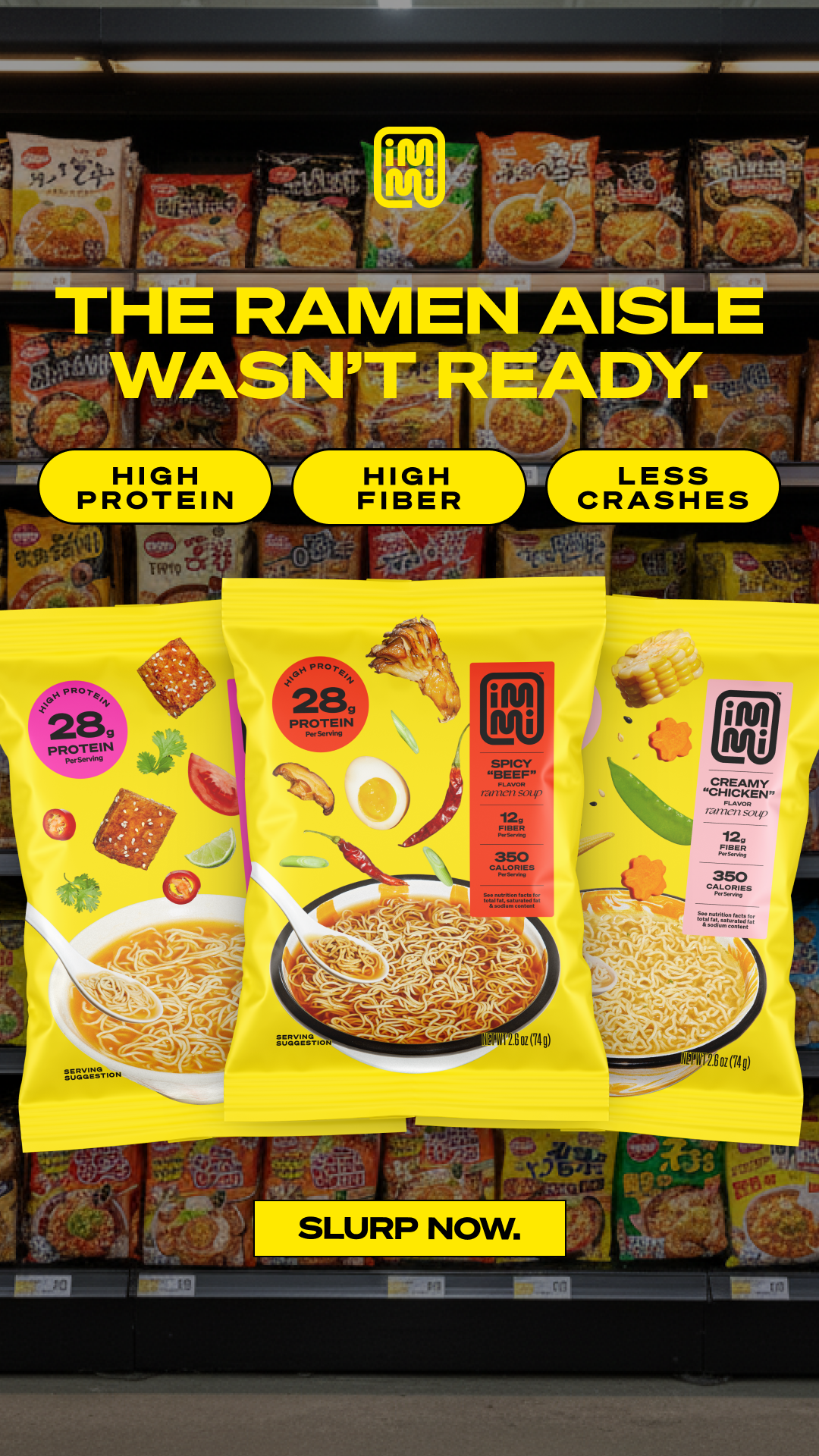
Hook: "THE RAMEN AISLE WASN'T READY," over a supermarket shelf shot with three immi packages pushed to the front.
-
Why it works: It reframes the product as a disruption to a category the shopper already trusts by habit, borrowing the retail shelf itself (where immi now sits next to incumbents like Nissin) as the proof rather than a claim.
-
Run this play: expanded as Play 3 below.
-
Hook: "the perfect satisfying ramen meal," with on-screen text reading "28 grams protein, 12 grams fiber, 350 calories" over UGC-style footage of a woman eating from a bowl.
-
Why it works: It replaces adjectives with the exact macro numbers, pre-empting the core objection (instant ramen is empty calories) with a specific, checkable figure inside a format that still reads as a real person's kitchen, not a studio shoot.
-
Run this play: Lead your own hook with the single hardest number in your spec sheet, overlaid on-screen, instead of a benefit adjective.
-
Hook: an "immi Mi" vs. "REGULAR INSTANT RAMEN" comparison table, 28g vs 12g protein.
-
Why it works: It does the shopper's mental math for them in one static frame, no video production or watch-through required to get the pitch.
-
Run this play: Build a two-column, product-vs-default comparison graphic around your single strongest spec and run it as a static image ad.
Because none of the visible library has run long enough to separate winners from tests, there's no distinct new-experiment bucket yet: the whole 13-ad set is the experiment, testing whether the post-reset funnel holds up at scale.
Both analyzed landing pages sit behind the same "Why would you ever eat regular ramen again?" ad hook, but they test different offer depths. The "Physical Fitness LP V3" page shows tighter bundle pricing ($4.99 to $128) at 19-23% off with free shipping and a "save up to 23%, choose your bundle" email/SMS capture offer. The "OTP LP v1" page tests a steeper 53% off with bundle and set pricing running up to $340, suggesting immi is actively split-testing entry-level bundle depth against a deeper, larger-basket discount off the same ad creative. Both funnels route the subscription mechanic through Skio, a Shopify subscription-management platform, consistent with the Recharge-and-Klaviyo rebuild behind their CAC drop.
- Running
- 4 days (new — still being tested)
- Hook
- "When you're eating noodle and you randomly start getting nauseous" overlay text on a video of a person eating noodles from a yellow bowl.
- CTA / offer
- SLURP IMMI NOW
- Audience
- Individuals who experience discomfort or nausea from eating traditional instant ramen, indicated by the opening problem statement and subsequent explanation of ingredients.
Why it works. Problem-solution narrative to position immi Ramen as a healthier, more digestible alternative to traditional instant noodles, targeting consumers who experience negative physical reactions to conventional ramen.
Start with a relatable problem using on-screen text and a humorous sound effect at "0:00-0:03": "When you're eating noodle and you randomly start getting nauseous". Identify a common, specific pain point related to your product category and present it as the immediate hook, either visually or with text, to capture the target audience's attention.
- Running
- 3 days (new — still being tested)
- Hook
- When you're eating noodle and you randomly start getting nauseous" overlay text on a video of a person eating noodles from a yellow bowl.
- CTA / offer
- SLURP IMMI NOW
- Audience
- Individuals who enjoy instant noodles but experience negative side effects like nausea, bloating, or heartburn, and are looking for a healthier alternative. This is signaled by the opening problem statement and the subsequent explanation of common ramen issues.
Why it works. Problem-solution narrative to position immi Ramen as a healthier alternative to traditional instant noodles, aiming to convert users experiencing discomfort into customers seeking a better option.
Problem identification and validation (0:00-0:07): The video opens with a relatable scenario: "When you're eating noodle and you randomly start getting nauseous" followed by the speaker stating, "Okay, this is actually super common." Start your ad with a common, specific pain point your target audience experiences, using on-screen text and a direct statement to validate their experience.
- Running
- 2 days (new — still being tested)
- Hook
- Visual: A close-up shot of a bowl of ramen with a fried egg, yellow bell peppers, and green onions. On-screen text: "high fiber". Audio: "Looking for high fiber meals that don't taste like cardboard?"
- Audience
- Individuals seeking high-fiber, high-protein, convenient, and tasty meal options, particularly those who enjoy ramen but want a healthier alternative. This is signaled by the direct address of the problem ('high fiber meals that don't taste like cardboard') and the focus on nutritional benefits and ease of preparation.
Why it works. Problem-solution demonstration + benefit-driven narrative to position immi ramen as a superior, healthy, and convenient alternative to traditional ramen and other high-fiber foods, aiming to convert health-conscious consumers.
Problem-agitation hook with on-screen text and audio at 0:00-0:03: "Looking for high fiber meals that don't taste like cardboard?" with a visual of appealing ramen. Start your ad with a direct question addressing a known pain point of your target audience, using on-screen text to reinforce the problem while visually presenting your product as the solution.
Show 7 more exhibits
- Running
- 15 days (longevity = it's converting)
- Hook
- “pov: you eat ramen to hit your summer body goals” is on-screen text, a woman with dark hair is holding a fork with ramen noodles on it, looking at the camera with her mouth open.
- Audience
- The mention of "summer body goals" and the focus on protein and calories targets individuals who are health-conscious but also enjoy comfort food like ramen.
Why it works. This creative uses a relatable problem-solution narrative to position a high-protein, low-calorie ramen as a viable option for health-conscious individuals, aiming to drive product trial and purchase.
The video opens with on-screen text and a spoken line that creates a curiosity gap by presenting a seemingly contradictory idea. (0:00-0:03) "pov: you eat ramen to hit your summer body goals" and "All my body is trying to get fine for summer, I gotta hit the gym, but you still like ramen like me?" Start your creative with a bold, counter-intuitive claim or question related to your product that challenges common assumptions, using both on-screen text and spoken audio.
- Running
- 8 days (new — still being tested)
- Hook
- Visual: A woman with long dark hair, wearing a white knitted sweater, holds a white square bowl with ramen noodles on a fork, bringing it to her mouth. On-screen text: "28 grams protein 12 grams fiber 350 calories". Audio: "the perfect satisfying ramen meal."
- Audience
- Individuals seeking convenient, high-protein, high-fiber, and lower-calorie meal options, particularly ramen enthusiasts.
Why it works. Product demonstration and nutritional value proposition to attract health-conscious consumers looking for convenient meal solutions.
Front-loading nutritional benefits with on-screen text and spoken claims (0:00-0:03, 0:07-0:15): "28 grams protein 12 grams fiber 350 calories" and "This one bowl of ramen is going to give you 28 grams of protein and 12 grams of fiber for only 350 calories." For products with strong nutritional or functional benefits, display these key metrics as on-screen text within the first 3 seconds and reiterate them verbally early in the video.
- Running
- 18 days (longevity = it's converting)
- Hook
- On-screen text: "THE RAMEN AISLE WASN'T READY." Visual: A supermarket aisle with shelves full of ramen packages, with three immi ramen packages in the foreground.
- CTA / offer
- SLURP NOW.
- Audience
- Individuals who consume instant ramen but are health-conscious, indicated by the emphasis on "HIGH PROTEIN," "HIGH FIBER," and "LESS CRASHES."
Why it works. Product differentiation through health benefits to attract existing ramen consumers seeking healthier alternatives.
Bold, disruptive headline: "THE RAMEN AISLE WASN'T READY." (on-screen text, top-center) Use a provocative, category-challenging headline in your ad's primary visual to immediately grab attention and differentiate your product from competitors.

- Hook
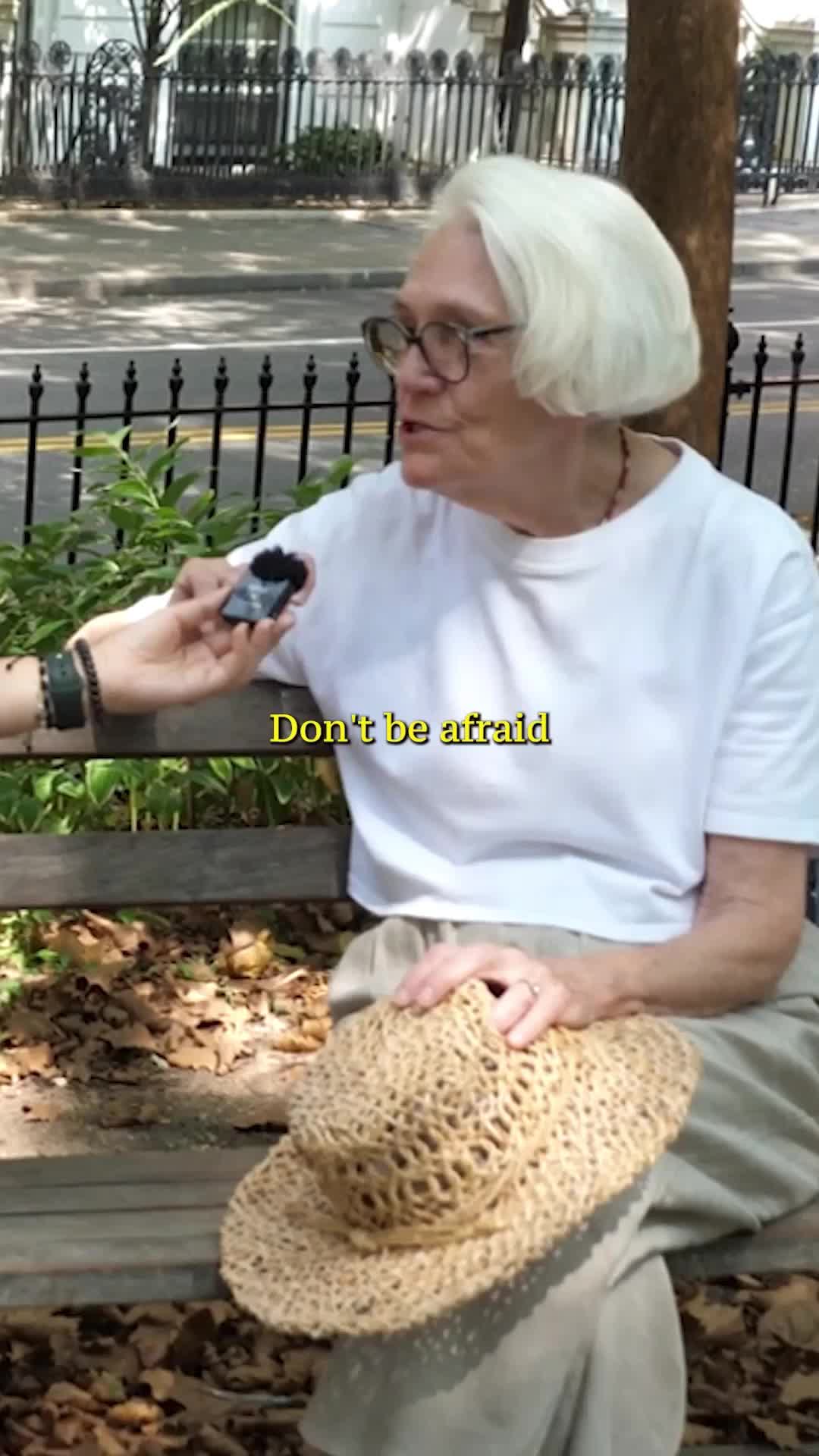
- "Don't be afraid" - An older woman with white hair and glasses is sitting on a park bench, holding a straw hat, and speaking into a small black microphone held by an unseen person.
- CTA / offer
- FIND IMMI AT WHOLE FOODS MARKET
- Audience
- The conversation between an older woman and a younger interviewer, discussing career decisions and taking risks, targets young adults or those contemplating career changes, who might be seeking guidance or inspiration.
Why it works. This creative uses an inspirational interview with an older individual to build brand affinity and subtly transition to a product call-to-action, aiming to connect positive life advice with the brand's image.
Inspirational advice from an elder (0:00-0:05, "Don't be afraid to do what you think you can't do.") Feature an older, respected figure sharing life advice relevant to your target audience's aspirations or challenges in the first 10 seconds of your video.
- Reach
- 127 upvotes · 82 comments · r/ramen
A community is already discussing this in r/ramen. Show up there authentically and answer the thread before a competitor does.
Who amplifies them
Amplification is almost entirely third-party creators rather than the brand's own reach. On TikTok, reviewers like @zukisuzuki__bgm and mukbang-format accounts like Ken's Kravings post organic reviews in the low-thousands engagement range, while an account called straightwhiteteethsongs has reposted the brand's own street-interview clips under the same tags. On Instagram, food and lifestyle creators (munchingwithmarina, memissgirl, dreybradford) post recipe-integration and taste-test reels, and a named grocery-partner tag ("hebpartner," referring to Texas grocer H-E-B) shows the retail relationship extending into creator content. immi Ramen (the brand account) drives the interview series and TikTok Shop clips directly; no founder personal social accounts appear in the available evidence.
07 Organic & video
The organic content engine: the videos, creator posts, and community presence earning attention without paid spend.
The brand's TikTok output splits into two distinct formats with very different payoff curves. The ramenonthestreetinterview series (a staffer in a yellow, chip-bag-like costume interviewing strangers about life, not the product) produced a steady band of results in the tens of thousands: "Its okay if I am a bit much for you" (≈109,500 engagements) and "Go for it" (≈116,000 engagements) both landed in that range, with "I am now pouring into my cup" as the outright top performer at ≈182,000. The TikTok Shop commerce clips are far lumpier: one live-sale post, "My best friend and I made high protein instant ramen," spiked to ≈2.73 million engagements, while near-identical follow-up clips in July 2026 drew only in the low thousands. The interview format is the reliable reach engine, while TikTok Shop clips are boom-or-bust commerce spikes layered on top.
08 Affiliate & partners
How the brand turns creators and partners into a tracked, variable-cost acquisition channel, and how the program is structured.
immi runs a live seller layer through TikTok Shop, evidenced by the 2.73-million-engagement live-sale clip and repeated "LIVE NOW in TikTok Shop" posts, functioning as their affiliate-seller channel. A parallel, lighter-weight ambassador motion shows up in Instagram creator posts: one creator, minneapaula, posts a personalized discount code under an "immiamb" ambassador tag, and smaller creators like saka_snacks post under a "gifted" product-seeding tag. There's no evidence of a formal site-based referral program (a Rewardful- or PartnerStack-style link), so the affiliate motion runs through TikTok Shop and informal named codes rather than a structured program.
09 The playbook
The channels are not separate. They are one system where each stage feeds the next. Here is the read, then the plays to run tomorrow.
The inferred playbook
immi's engine is a subscription DTC business that deliberately throttled paid acquisition until its retention math worked, then restarted spend on top of an already-repaired funnel.
The company paused paid social in late 2024, rebuilt its Klaviyo and Recharge flows, and only resumed Meta and TikTok spend once CAC fell from $68 to $41 and month-6 subscription retention hit 74%. The fact that all 13 active Meta ads are 18 days old or younger is the visible fingerprint of that resumption.
Rather than a blog funnel, immi's flavor and bundle pages carry the organic search load directly, ranking #1 for branded terms and #2 for the non-branded "high protein ramen," letting the SKU page double as both landing page and content asset.
Dig deeper+3▾
The costumed street-interview series builds steady tens-of-thousands reach, while TikTok Shop live-sale clips are a separate, spikier commerce layer that can outperform everything else by orders of magnitude in a single post.
Reddit mentions show real complaints about pricing rigidity and inflexible customer service running concurrently with the ad relaunch, a friction point that could blunt the CAC gains if it scales with ad-driven volume.
the first-order-to-paid-subscriber conversion rate behind the 74% month-6 retention figure, blended CAC by channel since the paid resumption, per-store sell-through or reorder velocity across their retail footprint, and the commission or take rate behind the TikTok Shop affiliate layer.
Pause paid until retention proves itself
The proofimmi's CAC drop to $41 and 74% month-6 retention (both referenced above) came from a deliberate pause in paid social, not from a better ad.
The adaptationIf your CAC is climbing while retention is soft, stop new paid spend for a fixed window and rebuild your post-purchase flow around your single biggest cancellation reason instead. Pull your last 90 days of cancellations or churn events, tag the top reason, and build one automated email or SMS sequence against it in whatever tool you already use (Klaviyo, Recharge, or their equivalents) before turning ad spend back on. The mechanism: a subscription business's real leak is usually in the flow, not the ad, and fixing the flow first makes every dollar spent afterward worth more.
Cost: dedicated budget or hire · Time to signal: months · Works pre-PMF: no, this requires an existing subscriber base large enough to measure a retention cohort against.
Make the product page the content
The proofimmi's top organic pages are its own flavor and bundle pages, not blog posts, and they rank #1 to #3 for both branded and category search terms (covered above in Organic Content).
The adaptationPick your single flagship product page and rewrite its title, H1, and body copy around the exact non-branded category term buyers actually search, not just your brand name. Check whichever search console tool you use for the top query already landing on that page and rework the on-page copy to match it directly, rather than parking that language only in a separate article.
Cost: $0 · Time to signal: weeks, once the page reindexes · Works pre-PMF: yes.
Turn a shelf or search-results war into the ad itself
The proofimmi's "THE RAMEN AISLE WASN'T READY" creative shoots its own product crowding a real supermarket shelf next to category incumbents.
The adaptationFind the one place your product visibly sits next to the category default, a retail shelf, a marketplace search page, a comparison chart, and photograph or screenshot that exact moment. Write one ad headline that names the moment rather than describing your features abstractly, then run it as a small paid test against whatever creative you're using.
Cost: under $500 · Time to signal: days · Works pre-PMF: conditional, yes if a visible point of comparison against an incumbent already exists, no if there's no shelf or results page to contrast against yet.
Run a values-first interview format that barely mentions the product
The proofThe ramenonthestreetinterview series (the costumed stranger-interview format referenced in Organic & Video) drove the brand's most consistent organic numbers, but results were lumpy: most clips sat in the tens of thousands while one TikTok Shop clip spiked to millions.
The adaptationPick a low-cost public interview format tied loosely to your brand (a prop, a costume, a held item) and ask strangers one open, values-driven question that has nothing to do with your product's features, posting the rawest answer first. Budget for a long, low-cost run rather than one viral swing: draft three non-salesy questions, film ten minutes of responses on a phone, and expect payoff to be uneven rather than steady.
Cost: $0 · Time to signal: months, given how lumpy this format's own results were · Works pre-PMF: yes, provided you can sustain an unpaid run for a while before judging it.
Seed creators with a named code, not a generic link
The proofimmi's Instagram ambassador layer runs on personalized codes (the "minneapaula" code under the immiamb tag) and free-product seeding (the "gifted" tag on smaller creators), not a formal affiliate platform (both referenced above in Who Amplifies Them and Affiliate Motion).
The adaptationRecruit a handful of small creators in your niche (roughly 1,000 to 20,000 followers), send free product, and give each one their own memorable discount code tied to their handle instead of a generic tracking link. Watch which codes actually get redeemed over a few weeks to find the one or two creators worth a deeper, paid relationship.
Cost: under $500 · Time to signal: weeks · Works pre-PMF: yes. Not transferable at an earlier stage: immi's multi-month paid pause and full Klaviyo/Recharge rebuild assume real runway and an existing subscriber base large enough to measure retention against, funded in part by a reported $10 million Series A. A pre-revenue founder can adapt the retention-first logic in play 1 at a much smaller scale, but cannot replicate the act of going dark on paid acquisition for months while a team rebuilds infrastructure behind the scenes.
You just read how immi Ramen does it. Tomorrow it is someone else.
Every morning we take one company that is actually growing and break down where its customers come from: the ads still running after a year, the channel doing the real work, and the play you can run this week.
Systemaic · directional intelligence. Traffic, spend, and reach figures are SimilarWeb-style estimates and qualitative reads of public data, not audited numbers. Built on real public receipts.
// teardowns with a similar GTM motion
sources & receipts (9)
Live ad libraries: meta ad library
Researched facts: immi was founded in 2019 by Kevin Lee and Kevin Chanthasiriphan, headquartered in San Fran · immi publicly launched its DTC website/brand: January 2021 · immi raised a seed funding round: $3.8 million, led by Siddhi Capital, closed/announced Se · immi raised a Series A funding round: $10 million, led by Touch Capital, with celebrity in · immi's first brick-and-mortar retail launch was into Whole Foods Market: April 2022, in 5 · Retail store count at time of Series A close, with growth targets stated: ~500 stores as o · Current retail distribution footprint: Over 7,000 stores including Target, Whole Foods, Sp · Sample product pricing on shop.immieats.com: 12-pack Variety box valued at up to $78 (~$6.
Traffic, spend, and revenue figures are estimates as noted in the report; the links above are the primary public artifacts.