- 01Turn your founding frustration into your first press pitch
- 02Answer the comparison question your buyer is already asking, in their own forum
- 03Write the how-to page in your buyer's job vocabulary, not your feature list
- 04Film one real customer's "before" moment as your first ad creative
01 Snapshot
The one-glance read on who they are and how they grow. Each point is verifiable from the receipts above.
AI-native AML transaction monitoring, sanctions/PEP screening, and case-management software sold to fintechs and banks, with 100+ customers across 30 countries as of the June 2026 Series A.
Founder-led enterprise sales, layered with practitioner content and paid LinkedIn amplification rather than a self-serve funnel.
A $12.5M Series A closed June 2026 (over $19.6M disclosed across three rounds since 2022), ~42,500 estimated monthly visits (-5.5% over the last 3 months) as of July 2026, and a ~162-ad LinkedIn library (23 of a sampled 24 still active) against 26 total Google ads (0 active) as of July 27, 2026.
CEO Baran Ozkan frames the company's three-plus years as starting with "YC, which gave us network and traction," before pivoting to trust-building and "doubling down on the future with GenAI, that's also why our punchline is 'AI-native AML compliance.'"
As of July 27, 2026, live LinkedIn tests skew toward account-based invites, a Kuala Lumpur fincrime roundtable gated by company email and a London happy hour, targeting named compliance leaders rather than broad reach.
Flagright's engine is a long sales cycle wrapped in trust proof: YC pedigree and named case studies (Betterment, sciopay, B4B Payments) do the convincing, while paid LinkedIn media re-broadcasts the company's own funding and customer wins to the exact job titles that buy AML software.
02 How it unfolded
The order the channels came online. Sequence is strategy: what they did first, and what they layered on once demand existed.
03 Traffic & channel mix
Estimated demand, the channel split behind it, and the keywords and referrers doing the work. Directional modeling, not audited analytics.
Traffic sources
Top search keywords
| Keyword | Volume | Weight | CPC |
|---|---|---|---|
| flagright | 2.8k | $21.12 | |
| what would trigger a bank of suspicious activity | 290 | - | |
| flaghright ceo | 130 | - | |
| when does travelling rules apply in australia for crypto providers | 230 | - | |
| flagright headquarters | 120 | - |
Closest competitors by audience
Flagright draws roughly 42,500 estimated monthly visits, down 5.5% over the last 3 months. The mix is led by direct traffic at 40.6%, consistent with a branded, sales-cycle-driven buyer who already knows the name, followed by organic search at 35.3%, the second-biggest channel and the clearest sign the blog is doing real work. Social organic (10.1%) and referrals (8.7%) trail well behind, and AI-assistant traffic (Gen AI, 5.3%) is a small but real slice of demand, rounding the mix to 100%. Their top-ranking search terms show a company built on its own name and its category's process vocabulary: "flagright" pulls 2,790 monthly searches, while niche compliance queries like "what would trigger a bank of suspicious activity" (290/mo) and a crypto-specific travel-rule question for Australia (230/mo) show them positioned against practitioner-level informational demand, not broad consumer volume. Stated competitors span AI-driven AML (napier.ai), legacy compliance vendors (abrigo.com), and risk-decisioning tooling (taktile.com), though the underlying data ranks none of them as a closest rival.
04 Organic content
The specific pages earning their organic search traffic, and the pattern behind why they rank. Adapt the format, not the topic.
Flagright's top organic pages are practitioner how-to guides on core AML tasks, not product marketing: customer risk assessment, real-time transaction monitoring, and suspicious-activity reporting each get their own dedicated post, plus the homepage itself. The pattern is task-first, buyer-vocabulary content: pages are titled the way a compliance officer would search ("best practices for conducting customer risk assessment," "everything you should know about reporting suspicious activity"), and the ranking data backs it up, with the transaction-monitoring and customer-risk-assessment pages holding #1 rankings for their matching non-branded terms. This works because the audience is narrow and technical: there's little competing content written at this specificity for compliance-officer workflows, so exact-match how-to pages own the long tail.
Top pages by organic traffic
05 Channel map
Not traffic share. How much weight the growth system actually puts on each channel, with a one-line read on the role it plays.
What drove growth
06 The motions doing the work
For founder-led SaaS the breakdown shifts from ads to traction: where the first users came from, how the founder grows it in the open, and the compounding organic surface.
Flagright's early traction ran through the Y Combinator pipeline and enterprise proof points, not a coordinated launch-day stunt.
Founders Baran Ozkan and Madhu Nadig joined YC's Winter 2022 batch, and TechCrunch profiled the launch and $2.8M seed round on 2022-06-28, the earliest public traction anchor available.
Ozkan has described the founding motivation as a roughly 15 to 18 month search for a real-time, risk-based transaction-monitoring product he wanted to buy and couldn't find, the origin story that later press coverage keeps returning to.
Dig deeper+2▾
Rather than one launch moment, named customer case studies (Betterment, sciopay, B4B Payments) became both YouTube videos and paid LinkedIn creative, with sciopay and B4B Payments becoming the two highest-view assets in the entire YouTube library.
Three rounds since 2022, the $2.8M seed (2022-06-28), the $4.3M seed (2025-03-27), and the $12.5M Series A (2026-06-17), each paired with a company blog post and, most, a cluster of first-person "we raised" posts pushed as paid LinkedIn ads.
Founder-led distribution here isn't a daily personal broadcast, it's occasional milestone narratives that get put behind paid media rather than left to organic reach.
CEO Baran Ozkan carries 17,211 LinkedIn followers, but the visible content centers on funding milestones and press interviews (the FF News clip series) rather than a running stream of build-in-public updates.
CTO Madhu Nadig's account shows 430 posts and 232 followers; the sampled tweets span 2022 to 2024 with modest reach, and even the AI Forensics launch tweet topped out at 21 likes and roughly 10,800 views.
Dig deeper+2▾
Several first-person "I'm excited to announce Flagright has raised $12.5M" style posts run as active LinkedIn ads rather than relying on follower reach alone, a deliberate choice to back the founders' own narrative with spend.
Public "in the open" presence leans on named-city compliance-officer dinners (London, NYC, Dubai, Singapore, Texas) and conference appearances (Singapore Fintech Festival), captured on YouTube as relationship-building rather than a written build-in-public habit.
Search compounds on the same practitioner content covered above, while paid spend does two different jobs depending on the platform.
Organic search is 35.3% of total visits, trailing only direct traffic, and rides the how-to pages named above.
flagright.com/partners recruits partners to drive referrals; in a sales-led enterprise category this most plausibly functions as a channel or reseller arrangement with consultancies or adjacent compliance vendors rather than a retail affiliate network, though the evidence doesn't specify the partner mix.
Dig deeper+2▾
The 26-ad Google library sits at 0 active as of July 27, 2026, and its longest proven winner ran 215 days, and its text ads ran capability lines like "AI-Native AML Software" and "No-Code AML Software," a branded and capability-keyword capture play rather than broad demand generation.
The ~162-ad library (23 of 24 sampled still active) mixes a recurring "We reached a point" customer-testimonial video (a problem-agitation hook) with funding posts and city-specific event invites, an account-based motion aimed at named compliance-leader audiences rather than mass reach.
07 Paid ads
This founder-led SaaS also runs paid acquisition. Here are the live ads doing the work, each with the X-ray and a play you can adapt.
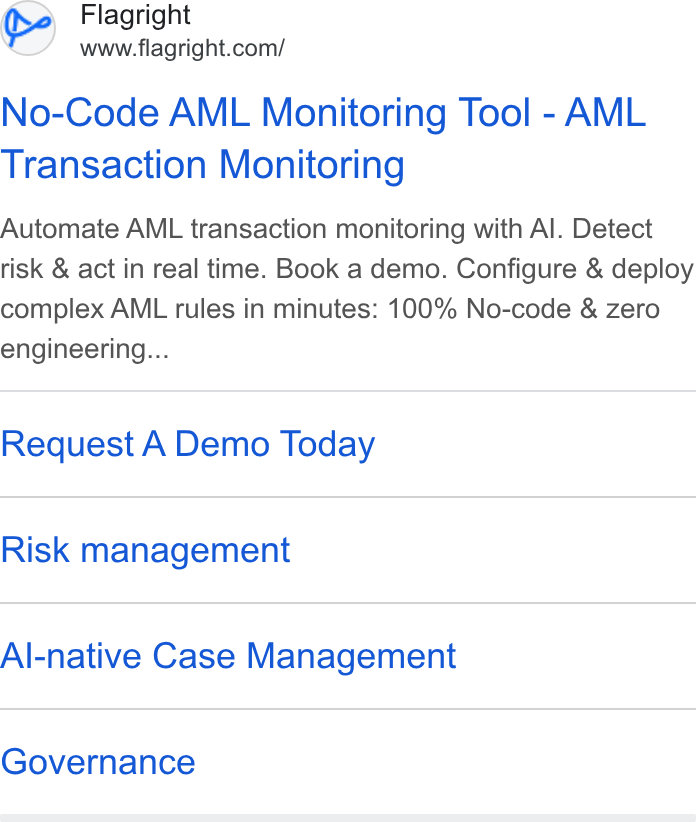
- Running
- 165 days (longevity = it's converting)
- Hook
- Visual: A logo with a blue stylized 'P' or similar shape, next to the text "Flagright" and "www.flagright.com/". On-screen text: "No-Code AML Monitoring Tool - AML Transaction Monitoring".
- CTA / offer
- Request A Demo Today
- Audience
- Businesses or financial institutions dealing with AML (Anti-Money Laundering) compliance, indicated by terms like "AML transaction monitoring," "risk management," and "Governance."
Why it works. Search ad copy mirrors high-intent buyer queries verbatim, positioning Flagright as the direct match for teams already looking for a no-code AML tool.
Headline directly addresses a key pain point and offers a solution: "No-Code AML Monitoring Tool - AML Transaction Monitoring". Mirror the exact phrase your buyers type into Google as your headline, pairing the category name with your specific differentiator like no-code.
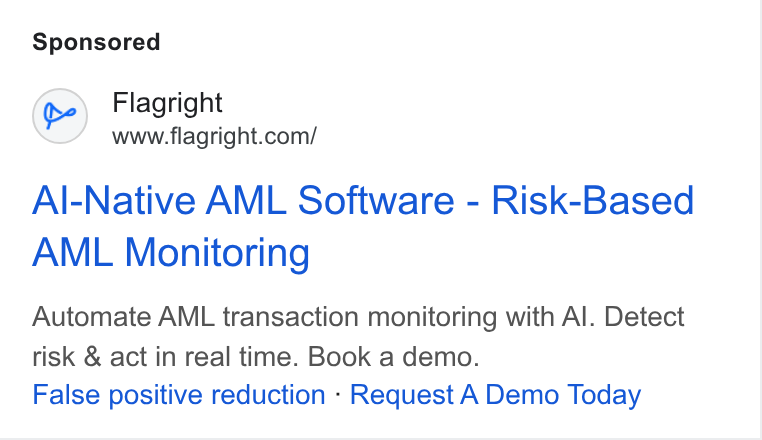
- Running
- 152 days (longevity = it's converting)
- Hook
- Sponsored Flagright www.flagright.com/ AI-Native AML Software - Risk-Based AML Monitoring
- CTA / offer
- Book a demo. Request A Demo Today
- Audience
- Businesses or financial institutions dealing with Anti-Money Laundering (AML) compliance, indicated by the terms "AML Software", "AML Monitoring", and "Automate AML transaction monitoring".
Why it works. Search ad matches high-intent AML software queries by naming both the technology and the exact monitoring approach.
Headline clearly states the product and its core benefit: "AI-Native AML Software - Risk-Based AML Monitoring". Pair a technology differentiator like AI-native with the exact product category term your buyers type into search.
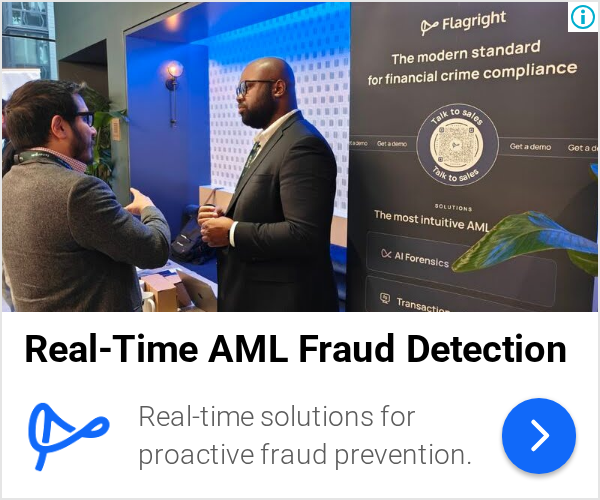
- Running
- 86 days (longevity = it's converting)
- Hook
- Visual: Two men talking at a booth with a banner in the background. On-screen text: "Flagright The modern standard for financial crime compliance"
- CTA / offer
- Talk to sales / Get a demo
- Audience
- Professionals in financial crime compliance, indicated by the text "The modern standard for financial crime compliance" and "AML Fraud Detection".
Why it works. Pairs a trade-show photo with a category-ownership tagline to build trust with compliance buyers evaluating vendors.
Prominent display of company name and tagline: "Flagright The modern standard for financial crime compliance" at the top of the banner. Put your category-defining claim (the standard for X) next to a real photo of your team engaging customers, not a stock graphic.
Show 3 more ads
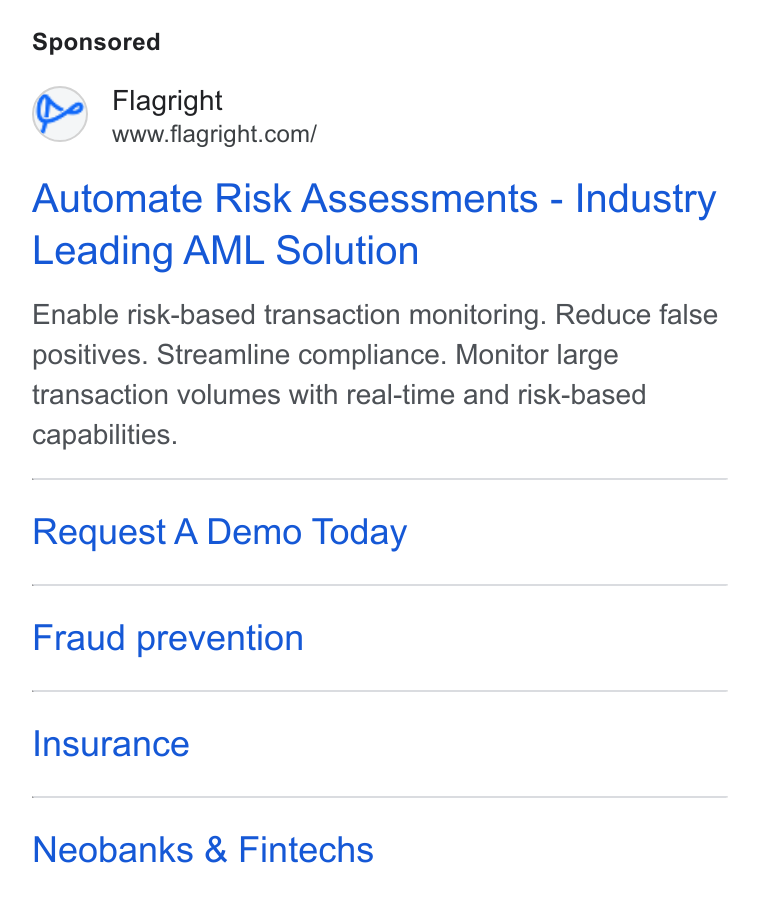
- Running
- 86 days (longevity = it's converting)
- Hook
- Sponsored Flagright www.flagright.com/ Automate Risk Assessments - Industry Leading AML Solution
- CTA / offer
- Request A Demo Today
- Audience
- Professionals in financial institutions, compliance, and risk management, indicated by terms like 'AML Solution', 'transaction monitoring', 'compliance', 'Fraud prevention', 'Insurance', and 'Neobanks & Fintechs'.
Why it works. Combines the specific automatable task with a market-position claim, targeting buyers comparing vendors on function and reputation.
Headline stating a clear benefit and industry positioning: 'Automate Risk Assessments - Industry Leading AML Solution'. Pair your product's specific automatable task with a market-position line so the ad covers both function and trust searches.
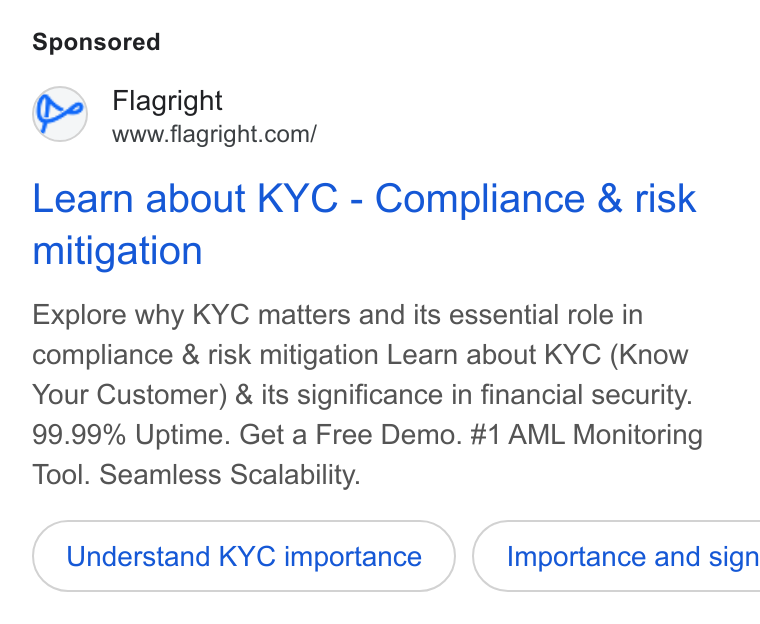
- Running
- 85 days (longevity = it's converting)
- Hook
- Sponsored" text at the top, followed by the Flagright logo and company name, then the headline "Learn about KYC - Compliance & risk mitigation".
- CTA / offer
- Get a Free Demo.
- Audience
- Professionals in finance or compliance, indicated by terms like "KYC," "Compliance," "risk mitigation," "financial security," and "AML Monitoring Tool."
Why it works. Targets professionals searching for KYC education, capturing them earlier in the research cycle than a demo-focused ad would.
Headline framing as educational content: "Learn about KYC - Compliance & risk mitigation" Add a Learn about [topic] ad variant targeting the educational, not the buying-stage, version of your core keyword.
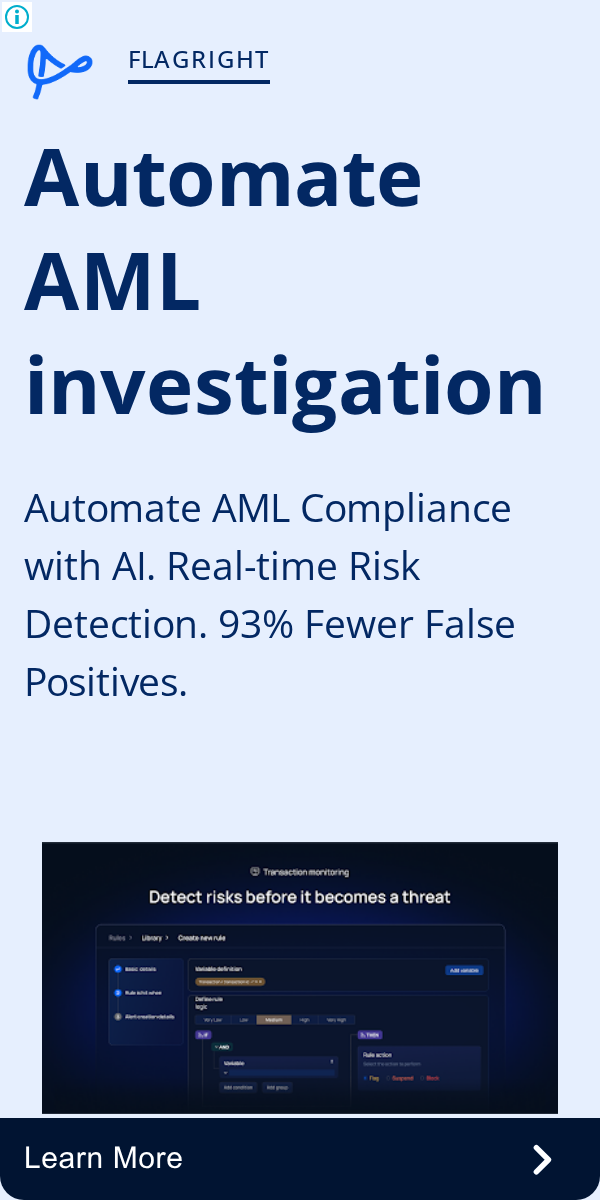
- Running
- 61 days (longevity = it's converting)
- Hook
- "Automate AML investigation" - A blue background with a logo and the text "FLAGRIGHT" at the top, followed by large text "Automate AML investigation".
- CTA / offer
- Learn More
- Audience
- The terms "AML Compliance", "Risk Detection", and "False Positives" indicate a target audience in financial compliance, risk management, or anti-money laundering roles.
Why it works. Short, task-first headline mirrors how compliance teams phrase their own to-do list, increasing keyword-to-intent match.
Headline stating a clear solution to a known problem: "Automate AML investigation" Write a headline that starts with the verb your buyer would use in their own task list, not your product's feature name.
08 The playbook
The channels are not separate. They are one system where each stage feeds the next. Here is the read, then the plays to run tomorrow.
The inferred playbook
The loop starts with name recognition, converts through a sales conversation backed by proof, and compounds through search content written in the buyer's own vocabulary.
Direct traffic (40.6%) and branded search dominate the mix, meaning most visits arrive already knowing the name, likely seeded by YC and funding-round press plus quiet word-of-mouth in tight compliance circles like the r/AMLCompliance thread comparing Flagright to Verafin.
With no self-serve checkout, every visitor funnels into a sales conversation; third-party competitive analysis pegs Flagright's annual plans at roughly $30K to $75K depending on API volume and seats (not company-confirmed), which at 100+ customers implies a rough multi-million-dollar ARR, though no audited revenue figure is public.
Dig deeper+3▾
The practitioner how-to pages hold #1 rankings on non-branded terms and keep earning traffic long after any single ad or press cycle ends, a durable asset next to the ad libraries, which cycle in and out entirely.
There's no visible community or open-source surface and no independent creator or UGC engine, so beyond sales conversations the company has essentially one organic lever (content) and one paid lever (LinkedIn ABM) doing all the work.
confirmed annual recurring revenue beyond a single unverified third-party estimate, the renewal or expansion rate when discounted first-year fintechs convert to standard pricing, and per-account API-call volume growth that would show contract expansion.
Turn your founding frustration into your first press pitch
The proofOzkan's origin story, roughly 15 to 18 months hunting for a real-time transaction-monitoring product he wanted to buy and couldn't find, recurs across founder press coverage as the company's credibility hook.
The adaptationWrite down the exact unsolved buying problem that pushed you to build your product, in the same "I looked for X for N months and it didn't exist" structure, and pitch that specific frustration, not your product, to one trade newsletter or niche community your buyer already reads. Lead with the months-long search, not the solution, since that specificity is what made this story pick up press in the first place.
Cost: $0 · Time to signal: days · Works pre-PMF: yes
Answer the comparison question your buyer is already asking, in their own forum
The proofan organic r/AMLCompliance thread comparing Flagright against incumbent Verafin drew 9 comments without any brand posting.
The adaptationFind the one or two forums or subreddits where your buyer persona already posts "has anyone used X vs Y" questions, and show up as a practitioner giving a specific, honest comparison, not a pitch, the same way this thread let a real user's question do the selling. Post substantive answers, not links, so future searchers find your name inside a real comparison thread instead of an ad.
Cost: $0 · Time to signal: weeks · Works pre-PMF: yes, conditional: only works where genuine comparison threads for your category already exist
Write the how-to page in your buyer's job vocabulary, not your feature list
The proofFlagright's blog posts on core compliance tasks, like conducting a customer risk assessment, rank #1 for their matching non-branded search terms and each drive 5.5 to 11.6% of the site's organic traffic.
The adaptationList the 3 to 5 tasks your buyer does every week, then write the definitive how-to for each one using their own job-title language as the headline, mirroring the exact phrase-match between task and ranking term shown here. Publish one page per task and title each one the way your buyer would type it into a search bar, not the way your product names the feature.
Cost: $0 · Time to signal: months (organic search takes time to rank) · Works pre-PMF: yes
Film one real customer's "before" moment as your first ad creative
The proofa single testimonial-style clip ("We reached a point...") recurs across multiple entries in Flagright's active LinkedIn ad library as one of its proven winners.
The adaptationRecord one genuinely happy early user describing the specific moment things broke before your product, on a phone camera is fine, and post it organically first, using the same direct-to-camera, problem-first structure before ever putting spend behind it. Only add paid boosting once you see organic engagement, since the format is what's proven here, not the ad budget.
Cost: $0 to start, under $500 to test a paid boost · Time to signal: weeks · Works pre-PMF: yes, conditional: needs one customer genuinely willing to go on camera
Use your accelerator or cohort as your first customer-intro channel
The proofFlagright's earliest public traction traces to its Y Combinator batch, the network Ozkan credits for giving the company its first "network and traction" before any paid channel existed.
The adaptationIf you're in any accelerator, fellowship, or certification cohort, message 10 cohort-mates directly asking for feedback or a warm intro to someone who fits your buyer profile, treating the cohort as your first distribution channel the way YC functioned for Flagright's first press and customers. Do this before spending on ads, since a warm cohort intro converts faster than cold outreach at this stage.
Cost: $0 · Time to signal: days · Works pre-PMF: yes Not transferable at an earlier stage: the account-based LinkedIn event invites (the Kuala Lumpur roundtable, the London happy hour) and the full paid-ad-library scale depend on an existing enterprise pipeline and a real ad budget most pre-seed founders won't have yet, so adapt the underlying tactics in these plays rather than the media spend itself.
You just read how Flagright does it. Tomorrow it is someone else.
Every morning we take one company that is actually growing and break down where its customers come from: the ads still running after a year, the channel doing the real work, and the play you can run this week.
Systemaic · directional intelligence. Traffic, spend, and reach figures are SimilarWeb-style estimates and qualitative reads of public data, not audited numbers. Built on real public receipts.
// teardowns with a similar GTM motion
sources & receipts (22)
Live ad libraries: linkedin ad library · google ad library
Researched facts: Flagright was founded by Baran Ozkan and Madhu G. Nadig and went through Y Combinator's Wi · Founding motivation described by CEO Baran Ozkan: Ozkan and Nadig built Flagright after se · Founders' pre-Flagright professional backgrounds: Baran Ozkan previously ran the product t · Pre-seed/seed round of $2.8M: $2.8M pre-seed round led by Moonfire Ventures, with particip · $4.3M seed round: $4.3M seed round led by Frontline Ventures with participation from Y Com · $12.5M Series A round: $12.5M Series A led by Infinity Ventures, with Sella Direct Venture · Headquarters and global office footprint: Headquartered in San Francisco with additional o · Ranked #37 on Sifted 250 (2025), Europe's fastest-growing startups list: Flagright ranked · G2 Summer 2025 grid results: Flagright won #1 in Transaction Monitoring plus 10 total badg · Named to AIFinTech100 2025 for the third consecutive year: Flagright recognized in FinTech · Named to RegTech100 for 2026, third consecutive year: Flagright named a RegTech100 innovat · Partnership with Webull to strengthen AML compliance: Flagright partnered with online inve
Milestone sources: 2023-10-16: Flagright announces Banked, a global account-to-account payments fintech, as a · 2024-02: Flagright partners with SALT, a Bengaluru-based SME fintech and fellow Y Combinat · 2025-09-24: Stablecoin-payments company Reap partners with Flagright for real-time transac · 2026-01-29: Flagright partners with AiPrise to deliver global KYC/KYB and identity verific · 2026-04: Flagright launches AI Forensics for Monitoring, an automated-investigation module · 2026-06-17: Flagright closes a $12.5M Series A led by Infinity Ventures (with Sella, Front
Community threads: G2: G2 reviewer (VP of Compliance, mid-market) says Flagright covers AML/CFT/sanctions scr · Gartner Peer Insights: Gartner Peer Insights reviewer (Operations Manager, Finance/non-ban
Traffic, spend, and revenue figures are estimates as noted in the report; the links above are the primary public artifacts.