- 01The self-inclusion listicle
- 02Customer pages that inherit search
- 03Ride a competitor's deprecation
- 04Ship the narrow utility, not the pitch
01 Snapshot
The one-glance read on who they are and how they grow. Each point is verifiable from the receipts above.
Open-source link management and partner/affiliate infrastructure, positioned as the open-source alternative to Bitly, with an open-core GitHub repo as its main discovery surface.
Founder-led and open-source-led, running on the founder's personal X following rather than a brand marketing team.
About 857,744 estimated monthly visits (+47.9% over the last 3 months), 57,987 X followers on the founder's account, and $20M+ in cumulative Dub Partners payouts as of mid-2026.
As of 2026-07-14, three active LinkedIn ads push the Dub Partners payout milestone and a Firebase Dynamic Links migration pitch.
Dub's own paying customers generate its SEO surface: each Dub Partners program page inherits that customer's own brand-search demand, like "perplexity login."
02 How it unfolded
The order the channels came online. Sequence is strategy: what they did first, and what they layered on once demand existed.
03 Traffic & channel mix
Estimated demand, the channel split behind it, and the keywords and referrers doing the work. Directional modeling, not audited analytics.
Traffic sources
Top search keywords
| Keyword | Volume | Weight | CPC |
|---|---|---|---|
| dub | 34k | $1.66 | |
| polymarket affiliate program | 3.6k | $19.58 | |
| dub partners | 1.5k | $6.86 | |
| framer affiliate program | 2.1k | $0.85 | |
| polymarket affiliate | 1.2k | - |
Top referring sites
Closest competitors by audience
Dub pulls an estimated 857,744 monthly visits, up 47.9% over the last three months. Direct traffic dominates the mix at 66.6%, consistent with a name-already-known audience rather than one arriving via discovery channels; search organic sits at 11.1% and referrals at 9.6%, both smaller confirmations of the same pattern. The rest, social organic, email, gen AI, affiliate, social paid, and display, together total roughly 12% and none of them individually moves the needle.
The clearest keyword signal is the bare term "dub" at 33,820 monthly searches, dwarfing the next tier: "polymarket affiliate program" (3,640/mo) and "framer affiliate program" (2,060/mo). Those two are people searching for Dub's own customers' partner programs, not for Dub itself, a preview of the customer-inherited demand pattern detailed in Content & SEO Engine below.
Referrers: granola.ai (a named Dub customer, so more likely a case-study or partner-badge backlink than a discovery source), oss.gallery (an open-source directory placement reinforcing GitHub-led distribution), and tynk.ai (a minor, unexplained referral source). Competitors: SimilarWeb groups Dub with bitly.com (the incumbent it explicitly positions against), rebrandly.com, and short.io, all traditional shorteners lacking Dub's open-source and partner-program layer.
04 Organic content
The specific pages earning their organic search traffic, and the pattern behind why they rank. Adapt the format, not the topic.
Dub's top organic pages split between two different jobs. The homepage carries the largest share (about 1,311 monthly organic visits, 46.3% of the tracked total), but the next two spots, a Dub Partners program page and its login page, are customer-specific pages that rank for that customer's own brand terms, not Dub's. A comparison listicle ("best link management tools") and a free QR-code tool round out the top five, the classic pairing of a comparison page for people already shopping and a free utility for people who aren't shopping yet. The pattern that stands out is structural: Dub's own product feature, hosting a partner program for a customer, doubles as an SEO asset the moment that customer has any brand-search volume, a fundamentally different content motion than writing blog posts.
Top pages by organic traffic
05 Channel map
Not traffic share. How much weight the growth system actually puts on each channel, with a one-line read on the role it plays.
What drove growth
06 Who they’re hiring
Open roles read like a roadmap: the functions they’re staffing show where the company is investing next and what stage it’s at.
1 open role
07 The motions doing the work
For founder-led SaaS the breakdown shifts from ads to traction: where the first users came from, how the founder grows it in the open, and the compounding organic surface.
Dub's visible launch history is less a single breakout moment than a founder who kept shipping small, submittable things until Hacker News finally noticed one of them.
Two separate readers submitted "Dub.co, Link Management for Modern Marketing Teams" within the same month (2024-03-20 and again 2024-03-28), and both closed at 1 point with 0 comments, showing the company pitch itself never caught on with that audience.
The founder's own Show HN post for Git.new, a free GitHub link shortener, broke through where the company page didn't, drawing 12 points and 5 comments in March 2024, while a later Show HN for "Dub AI" drew just 1 point in April 2024.
Dig deeper+1▾
Dub began as a side project Steven Tey built while a Developer Advocate at Vercel to dogfood Vercel's Edge Middleware, only becoming a company after he left in late 2023, so its earliest users were effectively an existing developer audience rather than a cold launch.
Dub's build-in-public engine runs almost entirely through one person, founder Steven Tey's personal X account, not a separate brand voice.
Tey repeatedly builds "open-source alternative to popular SaaS" threads that tag other tools by their real handles (Calendly to Cal.com, Firebase to Supabase, Bitly to his own project), a format that pulled 2,149 likes and 284,263 views in August 2023 and 939 likes and 230,582 views in April 2024 for oss.gallery, a related open-source directory project that dogfoods Dub's own click-analytics API.
As early as September 2022, before the dub.co rebrand, Tey listed his own project (then Dubdotsh) alongside established names as "the open-source Bitly," using the same audience-building thread format to plant category positioning rather than a separate announcement.
Dig deeper+2▾
Tey's LinkedIn profile carries 17,073 followers with a bio tied to his CEO title, a smaller professional audience the evidence does not show him posting to at the same cadence as X.
There is no evidence of a distinct brand X account carrying this content, so the founder's personal reach is both the whole asset and the whole risk of this motion.
Organic search is a minority slice of total traffic at 11.1%, but Dub's real content asset is structural: the product itself manufactures new SEO surface.
Every company running a partner program through Dub Partners (Dub's affiliate and partner-management product) gets a public page on the partners.dub.co subdomain, and because that page inherits the customer's own brand-search demand, the polymarket and framer affiliate-program searches noted above, Dub gains a new indexed, ranking page every time it signs a customer, with zero content-team output required.
The AGPLv3-licensed core repository (an open-source license that requires anyone reselling a hosted version to open-source their changes too) has drawn roughly 23.7k GitHub stars and 3k forks, feeding the 33,820 monthly searches for the bare term "dub" and giving the company a discovery surface no single campaign produced.
Dig deeper+2▾
The site runs three third-party affiliate-tracking tools simultaneously, FirstPromoter, PartnerStack, and Rewardful, alongside a dedicated referral-program blog post, an unusually layered setup suggesting either parallel experiments or a provider migration in progress, and it recruits affiliates directly off the marketing site.
LinkedIn's library holds 3 total ads (all active as of 2026-07-14, all brand-run) built around the Partners payout milestone and a curiosity-hook Firebase Dynamic Links deprecation pitch ("Google will be deprecating Firebase Dynamic Links on Aug 25... Join companies like Twilio, Perplexity, Yuka & more"), while Google's library shows only 5 total ads with just 1 still active, an ad from an advertiser account unrelated to Dub's own name (Connect Profit (Hong Kong) Limited) running a "refer.dub.co" text ad, suggesting most Google search-ad activity around the Dub brand term is affiliates chasing referral payouts, not Dub buying its own search ads.
08 Paid ads
This founder-led SaaS also runs paid acquisition. Here are the live ads doing the work, each with the X-ray and a play you can adapt.
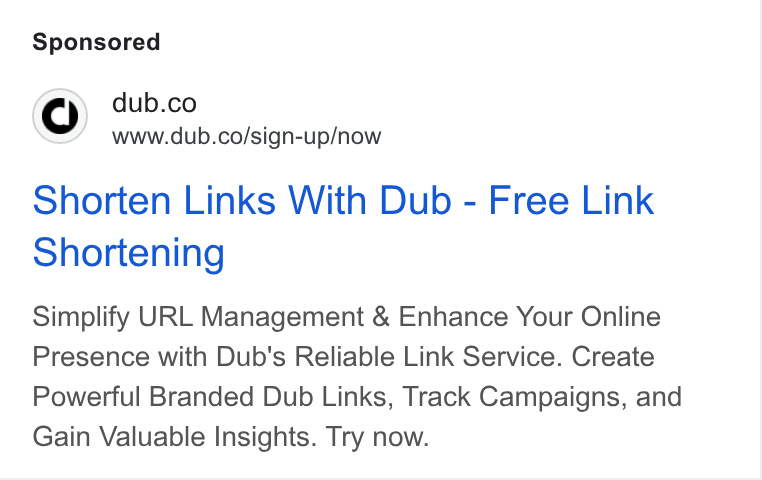
- Running
- 28 days (longevity = it's converting)
- Hook
- Sponsored dub.co www.dub.co/sign-up/now Shorten Links With Dub - Free Link Shortening
- CTA / offer
- Try now.
- Audience
- Individuals or businesses managing URLs and online presence, indicated by phrases like "URL Management" and "Track Campaigns."
Why it works. Mirrors the exact search intent, shorten links, and anchors it to a free price point, capturing bottom-funnel searchers comparing shorteners.
Clear value proposition in the headline: "Shorten Links With Dub - Free Link Shortening" Mirror your prospect's exact search phrase in the headline and place your strongest price hook right next to it.
- Running
- 3 days (new — still being tested)
- Hook
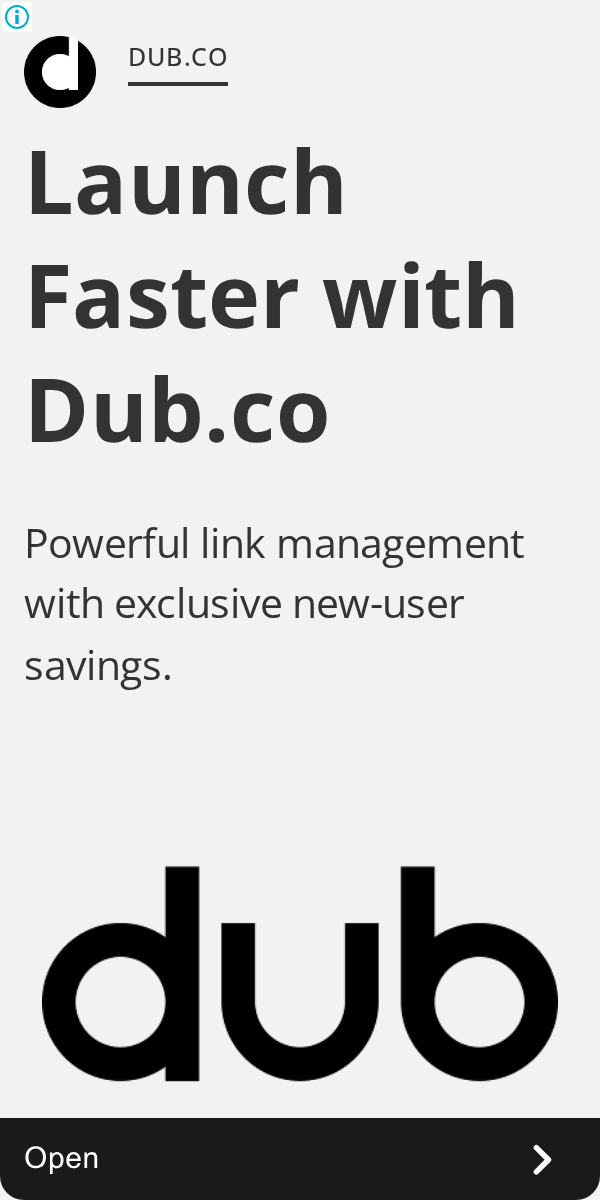
- An 'i' icon in a light blue circle, followed by a black circle with a white 'c' shape inside, then the text "DUB.CO" underlined. Below this, the large text "Launch Faster with Dub.co".
- CTA / offer
- Powerful link management with exclusive new-user savings.
- Audience
- Individuals or businesses seeking to optimize their online presence and save money, indicated by the phrases "Launch Faster" and "Powerful link management" and "new-user savings."
Why it works. Leads with a benefit-driven headline that tells a developer exactly what switching to Dub buys them before any feature detail.
Prominent headline stating a clear benefit: "Launch Faster with Dub.co". Put your single biggest outcome claim in the headline, paired directly with your brand name, and skip the preamble.
- Running
- 6 days (new — still being tested)
- Hook
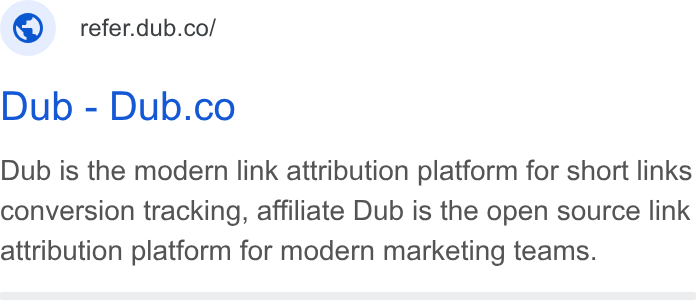
- refer.dub.co/ Dub - Dub.co
- Audience
- The text mentions "modern marketing teams" and "affiliate" and "conversion tracking", indicating it targets professionals in digital marketing, affiliate marketing, and analytics.
Why it works. Displays the subdomain refer.dub.co directly in the ad, signaling the referral/attribution product to marketers already searching for that specific use case.
Displaying the website URL and brand name prominently at the top: "refer.dub.co/ Dub - Dub.co" If you have a dedicated feature subdomain, surface it directly in your ad copy so searchers self-select into the right product line.
09 The playbook
The channels are not separate. They are one system where each stage feeds the next. Here is the read, then the plays to run tomorrow.
The inferred playbook
The growth loop is unusually self-funding: open-source and the founder's own reach generate free attention, and the resulting paying customer base then manufactures the next round of SEO surface on its own.
Two feeder channels do the top-of-funnel work: the founder's viral X threads (up to ~284K views on a single post) and an open-core GitHub repo with tens of thousands of stars, both funneling into branded search for the bare term "dub."
A $0 Free tier (25 links, 1,000 tracked events) is the entry point, and the paid ladder now prices largely off Dub Partners usage rather than links alone: Pro at $25/mo, Business at $90/mo (up to $2,500 in monthly partner payouts, 10 users), Advanced at $300/mo (up to $15,000 in monthly partner payouts, 20 users), and custom Enterprise, a packaging shift that puts the affiliate product at the center of the monetization ladder rather than treating it as a bolt-on feature.
Dig deeper+3▾
Every Dub Partners customer adds a page that inherits its own brand-search demand, a distribution asset none of Dub's other channels replicate, and cumulative partner payouts grew from $10M in December 2025 to $20M+ in just over five months, a rough proxy for how fast that customer base, and therefore the page count, is expanding.
A modest $2M raise in January 2025 from OSS Capital and angel operators including Vercel CEO Guillermo Rauch keeps the team lean (roughly 13 employees, one open engineering role as of 2026-07-14), which tracks with a GTM motion that has almost no paid demand-generation bench and no brand voice separate from the founder, meaning the whole funnel depends on one person's account and one open-source repo staying visible.
How many Free-tier signups convert to Pro or Business is not public. Dub Partners' own take rate or fee on the payouts it processes is not disclosed, the $20M figure is volume moved for customers, not Dub's revenue. And blended ARPU across the seat-plus-usage pricing tiers has no public breakdown, so no company-confirmed revenue figure exists; a third-party estimate placed revenue near $1.4M as of mid-2025, a figure that predates the Partners payout growth to $20M+ cumulative, so current revenue is plausibly higher, but that remains an estimate, not a confirmed number.
The self-inclusion listicle
The proofSteven Tey's "open-source alternatives to popular SaaS" X threads, which named his own product as the Bitly alternative alongside category leaders, pulled up to ~284K views with zero ad spend.
The adaptationBuild your own "open-source alternative to X" or "the indie alternative to X" list in your category, name 5-6 real, well-known tools by their actual handles so each has a reason to notice and reshare it, and slot your own product into the list on equal footing rather than pitching it separately. Post it from a personal account, not a brand account, since a founder's own voice tagging real competitors reads as a genuine roundup, not an ad. First step: draft the list and tag the tools' official accounts when posting it.
Cost: $0 · Time to signal: days · Works pre-PMF: yes
Customer pages that inherit search
The proofDub Partners gives every customer a public page that ranks for that customer's own brand terms like "perplexity login," turning each new signup into a new indexed page with no content-team output.
The adaptationIf your product has any customer-facing public surface, a status page, a directory listing, an embeddable badge, a public integration page, structure it so each new customer automatically gets their own indexable URL under your domain carrying their brand name in the title and slug. The mechanism to carry over is specific: the page must target a query the customer's own audience already types (a login page, a program page, a docs page), not a generic marketing page. First step: pick the one customer-facing page your product already generates behind a login and make a public, indexable version of it for your next new customer.
Cost: $0 · Time to signal: months · Works pre-PMF: conditional, only once you have at least one paying customer whose name carries its own search demand
Ride a competitor's deprecation
The proofDub's top LinkedIn creative is a curiosity-hook ad timed to Google's Firebase Dynamic Links shutdown (Google's deep-linking service), positioning Dub as the migration path and naming three customers already on it.
The adaptationSet an alert for deprecation or shutdown announcements from the incumbent tool in your category, and the moment one fires, ship a single landing page framed as "migrating from [tool]" plus 2-3 named users already using your product as proof, then put a small budget behind it on whichever platform your buyers actually use. The mechanism that makes it work is urgency plus a real, dated deadline, not a generic switch-to-us pitch. First step: search your category plus "deprecat" or "shutting down" and bookmark the official sunset date the moment you find one.
Cost: under $500 · Time to signal: days · Works pre-PMF: conditional, only if you already have a couple of recognizable users to name as proof
Ship the narrow utility, not the pitch
The proofCompany-pitch submissions of the Dub.co landing page flopped twice at 1 point on Hacker News, while the founder's own narrow, free utility, Git.new, a GitHub link shortener, drew 12 points and 5 comments under the same account.
The adaptationInstead of submitting your company or product page, carve out one narrow, genuinely free, single-purpose tool from inside your product, something a stranger can use in one click with no signup, and submit that on its own merits. The mechanism is scope: a tool that does exactly one thing gets judged on usefulness, while a company page gets judged as marketing and mostly ignored. First step: identify the smallest useful slice of your product that works standalone, ship it at its own URL, and submit only that.
Cost: $0 · Time to signal: days · Works pre-PMF: yes
Open-core as a discovery surface
The proofDub's AGPLv3-licensed core has drawn roughly 23.7k GitHub stars, feeding the 33,820 monthly searches for the bare term "dub" and giving the company a top-of-funnel independent of any single campaign.
The adaptationOpen-source the smallest genuinely useful, self-hostable slice of your product under a license that still requires anyone reselling a hosted version to open-source their changes (an AGPL-style license), keep the hosted, managed version as your paid product, and write clear self-hosting docs so the repo itself becomes a landing page. The mechanism is the same one that built Dub's branded search: stars and forks are a public, compounding signal a generic landing page can't produce on its own. First step: pick one feature that's valuable standalone but not your core paid differentiator, and publish it as its own repo with a README naming your hosted product as the easy alternative to self-hosting.
Cost: dedicated budget or hire · Time to signal: months · Works pre-PMF: conditional, only if the open-sourced piece is genuinely useful on its own, not a crippled teaser Not transferable at an earlier stage: the customer-inherited SEO surface in Play 2 needs paying customers with their own brand-search demand already, and the founder's listicle reach in Play 1 compounds faster with an existing following than it will from zero, though the mechanic itself works at any following size.
You just read how Dub does it. Tomorrow it is someone else.
Every morning we take one company that is actually growing and break down where its customers come from: the ads still running after a year, the channel doing the real work, and the play you can run this week.
Systemaic · directional intelligence. Traffic, spend, and reach figures are SimilarWeb-style estimates and qualitative reads of public data, not audited numbers. Built on real public receipts.
// teardowns with a similar GTM motion
sources & receipts (8)
Live ad libraries: linkedin ad library · google ad library
Launch archives: Hacker News: Boeing 777 departing Dubai nearly had a major incident after · Hacker News: Show HN: AI dub tool I made to watch foreign language videos · Hacker News: Tortured phrases: A dubious writing style emerging in scienc · Hacker News: A new term, ‘slop’, has emerged to describe dubious A.I.-gen · Hacker News: The Dubai Debt Trap · Hacker News: Iran strikes leave Amazon availability zones "hard down" in
Traffic, spend, and revenue figures are estimates as noted in the report; the links above are the primary public artifacts.