- 01Open the black box of your product mechanics in a pre-launch thread, not a features list
- 02Build a second product that serves the same audience as a referral channel for your first
- 03Seed your affiliate program with direct outreach so affiliates run paid search on your behalf
- 04Write honest tool comparisons as your first SEO investment before scaling broader content
01 Snapshot
The one-glance read on who they are and how they grow. Each point is verifiable from the receipts above.
SeoBotAI is an AI agent for blog SEO, handling keyword research, content generation, auditing, and programmatic SEO for founders and marketers who want to run search acquisition without a dedicated team; publicly reported MRR is ~$54,429 across 744 active paying subscriptions at ~$73 blended ARPU per month.
Founder-led and launch-led, compounded by portfolio cross-promotion across co-founder John Rush's 20+ tool ecosystem.
~42,306 estimated monthly visits; co-founder John Rush's personal X account (John Rush) has 116,885 followers; a December 2024 Product Hunt launch hit 853 upvotes and 125 comments; 6 active Google ads as of 2026-06-29.
"It's not similar to traditional SaaS. AI controls a large tree of nested tasks imitating a human org.", co-founder John Rush, on X, December 2024.
Distribution is almost entirely co-founder audience (56.1% direct traffic), portfolio cross-referrals, and a single well-executed Product Hunt launch; organic search is the only channel that does not depend on John Rush's personal posting cadence.
02 How it unfolded
The order the channels came online. Sequence is strategy: what they did first, and what they layered on once demand existed.
03 Traffic & channel mix
Estimated demand, the channel split behind it, and the keywords and referrers doing the work. Directional modeling, not audited analytics.
Traffic sources
Top search keywords
| Keyword | Volume | Weight | CPC |
|---|---|---|---|
| seobot | 3.0k | $3.44 | |
| seobotai | 950 | $13.31 | |
| seo bot | 780 | $8.90 | |
| seo bot ai | 320 | - | |
| open source seo tools to check the traffic of websites | 270 | - |
Top referring sites
Closest competitors by audience
~42,306 estimated monthly visits, down -17.7% over the three months ending 2026-06-29. The channel mix reveals the distribution model clearly: direct traffic at 56.1% is the dominant channel, almost certainly reflecting brand recall from social posts and word-of-mouth from co-founder John Rush's X presence rather than any dark funnel. Organic search contributes 27.3%, making it the one scalable channel not dependent on founder posting cadence. Referrals account for 11.5%, with the top referring domains being launchspot.ai and unicornplatform.com, both other properties in John Rush's portfolio, confirming that cross-promotion within his tool ecosystem is a real and measurable acquisition lever. Social organic is 2%, Gen AI 1.7%, display ads 1.1%, email 0.3%.
Organic keyword positioning is tight around brand and category: the site ranks first for "seo bot" (780 searches per month across the web), "seo robot," and "seobot," and second for "robot seo" and "seo bots." The keyword "open source seo tools to check the traffic of websites" (270 searches per month across the web) shows an early signal of targeting informational queries beyond pure brand. Top referrers are launchspot.ai and unicornplatform.com. Closest competitors by traffic overlap include backlinkgpt.com, seowl.co, and wordlift.io.
04 Organic content
The specific pages earning their organic search traffic, and the pattern behind why they rank. Adapt the format, not the topic.
SEOBOT's organic content clusters around two proven formats: head-to-head tool comparisons (Ahrefs vs KWFinder, an explainer on the Ahrefs crawler bot) and resource listicles (open-source SEO tools), plus a standalone free tool page (keyword difficulty checker). The pattern targets buyers who are actively researching which SEO tool to purchase, a high-intent query type that sits at the bottom of the funnel and converts with less friction than awareness content. The homepage itself captures 42.3% of organic traffic by ranking for category terms like "seo bot" and "seo robot," which means brand and category terms do as much or more acquisition work than the blog alone.
Top pages by organic traffic
05 Channel map
Not traffic share. How much weight the growth system actually puts on each channel, with a one-line read on the role it plays.
What drove growth
06 The motions doing the work
For founder-led SaaS the breakdown shifts from ads to traction: where the first users came from, how the founder grows it in the open, and the compounding organic surface.
The December 2024 X-to-Product Hunt sequence was the clearest acquisition event in SEOBOT's public history, and it ran as a deliberate two-step primer-then-launch motion.
On December 5, 2024, co-founder John Rush posted a detailed thread explaining how SEOBOT's AI agent works, framing each article as "running 727 prompts, 126 jobs, costing $6," and positioning SEOBOT as "not similar to traditional SaaS." The thread reached 417,810 views and 2,057 likes, seeding demand and giving potential users a concrete mental model before the formal launch.
The December 27, 2024 Product Hunt launch hit 853 upvotes and 125 comments, with the X audience primed 22 days earlier likely forming a meaningful share of the first-day voter pool. Co-makers were Vitalik May and John Rush.
Dig deeper+2▾
Two Show HN submissions from John Rush (September 2023 at 2 points, 1 comment; February 2026 at 3 points, 0 comments) show Hacker News was attempted as a secondary surface, but neither submission broke through. HN was not a meaningful driver of initial users.
The top referral domains (unicornplatform.com, launchspot.ai) confirm John Rush cross-promoted SEOBOT to existing users of his other tools at launch, adding a warm-audience layer on top of cold Product Hunt traffic. (source)
John Rush, co-founder of SEOBOT, runs one of the most active founder-led distribution channels in indie SaaS: 116,885 followers on X (John Rush) with 41,508 posts.
His highest-performing SEOBOT posts open the black box rather than announcing features. The December 2024 thread (727 prompts, 126 jobs, $6 per article, 417,810 views, 2,057 likes) and the February 2025 origin-story post (234,969 views, 999 likes) both outperform standard product updates by an order of magnitude because they give the audience something concrete to share and debate. The mechanism transparency is the hook, not the outcome claim.
John Rush's X account covers all 24 of his tools, not just SEOBOT, so his highest-reach posts are often portfolio-level insights. A May 2025 post on Unicorn Platform's growth from 25,000 to 551,000 users (1,173 likes, 334,953 views) and a post on how he got his first 100 users across 24 startups (1,457 likes, 239,874 views) build authority that benefits SEOBOT as part of the broader portfolio. (source)
Dig deeper+1▾
No founder-authored Reddit or LinkedIn posts specific to SEOBOT appear in the evidence. Reddit signals are user-generated: a digital_marketing thread from 2024 ("Has anybody used seobotai.com?" at 8 points, 21 comments) and a third-party tool comparison post in 2026, neither authored by the founding team. Co-founder Vitalik May has no visible separate social presence in the evidence.
Organic search at 27.3% of traffic is the only channel that compounds independently of founder posting cadence, but the content surface is still thin relative to the opportunity in the SEO software comparison market.
The top-performing blog pages are head-to-head comparisons and resource listicles targeting buyers at the bottom of the research funnel. These formats earn traffic because they answer specific purchase-research queries, and visitors arriving this way are already evaluating tools, making them higher-conversion candidates than awareness readers.
Ranking first for "seo bot," "seo robot," and "seobot" means category-level searches land directly on the homepage rather than filtering through a blog post. This is a structural SEO advantage as long as those positions hold.
Dig deeper+3▾
The keyword difficulty checker page earns ~332 organic visits per month independently, pointing toward a hub-and-spoke model where free utilities drive top-of-funnel discovery that converts into paid subscriptions. SEOBOT's own "mini apps" feature suggests this surface may expand programmatically.
Tolt (a referral tracking platform) is embedded on the homepage. As of 2026-06-29, several third-party advertisers are running the 6 active Google ads pointing to seobotai.com, consistent with affiliates running their own paid campaigns. The longest-running ad at ~430 days and the "Automated Content Creation" and "Fully Automated SEO Agent" creative angles show the affiliate channel has sustained ROI without SEOBOT absorbing all ad spend directly.
Unicorn Platform (a no-code landing page builder, also John Rush's product) and launchspot.ai are the top referral sources, meaning existing users of John Rush's other tools discover SEOBOT as a natural next product in the ecosystem. (source) Conversion rate, CAC, and churn are not visible in public data.
07 Paid ads
This founder-led SaaS also runs paid acquisition. Here are the live ads doing the work, each with the X-ray and a play you can adapt.
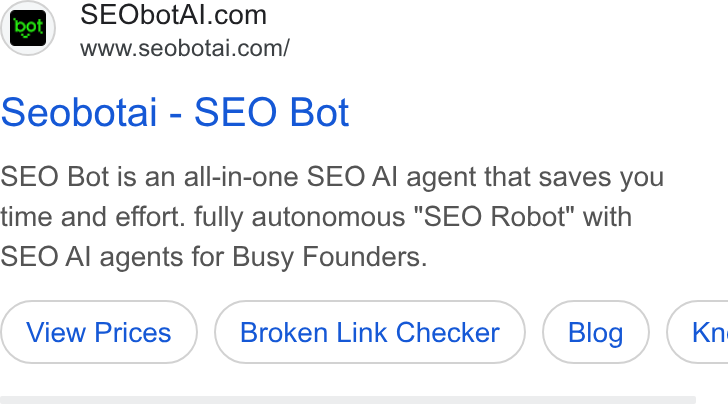
- Running
- 127 days (longevity = it's converting)
- Hook
- Image shows a search result snippet with a logo, website, title "Seobotai - SEO Bot", and a description starting with "SEO Bot is an all-in-one SEO AI agent...".
- CTA / offer
- View Prices
- Audience
- The phrase "Busy Founders" directly targets entrepreneurs and business owners who are time-constrained.
Why it works. Uses the description line to reposition a point solution as an all-in-one agent, appealing to buyers tired of stitching together SEO tools.
Headline clearly states the product and its core function: "Seobotai - SEO Bot". In your meta description, state what suite of tools your product replaces, not just what it does.
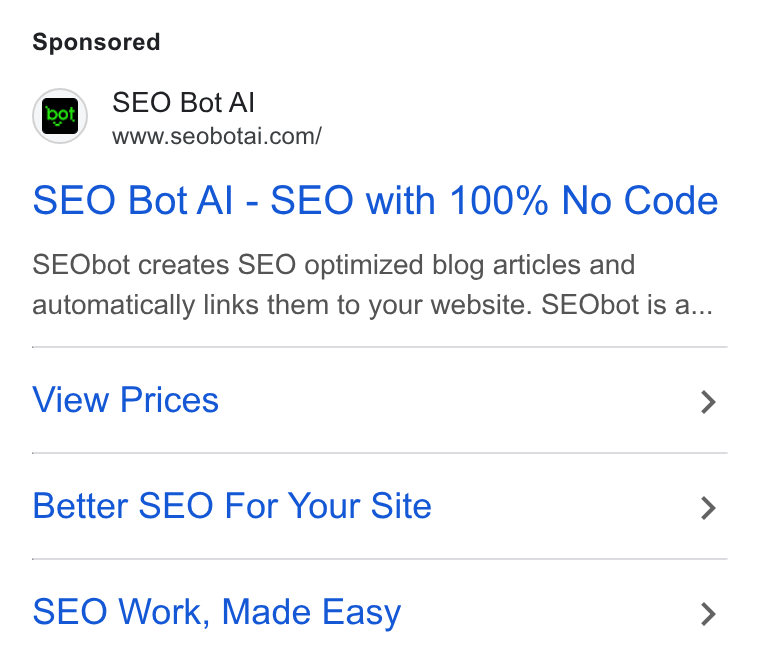
- Running
- 268 days (longevity = it's converting)
- Hook
- Sponsored text at the top, followed by a small green square logo with "bot" in white, next to "SEO Bot AI" and "www.seobotai.com/". Below this, the headline reads "SEO Bot AI - SEO with 100% No Code".
- Audience
- Individuals or businesses seeking SEO solutions without needing technical coding skills, indicated by "100% No Code" and the description of creating "SEO optimized blog articles" and linking them automatically.
Why it works. Targets non-technical founders wary of SEO tooling by quantifying ease of use as 100% no code instead of a vague simplicity claim.
Headline with a strong, quantifiable benefit: "SEO Bot AI - SEO with 100% No Code" Add a specific number to your ease-of-use claim, like 100% no code or a 5-minute setup, instead of saying easy to use.
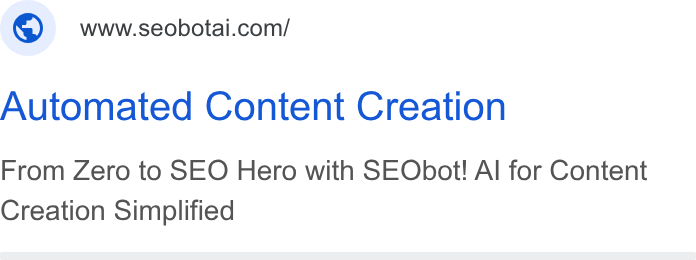
- Running
- 127 days (longevity = it's converting)
- Hook
- www.seobotai.com/ with a blue globe icon next to it. Below that, "Automated Content Creation" in large blue font.
- Audience
- Businesses or individuals seeking to improve their SEO and content creation processes, indicated by terms like "SEO Hero" and "AI for Content Creation Simplified."
Why it works. Search ad targets founders already typing content-automation queries, pairing the brand with the exact benefit phrase they searched for.
Headline with a clear value proposition: "Automated Content Creation" Make your search ad headline literally state the deliverable your buyer is Googling, not your brand tagline.
Show 1 more ad
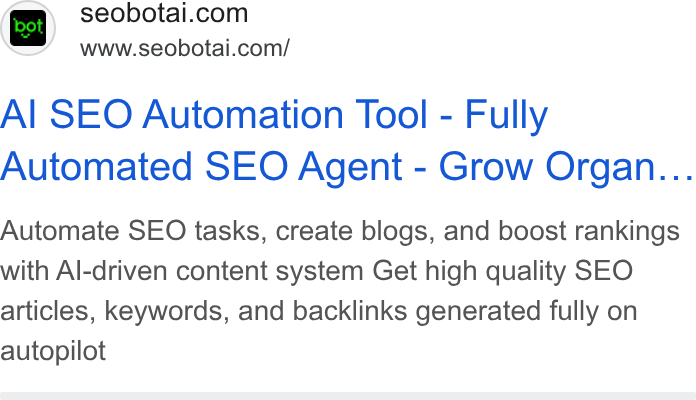
- Running
- 36 days (longevity = it's converting)
- Hook
- The image displays a search result snippet. The top left shows a small square icon with "bot" in green text on a black background. To its right, the text "seobotai.com" is visible, followed by "www.seobotai.com/" on the next line. Below this, the blue headline reads "AI SEO Automation Tool - Fully Automated SEO Agent - Grow Organ...".
- Audience
- Businesses or individuals interested in SEO and content marketing, indicated by terms like "SEO tasks," "create blogs," "boost rankings," "SEO articles," "keywords," and "backlinks."
Why it works. Reaches searchers using the term SEO automation with matching headline language, then escalates to the bigger promise of a fully autonomous agent.
Headline stating a core benefit: "AI SEO Automation Tool - Fully Automated SEO Agent - Grow Organ..." Mirror your searcher's exact query term in the headline, then use the description line to level up the promise.
08 In their own words
Pulled from interviews and community sessions. The quotes are the angle; the takeaway is what to do with it.
“I launch a waitlist and I see whether I am able to generate 100 signups. I email them all and I offer them 90% discount on a pre-sale before I build anything. And then if I get five sales, I build the first MVP.”
Expand
John Rush grew his portfolio by validating ideas through public pain-sharing and waitlists before writing any code, using SEO and daily social content to drive early users, then connecting his 20+ tools into an ecosystem where users flow from free/traffic tools into paid products via cross-promotion and native integrations.
“I don't even build a product. I actually deliver the solution manually. At this stage, I don't care about the margins yet. I just care about the solution being delivered to the customers and whether they actually satisfied with that.”
“Before my product is great, I usually go for SEO. And then the second most popular method I have is social media marketing. So I run that on X, on LinkedIn, on Substack, on Facebook, everywhere. I repurpose the same content on all platforms and I do that every day.”
“I have over 20 tools where some tools are premium tools I make money on and some tools are just to bring traffic in and channel it to my premium tools. Users natively float from product to product and end up using my entire ecosystem.”
“Before building in public, my failure rate was really high. 90% of the things I've done failed. And when I start building in public, it flipped. So now only 10% of my products fail and 90% don't fail because I adjust them before I ship them just because I build in public.”
Validate before building: post about the pain publicly, collect 100 waitlist signups, offer a 90% pre-sale discount, and only build if you get 5 paying customers.
Deliver the solution manually first — no code — and iterate until customers are satisfied, then bring in a co-maker to build the product.
Use SEO as the primary early-traction channel, then layer in daily cross-platform social content (30+ posts/month), directory listings, and only then rely on word-of-mouth.
Build a portfolio where some tools are free/traffic magnets and others are paid, then connect them with deep integrations (not just links) so users flow naturally between products.
Build in public from day one — not just for marketing reach, but because audience feedback before shipping is what flips your failure rate from 90% to 10%.
He Makes $3M/Year From Tiny AI Tools (Here’s How You Can Too) ↗Chris Koerner on The Koerner Office Podcast · 76k views · 52 min▶ Listen“half of my sales every month for new users. Half of them come from one tool to the other. That's why when I land one user in any of my tool, like I have some tools that are making like 1K a month, like very small tools, but at the same time they are so cheap and they have trial and people enter those tools and they might even cancel that tool but you know move over to the other tools and it's very rare when people leave my universe.”
Expand
John Rush grows by building tools to solve his own operational pain first, validating demand through Google autocomplete keyword research and cold social outreach before writing a line of product code, and then compounding growth by cross-selling users across his 24-tool portfolio so that even a $1K/month tool feeds revenue into his larger products. He starts SEO on day one of every project, treating early article traffic as a second validation signal rather than waiting for a product to be mature.
“I usually start SEO work on a day one. In that case, I can just post the product and wait for a few months and then come back and see whether there's traffic from SEO. And that's interesting. So SEO traffic is a new source of validation because you know one thing that you have to also validate with a product is not just if people want it but also if you're able to drive traffic there.”
“right now they don't really respect the follower count as it did in the past. So if your content is interesting they will show it to a few people and if they find it interesting they will show it to more people and eventually it can blow up even without followers. So you should try that.”
“directories are so good at driving traffic from people who would otherwise not land on your website. Most of my directories are making 1K a month. Some make 10K, but most make just 1K.”
“you should try to kill your idea because there are so many ideas. You rather kill, you know, 20 of them and 21 works out and then you don't waste time building it, right? Because building an idea takes a lot of time.”
Use Google autocomplete as a keyword discovery tool: type '[category] that' or '[category] for' and treat every autocomplete suggestion as a real demand signal, then validate search volume in a keyword tool before committing to build.
Start SEO on day one even before you have a product: publish articles with a waitlist banner embedded so organic traffic becomes a second, audience-qualified validation layer on top of your initial cold outreach.
Validate willingness to pay with a pre-booking offer (70-90% discount) before launching — if fewer than 10% of your waitlist converts at a discount, the audience or pricing model is wrong and you should kill the idea.
Cross-sell aggressively across a portfolio of cheap, narrowly-scoped tools: a $1K/month tool that acquires a customer who then migrates to your $10K/month tool is a profitable acquisition channel, not a failure.
Do 100 cold social replies and DMs to people in the target audience before building anything; zero signups means the problem is not painful enough, while even 5-10 signups is sufficient signal to proceed to the next validation stage.
How to Build SEO Directories (Step-by-Step) With John Rush ↗Jaume Ros · 44k views · 44 min▶ View source“99% of directories fail and number one reason why people fail is that they don't spend enough time on keyword research because if you look at SaaS products if you have a pain and you come up with idea eventually you will find your product market fit if you pivot enough… but with directories it's purely SEO game.”
Expand
John Rush built 50+ directories (12 performing well) by treating them as a pure SEO game: success is 80% keyword research and domain selection, 15% data curation, and only 5% technology/design. His growth playbook centers on finding high-traffic, growing, low-competition keywords via Google Keyword Planner, securing a matching domain, then seeding initial traction by plugging the directory URL into relevant Reddit threads, Quora answers, and social posts where directories are welcomed because they appear non-commercial. He compounds this with listing submissions to other directories and letting great data earn organic backlinks from influencers.
“the directories are 80% success lays in keyword research and domain — that's 80% literally — the other 15% is in the data curation like actual items, and 5% is in technology what exactly is this tech or what's the design.”
“when you launch your directory the best way to promote your directory at the start is to find the questions on internet and go there and say look I built a directory that helps you — and surprisingly if you share directory under those questions even on Reddit nobody hates you nobody downvotes you because the directory is nonprofit.”
“I went to a Reddit subreddit with a viral post and I just added my site there and then the next day I woke up and I had tons of backlinks because people just created blog articles and included my link there.”
“if you start with the directory in a space you like the chance that you will be able to utilize that directory later to come up with idea for a SaaS tool is really high — and not just coming up with idea but you have the whole channel with traffic in your hand that you can drive to your SaaS tool.”
Start with Google Keyword Planner + Google Search in a ping-pong loop: find a keyword with 10K+ monthly searches, check year-over-year growth (high growth = less saturated), then verify no specialist directory ranks on the first page — that gap is your opportunity.
Before building, validate social/Reddit demand by searching 'site:reddit.com <keyword>' to find active subreddits and viral threads where you can legitimately post a non-commercial directory link on launch day.
On launch, post the directory URL directly in the top Reddit threads, Quora answers, and Twitter replies about that topic — directories are tolerated where SaaS links get removed, and a single viral Reddit thread can generate dozens of organic backlinks overnight.
Email every business listed in your directory offering to 'claim their listing' and share view counts — this converts well because you're delivering traffic, and it opens a natural upsell to featured/boosted placements and ongoing sponsorships.
Build in a niche you genuinely know and find unsexy: the less obvious the topic, the less developer/founder competition, which means easier keyword wins, cheaper domains, and a more natural editorial voice when curating and updating data monthly.
An Unfiltered Talk with John Rush: Directories, AI SEO & Building To Win ↗Frey Chu · 12k views · 33 min▶ View source“I built my first directory which was AllGPT right after the OpenAI demo day and then it kind of went super viral and after that I started doing a lot of directories.”
Expand
John Rush built his directory business by jumping in early on trends (he launched AllGPT right after the OpenAI demo day and it went viral), then doubling down when the market validated demand. His core GTM insight is that directories win by owning the highest-quality, most specific data in a niche — not by being first or biggest — and that winning LLM/AI search requires being present across Reddit, top Google/Bing rankings, and social UGC simultaneously. He treats thinking and research as the real work, spending months shaping a directory concept before building anything.
“The one who does the best quality and the best work kind of wins and the rest will lose.”
“I spent like month or years thinking and then people ask how long does it take to succeed and I'm like well from the moment I started building and I built it it was pretty fast but before that I just thought about it for six months.”
“If you want to play the game really really well you have to be A on Reddit, B on top of Bing, C on top of Google, and be on top of social media — so there's a tweet on the internet where somebody asks what are the best dog parks and somebody has to answer and then there has to be a link to you or description of you.”
“Whenever I had a viral tweet for my directory it just jumps out with traffic the next day — it takes just a day, it's so fast because Google has quicker reaction for social media content.”
Launch on trend spikes early: Rush timed his first directory to the OpenAI launch moment, got viral distribution for free, and used that signal to justify going deeper into the category.
Spend most of your time in pre-build research — reading Reddit, competitor comments, and UGC — to identify the single most important missing data point in a niche before writing any code.
Win on data quality, not volume: as directories commoditize, the one with the richest, most accurate dataset for a specific niche beats shallow aggregators, including what LLMs can produce quickly.
For LLM/AI search visibility, cover all four surfaces in parallel: Reddit presence, Bing/Google top rankings, and social posts with links — because modern LLMs query live search (Bing deal) and training data (Reddit deal) and weight UGC as a hard-to-manipulate authority signal.
Treat a viral social post as an SEO lever: UGC and social engagement create fast Google ranking bumps (Rush observed next-day traffic lifts), so seeding authentic community discussion around a directory is a distribution tactic, not just a branding one.
09 The playbook
The channels are not separate. They are one system where each stage feeds the next. Here is the read, then the plays to run tomorrow.
The inferred playbook
SEOBOT's acquisition loop starts with the co-founder's X audience, converts through a coordinated Product Hunt launch, and compounds via portfolio cross-referrals, affiliate-driven paid search, and organic brand-term ranking.
Co-founder John Rush generates awareness by posting technical transparency threads on X, where the specifics of how the product works (the 727 prompts, the $6 cost per article, the nested AI task tree) drive sharing among founders and marketers considering SEO automation tools.
The Product Hunt launch crystallized that attention into signups: 853 upvotes and 125 comments on December 27, 2024, with the X primer thread seeding the audience 22 days earlier. The coordinated two-surface launch is the clearest signal of an intentional distribution stack rather than an accidental traction moment.
Dig deeper+2▾
Portfolio cross-promotion from John Rush's other tools (Unicorn Platform, launchspot.ai referrals), an affiliate program generating third-party paid search coverage, and organic brand-term rankings each provide baseline traffic that does not require a new post or launch.
56.1% of visits are direct, meaning the entire acquisition motion is structurally dependent on John Rush's posting cadence and his portfolio's size. The organic content library is thin relative to the opportunity in the SEO software comparison market, and no community-generated surface (no public open-source repo or user forum visible in the evidence) compounds discovery beyond the founder's personal reach. Conversion rate, CAC, and churn are not visible in public data.
Open the black box of your product mechanics in a pre-launch thread, not a features list
The proofJohn Rush's December 2024 X thread describing how SEOBOT works ("727 prompts, 126 jobs, costs $6 per article, AI controls a large tree of nested tasks") reached 417,810 views and 2,057 likes and was posted 22 days before the Product Hunt launch that hit 853 upvotes. The mechanics post outperformed any conventional product announcement and primed the audience that drove launch-day votes.
The adaptationBefore your next launch or major update, write a thread that describes what literally happens inside your product when a user presses go: the steps, the costs, the throughput numbers, the surprising chain of processes. Start by listing the 5-7 internal steps your product runs per job, then identify the one that would most surprise a peer founder and lead with that as the first sentence. This works because mechanism transparency signals credibility to a technical audience and gives readers something concrete to forward to a colleague who would want the same tool.
Build a second product that serves the same audience as a referral channel for your first
The proofThe top two referring domains to seobotai.com are unicornplatform.com (a no-code landing page builder) and launchspot.ai, both John Rush properties. This cross-portfolio referral stream contributes to 11.5% of SEOBOT's total traffic at no additional ad spend, because users of one tool encounter SEOBOT as a natural next step.
The adaptationIf you own more than one product serving overlapping audiences, build a deliberate cross-link into each product's onboarding flow, dashboard, or help docs the user would naturally need the other tool. Start by mapping which of your current users would genuinely benefit from your adjacent product, then add one clear contextual mention at the highest-intent moment (for example, inside a feature that touches both products' territory). Caveat: this play requires owning at least two products with meaningfully overlapping user profiles and does not apply if you have a single-product business.
Seed your affiliate program with direct outreach so affiliates run paid search on your behalf
The proofSEOBOT's affiliate program (embedded Tolt) has generated at least several active third-party advertisers running Google ads pointing to seobotai.com as of 2026-06-29, including Digital Funda with ads running ~430 days, the longest-running in the active set. This gives SEOBOT category-term Google search coverage without absorbing all paid search spend directly.
The adaptationLaunch an affiliate program on a commission-tracking platform (Tolt, Rewardful, or similar) and actively recruit power users or niche content creators who already rank or bid on your category keywords. Start by finding the top 20 people who have published comparison content or reviews in your niche, then reach out with a specific commission rate and a one-paragraph pitch on why their audience would convert. The mechanism is that affiliates who run their own paid search absorb the ad spend risk while you get sustained keyword coverage and conversion data you did not have to buy yourself.
Write honest tool comparisons as your first SEO investment before scaling broader content
The proofSEOBOT's top blog pages by organic traffic are a head-to-head comparison ("Ahrefs vs KWFinder," ~417 organic visits per month) and a resource listicle ("open-source SEO tools," ~370 organic visits per month). Together they represent roughly 13% of total organic traffic from just two posts, both targeting buyers actively researching a purchase decision rather than browsing for information.
The adaptationIdentify the 3-5 most-searched comparisons in your niche by searching Google for "[competitor] vs [competitor]" in your category, then write the most honest and detailed version of those pages with your product included in the comparison naturally. Start with the combination that already has several ranking results you can clearly outpublish in depth and recency. This works because comparison queries attract visitors who are near the end of a purchase decision, making them higher-conversion candidates than awareness content with a much shorter path to a trial or signup.
Publish a free utility page as a standalone organic and conversion asset in your product's domain
The proofSEOBOT's keyword difficulty checker page earns ~332 organic visits per month independently of the main product or blog, adding a top-of-funnel surface that does not require ongoing content production. The product's own "mini apps" feature signals SEOBOT is deliberately building a hub-and-spoke model where free utilities drive discovery that converts to paid subscriptions.
The adaptationIdentify one calculation, lookup, or data check your target users do manually or through a clunky external resource, then build a minimal interactive version as a dedicated page within your product's domain. Start with the most common "how do I calculate X?" or "what is Y for my site?" question from your support inbox or replies, then build the simplest version that actually answers it. Free utility pages earn organic links from people who share them as references, which compounds domain authority and discovery across all other pages on your site over time.
You just read how SEOBOT does it. Tomorrow it is someone else.
Every morning we take one company that is actually growing and break down where its customers come from: the ads still running after a year, the channel doing the real work, and the play you can run this week.
Systemaic · directional intelligence. Traffic, spend, and reach figures are SimilarWeb-style estimates and qualitative reads of public data, not audited numbers. Built on real public receipts.
// teardowns with a similar GTM motion
sources & receipts (11)
Live ad libraries: google ad library
Launch archives: Hacker News: Show HN: Seobots.io – simple bots for task automation · Hacker News: Show HN: SEOBot – open-source AI SEO tool (keyword research, · Hacker News: Show HN: SeoBot – An Autopilot for Programmatic SEO · Hacker News: Show HN: Made a broken link checker with AI (didn't touch th
Founder interviews: I Make $250K/Month From 20 Apps · He Makes $3M/Year From Tiny AI Tools (Here’s How You Can Too) · How to Build SEO Directories (Step-by-Step) With John Rush · How To Build A Directory In A Weekend: The John Rush Directory Method · An Unfiltered Talk with John Rush: Directories, AI SEO & Building To W · John Rush on AI and Entrepreneurship
Traffic, spend, and revenue figures are estimates as noted in the report; the links above are the primary public artifacts.