- 01One search ad per SKU, not per brand
- 02A tagged creator-gifting program
- 03Bundle-as-SKU for shoppable social
- 04A specific timeframe beats a vague claim
01 Snapshot
The one-glance read on who they are and how they grow. Each point is verifiable from the receipts above.
Liposomal, squeeze-packet vitamins sold direct-to-consumer and now stocked in Target, Ulta, and Whole Foods, with revenue estimated at $150M-200M annually as of late 2025 (estimate, not independently verified).
Creator-led virality feeds an always-on paid engine, roughly 2,000 active Google ads and 1,300 active Meta ads as of 2026-07-12.
About 1.31M estimated monthly visits (+54.6% over the last 3 months), 539,450 Instagram followers, and $55M+ raised across debt and equity through November 2025.
As of 2026-07-12, Google's newest tests (first shown 2026-07-02) swap years of plain text ads for image and video creative.
The edge isn't the liposomal format itself: the brand bootstrapped past $150M in revenue before taking outside capital, then raised its first round from celebrities who now double as organic amplifiers, not just financiers.
02 How it unfolded
The order the channels came online. Sequence is strategy: what they did first, and what they layered on once demand existed.
03 Traffic & channel mix
Estimated demand, the channel split behind it, and the keywords and referrers doing the work. Directional modeling, not audited analytics.
Traffic sources
Top search keywords
| Keyword | Volume | Weight | CPC |
|---|---|---|---|
| cymbiotika | 30k | $1.26 | |
| 36.8M | $1.28 | ||
| liposomal glutathione | 24k | $1.48 | |
| glutathione | 132k | $0.77 | |
| cymbiotica | 1.2k | $1.34 |
Top referring sites
Closest competitors by audience
Cymbiotika draws an estimated 1.31M monthly visits, up 54.6% over the last 3 months. The mix is led by Search Organic at 32.2%, Social Paid at 21.1%, and Search Paid at 19.6%, meaning almost as much traffic arrives through paid social and paid search combined as through unpaid search, a sign the always-on Google and Meta libraries covered below are doing real work rather than sitting idle. Direct traffic adds another 11.5% (people typing the URL or using a saved bookmark, consistent with the branded-search pattern in Organic Content below), while Social Organic (5.2%) and Display Ads (4.6%) contribute smaller but real shares; referrals, email, affiliate, and emerging AI-search traffic round out the rest at under 6% combined. The most telling keyword is the brand name itself, "cymbiotika" (30,460 searches/month), followed by category demand around "glutathione" (132,170 searches/month) and "liposomal glutathione" (24,120 searches/month), the ingredient the brand has built some of its strongest ad and content assets around. Referring traffic comes mostly from infrastructure rather than editorial placements: shopify.com (likely checkout/platform traffic from their Shopify-hosted store, not a partner referral), plus juicebox.ai and gethookd.ai, both niche software tools rather than recognizable publishers. Of the listed competitors, thorne.com is the closest like-for-like rival in premium capsule-based supplements, livemomentous.com (Momentous) competes directly for the same performance-wellness DTC buyer, and iherb.com is really a multi-brand retailer rather than a head-to-head competitor, its presence signals overlapping search real estate more than direct rivalry.
04 Organic content
The specific pages earning their organic search traffic, and the pattern behind why they rank. Adapt the format, not the topic.
The organic engine is overwhelmingly branded: the homepage alone pulls an estimated 38,800 organic visits/month (33.7% of their top-page organic traffic), and the next-highest pages are direct product pages for glutathione and vitamin C plus the all-products collection, all ranking #1-2 for their own name variants. The one exception is a blog post on choosing a vitamin D3 supplement, which ranks #12 for the generic "best vitamin d supplement" query, a rare piece of top-of-funnel informational content in an otherwise navigational content footprint. The pattern reads as a brand that converts existing name recognition into site visits rather than one manufacturing new demand through content, leaving the informational-content lane mostly unclaimed.
Top pages by organic traffic
05 Channel map
Not traffic share. How much weight the growth system actually puts on each channel, with a one-line read on the role it plays.
What drove growth
06 The creative doing the work
Each exhibit shows the actual asset, an X-ray of why it works, a status, and a play you can adapt. This is the heart of the teardown.
Google carries the largest footprint at roughly 2,000 active ads as of 2026-07-12, all built from the same October 2024 launch wave and still running, next to roughly 1,300 active Meta creatives and a small 7-ad LinkedIn library (4 active). The Google library is old enough, and Meta's testimonial ads long-running enough, to call them proven rather than experimental.
Hook: A cluster of near-identical Google text ads, each for a single SKU: "Magnesium L Threonate - 20% Off Sitewide," "Cymbiotika® 25% Off Sitewide - Vitamin D3 + K2 + CoQ10," "The Ultimate Omega Fatty Acids - 20% Off Sitewide." Why it works: These aren't trying to create demand, they're catching people already searching for that exact ingredient, at the exact moment of purchase intent, with a low-production text ad and a matching landing page. Running unchanged for ~640 days (since October 2024) is itself the proof it converts. Run this play: expanded as Play 1 below.
Hook: "CYMBIOTIKA LIPOSOMAL NAD+ After 30, NAD+ levels drop. Replenish them daily," paired with a video ad reading "Our NEW NAD+ is designed to support cellular energy production, promote healthy aging, and encourage even skin tone." Why it works: It leans on a biological fact almost nobody disputes (age-related decline) rather than trying to convince viewers of a problem, then closes the gap with a single daily action. That NAD+ ad has run about 131 days. Run this play: expanded as Play 5 below.
Hook: A dynamic product ad reading "I feel 10 years younger!" next to a second version, "My energy is through the roof after 2 weeks!" Both ads add "Join 500,000+ customers who discovered what premium supplements really feel like" (an advertised claim from the brand's own copy, not an independently verified figure). Why it works: The specific timeframe ("after 2 weeks") makes a vague wellness claim feel measurable, and the dynamic-product format auto-swaps in whatever item the shopper already viewed, marrying retargeting mechanics to a testimonial voice. This ad has run about 135 days. Run this play: expanded as Play 4 below.
Ads land on matched product pages, not a generic homepage: the Irish Sea Moss ad lands on the dedicated Irish Sea Moss product page, the "gym bag/office desk" ad lands on the Best Sellers collection, and the shilajit-flavored ads land on the Pürblack Shilajit page specifically. Every landing page runs the same Recharge-powered toggle between a one-time purchase and a subscription, with sitewide discounts observed at 20%, 30%, and 40% off depending on the offer, free shipping, and an international "ship to?" geo-redirect popup for non-U.S. visitors. The subscription framing is consistent everywhere, both the ad copy ("Save up to 30% on every order") and the landing pages push the same subscribe-and-save mechanic rather than a one-off discount code, which is the core lever converting a paid click into recurring revenue. A separate research pass on list pricing (not ad-derived) puts a 30-pouch box of Liposomal Vitamin C at roughly $62 one-time or $55.80 on subscription, alongside a lower $29.99 Target-exclusive 12-count box, suggesting the retail SKU is deliberately priced as a cheaper trial size next to the fuller DTC pack.
- Running
- 149 days (longevity = it's converting)
- Hook
- "If you're sleeping well, eating well, and you're still foggy at the end of the day, this might be your issue." Visual: A man with a beard and white shirt leans over a white kitchen counter, pointing toward the camera.
- CTA / offer
- "stock up while you can" / "head over to Cymbiotika"
- Audience
- Health-conscious individuals who already prioritize sleep and diet but still suffer from 'brain fog' or low energy.
Why it works. Rules out the standard fixes viewers already tried before naming the real culprit, which builds credibility with high-performers who feel stuck.
The 'Doing Everything Right' Hook (0:00 - 'If you're sleeping well, eating well...') Open by naming the 2-3 solutions your audience already tried and ruled out before revealing your product as the overlooked answer.
- Running
- 149 days (longevity = it's converting)
- Hook
- "MOST IMPORTANT HORMONES IN YOUR BODY!" shown as text over a close-up of a yellow Cymbiotika box, followed by a man saying "Most people don't even realize that vitamin D3 isn't a vitamin, it's actually a hormone."
- CTA / offer
- head over to Cymbiotika and check them out for yourself
- Audience
- Health-conscious individuals or biohackers interested in "ATP energy," "mitochondrial powerhouse," and "brain fog" solutions.
Why it works. Corrects a specific, widely held misconception about vitamin D3 to justify why a bundled stack, not a single vitamin, is the right purchase.
Educational Reframe at 0:02: "vitamin D3 isn't a vitamin, it's actually a hormone." Open with a factual correction to a common misconception in your category before pitching the product bundle.
- Running
- 17 days (longevity = it's converting)
- Hook
- "As someone with a chronic illness, it is very important to me that I age well" + a hand picking a blue "Liposomal NAD+" packet from a box.
- Audience
- Women interested in 'Healthy Aging + Longevity' (text on packet) who value 'researched' ingredients and aesthetic morning routines.
Why it works. Leads with a personal medical stake to earn credibility for a premium supplement pick, resonating with viewers managing similar conditions.
Vulnerability-based Authority (0:00 - "As someone with a chronic illness") Open with a specific personal health circumstance that explains why you hold your product category to a higher bar.
Show 7 more exhibits
- Running
- 16 days (longevity = it's converting)
- Hook
- "I didn't believe a supplement could feel different until I tried Cymbiotika." A woman's hands are shown opening a box of small, light green packets labeled "CYMBIOTIKA LIPOSOMAL Magnesium Complex Cognitive + Stress Support".
- Audience
- Individuals seeking natural ways to improve energy, mood, sleep, and stress management, likely those interested in health and wellness supplements.
Why it works. Opens with a first-person skeptic's voice before showing the sachet, building trust with supplement buyers who have been burned by exaggerated claims before.
Personal testimonial and problem/solution narrative (0:00-0:03: "I didn't believe a supplement could feel different until I tried Cymbiotika.") Script your testimonial's opening line as the exact skepticism your prospect already has, then resolve it by naming your product right after.
- Running
- 640 days (longevity = it's converting)
- Hook
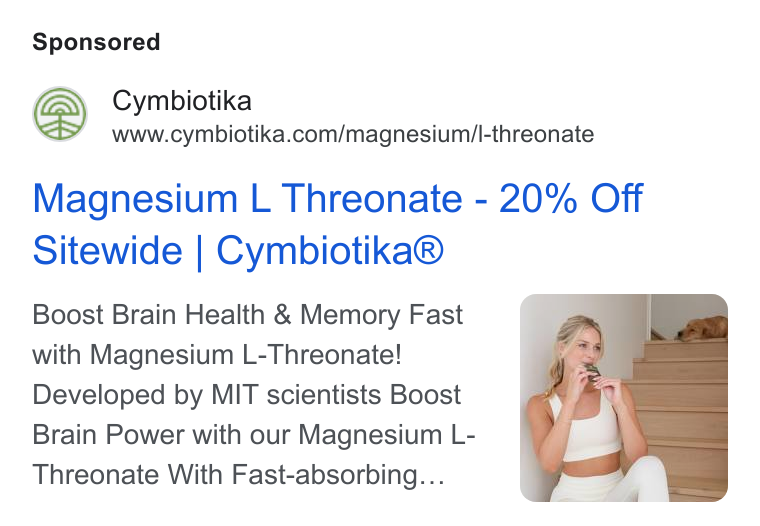
- Sponsored Cymbiotika www.cymbiotika.com/magnesium/l-threonate Magnesium L Threonate - 20% Off Sitewide | Cymbiotika®
- CTA / offer
- 20% Off Sitewide
- Audience
- Individuals interested in cognitive enhancement and natural health supplements, indicated by the claims "Boost Brain Health & Memory Fast" and "Developed by MIT scientists."
Why it works. Combines a supplement's precise ingredient name with a sitewide percentage discount, matching high-intent searchers already looking for that ingredient.
Headline with discount and product name: "Magnesium L Threonate - 20% Off Sitewide | Cymbiotika®" Put your product's specific active ingredient name plus a concrete discount percentage in the ad headline so intent-matched searchers see value instantly.
- Running
- 640 days (longevity = it's converting)
- Hook
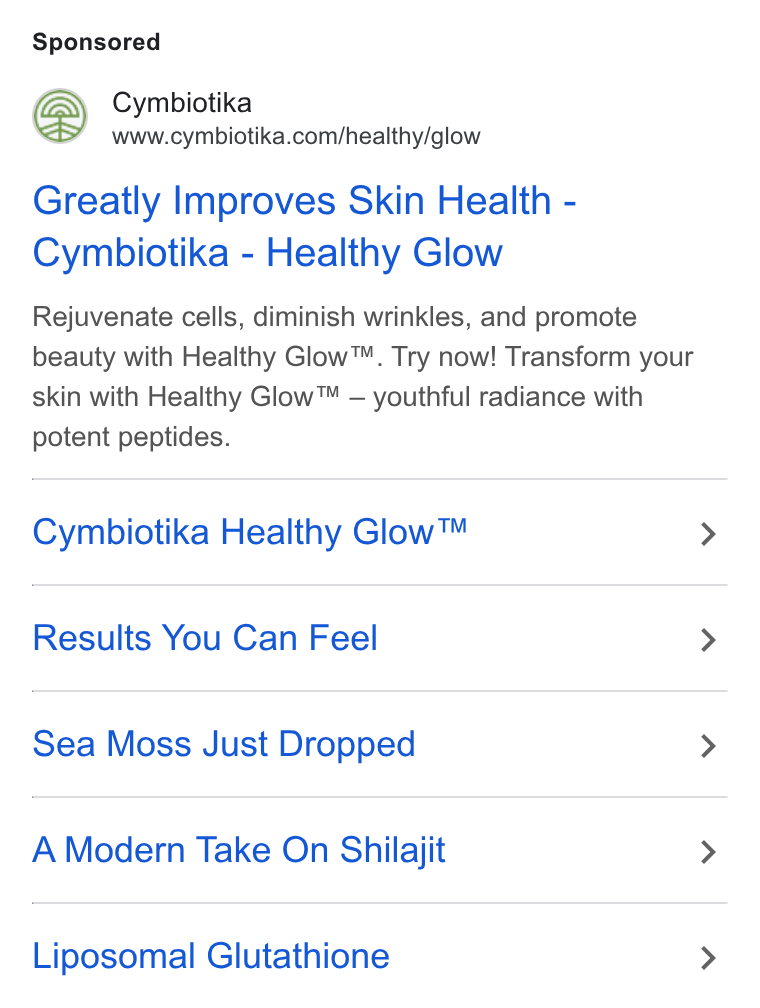
- The word "Sponsored" at the top left, followed by a green circular logo and the brand name "Cymbiotika". Below this, the text "Greatly Improves Skin Health - Cymbiotika - Healthy Glow" is displayed prominently.
- Audience
- Individuals interested in skin health, anti-aging, and natural supplements, indicated by product names like "Healthy Glow", "Sea Moss", "Shilajit", and "Glutathione".
Why it works. Leads with a direct benefit claim tied to skin health, matching intent for shoppers already searching supplement or skincare terms.
The headline "Greatly Improves Skin Health - Cymbiotika - Healthy Glow" is displayed prominently. Put your single strongest outcome claim directly in the headline text, not buried in body copy, so search intent matches instantly.
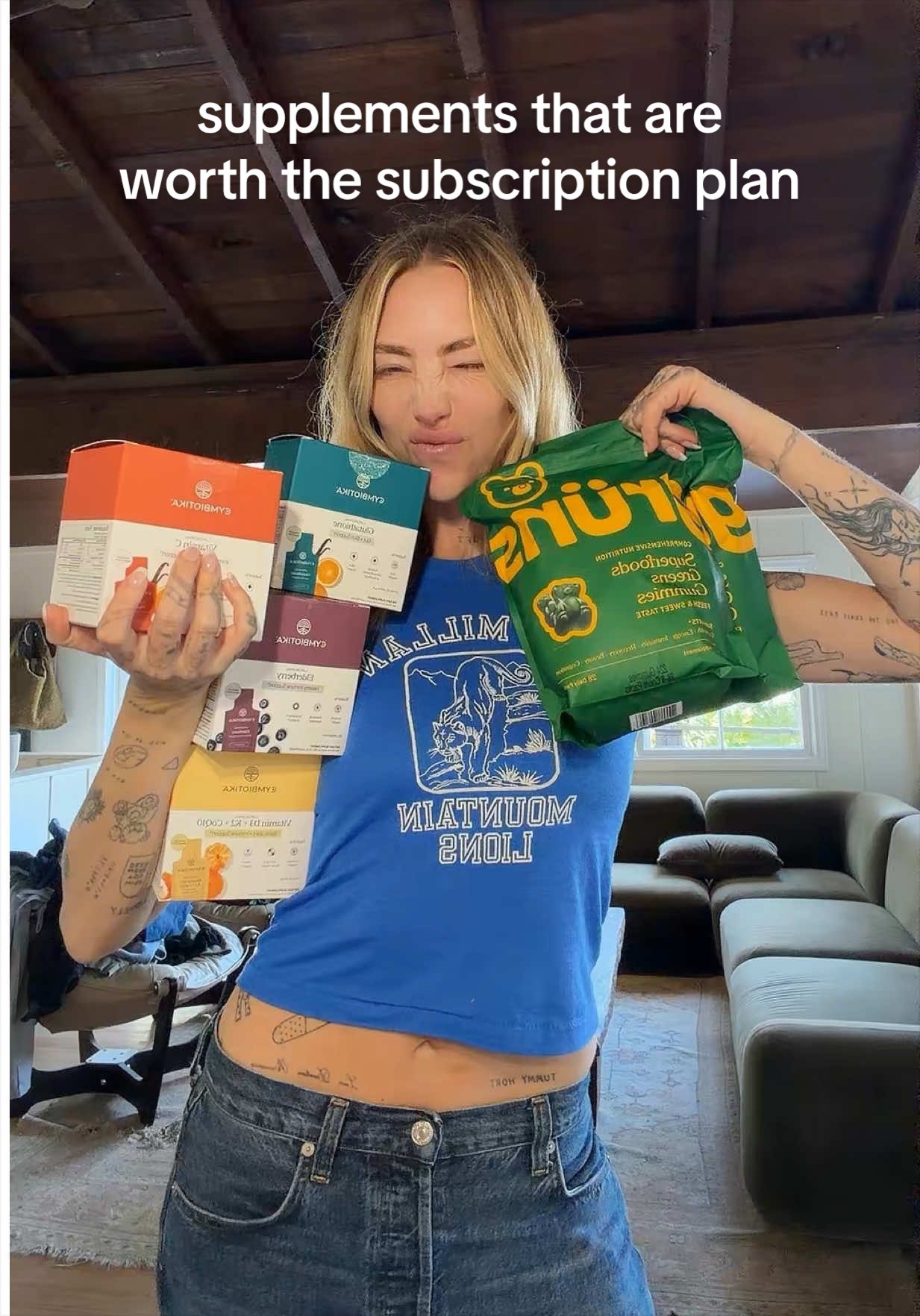
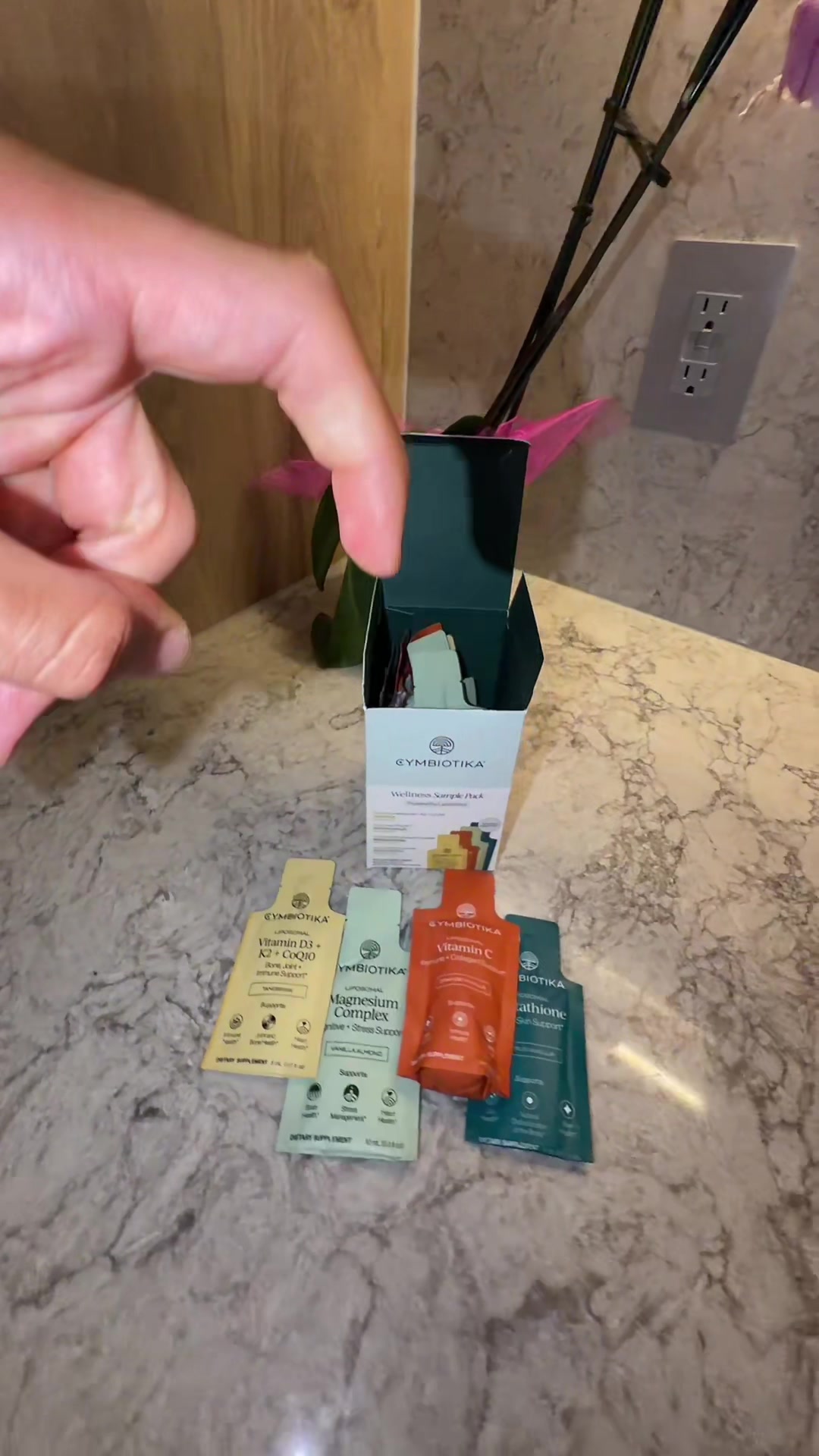
Clean energy that hits fast, that’s what I get with @cymbiotika Advanced Creatine. 5 grams a day of pure power! #cymbiotikapartner
- Reach
- 20 upvotes · 37 comments · r/Supplements
A community is already discussing this in r/Supplements. Show up there authentically and answer the thread before a competitor does.
Who amplifies them
The clearest amplification comes from creators using the #cymbiotikapartner tag, including NBA player @juliusrandle30, whose post ties a Vitamin C testimonial directly to the Target nationwide launch, and @camilacoelho, whose Advanced Creatine reel is the top single-creator post by engagement outside the @phiphibbbbb mention above. TikTok Shop reseller @inaaronwetrustttt lists a pre-bundled bestsellers kit rather than driving traffic off-platform, functioning as an in-app storefront. A distinctive structural feature is that some amplifiers are also investors: David Grutman, who led Cymbiotika's November 2025 celebrity-heavy funding round, separately posts organic Instagram collabs tagging the brand, blurring the line between backer and creator. On the community side, Reddit's r/Supplements and r/CPGIndustry carry real but modest conversation, mostly skepticism about the founders' credentials and undisclosed medical advisors, plus a thread on Durana Elmi's promotion to Chief Creative and Chief Experiential Officer, rather than fan enthusiasm.
07 Organic & video
The organic content engine: the videos, creator posts, and community presence earning attention without paid spend.
The format that performs across creator content is the casual stacking or reaction clip, not polished demo video: Bearenger's morning-routine post pairing Vitamin D3+K2+CoQ10 with B12 (2,820 engagements), and Amber Ciaglia's blunt "Might taste like 💩 but it works" (10,068 engagements) both outperform more produced content by reading as unfiltered. The single highest-engagement post in the set comes from creator @phiphibbbbb (248,138 engagements), naming Cymbiotika alongside another wellness brand as products she genuinely uses, an unusually large number for organic UGC. On the brand's own channel, an Instagram reel announcing the Ulta launch ("Cymbiotika is now available at Ulta Beauty") pulled 2,625 engagements, showing the account uses retail-expansion news as content in its own right. Not every review is positive: a critical TikTok from Laura Lam Nutrition flagged added carbs and single-use packaging (1,073 engagements), a complaint that recurs independently on Reddit.
08 Affiliate & partners
How the brand turns creators and partners into a tracked, variable-cost acquisition channel, and how the program is structured.
Cymbiotika runs a formal affiliate program (listed at cymbiotika.com/pages/affiliates), which shows up in the traffic mix as a small but real 1% affiliate channel share and lines up with the widespread #cymbiotikapartner creator tagging seen across TikTok and Instagram. The TikTok Shop bundle listing functions as a parallel affiliate-commerce channel, letting resellers sell the product directly inside the app rather than only linking out.
09 The playbook
The channels are not separate. They are one system where each stage feeds the next. Here is the read, then the plays to run tomorrow.
The inferred playbook
The loop runs on creator-driven product virality that gets recycled into paid retargeting copy, while celebrity investors double as an organic amplification layer on top of a widening retail footprint.
The testimonial language in Meta's top-performing dynamic ads ("I feel 10 years younger," "after 2 weeks") mirrors the tone of the organic creator posts covered above, suggesting winning ad copy is lifted from genuine customer reaction rather than written from scratch.
The Target, Ulta, and Whole Foods rollout turns DTC virality into shelf presence, which then gets folded back into content, as with Julius Randle's post tying his testimonial directly to Target availability.
Dig deeper+3▾
The celebrity-heavy funding round functions as more than capital. David Grutman's own organic posting shows the same names writing checks and generating reach.
Recurring Reddit and TikTok skepticism about founder credentials, an undisclosed medical advisory board, and single-use plastic packaging sits underneath the growth story and is never publicly addressed in the evidence collected. What closed the gap between the roughly $50-100M in 2023 revenue estimates and the $150-200M range reported around the 2025 raise, whether retail, the funding, or organic compounding did the heavy lifting, isn't spelled out in what's public.
subscription-versus-one-time purchase mix, wholesale-versus-DTC revenue split, blended customer acquisition cost, and subscription churn.
One search ad per SKU, not per brand
The proofGoogle's roughly 2,000-ad library runs largely as individual text ads per ingredient or product, active since October 2024, expanded from the Paid Ads section above.
The adaptationTake your five best-selling SKUs and build one narrowly targeted search ad plus a matching landing page for each, using the exact product or use-case term a buyer would type, not a generic brand ad. Start by listing the specific problems each product solves and writing one ad headline per problem, so the ad copy and the page headline match word for word when the click lands.
Cost: under $500 · Time to signal: weeks · Works pre-PMF: conditional, yes if you already have several distinct SKUs or use cases to target, no if you only sell one product.
A tagged creator-gifting program
The proofdozens of creators post under the same #cymbiotikapartner tag in exchange for product, referenced in Who Amplifies Them above.
The adaptationCreate your own single branded hashtag and a simple application page (modeled on a plain "become a partner" page), then gift product to a handful of creators in your niche in exchange for one honest post using that tag. Start by DMing 10 creators who already post in your category organically, offering product only, no payment, and ask them to use your tag so the posts double as a trackable, disclosed campaign.
Cost: $0 (product cost only) · Time to signal: weeks · Works pre-PMF: yes, provided you have physical product to gift and a visually demonstrable use case.
Bundle-as-SKU for shoppable social
The proofreseller @inaaronwetrustttt lists a pre-packaged bestsellers bundle directly inside TikTok Shop rather than linking off-platform, noted in Who Amplifies Them.
The adaptationPackage your top three products into a single "starter kit" SKU and list it on a shoppable-social feature (TikTok Shop or an equivalent in-app storefront) at a set commission, so a creator can complete the sale without sending anyone to your website. First step: pick your three most-loved SKUs, price the bundle at a slight discount to buying separately, and recruit one creator to list it before rolling out to more.
Cost: $0 (commission-based) · Time to signal: weeks · Works pre-PMF: conditional, needs at least three complementary SKUs, not viable for a single-product line.
A specific timeframe beats a vague claim
The proofthe dynamic ad reading "My energy is through the roof after 2 weeks!" outperforms generic praise, covered in Paid Ads above.
The adaptationTake one real customer quote and rewrite it to include the exact timeframe they experienced a result in, then pair it with a plain product photo, no video production needed. Post it organically first as a caption test before ever putting ad money behind it, and watch saves and comments rather than guessing.
Cost: $0 · Time to signal: days · Works pre-PMF: yes.
The "declines with age, fix it daily" hook
The proofthe NAD+ ad's "After 30, NAD+ levels drop. Replenish them daily" framing, expanded in Paid Ads above.
The adaptationIdentify one well-established, factual decline relevant to your own audience (not invented) and write a single line following the template: fact, then daily fix. The mechanism: pairing an undeniable, widely accepted problem with an easy daily action removes the need to first convince anyone the problem exists. Post it as an organic caption or a single static ad before scaling spend behind it.
Cost: $0 · Time to signal: days · Works pre-PMF: yes, provided the underlying decline is factually defensible; fabricating or exaggerating a health claim carries real regulatory risk. Not transferable at an earlier stage: the celebrity-investor amplification layer and the multi-retailer rollout (Target, Ulta, Whole Foods) both depend on capital and negotiating leverage a pre-revenue founder won't have yet; treat those as later-stage milestones, not day-one tactics.
You just read how Cymbiotika does it. Tomorrow it is someone else.
Every morning we take one company that is actually growing and break down where its customers come from: the ads still running after a year, the channel doing the real work, and the play you can run this week.
Systemaic · directional intelligence. Traffic, spend, and reach figures are SimilarWeb-style estimates and qualitative reads of public data, not audited numbers. Built on real public receipts.
// teardowns with a similar GTM motion
sources & receipts (3)
Live ad libraries: meta ad library · linkedin ad library · google ad library
Traffic, spend, and revenue figures are estimates as noted in the report; the links above are the primary public artifacts.