- 01Bundle every launch announcement into one day
- 02Pair one honest essay with a small paid boost
- 03Write the definitional pages your buyer searches before they know your name
- 04Name the exact place you'll be, not just that you're attending
01 Snapshot
The one-glance read on who they are and how they grow. Each point is verifiable from the receipts above.
AI-moderated voice and video research interviews for enterprise insights teams, with named users including Unilever, Orange, Sanofi, and Google.
Paid-led enterprise demand generation, layered on a thin but growing definitional-SEO content hub.
~403,000 monthly visits (+91.4% over the last 3 months); a Google ad library of ~300 (63 active as of 2026-08-01) and a LinkedIn library of ~1,311 (their largest paid surface); a $5.3M seed round announced 2025-03-06.
As of 2026-07-16, Google ads shifted from pure text creative into video format for the first time, running alongside a LinkedIn push for the newly shipped Price Sensitivity feature.
Conveo's growth machine is a synchronized three-platform paid ramp timed to named product launches (StoryLines, Price Sensitivity), not an organic audience or a bottom-up launch moment.
02 How it unfolded
The order the channels came online. Sequence is strategy: what they did first, and what they layered on once demand existed.
03 Traffic & channel mix
Estimated demand, the channel split behind it, and the keywords and referrers doing the work. Directional modeling, not audited analytics.
Conveo draws an estimated 402,823 monthly visits, up 91.4% over the last 3 months, a window that overlaps with the July 2026 StoryLines launch and the paid ramp that followed it. No channel-level breakdown (search vs. direct vs. paid vs. social share) was available in this pull, so the mix itself can't be stated. What is visible is which search terms Conveo is winning: they rank #1 for their own brand name and for the misspelling "conveyo," #1 for "custom qualitative research," #3 for "qualitative research platform," and #4 for "customer insights platform." That mix of branded and category terms suggests a company still building category recognition alongside brand defense. No referrer or competitor list was available in this pull.
04 Organic content
The specific pages earning their organic search traffic, and the pattern behind why they rank. Adapt the format, not the topic.
Conveo's top organic page by a wide margin is /insights/customer-insights-platform, carrying 37.8% of its top-five organic pages' traffic, followed by the homepage at 18.3%. The remaining three pages (qualitative-research-software, is-survey-research-qualitative-or-quantitative, custom-qualitative-research) each pull a similar, smaller share around 5%. The pattern is a definitional content hub: pages that answer "what is X" and "is X qualitative or quantitative" style questions for a product category most buyers don't yet know to search for by brand. That format likely ranks because it matches the exact phrasing a confused first-time buyer types into Google, well before they've heard of Conveo specifically.
Top pages by organic traffic
05 Channel map
Not traffic share. How much weight the growth system actually puts on each channel, with a one-line read on the role it plays.
What drove growth
06 The motions doing the work
For founder-led SaaS the breakdown shifts from ads to traction: where the first users came from, how the founder grows it in the open, and the compounding organic surface.
Conveo's traction story runs through funding and enterprise events rather than a bottom-up online launch.
Conveo was founded in Antwerp in April 2024 by Dieter De Mesmaeker, Hendrik Van Hove, and Ben De Smet, went through Y Combinator's Summer 2024 batch, and raised a $5.3M seed round on 2025-03-06 led by Y Combinator with 6 Degrees Capital, Entourage Capital, Pitchdrive, and Syndicate One. There is no visible Product Hunt or Hacker News launch tied to any of this.
Rather than a single company launch moment, Conveo treats each new product capability as its own launch event: StoryLines (a continuous consumer-tracking product) shipped 2026-07-15, and Price Sensitivity followed on 2026-07-30, each triggering a fresh wave of paid creative within days.
Dig deeper+1▾
Conveo hosted a customer and partner yacht activation called "Conveo Anchored" at Cannes Lions on 2026-06-21, and its LinkedIn ads directly invite prospects to "Stop by Booth #514" at the Quirk's NY research conference, a physical presence strategy aimed squarely at the insights-industry buyer.
Conveo's version of build-in-public is a company account boosting personal-voice writing and culture messaging as paid content, not a founder running their own audience.
One LinkedIn ad, run under "Promoted by Conveo," carries a first-person, reflective essay about the craft of writing on Substack ("I'm probably read by 7 people... I so enjoy the process of buildup and argument"), pointing to open.substack.com and running as both a proven winner and a fresh test as of the pull.
A second boosted LinkedIn post reframes their customer success org as a "Research Impact Team" staffed by former Fortune 500 and agency researchers, a hiring-and-credibility message aimed at buyers who care about researcher pedigree, not a product pitch.
Dig deeper+1▾
Each new capability gets its own LinkedIn post at launch, MaxDiff's qualitative video probing and then Price Sensitivity roughly two weeks apart, functioning as their public changelog. No verified personal founder social account (X, LinkedIn, or otherwise) was present in this pull, so there is no founder-audience-size read to give.
Organic search is a secondary, compounding layer here, not the primary engine; the real weight sits in paid.
The insights hub covered above is Conveo's SEO bet: own the category-definition searches before buyers know the brand name, a strategy that pays off slowly relative to the paid ramp.
Nothing in the evidence points to a customer referral or affiliate program; the closest partner relationship is a participant-recruitment integration with Respondent.io, a fulfillment partnership for sourcing interview subjects, not a customer-acquisition channel.
Dig deeper+1▾
Google's 63 active ads (of ~300 in the library) mix a 384-day-old brand-and-category search runner with brand-new video-format tests introduced 2026-07-16; LinkedIn is the largest bet by library size (~1,311 total) and 100% StoryLines/Price Sensitivity messaging; Meta runs the same "Real people. Real conversations." and "What aren't you asking?" creative across Facebook, Instagram, and Threads. Together the pattern reads as demand generation for named launches, not defensive brand-term capture alone.
07 Paid ads
This founder-led SaaS also runs paid acquisition. Here are the live ads doing the work, each with the X-ray and a play you can adapt.
- Running
- 12 days (new — still being tested)
- Hook
- "For all the questions you could ask" appears on screen, with four circular video frames of different people talking, arranged around the text. The background is dark gray with orange and pink circular accents.
- Audience
- The ad targets businesses and market researchers who need continuous, in-depth consumer insights to make strategic decisions, evidenced by phrases like "market shifts," "act before competitors do," and the display of detailed market sentiment graphs and interview data.
Why it works. Shows four simultaneous video interviews to make 'ask anything, at scale' feel concretely demonstrated rather than claimed.
Posing a thought-provoking question at the outset: "For all the questions you could ask what are you not asking?" (0:00-0:05). Show several parallel conversations happening at once on screen while your headline promises unlimited follow-up depth.
- Running
- 437 days (longevity = it's converting)
- Hook
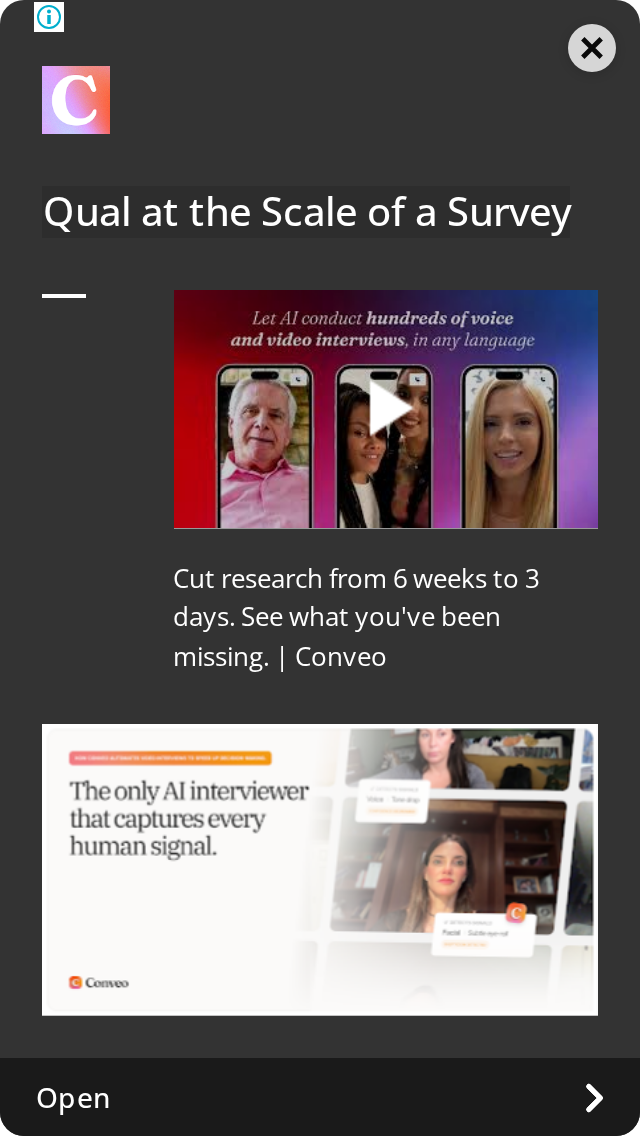
- Visual: A large 'C' logo in purple and orange gradient, next to an information icon. Text: "Qual at the Scale of a Survey"
- CTA / offer
- Open
- Audience
- Professionals in research or product development who need to conduct interviews, indicated by the terms "Qual at the Scale of a Survey" and "research from 6 weeks to 3 days."
Why it works. Names two research categories buyers already understand as a tradeoff and claims to have eliminated it, aimed at market researchers on Google search.
Problem-solution framing with a bold claim: The headline "Qual at the Scale of a Survey" immediately presents a solution to a common research challenge. Identify two things your buyers believe are mutually exclusive and claim your product delivers both in a short headline.
- Running
- 305 days (longevity = it's converting)
- Hook
- Conveo.ai www.conveo.ai/ Conveo: AI-led market research - Voice & video-first research
- CTA / offer
- Switch to Conveo: AI-led qual platform built for enterprise market research teams.
- Audience
- Enterprise market research teams, indicated by the phrase 'built for enterprise market research teams.'
Why it works. Specifies voice and video as the input format, differentiating from text-survey tools bidding on the same market research keywords.
Headline clearly states the product's core offering: 'Conveo: AI-led market research - Voice & video-first research'. Name the specific input or data format your product handles in the headline to stand out from competitors on the same search terms.
Show 3 more ads
- Running
- 434 days (longevity = it's converting)
- Hook
- Visual: A circular logo with a stylized 'C' in purple and orange, next to the text "Conveo" and "www.conveo.ai/". Below this, a large blue headline reads "Get the nuance and context surveys miss".
- Audience
- Professionals or teams who rely on surveys for decision-making but find them inadequate, indicated by the focus on 'nuance and context' and 'speed your team needs'.
Why it works. Calls out a method researchers already use and know is shallow, speaking directly to their existing frustration with surveys.
Headline directly addresses a common pain point: "Get the nuance and context surveys miss". Name the specific tool or method your prospect currently uses and state exactly what it fails to capture, in your headline.
- Running
- 370 days (longevity = it's converting)
- Hook
- Sponsored Conveo.ai www.conveo.ai/ AI-Led Research Interviews - Conveo
- Audience
- Targets businesses or researchers looking for efficient, AI-powered solutions for qualitative research, indicated by terms like 'expert studies', 'interviews real people', and 'AI-powered platform'.
Why it works. States the exact method, AI-led interviews, so it matches searches from buyers who already know that category exists.
Lead with a clear, benefit-driven headline: "AI-Led Research Interviews - Conveo" Make your search headline the literal name of your method, not a benefit adjective, so it matches buyers already searching that term.
- Running
- 362 days (longevity = it's converting)
- Hook
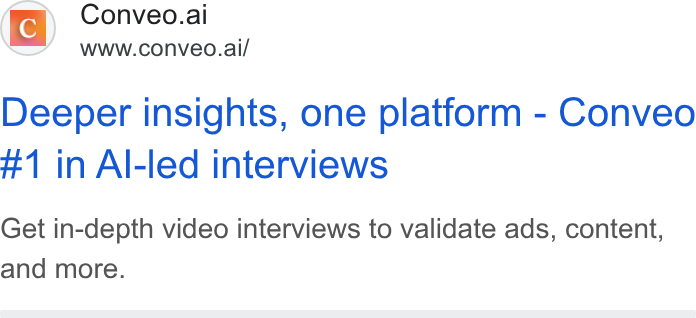
- Visual: A circular icon with an orange 'C' on a white background, next to the text "Conveo.ai" and "www.conveo.ai/". Text: "Deeper insights, one platform - Conveo #1 in AI-led interviews"
- Audience
- Businesses or individuals seeking in-depth market research and validation for ads and content, indicated by the phrases "Deeper insights" and "validate ads, content, and more."
Why it works. Combines a consolidation benefit with a specific #1-in-category claim so it reads as leadership, not just marketing filler.
Headline with a bold claim: "Deeper insights, one platform - Conveo #1 in AI-led interviews" Pair a concrete efficiency benefit with a specific ranking claim in the same headline, naming the exact category you lead.
08 The playbook
The channels are not separate. They are one system where each stage feeds the next. Here is the read, then the plays to run tomorrow.
The inferred playbook
Attention here is bought and timed to ship dates, then handed to a sales-assisted enterprise close, since no self-serve signup path is visible anywhere in the evidence.
Conveo's own pricing (per a third-party vendor listing) pairs a pay-as-you-go tier for agencies with an Enterprise plan starting near $45,000 per year on prepaid interview-minute credits and no free trial, a paid model built for sales conversations, not click-to-signup.
Named logos (Unilever, Orange, Sanofi, Google) plus in-person activations at Cannes Lions and Quirk's NY function as credibility deposits that make the next enterprise deal easier to close.
Dig deeper+3▾
With a $5.3M seed, an enterprise tier anchored near $45,000/year, and a third-party estimate putting annual revenue near $1.1 million, Conveo's business is most likely in the low single-digit millions of annual recurring revenue, meaning the current three-platform paid ramp is funded by seed capital, not by ad-driven revenue at scale.
There is no visible organic word-of-mouth engine (no Product Hunt, Hacker News, or founder-audience signal), so growth outside of sales relationships depends entirely on continuing to buy attention.
Interview-minute credit consumption or expansion within existing enterprise accounts, the pay-as-you-go-to-Enterprise upgrade rate, and a true total count for Meta's active ad library (only Google and LinkedIn had a stated library size in this pull).
Bundle every launch announcement into one day
The proofGoogle, Meta, and LinkedIn creative all pivoted to StoryLines messaging within days of each other starting 2026-07-20, five days after the 2026-07-15 launch.
The adaptationWhen you ship something worth announcing, pick every channel you actually have, even if that's just an email list, a boosted post, and a site banner, and push all of them the same day instead of trickling the news out over weeks. Write the single sentence describing the launch first, then adapt it per channel, so the message stays identical across surfaces the way Conveo's did across three ad platforms.
Cost: $0. Time to signal: days. Works pre-PMF: yes.
Pair one honest essay with a small paid boost
The proofConveo boosted a first-person Substack essay about the craft of writing, not a product pitch, via LinkedIn ads pointing to open.substack.com.
The adaptationWrite one genuine, specific essay about a real lesson from building your product (a mistake, a customer conversation that changed your mind), publish it free, then put a small budget behind boosting that single post on the platform where your buyers already scroll. The mechanism worth carrying over is pairing exactly one authentic post with paid reach, not spreading a fixed budget across many mediocre posts.
Cost: under $500. Time to signal: weeks. Works pre-PMF: yes, since it builds buyer trust before there's a sales-ready product to pitch.
Write the definitional pages your buyer searches before they know your name
The proof/insights/customer-insights-platform, a page answering "what is this category," pulls the largest share of Conveo's top-five organic pages.
The adaptationList the 3-5 questions a buyer would type into Google before they've heard of your product ("what is a [category] tool," "is X qualitative or quantitative" style phrasing), and write one clear, standalone page answering each using that exact question format, not a general blog post. Start with the single highest-confusion term in your category.
Cost: $0. Time to signal: months. Works pre-PMF: yes.
Name the exact place you'll be, not just that you're attending
The proofConveo's LinkedIn ads tell prospects to "Stop by Booth #514" at Quirk's NY, and it ran the "Conveo Anchored" yacht activation at Cannes Lions.
The adaptationPick the one event your buyers already attend, and if you can't afford a booth, get a coffee meetup on the calendar and post the exact time and location in your existing channels, inheriting the specificity of naming a real, findable place instead of a vague "see you there." This only works if your buyers genuinely cluster at one event; skip it if your audience is scattered.
Cost: under $5,000. Time to signal: weeks. Works pre-PMF: conditional, best once you have something concrete to demo in person.
Run one evergreen brand-and-category search ad underneath your tests
The proofConveo's oldest active Google ad has run roughly 384 days as of 2026-08-01, bidding on brand and category terms, while newer creative rotates in around each launch.
The adaptationSet up one cheap, always-on search campaign bidding on your own brand name plus the one or two category terms you most want to own, and leave it running continuously regardless of whatever else you test on top of it, the same long-runner-plus-rotating-tests split Conveo uses.
Cost: under $500. Time to signal: days for brand-term capture. Works pre-PMF: yes. Not transferable at an earlier stage: the three-platform, seed-funded ad ramp and the Cannes Lions yacht activation assume capital and an enterprise sales team a pre-seed founder won't have; adapt the timing and format of these plays at a fraction of the budget rather than the ad spend itself.
You just read how Conveo does it. Tomorrow it is someone else.
Every morning we take one company that is actually growing and break down where its customers come from: the ads still running after a year, the channel doing the real work, and the play you can run this week.
Systemaic · directional intelligence. Traffic, spend, and reach figures are SimilarWeb-style estimates and qualitative reads of public data, not audited numbers. Built on real public receipts.
// teardowns with a similar GTM motion
sources & receipts (16)
Live ad libraries: meta ad library · linkedin ad library · google ad library
Researched facts: Seed round amount and lead investor: $5.3M (~€4.9M) seed round led by Y Combinator, announ · Full seed round investor list: Y Combinator, 6 Degrees Capital, Entourage Capital, Pitchdr · Founding team (three co-founders): Ben De Smet, Hendrik Van Hove, and Dieter De Mesmaeker · Notable named enterprise clients: Unilever, Orange, Sanofi, and Google use Conveo's AI vid · Google Cloud / Gemini technology partnership: Conveo's video-interview AI is built on Goog · Founder origin story / pain point: Co-founder Hendrik Van Hove says the idea came from exp · Pricing model and Enterprise entry price: Dual-tier pricing: Pay-As-You-Go for agencies/pr · Co-founder/CTO Dieter De Mesmaeker's prior company: Dieter De Mesmaeker previously co-foun · Partnership strategy / stealth period: Founders describe running significant partnerships · Respondent.io participant-recruitment partner integration: Conveo has a formal partner lis
Milestone sources: 2026-06-21: Conveo hosts 'Conveo Anchored' customer/partner yacht activation at Cannes Lio · 2026-07-15: Conveo launches 'StoryLines', a continuous AI-moderated research program for t
Community threads: G2: G2 reviewer (Research Associate) describes Conveo's core value as automating the full
Traffic, spend, and revenue figures are estimates as noted in the report; the links above are the primary public artifacts.