- 01Run the EMQ problem-agitation hook as a Meta lead-magnet ad.
- 02Build a breakeven calculator targeting your category's highest-volume adjacent tool query.
- 03Adapt the affiliate-recruitment YouTube video for your own program.
- 04Publish platform-combination tracking setup guides on YouTube.
01 Snapshot
The one-glance read on who they are and how they grow. Each point is verifiable from the receipts above.
Cometly is a marketing attribution platform for B2B SaaS teams that connects ad spend across 70+ integrations (ad platforms, CRMs, payment processors) to pipeline and revenue, with an AI chat layer for querying ad data, positioned explicitly as the B2B alternative to DTC-focused attribution tools.
Paid-assisted acquisition with organic search and a recurring affiliate network as the compounding foundation.
Publicly reported MRR of ~$201,349 across 305 active subscriptions (~$660 blended ARPU/mo); ~158,463 estimated monthly visits; 4 active Meta ads and 4 active Google ads as of 2026-06-28, with the oldest Google ad running approximately 1,350 days.
Co-founder Grant Cooper, in a recorded session with D2C agency Evestar, framed Cometly as the confidence layer that unlocks campaign structures you would never run on incomplete data, citing a client scaled from $40k to $180k per month in ad spend in four months once attribution was reliable (source).
Every acquisition surface (paid ads, organic content, the founder's social posts) runs the same single hook: your Facebook event match quality score is broken and it is costing you sales; the affiliate program then turns practitioners into a self-extending referral distribution layer.
02 How it unfolded
The order the channels came online. Sequence is strategy: what they did first, and what they layered on once demand existed.
03 Traffic & channel mix
Estimated demand, the channel split behind it, and the keywords and referrers doing the work. Directional modeling, not audited analytics.
Traffic sources
Top search keywords
| Keyword | Volume | Weight | CPC |
|---|---|---|---|
| cometly | 7.9k | $0.56 | |
| saashub | 15k | $3.12 | |
| cometly pricing | 360 | $37.26 | |
| breakeven roas calculator | 18k | $5.97 | |
| how to track conversions with youtube channel | 290 | - |
Top referring sites
Closest competitors by audience
~158,463 estimated monthly visits with a +0.8% change over the trailing three-month period. Direct traffic at 56.4% is the dominant channel: for a B2B SaaS tool with 305 paying subscribers, that share reflects a combination of returning-user login traffic and strong brand recall among advertising practitioners who type the URL directly. Organic search at 28.2% represents roughly 44,700 monthly visits, confirming a meaningful SEO surface. Referrals account for 8.2%, Gen AI traffic for 2.7%, and paid channels combined (search paid at 2.4% plus display at 0.3%) represent just 2.7% of measured site visits. Meta ad traffic routes to the go.cometly.com subdomain and may not be fully captured in this domain's estimate, which means paid acquisition's real contribution to trial starts could be higher than the channel split suggests.
Top keyword targets span brand queries (cometly: 7,880 total monthly web searches), practitioner tools (breakeven roas calculator: 17,650 total monthly web searches), and category positioning (marketing attribution software, pay per click tool). The breakeven ROAS calculator term is the standout: it captures advertising practitioners who are calculating campaign ROI before they have committed to any attribution vendor, placing Cometly at the point of first contact.
Top referring sites include Rewardful, an affiliate management platform, confirming that the affiliate program is active and tracking measurable referral traffic back to the domain. The closest competitor list includes lifesight.io and metriclabs.com.au, signaling Cometly competes in the comparison layer where marketing attribution buyers evaluate multiple tools before deciding.
04 Organic content
The specific pages earning their organic search traffic, and the pattern behind why they rank. Adapt the format, not the topic.
Cometly's top organic pages follow a practitioner-tool-query pattern, with the highest-traffic posts targeting specific marketing tool types (PPC tools, scheduling calendars, keyword performance reports, off-page SEO reports) rather than leading with attribution-specific searches. These pages attract advertising operators searching for a concrete tool to complete a specific workflow task, placing Cometly in front of its ICP at the tool-selection stage rather than the awareness stage. The strategy earns rankings because these tool-query terms carry lower keyword competition than category-level terms like "marketing attribution software," while drawing the exact practitioners who eventually need attribution software, with the homepage completing the funnel by ranking for the higher-competition attribution category term.
Top pages by organic traffic
05 Channel map
Not traffic share. How much weight the growth system actually puts on each channel, with a one-line read on the role it plays.
What drove growth
06 The motions doing the work
For founder-led SaaS the breakdown shifts from ads to traction: where the first users came from, how the founder grows it in the open, and the compounding organic surface.
Cometly built its initial user base through ecommerce marketplace distribution in the post-iOS 14 disruption window, with no Product Hunt launch or Hacker News submission visible in public records, meaning traction compounded through organic and affiliate channels rather than a single coordinated launch event.
Grant Cooper's October 2021 X post announcing Shopify Developer Partners approval is the earliest verifiable public signal, placing the go-to-market origin at the exact moment Shopify merchants were scrambling for attribution alternatives after iOS 14 broke Facebook's native pixel reporting.
Creator UGC from 2022 and a 2023 case study co-hosted with D2C agency Evestar (source) confirm the initial user base was in the ecommerce and DTC agency market. The current "B2B SaaS alternative to Triple Whale" (Triple Whale being a marketing analytics tool built primarily for ecommerce brands) framing is a more recent repositioning; the specific pivot date is not visible in public data.
Dig deeper+1▾
Without a PH or HN launch event, early traction appears to have come from the Shopify app listing, organic creator UGC in the dropshipping community, and Google-indexed tutorial content, compounding over time into the brand-dominant traffic profile the site shows.
Co-founder Grant Cooper's personal X account @heygrantcooper (2,077 followers, 618 posts) is the founder's primary distribution channel, running a practitioner-credential-first approach where the product mention arrives after the insight rather than leading with it.
Grant's most-engaged posts lead with a first-person dollar figure that pre-validates credibility, such as "I've spent over $400,000 on ads last year in SaaS," paired with hard-won lessons before the @CometlyApp tag appears. This structure positions him as a practitioner who built Cometly out of his own attribution pain, not a founder promoting software.
Grant's June 2025 post "This is why your Meta ads don't work. It's not your copy, creative, audience. It's your EMQ score. Fix it in 1 day with @CometlyApp" is the identical hook Cometly runs in its Meta ad creative library, confirming that the founder's social content and the paid ad creative are intentionally synchronized on a single pain-point message.
Dig deeper+1▾
At 2,077 followers, Grant's X presence is a narrow distribution surface by absolute numbers. No Reddit founder posts are visible in public data and no LinkedIn content evidence is present, making @heygrantcooper an ICP-dense brand signal rather than a high-volume acquisition engine.
Organic search at 28.2% of traffic is Cometly's most replicable acquisition lever, built on a content surface that mixes attribution-specific content with broader practitioner-tool coverage designed to intercept ad operators before they select a vendor.
Top-ranking posts target tool-type queries (pay per click tool, breakeven ROAS calculator, keywords performance report) where the searcher knows what type of solution they need but has not yet selected a provider. These posts draw advertising operators into the Cometly content ecosystem of tool evaluation, with the homepage and help center content capturing the attribution-specific demand further down the funnel.
The 30% recurring affiliate program, managed through Rewardful and actively recruited through a YouTube video titled "How To Make Fast Recurring Revenue Promoting Cometly (Step-By-Step)," converts practitioners and customers into an ongoing referral network. The recurring commission structure gives affiliates an incentive to produce evergreen review and tutorial content, extending Cometly's organic footprint into practitioner communities the brand itself does not directly publish in. YouTube video descriptions also funnel viewers into a free practitioner community hosted on Skool (an online community platform), adding a downstream engagement layer before a trial decision.
Dig deeper+1▾
Cometly's Meta ads center on two proven formats: a problem-agitation text card with the hook "YOUR MATCH SCORE IS COSTING YOU SALES!" and a customer story format where their ad claims a ROAS improvement from 2.1x to 4.8x in 90 days after fixing event match quality (this outcome is an advertised claim in Cometly's own ad copy, not independently verified). Google text ads hold branded and category positions, with the oldest ad running approximately 1,350 days, indicating consistent ROI on branded search demand capture.
07 Paid ads
This founder-led SaaS also runs paid acquisition. Here are the live ads doing the work, each with the X-ray and a play you can adapt.
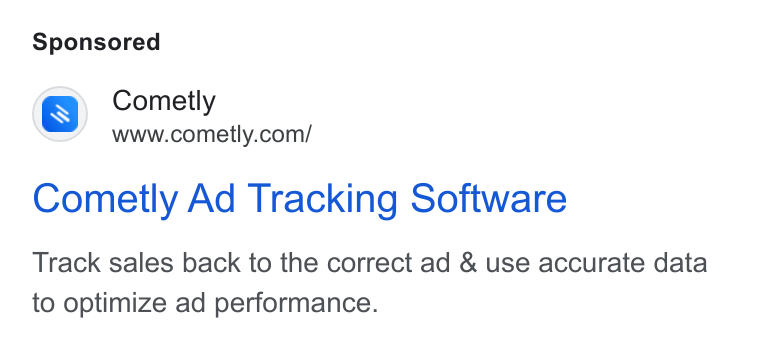
- Running
- 1350 days (longevity = it's converting)
- Hook
- Sponsored + Cometly logo + "Cometly Ad Tracking Software"
- Audience
- Businesses or individuals running paid advertisements, indicated by the phrases "Ad Tracking Software" and "optimize ad performance."
Why it works. Pairs the brand name with a literal product category, ad tracking software, so searchers already looking for that category recognize the fit fast.
Headline clearly states product and category: "Cometly Ad Tracking Software" Put your product name directly next to its plain category name in the headline for high-intent category searches.
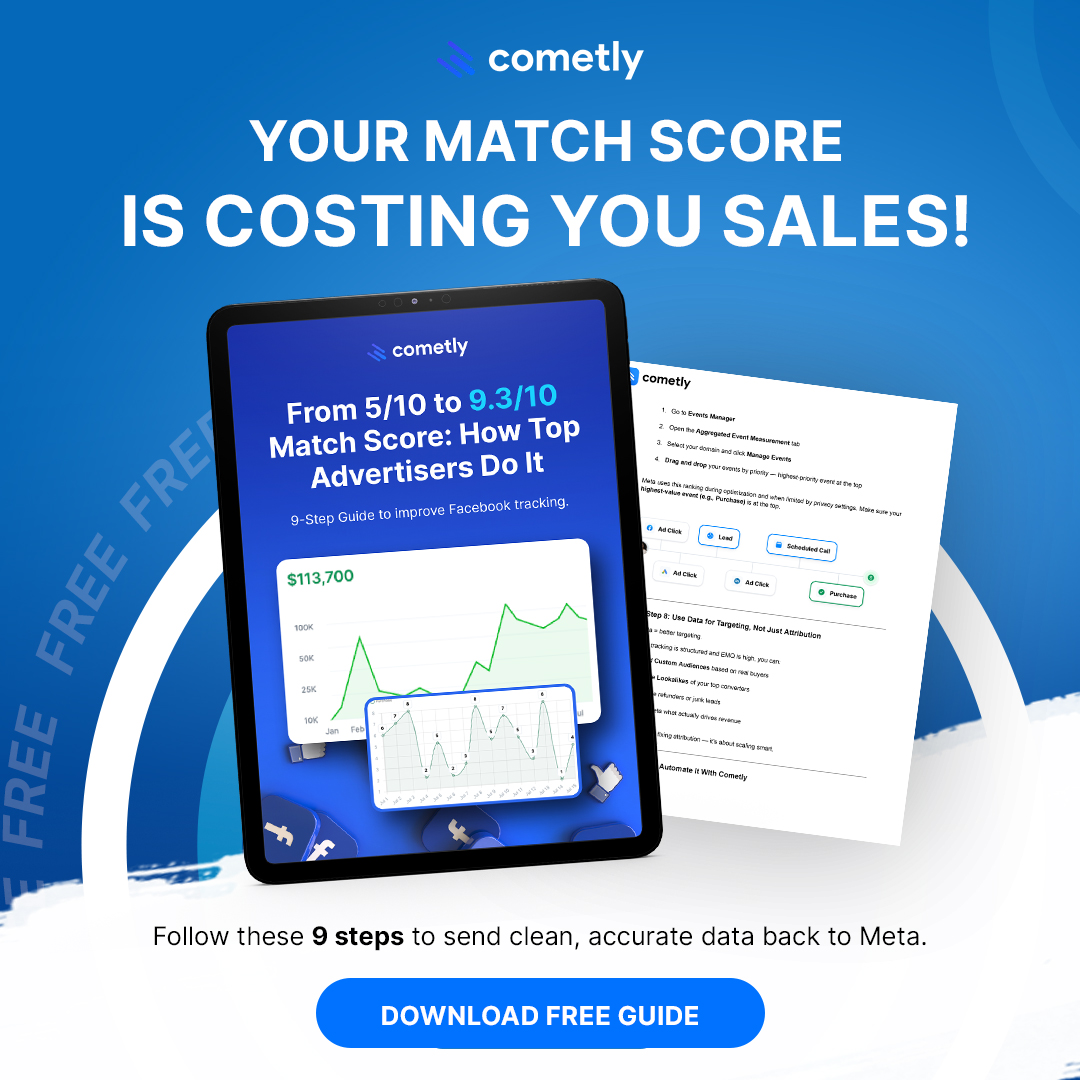
- Running
- 228 days (longevity = it's converting)
- Hook
- "YOUR MATCH SCORE IS COSTING YOU SALES!" with the cometly logo above it, against a blue background.
- CTA / offer
- DOWNLOAD FREE GUIDE
- Audience
- The phrases "YOUR MATCH SCORE IS COSTING YOU SALES!", "Top Advertisers", "Facebook tracking", "Meta", "Targeting, Not Just Attribution", and "Custom Audiences" indicate the target audience is advertisers, likely those using Facebook/Meta platforms, who are concerned with optimizing their ad performance and data accuracy.
Why it works. Ties a technical metric directly to lost sales, so advertisers who already distrust their match rates feel the headline was written about them specifically.
Bold problem statement as the main headline: "YOUR MATCH SCORE IS COSTING YOU SALES!" Pick the one dashboard metric your buyers already distrust and state in your headline that it is costing them money.

- Running
- 228 days (longevity = it's converting)
- Hook
- "Struggling With Pixel Accuracy?" is displayed in large white text on a dark blue background with a subtle gradient. The cometly logo is at the top.
- CTA / offer
- DOWNLOAD FREE GUIDE
- Audience
- The phrases "Pixel Accuracy," "Events Manager," "Aggregated Event Measurement," "Server-Side Tracking (CAP)," "Facebook tracking," and "iOS 14" indicate the target audience is advertisers, likely those managing Facebook ads and dealing with data tracking challenges.
Why it works. Uses the precise technical complaint advertisers already have after iOS 14 changes as the headline, then offers a free guide as the low-friction next step.
Directly state a common problem in the headline: "Struggling With Pixel Accuracy?" Turn your product's core technical complaint into a short yes or no question and lead with it before any feature explanation.
Show 2 more ads
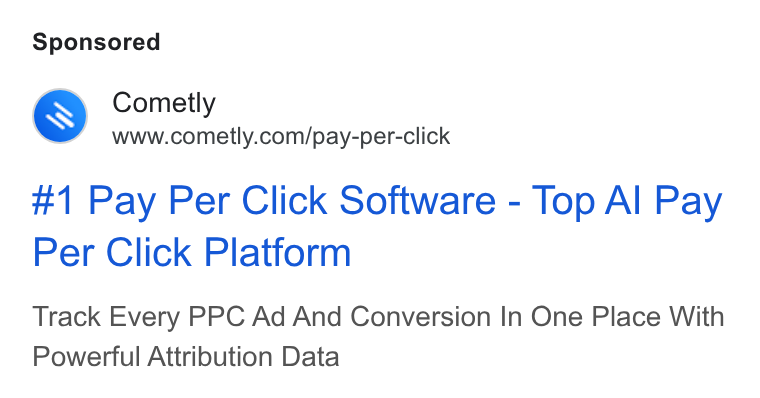
- Running
- 22 days (longevity = it's converting)
- Hook
- Visual: The word "Sponsored" at the top left, followed by a blue icon with three white diagonal lines, and the text "Cometly" and "www.cometly.com/pay-per-click". Text: "#1 Pay Per Click Software - Top AI Pay Per Click Platform"
- Audience
- The phrases "Pay Per Click Software," "AI Pay Per Click Platform," "PPC Ad," and "Attribution Data" clearly target marketers, advertisers, and businesses managing paid advertising campaigns.
Why it works. Combines a ranking claim with the exact search term to win the click among a page of near-identical PPC software listings.
Lead with a strong numerical claim in the headline: "#1 Pay Per Click Software - Top AI Pay Per Click Platform" If you can defend a ranking claim, put it first in your search headline ahead of your category term, not after it.
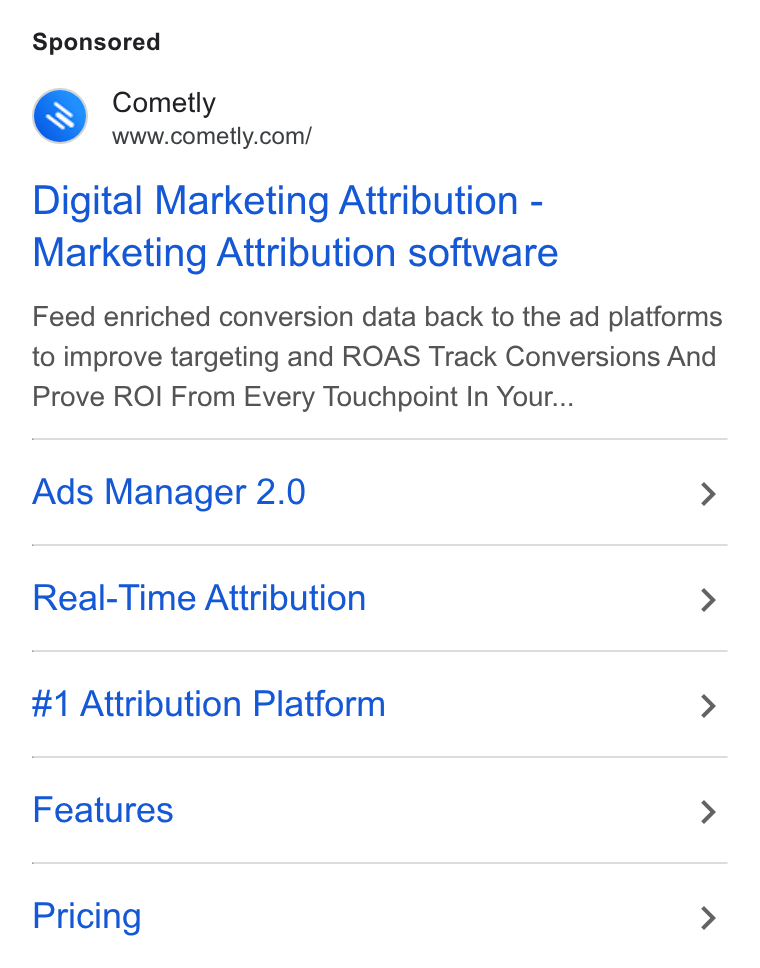
- Running
- 18 days (longevity = it's converting)
- Hook
- Sponsored Cometly www.cometly.com/ Digital Marketing Attribution - Marketing Attribution software
- Audience
- Businesses and marketers looking to optimize their ad spend and prove ROI, indicated by terms like "Digital Marketing Attribution," "ROAS," and "ad platforms."
Why it works. Ranks for the exact category term, digital marketing attribution, catching high-intent searchers who already know what they need to buy.
Headline directly names the product category and its benefit: "Digital Marketing Attribution - Marketing Attribution software" Make sure your search ad headline contains the literal category term your buyer types, not a clever rebrand of it.
08 In their own words
Pulled from interviews and community sessions. The quotes are the angle; the takeaway is what to do with it.
Top D2C Ecommerce Ad Agency Scales Ads Using Cometly ↗Cometly · 634 views · 32 min3rd-party breakdown▶ View source“After iOS 14 and 14.5 there became an attribution problem — very hard to understand where the sales are actually coming from. If there's one ad that's running and I don't see sales coming from it and I turn it off, but that was actually the ad that brought me the money in, I'm pretty much sabotaging myself.”
Expand
Evestar, a D2C agency, used Cometly to solve the post-iOS 14 attribution problem that made Facebook's native reporting unreliable. Accurate attribution gave them the confidence to scale ad spend dramatically (one footwear client went from $40-50k/month to $180k/month) and to run unconventional campaign structures, like one campaign per SKU, that they would never have trusted without reliable data. Cometly became a required tool they onboard every new client with, because visibility directly unlocked spend growth.
“We have like eight or nine prospecting campaigns, which I would have never entertained in my life without the level of visibility we have — one campaign almost per SKU. It's become a little bit of a day trading environment.”
“Cometly showed me that this campaign is actually performing [when Facebook said it wasn't]. Within 10 days that specific product became our best seller — we would have probably given up on that style and not sold the thousands of pairs we now sell every month.”
“There's some examples where we were spending $20,000–$25,000 but because of the visibility and results that were created, all of a sudden you're jumping to $120,000–$130,000 a month.”
“We're requiring Cometly on most of these [clients] — that's part of our conversation. Without that level of visibility the chances are that we won't do as well.”
Don't kill campaigns based on Facebook's native attribution alone — cross-reference a pixel-independent tool before turning off ad sets, because Facebook systematically over- or under-attributes after iOS 14.
When you have many SKUs with inventory imbalances, give each SKU its own campaign and treat budget allocation like day trading — shift dollars daily toward what's actually converting, not what Facebook's algorithm favors.
Check ROAS and purchases daily (and intraday on large accounts), then layer in Shopify sell-through data to validate whether ad-level trends match actual order volume before scaling or cutting.
Use the two-week trial window of any attribution tool to run a controlled test: keep one 'about to be killed' campaign alive and let the new attribution data decide — you may discover a new best seller.
Make attribution tooling a non-negotiable client requirement, not an optional add-on — framing it as 'we can't hit your growth targets without this visibility' gets buy-in and protects your media buying decisions.
09 The playbook
The channels are not separate. They are one system where each stage feeds the next. Here is the read, then the plays to run tomorrow.
The inferred playbook
Cometly converts awareness of a single, specific post-iOS 14 pain point (low Facebook event match quality scores destroying ad optimization) into trials through paid and organic surfaces, then compounds reach through a recurring affiliate program and a YouTube tutorial library that continues earning views.
Every acquisition surface starts from the same broken-data diagnostic: the Facebook pixel is misconfigured, the event match quality score is low, and the advertiser is making budget decisions on incomplete signals. This single hook makes the paid creative, the organic blog content, the YouTube tutorials, and the founder's social posts feel like one coherent message rather than scattered touchpoints.
The 30% recurring affiliate commission converts Cometly's existing customers and media-buyer community into a self-sustaining referral distribution network. Because the commission recurs with the subscription, affiliates have an ongoing financial incentive to produce review content and direct referrals rather than a single promotional push.
Dig deeper+2▾
Cometly's two tiers (Core and Enterprise) are session-based with no public price points. With a publicly reported ~$660 blended ARPU/mo, the actual per-tier prices would place Cometly above most self-serve analytics tools, but the lack of public pricing creates competitive opacity that delays the benchmark comparison buyers typically do before signing.
Free-to-paid conversion rate, churn, and CAC are not visible in public data. Whether the 305-subscriber count is growing or stable at the current MRR level is not detailed in public sources.
Run the EMQ problem-agitation hook as a Meta lead-magnet ad.
Cometly's longest-running Meta creative (approximately 228 days as of 2026-06-28) leads with "YOUR MATCH SCORE IS COSTING YOU SALES!" and routes to a free guide download rather than a direct trial page. Identify the single broken metric in your ICP's daily workflow, build a one-image ad with that metric name plus "is costing you [specific outcome]" in large type on a dark background, and gate a practical fix guide behind an email capture. The guide is the lead; the product is the full solution. This format has held through all four of Cometly's active Meta creatives, suggesting the lead-magnet-to-trial path outperforms a direct trial CTA for a considered purchase like attribution software.
Build a breakeven calculator targeting your category's highest-volume adjacent tool query.
Cometly ranks for "breakeven roas calculator" (17,650 total monthly web searches), a practitioner tool search that occurs before any vendor decision. Identify the top non-branded tool or calculator search in your category, build it as an interactive blog post, and treat it as a top-of-funnel compounding asset. The conversion path is: tool user solves an immediate practical problem, then hits a CTA for the product that solves the underlying strategic problem. The term does not need to be attribution-adjacent; it needs to be searched by the same buyer persona.
Adapt the affiliate-recruitment YouTube video for your own program.
Cometly published "How To Make Fast Recurring Revenue Promoting Cometly (Step-By-Step)" on their brand channel to actively recruit affiliates by showing exactly what affiliates earn. If you run a referral or affiliate program, produce a dedicated video that walks through the commission structure with a worked dollar example (specific ARPU times commission percentage equals monthly recurring income for the affiliate), link it from your /affiliates page, and optimize the title for "[your product] affiliate program" searches. The goal is to attract practitioners who are already building audiences in your category and are looking for recurring income products to recommend.
Publish platform-combination tracking setup guides on YouTube.
Cometly's "How To Setup GA4 On Shopify" earns 9,331 views and "How To Setup Google Ads Conversion Tracking for WooCommerce" earns 9,290 views by precisely matching platform-pairing queries that practitioners search when they hit a specific integration problem. Map your product's most common integration touchpoints to the specific platform combinations your customers ask about in support tickets, and produce a step-by-step setup video for each pairing. Start with the integration that generates the most support volume: the searcher is already in-product, the query is high-intent, and a helpful tutorial converts them into a product-aware prospect who may not have previously discovered your brand.
Use the practitioner-credential post structure Grant Cooper runs on X.
His highest-engagement posts lead with a first-person operating figure that proves the founder has run what the reader is running ("I've spent over $400,000 on ads last year in SaaS"), follow with a counterintuitive diagnostic directly tied to the product's core problem, and close with a soft product tag. The structure is: dollar figure or effort signal establishing credibility, then the unexpected lesson, then the product mention. Note the honest constraint: Grant has built to 2,077 followers over time, and this is a slow-compounding brand channel rather than a short-term acquisition lever. It is most valuable as a signal to prospects who discover Cometly through another channel and then check whether the founder knows what they are talking about.
You just read how Cometly does it. Tomorrow it is someone else.
Every morning we take one company that is actually growing and break down where its customers come from: the ads still running after a year, the channel doing the real work, and the play you can run this week.
Systemaic · directional intelligence. Traffic, spend, and reach figures are SimilarWeb-style estimates and qualitative reads of public data, not audited numbers. Built on real public receipts.
// teardowns with a similar GTM motion
sources & receipts (3)
Live ad libraries: meta ad library · google ad library
Founder interviews: Top D2C Ecommerce Ad Agency Scales Ads Using Cometly
Traffic, spend, and revenue figures are estimates as noted in the report; the links above are the primary public artifacts.