- 01Ship a narrow open-source tool as your wedge
- 02Post the plain launch announcement and tag who helped
- 03Write for the exact error message, not the category
- 04Show up on the community thread your own team can host
01 Snapshot
The one-glance read on who they are and how they grow. Each point is verifiable from the receipts above.
An eBPF-based (a Linux kernel technology that captures telemetry without code changes) zero-instrumentation observability platform that deploys inside a customer's own cloud, aimed at Kubernetes engineering teams switching off Datadog and New Relic.
Direct-led on traffic share, narrowly ahead of organic search, with a heavy paid-search and LinkedIn overlay layered on top for enterprise demand generation.
$60M raised across three rounds (most recently a $35M Series B in April 2025); ~86,194 monthly visits (down ~13.94% versus the previous month) and roughly 200 Google ads plus 95 LinkedIn ads in their libraries, as of 2026-07-07.
As of 2026-07-07, LinkedIn ads are pushing a new "Agent Mode" AI-agent feature (connectors into Slack, Linear, and GitHub) alongside a gated "Observability Imperative Report" survey asset.
Growth here runs on competitor-displacement search terms and a reusable content library (YouTube demos, technical troubleshooting pages), not on founder virality, the founder's own X account has been dormant since 2023 even as paid and organic surfaces expanded.
02 How it unfolded
The order the channels came online. Sequence is strategy: what they did first, and what they layered on once demand existed.
03 Traffic & channel mix
Estimated demand, the channel split behind it, and the keywords and referrers doing the work. Directional modeling, not audited analytics.
Traffic sources
Top search keywords
| Keyword | Volume | Weight | CPC |
|---|---|---|---|
| datadog | 220k | $3.99 | |
| groundcover | 3.4k | $0.53 | |
| prometheus | 377k | $1.59 | |
| new relic | 55k | $5.12 | |
| hermes agent | 1.8M | $2.41 |
Closest competitors by audience
Groundcover pulls an estimated 86,194 monthly visits, down about 13.94% versus the previous month. Direct traffic (43.1%) and organic search (39%) together account for over four-fifths of visits, a split that points to a technical audience returning by memory or bookmark alongside a real search-ranking footprint; referrals add another 7.8%. The rest, paid search, social, AI-assistant referrals, and email, together total under 11% of visits despite the size of the paid ad libraries described below, suggesting the ad spend is aimed more at enterprise lead capture (report downloads, event registrations) than at driving raw site traffic.
They rank and bid into large adjacent-category terms rather than their own name: datadog (219,530 searches/month), prometheus (377,170 searches/month), and new relic (54,530 searches/month) all dwarf "groundcover" itself (3,390 searches/month), confirming a displacement rather than brand-defense keyword strategy. Among the listed competitors, groundcover's own comparison pages name Datadog, Dynatrace, Grafana Cloud, New Relic, and Chronosphere as the direct observability rivals, not sysdig.com, while kubernetes.io is not really a competitor at all, it is the audience-overlap signal of engineers researching Kubernetes internals who later land on Groundcover's troubleshooting content.
04 Organic content
The specific pages earning their organic search traffic, and the pattern behind why they rank. Adapt the format, not the topic.
Their top organic pages are narrow technical-troubleshooting and comparison assets rather than broad thought-leadership posts: a Kubernetes health-check guide, an "exit code 137" reference page, an observability-tools roundup, a microservices-logging guide, and a Kubernetes deployment-strategies post. The pattern is deliberate long-tail capture, targeting the exact error codes and tool-comparison queries an engineer types mid-incident or mid-evaluation, which is why a page as narrow as "exit code 137" ranks #1 and "microservices monitoring tools" ranks #2. This is a pain-point-first SEO strategy: write for the moment someone is already stuck, not for a generic category term.
Top pages by organic traffic
05 Channel map
Not traffic share. How much weight the growth system actually puts on each channel, with a one-line read on the role it plays.
What drove growth
06 The motions doing the work
For founder-led SaaS the breakdown shifts from ads to traction: where the first users came from, how the founder grows it in the open, and the compounding organic surface.
There is no single viral spike in the evidence; early traction ran through the founder's own posts and physical conference presence rather than any platform breaking out.
Co-founder and CEO Shahar Azulay posted "We're live!" on X on 2022-09-14, tagging the newly created @groundcover_com account and the company's investors, the only explicit launch marker in the record.
A month later (2022-10-20) his next post promoted a KubeCon 2022 booth and an "eBPF day" session, showing the initial go-to-market leaned on trade-show floor presence rather than a content spike.
Dig deeper+2▾
In January 2023, Azulay separately announced that Caretta, a standalone open-source Kubernetes dependency-mapping tool built by co-founder and CTO Yechezkel Rabinovich, had gone live as its own listing, a companion project distinct from the core paid platform, with no traction numbers captured for it.
The available evidence shows no single platform spike tied to a specific date; instead, traction accumulates gradually across the YouTube library, paid search, and organic content described elsewhere in this report.
The strongest personal-audience asset here is dormant: growth does not run through a compounding founder following, it runs through a broader engineering-team presence and gated content assets instead.
Shahar Azulay's X account sits at 110 followers with its last captured post on 2023-07-02 (a live-demo webinar announcement), after an active run of launch, KubeCon, Product Hunt, and podcast posts through 2022-2023.
Azulay's LinkedIn profile carries 9,582 followers and states his CEO title directly, a meaningfully larger audience than his X account, but no specific post content was captured to show it being used as a build-in-public channel.
Dig deeper+1▾
The founding engineering team ran a "We're Part of the Founding Engineering Team at groundcover!" AMA in r/devops from May 19-23, 2025, scoring 71 upvotes and 16 comments, the single subreddit where they have shown up and the one with a concrete, citable result.
Organic search already supplies 39% of total traffic through the pain-point pages covered above; this section is about the system feeding and monetizing that surface.
Both the SEO footprint and the paid programs chase category and competitor terms (prometheus, datadog, new relic) rather than the low-volume brand term "groundcover" (3,390 searches/month), an intent-capture motion built for engineers already mid-search for a fix or a replacement, not for people who already know the name.
A dedicated "Observability Cost Calculator" Google ad, paired with per-host pricing (Free at $0/month, Pro at $30/host/month, Enterprise at $35/host/month, On Premise at $50/host/month), gives volume-based Datadog spenders a concrete number to compare against before they ever talk to sales.
Dig deeper+2▾
groundcover.com/partners recruits affiliates or channel partners as a distribution lever layered on top of the direct-to-developer motion, though no recruitment mechanics or partner volume are visible in the evidence.
As of 2026-07-07, Google carries ~200 ads (13 active) and LinkedIn ~95 ads (sampled set entirely active); the current wave centers on the gated "Observability Imperative Report" (an 87%-adoption-vs-34%-trust "53-point gap" hook, described in the ad copy as based on 500 surveyed SREs) and the Agent Mode launch, a demand-generation play into a proprietary research asset, not defensive brand-term bidding.
07 Paid ads
This founder-led SaaS also runs paid acquisition. Here are the live ads doing the work, each with the X-ray and a play you can adapt.
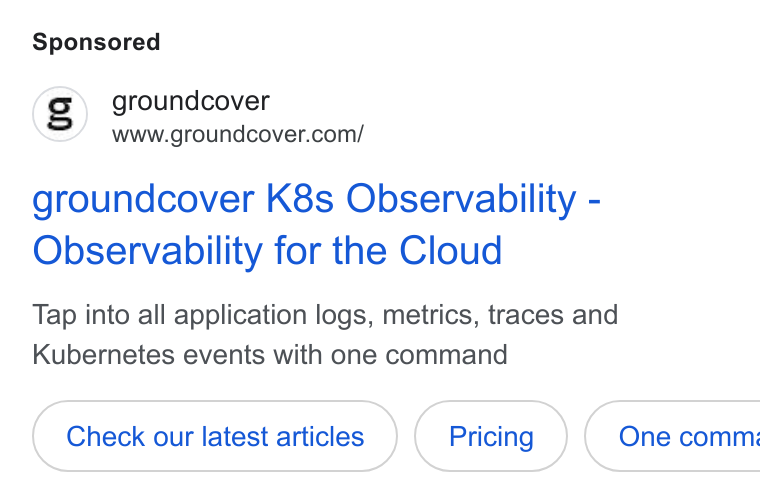
- Running
- 763 days (longevity = it's converting)
- Hook
- Sponsored groundcover www.groundcover.com/ groundcover K8s Observability - Observability for the Cloud
- CTA / offer
- Check our latest articles, Pricing, One comma
- Audience
- The terms "K8s Observability," "application logs, metrics, traces," and "Kubernetes events" clearly signal that this ad targets developers, DevOps engineers, or IT professionals working with Kubernetes.
Why it works. Front-loads the Kubernetes keyword before the generic tagline so K8s-specific searches see the most relevant word first.
Directly addresses a technical pain point in the headline: "groundcover K8s Observability - Observability for the Cloud" Put your prospect's exact search keyword, their infrastructure or platform name, before your generic value prop, not after.
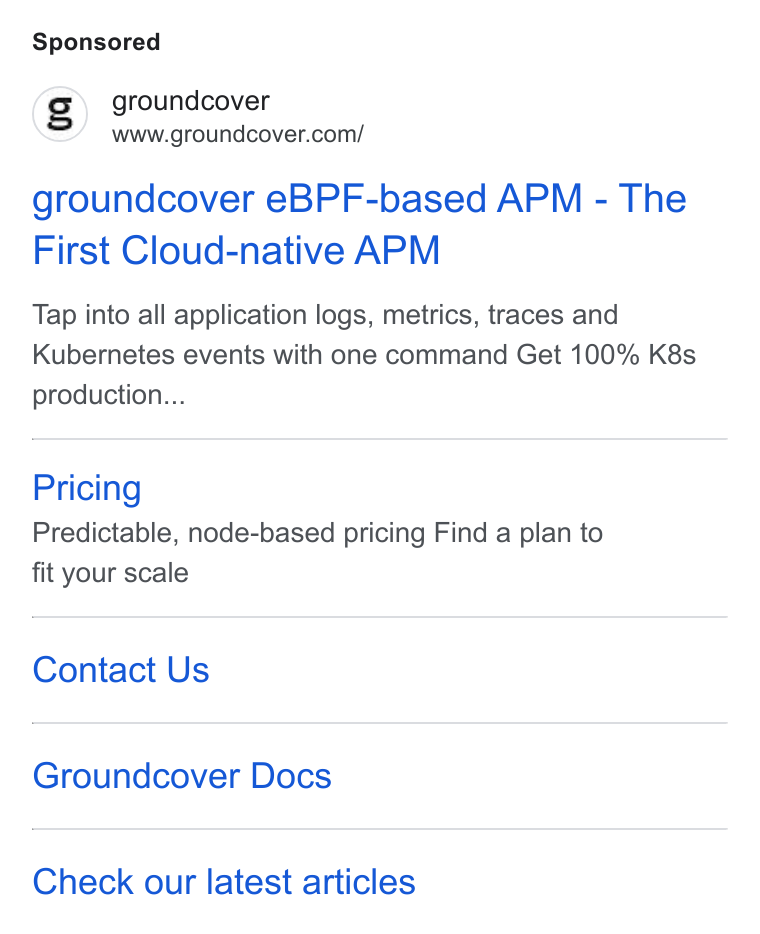
- Running
- 891 days (longevity = it's converting)
- Hook
- groundcover eBPF-based APM - The First Cloud-native APM
- Audience
- IT professionals, developers, or DevOps engineers working with Kubernetes and cloud-native applications, indicated by terms like 'eBPF-based APM', 'Cloud-native APM', 'Kubernetes events', and 'K8s production'.
Why it works. Uses the first claim plus the specific underlying technology to win clicks from technical buyers already researching eBPF-based monitoring.
Headline with a bold claim and technical specificity: "groundcover eBPF-based APM - The First Cloud-native APM" If you were early to a specific technical approach, state both the mechanism and the first claim together in your headline, not just one.
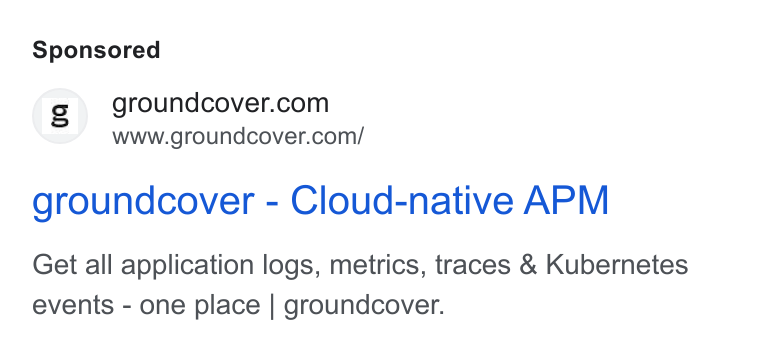
- Running
- 889 days (longevity = it's converting)
- Hook
- Sponsored groundcover.com www.groundcover.com/ groundcover - Cloud-native APM
- Audience
- The terms "Cloud-native APM", "application logs, metrics, traces & Kubernetes events" indicate a target audience of developers, DevOps engineers, or IT professionals managing cloud-native applications and infrastructure.
Why it works. Uses the plainest possible category label, Cloud-native APM, to win branded and category searches from buyers who already know what APM is.
Headline clearly states product and primary benefit: "groundcover - Cloud-native APM" Ensure your ad headline explicitly names your product and its primary, most compelling benefit for your target niche.
Show 3 more ads
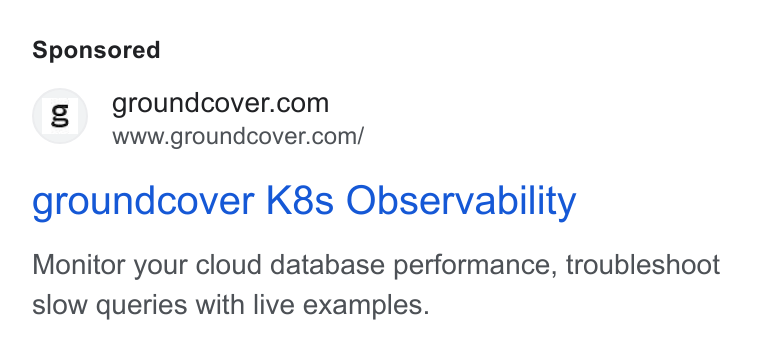
- Running
- 797 days (longevity = it's converting)
- Hook
- groundcover K8s Observability - Monitor your cloud database performance, troubleshoot slow queries with live examples.
- Audience
- IT professionals or developers managing cloud databases and Kubernetes (K8s) environments, indicated by 'K8s Observability', 'cloud database performance', and 'slow queries'.
Why it works. Speaks directly to the pain of slow queries in Kubernetes, offering a live example instead of an abstract feature list.
Headline directly addresses a technical need: "groundcover K8s Observability" Name the exact failure mode your tool fixes, like slow queries, and promise a live example of fixing it, not just a feature category.
- Running
- 473 days (longevity = it's converting)
- Hook
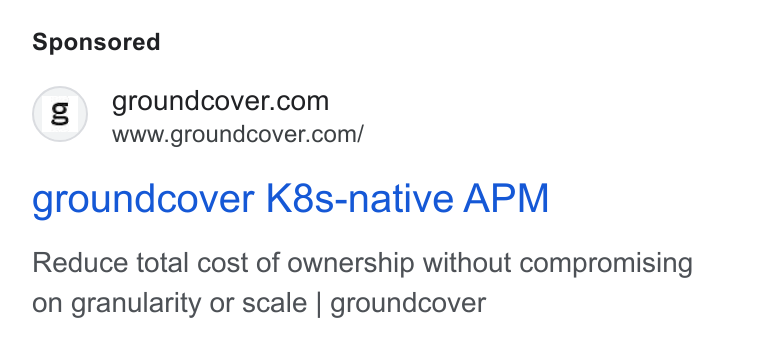
- Sponsored groundcover.com www.groundcover.com/ groundcover K8s-native APM
- Audience
- IT professionals or decision-makers dealing with Kubernetes (K8s) and Application Performance Monitoring (APM), indicated by the specific technical terms 'K8s-native APM' and 'total cost of ownership'.
Why it works. Narrows the category claim to K8s specifically, filtering for Kubernetes operators rather than general cloud-native buyers.
Headline directly names the product and its core function: "groundcover K8s-native APM". Test a narrower version of your category claim, swap a broad term for the exact platform your buyer runs, as a separate ad variant.
- Running
- 473 days (longevity = it's converting)
- Hook
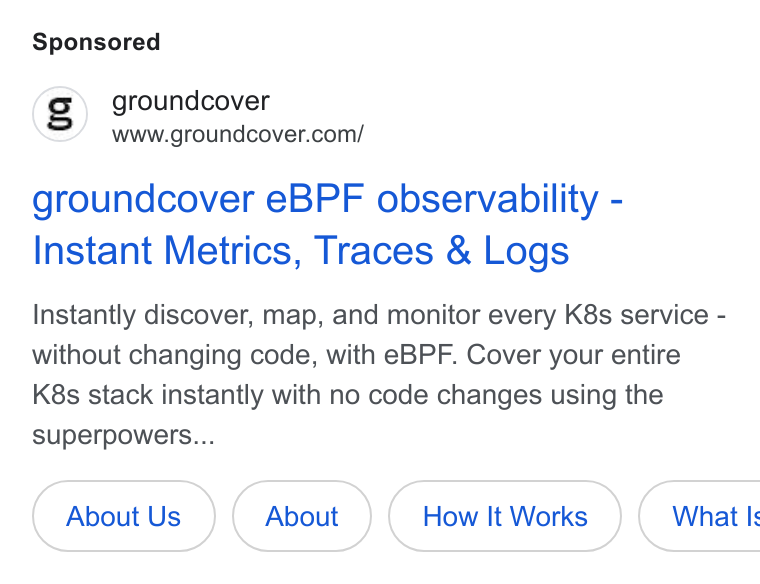
- groundcover eBPF observability - Instant Metrics, Traces & Logs
- Audience
- The mention of 'K8s service', 'eBPF', and 'K8s stack' targets developers, DevOps engineers, and SREs who work with Kubernetes and observability tools.
Why it works. Bundles all three observability data types into one instant promise, appealing to teams juggling separate tools for each today.
Headline directly states the core benefit: 'groundcover eBPF observability - Instant Metrics, Traces & Logs'. If your product unifies several previously separate capabilities, list them by name in the headline instead of using an umbrella term.
08 The playbook
The channels are not separate. They are one system where each stage feeds the next. Here is the read, then the plays to run tomorrow.
The inferred playbook
The loop runs on intent capture and reusable content rather than a personal following: pain-point search pulls engineers in, a free tier and cost tooling let them self-qualify, and per-host pricing converts against a legacy per-gigabyte budget line, but none of it compounds through the founders' own audiences.
Paid and organic both pull attention using competitor and error-message terms instead of the brand name, an intent-capture entry point built for engineers already frustrated with an incumbent tool.
A $0 Free tier (12-hour retention, deployed inside the customer's own cloud) and the cost-calculator ad let a skeptical engineer self-serve toward a decision before a sales call, with the paid tiers priced per host rather than per gigabyte.
Dig deeper+3▾
The 30-video YouTube library (topping out near 1.17M views on one demo) and the "Observability Imperative Report" lead magnet are reusable assets that keep paying back on every ad click, unlike a one-time launch moment.
With the founder's X account stalled at 110 followers since 2023 and no visible LinkedIn post activity despite a 9,582-follower base, there is no compounding founder-led audience to lean on, so nearly every new visitor has to be paid for or ranked for rather than referred in.
free-to-paid conversion rate, churn, customer acquisition cost, and blended ARPU across the per-host tiers.
Ship a narrow open-source tool as your wedge
The proofCo-founder Rabinovich built Caretta, a standalone open-source Kubernetes dependency mapper, and Azulay announced its own separate launch rather than folding it into the main product pitch.
The adaptationPick the single sub-problem your own paid product solves that a developer would happily solve for free, build a small open-source utility for just that piece, publish it under your own name on GitHub, and link back to the paid product only in the README. The mechanism: a free tool earns trust and search visibility (stars, forks, backlinks) that a landing page never does, and it puts your product in front of people before they are ready to buy.
Cost: under $500 · Time to signal: weeks · Works pre-PMF: yes
Post the plain launch announcement and tag who helped
The proofAzulay's first company post was a simple "We're live!" tagging the new company account and the investors involved, not a polished campaign.
The adaptationWhen you ship something worth announcing, write one direct, unpolished post naming the people and backers who made it possible and tag them so their networks see it too. Post it on the platform where your buyers already are, not everywhere at once. This works once per real milestone, not as a recurring content format, so save it for launches, funding, or major feature moments rather than routine updates.
Cost: $0 · Time to signal: days · Works pre-PMF: yes
Write for the exact error message, not the category
The proofGroundcover's highest-performing organic page targets "exit code 137" specifically, a page narrow enough to rank #1 for a query only someone mid-incident would type.
The adaptationList the five specific error messages, failure states, or exact phrases your own users hit right before they go looking for a tool like yours, then write one page per phrase using that phrase as the title and the first line. Publish the first one and check its search ranking in a few weeks. The mechanism: narrow, acute-pain queries have far less competition than broad category terms, so a small site can rank for them fast.
Cost: $0 · Time to signal: weeks · Works pre-PMF: yes
Show up on the community thread your own team can host
The proofThe founding engineering team's Reddit AMA in r/devops drew 71 upvotes and 16 comments, the single highest-engagement community touchpoint in the entire evidence set.
The adaptationIdentify the one subreddit or forum where your actual buyer persona already asks questions, and have two or three engineers (not just the founder) host an open AMA about a real technical problem your product touches, answering with genuine detail rather than pitching. First step: find the subreddit, read its self-promotion rules, and schedule the AMA for a week your team can commit to answering for several days straight.
Cost: $0 · Time to signal: days · Works pre-PMF: yes
Turn a small original survey into a gated asset
The proofGroundcover's current LinkedIn push centers on "The Observability Imperative Report," a 500-respondent survey packaged around one striking stat (a 53-point gap between AI adoption and trust) and gated behind a download form.
The adaptationSurvey even 30-50 people in your niche (customers, waitlist, a relevant community) on one specific tension in your category, pull out the single most surprising number, and build a short report around that one stat instead of a generic "state of the industry" piece. Gate it behind an email field and promote it on the one channel where your audience already gathers. This only works if the stat is genuinely surprising and the sample is real, a small or unconvincing survey undermines credibility rather than building it.
Cost: under $500 · Time to signal: weeks · Works pre-PMF: conditional, only if you can reach enough real respondents in your niche to make the number credible Not transferable at an earlier stage: the scale of the paid programs (roughly 200 Google ads and 95 LinkedIn ads running concurrently) and the KubeCon booth presence both assume a funded budget most pre-seed founders will not have; adapt the underlying mechanics above (the wedge tool, the pain-point content, the community AMA, the small survey) rather than the ad spend itself.
You just read how Groundcover does it. Tomorrow it is someone else.
Every morning we take one company that is actually growing and break down where its customers come from: the ads still running after a year, the channel doing the real work, and the play you can run this week.
Systemaic · directional intelligence. Traffic, spend, and reach figures are SimilarWeb-style estimates and qualitative reads of public data, not audited numbers. Built on real public receipts.
// teardowns with a similar GTM motion
sources & receipts (8)
Live ad libraries: linkedin ad library · google ad library
Launch archives: Hacker News: Helm vs. Kubernetes Operator · Hacker News: Investigating Golang Memory Leak with Pprof · Hacker News: Lessons from Building an OTel Normalizer for GenAI · Hacker News: Deep Dive into the OTel Normalizer groundcover Built for Gen · Hacker News: Goodbye Sidecars: Could eBPF Steal Istio Service Meshes' Thu · Hacker News: Supercharge Your Kafka Clusters with Consumer Best Practices
Traffic, spend, and revenue figures are estimates as noted in the report; the links above are the primary public artifacts.