- 01Let one product page own its long-tail search term
- 02Wrap the product in a cultural-moment parody, not a demo
- 03Write one plain-benefit search ad and stop touching it
- 04Turn your product catalog into a self-refreshing retargeting ad
01 Snapshot
The one-glance read on who they are and how they grow. Each point is verifiable from the receipts above.
A direct-to-consumer supplements brand (collagen, probiotics, NAD+/longevity, multivitamins) founded in 2017, sold on codeage.com and through Costco, Walmart, GNC, Vitamin Shoppe, iHerb, and Bloomingdale's.
Paid-led, backed by a high-production cinematic brand-video content engine on YouTube and TikTok.
~197,278 estimated monthly visits (+3.1% over the trailing 3 months as of 2026-07-31); an ~200-ad Google search library with 41 active (longest-running ad live 1,726 days as of 2026-07-31); 85,590 Instagram followers; a YouTube brand film that hit ~11.5M views. Third-party estimates put annual revenue anywhere from roughly $2M to $9M, unverified and unconfirmed by the company.
As of 2026-07-31, Google carries ten fresh text and video tests launched between June 26 and July 22, 2026, while Meta's newest wave swaps the gym-and-neon Athlete imagery for a minimalist "WHERE STRUCTURE BEGINS" pedestal shot for Multi Collagen Peptides.
Codeage pairs surreal, non-selling brand films (a parody Louvre heist, a zombie Halloween short) built for organic reach with a Google search ad that has run continuously since 2021, letting cinematic top-of-funnel content feed a direct-response engine tuned for years, not weeks.
02 How it unfolded
The order the channels came online. Sequence is strategy: what they did first, and what they layered on once demand existed.
03 Traffic & channel mix
Estimated demand, the channel split behind it, and the keywords and referrers doing the work. Directional modeling, not audited analytics.
Codeage draws an estimated 197,278 monthly visits, up 3.1% over the trailing three months as of 2026-07-31. That steady, unspectacular climb fits a brand running an always-on paid program rather than chasing a single spike: the oldest active Google ad has been live for 1,726 days, and Meta's library still carries creative first shown in February 2026. Codeage ranks #1 for its own brand terms "codeage" and "codeage vitamins," a branded-search position consistent with a company whose awareness is built by ad and video spend rather than pure category SEO, and it also holds mid-page rankings (#5-#8) on descriptive product terms covered below.
04 Organic content
The specific pages earning their organic search traffic, and the pattern behind why they rank. Adapt the format, not the topic.
Codeage's top organic pages are individual product pages, not blog or listicle content: the homepage, a beef organs supplement page, a methylated multivitamin page, a multi collagen protein powder page, and a beef liver page make up its top organic traffic. The pattern is SKU pages doing the SEO work directly, ranking on their own descriptive ingredient-plus-format phrasing (methylated multivitamin, beef organ supplement, multi collagen peptides) rather than routing search traffic through an editorial funnel. That works because those phrases are specific enough to be low-competition while still buyer-intent, letting a single product page capture a searcher who already knows what they want instead of needing a comparison or how-to layer in between.
Top pages by organic traffic
05 Channel map
Not traffic share. How much weight the growth system actually puts on each channel, with a one-line read on the role it plays.
What drove growth
06 The creative doing the work
Each exhibit shows the actual asset, an X-ray of why it works, a status, and a play you can adapt. This is the heart of the teardown.
Codeage runs an ~200-ad Google search library (41 active as of 2026-07-31) alongside at least 56 analyzed Meta creatives spread across Facebook, Instagram, Audience Network, Messenger, and Threads. The Google text ads qualify as genuine proven winners on longevity alone: the oldest has stayed active for 1,726 days, and several sibling headlines in the same bucket have run continuously since October 2021.
-
Hook: "Codeage® Collagen Supplements - Beauty Comes From Within" / "Codeage® Multi-Collagen - Grass-fed Collagen Peptides."
-
Why it works: Plain benefit-plus-brand headlines matched to high-intent branded and category searches; there's no creative fatigue to manage because search text ads don't need visual refresh, and the multi-year run-times across this search bucket are themselves the proof this format keeps converting.
-
Run this play: expanded as Play 3 below.
-
Hook: "Elevate Your Health & Wellness With Advanced Formulas." (dynamic product ad, active 173 days as of 2026-07-31, since 2026-02-08.)
-
Why it works: A generic benefit line wrapped around a catalog-fed dynamic product ad (DPA) means Meta auto-swaps in the exact SKU image a given viewer browsed, so the same evergreen headline stays relevant across the whole catalog without new creative production.
-
Run this play: expanded as Play 4 below.
-
Hook: "Built for active routines," opening on a boxer leaning against the ropes, no product in frame (video, active 136 days as of 2026-07-31, part of the Athlete Multivitamin Platinum DCO wave since 2026-03-17).
-
Why it works: The cut delays the product reveal: three seconds of a relatable athlete moment before the voiceover plants "Built for active routines" as an identity claim, then product shots follow on a gym bench or a neon-lit podium to cash in the performance positioning. Running it as a DCO (dynamic creative optimization) wrapper explains why so many near-duplicate image and video variants sit in the library under one 136-day run: Meta is auto-testing combinations inside a single campaign.
-
Run this play: Brief your own testimonial or demo ad to open on a relatable moment in your product's use context, not the product itself, and hold the product reveal for the second half of the cut.
Winning ads land directly on the relevant product detail page rather than a dedicated lander: the Beef Kidney ad points to a $39.99/$50 product page, the Beef Organs ad to a page spanning $39.99 to $59.99 across pack sizes, and the Marine Collagen ad to a page ranging $29.99 to $59.99. Every landing page runs the same Subscribe & Save mechanic through Recharge, giving 15% off plus free shipping versus a one-time purchase, with self-service pause, skip, or cancel. None of the analyzed pages show a discount code, a free-shipping threshold distinct from Subscribe & Save, or an email/SMS capture offer, so the funnel's job is simple: land on the SKU, offer the subscription discount, and check out.
- Running
- 136 days (longevity = it's converting)
- Hook
- 0:00-0:03, visual: A man with short dark hair, wearing a grey t-shirt and black shorts, with white hand wraps and a white arm band on his left bicep, leans against the ropes of a boxing ring. He looks down and to his right. The background is dark with some light. audio: "Built for active routines."
- Audience
- The video targets athletes and physically active individuals, evidenced by the visuals of boxing, basketball, battle ropes, and pickleball, and the product name 'ATHLETE MULTIVITAMIN.'
Why it works. Opens on unbranded athletic footage synced to the line before revealing the multivitamin, letting active viewers self-identify with the lifestyle first.
Visual demonstration of active lifestyles (0:00-0:03, 0:03-0:06, 0:08-0:10, 0:10-0:12, 0:12-0:14, 0:16-0:20) combined with a voiceover stating, "Built for active routines." Open your video on lifestyle footage matched to a short voiceover claim before naming your product, so viewers connect with the outcome first.
- Running
- 112 days (longevity = it's converting)
- Hook
- 0:00-0:03, a close-up shot of rippling water with a bright light reflecting on the surface. Audio: "When everything settles."
- Audience
- The aesthetic of the video, featuring a serene woman in a minimalist setting, suggests a target audience interested in wellness, self-care, and premium health supplements. The focus on 'rhythm' and 'clarity from within' appeals to those seeking holistic well-being.
Why it works. Withholds the product for the first three seconds, using water imagery and a reflective line to sell a feeling before the pitch.
Visual metaphor and calming audio at 0:00-0:05, showing rippling water and a woman finding 'rhythm'. Audio: "When everything settles. The body finds its rhythm." Delay your product reveal a few seconds behind a mood-setting visual and one short reflective line tied to your product's emotional payoff.
- Running
- 7 days (new — still being tested)
- Hook
- Visual: Two white cylindrical containers, labeled "HAIR VITAMINS. PLATINUM" and "HAIR VITAMINS." are shown on a white marble surface. Audio: Soft, uplifting instrumental music begins.
- Audience
- The focus on luxurious hair, the mention of 'Platinum' and 'Bloomingdale's', and the overall aesthetic of clean, bright visuals suggest a target audience interested in premium beauty and wellness products, likely women who value high-quality ingredients and a sophisticated brand image.
Why it works. Places the Platinum bottle next to the standard one on marble to frame a retail partnership as a tier upgrade rather than a routine product push.
Product-focused opening with clean aesthetics (0:00-0:02): Two white product containers are prominently displayed on a pristine white marble surface, with soft, natural lighting. Shoot your premium SKU beside your standard SKU on a neutral surface to visually justify a price step-up.
Show 7 more exhibits
- Running
- 1536 days (longevity = it's converting)
- Hook
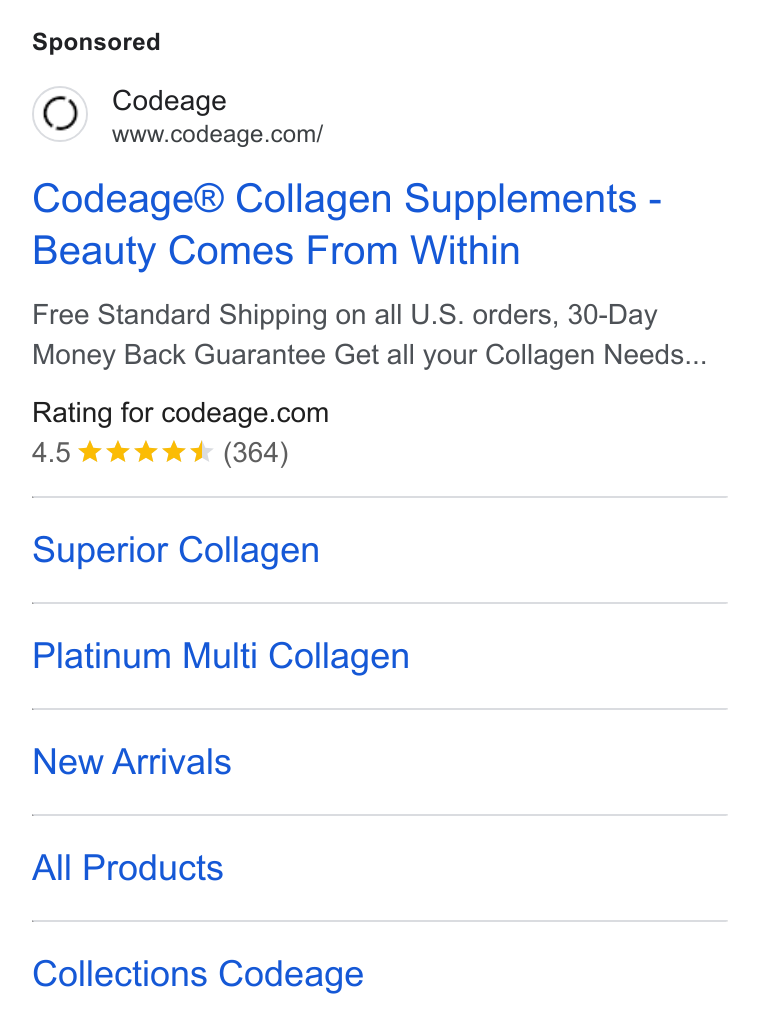
- Sponsored Codeage www.codeage.com/ Codeage® Collagen Supplements - Beauty Comes From Within
- CTA / offer
- Free Standard Shipping on all U.S. orders, 30-Day Money Back Guarantee
- Audience
- Individuals interested in beauty and wellness, specifically those looking for collagen supplements, indicated by the product name and associated search terms like 'Superior Collagen' and 'Platinum Multi Collagen'.
Why it works. Targets beauty-focused searchers who think in skincare language rather than supplement language, bridging the two categories in one line.
Headline with benefit and brand: 'Codeage® Collagen Supplements - Beauty Comes From Within' Borrow a well-known promise line from an adjacent category to reposition your product for a search audience that doesn't use your category's usual words.
- Running
- 1536 days (longevity = it's converting)
- Hook
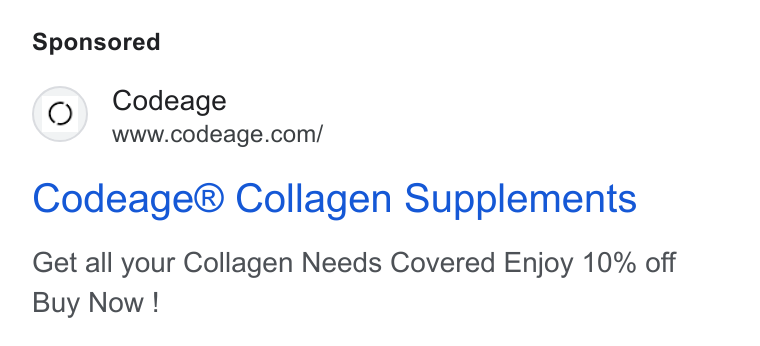
- "Sponsored" text at the top, followed by a circular icon and the text "Codeage www.codeage.com/". Below that, "Codeage® Collagen Supplements" in blue.
- CTA / offer
- Enjoy 10% off Buy Now !
- Audience
- Individuals interested in health supplements, specifically collagen, indicated by the product name 'Codeage® Collagen Supplements'.
Why it works. Pairs a plain product-category headline with a discount offer to convert shoppers who are already comparing on price.
Clear product identification and benefit statement: "Codeage® Collagen Supplements Get all your Collagen Needs Covered" (on-screen text). For bottom-funnel search traffic, pair a plain category headline with a visible discount rather than a benefit claim.
- Running
- 1087 days (longevity = it's converting)
- Hook
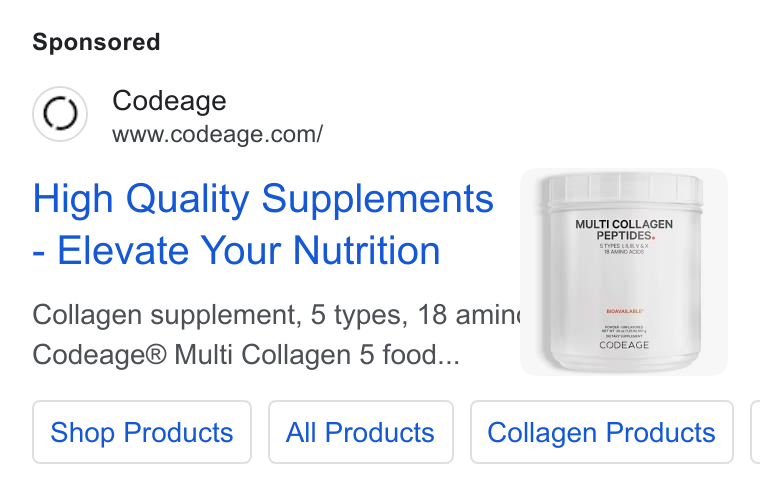
- Sponsored" text at the top left, followed by the Codeage logo and "Codeage" with "www.codeage.com/" below it. The main headline is "High Quality Supplements - Elevate Your Nutrition".
- CTA / offer
- Shop Products
- Audience
- Individuals interested in health supplements, specifically collagen, indicated by the product image and descriptive text.
Why it works. Covers two different buyer motivations, trust in quality and desire for improvement, in a single search headline.
Headline stating a clear benefit: "High Quality Supplements - Elevate Your Nutrition" Test a two-part headline that pairs a trust claim with an aspirational outcome, separated by a dash.
- Hook
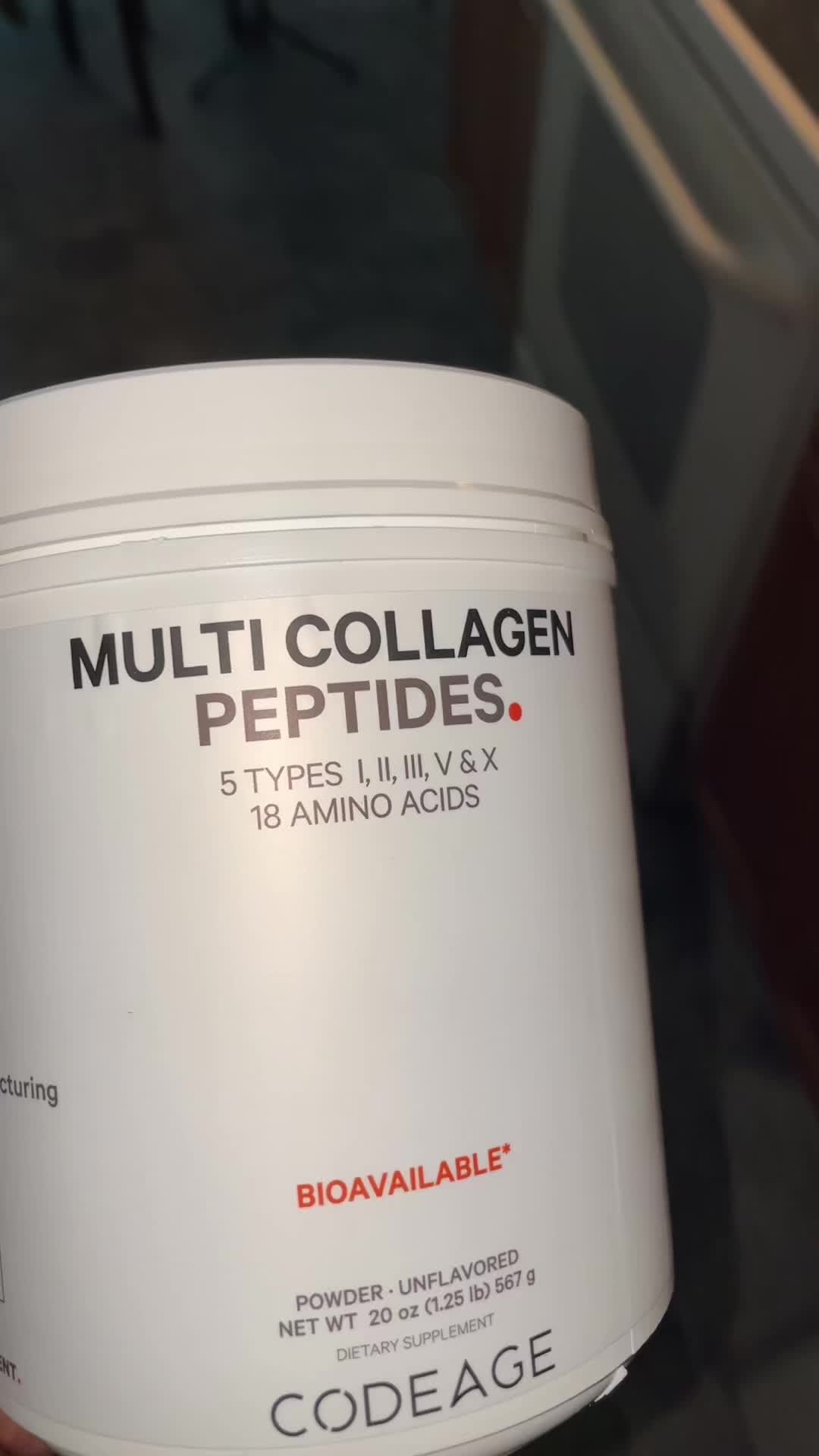
- Visual: A hand holds a white tub of "MULTI COLLAGEN PEPTIDES." On-screen text: "so CODEAGE's collagen powder". Audio: "So CODEAGE's collagen powder might be one of the most versatile and mixable collagen powders there is out there."
- CTA / offer
- Tap the screen right now and get your collagen powder from CODEAGE.
- Audience
- Individuals seeking versatile health supplements for skin, hair, nails, joints, and bone support, who prefer unflavored, easy-to-mix options.
Why it works. A creator names a specific, testable product attribute, mixability, that shoppers often worry about before buying a collagen powder.
Directly addresses a common user question about product benefits. (0:10-0:17) "and you're probably wondering okay well what are all these amino acids good for well it's gonna help your skin clear skin it's gonna help your joints." Have a reviewer name the one practical flaw people worry about in your product category, then state plainly why yours avoids it.

- Hook
- Visual: An aerial shot of a modern house with a pool on a cliffside, overlooking mountains at sunset. Audio: Soft, ambient music begins.
- Audience
- Individuals interested in longevity, health optimization, and a luxurious lifestyle, indicated by the high-end setting, elegant attire, and focus on 'renewal' and 'intention'.
Why it works. Opens on an aspirational cliffside home to link the supplement line to a deliberate, high end lifestyle before any product appears.
Aspirational setting and aesthetic (0:00-0:02, 0:04-0:06, 0:11-0:12, 0:16-0:23): The video opens with an aerial shot of a modern, luxurious house on a cliffside overlooking mountains at sunset, and features models in elegant attire within this setting. Open your video with 3 seconds of aspirational lifestyle footage matching your customer's ideal life, with no product or logo yet.
- Reach
- 7 upvotes · 7 comments · r/Supplements
A community is already discussing this in r/Supplements. Show up there authentically and answer the thread before a competitor does.
Who amplifies them
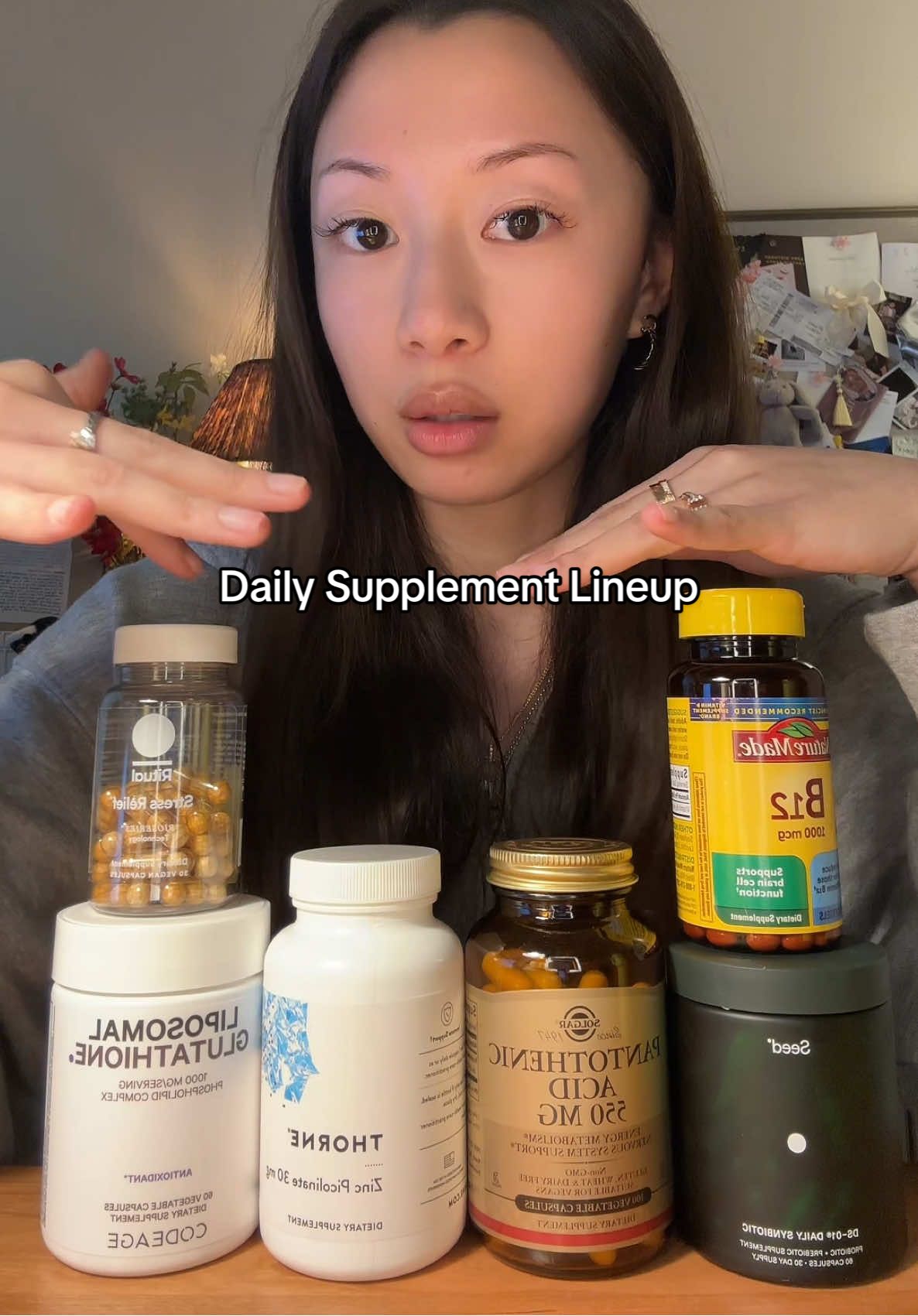
Amplification is thin and largely organic rather than a managed creator program. A multi-brand roundup post by @PAUL🧃, tagging Codeage alongside Seed, Thorne, Ritual, Nature Made, and Solgar Azerbaijan, pulled 83,865 engagements (2025-02-13), the largest third-party post in the evidence, but it treats Codeage as one supplement among several rather than a dedicated partnership. Two Vietnamese-market creators, @Hoà Linh and @PHUONG AN HOUSE, post about the Multi Collagen and Magnesium lines with modest engagement, hinting at organic pull in that market. Reddit chatter in r/Supplements and r/Biohackers is unprompted and occasionally skeptical, including a thread flagging the site's copy as reading AI-generated and threads questioning the Beef Organs formula. On the retail side, Erewhon featured Codeage Hair Vitamins Powder in a Jasmine Tookes-branded smoothie in August 2025, a celebrity-tied placement inside a partner retailer rather than a paid creator deal. No dedicated affiliate-creator roster surfaced in the evidence.
07 Organic & video
The organic content engine: the videos, creator posts, and community presence earning attention without paid spend.
Codeage's format that performs is the surreal, cultural-moment parody short, not a straight product demo. "The Day Mona Lisa Transformed" (a parody Louvre visit, ~11.5M views), "Halloween Night: No Candy, Only Zombie Collagen!" (~4.7M views, 2025-10-31), and "Smash the Parking Ticket" (~6.7M views, 2025-12-01) each hook a recognizable cultural moment, spin a short absurdist narrative, and close on a product link, with TikTok captions explicitly flagging "This is a parody. But the mindset behind it is real." On TikTok, straight product-demo explainer clips (methylated multivitamin, probiotic) sit in the 1,000-30,000 engagement range; the parody films instead rack up millions of views on YouTube. The standout TikTok post is itself a product post ("Discover Codeage Multi Collagen powder," 114,875 engagements), so the parody-versus-demo gap shows up on YouTube view counts, not TikTok engagement.
08 Affiliate & partners
How the brand turns creators and partners into a tracked, variable-cost acquisition channel, and how the program is structured.
Codeage runs an affiliate/partner registration program linked from its own site, recruiting third-party affiliates to drive referrals, plus a separate customer-facing referral incentive giving 10% off one-time orders. Neither mechanic shows visible recruitment activity (no named affiliates, no TikTok Shop) in the evidence beyond the program pages existing, so the heavier distribution lever is wholesale placement rather than affiliate marketing: Costco, a Walmart marketplace storefront, GNC.com, Vitamin Shoppe, iHerb, Erewhon (since February 2024), and Bloomingdale's (as of a July 2026 product post) all carry Codeage product.
09 The playbook
The channels are not separate. They are one system where each stage feeds the next. Here is the read, then the plays to run tomorrow.
The inferred playbook
Codeage's loop starts with a cinematic, non-selling video built for a cultural moment, converts the resulting brand-name searches through a Google text ad that has run since 2021, and lets retail shelf placement pick up demand the owned funnel never touches.
High-production parody shorts on YouTube and TikTok, the Mona Lisa heist, the Halloween zombie potion, the Santa AI mishap, rack up multi-million views without pitching a product until the final seconds, building brand recall that shows up as Codeage's #1 ranking for its own name.
That awareness gets captured by a Google search text ad active for 1,726 days and a Meta dynamic product ad running since February 2026, both structured to keep converting branded search and catalog-browse traffic without constant creative refresh.
Dig deeper+3▾
Wholesale placement in Costco, Walmart, GNC, Vitamin Shoppe, iHerb, Erewhon, and Bloomingdale's extends reach into shelf discovery that neither the ad spend nor the video views can measure, and the Erewhon celebrity-smoothie tie-in shows how a single retail partner can generate its own amplification.
iHerb and third-party reviews surface real cracks under the polished ad layer: complaints about rancid-smelling L-glutamine powder and chronic Liposomal NMN stockouts on iHerb that show demand outpacing supply on the longevity line specifically.
the Subscribe & Save attach rate versus one-time purchase, the wholesale-versus-DTC revenue split across Costco/Walmart/iHerb/GNC, and any conversion data behind the affiliate/partner registration page.
Let one product page own its long-tail search term
The proofCodeage's top organic pages aren't blog content, they're SKU pages ranking on their own descriptive phrase (methylated multivitamin, beef organ supplement, multi collagen peptides) at positions #5-#8, with no comparison or how-to layer between search and checkout.
The adaptationPick your single most specific, ingredient-or-feature-plus-format product name, the exact phrase a ready-to-buy searcher would type, and make sure your product page's title tag and first paragraph use that exact phrase rather than your brand name or a generic category term. Skip building a separate blog post around it; let the product page itself be the landing page for that search.
Cost: $0 · Time to signal: weeks · Works pre-PMF: yes
Wrap the product in a cultural-moment parody, not a demo
The proofCodeage's highest-performing content by a wide margin is a surreal narrative tied to a recognizable moment (a Louvre visit, Halloween, New Year's), with the product appearing only in the final seconds; those clips outperform straight product-demo posts by roughly 10-100x on YouTube views.
The adaptationStart by picking one upcoming holiday or widely-known cultural reference relevant to your category, write a 30-60 second absurdist scene around it that only makes sense once your product shows up at the end, and shoot it on a phone for a native TikTok or YouTube Shorts post rather than a paid placement, testing organic reach before committing ad budget to the format.
Cost: $0 · Time to signal: weeks · Works pre-PMF: conditional, the joke needs a genuinely distinct or memorable product moment to land; a generic product cameo in someone else's meme falls flat.
Write one plain-benefit search ad and stop touching it
The proofCodeage's longest-running Google text ad has stayed active for 1,726 days, and its search rotation leans on plain benefit headlines like "Beauty Comes From Within," with no creative refresh needed because search ads don't fatigue the way social creative does.
The adaptationWrite a single, benefit-plus-brand headline for your top branded or category search term, set a modest daily budget, and deliberately leave it running unedited for at least a full quarter before touching the copy. Judge it on cost-per-conversion trend, not on how many new variants you've shipped; the goal is to find out if a boring, permanent ad beats a rotating one.
Cost: under $500 · Time to signal: months · Works pre-PMF: conditional, only once you have at least one converting product page to send the click to.
Turn your product catalog into a self-refreshing retargeting ad
The proofCodeage's dynamic product ad, "Elevate Your Health & Wellness With Advanced Formulas," has run for 173 days by pairing one evergreen headline with an auto-swapped catalog image for whatever SKU a given visitor browsed, avoiding the need for per-product creative.
The adaptationOnce you have a product feed of at least a handful of SKUs, set up a single dynamic/catalog ad in Meta Ads Manager with one generic benefit headline, and let the platform auto-populate the image per viewer instead of building a separate ad for each product. Reuse the same headline across your whole catalog rather than writing new copy per SKU.
Cost: dedicated budget or hire · Time to signal: weeks · Works pre-PMF: no, this needs both a live product catalog and existing site traffic to retarget.
Pitch a single small retailer once you have organic proof
The proofCodeage's Erewhon placement (February 2024) and the resulting Jasmine Tookes smoothie collaboration show a single boutique retail relationship generating its own amplification well beyond the shelf sale itself.
The adaptationCompile your product's existing review count, repeat-purchase or subscription rate, and any organic social mentions into a one-page pitch, then approach one regional or specialty retailer that already serves your target customer, not a national chain, offering a trial placement. Lead with the same proof points (review volume, repeat-purchase signal) that would make a buyer confident in shelf velocity.
Cost: $0 · Time to signal: months · Works pre-PMF: conditional, you need enough reviews or repeat-purchase data to make the pitch credible; a brand-new product with no track record won't get a meeting. Not transferable at an earlier stage: the multi-million-view cinematic production values behind Codeage's parody films, the six-figure production budget implied by studio-quality b-roll and voiceover work, and the multi-retailer wholesale footprint (Costco, Walmart, iHerb) all assume a production and distribution budget most pre-revenue founders won't have; adapt the storytelling structure and the retail-pitch mechanic, not the production scale.
You just read how codeage does it. Tomorrow it is someone else.
Every morning we take one company that is actually growing and break down where its customers come from: the ads still running after a year, the channel doing the real work, and the play you can run this week.
Systemaic · directional intelligence. Traffic, spend, and reach figures are SimilarWeb-style estimates and qualitative reads of public data, not audited numbers. Built on real public receipts.
// teardowns with a similar GTM motion
sources & receipts (22)
Live ad libraries: meta ad library · google ad library
Researched facts: Company founding details: Codeage was founded in 2017; company page lists headquarters in · Founder identity: Augustin Quancard is the founder of Codeage · Founder/CEO mission statement: Augustin Quancard (referred to in this article as "Augustin · Erewhon retail partnership: Codeage announced a retail partnership with Erewhon, the LA-ba · iHerb distribution partnership: Codeage has a longstanding distribution partnership with i · Costco distribution: Costco carries Codeage's Platinum Multi Collagen Peptides Powder (45 · Walmart marketplace storefront: Codeage LLC operates an official third-party seller storef · Additional national retail distribution: Codeage products are also sold via GNC.com and Vi · Subscription pricing program: Codeage's 'Subscribe & Save' auto-ship program gives 15% off · Customer review standing: Codeage holds a 4-star TrustScore on Trustpilot's US site with 8 · Revenue estimates (unverified, conflicting): Third-party data providers disagree sharply: · Pet-wellness line expansion: Codeage extended its supplement expertise into pet nutrition
Milestone sources: 2018-10-05: Codeage launched an exclusive line of 10 superfood nutritional products and su · 2024-03-20: Codeage launched GLP-Harmony Companion+, entering the GLP-1-adjacent supplemen · 2024-08-30: Codeage launched its Liposomal Glutathione supplement in the UK, marking a geo · 2024-11-04: Codeage released M-Burn Optimized, expanding into the metabolic/weight-managem · 2025-08-26: Erewhon launched 'The Golden Hour Glow Smoothie by Jasmine Tookes' featuring C
Community threads: PissedConsumer: A PissedConsumer complaint reports rancid-smelling L-glutamine powder, a p · SmartCustomer: A customer describes Codeage cancelling her orders and demanding ID/debit-c · iHerb: NMN buyer explains why she picked Codeage over other NMN brands: it bundles TMG and
Traffic, spend, and revenue figures are estimates as noted in the report; the links above are the primary public artifacts.