- 01Run a recurring street-interview series
- 02Stack verifiable numbers into one ad claim
- 03Publish adjacent-search content before brand content
- 04Recruit niche-specific creators under one tracked tag
01 Snapshot
The one-glance read on who they are and how they grow. Each point is verifiable from the receipts above.
Individually wrapped, grass-fed beef, turkey, chicken, and venison meat sticks sold DTC and through 180,000+ retail doors as of 2024, including Trader Joe's, Whole Foods, Target, Walmart, Costco, and roughly 3,000 7-Eleven locations.
Paid-led and retail-amplified: a large always-on search and social ad footprint drives awareness for a product whose real distribution advantage is shelf space, not the website.
~304,000 monthly site visits (-2.4% over the last 3 months) as of 2026-07-05, 162,142 Instagram followers, a ~500-ad Google library (102 sampled ads still active) and 55 active Meta ads as of 2026-07-05, and ~$660M in revenue (2025, Forbes estimate), with a stated 2026 internal projection of ~$900M.
As of 2026-07-05, Chomps is running fresh Google search variants only 14-19 days old (one served under a different advertiser name, Ethan Mart LLC, rather than its usual We Are The Chompians LLC entity) alongside a Meta push for Chili Lime Beef and a Chicken Trial Pack offer.
The paid engine's job is not to sell chomps.com directly, it's to manufacture retail discovery and flavor-launch awareness (chicken-line ads route to Target's product page, not just the DTC site) while direct and largely branded organic search, together the majority of visits, do most of the actual converting off a decade of shelf presence, even though part of that organic search is top-of-funnel diet content rather than brand demand.
02 How it unfolded
The order the channels came online. Sequence is strategy: what they did first, and what they layered on once demand existed.
03 Traffic & channel mix
Estimated demand, the channel split behind it, and the keywords and referrers doing the work. Directional modeling, not audited analytics.
Traffic sources
Top search keywords
| Keyword | Volume | Weight | CPC |
|---|---|---|---|
| chomps | 17k | $0.74 | |
| chomps beef sticks | 4.5k | $0.80 | |
| chomp | 6.0k | $0.83 | |
| chomps meat sticks | 2.4k | $0.75 | |
| paleovalley | 11k | $0.87 |
Top referring sites
Closest competitors by audience
Chomps draws an estimated 304,000 monthly visits, down 2.4% over the last 3 months. The mix is dominated by three channels: Search Organic at 39.9%, Direct at 22.6%, and Search Paid at 13.1%, meaning most traffic arrives already looking for the brand by name rather than being cold-prospected on-site. Display Ads add 9.4% and Email 5.9% as secondary levers; the rest, social paid, referrals, social organic, and emerging AI-search traffic, together total under 9%. The keywords they show up for are overwhelmingly branded: "chomps" carries 17,040 monthly searches, "chomp" 5,950, and "chomps beef sticks" 4,490, demand signals for the brand and product line, not traffic counts. Fitt.co is their one named referring site, a fitness-content publisher sending health-focused readers. Among named competitors, paleovalley.com is a direct rival in the paleo/keto snack space, primalkitchen.com targets the same Whole30 and paleo-certified buyer from the condiments side, and jacklinks.com signals that Chomps still competes against the mainstream jerky category it was built to reposition away from.
04 Organic content
The specific pages earning their organic search traffic, and the pattern behind why they rank. Adapt the format, not the topic.
The organic footprint is split between brand/category pages and evergreen nutrition-education content. The homepage and the general product collection page alone account for over a third of organic visits and hold the #1 ranking for "chomps," "chomps beef sticks," and "chomps meat sticks," reflecting a decade of branded-search equity built through retail exposure. Two blog posts, a "no-carb foods" list and a "nightshade vegetables list," pull meaningful organic traffic by targeting diet-specific informational queries (also ranking for "carnivore diet"), functions that capture health-conscious searchers before they know the brand exists and route them toward the collection pages. The pattern is a branded-term moat paired with diet-keyword content acting as top-of-funnel, rather than a comparison or programmatic-page play.
Top pages by organic traffic
05 Channel map
Not traffic share. How much weight the growth system actually puts on each channel, with a one-line read on the role it plays.
What drove growth
06 The creative doing the work
Each exhibit shows the actual asset, an X-ray of why it works, a status, and a play you can adapt. This is the heart of the teardown.
As of 2026-07-05, Chomps runs a ~500-ad Google library (240 sampled, 102 still active, longest-running active ad ~397 days), 55 active Meta ads across its Facebook/Instagram/Audience Network/Messenger/Threads footprint, and a minor 5-ad LinkedIn presence (3 active). Only a handful of Meta creatives clear the 60-day bar that makes "proven winner" a meaningful label; most of what's live is under two months old and better read as the current push behind the April 2026 chicken-line launch.
Hook: "Chomps Beef Sticks - 100% Grass Fed & Finished Beef" (Google search text ad, part of the set anchoring the ~397-day longest-running active ad). Why it works: It leads with the ingredient claim that differentiates Chomps from mainstream jerky, answering the label-conscious searcher's first objection ("is this real meat") directly in the headline rather than burying it below the fold, which matters most on a search ad where the headline is the entire pitch. Run this play: Put your single strongest ingredient or sourcing claim in the ad headline itself, not the landing page, so it pre-qualifies the click before the visitor ever lands.
Hook: "3 new chicken flavors. Zero reasons not to try them." (Meta dynamic-creative ad, active since 2026-04-07, ~89 days running as of 2026-07-05). Why it works: It frames a new product line as a zero-risk trial for an already-loyal beef and turkey buyer, while the dynamic creative optimization format auto-rotates the three flavor images against one fixed copy block, letting Meta find the best-performing pack shot without new creative production. Run this play: When launching a line extension to an existing audience, write copy that explicitly kills the "why would I switch" objection rather than just announcing the new SKU.
Hook: "PROTEIN POWER! Get ready to level up your snack game with Chomps!" (Meta image ad, active since 2026-04-08, ~88 days running as of 2026-07-05). Why it works: It bundles three specific numbers (10+ grams protein, 0 grams sugar, real ingredients) into a single scannable claim stack aimed at gym-goers and busy professionals, converting a broad health positioning into a concrete label comparison a shopper can verify at the shelf. Run this play: Stack your three most verifiable spec numbers into a single scannable claim block inside the ad itself (expanded as Play 2 below).
- Running
- 36 days (longevity = it's converting)
- Hook
- "NEW! TRY OUR CHICKEN VARIETY PACK" on screen with six chicken sticks fanned out against an orange background.
- CTA / offer
- "TRY OUR CHICKEN VARIETY PACK" / "SHOP NOW"
- Audience
- Health-conscious snackers looking for high protein (12G PROTEIN) and low sugar (0G SUGAR) options.
Why it works. Turns a new flavor launch into a variety-pack pitch, giving fence-sitters an easy way to sample several flavors instead of committing to one.
Benefit stacking with arrows (0:02-0:07) pointing to the product: "12G PROTEIN", "REAL INGREDIENTS", "0G SUGAR". When launching a new SKU, bundle it as a variety pack in the ad headline so shoppers can sample instead of committing to a single flavor.
- Running
- 5 days (new — still being tested)
- Hook
- "Okay guys let's pack my snack bag for my shadow shift today." Visual: A woman in a blue zip-up jacket and white headband stands in a white kitchen behind a patterned lunch bag.
- Audience
- Nurses and healthcare workers (mentions "shadow shift", "nursing bag", "hospital", and uses stethoscope/hospital emojis).
Why it works. Uses a specific, niche routine, a nursing shadow shift, to build relatability with a narrow professional audience instead of a generic parent pitch.
Niche-Specific Identity (0:00-0:15 'shadow shift', 'nursing bag') Open your UGC ad by naming the exact shift or routine your buyer is prepping for, using the insider term your audience uses for it.
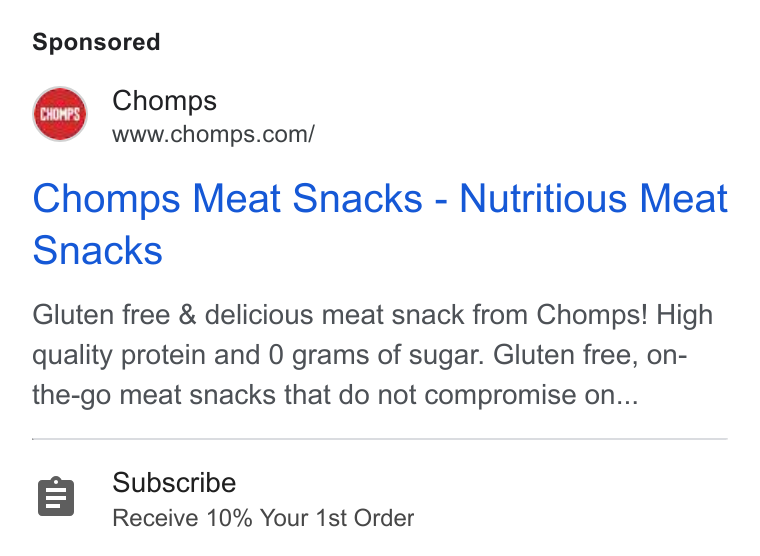
- Running
- 1087 days (longevity = it's converting)
- Hook
- "Sponsored" text at the top, followed by the Chomps logo and brand name, then the website "www.chomps.com/". Below this is the blue headline "Chomps Meat Snacks - Nutritious Meat Snacks".
- CTA / offer
- Receive 10% Your 1st Order
- Audience
- Individuals seeking healthy, convenient, and gluten-free snack options, indicated by phrases like "Gluten free & delicious meat snack", "High quality protein and 0 grams of sugar", and "on-the-go meat snacks".
Why it works. Uses a broad nutrition term to catch general healthy-snack searches instead of narrowing to one specific diet or nutrient.
Headline benefit statement: "Chomps Meat Snacks - Nutritious Meat Snacks" Reserve specific claims for narrow keyword ad groups and use a broad benefit term for your top-of-funnel search ads.
Show 7 more exhibits
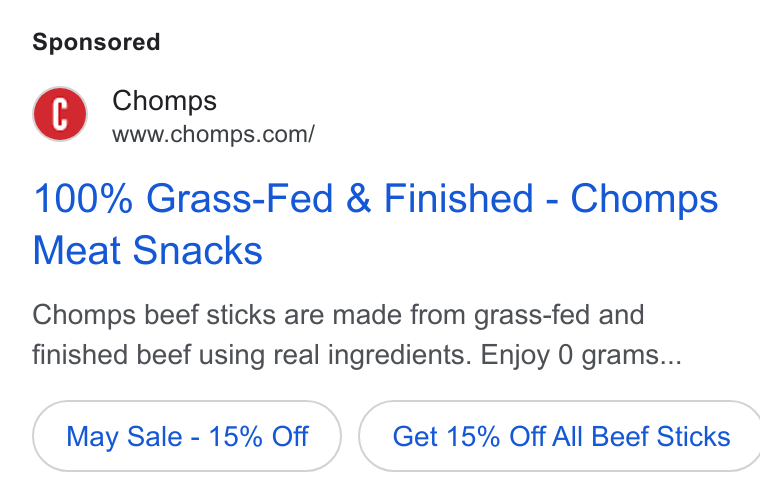
- Running
- 397 days (longevity = it's converting)
- Hook
- Sponsored Chomps www.chomps.com/ 100% Grass-Fed & Finished - Chomps Meat Snacks
- CTA / offer
- May Sale - 15% Off, Get 15% Off All Beef Sticks
- Audience
- Individuals interested in healthy, natural food options, evidenced by the emphasis on "100% Grass-Fed & Finished" and "real ingredients."
Why it works. Puts a specific sourcing claim ahead of the brand name so quality is the first thing a comparison shopper reads.
Headline emphasizes a key product benefit: "100% Grass-Fed & Finished - Chomps Meat Snacks" Put your strongest sourcing or ingredient claim before your brand name in the search ad headline.
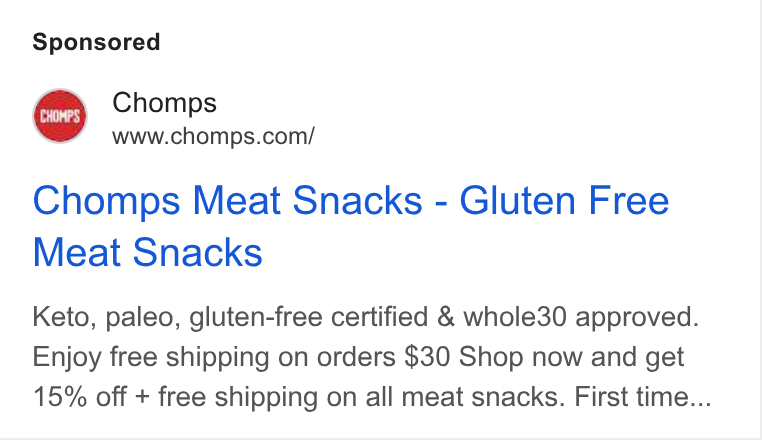
- Running
- 305 days (longevity = it's converting)
- Hook
- Sponsored CHOMPS Chomps www.chomps.com/ Chomps Meat Snacks - Gluten Free Meat Snacks
- CTA / offer
- Enjoy free shipping on orders $30 Shop now and get 15% off + free shipping on all meat snacks. First time...
- Audience
- Individuals following specific diets (Keto, paleo, whole30) and those seeking gluten-free options, indicated by the explicit mention of these terms.
Why it works. Puts the dietary restriction directly in the headline so shoppers filtering for that diet self-select into the ad.
Headline explicitly states a key product benefit: "Chomps Meat Snacks - Gluten Free Meat Snacks". If your product fits a specific diet, name that diet directly in the search ad headline instead of a general health claim.
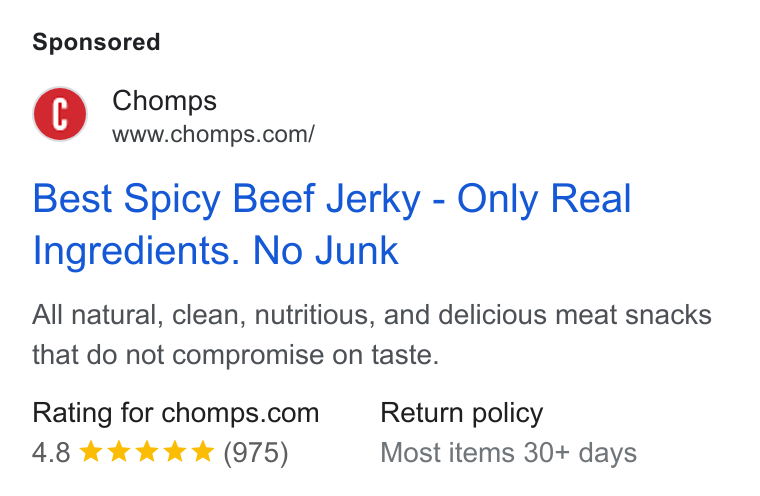
- Running
- 527 days (longevity = it's converting)
- Hook
- Sponsored C Chomps www.chomps.com/ Best Spicy Beef Jerky - Only Real Ingredients. No Junk
- Audience
- Health-conscious individuals and those seeking high-quality, natural food products, indicated by phrases like 'Only Real Ingredients. No Junk' and 'All natural, clean, nutritious'.
Why it works. Uses 'No Junk' to imply a contrast with fillers in competitor jerky, appealing to shoppers already reading ingredient labels.
Headline claim: 'Best Spicy Beef Jerky - Only Real Ingredients. No Junk' Pair a category superlative with a short 'no junk' or 'no fillers' promise to imply a comparison without naming a competitor.
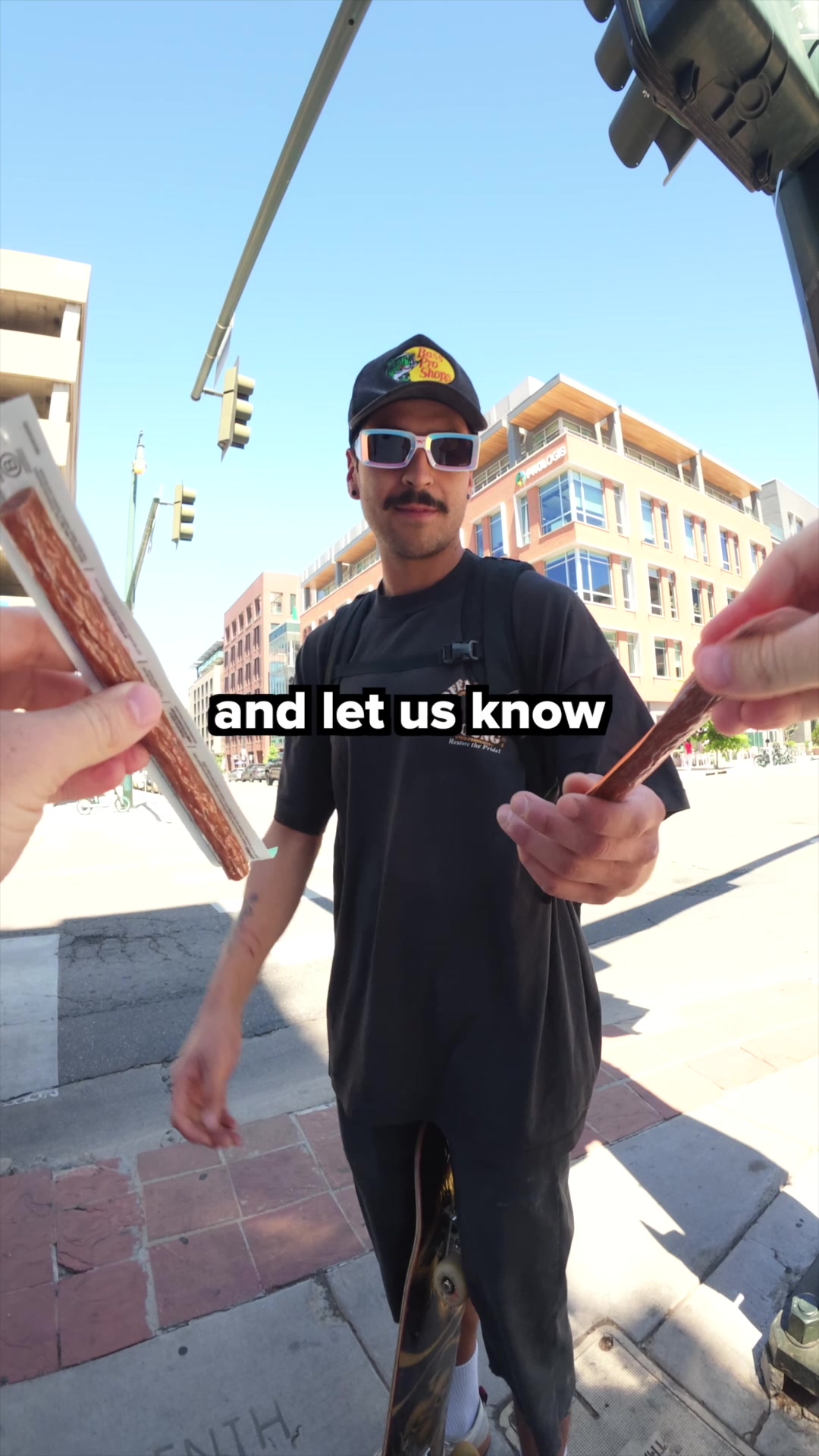
- Hook
- "So basically" + A person in a black t-shirt, black hat, and white sunglasses is standing on a sidewalk, looking at the camera. A hand from off-screen extends a long, thin, brown snack stick towards them.
- Audience
- People who enjoy snack sticks or are looking for a quick, convenient snack, indicated by the product being offered to random people on the street.
Why it works. Hands a stranger the product on camera and lets the reaction play out unscripted, borrowing street-interview authenticity for a taste test.
Direct engagement and taste test (0:00-0:03, "I want you to try both and let us know which one you like better.") Approach real people in public, hand them your product on camera, and film their unscripted first reaction as your ad.
- Hook
- Visual: A wide shot of a store aisle with shelves stocked with various packaged snacks. Audio: "We're at the store looking for a protein snack and I am keep going back to these Chomps mini sticks."
- Audience
- The mention of "protein snack" and "0 sugar" targets health-conscious individuals looking for convenient, low-sugar, high-protein options. The focus on price and a 'major deal' targets budget-conscious shoppers.
Why it works. Films the exact in-aisle decision moment against visible competitor snacks, making the repeat-purchase claim feel observed, not scripted.
Problem-solution framing with product attributes (0:03-0:06): The creator states, "Not only are they so cute but they actually have 4 grams of protein and that price is so good to add to that orange cart." Film your product being chosen in a real store aisle next to competitor products rather than in a staged, clean setting.
UGC talking-head
- Hook
- 0:00-0:03, a woman with blonde hair in a bun, wearing a black t-shirt, is speaking directly to the camera. On-screen text reads: "EATING A BEEF CHOMP AFTER MONTHS OF DEPRIVATION". Audio: "Hey guys. I had the turkey chomp."
- Audience
- Individuals interested in snack reviews, particularly those familiar with 'chomp' brand products or looking for high-protein snacks. The casual, informal language and setting suggest a younger, social media-savvy audience.
Why it works. Reframes a snack stick as a post-diet reward using deprivation language, aimed squarely at viewers currently restricting food.
On-screen text sets up a curiosity gap at 0:00: "EATING A BEEF CHOMP AFTER MONTHS OF DEPRIVATION". If your product fits a restrictive diet, frame a review around returning to it after a period of deprivation rather than a plain taste test.
- Reach
- 81 upvotes · 18 comments · r/AwesomeFreebies
A community is already discussing this in r/AwesomeFreebies. Show up there authentically and answer the thread before a competitor does.
Who amplifies them
Chomps' amplification splits into three tiers: hashtag-tagged partner creators, an unpaid organic tier, and marketplace resale. The formal layer carries a #ChompsPartner tag across creators like @costcoclaudia ("CHOMPS beef sticks at Costco," a bigger-pack retail tie-in) and @grillin_with_dad (a grilling and family niche account), signaling a recruited creator arrangement rather than spontaneous coverage. Alongside it sits at least one TikTok Shop seller, @Elaina|Koa&Noa, listing Chomps' Chomplings (its mini-stick line) directly for commission-based sale, plus a wave of unprompted organic mentions from creators like @claviermusic, @lifewithagirlmom, and @toila.nle, who tags her own clip explicitly as UGC. On Reddit, the only visible mention is a single high-scoring giveaway post (score 81) in r/AwesomeFreebies rather than a sustained community thread. None of the evidence shows co-founders Pete Maldonado or Rashid Ali running personal build-in-public accounts; the amplification engine runs on recruited and organic creators plus retail-partner reposts (Thrive Market), not founder-led social presence.
07 Organic & video
The organic content engine: the videos, creator posts, and community presence earning attention without paid spend.
Chomps posts to TikTok and Instagram at high volume (its own account carries 3,110 posts, covered above), but the more useful pattern is in what its unpaid creator content shares in common: a talking-head reveal or reaction to the product, often stacked against a specific pain point. Lifewithagirlmom's "Original Beef Chomplings with 4g protein" post pulled 12,700 engagements, claviermusic's "@Chomps pls send me a package to Paris" pulled 8,175, and erica morgan's "love a chomps meat stick but not if I have to talk to anyone" pulled 923, with a long tail of smaller creator clips in the 25-500 engagement range. The same shape repeats on Instagram, where a "caught in 4k" hashtag post leads at 2,333 engagements, followed by a cluster of family- and Costco-themed reviews in the 800-1,000 range. The format that performs across both platforms is the relatable-problem hook ("meat stick problems," protein-bar fatigue, wedding-day snacking anxiety) delivered as unscripted talking-head or b-roll-with-voiceover rather than polished brand video, alongside the recurring street-interview series covered above. Chomps' own YouTube channel runs a slower cadence built on founder-hosted interviews (the Chompcast series) and employee profiles, functioning more as a retention and culture layer than a discovery engine.
08 Affiliate & partners
How the brand turns creators and partners into a tracked, variable-cost acquisition channel, and how the program is structured.
Chomps runs a visible affiliate and partner program at chomps.com/pages/refer, recruiting outside partners to drive referral traffic. That sits alongside the #ChompsPartner creator tier and the TikTok Shop listing covered above, forming a three-layer motion: a formal referral link for partners, a hashtag-tracked creator arrangement for reach, and a commission-based shop listing for direct in-app sales. At Chomps' scale this reads as a deliberate spread of the affiliate motion across owned, creator, and marketplace channels rather than dependence on any single one.
09 The playbook
The channels are not separate. They are one system where each stage feeds the next. Here is the read, then the plays to run tomorrow.
The inferred playbook
Chomps' loop starts with a large always-on paid and creator footprint that manufactures awareness for each flavor launch, but the purchase itself converts overwhelmingly at the retail shelf rather than on chomps.com.
The ~304,000 monthly site visits (covered above) are a rounding error against the ~$660M in 2025 revenue (covered above), meaning the paid and organic engine's real job is driving in-store pickup and branded search, not DTC checkout.
The April 2026 chicken launch (covered in Paid Ads) followed by the Chili Lime Beef and Chicken Trial Pack tests shows a repeatable motion: launch a new protein line, backstop it with a low-commitment sampler offer, then let retail distribution carry it past the initial ad push.
Dig deeper+3▾
The #ChompsPartner tier, the TikTok Shop listing, and the refer page (covered above) act as three distinct entry points, so no single creator or platform going quiet would remove the earned-content layer entirely.
With no build-in-public presence from either co-founder and a dormant brand X account last active around mid-2023 (covered above), the brand's credibility signal rests entirely on third-party creators rather than founder story, a structural gap in a category where founder narrative often drives organic press.
DTC-versus-retail revenue split, blended customer acquisition cost, subscription attach rate on the site's repeat-order option.
Run a recurring street-interview series
The proofChomps' brand TikTok account posts a recurring street-interview series, its single best-performing organic post at 30,301 engagements (covered above).
The adaptationPick one recognizable public spot near your buyers, film a few people trying or reacting to your product with a phone camera and one repeatable prompt ("which one wins?"), and post the raw reactions with minimal editing. Publish it on whichever short-video platform your buyers already use, then repeat on a set cadence with a new location or product angle so it reads as a series rather than a one-off. Unscripted stranger reactions carry more credibility than brand-produced demo footage, so the format itself does the persuading before any line of copy does.
Cost: $0 Time to signal: days Works pre-PMF: yes
Stack verifiable numbers into one ad claim
The proofChomps' "PROTEIN POWER" ad (covered in Paid Ads) bundles three concrete numbers, 10+ grams protein, 0 grams sugar, real ingredients, into one scannable claim stack instead of a single abstract health pitch.
The adaptationList every hard, checkable number your product can claim (weight, price per use, time saved, ingredient count, whatever a buyer could verify on a spec sheet or label), pick the three most relevant to your buyer's real objection, and put them together in one ad or landing-page block instead of scattering them across separate lines of copy. Test it against your current single-benefit headline in the same ad account. A skimmer can verify a stacked claim in one glance, where the same numbers spread through paragraph copy get skipped.
Cost: under $500 Time to signal: weeks Works pre-PMF: conditional, it only works once you have real, checkable numbers to stack; a product without measurable specs has nothing to put in the boxes.
Publish adjacent-search content before brand content
The proofChomps' top organic pages beyond its own product listings are diet-specific guides like its no-carb foods and nightshade vegetables lists (covered in Organic Content), ranking for category terms like "carnivore diet" rather than the Chomps name.
The adaptationIdentify the two or three lifestyle or use-case searches your ideal buyer runs before they know your product exists (a diet, a hobby, a problem category), write one thorough guide-style page per term, and link it directly into your own product or collection pages. Publish it on your own domain rather than as a guest post so the ranking equity compounds under your brand over time. This captures demand of problem-awareness, well before anyone searches your brand name.
Cost: $0 Time to signal: months Works pre-PMF: yes
Recruit niche-specific creators under one tracked tag
The proofThe #ChompsPartner tag ties together otherwise-unrelated creators, a Costco-focused account and a grilling and family account (covered in Who Amplifies), into one trackable, recruited tier distinct from unpaid organic mentions.
The adaptationInstead of one generic influencer outreach list, sort your creator prospects by the specific context each covers (a retailer, a hobby, a life stage) and give every recruited creator the same branded hashtag so you can pull performance by tag later. Start by gifting product to two or three creators in different niches rather than running one broad campaign. Consistent tagging turns scattered gifted posts into a measurable program instead of untraceable goodwill.
Cost: under $500 Time to signal: weeks Works pre-PMF: yes, provided you have product to gift; paid creator fees can wait until the tagged tier proves out.
Ship a low-commitment sampler for every new line
The proofChomps backstops its chicken-line launch with a Chicken Trial Pack sampler offer (covered in Paid Ads), letting repeat buyers taste multiple new flavors before committing to a full-size pack.
The adaptationWhenever you launch a variant of your core product, package a small multi-variant sampler at a lower price point specifically for existing customers, and promote it only to people who already bought the original line rather than cold audiences. Frame it as a taste test, not a discount. It lowers the switching cost for buyers who already trust you but haven't tried the new option, a cheaper conversion than winning a stranger.
Cost: under $5k Time to signal: weeks Works pre-PMF: conditional, it only makes sense once you have more than one variant of your product to sample. Not transferable at an earlier stage: the retail-shelf flywheel behind 180,000+ doors and the January 2022 $80M private-equity raise (from Stride Consumer Partners) that funded it are not available to a bootstrapped founder; adapt the content, creator-tagging, and sampler mechanics above, not the distribution scale itself.
You just read how Chomps does it. Tomorrow it is someone else.
Every morning we take one company that is actually growing and break down where its customers come from: the ads still running after a year, the channel doing the real work, and the play you can run this week.
Systemaic · directional intelligence. Traffic, spend, and reach figures are SimilarWeb-style estimates and qualitative reads of public data, not audited numbers. Built on real public receipts.
// teardowns with a similar GTM motion
sources & receipts (9)
Live ad libraries: meta ad library · linkedin ad library · google ad library
Launch archives: Hacker News: Nanoparticle chomps away plaques that cause heart attacks · Hacker News: The ChompSaw: A benchtop power tool that's safe for kids to · Hacker News: Rate my startup: ChompStack, a mobile website builder for re · Hacker News: ChompStack aims to bring restaurant owners to the mobile Web · Hacker News: Apple Chomps At App Store Search? Developers See Shift In Se · Hacker News: Gator Chomps Drone Out of the Air
Traffic, spend, and revenue figures are estimates as noted in the report; the links above are the primary public artifacts.