- 01Mine your own usage data for a lead magnet
- 02Lead with the customer's number, not your feature
- 03Bid on "[competitor] alternative" searches
- 04Put the free tier behind the ad, not the homepage
01 Snapshot
The one-glance read on who they are and how they grow. Each point is verifiable from the receipts above.
A Generative Engine Optimization (GEO) / Answer Engine Optimization (AEO) platform that monitors and improves how brands appear in ChatGPT, Perplexity, Gemini, and Google AI Overviews, built by a YC W25 team led by CEO Andrew Yan (ex-Google Search) alongside co-founder Alan Yao.
Paid-led: an approximately 78-ad LinkedIn library and a 14-ad Google program carry more real weight than the site's modest organic and social footprint, with founder Andrew Yan's research posts feeding the creative.
Roughly 59,600 monthly visits (-13.9% over the last 3 months) as of 2026-07-25; 8 of 14 Google ads and about 23 of 24 sampled LinkedIn ads still active as of 2026-07-25 (from a ~78-ad library); $2.7M total raised (a YC-led pre-seed plus a $2.2M seed in June 2025); and an estimated $50K-100K in monthly recurring revenue, an ESTIMATE with no public metrics available, built on the $295/month Starter tier and the "100+ brands and agencies" the founder cited at the seed round.
As of 2026-07-25, the newest LinkedIn tests are customer-outcome case studies (Rootly, Popl) and content-mix data infographics rather than new formats or channels.
AthenaHQ turns its own product output, aggregate AI-citation research like the State of AI Search 2026 report, into the ad creative that sells the product, then pushes that research through paid LinkedIn distribution rather than waiting for it to spread on its own.
02 How it unfolded
The order the channels came online. Sequence is strategy: what they did first, and what they layered on once demand existed.
03 Traffic & channel mix
Estimated demand, the channel split behind it, and the keywords and referrers doing the work. Directional modeling, not audited analytics.
Traffic sources
Top search keywords
| Keyword | Volume | Weight | CPC |
|---|---|---|---|
| athenahq | 9.7k | $9.07 | |
| athena hq | 2.1k | $8.42 | |
| athena ai | 7.4k | $4.49 | |
| does athena hq ai support amazon alexa for shopping | 340 | - | |
| ai search manager specializing in geo and aeo for enterprise customers. | 830 | - |
Closest competitors by audience
AthenaHQ pulls an estimated 59,600 monthly visits, down 13.9% over the last 3 months. The mix is led by Direct at 39.2%, ahead of Search Organic at 29.9% and Search Paid at 14.3%, a pattern consistent with a heavily-advertised B2B brand where prospects who see a LinkedIn ad later type the URL directly rather than clicking through. The remaining four channels, referrals, Gen AI referrals, social organic, and email, together account for 16.6% of visits; the Gen AI slice (4.9%) is the notable one here, since AI chatbots sending visitors is exactly the channel AthenaHQ sells monitoring for. The keywords they show up for, athenahq (9,730 searches/month), athena ai (7,440/month), and athena hq (2,100/month), are all branded terms, meaning most of that Search Organic share is people already looking for the company, not category shoppers discovering it cold. Of the listed competitors, chatbeat.com reads as the closest direct GEO-monitoring peer, while ahrefs.com (a traditional SEO tool) and claude.ai (an AI model, not a SaaS competitor) look like audience-overlap noise rather than real competitive alternatives.
04 Organic content
The specific pages earning their organic search traffic, and the pattern behind why they rank. Adapt the format, not the topic.
The top organic pages are dominated by the homepage (69.9% of organic visits) and a single "best AI SEO tools" roundup article (20.3%), with a head-to-head comparison page against rival Profound, a second tools-listicle article, and even the careers page rounding out the rest at low single digits each. The pattern is a category-defining listicle plus direct competitor-comparison pages, the same "best X" and "X vs Y" format that works because GEO/AEO is still a young enough category that few dedicated players are competing for those exact commercial-intent phrases. That format also lines up with the ranking keywords: AthenaHQ sits at #1 for "ai seo tools" and "generative ai seo software," and #3 for "athena ai visibility products company," meaning the roundup and comparison pages are winning the searches a prospect runs while actively shopping the category.
Top pages by organic traffic
05 Channel map
Not traffic share. How much weight the growth system actually puts on each channel, with a one-line read on the role it plays.
What drove growth
06 Who they’re hiring
Open roles read like a roadmap: the functions they’re staffing show where the company is investing next and what stage it’s at.
4 open roles
07 The motions doing the work
For founder-led SaaS the breakdown shifts from ads to traction: where the first users came from, how the founder grows it in the open, and the compounding organic surface.
The clearest public launch moment on record is founder Andrew Yan's own funding announcement, not a coordinated multi-surface event.
Yan's June 17, 2025 X post, "Today we're pumped to announce Athena's $2.2M seed round... We're already serving 100+ brands and agencies," is by far the top-performing post in the founder's feed at 60,256 views and 246 likes, doubling as a funding announcement and a traction proof point.
the visible record here doesn't include a Product Hunt page or a forum-launch spike, so what's traceable is the founder's own funding and research-drop posts rather than a single coordinated event across multiple platforms.
Dig deeper+2▾
an October 8, 2025 tweet unveiling "the first GenAI Search benchmark" (6 million responses analyzed, 13,398 views) and the later State of AI Search 2026 report function as repeat mini-launches, and both get reused directly as the backbone of the LinkedIn ad library.
the r/aeo comparison thread weighing AthenaHQ against Peec AI, dated June 2026, shows the category is now being discussed and shopped organically in a dedicated subreddit roughly a year after the seed launch.
Andrew Yan, Co-Founder and CEO, is the sole visible face of the company, running two very differently sized audiences with company research doing double duty as content and ad creative.
Yan's X account carries 885 followers across 128 posts, while his LinkedIn profile carries 18,911 followers, over 20 times larger, making LinkedIn the bigger owned surface even though the available evidence captures specific post text only on X.
his X posts are infrequent and event-triggered: the seed round, a hiring call, the GenAI Search benchmark drop, a Forbes-blocks-OpenAI news jack, and a July 24, 2026 recap of a CMO talk titled "Why AI Search Monitoring Failed and What Actually Moves the Needle," rather than a running build-in-public log.
Dig deeper+2▾
the benchmark and report posts consistently outperform generic updates and get repurposed as paid creative, so original data functions as Yan's primary content format rather than personal narrative.
the only Reddit activity tied to AthenaHQ is a third party's comparison post, not a founder account, so whatever community traction exists there runs on prospects talking about the category rather than Yan posting into subreddits himself.
Search organic sits at nearly 30% of total traffic, a real second channel behind direct, built on a narrow but functional owned-content base.
the site's content investment (detailed above) is concentrated in "best AI SEO tools" roundups and head-to-head comparison pages, a strategy of owning exact commercial-intent phrases while the GEO/AEO category still has little established SEO competition.
only five indexed pages are pulling meaningful organic traffic, and there's no visible integrations directory, template library, or open-source repo, so the compounding surface here is narrow rather than a large programmatic footprint.
Dig deeper+2▾
the owned-site evidence shows no referral or affiliate program link, so distribution runs on the company's own content and paid spend rather than a recruited-partner network.
Google's bold-claim text ads ("AthenaHQ: AI Search Leader," "Dominate AI Search Results") defend branded queries, while curiosity-hook pages like "seoClarity Alternative for AEO" bid directly against named competitors. The Google side runs under the advertiser name NuvoTech, Inc. rather than AthenaHQ itself, likely an agency or ad-account entity. On LinkedIn, a recurring case-study ad, "Our customer Grüns 6x Share of Voice in 60 days. 23x citation rate growth. 10,500+ AI search impressions," stacks three quantified outcomes as its opening hook and appears both as a long-running workhorse ad and among the newest tests, meaning it graduated from test to workhorse while still being iterated on.
08 Paid ads
This founder-led SaaS also runs paid acquisition. Here are the live ads doing the work, each with the X-ray and a play you can adapt.
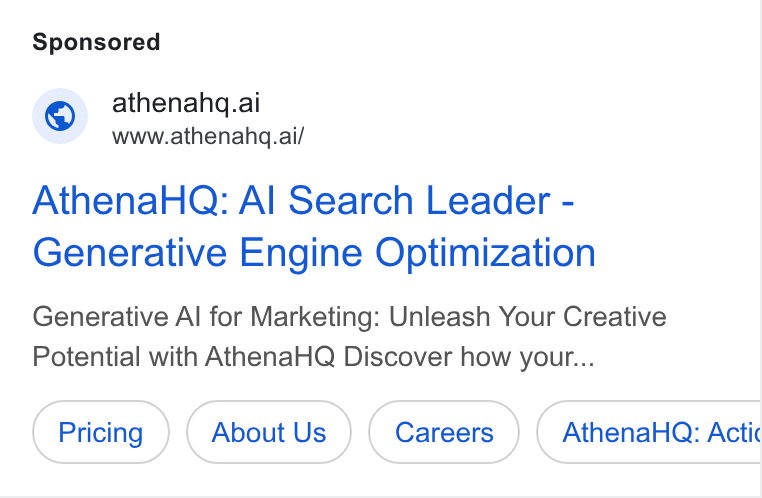
- Running
- 300 days (longevity = it's converting)
- Hook
- Sponsored athenahq.ai www.athenahq.ai/ AthenaHQ: AI Search Leader - Generative Engine Optimization
- Audience
- Professionals in marketing or businesses looking to improve their online presence, indicated by 'Generative AI for Marketing' and 'Generative Engine Optimization'.
Why it works. Search ad matches people already typing the GEO/AI-search term, pairing that exact jargon with a leader claim to convert high-intent searchers.
Headline with a strong claim and keyword: 'AthenaHQ: AI Search Leader - Generative Engine Optimization' Put your niche's exact search term in the headline right beside your leadership claim so intent-matched searchers self-qualify.
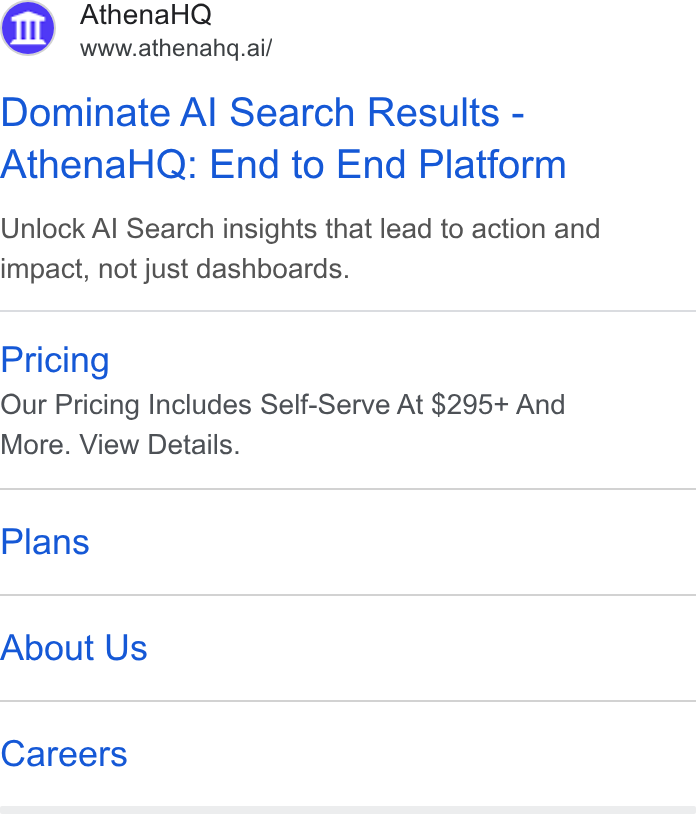
- Running
- 185 days (longevity = it's converting)
- Hook
- "Dominate AI Search Results - AthenaHQ: End to End Platform" with a blue icon of a building with columns.
- CTA / offer
- Our Pricing Includes Self-Serve At $295+ And More. View Details.
- Audience
- Businesses or individuals seeking to improve their AI search performance, indicated by the phrases "Dominate AI Search Results" and "Unlock AI Search insights."
Why it works. Targets buyers comparing point-solutions by naming 'end to end' so they can rule out needing a second tool to fill gaps.
Headline with a strong benefit and product name: "Dominate AI Search Results - AthenaHQ: End to End Platform" If your product covers a full workflow, state 'end to end' right next to your outcome verb so buyers rule out a second purchase.
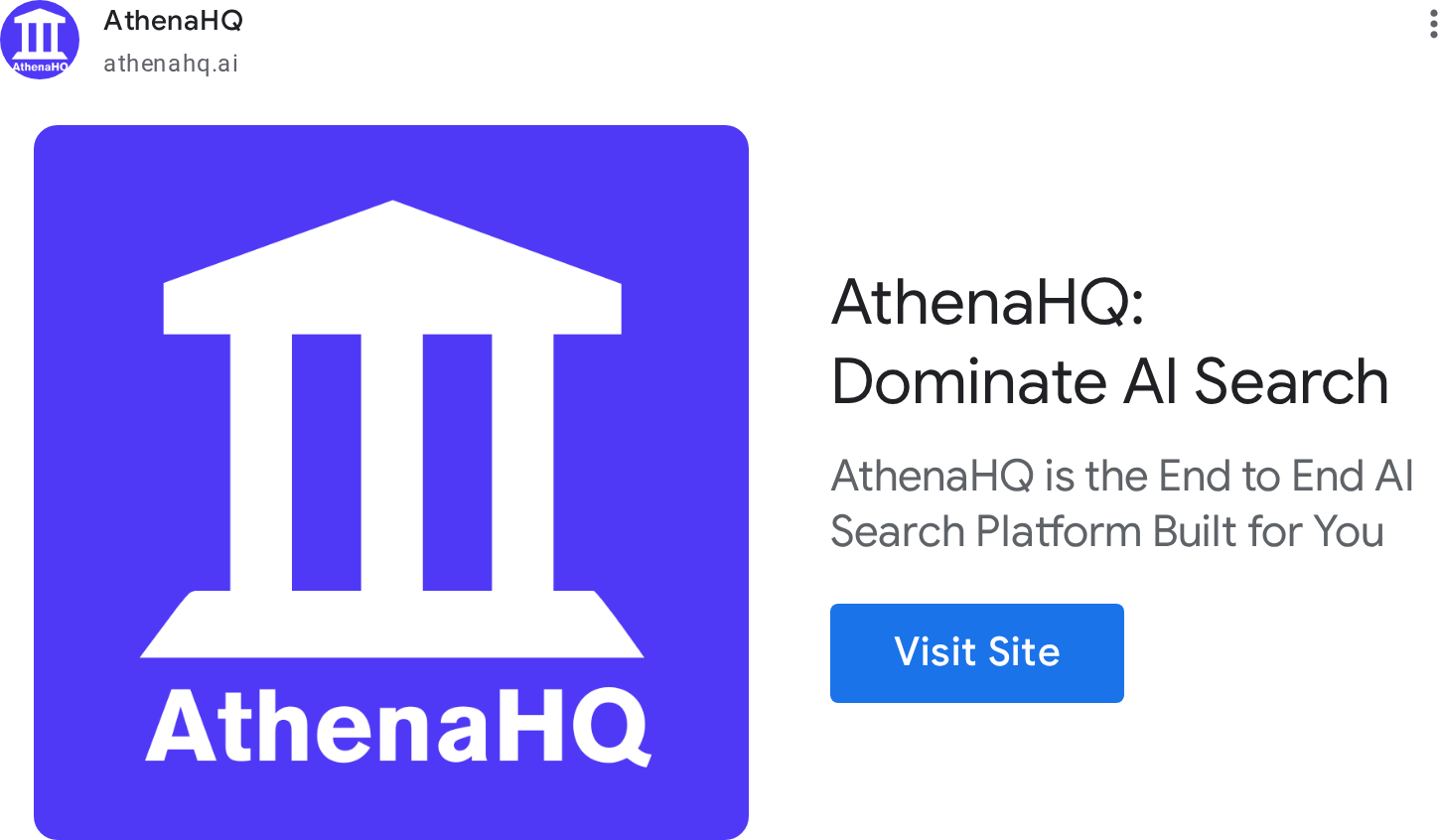
- Running
- 133 days (longevity = it's converting)
- Hook
- "AthenaHQ: Dominate AI Search" with a large blue square logo featuring a white classical building facade and the text "AthenaHQ" below it.
- CTA / offer
- Visit Site
- Audience
- Businesses or individuals involved in AI, SEO, or digital search, indicated by the phrases "AI Search" and "AI Search Platform."
Why it works. Display ad for AI-search buyers using a compressed brand-plus-outcome line suited to small ad real estate.
Headline with a strong, aspirational claim: "AthenaHQ: Dominate AI Search" Compress your value prop to brand name plus a two-word outcome phrase for placements with limited headline space.
Show 3 more ads
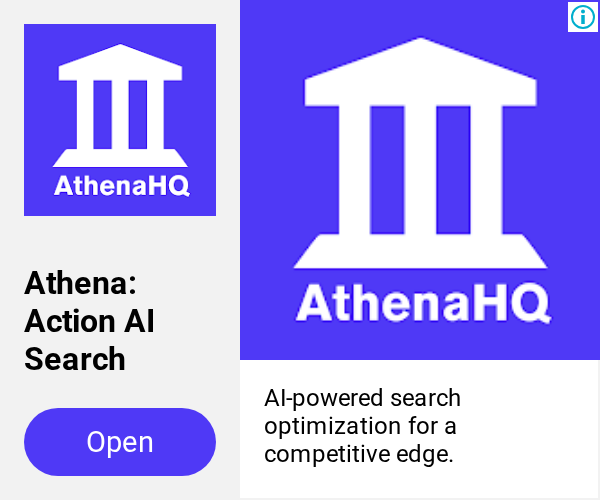
- Running
- 70 days (longevity = it's converting)
- Hook
- Visual: A purple square with a white icon resembling a building with three pillars and the text "AthenaHQ" below it. Text: "Athena: Action AI Search"
- CTA / offer
- Open
- Audience
- The text "AI-powered search optimization for a competitive edge" targets businesses or individuals looking to improve their search performance and gain an advantage.
Why it works. Small logo-plus-tagline tile used as a Performance Max display asset to build repeated brand recall rather than carry a sales pitch.
Prominent branding and product name: The logo "AthenaHQ" is displayed twice, once as a standalone icon and again as part of the main ad image. Keep a consistent icon-plus-wordmark pairing across your smallest display asset sizes so repeated impressions build recognition.
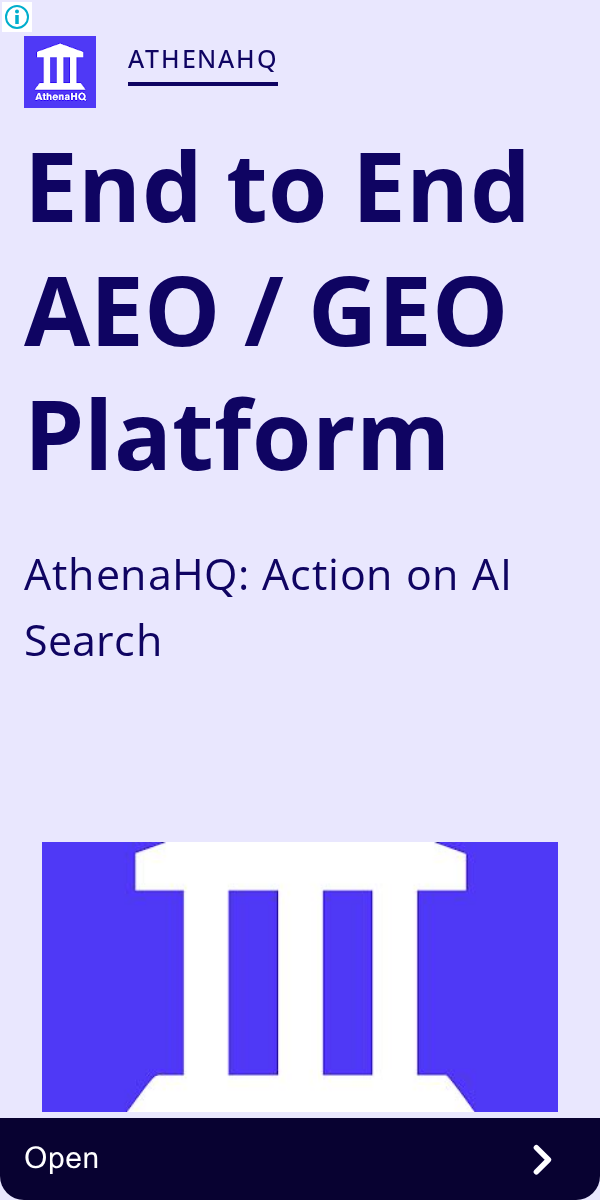
- Running
- 26 days (longevity = it's converting)
- Hook
- "End to End AEO / GEO Platform" as large, dark blue text on a light purple background, with a blue logo and "ATHENAHQ" at the top.
- Audience
- Professionals or businesses interested in AI-driven search optimization, indicated by terms like "AEO / GEO Platform" and "AI Search".
Why it works. Static ad for buyers unsure which acronym applies to their search, covering both AEO and GEO so no relevant searcher is missed.
Prominent display of core product function: "End to End AEO / GEO Platform" is displayed in large, dark blue font. If your category has competing acronyms in the market, name both together instead of betting on just one term.
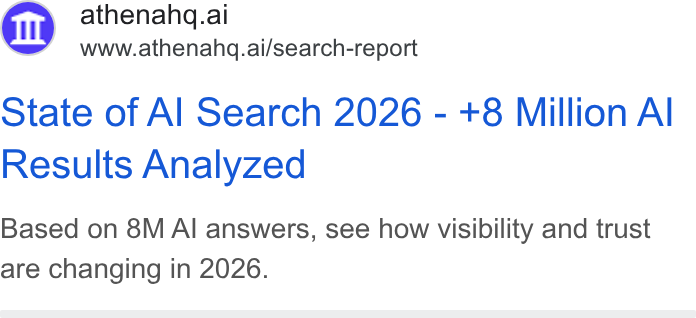
- Running
- 183 days (longevity = it's converting)
- Hook
- athenahq.ai www.athenahq.ai/search-report State of Al Search 2026 - +8 Million Al Results Analyzed
- Audience
- Professionals interested in AI, search engine optimization (SEO), and future trends in technology, indicated by the specific mention of 'AI Search' and '2026'.
Why it works. Report-download ad for researchers and marketers, using a large precise dataset count so the report reads as analysis, not opinion.
Presenting a specific, large data point in the headline: "State of Al Search 2026 - +8 Million Al Results Analyzed" State the raw count of data points behind your report in the ad headline, before the report title itself.
09 The playbook
The channels are not separate. They are one system where each stage feeds the next. Here is the read, then the plays to run tomorrow.
The inferred playbook
The loop runs on proprietary research pulling attention through paid LinkedIn distribution, with customer case studies doing the trust-building a new category needs.
original research, the 6-million-response benchmark and the State of AI Search 2026 report, is the attention engine, published by the founder and then re-run as the backbone of the LinkedIn ad library, so one asset does organic and paid duty at once.
the ad set leans on named-customer before/after numbers rather than product-feature messaging, which suggests buyers in this new category are trust-limited (they need a peer's result) more than awareness-limited.
Dig deeper+3▾
the Essential plan's $0/month, 300-credit tier lets an ad click convert straight into product use, upgrading to the $295/month Starter tier once a team needs more credits or seats, a self-serve motion sitting underneath the paid spend.
sustained top-of-funnel volume still runs almost entirely through paid and founder posts rather than a compounding owned-content library, a fragile position for a company whose whole pitch is helping other brands win the organic-discovery game.
the free-to-paid conversion rate from Essential to Starter, credit-overage or upgrade attach rate under the credit-metered model, expansion revenue on Enterprise contracts, and a true paying-customer count independent of the company's own "100+" and "300+" claims.
Mine your own usage data for a lead magnet
The proofAthenaHQ's State of AI Search 2026 report, built from analyzing millions of AI responses, recurs across the LinkedIn ad library and doubles as the founder's best-performing organic content.
The adaptationPull one surprising, quotable stat out of your own product's usage data, the kind only you could know because it's your dataset, and ship it as a single-page report or landing page. Use that one number as the entire hook of your next ad or post, the way AthenaHQ leads with a single citation stat pulled from its own report instead of describing its own features.
Cost: $0 · Time to signal: days · Works pre-PMF: yes
Lead with the customer's number, not your feature
The proofAthenaHQ's recurring ads open with a specific customer outcome, Grüns' 6x share-of-voice gain or Rootly's jump from 3% to 30% citation rate, before ever describing the product.
The adaptationTake your single best early customer result, even from one beta user, and write one post that leads with the exact number and timeframe in an "X to Y in Z days" format, publishing it to your existing following as the opening line instead of burying it after a product pitch.
Cost: $0 · Time to signal: days · Works pre-PMF: conditional, needs at least one customer willing to share a measurable result.
Bid on "[competitor] alternative" searches
The proofAthenaHQ runs Google ads pointing directly at "/seoclarity/alternative" and "/scrunch/alternative" landing pages, part of the ad set still active as of 2026-07-25.
The adaptationBuild one dedicated "[Your Product] vs [Competitor]" landing page for a named competitor, then run a small Google Ads budget targeting the exact "[competitor] alternative" search term, high-intent bottom-funnel traffic because the searcher is already comparing options.
Cost: under $500 · Time to signal: weeks · Works pre-PMF: no, this needs an established competitor with existing switching intent to bid against.
Put the free tier behind the ad, not the homepage
The proofAthenaHQ's $0/month Essential tier (300 credits, unlimited seats) sits directly behind its paid ad spend, letting a click convert without a sales call.
The adaptationBuild a capped free version of your product's core action, not a generic signup form, and point every paid or organic click straight at that flow instead of a marketing homepage, cutting the distance between ad and first value to one step.
Cost: under $5k · Time to signal: weeks · Works pre-PMF: yes
Track your own citations in AI answers
The proofAthenaHQ's own traffic mix shows Gen AI referrals, AI chatbots sending visitors, at 4.9% of total traffic, a real channel the company both monitors for customers and benefits from itself.
The adaptationPeriodically ask ChatGPT, Perplexity, and Gemini the exact questions a prospect would ask when shopping your category, log whether you're mentioned and which competitor is, and feed anything missing into a comparison or listicle page. This doubles as content research and a free version of the exact monitoring AthenaHQ charges for.
Cost: $0 · Time to signal: weeks · Works pre-PMF: yes Not transferable at an earlier stage: the $2.7M backing AthenaHQ's 78-ad LinkedIn library, and Andrew Yan's 18,911-follower LinkedIn audience, built before AthenaHQ existed, give founder posts a head start a brand-new founder won't have on day one.
You just read how AthenaHQ does it. Tomorrow it is someone else.
Every morning we take one company that is actually growing and break down where its customers come from: the ads still running after a year, the channel doing the real work, and the play you can run this week.
Systemaic · directional intelligence. Traffic, spend, and reach figures are SimilarWeb-style estimates and qualitative reads of public data, not audited numbers. Built on real public receipts.
// teardowns with a similar GTM motion
sources & receipts (19)
Live ad libraries: linkedin ad library · google ad library
Researched facts: AthenaHQ raised a $2.2M seed round: $2.2M seed round, announced June 2025 · Seed round investors: Y Combinator, FCVC, Red Bike Capital, Amino Capital, plus angels Eli · Total funding raised to date: $2.7M across 2 rounds (pre-seed/YC ~$500K in Feb 2025, then · Co-founder and CEO: Andrew Yan, formerly a Google Search product manager and DeepMind gene · Co-founder and CTO: Alan Yao, previously built AI tools at ServiceNow and was engaged with · Company tagline/positioning on YC: YC launch framed as helping brands get discovered on Ch · Employee headcount: 19 employees · Named enterprise customers (first-party): SoFi, ZoomInfo, OneSignal, Volkswagen, Ollie, Pa · Product suite / feature names: Three named products: Lighthouse (hallucination/outdated-in · AI engine coverage across all plans: All plans monitor ChatGPT, Perplexity, Gemini, Google
Milestone sources: 2025-03-12: AthenaHQ closes a $500K pre-seed round led by Y Combinator (coinciding with YC · 2025-06-17: AthenaHQ launches out of stealth with a $2.2M seed round (Y Combinator, FCVC, · 2025-09-29: AthenaHQ launches the Athena Citation Engine (ACE), a machine-learning model t · 2025-10: AthenaHQ completes its AICPA SOC 2 Type 1 security certification (Type 2 observat · 2025-12-16: Uberall and AthenaHQ launch the industry's first Generative Engine Optimizatio · 2026-04: AthenaHQ publishes its "State of AI Search 2026" report, finding the average bran · 2026-04: AthenaHQ receives a G2 Spring 2026 award (High Performer) in the Answer Engine Op
Traffic, spend, and revenue figures are estimates as noted in the report; the links above are the primary public artifacts.