- 01Target problem-function search terms with direct product pages, not blog content
- 02Film system tutorials instead of single-product demos
- 03Brief creators on a time-horizon outcome, not a product feature
- 04Name the stockist in paid ad copy to borrow their credibility
01 Snapshot
The one-glance read on who they are and how they grow. Each point is verifiable from the receipts above.
Plant-based, Cold Processed® scalp treatments and hair-loss systems (serums, shampoos, dermastamps, peptide treatments) for prestige beauty buyers, co-founded by trichologist and celebrity hairstylist Helen Reavey and co-founder Colm Mackin; the brand claimed the scalp-care-as-skincare positioning before it reached mainstream and launched in 235+ Sephora U.S. doors in 2023 after turning down the retailer's first approach in year one.
Paid-led, with a TikTok creator-affiliate network seeding branded awareness and Sephora retail validating the brand for first-time buyers who won't purchase DTC.
Approximately 76,459 estimated monthly visits; 133,492 Instagram followers across 1,780 posts; approximately 44 Google ads in the transparency library with 11 active as of July 1, 2026; $10M raised across two rounds from CULT Capital, a consumer-brand venture firm.
Sustained paid-ad activity across Meta and Google alongside Sephora's retail distribution shows a brand betting on omnichannel demand capture rather than a single acquisition lever, using retail to validate buyers who won't purchase DTC and paid social to keep the top of funnel fed.
02 How it unfolded
The order the channels came online. Sequence is strategy: what they did first, and what they layered on once demand existed.
03 Traffic & channel mix
Estimated demand, the channel split behind it, and the keywords and referrers doing the work. Directional modeling, not audited analytics.
Traffic sources
Top search keywords
| Keyword | Volume | Weight | CPC |
|---|---|---|---|
| act acre | 1.4k | $1.24 | |
| act and acre | 1.5k | $1.23 | |
| act acre | 850 | - | |
| act and acre scalp serum | 270 | $1.45 | |
| hair growth serum | 20k | $1.13 |
Closest competitors by audience
Estimated total monthly visits sit at approximately 76,459, down roughly 30.9% over the last three months. The channel split reveals a brand whose acquisition model depends on building awareness off-site and capturing it on-site through search: organic search at 33.3% is the single largest traffic driver, followed by direct at 19.8% and paid social at 19.4%. Paid search adds 15.2%, and display accounts for 3.6%, putting paid channels combined (paid social, paid search, display) at 38.2% of all traffic. Social organic is 0.1%: nearly nothing, despite 133,492 Instagram followers, meaning their social content does not move people to the website. Email (3%), affiliate (2.9%), and referral (2.6%) make up the tail.
The keyword profile explains why organic search is so branded-heavy. Their top-searched terms are "act and acre" (1,470 monthly searches across the web), "act acre" (1,370), and "act + acre" (850). Their strongest non-branded positions are #2 for "derma stamp for hair growth" and #4 for "hard water shampoo," both narrow problem-specific terms. They also compete for "hair growth serum" (20,240 total monthly searches across the web), a head term shared with Vegamour, Prose, Divi, Nutrafol, and Obagi. The branded keyword dominance means most organic search traffic consists of people who already know the brand, demand generated elsewhere through paid media or creator content, not net-new discovery.
Closest competitive reference set in their traffic overlap: vegamour.com, prose.com, diviofficial.com, rhutehair.com, us.champohaircare.com, nutrafol.com, idealofmed.com, and obagi.com.
04 Organic content
The specific pages earning their organic search traffic, and the pattern behind why they rank. Adapt the format, not the topic.
Their organic strategy skips editorial content entirely. The pattern across the top five organic pages is individual product pages each optimized for the specific problem the SKU solves, not the product category it belongs to. The dermastamp page ranks #2 for "derma stamp for hair growth," the clarifying shampoo page ranks #4 for "hard water shampoo," and the Scalp Detox Oil captures its own branded product queries. These pages earn consistent, purchase-ready traffic on narrow problem-function terms where buyer intent is high and editorial competition from content sites is lower than on category head terms. The strategy trades breadth for depth: every organic visitor is already problem-aware and searching for a specific solution.
Top pages by organic traffic
05 Channel map
Not traffic share. How much weight the growth system actually puts on each channel, with a one-line read on the role it plays.
What drove growth
06 The creative doing the work
Each exhibit shows the actual asset, an X-ray of why it works, a status, and a play you can adapt. This is the heart of the teardown.
Google has approximately 44 ads in its transparency library, with 11 active as of July 1, 2026 and the longest-running active ad at approximately 233 days. All current active Google placements are video format; their specific creative content is not visible in the transparency library. The creative template that those videos almost certainly follow is established by their previously-run Google ads (all inactive as of February 2026, having run up to 720 days): every format relied on problem-agitation headlines and clinical-percentage proof points, including "Relieve Scalp Irritation: Relieves Dry Scalp Itch in Just 30 Seconds," "Too Much Hair Thinning?", "Stem Cell Hair Loss Treatments: Trichologist developed, clinically tested systems to stop hair thinning and hair loss," and "93% Saw Less Shedding."
On Meta, 56 ad variants appear in the sampled evidence, with the proven winner batch launched in May 2026 and running as DCO, video, and static image across all four Meta placements as of July 1, 2026.
- Running
- 50 days (longevity = it's converting)
- Hook
- "The reason why it's always sold out on Sephora and on our own website." + Visual of a blonde woman in a black top speaking over a green-screened digital article headline.
- CTA / offer
- "Take 30% Off Your First 3 Months"
- Audience
- People with "middle-aged" hair that is "dry and brittle" or "thinning," as explicitly mentioned in the article text and CTA.
Why it works. Opens with an unexplained scarcity fact spoken direct-to-camera, so the viewer stays to hear the reason instead of scrolling past.
Authority Transfer via Green Screen (0:00 - "The reason why it's always sold out") Open with a scarcity fact stated as a mystery ('there's a reason X keeps selling out') before you explain what the product is.
- Running
- 50 days (longevity = it's converting)
- Hook
- "guess how much for this entire kit?" shown over hands opening a brown mesh bag on a white background.
- CTA / offer
- Total $84 for a $224.00 value kit including three free gifts.
- Audience
- People seeking 'thicker fuller hair' and 'scalpcare' who appreciate 'lux' aesthetic packaging.
Why it works. Turns a routine bundle reveal into a guessing game by asking shoppers to price the kit before showing what's inside or what it costs.
Price Anchoring and Gift Stacking (0:24-0:32) Open your next ad with a direct question about your bundle's value before showing the price, then reveal the breakdown item by item.
- Running
- 50 days (longevity = it's converting)
- Hook
- "POV: you're a celebrity hairstylist who has experienced hair loss" shown over two women working on a long blonde head of hair.
- CTA / offer
- "Claim Free Welcome Kit With Your First Purchase"
- Audience
- Women experiencing thinning hair ("helping thousands of women combat thinning hair").
Why it works. Uses a POV frame to make an industry expert's hair loss feel personal and relatable, borrowing their authority for the product.
Authority-Pain Point Hook (0:00-0:03): "POV: you're a celebrity hairstylist who has experienced hair loss" Cast an expert who normally sells confidence in your category, then have them admit to the same problem your product solves.
Show 7 more exhibits
- Running
- 50 days (longevity = it's converting)
- Hook
- "How To" and "Stem Cell Serum" text overlays with hands holding a bottle of Act+Acre Cold Processed Stem Cell Scalp Serum next to a model's head.
- Audience
- Women seeking premium hair-thinning or scalp-health solutions, indicated by the 'Stem Cell' terminology and prestige salon setting.
Why it works. Opens on a plain 'How To' label over a real application shot, setting up a tutorial format that reads as instructional before pitching the serum.
Step-by-Step Instructional Overlays (0:03-0:08) Label your product demo video with a simple 'How To' overlay so it reads as a tutorial in the feed rather than an ad.
- Running
- 50 days (longevity = it's converting)
- Hook
- "How To" and "Peptide Treatment" text overlays with a hand holding a bottle of "3% Stem Cell Peptide Scalp Treatment" next to a woman's parted hair.
- Audience
- Women with long hair interested in scalp health and hair volume, evidenced by the "Peptide" and "Stem Cell" terminology.
Why it works. Shows the product actually being sprayed onto the scalp under a plain 'How To' label, letting the visible application stand in for a claim.
Numbered instructional overlays from 0:03-0:09 ("Step 1", "Step 2", "Step 3"). Film the product being applied in real time under a simple 'How To' label instead of narrating benefits over B-roll.
- Running
- 426 days (longevity = it's converting)
- Hook
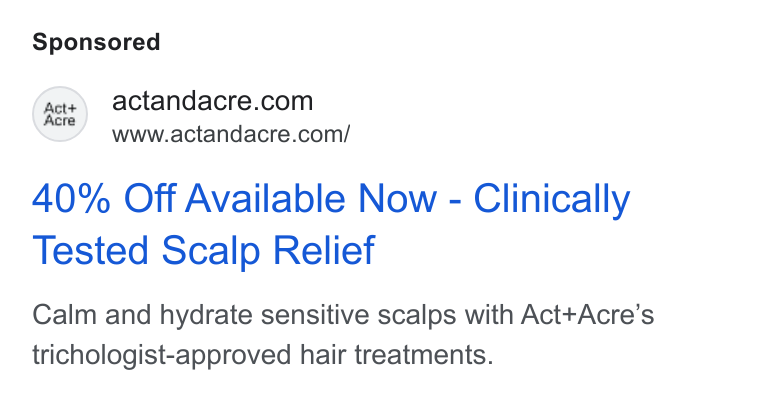
- Sponsored text at the top, followed by a small circular logo with "Act+ Acre" and the website "actandacre.com" and "www.actandacre.com/". Below this is the headline "40% Off Available Now - Clinically Tested Scalp Relief".
- CTA / offer
- 40% Off Available Now
- Audience
- Individuals with sensitive scalps or those seeking hair treatments approved by trichologists, indicated by "sensitive scalps" and "trichologist-approved hair treatments."
Why it works. Combines urgency (40% off now) with a credibility marker (clinically tested) so price-driven and skeptic buyers both get a reason to click.
Headline with a strong discount and benefit: "40% Off Available Now - Clinically Tested Scalp Relief" Put your discount percentage and your strongest credibility phrase in the same headline instead of separate lines.
product demo
- Hook
- Visual: A woman with blonde hair is brushing her hair near the roots with a green brush, while a black hairdryer is pointed at her hair. On-screen text: "brush down then up". Audio: Upbeat pop music with female vocals.
- Audience
- Individuals with blonde hair, likely women, seeking quick and easy hair volume solutions, indicated by the model's appearance and the product's function.
Why it works. Demonstrates a specific, copyable brush motion for volume, giving viewers a technique they can try after one viewing.
Clear, step-by-step instructions with on-screen text at 0:00, 0:01, and 0:03: "brush down then up", "5-8 seconds hot air", "3-5 seconds cold air". Break your product technique into a short, literal instruction like 'brush down then up' that viewers can copy without rewatching.
- Hook
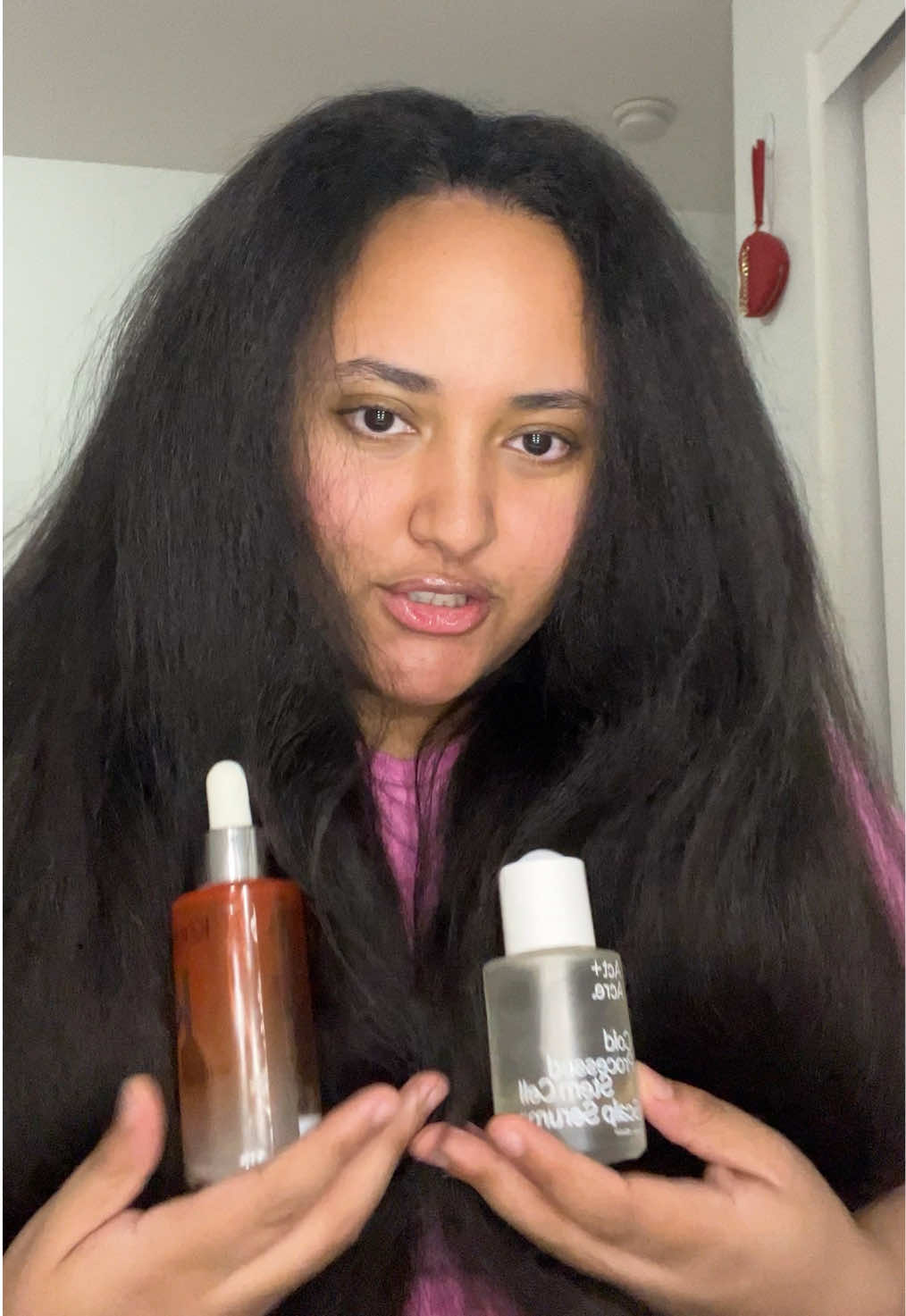
- Visual: A woman with long, dark, wavy hair is looking directly at the camera and speaking. On-screen text: "Top 2 hair serums to grow long and healthy hair". Audio: "If you want your hair to be as thick and as long as mine, I'm gonna put you on to the best two serums, okay?"
- Audience
- Individuals seeking solutions for hair growth, thickness, and scalp hydration, indicated by the creator's direct address and product benefits.
Why it works. Leads with her own hair as visible proof before naming any product, so the recommendation rides on a result the viewer can already judge.
Personal endorsement and bold claim at 0:00-0:07: "If you want your hair to be as thick and as long as mine, I'm gonna put you on to the best two serums, okay?" Open your UGC ad by pointing to your own visible result first, then pivot to naming the specific products that produced it.
- Reach
- 75 upvotes · 68 comments · r/finehair
A community is already discussing this in r/finehair. Show up there authentically and answer the thread before a competitor does.
Who amplifies them
Act+Acre runs a visible creator discount-code program on TikTok, with four named creators holding individual codes:
- Lauren (code laurenelam_): Multi-month hair-loss and regrowth journey, 656 and 219 engagements on recent update clips.
- kiers (code kierslynnwright): Hair growth and loss focus, 153 engagements.
- Kassia (code KASSIABARBO): Post-buzzcut regrowth series across seven weekly updates, 236 engagements per clip.
- @genbug (code GENBUG): Product feature with code callout, 249 engagements.
Two additional creators carry disclosed paid partnerships (#actandacrepartner) directed specifically to Sephora: Maria Villarreal (Daily Hydro Hydration System, 572 engagements) and Lauren (Sephora Spring Savings Event, 301 engagements). Trichologist creator Tiffany Hall posted an organic endorsement ("Love love love Act and Acre," 400 engagements); her professional credential mirrors Helen Reavey's positioning and adds a peer-validation layer that is distinct from standard affiliate content.
Helen Reavey maintains her own personal Instagram (@helenreavey, roughly 40,000 followers) as founder and trichologist, separate from the brand's @actandacre accounts. The distinction between brand content and creator content is clear in the evidence: creator posts carry personal discount codes or #actandacrepartner disclosures; the brand's @actandacre posts do not.
Reddit mentions are entirely user-driven with no visible brand participation. An organic thread in r/FemaleHairLoss described the Stem Cell Serum as "supposedly always sold out and is really good for regrowth," language Act+Acre later codified into a paid ad hook: "There's a reason why it's always sold out on Sephora and on our own website."
07 Organic & video
The organic content engine: the videos, creator posts, and community presence earning attention without paid spend.
Helen Reavey appears on camera in every YouTube how-to tutorial, identified each time as "Founder, trichologist, and celebrity hairstylist," and the format is consistent across 30-plus videos: step-by-step product application on a model or herself, 30-130 seconds, with the product name in the title. System tutorials outperform single-SKU demos at a factor of 10 to 100: "How To: Reset + Repair Clarifying System" (130,192 views) and "How To: Instant Scalp Relief Pro System" (118,413 views) both demonstrate 2-3 products used in sequence, though several single-product tutorials also exceed 5,000 views, including the Apple Stem Cell Serum (71,739 views) and the Microfiber Hair Towel (35,684 views). The pattern holds because system content answers both "how do I use it" and "what else do I need" in the same watch.
Read the full breakdown+3▾
On Instagram, the brand's average of roughly 113 engagements per post masks one significant outlier: a reel featuring Helen Reavey demonstrating an instant volume trick earned 304,363 engagements, more than 2,600 times the account average. The brand posted it from @actandacre with the caption "@helenreavey's back to break the internet with this instant volume trick," signaling that founder-face content belongs in paid amplification rotation, not just the organic feed.
On TikTok, creator-made content framing outcomes within a time horizon consistently outperforms feature-listing posts. Three standout clips by engagement: @bethologyyy's haircare haul ("My wallet is crying but my hair is happy because it's long and healthy," 4,043 engagements), Hasion Malik's 4C wash-day routine ("Wash Day with Act and Acre," 3,041 engagements), and Danielle Shugg's stem cell serum transformation ("Me and Act and Acre cold processed stem cell serum," 2,318 engagements). The personal journey update with a tagged brand mention is the format that consistently outperforms formal product reviews.
08 Affiliate & partners
How the brand turns creators and partners into a tracked, variable-cost acquisition channel, and how the program is structured.
A TikTok creator discount-code program is in operation, with four creators running named personal codes. The underlying affiliate platform is not identified in the public evidence.
Read the full breakdown+3▾
Two visible tiers exist: disclosed paid partnerships (#actandacrepartner, creator posts directed to Sephora or the DTC site) and code-based affiliate arrangements where creators post independently and offer a personal code for DTC site discounts. Both tiers are TikTok-native in the evidence.
No affiliate or referral program link is surfaced on the actandacre.com homepage. At their stage, with Sephora distribution and a managed creator roster, the creator-code structure is their affiliate layer rather than a traditional publisher-affiliate network. Publisher-affiliate and influencer network infrastructure are not visible in public data.
09 The playbook
The channels are not separate. They are one system where each stage feeds the next. Here is the read, then the plays to run tomorrow.
The inferred playbook
Act+Acre converts clinical authority into paid-search capture, seeding awareness through a creator-affiliate TikTok program and closing consideration-stage buyers through Sephora's physical retail presence.
The 12-week consumer study (86% new hair growth, 93% less shedding, 93% less fallout) is the central proof asset across every paid channel: Meta DCO, Meta video, Google text ads, and product landing pages all lead with the same three percentages. This is the "reason to believe" that separates a $84-$120 subscription treatment from mass-market alternatives, and it appears consistently regardless of format or platform.
Sephora distribution (235+ doors, expanding) serves two functions: it validates the brand for buyers who will not purchase DTC from an unknown name, and the "always sold out at Sephora" scarcity narrative flows from organic community chatter into creator content and paid ad copy as self-reinforcing social proof.
Dig deeper+2▾
TikTok creators running personal codes post hair-journey and transformation content that seeds branded awareness; that awareness converts downstream through organic search, which at 33.3% of traffic is the single largest acquisition channel and skews heavily branded, though the non-branded dermastamp and hard-water rankings sit inside that same organic total. Social organic at 0.1% of visits confirms that creators are not driving direct link traffic but are generating search demand that the brand then captures on-site.
Social organic is essentially zero despite a 133,492-follower Instagram account. The current model requires sustained paid-media spend to hold the top of funnel, against a crowded competitive field. Annual revenue across all channels is estimated in the range of $10 to $20 million based on Sephora distribution scale (235-plus doors), product pricing ($28 to $98 per SKU, subscription at approximately 30% off list), and team size; this figure is not confirmed in public disclosures. Free-to-paid conversion rate, CAC, and churn are not visible in public data. ---
Target problem-function search terms with direct product pages, not blog content
The proofAct+Acre earns organic search traffic across five product pages with no editorial blog layer in their top results. Their dermastamp page ranks #2 for "derma stamp for hair growth" and their clarifying shampoo page ranks #4 for "hard water shampoo," both product pages optimized for the problem the SKU solves rather than the category it belongs to.
The adaptationFor each product in your line, identify the 2-3 high-intent search terms that name the problem rather than the product type (e.g., "hard water shampoo" instead of "clarifying shampoo," "derma stamp for hair growth" instead of "scalp roller"). Start by checking whether your existing product page titles, H1 headings, and meta descriptions use the problem-function phrasing or the category name, then update the ones that default to category. The mechanism: problem-function terms carry high purchase intent and face less competitive pressure than category head terms because most brands optimize for what the product is rather than what problem it solves.
Film system tutorials instead of single-product demos
The proofAct+Acre's two highest-viewed YouTube uploads are multi-product system tutorials, "Reset + Repair Clarifying System" (130,192 views) and "Instant Scalp Relief Pro System" (118,413 views), each pairing 2-3 SKUs as a sequential routine. These outperform single-product how-tos on the same channel by a factor of 10 to 100, with Helen Reavey demonstrating each step on camera in the same consistent format.
The adaptationIf you sell complementary products, film a 2-3 minute tutorial pairing two or three SKUs as a routine rather than producing individual product demos. Start by identifying which two products in your catalog are most frequently bought together, then script a tutorial that states the problem in the first 15 seconds and shows the full routine in sequence. The mechanism: system content answers "how do I use it" and "what else do I need" simultaneously, which lifts average order value by showing the full routine and removes the "what do I pair this with" objection before the viewer has to ask it.
Brief creators on a time-horizon outcome, not a product feature
The proofAct+Acre's top-engaging TikTok creator posts frame results within a specific time window: Hasion Malik's wash-day routine (3,041 engagements), Danielle Shugg's serum transformation (2,318 engagements), and Kassia's seven-week post-buzzcut regrowth series (236 engagements per update) all lead with when the viewer can expect to see a result. Creator posts that listed product features without a time horizon earned 134-175 engagements.
The adaptationWhen briefing creators, specify the outcome claim and the time window matching your product's result cycle, and ask for a two-post "start plus update" format instead of a single review. Start by rewriting your creator brief to include a required structure: Post 1 on Day 0 (intro and baseline), Post 2 on Day X (results), where X corresponds to the number of days your product typically shows results. The mechanism: a time-horizon outcome gives the creator a narrative arc and gives their audience a reason to follow for the update, compounding reach across two posts for the cost of one creator relationship.
Name the stockist in paid ad copy to borrow their credibility
The proofAct+Acre's Meta ads reference Sephora directly by name ("always sold out on Sephora and on our own website"), and paid partnership creator posts (#actandacrepartner) direct buyers specifically to Sephora rather than the DTC site. Naming the retail partner transfers the retailer's curation authority to the product claim in a single phrase.
The adaptationIf your product sells through any recognized retailer, test a paid ad variant that includes "available at [Retailer]" in the headline or copy body alongside your existing creative. Start with one image or video ad where the stockist name appears in the first line of copy. The mechanism: a named stockist functions as an implied third-party endorsement because the buyer already trusts the retailer's standards, and that trust transfers in a phrase without requiring additional persuasion copy.
Mine organic community language for paid ad hooks
The proofThe scarcity phrase "always sold out on Sephora and on our own website" that appears in Act+Acre's Meta proven winner UGC ad traces to an organic Reddit thread in r/FemaleHairLoss from 2022, where a user wrote "supposedly always sold out and is really good for regrowth." The brand later turned that community-originated phrase into a spoken UGC hook, with a creator delivering it directly to camera while holding the product.
The adaptationSearch your brand name on Reddit, your top review platform, and TikTok comments for phrases that describe your product's best attribute in a customer's own unprompted words. When a phrase appears across multiple threads independently, test it verbatim as a UGC ad hook, a creator saying the phrase on camera while holding the product. First step: run a Reddit site search for your brand and hero product name, then highlight any top-upvoted comments that name an unexpected benefit or a social proof element in plain language. The mechanism: customer-sourced language removes the brand's self-interest from the claim and has already been validated by real buyers before you spend on media. Caveat: this play only works when the underlying claim (such as genuine sell-outs) is true; manufactured scarcity in a credibility-dependent health category damages trust permanently when discovered and cannot be run repeatedly.
You just read how Act+Acre does it. Tomorrow it is someone else.
Every morning we take one company that is actually growing and break down where its customers come from: the ads still running after a year, the channel doing the real work, and the play you can run this week.
Systemaic · directional intelligence. Traffic, spend, and reach figures are SimilarWeb-style estimates and qualitative reads of public data, not audited numbers. Built on real public receipts.
// teardowns with a similar GTM motion
sources & receipts (2)
Live ad libraries: meta ad library · google ad library
Traffic, spend, and revenue figures are estimates as noted in the report; the links above are the primary public artifacts.