- 01Post your real number as the headline
- 02Rank on comparisons you don't compete in
- 03Turn support answers into indexed docs pages
- 04Pay affiliates for life, not a bounty
01 Snapshot
The one-glance read on who they are and how they grow. Each point is verifiable from the receipts above.
An embeddable survey and feedback widget for Shopify and other e-commerce/SaaS merchants, now at $125K MRR as of June 2026.
Founder-led and marketplace-anchored: one person, Jason Zigelbaum, still runs the growth loop through the Shopify App Store, Hacker News, and an affiliate program.
$125K MRR as of June 2026 (up from ~$86K MRR / $1.03M ARR entering the year), ~110,000 monthly visits, and 38 combined active Google + LinkedIn ads as of 2026-07-16.
"I spent 2 years building a feedback tool with only the features I need," his framing for a 2026-02-06 Show HN post (source).
Google's newest creatives as of 2026-07-10 test blunt CTAs like "Get Started For Free" and a standalone "Survey Tool For Agencies" pitch, five days old.
Growth compounds through Shopify App Store reviews, a 50%-lifetime affiliate program, and six years of the founder narrating exact revenue numbers on Hacker News, not one launch spike.
02 How it unfolded
The order the channels came online. Sequence is strategy: what they did first, and what they layered on once demand existed.
03 Traffic & channel mix
Estimated demand, the channel split behind it, and the keywords and referrers doing the work. Directional modeling, not audited analytics.
Traffic sources
Top search keywords
| Keyword | Volume | Weight | CPC |
|---|---|---|---|
| zigpoll | 7.5k | $8.69 | |
| what are social sharing incentives | 240 | - | |
| hotel customer feedback form name ideas | 180 | - | |
| zig poll | 180 | - | |
| ideal target market for streetwear industry | 170 | - |
Top referring sites
Closest competitors by audience
Zigpoll draws an estimated ~110,000 monthly visits, down 20.3% over the trailing three months. Direct traffic dominates at 59%, an unusually high share for a B2B tool, plausibly reflecting merchants logging back into the app and docs dashboards rather than fresh brand discovery. Email sits at 11.1%, worth noting because Zigpoll's own paid tiers ship customer-facing survey emails (up to 2,500/mo on Standard), so some of that share may be its own product's email loop looping traffic back. Search Organic is 9.3%. The remaining six channels, referrals, display ads, organic and paid social, paid search, and an emerging "Gen AI" referral category (traffic from AI chatbots and answer engines), together total roughly 21%.
The most telling ranked terms: the branded "zigpoll" (7,540 searches/month) dwarfs everything else, while an oddly specific long-tail term, "hotel customer feedback form name ideas" (180/month), shows the content engine capturing intent nowhere near its core Shopify buyer. Top referrers include orderdesk.me, likely an order-management integration partner rather than a media mention, and chiarasfood.nl, which reads as an actual merchant customer linking back rather than a press hit. Named competitors span formbricks.com, an open-source survey builder with direct feature overlap, and nethunt.com, a CRM that looks more like adjacent tooling than a head-to-head rival.
04 Organic content
The specific pages earning their organic search traffic, and the pattern behind why they rank. Adapt the format, not the topic.
The ranking pages split between head-to-head comparison posts ("Formstack vs Typeform vs Google Forms," "Mouseflow vs Fullstory") and hyper-specific, almost forum-question-shaped long-tail pages (an affiliate-compliance guide, a "how to visually emphasize our money-back guarantee" post). That pattern, comparison pages against tools it doesn't directly compete with plus answers to oddly precise merchant questions, is a classic low-competition long-tail wedge: each page targets a query with little existing competition rather than fighting for "survey tool" head-on. The product's own documentation site also earns organic visits, meaning support content doubles as top-of-funnel material rather than sitting behind a login.
Top pages by organic traffic
05 Channel map
Not traffic share. How much weight the growth system actually puts on each channel, with a one-line read on the role it plays.
What drove growth
06 The motions doing the work
For founder-led SaaS the breakdown shifts from ads to traction: where the first users came from, how the founder grows it in the open, and the compounding organic surface.
Zigpoll never had one breakout launch moment; it had six years of the same founder relaunching the same product on Hacker News until the framing caught up with the market.
Jason Zigelbaum posted 12 separate Show HN attempts between 2019-09-30 and 2026-02-06, most drawing single-digit points, alongside non-launch devlog posts under the same account. No individual post broke past 17 points, but the persistence itself, not any one hit, is the pattern worth copying.
before the Shopify pivot, he beta-tested the product as a generic "fun and flexible polling widget" on r/alphaandbetausers and r/roastmystartup in April-May 2019, scoring 3-4 points each with a handful of comments.
Dig deeper+2▾
HN titles trace the repositioning over time, from a generic "embeddable polling widget" (2019), to "AI insights" tied to the OpenAI wave (2023), to "a turn-key survey platform for SaaS and eCommerce" (2024), to the 2026 framing quoted above: two years spent stripping a bloated category down to only needed features.
revenue-numbered posts like "Zero to Sixty Thousand Eight Hundred and Ninety" were submitted twice (2024-08-03 and 2024-08-26), the second version reaching 10 points and 3 comments, functioning as a relaunch of the same story with a fresher number attached.
Jason Zigelbaum's build-in-public channel is effectively Hacker News, used like a personal devlog under his own account for six years rather than a dedicated X or LinkedIn following.
the recurring "Adventures of Being a Solopreneur" series and exact-number milestone posts (the "Sixty Thousand Eight Hundred and Ninety" MRR post) show a consistent habit of naming the specific dollar figure rather than a vague "we grew" update.
third-party clips from the Conzia Podcast (surfaced via Instagram reels from conzia_gmbh) have him describing solo-building without funding or a cofounder, using Shopify reviews and app installs as his personal north-star metric; a separate LinkedIn ad repurposes a "SaaS Hub Podcast, Shopify App Founders Edition" episode built around the line "one person could build a $100K/month Shopify app alone."
Dig deeper+1▾
he cross-posted the same feedback-tool pitch to r/FutureTechFinds in April 2025, but it drew a score of 1, confirming his audience lives on Hacker News and podcasts, not Reddit.
The content system pairs adjacent-tool comparison pages with a public docs site, and layers a defensive paid-search presence and a lifetime-revenue affiliate program on top.
the "Formstack vs Typeform vs Google Forms" and "Mouseflow vs Fullstory" pages covered above target searches for tools Zigpoll doesn't compete with head-on, landing on comparison intent instead of fighting for its own category term.
docs.zigpoll.com pulling organic visits means the documentation itself is public, indexable top-of-funnel content rather than gated support material.
Dig deeper+2▾
the site links to a 50%-lifetime affiliate program at zigpoll.com/affiliates, the clearest structural distribution asset in the whole motion since it pays out indefinitely without added founder effort.
the Google library shows 67 total ads, 23 active as of 2026-07-16, the longest-running active one ~580 days old, run through an advertiser account named Argonautic Labs LLC rather than Zigpoll itself, suggesting an agency or holding entity manages the paid program. The recurring headline "Zigpoll is So Much Better, Switch To Zigpoll" is a competitive-displacement bid, not broad demand generation. The strongest LinkedIn creative is an image ad reading "$100K Month" over a photo of two smiling men and a pile of money, a bold-claim revenue flex paired with a separate customer-proof ad naming Manucurist's 2.5x response-rate lift.
07 Paid ads
This founder-led SaaS also runs paid acquisition. Here are the live ads doing the work, each with the X-ray and a play you can adapt.
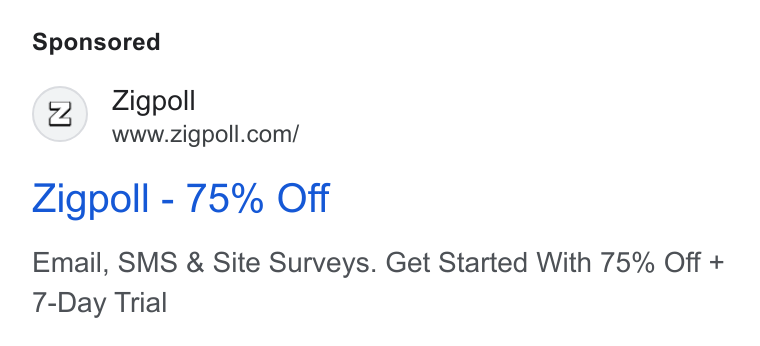
- Running
- 228 days (longevity = it's converting)
- Hook
- Sponsored Z Zigpoll www.zigpoll.com/ Zigpoll - 75% Off
- CTA / offer
- Get Started With 75% Off + 7-Day Trial
- Audience
- Businesses or individuals looking for survey tools, indicated by "Email, SMS & Site Surveys."
Why it works. Leads with a specific large discount figure, which converts price-sensitive Shopify merchants shopping for survey apps on price alone.
Prominent discount in headline: "Zigpoll - 75% Off" Put your largest specific discount percentage directly in the headline instead of a generic 'sale' word.
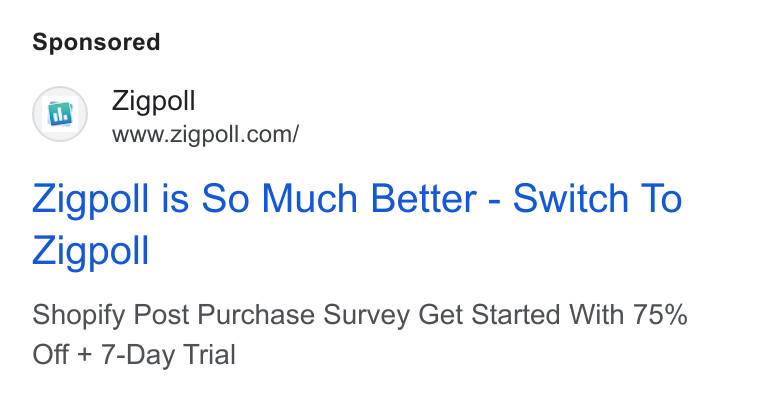
- Running
- 215 days (longevity = it's converting)
- Hook
- "Sponsored" text at the top, followed by a small icon with a bar chart and the text "Zigpoll" and "www.zigpoll.com/". Below this is the headline "Zigpoll is So Much Better - Switch To Zigpoll".
- CTA / offer
- Get Started With 75% Off + 7-Day Trial
- Audience
- Shopify store owners or e-commerce businesses looking for post-purchase survey solutions, indicated by "Shopify Post Purchase Survey".
Why it works. Adds a direct switch command to the superiority claim, converting browsers who are already unhappy with their current survey tool.
Headline with a direct comparative claim: "Zigpoll is So Much Better - Switch To Zigpoll". Follow your comparison claim with a one-word action verb like 'Switch' so curiosity converts into an immediate next step.
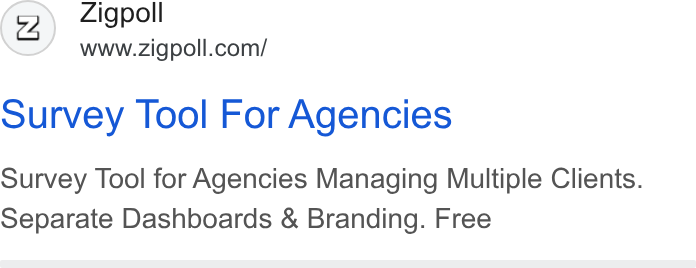
- Running
- 154 days (longevity = it's converting)
- Hook
- Visual: A small circular icon with a stylized 'Z' inside, next to the text "Zigpoll" and "www.zigpoll.com/". Below this, a large blue headline reads "Survey Tool For Agencies".
- CTA / offer
- Free
- Audience
- The phrase "Survey Tool For Agencies" and "Managing Multiple Clients" directly addresses agencies or businesses with multiple clients.
Why it works. Names the specific professional buyer, agencies, directly in the headline so only that niche audience self-selects into the click.
Headline targeting: The ad leads with "Survey Tool For Agencies" as the primary headline. Put your specific buyer type, not a broad category, directly in your ad headline to filter for the right audience.
Show 2 more ads
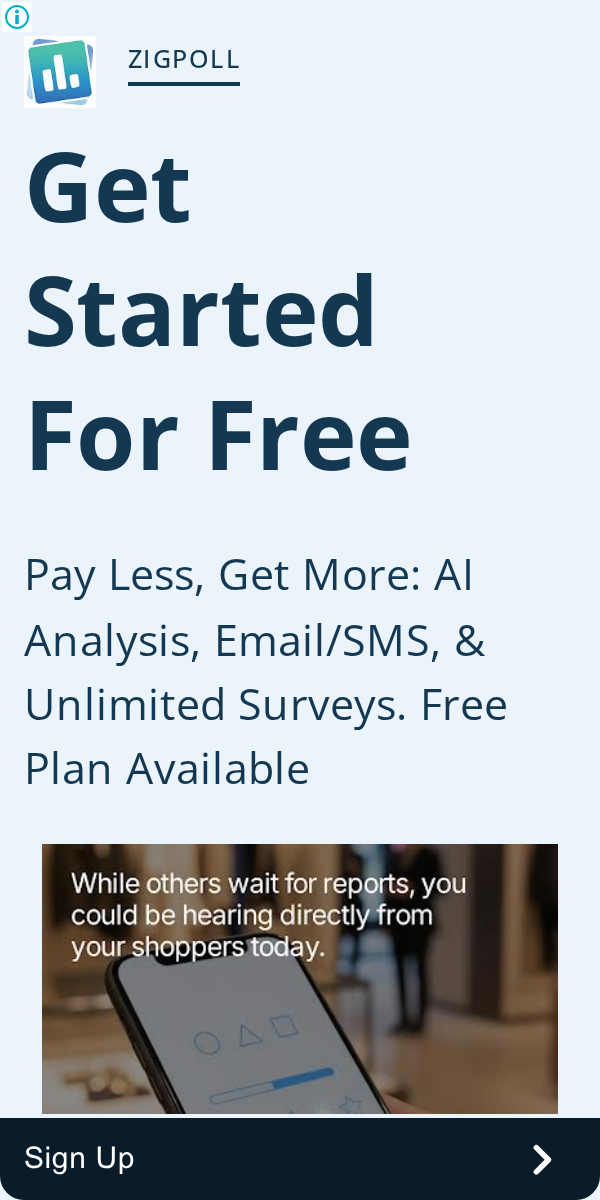
- Running
- 133 days (longevity = it's converting)
- Hook
- Visual: A light blue background with a logo featuring a stylized bar chart and the text "ZIGPOLL". Below this, in large dark blue font, are the words "Get Started For Free".
- CTA / offer
- Sign Up
- Audience
- Businesses or individuals seeking survey tools with advanced features (AI Analysis, Email/SMS, Unlimited Surveys) and a free entry point, indicated by "Pay Less, Get More" and "Free Plan Available".
Why it works. Leads with a free entry point instead of a feature list, lowering the barrier for merchants who haven't decided if they need a survey tool yet.
Prominent value proposition: The headline "Get Started For Free" is displayed in large, dark blue font at the top of the ad. Test a headline that states only your free starting point, with no feature description competing for attention.
- Running
- 120 days (longevity = it's converting)
- Hook
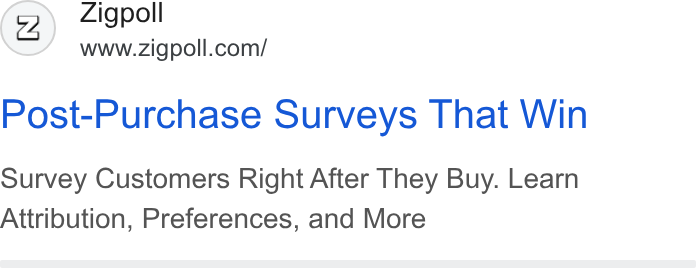
- Post-Purchase Surveys That Win
- Audience
- Businesses or e-commerce store owners looking to improve customer understanding and sales attribution, indicated by 'Post-Purchase Surveys' and 'Learn Attribution, Preferences, and More'.
Why it works. Names a specific survey moment, post-purchase, and pairs it with an outcome word, which is more concrete than a generic feedback pitch.
Headline with a strong, benefit-oriented claim: 'Post-Purchase Surveys That Win' Name the exact moment in your customer's journey your product targets, paired with the outcome it produces.
08 The playbook
The channels are not separate. They are one system where each stage feeds the next. Here is the read, then the plays to run tomorrow.
The inferred playbook
The loop starts on the Shopify App Store and Hacker News, converts through a freemium ladder, and compounds through reviews and the affiliate program rather than any single spike.
the Shopify App Store listing, reportedly 500+ reviews, plus the Hacker News devlog and defensive Google/LinkedIn ads drive awareness; branded search for "zigpoll" already pulls 7,540 monthly searches, well ahead of any generic acquisition term in the keyword data.
a $0 Lite plan (100 responses/mo) funnels into $29 Standard, $97 Advanced (which adds API and MCP access, Model Context Protocol, for AI-agent integrations), and $194 Ultimate tiers, letting merchants prove value on real traffic before paying.
Dig deeper+3▾
the 50%-lifetime affiliate program and Shopify review volume both grow without added founder hours, the closest thing to a self-sustaining flywheel in the motion.
there's no visible personal X or LinkedIn following for the founder, and the whole loop still runs through one person with no public hiring signal, capping how many channels can be worked at once.
the Lite-to-paid conversion rate, what share of the $125K MRR runs through the affiliate program specifically, and the Shopify install-to-paid attach rate behind the reported 3,503 installs.
Post your real number as the headline
The proofjason_zig's Hacker News devlog posts named the exact MRR in the title itself ("Zero to Sixty Thousand Eight Hundred and Ninety"), scoring higher than vaguer launch posts.
The adaptationFind the forum or community where your actual buyers already lurk, then post your specific, oddly precise number, not "we hit a milestone" but the literal digits, as the post title itself. Repeat the same move every few months as the number changes; the specificity is what earns the click over a generic update.
Cost: $0 · Time to signal: days · Works pre-PMF: yes, provided there's a real number worth naming.
Rank on comparisons you don't compete in
The proofZigpoll's "Formstack vs Typeform vs Google Forms" and "Mouseflow vs Fullstory" pages rank for adjacent-tool searches rather than its own category term.
The adaptationWrite an honest "X vs Y" page comparing two tools slightly outside your own category, ones your buyer actually researches, not your direct competitors, and publish it matching that exact comparison-query pattern in the title and headers. Start with the tool pairing your own support tickets mention most often.
Cost: $0 · Time to signal: weeks · Works pre-PMF: yes.
Turn support answers into indexed docs pages
The proofdocs.zigpoll.com itself earns organic visits, meaning the documentation functions as top-of-funnel content, not a gated support resource.
The adaptationPull your five most-asked support questions and publish each as its own public, indexable docs page titled in the customer's literal phrasing, not internal jargon. Link them from your homepage footer so search engines and future customers both find them.
Cost: $0 · Time to signal: weeks · Works pre-PMF: yes.
Pay affiliates for life, not a bounty
The proofZigpoll's affiliate program, linked from its own site, pays a 50% lifetime revenue share rather than a one-time bounty (expanded above as the compounding layer).
The adaptationSet up a lifetime-revenue-share affiliate program, even a generous one that costs real margin, and recruit your first affiliates directly from customers already talking about your product unprompted. First step: message the three most enthusiastic users you have and offer them the exact same lifetime terms before opening it publicly.
Cost: under $500 (affiliate-tracking tool subscription) · Time to signal: months · Works pre-PMF: conditional, you need a few genuinely happy users willing to refer before this pays off.
Repurpose a podcast appearance as paid creative
The proofa LinkedIn ad turns a "SaaS Hub Podcast" appearance into paid creative built around "one person could build a $100K/month Shopify app alone," and third-party podcast clips get reused as organic content elsewhere.
The adaptationPitch two or three niche podcasts that cover your exact tool category, then cut the strongest 15-second quote from each appearance into both a paid ad and an organic post, using the same specific-number hook (your revenue, your users, your timeline) that made the podcast worth booking in the first place.
Cost: $0 to pitch, under $500 if you pay for editing · Time to signal: weeks · Works pre-PMF: conditional, you need a specific, bookable story, not just "we exist." Not transferable at an earlier stage: the LinkedIn paid push and the named customer case study (Manucurist) assumes a base of Shopify App Store reviews and paying customers already in hand. A pre-revenue reader should build the Hacker News devlog, comparison-page, and docs plays first, then layer paid and affiliate motions on top once there's a real customer story to defend.
You just read how Zigpoll does it. Tomorrow it is someone else.
Every morning we take one company that is actually growing and break down where its customers come from: the ads still running after a year, the channel doing the real work, and the play you can run this week.
Systemaic · directional intelligence. Traffic, spend, and reach figures are SimilarWeb-style estimates and qualitative reads of public data, not audited numbers. Built on real public receipts.
// teardowns with a similar GTM motion
sources & receipts (16)
Live ad libraries: linkedin ad library · google ad library
Launch archives: Hacker News: Use the CSS zoom property to make responsive web development · Hacker News: Show HN: My Solo-Project, Zigpoll · Hacker News: Adventures of being a solopreneur. (Part 1) · Hacker News: Zero to Sixty Thousand Eight Hundred and Ninety · Hacker News: Don't Trust Your Ad Vendors. Optimize Your Ad Spending with · Hacker News: Maxing Out Concurrent WebSocket Connections on Node.js
Researched facts: Founding date and founder: Zigpoll was founded by Jason Zigelbaum in April 2019 (per Crunc · Funding status: Bootstrapped, $0 raised in outside funding — no VC, no angel investment, n · Earlier revenue snapshot (conflicts with 2026 figures): 2023 revenue reported as $30.4K AR · Customer base claim: 'Trusted by 20,000+ stores including Crocs, TOMS, Steve Madden & lulu · Shopify App Store presence: Zigpoll's Shopify listing shows 500+ five-star reviews per the · Pricing structure: Free 'Lite' plan (unlimited surveys, up to 100 responses/month) plus pa · Notable enterprise customers/brand claim: Described (via founder-featured podcast) as 'the · Founder's prior venture: Jason Zigelbaum previously founded JQBX (a collaborative music-li
Traffic, spend, and revenue figures are estimates as noted in the report; the links above are the primary public artifacts.