- 01Publish an annual numbers-dense retrospective
- 02Turn an infrastructure partner into a default-on channel
- 03Give your best customers a referral code before building a program
- 04Defend your brand name in paid search once people start typing it
01 Snapshot
The one-glance read on who they are and how they grow. Each point is verifiable from the receipts above.
Per-site WordPress maintenance software (backups, updates, monitoring, security, client reporting) at €1.99/site/month, growing to $110K MRR, +67% YoY, as of the most recent year-end review.
Founder-led and build-in-public, now layered with embedded distribution through a hosting-partner bundling deal.
~109,000 monthly visits (+14.2% over the last 3 months), the founder's X account at 1,135 followers and 1,244 posts as of 2026-07-30, and 5,000+ professional users as of July 2026.
"In 2024, WP Umbrella grew by 152%! 39,969 active installs, $60k MRR... word of mouth is our main growth driver," co-founder and CEO Aurelio Volle posted in a numbers-dense annual review.
Growth increasingly runs through other companies' surfaces, a founder revenue-retrospective habit that manufactures word of mouth, now compounding through a hosting provider that bundles the tool into every new site by default.
02 How it unfolded
The order the channels came online. Sequence is strategy: what they did first, and what they layered on once demand existed.
03 Traffic & channel mix
Estimated demand, the channel split behind it, and the keywords and referrers doing the work. Directional modeling, not audited analytics.
WP Umbrella pulls an estimated ~109,000 monthly visits, up 14.2% over the last 3 months. The pull did not return a channel-by-channel breakdown, bid keywords, or a referrer/competitor list for this domain, so no mix percentages or named referrers are stated here. The organic-search read that is available lives in the page-level data below.
04 Organic content
The specific pages earning their organic search traffic, and the pattern behind why they rank. Adapt the format, not the topic.
Their organic footprint is carried almost entirely by one page: the German-language homepage (/de/), which the pull credits with essentially all of their measured organic-search visits and a #1 ranking for the short query "wp." The two blog posts in the data, a WordPress REST API guide and a website-design questionnaire template, draw negligible traffic and rank far down the results (#10 and #25) for their target terms. The pattern is a localized product page outperforming content marketing, not a built-out library of comparison or how-to posts, which tracks with a company that describes its growth as driven by word of mouth rather than SEO.
Top pages by organic traffic
05 Channel map
Not traffic share. How much weight the growth system actually puts on each channel, with a one-line read on the role it plays.
What drove growth
06 The motions doing the work
For founder-led SaaS the breakdown shifts from ads to traction: where the first users came from, how the founder grows it in the open, and the compounding organic surface.
There was no splashy launch-day spike; traction built as a multi-year, founder-narrated climb rather than a single breakthrough moment.
Starting from a modest MRR after going full-time, the founder's own tweets track the arc in public: an MRR double to $15,000 by mid-2023, then $60,000 MRR and 152% growth for 2024 (39,969 active installs, 5.7M backups created), each posted as a dated milestone rather than a one-time launch.
Aurelio Volle publicly rallied support for a Product Hunt appearance in June 2023, framing it as a shot at Product of the Day, but no launch-day upvote or ranking data is available to confirm the outcome.
Dig deeper+2▾
WordCamp Europe shows up across multiple years of the founder's posts (2023, 2025), a recurring in-person touchpoint with the exact WordPress freelancer and agency audience the product targets.
The clearest step-change in the evidence is a June 2026 deal with Rocket.net (a managed WordPress hosting provider): every site hosted there now ships with WP Umbrella included by default, turning a hosting relationship into a standing acquisition channel rather than a one-time win.
The company's own description of its growth as "almost entirely word of mouth" is backed by a visible pattern: the founder treats his personal X feed as the primary growth channel, not the brand account.
Aurelio Volle, co-founder and CEO (his co-founder, Thomas Deneulin, is CTO), posts detailed operating numbers, not just revenue, combining MRR, install counts, and product-usage stats in the same post, as in the 152%-growth review covered above.
Posts land irregularly around real events (an MRR doubling, a security add-on launch, a partnership signing) rather than on a fixed schedule, each one framed as a "here's what happened" update rather than a promotional push.
Dig deeper+2▾
One post cites a named agency owner, Kyle Van Deusen of The Admin Bar (a WordPress maintenance agency), moving his whole agency to WP Umbrella after testing rivals, a specific switch story rather than a generic testimonial.
A 2024 post seeking a CMO at a $50k-57k package shows the founder recognized his personal feed alone couldn't carry acquisition indefinitely, though no evidence shows the role's outcome.
Organic search plays a minor supporting role here; the assets they've actually built out are partnership and referral levers, not a content library.
The dominance of a single translated homepage over their blog posts (the /de/ page covered above) confirms that scaled how-to or comparison content isn't the lever being pulled.
The site embeds FirstPromoter, an affiliate and referral-tracking platform, implying an active program that lets agencies and consultants who already recommend the tool earn a cut of referrals, though its public terms and payout structure aren't in evidence.
Dig deeper+2▾
The "Agency Talks" video series pairs the brand with Patchstack's CEO to unpack a scary, technical topic (one clip cites over 1,600 WordPress vulnerabilities reported in a single month), lending credibility in the security niche without WP Umbrella having to build that authority alone.
Two Google text ads ran historically, one for 76 days and one for 8, both bidding on brand-adjacent terms ("Automates Your Workflow To Save Time...") and a plain sponsored brand listing, but 0 of 2 are still active as of 2026-07-30, so paid search is not a live channel for them.
07 Paid ads
This founder-led SaaS also runs paid acquisition. Here are the live ads doing the work, each with the X-ray and a play you can adapt.

- Running
- 76 days (longevity = it's converting)
- Hook
- WP Umbrella - Automates Your Workflow To Save Time And Prove Your Work Value To Clients!
- Audience
- WordPress professionals or agencies, indicated by 'WP Umbrella', 'Manage WP Sites', and 'Automates Your Workflow To Save Time And Prove Your Work Value To Clients!'
Why it works. Directly address the core pain points of WordPress professionals (time and value proof) with a clear solution to attract relevant users.
Headline clearly states the product name and its primary function: "WP Umbrella: Manage WP Sites". Ensure your ad's main headline explicitly names your product and its single most important function, making it instantly understandable to your target audience.
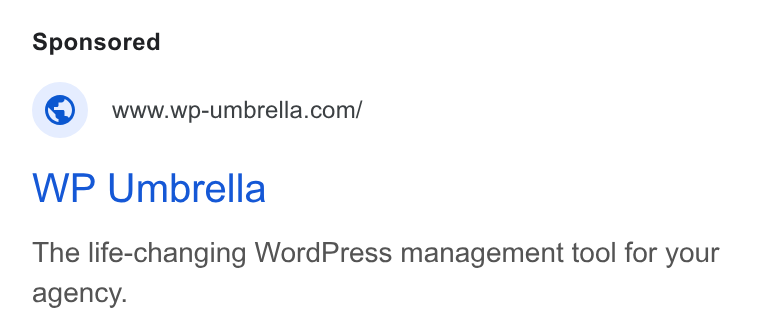
- Running
- 8 days (new — still being tested)
- Hook
- Sponsored www.wp-umbrella.com/ WP Umbrella
- Audience
- The phrase "WordPress management tool for your agency" directly targets agencies that use WordPress.
Why it works. Directly inform potential agency clients about a WordPress management tool to generate interest and website visits.
Clearly state the product's purpose: "The life-changing WordPress management tool for your agency." In your ad copy, clearly articulate the primary, most impactful benefit of your product for your target audience within the first two lines of text.
08 The playbook
The channels are not separate. They are one system where each stage feeds the next. Here is the read, then the plays to run tomorrow.
The inferred playbook
The loop runs on trust built in public and increasingly on other companies' distribution surfaces, not on paid acquisition or content marketing.
The founder's X feed and recurring WordCamp presence generate the initial awareness, not search or ads.
Per-site pricing with a 14-day no-card trial lets a freelancer test the tool on one or two client sites before rolling it across a whole portfolio, a low-friction wedge for a usage-based product.
Dig deeper+3▾
The Rocket.net hosting bundle and the FirstPromoter affiliate layer both convert other companies' existing relationships into a standing acquisition surface, a structurally different growth source than content or ads.
The organic-content library is thin relative to the traffic they already get, and the WordPress.org and Trustpilot complaints about incomplete backups and resetting settings are a direct risk to a maintenance tool whose entire referral engine depends on being trusted with client sites.
free-trial-to-paid conversion rate, the average number of sites per paying account (the core expansion metric for a per-site pricing model), and how much of new signup volume the FirstPromoter affiliate program actually drives.
Publish an annual numbers-dense retrospective
The proofThe founder's review posts pair MRR with operating metrics like install counts and backups created in one post, the mechanic behind the 152%-growth update covered above.
The adaptationWrite your own annual post that pairs your revenue figure with two or three operating numbers specific to your product (support tickets closed, units shipped, uptime, whatever proves the business is real), and publish it on your personal account rather than your company page. Start by pulling your own four hardest numbers from the last 12 months and drafting the post before touching design or promotion.
Cost: $0 · Time to signal: days · Works pre-PMF: yes, provided you have at least one real number worth sharing.
Turn an infrastructure partner into a default-on channel
The proofRocket.net now bundles WP Umbrella into every new hosted site by default, the distribution inflection covered above.
The adaptationIdentify one platform or infrastructure provider whose customers already overlap with yours and pitch a default-bundle or co-marketing integration, using your existing usage data as proof of overlap rather than a cold pitch. Start by listing the three platforms your current customers already pay for, then send one partnerships contact a one-page proposal showing the overlap.
Cost: $0 for the pitch, dedicated budget or hire once a deal needs building · Time to signal: months · Works pre-PMF: conditional, you need enough retained usage to make the overlap argument credible.
Give your best customers a referral code before building a program
The proofThe site runs FirstPromoter, an affiliate/referral platform, the referral layer covered above.
The adaptationBefore building formal affiliate infrastructure, email your five most vocal happy customers a personal referral code and a specific commission or discount, the same recruit-your-advocates mechanic FirstPromoter formalizes at scale. Start by naming those five customers and sending each one a direct, non-templated ask.
Cost: $0 · Time to signal: weeks · Works pre-PMF: yes, provided you already have a handful of genuinely satisfied users.
Defend your brand name in paid search once people start typing it
The proofTwo Google text ads bid on WP Umbrella's own brand terms for 76 and 8 days respectively, though neither is active as of 2026-07-30, a lapsed tactic worth reviving rather than a current one for them.
The adaptationOnce word of mouth starts sending people to search your company name, run a small exact-match campaign on your own brand terms and common misspellings so a competitor or directory can't intercept that branded intent. Start with a $5-10/day budget on 3-5 exact-match brand keywords.
Cost: under $500 · Time to signal: days · Works pre-PMF: conditional, only worth doing once branded search volume exists.
Co-host a recurring series with an adjacent authority on a feared topic
The proofThe "Agency Talks" video series pairs the brand with Patchstack's CEO on WordPress security, using a stat like the 1,600-vulnerabilities-in-a-month figure covered above to make the topic urgent.
The adaptationPartner with a recognized expert or vendor adjacent to your category and co-host one recorded session on the scariest unsolved problem in your niche, then cut it into short clips each side promotes to their own audience. Start by pitching one partner-adjacent expert a single 30-minute recorded conversation, not a series commitment.
Cost: $0 to under $500 for recording tools · Time to signal: weeks · Works pre-PMF: conditional, you need one credible partner willing to associate before an audience exists. Not transferable at an earlier stage: the hosting-partner bundling deal and the co-branded security series both required an existing track record and negotiating leverage that a pre-revenue founder won't have; readers earlier in their journey should lean on the retrospective-post and direct-referral plays first and treat the partnership-level plays as a later-stage goal to build toward.
You just read how WP Umbrella does it. Tomorrow it is someone else.
Every morning we take one company that is actually growing and break down where its customers come from: the ads still running after a year, the channel doing the real work, and the play you can run this week.
Systemaic · directional intelligence. Traffic, spend, and reach figures are SimilarWeb-style estimates and qualitative reads of public data, not audited numbers. Built on real public receipts.
// teardowns with a similar GTM motion
sources & receipts (8)
Live ad libraries: google ad library
Launch archives: Hacker News: WP Umbrella – Uptime Monitoring for WordPress
Community threads: WordPress.org plugin reviews: User's WordPress.org plugin review describes reliability bug · Trustpilot: 1-star Trustpilot review says WP Umbrella's marketed one-click restore claim d · G2: G2 reviewer switching from ManageWP describes the interface as a big improvement, call · AppSumo: AppSumo buyer likes the tool overall but flags the lack of one-click admin login · G2: G2 reviewer wants a free monitoring-only tier for sites without an active care plan, n · Capterra: Capterra reviewer values the maturing product and its client-facing status repor
Traffic, spend, and revenue figures are estimates as noted in the report; the links above are the primary public artifacts.