- 01Build all tutorial content for one hyper-specific use case, not the product category
- 02Train affiliates to produce tutorials, not just post referral links
- 03Open your Meta creative with a physical before-state, not a feature claim
- 04Post revenue milestones in the unit most viscerally specific to your audience
01 Snapshot
The one-glance read on who they are and how they grow. Each point is verifiable from the receipts above.
An AI video generator that converts scripts and text prompts into ready-to-post YouTube Shorts, TikToks, and Reels for creators who want to run monetized faceless video channels, with publicly reported MRR of $73,553 across 1,082 active paying subscribers at ~$68 blended ARPU/mo (TrustMRR, 2026-07-15).
Affiliate-led and paid-social-led, with a YouTube tutorialcontent layer targeting a single ICP: the aspiring faceless channel operator who wants passive income without appearing on camera.
~187,797 estimated monthly visits, 80 active Meta ads and 12 active Google ads as of 2026-07-01, with independent international operators funding their own Google campaigns through an active affiliate network.
Every surface, the Meta paid creative, the VidAIOfficial YouTube channel, co-founder Priyam Raj's X posts, and an affiliate network generating its own paid traffic, points at the exact same customer type, which is what makes the motion efficient.
02 How it unfolded
The order the channels came online. Sequence is strategy: what they did first, and what they layered on once demand existed.
03 Traffic & channel mix
Estimated demand, the channel split behind it, and the keywords and referrers doing the work. Directional modeling, not audited analytics.
Traffic sources
Top search keywords
| Keyword | Volume | Weight | CPC |
|---|---|---|---|
| vid ai | 5.7k | $0.12 | |
| vidai | 4.6k | $0.41 | |
| vid | 51k | $0.40 | |
| vid.ai | 130 | - | |
| video ai | 67k | $0.53 |
Closest competitors by audience
~187,797 estimated monthly visits, down 16.1% over the last 3 months. The channel breakdown shows a product with strong brand pull and a distributed affiliate layer underneath it. Direct traffic leads at 53.7%, meaning more than half of all arrivals already know the brand before clicking, a signal of word-of-mouth and return visits rather than cold discovery. Search organic adds 15.5%, display ads 7.7%, referrals 7.2%, social paid 5.6%, social organic 5.5%, search paid 4.2%, Gen AI 0.5%, and email 0.1%.
Referrals (7.2%) outpace Google search paid (4.2%), consistent with the affiliate network driving traffic through its own channels before Vid.AI's own paid spend shows up in the mix. Display (7.7%) sits in a separate programmatic-banner bucket, not affiliate-referred traffic, so it should not be read as part of that affiliate motion. The top search terms are entirely branded: "vid ai" (5,720 total monthly web searches), "vidai" (4,600), "vid.ai" (130), with the broader "video ai" (67,280 monthly web searches) being a much larger generic category they are capturing only partially.
Closest competitors in the traffic overlap include vidnoz.com, meme-gen.ai, storyshort.ai, keevx.com, dubverse.ai, and krikey.ai.
04 Organic content
The specific pages earning their organic search traffic, and the pattern behind why they rank. Adapt the format, not the topic.
Organic search for Vid.AI is almost entirely navigational: the homepage captures roughly 99.5% of per-page organic visits, ranking at position one for "vid ai" and "vid.ai," but not appearing in the top organic results for the generic term "vid generator," with no blog posts, comparison pages, or how-to guides appearing in the top organic results. The pattern across their top pages is not a content format or angle but simply the brand name itself, meaning every organic arrival is already looking for Vid.AI specifically. This signals that non-organic channels, paid ads, YouTube tutorials, and affiliate traffic, are building the brand awareness that then converts into branded organic searches, not the other way around.
Top pages by organic traffic
05 Channel map
Not traffic share. How much weight the growth system actually puts on each channel, with a one-line read on the role it plays.
What drove growth
06 The motions doing the work
For founder-led SaaS the breakdown shifts from ads to traction: where the first users came from, how the founder grows it in the open, and the compounding organic surface.
The acquisition story traces to focused ICP positioning and a live affiliate network rather than a single launch spike, with the $47,000 domain acquisition in August 2024 serving as the clearest public traction marker in the evidence.
A February 2023 post from co-founder Priyam Raj noting "someone from Disney is using vid.ai" places the product live and attracting real users by early 2023, well before any paid or affiliate infrastructure visible in the current evidence.
In August 2024, Priyam Raj and Matt Par paid $47,000 for the vid.ai premium domain, a move that makes financial sense only if the product was generating enough revenue to justify it; the announcement post earned 191,773 views and 682 likes, the highest-reach moment in the evidence window and a de-facto public milestone announcement.
Dig deeper+1▾
The live portal at affiliates.vid.ai and multiple YouTube creators using ref-tagged links mean the affiliate program functions as a continuous, distributed launch surface: each new affiliate creator introduces the product to a different audience segment on their own schedule rather than concentrating attention on a single day.
Co-founder Priyam Raj (@priymrj on X, 12,633 followers) is the build-in-public voice; co-founder Matt Par does not appear in the personal-social evidence and is visible only in VidAIOfficial YouTube tutorial content alongside Priyam Raj.
Revenue posts denominated in rupees earn disproportionate engagement: the July 2025 post reporting "₹3.4 cr halfway through the year, zero investors, no office hours, zero meetings" reached 58,327 views and 557 likes; a January 2026 post on "$6,780 in 4 days" drew 12,408 views and 178 likes. The local-currency framing and bootstrapped contrast give each number a story the figure alone would not carry.
A January 2026 call for a Remotion.js developer (an open-source library for building video content programmatically) at ₹80-90k/mo served simultaneously as a public job post and a reveal of the product's technical stack, keeping the account active and informative between milestone posts.
Dig deeper+1▾
A June 2026 post noting incoming brand-deal inquiries after starting Instagram Reels signals a new distribution channel under consideration, though no sustained Instagram presence is visible in the evidence.
YouTube tutorial content and Meta paid ads carry the entire acquisition surface; the written SEO footprint is brand-navigational only, with no compounding content moat underneath.
VidAIOfficial publishes how-to and niche-selection tutorials aimed at one persona: the creator who wants to run a profitable faceless video channel without appearing on camera. Titles like "Bulk Create 100 Viral YouTube Shorts in Under an Hour Using AI" and "Full Guide To $10k/Month With Faceless YouTube Shorts" function as both product demos and top-of-funnel discovery content for the exact query a prospect types before finding the tool.
The affiliate program at affiliates.vid.ai converts customers and YouTube creators into a distributed sales network; international affiliates running their own Google paid campaigns (one active for ~510 days, another for ~418 days as of 2026-07-01) demonstrate operators willing to sustain spend on their own P&L to earn commissions, the strongest affiliate health signal available.
Dig deeper+2▾
As of 2026-07-01, 80 active Meta ads run across approximately 138 in the library. The proven creative formula, running since February 2026, is a before-and-after problem-agitation image: a stressed creator at a cluttered three-monitor desk versus a VidAI-powered success state. A second proven format leads with "40+ Viral Voices That Don't Sound Like a Robot," making the abstract quality benefit concrete by naming the specific objection it pre-empts. Current testing rotates new video formats and a page-like campaign.
As of 2026-07-01, 12 active Google ads run with text-heavy bold-claim hooks: "Go Viral - Vid AI," "AI-Powered Video Generation," and "Trusted by 100K+ Creators" (the brand's own ad claim, not independently verified). Official pricing tiers are not visible in the public evidence; a user in r/aitubers reported $137/mo for the long-form plus shorts tier, and the blended ARPU of ~$68/mo (TrustMRR) reflects a mix of plan levels in the subscriber base. Free-to-paid conversion rate, churn, and CAC are not visible in public data.
07 Paid ads
This founder-led SaaS also runs paid acquisition. Here are the live ads doing the work, each with the X-ray and a play you can adapt.
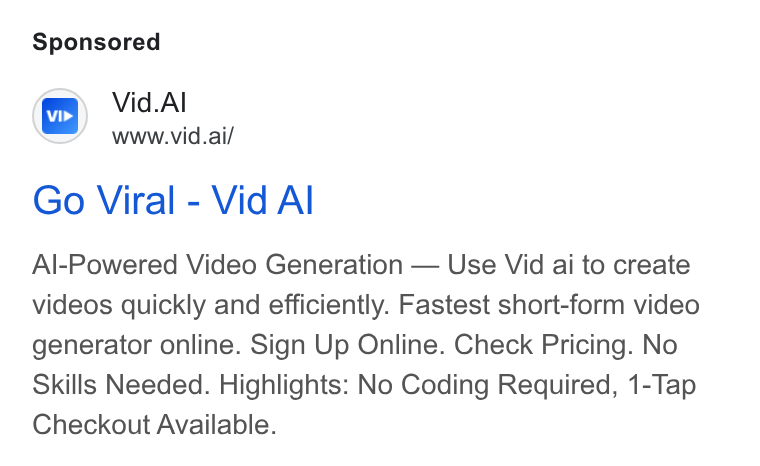
- Running
- 205 days (longevity = it's converting)
- Hook
- The image opens with the word "Sponsored" at the top left, followed by a small circular icon with a blue background and white play symbol, next to the text "Vid.Al" and "www.vid.ai/". Below this is the blue headline "Go Viral - Vid Al".
- CTA / offer
- Sign Up Online. Check Pricing.
- Audience
- Individuals or businesses looking to create videos quickly and efficiently without needing technical skills, indicated by phrases like "No Skills Needed" and "No Coding Required".
Why it works. Search ad leading with the aspirational outcome instead of the mechanism, useful for tools whose feature list is otherwise unremarkable.
Clear, benefit-oriented headline: The ad uses the headline "Go Viral - Vid Al". Write one search headline that states only the outcome your customer wants, no product name, and run it against your current feature headline.
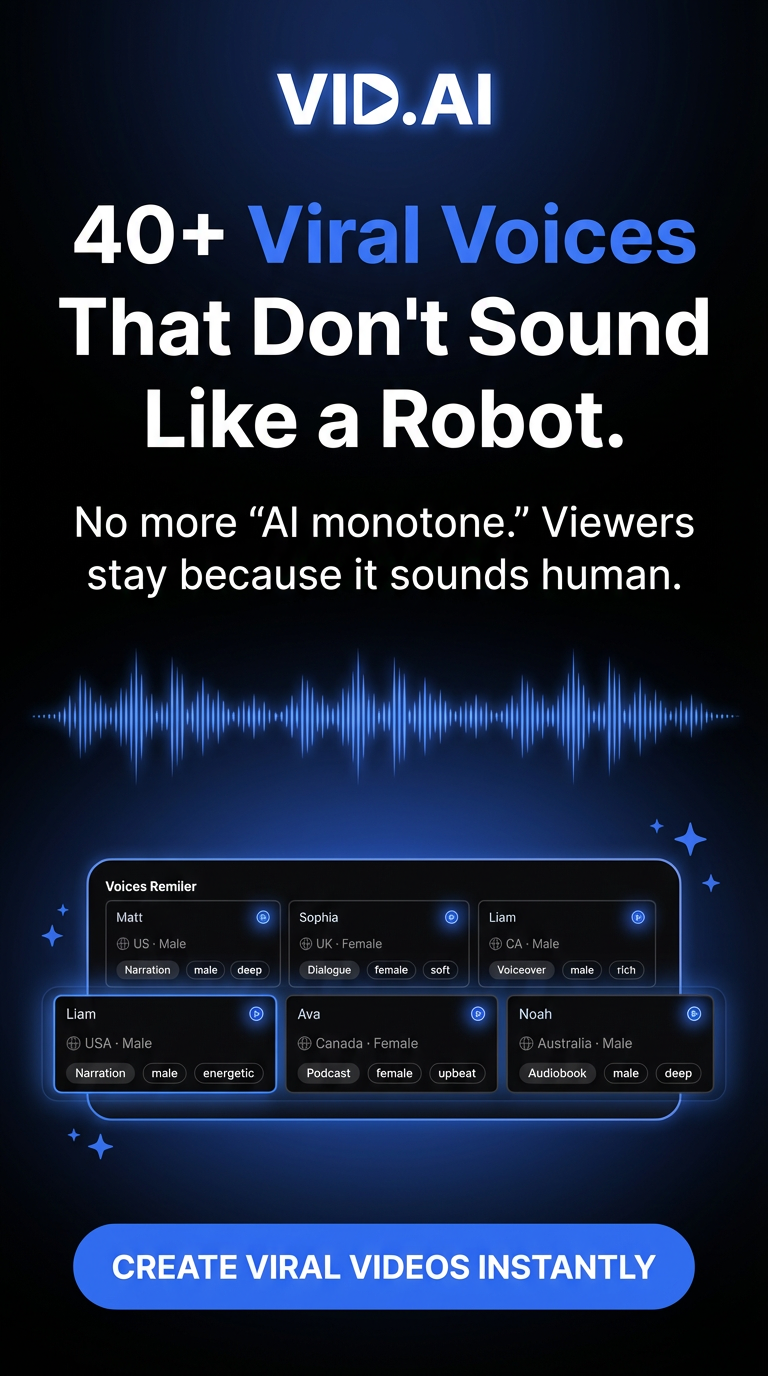
- Running
- 136 days (longevity = it's converting)
- Hook
- On-screen text: "VID.AI", "40+ Viral Voices That Don't Sound Like a Robot."
- CTA / offer
- CREATE VIRAL VIDEOS INSTANTLY
- Audience
- Content creators, marketers, or anyone producing videos who needs high-quality, human-sounding AI voices, indicated by the focus on 'viral voices' and 'viewers stay'.
Why it works. Leads with a number-backed rebuttal of the category's biggest trust objection, aimed at creators who already tried and rejected other AI voice tools.
Bold headline and problem/solution statement: "40+ Viral Voices That Don't Sound Like a Robot." and "No more 'AI monotone.' Viewers stay because it sounds human." Name the specific complaint people have about your category, then pair it with a number proving you solved it, like '40+ voices that don't sound like X.'
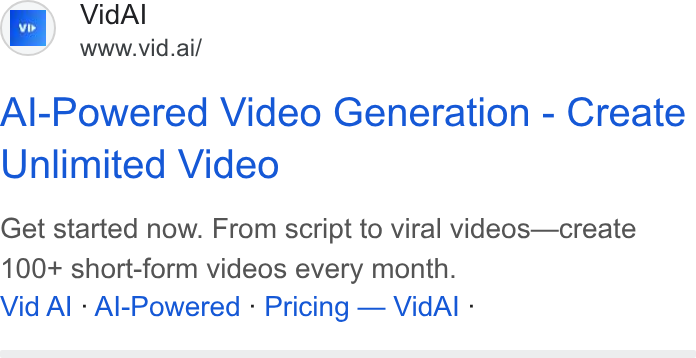
- Running
- 55 days (longevity = it's converting)
- Hook
- VidAI www.vid.ai/ AI-Powered Video Generation - Create Unlimited Video
- CTA / offer
- Get started now.
- Audience
- Businesses or content creators looking to scale video production, indicated by "AI-Powered Video Generation" and "create 100+ short-form videos every month."
Why it works. Search ad selling volume freedom to creators who feel capped by competitor plans, a pricing-anxiety angle rather than a feature angle.
Headline with core benefit: "AI-Powered Video Generation - Create Unlimited Video" If your plan has usage caps, test a headline naming the cap you remove (unlimited, no limits) against your current feature headline.
Show 3 more ads
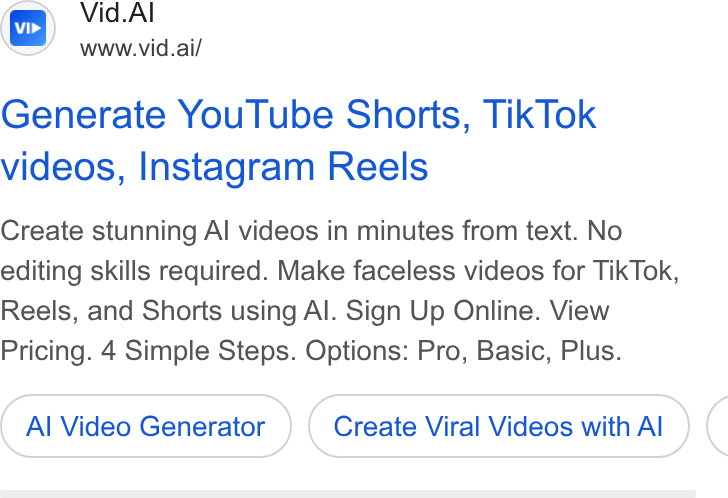
- Running
- 51 days (longevity = it's converting)
- Hook
- Vid.AI logo and website www.vid.ai/ followed by the headline "Generate YouTube Shorts, TikTok videos, Instagram Reels"
- CTA / offer
- Sign Up Online. View Pricing.
- Audience
- Content creators, marketers, or businesses looking to produce short-form video content for platforms like YouTube, TikTok, and Instagram, indicated by the explicit mention of these platforms and the promise of AI-driven, no-skill-required video generation.
Why it works. Search ad that names the exact platforms a searcher is already posting to, borrowing their own vocabulary instead of generic video-tool language.
Headline directly addresses a common content creation need: "Generate YouTube Shorts, TikTok videos, Instagram Reels". List the 2 to 3 specific platforms your customers post to, by name, in your headline instead of a generic 'social media' claim.
- Running
- 253 days (longevity = it's converting)
- Hook
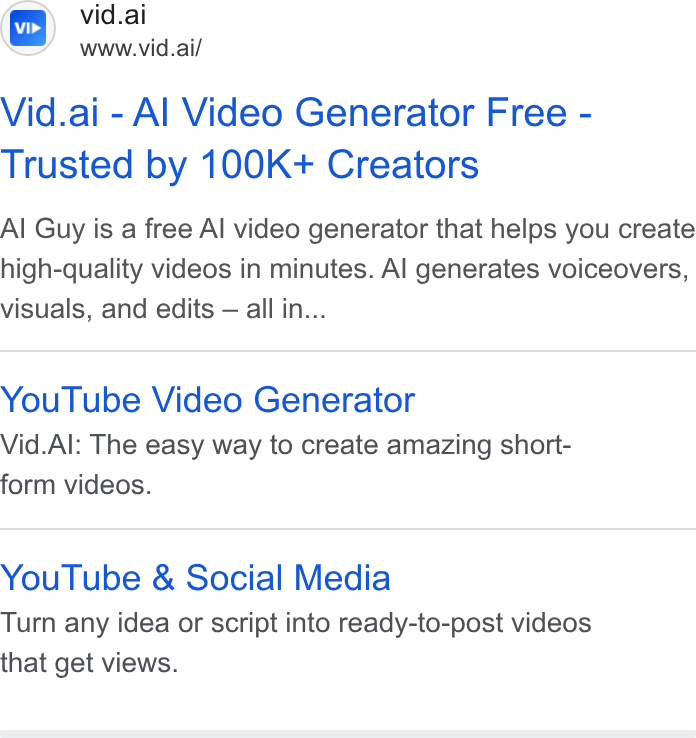
- The top of the image shows a small blue icon with a white play symbol, next to the text "vid.ai" and "www.vid.ai/". Below this, the blue text "Vid.ai - AI Video Generator Free - Trusted by 100K+ Creators" is visible.
- Audience
- The text "Trusted by 100K+ Creators" and references to "YouTube Video Generator" and "YouTube & Social Media" signal that the target audience is content creators, social media managers, and individuals looking to produce videos efficiently.
Why it works. Branded search ad that turns a generic AI video pitch into a numbers claim, useful for founders who need a fast way to signal traction in a headline.
Displaying a large number of users: "Trusted by 100K+ Creators" Add your actual user count to your next search ad headline instead of a generic benefit claim, even a rounded number beats none.

- Running
- 136 days (longevity = it's converting)
- Hook
- Top image: A man with disheveled hair sits at a desk with three computer monitors, typing on a keyboard. There are crumpled papers and coffee cups on the desk. The monitors display what appears to be YouTube and a spreadsheet. A large blue arrow with the text "VidAI Automation" points from this scene to the bottom image. Bottom image: A man in a suit sits in an office with a city skyline visible through a large window, holding a tablet displaying a logo. In front of him, a large holographic-style screen shows a dashboard with charts and metrics.
- Audience
- Individuals involved in online content creation, video production, or those seeking passive income, indicated by the 'YouTube' interface, 'VidAI' branding, and 'Passive Income' metrics.
Why it works. Contrasts a frazzled multi-monitor creator with an implied automated payoff, aimed at overwhelmed side-hustlers chasing passive income from video.
Visual contrast of 'before' and 'after' states: The top image shows a stressed man at a cluttered desk with multiple screens, while the bottom image shows a relaxed, smiling man in a modern office with a clean, high-tech dashboard. The text "VidAI Automation" and a large arrow connect these two states. Show your ICP's specific cluttered, overloaded 'before' moment as your first visual beat, then cut straight to the calm automated result without narrating it.
08 The playbook
The channels are not separate. They are one system where each stage feeds the next. Here is the read, then the plays to run tomorrow.
The inferred playbook
The acquisition loop runs from ICP-targeted tutorial content to affiliate-amplified distribution, with Meta paid as the demand-generation layer and branded direct traffic as the retention signal.
All content surfaces point at one persona, the person who wants to run a monetized faceless video channel. VidAIOfficial tutorials, Meta before-and-after creatives, and Priyam Raj's X milestone posts collectively build recognizable, cumulative awareness inside this niche before a prospect reaches vid.ai.
Meta paid creative does the emotional close: the before-and-after externalizes the pain state, and the feature list ("8 tools in 1," "40+ voices") addresses the quality objection a faceless-channel creator would raise. The $47,000 premium domain also functions as an implicit credibility signal on first visit.
Dig deeper+2▾
The affiliate program converts customers and creators into a self-funded distribution network; operators like HERA SEO SRL (~510 days active on Google) and 杭州索益网络科技有限公司 (~418 days active) are running persistently profitable campaigns on their own budgets, extending geographic and keyword coverage Vid.AI's own paid team does not need to fund.
MRR holds at $73,553 even as the affiliate and paid-social layers carry most of the load, which could indicate improving conversion efficiency or temporarily stable churn; with no SEO content surface beyond brand navigation, if those channels soften there is nothing underneath to sustain independent discovery.
Build all tutorial content for one hyper-specific use case, not the product category
The proofVidAIOfficial's 30+ YouTube tutorials are not generic "AI video tool" guides; they are faceless YouTube channel monetization tutorials demonstrating the product in the exact context the ICP cares about, from niche selection ("Top 10 Most Profitable Faceless Channel Niches") to bulk production ("Bulk Create 100 Viral YouTube Shorts in Under an Hour Using AI"). The co-founder full-product walkthrough earned 7,734 views with no paid promotion visible in the evidence.
The adaptationIdentify the single most specific job-to-be-done your product solves and produce 5-10 tutorial videos demonstrating the product solving that exact problem in that exact context, with the specific outcome in the title. A tool that helps freelancers manage client deliverables should produce "How I deliver Notion client dashboards in under 2 hours," not "AI project management." Start by writing five video titles a person with that specific problem would click, then record in order from most specific to broadest. This works because specific-use-case tutorial content earns the trust of a narrow ICP at low production cost and trains future affiliates by modeling exactly how to explain and demonstrate the product.
Train affiliates to produce tutorials, not just post referral links
The proofMultiple VidAIOfficial YouTube video descriptions embed ref-tagged affiliate links, including a dedicated "ref=isaac" URL and rebrand.ly affiliate links, meaning individual creators are producing their own tutorial content with affiliate attribution. The referral channel accounts for 7.2% of all estimated monthly visits, a share that reflects tutorial-based discovery compounding over time rather than one-time link clicks.
The adaptationWhen launching or expanding an affiliate program, produce a 5-minute screen recording of the product solving its core use case and send it to every affiliate alongside their referral link as a remixable "how to explain this" template. Tell affiliates explicitly that they may record their own version using the walkthrough as a guide. Start by identifying the top 10 affiliates by conversion volume and scheduling a 20-minute product walkthrough with each. This works because tutorial-based affiliate content compounds in platform recommendation algorithms long after the original session expires, unlike a newsletter link that exhausts its referral window within 48 hours.
Open your Meta creative with a physical before-state, not a feature claim
The proofVid.AI's longest-running proven Meta creatives (running since February 2026, ~136 days active) are before-and-after images showing a man with disheveled hair at a cluttered three-monitor desk bridged by "VidAI Automation" to a relaxed suited person with a city-skyline backdrop. A second proven angle leads with "40+ Viral Voices That Don't Sound Like a Robot," which makes the abstract quality benefit concrete by naming the exact objection it pre-empts.
The adaptationFor any productivity or automation SaaS, build two creative variants: one that externalizes the exact emotional before-state of a frustrated user (physical disorder, visible failure, time pressure shown on screen) bridged to a specific after-state symbol, and one that leads with a counter-intuitive feature claim that names the ICP's biggest quality objection and refutes it in the headline. Run both at equal budget for a minimum of 30 days before touching the allocation. This works because the before-and-after does the narrative work in under 3 seconds that the landing page cannot: it surfaces the problem, positions the product as the bridge, and delivers the emotional reward without requiring the viewer to read copy.
Post revenue milestones in the unit most viscerally specific to your audience
The proofPriyam Raj's July 2025 X post reporting "₹3.4 cr halfway through the year, zero investors, no office hours, zero meetings" reached 58,327 views and 557 likes from a 12,633-follower account, the highest-reach revenue-milestone post in the evidence window (behind only the 191,773-view domain-acquisition announcement). A January 2026 post reporting "$6,780 in 4 days" drew 12,408 views. In both cases, the local-currency denomination and bootstrapped contrast gave the number a story that a round dollar figure would flatten.
The adaptationWhen posting a revenue milestone, find the denomination that reads as most specific to your audience: a local currency, a per-day figure, a subscriber count multiplied by price per seat, or an annual run-rate framed in the largest credible unit. Then add a single contrasting clause that makes the number meaningful: "zero investors," "two-person team," "no paid ads." The contrast is what turns a number into a signal people want to share. Note: milestone posts earn the most reach when the founder already has an engaged audience of a few thousand or more; without that base, the ceiling on organic reach is low. This works because a specific number paired with a contrast activates the benchmarking instinct in the reader, who shares it to signal awareness of the data point to their own audience.
Explicitly permit affiliates to run their own paid search campaigns on your brand terms
The proofThe Google ads library for vid.ai shows active campaigns from HERA SEO SRL (~510 active days), 杭州索益网络科技有限公司 (~418 active days), and multiple Vietnamese and Hong Kong operators, all spending their own budgets on Google search to drive traffic to vid.ai in exchange for commissions. The longest-running of these affiliates has outlasted most in-house campaigns and was still active as of 2026-07-01.
The adaptationMost affiliate agreements either prohibit paid search or say nothing and leave affiliates uncertain about what is allowed. Draft a one-page affiliate paid-search policy specifying which keyword categories affiliates may bid on (branded terms, category terms, competitor terms, each as explicit opt-ins), what destination URL format to use for attribution, and any prohibited claims. Send it to the top 20% of affiliates by conversion volume as a permissions update. This unlocks paid-search coverage in geographies and keyword combinations you do not prioritize, funded entirely by the affiliate's own budget. This works because affiliates who sustain multi-month Google campaigns have already validated profitability on their own P&L, meaning the coverage they add is market-tested distribution that costs you nothing to maintain.
You just read how Vid.AI does it. Tomorrow it is someone else.
Every morning we take one company that is actually growing and break down where its customers come from: the ads still running after a year, the channel doing the real work, and the play you can run this week.
Systemaic · directional intelligence. Traffic, spend, and reach figures are SimilarWeb-style estimates and qualitative reads of public data, not audited numbers. Built on real public receipts.
// teardowns with a similar GTM motion
sources & receipts (2)
Live ad libraries: meta ad library · google ad library
Traffic, spend, and revenue figures are estimates as noted in the report; the links above are the primary public artifacts.