- 01Mobilize your own network on launch day
- 02Turn press mentions into reusable ad creative
- 03Give recurring milestones a running bit
- 04Coin and own a product-format term
01 Snapshot
The one-glance read on who they are and how they grow. Each point is verifiable from the receipts above.
Nostalgia-branded sun care (sunscreens, gels, oils, whips, mists) sold direct and across 2,500+ retail doors including Ulta, Target, CVS, Nordstrom and Costco.
Paid-led performance marketing layered on top of a large wholesale retail footprint, backed by a sizable owned Instagram audience.
254,566 Instagram followers across 912 posts, a ~200-ad Google library now at zero active ads, and at least 15 live Meta ads as of July 12, 2026.
Meta creative launched starting May 26, 2026 pushes fragrance-line extensions, a Gelée eau de toilette and a relaunched body-mist trio, alongside the core sunscreen message, as of the observation date.
The paid engine looks mid-reset: a multi-year Google search program that once ran a single ad for 628 straight days had gone fully dark by the observation date, while an entirely fresh, sub-two-month Meta wave now carries the live spend, mixing press pull-quotes, retail-availability call-outs and fragrance-line extensions, none of it yet old enough to call a proven winner.
02 How it unfolded
The order the channels came online. Sequence is strategy: what they did first, and what they layered on once demand existed.
03 Traffic & channel mix
Estimated demand, the channel split behind it, and the keywords and referrers doing the work. Directional modeling, not audited analytics.
SimilarWeb does not publish a traffic estimate for this domain yet, which is normal for a newer or smaller site below its tracking threshold. The growth read here leans on the other public signals in this teardown rather than modeled traffic.
SimilarWeb does not publish a traffic estimate for this domain yet, which is normal for a site this size, so the growth read here leans on the other public signals below.
04 Organic content
The specific pages earning their organic search traffic, and the pattern behind why they rank. Adapt the format, not the topic.
Their top organic pages skew toward the homepage and a handful of hero product and collection pages rather than blog or guide content: the homepage alone, the Classic Whip SPF 30 product page, a Sensitive Skin collection, a "Vacation by Vacation" fragrance page, and a Travel Size collection make up the bulk of the tracked organic pages. The pattern is a branded-vocabulary play: Vacation coined playful format names for its products (whip, gelée, buffing bar) and now ranks #1-2 for the literal product-format terms it invented, such as "whipped sunscreen" and "whipped cream sunscreen," alongside owning branded terms like "vacation sunscreen" and "vacation perfume." That combination, naming a category term nobody else was competing for and then building a dedicated collection or product page around it, is likely why these specific pages rank with comparatively little competition.
Top pages by organic traffic
05 Channel map
Not traffic share. How much weight the growth system actually puts on each channel, with a one-line read on the role it plays.
What drove growth
06 The creative doing the work
Each exhibit shows the actual asset, an X-ray of why it works, a status, and a play you can adapt. This is the heart of the teardown.
The true ad footprint splits sharply by platform as of July 12, 2026: a directional ~200-ad Google library (the transparency tool caps how many ads it returns, so the true historical total may be higher) sits at zero active ads, while Meta carries at least 15 live ads across its placements. Because every ad running, on Meta, is under 60 days old (the oldest active creative launched May 26, 2026), none of it clears the runway to call a proven winner; this reads as a current push, not a proven-winner rotation. The real longevity proof lives in Google's paused history: one ad ran actively for 628 days (May 2024 to January 2026) promoting the brand's "World's Best-Smelling Sunscreen" positioning, and a cluster of other Google text and image ads ran 470-630 days before also going dark, with the last Google activity of any kind (including a short-lived April-May 2026 test wave) ending by May 25, 2026.
Deconstructing the current Meta push:
-
Hook: "I have never used a sunscreen with this formula," spoken by a woman applying a clear gel from a light blue tube.
-
Why it works: It mimics organic UGC rather than polished ad copy, using a first-person disbelief framing that pre-empts skepticism about an unfamiliar gel texture before the viewer can raise it themselves.
-
Run this play: Front-load paid creative with a peer-testimonial reaction shot instead of a brand claim when the product's format itself is the novelty.
-
Hook: "Best SPF: Allure Best of Beauty Award" over a product shot of the orange gel tube.
-
Why it works: It borrows third-party editorial credibility to bypass the trust gap DTC sunscreen buyers have around efficacy claims, a harder sell than scent or aesthetics.
-
Run this play: expanded as Play 2 below.
-
Hook: "Vacation is retro pool vibes in a tube and instantly transports you to a mental vacation, whether you're applying this before a hot girl walk or actually on a beach." (Shape)
-
Why it works: Stacking near-identical pull-quotes from Shape, Oprah Daily, Daily Beast, Harper's Bazaar and Byrdie across separate ad units builds an "as seen in" halo cheaply, reusing the same five citations across the whole active rotation instead of shooting new proof each time.
Also in the current rotation: retail-availability call-outs pairing the sunscreen with "Now Available at Walgreens," fragrance-line extensions ("Introducing GELÉE by Vacation® Eau de Toilette" and a "back in stock" Body Mist trio), a tennis-ball-scented candle tie-in with Prince, the tennis-gear brand ("A fresh can of tennis balls, rethought as a candle" - Esquire), and a Pepsi Wild Cherry lip balm clip ("CRACK IT") tied to the brand's Pepsi collaboration.
The contrast is stark: the durable, multi-year Google program detailed above has gone quiet, while every dollar live now sits behind a fresh, under-two-month Meta push that spans press-quote creative, retail-availability call-outs, fragrance-line extensions (Gelée eau de toilette, the relaunched body-mist trio) and core sunscreen-gel demos, none of it old enough yet to have proven itself.
The live ads route to two distinct destinations depending on intent. Novelty and merch-adjacent creative, the "retro pool vibes" press-quote ads, lands on lifestyle SKU pages like the Vacation® Visor and a Classic Lotion-scented air freshener, both structured as quick-redirect pages rather than full landers. The core store front carries a sitewide offer architecture: free shipping on orders of $45 or more, with visible price points around $14-$15 for single items, and a storewide Pepsi® sweepstakes banner running through September 30 promising vintage Pepsi merchandise on specially marked packages. The Pepsi collaboration ad ("CRACK IT," the Wild Cherry lip gel clip) lands on a dedicated Pepsi® Wild Cherry Tinted Lip Gel page stacking a 10% discount on top of the same $45 free-shipping threshold, showing the brand using a co-branded collectible to pull first-time buyers over its shipping cutoff rather than running the lip gel as a standalone SKU.
- Running
- 48 days (longevity = it's converting)
- Hook
- "INTRODUCING gelée NEW! EAU DE TOILETTE" shown over a woman in a white shirt and sunglasses lounging on a beach chair spraying perfume.
- Audience
- Consumers who value retro-luxury aesthetics and the specific scent profile of classic sunscreen products.
Why it works. Extends the sunscreen brand's retro-glamour identity into a new fragrance format, so existing fans recognize the world before learning it's a new category.
Retro 80s magazine aesthetic (0:00-0:15) Use the same retro color grading and wardrobe styling across your core product and its extensions so a new launch reads as part of one continuous brand world.
- Running
- 48 days (longevity = it's converting)
- Hook
- "INTRODUCING gelée by Vacation" text overlay on a man and woman in white resort wear by a stone railing overlooking the ocean.
- Audience
- Consumers seeking a luxury 'leisure' lifestyle, signaled by the Mediterranean-style setting and retro resort fashion.
Why it works. Anchors a new fragrance launch to the existing Vacation lifestyle world through matching retro visuals and wardrobe, so the product borrows brand equity instead of building its own.
Retro-aesthetic styling (0:00-0:08) using white linen clothing, stone balustrades, and a grainy film texture. Launch a new SKU inside your existing brand's visual world (same palette, wardrobe, locations) rather than presenting it as a standalone product.
- Running
- 38 days (longevity = it's converting)
- Hook
- "I have never used a sunscreen with this formula" + visual of a woman applying a clear gel from a light blue tube to her cheek.
- Audience
- Makeup users who struggle with sunscreen pilling or white casts, signaled by the foundation application and the 'won't ruin your base' caption.
Why it works. Uses a first-person UGC claim paired with a clear-gel texture shot to counter the objection that sunscreen ruins makeup, aimed at daily-wear skincare buyers.
Visual proof of transparency (0:03 - 'completely clear gel') Open UGC ads with a first-person line that names the category and implies a specific difference, then prove it with a close-up of the product texture.
Show 3 more exhibits
- Running
- 11 days (new — still being tested)
- Hook
- "CRACK IT" text overlay with hands holding a blue Pepsi Wild Cherry flavored lip gel tube.
- CTA / offer
- "CHANCE TO WIN PRIZES UNDER THE CAP*"
- Audience
- Fans of vintage aesthetics and Pepsi brand enthusiasts, indicated by the 80s/90s style apparel and high-saturation retro color palette.
Why it works. Borrows Pepsi's brand recognition for a limited collab lip gel, with an action hook that mirrors how you'd actually use the product.
Unexpected brand collaboration at 0:00 showing 'PEPSI Wild Cherry' lip gel. For a co-branded limited drop, use a short action-verb hook tied to physically opening or using the product, not a scent claim.
- Running
- 4 days (new — still being tested)
- Hook
- "A fresh can of tennis balls, rethought as a candle." -Esquire text overlay above a lit green candle and three tennis balls.
- Audience
- Tennis enthusiasts and fans of the 'country club' aesthetic, signaled by the Prince brand collaboration and the specific scent notes like 'Cucumber Sandwiches'.
Why it works. Borrows a recognizable publication's own words to validate an unusual, memory-specific scent idea for a lifestyle audience that trusts editorial voice over ad copy.
High-authority quote placement at 0:00 ("'A fresh can of tennis balls, rethought as a candle.' -Esquire") If a credible outlet has described your product in a memorable line, quote it verbatim at the top of the creative instead of paraphrasing your own claim.
- Running
- 626 days (longevity = it's converting)
- Hook
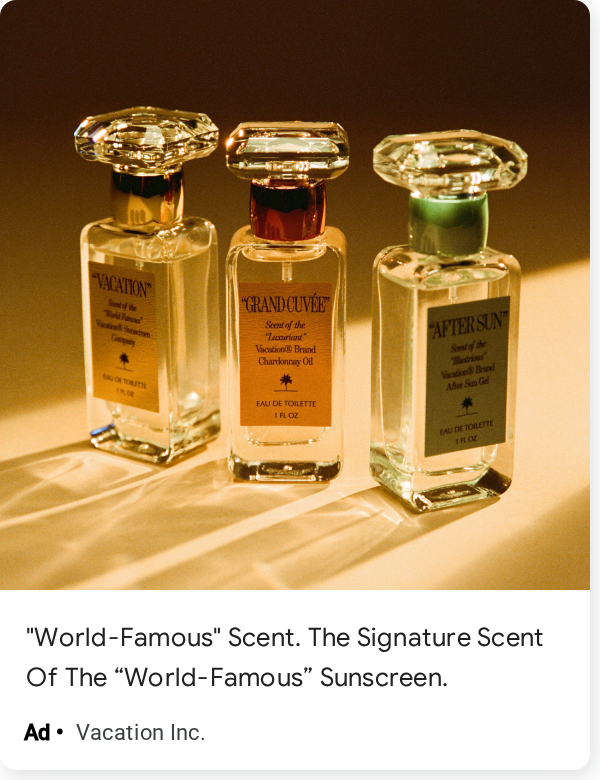
- "World-Famous" Scent. The Signature Scent Of The "World-Famous" Sunscreen. + Three clear glass perfume bottles with ornate crystal caps, arranged on a light-colored surface with shadows.
- Audience
- Individuals interested in luxury scents and brand extensions from known companies, indicated by the product type (perfume) and the brand name "Vacation Inc."
Why it works. Turns brand recognition of Vacation's sunscreen scent into the entire pitch for the perfume version, useful for founders launching format extensions off a hero product.
Displaying three distinct product variations with clear labels: "VACATION", "GRAND CUVÉE", and "AFTER SUN". When launching a new format of an existing hit product, headline with the parent product's established reputation instead of introducing the new format cold.
Who amplifies them
The amplification footprint is thin outside owned channels. The only named creator in the evidence is "Sarah D," whose poolside product-placement clip carries the #vacationpartner tag, hinting at some kind of creator or ambassador designation, but no other creators, sellers, or community threads surfaced in this pass. No subreddit activity, no press-adjacent creator network, and no aggregate creator-UGC volume were captured, so beyond that single tagged clip and the brand's own retail-partner shoutouts (Kith, Nordstrom, Ulta, all covered above), this is not a channel with visible third-party word-of-mouth infrastructure in the data collected.
07 Organic & video
The organic content engine: the videos, creator posts, and community presence earning attention without paid spend.
The clearest organic format is a recurring in-house bit: nearly every brand-account milestone post opens with the mock-corporate phrase "IMPORTANT COMPANY ANNOUNCEMENT" before delivering a retail win, a joke voice that turns routine distribution news (Nordstrom, Ulta, Kith) into a bit followers came back for. The standout post by engagement is co-founder Lach Hall's own account recalling the brand's start: "Didn't quite imagine this when we were lugging around oil samples to bars in Miami asking friends and strangers for their feedback," which pulled 74 likes and 27,426 views, far outperforming anything on the brand account. The brand account's own top posts stayed retail-news-shaped: the AriZona Iced Tea lip balm partnership announcement drew 20 likes and 4,194 views, and the 700-store Ulta expansion post drew 17 likes with two quote-tweets. The one piece of creator-style content in the evidence is a clip from a poster tagged "Sarah D," captioned "pool days are better with vacation chardonnay oil" and tagged #vacationpartner, but it surfaces inside the Meta ad library rather than as organic reach, meaning it is a boosted creator clip, not an independently verified organic post. Talking-head, first-person demo footage (covered in Paid Ads) and this poolside lifestyle clip are the only two video formats present; no dedicated organic TikTok or Reddit activity was captured for this pass.
08 Affiliate & partners
How the brand turns creators and partners into a tracked, variable-cost acquisition channel, and how the program is structured.
No dedicated affiliate or referral program link surfaced on the owned site, which links out only to the brand's Instagram, X, and TikTok profiles. The strongest partner signal is indirect: the "Sarah D" creator clip tagged #vacationpartner, which suggests an informal creator or ambassador relationship rather than a structured, publicly documented affiliate program (no PartnerStack, Rewardful, or TikTok Shop link was found). At a brand now backed by institutional capital and running a 2,500-plus-door wholesale footprint, the absence of a visible self-serve affiliate program implies amplification is being sourced through direct creator outreach or brand deals rather than an open recruitment funnel.
09 The playbook
The channels are not separate. They are one system where each stage feeds the next. Here is the read, then the plays to run tomorrow.
The inferred playbook
Vacation's growth engine runs on wholesale retail placement and press-quote recycling, with paid social mid-rebuild after its longest-running channel went dark.
The brand-account cadence covered above was built almost entirely from retail-door announcements rather than DTC acquisition content, suggesting organic social has functioned as a channel-partner press release feed as much as a customer-acquisition tool.
Cross-brand tie-ins with legacy consumer names like AriZona and Pepsi, paired with the editorial "as seen in" halo covered in Paid Ads, form a low-cost proof engine: each collaboration or press mention becomes reusable creative across both search and social rather than a one-off placement.
Dig deeper+3▾
The 628-day Google program and the sub-two-month Meta wave detailed above sit on opposite ends of the durability spectrum, meaning the brand's current paid proof is unproven and its next few months of Meta performance will determine whether this reset sticks.
A 2026 minority investment from VMG Partners, the same fund that took Sun Bum to a roughly $400M sale, points to outside capital betting on a similar sun-care roll-up path. Outside reporting pegs retail sales at roughly $40M in 2024 with a company projection near $80M for 2025 against independent estimates in the $54M-$70M range, an estimate range rather than a verified figure, consistent with a brand whose growth is carried more by retail distribution than by DTC paid spend alone.
the DTC-versus-retail revenue split, paid customer acquisition cost, and organic performance on the linked @vacationinc TikTok account.
Mobilize your own network on launch day
The proofCo-founder Lach Hall's early ask, personally requesting an upvote and comment on Product Hunt from his own following, covered in Where They Show Up.
The adaptationBefore any public launch, draft a short personal message (not brand copy) from the founder's own account asking your existing network for a specific, low-friction action: an upvote, a comment, a reply. Send it to your email list, DM ten people individually, and post it from your personal profile rather than only the company one. The mechanism is that a personal ask from a named individual converts favors-for-a-friend far better than a brand broadcast, because it activates social reciprocity instead of algorithmic reach.
Cost: $0 · Time to signal: days · Works pre-PMF: yes
Turn press mentions into reusable ad creative
The proofexpanded as referenced in Paid Ads above, the Allure Best of Beauty citation and five other outlet quotes recur across the brand's active Meta rotation.
The adaptationPitch small trade blogs, niche newsletters, and category roundups for a review or "best of" mention before you have an ad budget: most accept free submissions or samples. The moment you land even one quote, turn it into a static image ad and a homepage banner, and keep reusing that same quote across every channel until you land a second one. The mechanism is that a third-party sentence does the trust-building work a founder's own claim cannot, so one earned quote can be stretched across months of creative.
Cost: under $500 · Time to signal: weeks to months · Works pre-PMF: yes, provided you have something genuinely review-worthy to submit
Give recurring milestones a running bit
The proofthe brand account's repeated "IMPORTANT COMPANY ANNOUNCEMENT" framing for every retail win, covered in Organic & Video above.
The adaptationPick one consistent voice or running joke for your own milestone posts (a mock press release, a recurring character, a fixed opening line) and reuse it every time you have real news: a new stockist, a sold-out restock, a press mention. Post it from day one, even before you have retail wins, applying the bit to smaller milestones like a first sale or a hundredth customer. The mechanism is that a recognizable format trains followers to expect and open your next announcement instead of scrolling past generic company news.
Cost: $0 · Time to signal: days to weeks · Works pre-PMF: yes
Coin and own a product-format term
The proofthe branded-vocabulary SEO pattern covered in Organic Content, where invented format names like "whip" and "gelée" now rank first or second for their own literal search terms.
The adaptationIf your product has a genuinely novel format or texture, give it a distinct, ownable name rather than a generic category term, then build one dedicated page around that exact phrase. Search demand for a name nobody else uses yet has close to zero competition, so a single well-built page can rank quickly once the term gets any search volume at all. The mechanism is that you are not competing for an existing keyword, you are creating one that only you can win.
Cost: $0 · Time to signal: weeks to months · Works pre-PMF: yes, provided the format is actually distinctive enough that people search for it by that name
Borrow audience through a legacy-brand crossover
The proofthe AriZona and Pepsi collaborations covered above, including the Pepsi sweepstakes offer and Wild Cherry lip gel tie-in.
The adaptationIdentify one adjacent, nostalgic, or culturally loaded brand whose audience overlaps with yours but doesn't compete with you directly, and pitch a small co-branded product or limited-run item rather than a generic sponsorship. The mechanism is audience borrowing: their name pulls in attention and trust you haven't earned yet, while your product supplies the novelty their audience hasn't seen from them before.
Cost: dedicated budget or hire · Time to signal: weeks to months · Works pre-PMF: no, this requires negotiating leverage, licensing budget, and a large enough audience of your own to make you worth a bigger brand's time Not transferable at an earlier stage: the legacy-brand crossover play and the retail-first distribution model both assume negotiating leverage, licensing budget, and buyer relationships that come from years of retail placement and institutional backing, not something a pre-revenue founder can replicate directly; treat those as a horizon to build toward once the lower-cost plays above have produced traction.
You just read how Vacation does it. Tomorrow it is someone else.
Every morning we take one company that is actually growing and break down where its customers come from: the ads still running after a year, the channel doing the real work, and the play you can run this week.
Systemaic · directional intelligence. Traffic, spend, and reach figures are SimilarWeb-style estimates and qualitative reads of public data, not audited numbers. Built on real public receipts.
// teardowns with a similar GTM motion
sources & receipts (2)
Live ad libraries: meta ad library · google ad library
Traffic, spend, and revenue figures are estimates as noted in the report; the links above are the primary public artifacts.