- 01One-Task Landing Pages
- 02Tactic-Dump Reddit Posts
- 03Time-Boxed Lifetime Deal
- 04Failure-to-Traction Threads
01 Snapshot
The one-glance read on who they are and how they grow. Each point is verifiable from the receipts above.
Drag-and-drop static site and file hosting for non-developers, riding the 2025-2026 "vibe coding" wave of ChatGPT/Claude-generated sites that need somewhere to live.
Founder-led and organic-led, with a meme-heavy paid social layer testing on top of an SEO base.
~966,000 estimated monthly visits (+3% over the trailing 3 months) as of the observation window, roughly $1M ARR by early 2026 per the founder's own account, up from $500K+ ARR he reported mid-2025, against 24 total Meta ads and 36 total Google ads as of 2026-07-27.
In a June 2025 post, founder Elston Baretto wrote: "I applied to YC. Rejected. Tried to raise from Angels. Ghosted. Still scaled to a $500K+ ARR SaaS with: Reddit, SEO, Twitter."
As of 2026-07-27, Google's newest ad batch leans into video creative while Meta's newest test is a literal screenshot of the drag-and-drop upload box explaining the product mechanic directly.
A decade-old library of single-task SEO pages (turn a PDF into a link, unzip a file online) is now catching a second wave of demand as "where do I host what ChatGPT just built me," with the founder's own X and Reddit voice compounding awareness on top of that base.
02 How it unfolded
The order the channels came online. Sequence is strategy: what they did first, and what they layered on once demand existed.
03 Traffic & channel mix
Estimated demand, the channel split behind it, and the keywords and referrers doing the work. Directional modeling, not audited analytics.
Traffic sources
Top search keywords
| Keyword | Volume | Weight | CPC |
|---|---|---|---|
| tiiny host | 13k | $1.93 | |
| tinyhost | 7.0k | $1.77 | |
| tiny host | 5.8k | $1.78 | |
| tiinyhost | 2.3k | $5.21 | |
| tiiny | 4.5k | $4.97 |
Top referring sites
Closest competitors by audience
Tiiny Host draws an estimated ~966,000 monthly visits, up 3% over the trailing 3 months. Direct traffic dominates at 50.3%, consistent with a tool people bookmark and return to repeatedly to re-upload files, while Search Organic sits at 36.9%, the SEO engine covered below. A smaller but notable 3.4% comes through Gen AI referrals, the rest, referrals, social organic, email, paid social, paid search, and display, together total under 10%.
Their top-ranking keywords are almost entirely branded variants and misspellings: "tiiny host" (13,390 searches/mo), "tinyhost" (6,990/mo), and "tiny host" (5,780/mo), meaning most of that search-organic volume is people already looking for the product by name rather than a generic category term, a sign that awareness is built elsewhere and search just captures the follow-through. Among referrers and rivals, github.com shows up as a top referral source, likely developers linking to it in project docs or README files, while netlify.com and surge.sh appear as the closest competitors, both dev-first static hosts in the same setup-complexity niche Tiiny Host's own ad creative mocks ("reading Vercel documentation from 2 hours ago").
04 Organic content
The specific pages earning their organic search traffic, and the pattern behind why they rank. Adapt the format, not the topic.
The pages earning Tiiny Host's organic traffic are not blog posts, they are narrow, single-task landing pages built around one converting action: turning a PDF into a shareable link, turning a resume into a link, or unzipping a file online, sitting alongside the homepage. The pattern is a use-case page factory: each page targets one literal job-to-be-done phrase rather than a broad feature pitch, which lets it rank for exact-match long-tail queries with little competition while still funneling straight into the same upload flow. It's a strategy any founder-led tool with a simple core action can replicate: pick the specific verbs and file types people already search for, and ship one page per verb.
Top pages by organic traffic
05 Channel map
Not traffic share. How much weight the growth system actually puts on each channel, with a one-line read on the role it plays.
What drove growth
06 The motions doing the work
For founder-led SaaS the breakdown shifts from ads to traction: where the first users came from, how the founder grows it in the open, and the compounding organic surface.
Tiiny Host's early traction came from a single Product Hunt day and repeated, mostly unsuccessful Show HN attempts, but the real engine was years of grinding SEO rather than one launch spike.
The company launched on Product Hunt on March 25, 2020, driving over 1,500 visitors in a single day and delivering its first paying customer, who used a 50%-off Pro promo code, per the founder's own recap.
Five Hacker News submissions from 2020 onward, titled things like "Show HN: Super simple static web hosting" and later "Show HN: Tiiny Host hits $2k MRR," never broke past 10 points, showing the front page never became a real acquisition channel despite repeated attempts.
Dig deeper+2▾
In September 2020 the founder ran a $59 lifetime static-hosting deal through a countdown widget on the homepage and a Reddit post, generating over $1,000 in sales in 3 days by his own account.
Milestones built gradually rather than spiking, from roughly $500 MRR at the 14-month mark to $2K MRR by October 2021 (the point of that low-scoring Show HN post) to $10K MRR by February 2023, reflecting a multi-year content grind rather than a single breakout moment.
The founder, Elston Baretto, runs nearly the entire public narrative himself from his personal X account, with Reddit as a secondary, more tactical channel.
His account, @_baretto, mixes tactical advice and revenue admissions, an April 2025 post laying out a "10 cold DMs/emails daily, 1 tweet daily, 2 blogs weekly" routine pulled 8,494 views, while the YC-rejection thread quoted above pulled 874 likes and 46,769 views, his best-performing post in this data.
In r/EntrepreneurRideAlong, "Every single important tool I've used to build my SaaS tool so far" scored 126 upvotes, and the lifetime-deal writeup covered above scored 48, both framed as resource lists rather than pitches, the clearest "post here" evidence in this data is that single subreddit.
Dig deeper+1▾
A separate brand handle, @TiinyHost, exists, but no brand-account posts appear in this data, so the public build-in-public voice runs almost entirely through Baretto personally rather than a company account.
Search organic is the second-largest channel at 36.9% of total visits, built on a stack of narrow use-case pages rather than one content hub.
The PDF-link, resume-link, and zip-extractor pages covered above sit inside a broader strategy the founder has publicly credited, ranking for terms like "host zip file" and "html hosting."
The 3.4% Gen AI slice of total traffic lines up with the founder's own claim of 80,000+ visitors from large language models in a recent 90-day window, which he called "highly converting," suggesting the same SEO pages are now surfacing inside AI chat answers, not just search results.
Dig deeper+2▾
The site embeds FirstPromoter, an affiliate-tracking platform, confirming Tiiny Host runs a referral or affiliate program as a distribution lever, though no evidence here shows its payout terms, recruiting page, or active volume.
36 total Google ads (20 active, oldest running about 292 days as of 2026-07-27) largely target brand and category terms such as "Tiiny.host" and "Webflow Hosting Made Easy," while 24 Meta ads, all active and mostly launched 2026-06-13, run meme-format demand-gen creative built around the ChatGPT-to-live-link use case, including a Gru-pointing meme captioned "Build a simple HTML site" and a Drake-reject meme dismissing "MANUAL DEPLOYMENT."
07 Paid ads
This founder-led SaaS also runs paid acquisition. Here are the live ads doing the work, each with the X-ray and a play you can adapt.
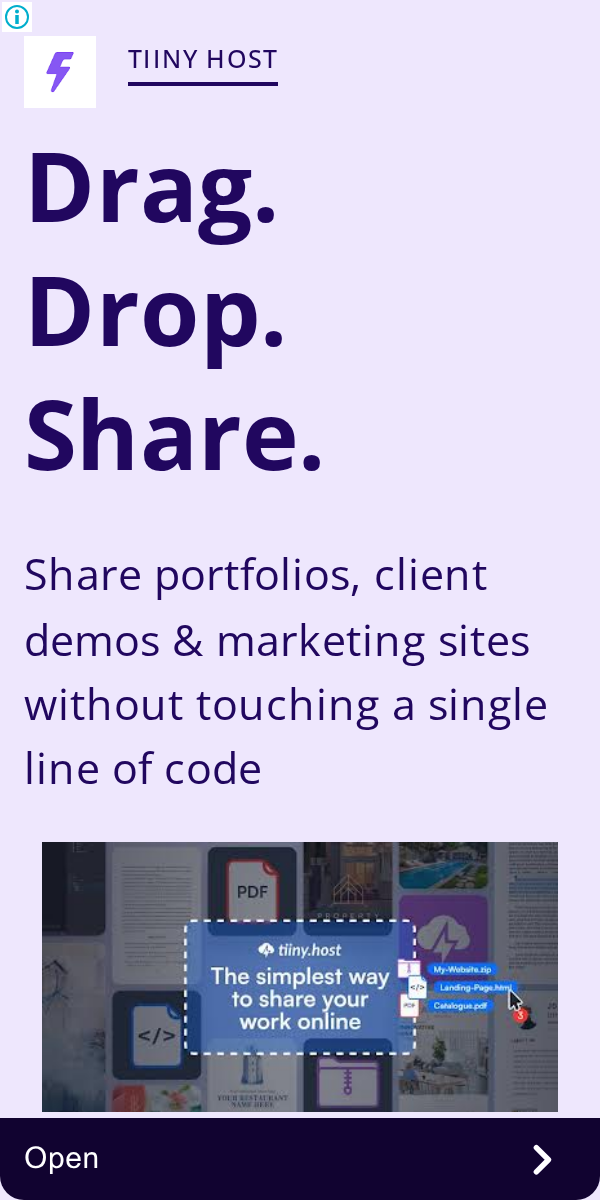
- Running
- 181 days (longevity = it's converting)
- Hook
- Visual: A light blue circle with an 'i' in the center, a purple lightning bolt icon, and the text "TIINY HOST" with an underline. Text: "Drag. Drop. Share."
- CTA / offer
- Open
- Audience
- Individuals or businesses who need to share digital content (portfolios, demos, marketing sites) but lack coding skills or desire a simple solution, indicated by "Share portfolios, client demos & marketing sites without touching a single line of code."
Why it works. A three-word action headline shows non-technical users the entire product experience before they even click, cutting perceived complexity to zero.
Prominent, action-oriented headline: "Drag. Drop. Share." Write your headline as three one-word verbs that are literally the steps a user takes in your product.
- Running
- 97 days (longevity = it's converting)
- Hook
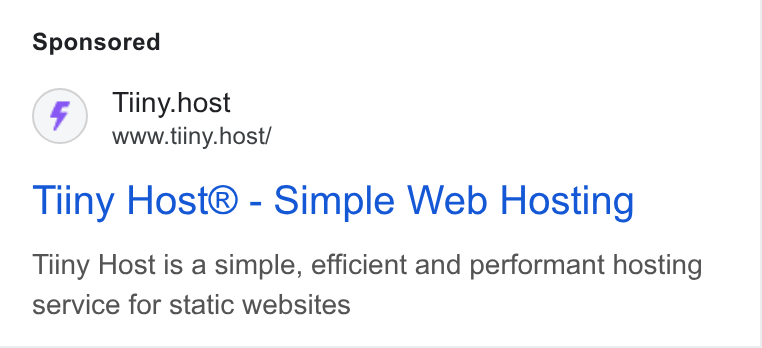
- Sponsored Tiiny.host www.tiiny.host/ Tiiny Host® - Simple Web Hosting
- Audience
- Individuals or small businesses looking for straightforward web hosting for static websites, indicated by the phrase "Simple Web Hosting" and "service for static websites."
Why it works. States the product category and single benefit in the headline so anyone searching for simple site hosting self-qualifies on sight.
Directly stating the product's core benefit in the headline: "Tiiny Host® - Simple Web Hosting" Write your search ad headline as brand plus category plus one benefit word, nothing more.
- Running
- 65 days (longevity = it's converting)
- Hook
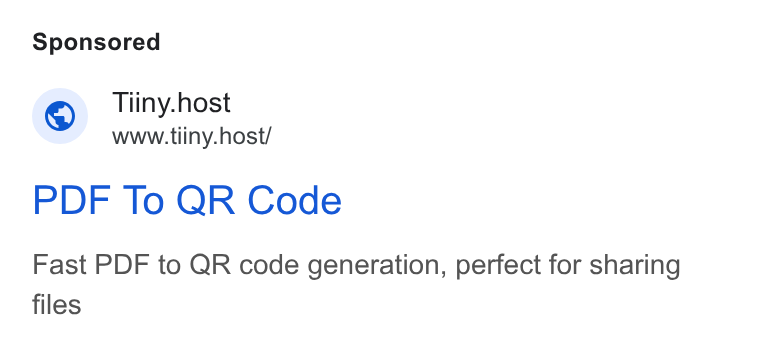
- Sponsored Tiiny.host www.tiiny.host/ PDF To QR Code
- Audience
- Individuals or businesses who frequently need to share PDF files and are looking for a quick and easy method to do so, indicated by the phrase "perfect for sharing files."
Why it works. Matches a narrow search intent, letting anyone converting a PDF to a shareable QR code find the exact feature by name.
Clear product naming and benefit statement: The ad prominently displays "PDF To QR Code" and describes it as "Fast PDF to QR code generation, perfect for sharing files." Turn your most specific product feature into a literal search headline that mirrors how users phrase that exact need.
Show 3 more ads
- Running
- 64 days (longevity = it's converting)
- Hook
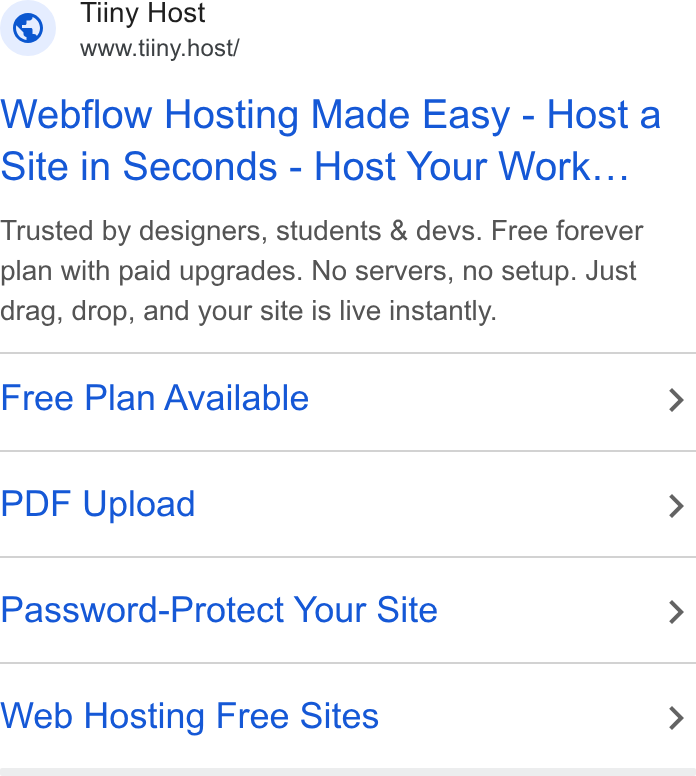
- Webflow Hosting Made Easy - Host a Site in Seconds - Host Your Work..." + a blue globe icon and the text "Tiiny Host www.tiiny.host/"
- Audience
- The text 'Trusted by designers, students & devs' and 'Webflow Hosting' targets individuals involved in web design and development.
Why it works. Targets Webflow users specifically by name and promises seconds-fast hosting, turning a niche export problem into a one-line pitch.
Headline: "Webflow Hosting Made Easy - Host a Site in Seconds - Host Your Work..." Name the specific platform or file type your audience exports from directly in your headline, paired with a concrete speed claim.
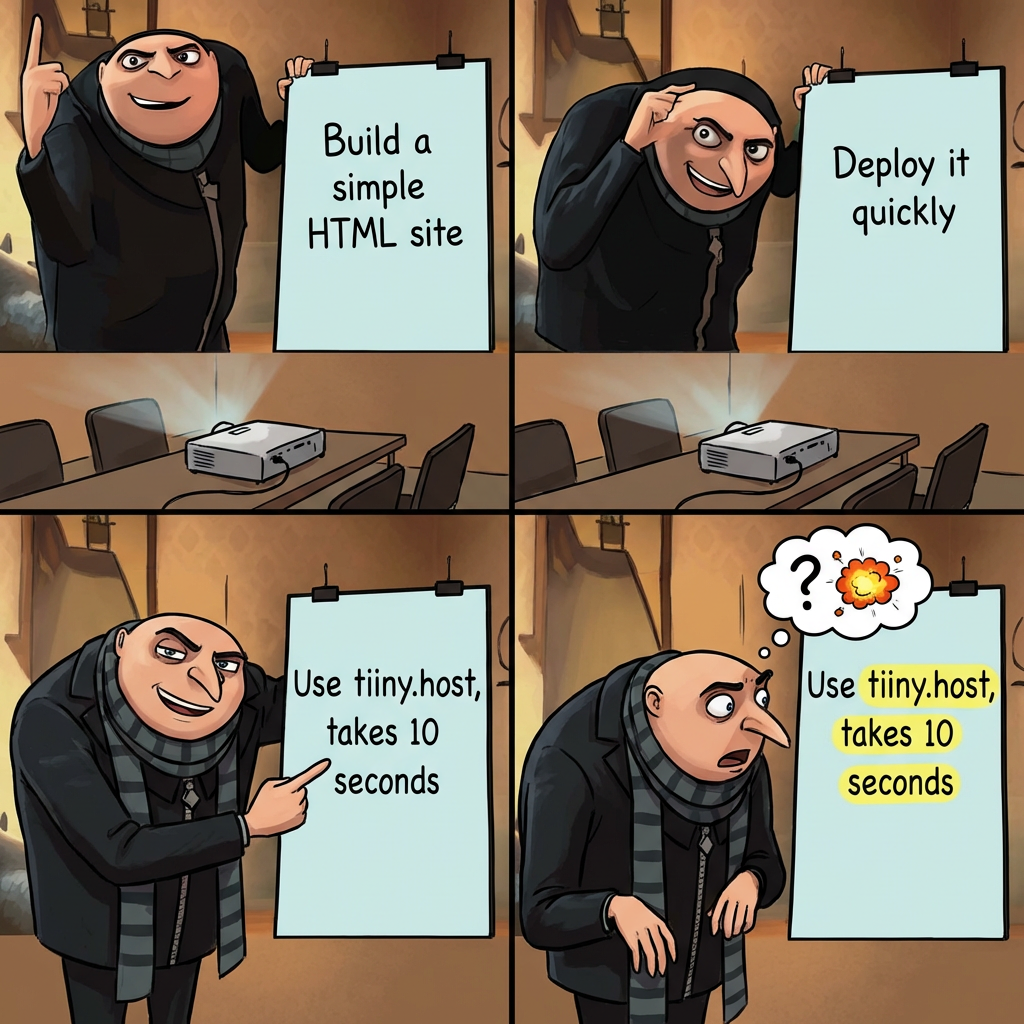
- Running
- 44 days (longevity = it's converting)
- Hook
- Gru pointing up with a mischievous smile, holding a sign that reads "Build a simple HTML site"
- Audience
- Individuals who build simple HTML sites and need quick deployment, indicated by the specific problem and solution presented.
Why it works. Opens with a task every hobbyist coder recognizes, then rides a familiar meme format so the Tiiny Host punchline lands without explaining the product first.
Utilizing a well-known meme format: The entire creative is structured as the 'Gru's Plan' meme. Pick a meme with a built-in setup-then-twist structure and let panel one state your audience's actual task verbatim.
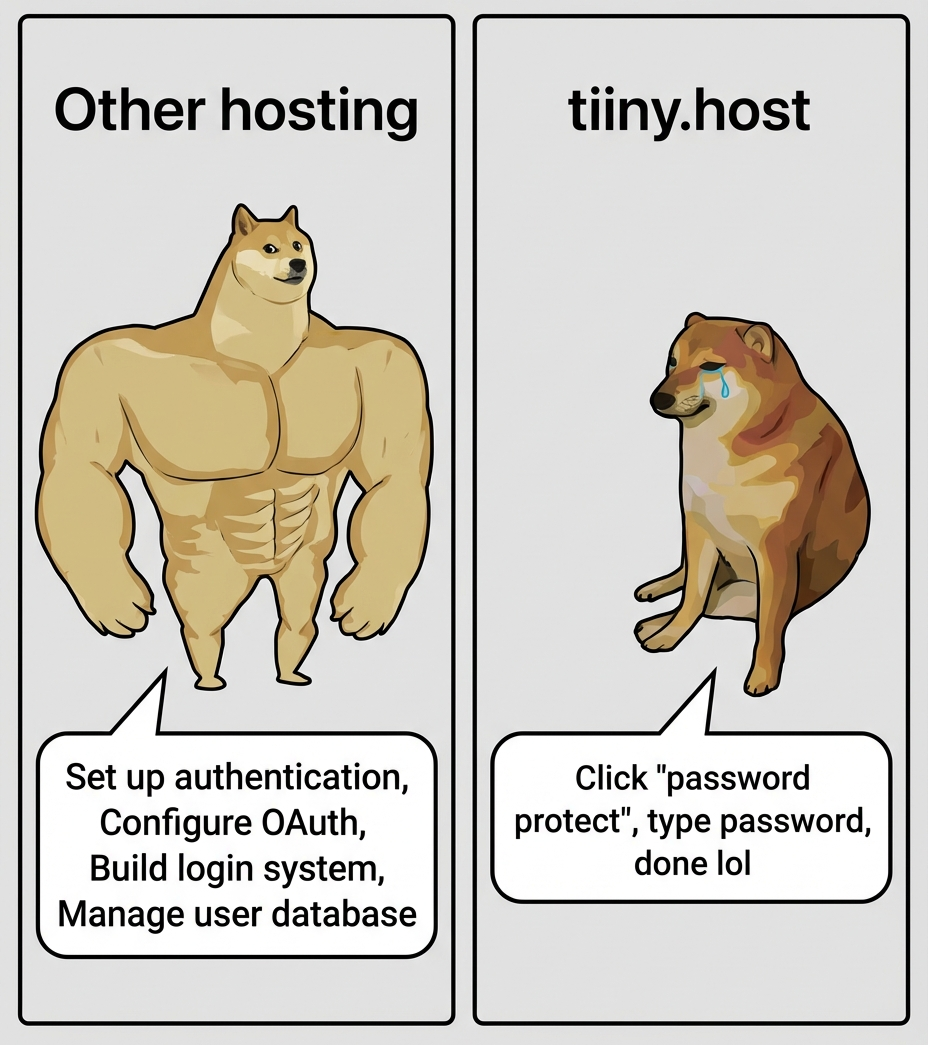
- Running
- 44 days (longevity = it's converting)
- Hook
- Image split into two panels. Left panel has "Other hosting" at the top and a muscular doge meme character below. Right panel has "tiiny.host" at the top and a crying cheems meme character below.
- Audience
- Developers or individuals who need to host content and understand technical terms like 'authentication', 'OAuth', 'login system', and 'user database'. The use of meme culture also targets a younger, tech-savvy audience.
Why it works. Pairs a muscular meme character with 'other hosting' and a crying one with tiiny.host's own name, flipping the usual chad or virgin joke so the underdog brand reads as the win.
Visual contrast using a popular meme format: The left panel shows a muscular doge with the text "Other hosting" and a speech bubble detailing complex tasks like "Set up authentication, Configure OAuth, Build login system, Manage user database". The right panel shows a crying cheems with "tiiny.host" and a speech bubble stating "Click 'password protect', type password, done lol". Use the chad versus virgin meme format but assign your own brand to the losing character, then let the punchline reverse expectations.
08 The playbook
The channels are not separate. They are one system where each stage feeds the next. Here is the read, then the plays to run tomorrow.
The inferred playbook
The loop runs on free, narrow SEO and LLM-referral pages that capture people already trying to solve one small task, and the founder's personal audience does the rest of the convincing.
The use-case pages and emerging Gen AI referral traffic feed a free tier that lets anyone try the drag-and-drop workflow before signing up for anything.
Roughly 2 million cumulative signups and around 70,000 new signups per month, per the founder's public claims, suggest the free tier itself, not a sales process, is the primary growth engine, with paid Tiny/Solo/Pro/Pro Max tiers converting only a slice of that base.
Dig deeper+2▾
Nothing in this data shows a lifecycle email sequence or in-product upgrade nudge distinct from the small email channel share, so the path from free-tier hobbyist to paying customer looks thin relative to the top-of-funnel volume.
what share of the roughly 70,000 monthly new signups convert to a paid Tiny/Solo/Pro/Pro Max plan, how many of the 2 million cumulative signups remain active, and the volume moving through the FirstPromoter affiliate program.
One-Task Landing Pages
The proofTiiny Host's top organic pages are not a blog, they are narrow "verb plus file-type" pages, a PDF-to-link page and a resume-to-link page among them, together pulling roughly 30% of organic-traffic share, second only to the homepage.
The adaptationList the exact one-sentence jobs customers already ask about in support tickets or DMs ("turn my X into a Y"), then build one standalone page per job titled to match the literal phrase, not a generic features page. First step: draft the page for the single most-asked task from your last batch of support messages before touching anything else.
Cost: $0 · Time to signal: months · Works pre-PMF: yes, provided the task the page promises is already something you can deliver by hand.
Tactic-Dump Reddit Posts
The proofThe founder's own r/EntrepreneurRideAlong post listing every tool used to build the product scored 126 upvotes, a plain resource list, not a pitch.
The adaptationWrite a post in the single subreddit most relevant to your actual buyer, not a generic startup forum, listing the specific tools and vendors behind your product as a resource for other builders, mentioning your own product once in passing rather than pitching it. First step: draft the tool list from what you already use, before writing anything else.
Cost: $0 · Time to signal: days · Works pre-PMF: yes, conditional: works only in build-in-public-friendly subreddits, and reads as spam (with ban risk) if the product mention isn't genuinely incidental.
Time-Boxed Lifetime Deal
The proofA $59 lifetime-hosting deal, seeded through a homepage countdown widget and a single Reddit post, brought in over $1,000 in 3 days per the founder's own account.
The adaptationCap a founder's-rate or lifetime deal at a fixed number of seats (the founder used 100), build one countdown or seats-remaining widget on your own homepage, and post it once in the specific community where your real users already gather, mirroring that fixed-seat, fixed-price framing at whatever number your margins can sustain forever. Treat this as a one-time, launch-funding mechanic rather than a monthly promo, since running it repeatedly on the same audience burns the scarcity that makes it work.
Cost: under $500 · Time to signal: days · Works pre-PMF: yes, conditional: only credible if the product already works end-to-end for the first buyers, since a lifetime price locks in support obligations permanently.
Failure-to-Traction Threads
The proofThe founder's post "I applied to YC. Rejected. Tried to raise from Angels. Ghosted. Still scaled to a $500K+ ARR SaaS with: Reddit, SEO, Twitter" pulled 874 likes and 46,769 views, his best-performing post in this data.
The adaptationDraft your own three-line rejection-to-traction sequence, what specifically failed, then the plain channel names that actually produced results, however small, and post it from your personal account rather than a brand account. The mechanism: naming exact channels and admitting exact rejections outperforms polished founder-story prose. First step: write down what has already failed and the smallest real traction number you have to back it up.
Cost: $0 · Time to signal: days · Works pre-PMF: conditional, needs at least one real number to cite or the post reads as empty complaining.
Meme-Format Comparison Ads
The proofTiiny Host's Meta library (24 total ads as of 2026-07-27) leans on recognizable meme templates, a Gru-pointing meme captioned "Build a simple HTML site" and a Drake-reject meme dismissing "MANUAL DEPLOYMENT," both flagged as proven-winner creative.
The adaptationTake your single strongest before/after contrast, the painful old workflow versus your product's one-click version, and drop it into two or three widely recognized meme templates run as low-spend image ads, testing the same contrast across formats before writing any new copy. Start with whichever meme format is most recognizable in your own feed, since template familiarity is what makes the joke land instantly.
Cost: under $500 · Time to signal: days · Works pre-PMF: conditional, only credible once you have one real before/after to joke about, so it needs a working product to demo. Not transferable at an earlier stage: the volume of meme-ad testing and years of compounding use-case pages assume existing traffic and creative budget that a zero-user founder won't have yet, so start with the three zero-cost plays above and treat paid meme testing as a later-stage addition once there's real traffic to retarget.
You just read how Tiiny Host does it. Tomorrow it is someone else.
Every morning we take one company that is actually growing and break down where its customers come from: the ads still running after a year, the channel doing the real work, and the play you can run this week.
Systemaic · directional intelligence. Traffic, spend, and reach figures are SimilarWeb-style estimates and qualitative reads of public data, not audited numbers. Built on real public receipts.
// teardowns with a similar GTM motion
sources & receipts (27)
Live ad libraries: meta ad library · linkedin ad library · google ad library
Launch archives: Hacker News: Creating Beautiful HTML Visualizations · Hacker News: Show HN: Super simple static web hosting · Hacker News: Show HN: Ideas to get more clients for freelancers and agenc · Hacker News: We Got Our First Paying Users · Hacker News: Tiiny.host: The simplest way to share your work online · Hacker News: Tiiny.host: The simplest way to host and share your work onl
Researched facts: Founder and CEO: Elston Baretto (also referred to as Philip Baretto in earlier interviews) · Founding and bootstrapped status: Tiiny Host (legally Tiiny Labs Ltd.) was built solo star · Funding status: No public funding rounds; company has raised $0 and remains fully bootstra · HQ location: London, England, UK (Tiiny Labs Ltd.) · $6K MRR / 33-month bootstrapping milestone: Documented growth to $6K MRR at the 33-month m · Revenue milestone (Oct 2024): Tiiny Labs Ltd. hit $387.2K in annual revenue in October 202 · User count milestone (Nov 2025): Described in press release as 'the static website hosting · Pricing - Free plan: 1 active project, no custom domain/subdomain, ~3MB storage, unlimited · Pricing - Tiny plan: $5/mo billed annually ($60/yr) or $9/mo billed monthly; 1 active proj · Pricing - top tier plan and MCP availability: Paid plans range from Tiny ($5/mo) through S · AI Chrome extension launch: On Nov 26, 2025, launched a Chrome extension enabling one-clic · AI agent publishing positioning: Marketed itself as giving AI agents the ability to publis
Community threads: Hacker News: HN commenter recommends tiiny.host as a lightweight alternative in a thread a · Trustpilot (CA): Negative Trustpilot (Canada) review accuses Tiiny Host of a bait-and-swit · Trustpilot: Positive Trustpilot review praises Tiiny Host's simplicity for publishing stat · Indie Hackers: Tiiny Host founder's Indie Hackers launch log: first paying user came from · Indie Hackers: Founder update on Indie Hackers explains Tiiny 2.0's branded-subdomain feat · DEV Community: Developer complaint (via dev.to/SaaSHub) that Tiiny Host's deployment model
Traffic, spend, and revenue figures are estimates as noted in the report; the links above are the primary public artifacts.