- 01Rank on a rival's alternative searches
- 02Reuse one visual hook across paid and organic
- 03Route paid clicks to a quiz, not the homepage
- 04Name the audience's unspoken objection, not your features
01 Snapshot
The one-glance read on who they are and how they grow. Each point is verifiable from the receipts above.
A freemium AI interactive-story and roleplay app (200+ story games across romance, fantasy, sci-fi, thriller) monetized through subscriptions and Taleys, its in-app credit currency.
Organic-led, running on branded and competitor-alternative SEO plus scattered TikTok/Instagram activity, after a large paid-search chapter went dark.
≈217,300 monthly visits (+41.3% over the trailing 3 months) as of 2026-07-30; $25,351 publicly reported MRR across 872 paying subscribers (~$29 blended ARPU).
A single blog post ranking #1 for "character ai alternatives" is doing more current acquisition work than the ads or social accounts, both of which have gone quiet.
02 How it unfolded
The order the channels came online. Sequence is strategy: what they did first, and what they layered on once demand existed.
03 Traffic & channel mix
Estimated demand, the channel split behind it, and the keywords and referrers doing the work. Directional modeling, not audited analytics.
Talefy pulls an estimated 217,300 monthly visits, up 41.3% over the trailing 3 months as of 2026-07-30. The data available covers total volume only: no channel-level split, keyword-volume figures, or referrer/competitor list was captured beyond the ranking positions covered in Organic Content below, so this section can't responsibly claim a dominant-channel breakdown beyond what's shown there.
04 Organic content
The specific pages earning their organic search traffic, and the pattern behind why they rank. Adapt the format, not the topic.
Talefy's top organic pages split between two utility surfaces and one piece of competitor-facing content. The /characters directory (30.2% of organic traffic) and /generate-story tool (22.7%) are product-adjacent utility pages that rank on their own function, while a blog post titled "best character-ai-alternatives-in-2026" (7.7%) is a comparison page aimed squarely at a rival's audience. That post lines up with the site's #1 ranking for "character ai alternatives" and #2 for "talk to ai characters," meaning Talefy is intercepting people actively searching for substitutes to a better-known competitor rather than only competing on its own brand name (it also ranks #1 for "talefy" itself). A genre-niche category page for anime chat rounds out the top five, suggesting the SEO strategy leans on both broad utility pages and narrow genre/competitor angles rather than one content type alone.
Top pages by organic traffic
05 Channel map
Not traffic share. How much weight the growth system actually puts on each channel, with a one-line read on the role it plays.
What drove growth
06 The creative doing the work
Each exhibit shows the actual asset, an X-ray of why it works, a status, and a play you can adapt. This is the heart of the teardown.
Talefy's Google Ads library holds roughly 200 ads (a directional, collection-capped count) under advertiser "AIceberg Labs, Inc.," Talefy's Delaware-incorporated operating entity. None of them show as active as of 2026-07-30: the real activity window ran from August 2025 to January 2026, when the longest creatives ran 120-133 days before the whole library went quiet, so there is no current test wave to report, only a closed chapter.
The three longest-running creatives from that window:
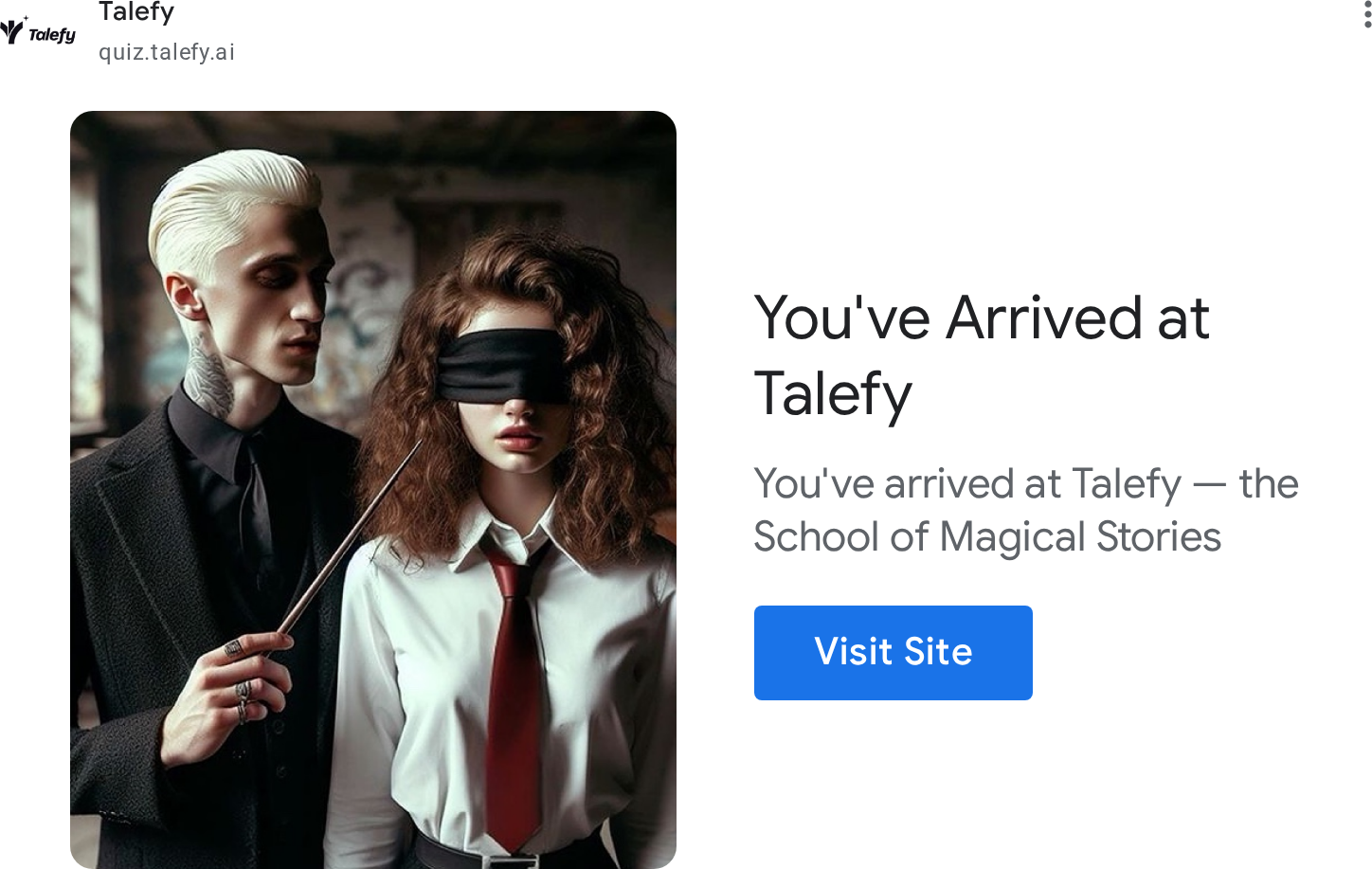
- Hook: "You've arrived at Talefy, the School of Magical Stories," over an image of a white-haired mentor figure holding a wand opposite a blindfolded woman. Why it works: it borrows a Hogwarts-adjacent fantasy frame and pairs it with a mentor/student power dynamic and a blindfolded vulnerability cue, curiosity bait that never narrates the plot. Run this play: expanded as Play 2 below.
- Hook: "Unrestricted Story Adventures, You've Arrived at Talefy" (blue text headline). Why it works: it names the specific frustration AI-roleplay users have with mainstream chat apps (content filters) directly as the value prop, instead of describing features. Run this play: expanded as Play 4 below.
- Hook: branded "Sponsored" text ads reading "Talefy | Official Site, AI Story Generator" pointing to a quiz.talefy.ai landing subdomain. Why it works: it intercepts users already searching "Talefy" or generic "AI story generator" queries and routes them to a lighter-friction quiz path rather than the homepage. Run this play: expanded as Play 3 below.
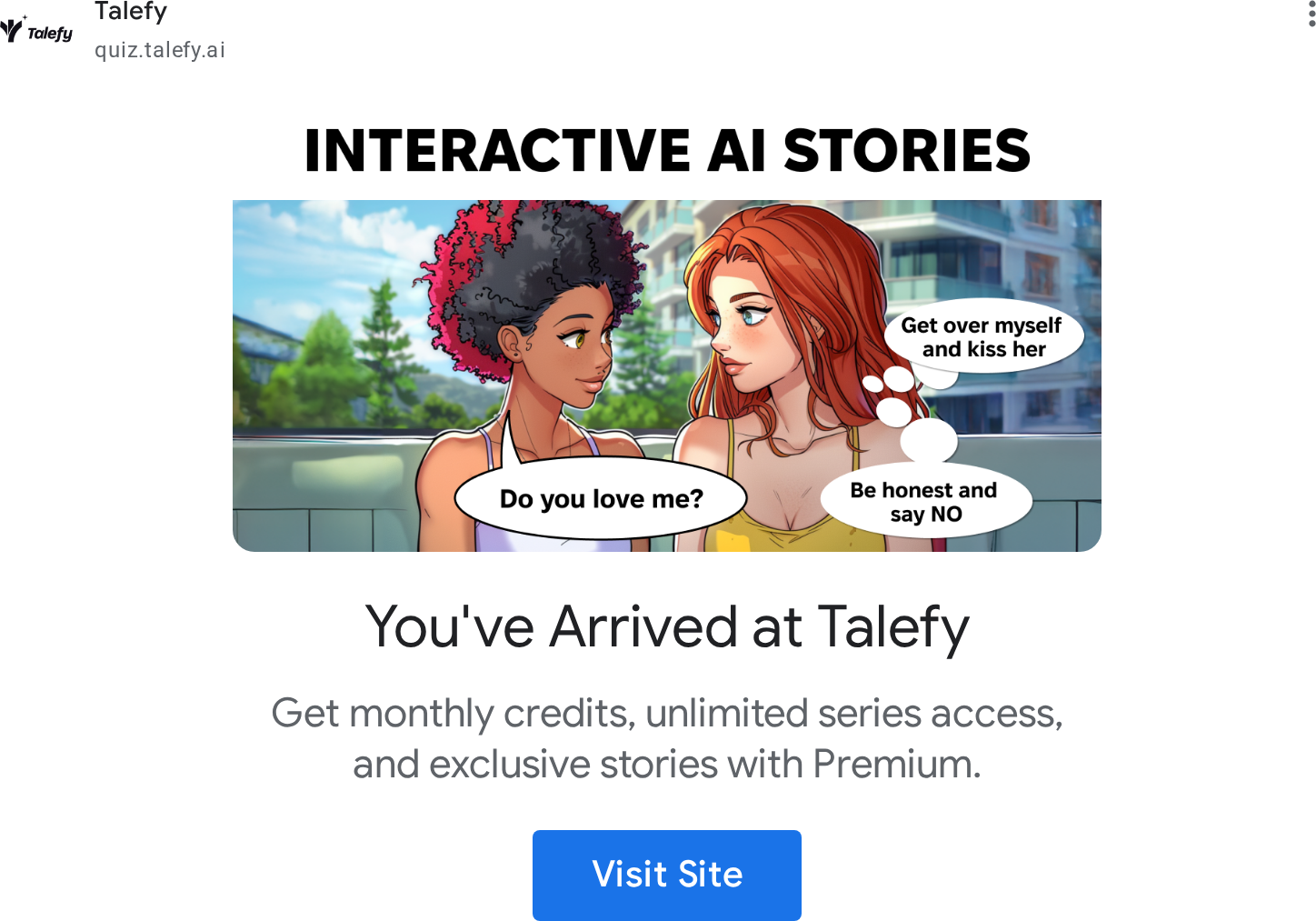
- Running
- 133 days (longevity = it's converting)
- Hook
- Visual: A white background with a black logo and text 'Talefy' and 'quiz.talefy.ai' in the top left corner. Text: "INTERACTIVE AI STORIES"
- CTA / offer
- Visit Site
- Audience
- Individuals interested in interactive storytelling, AI, and mobile games, indicated by the visual of two animated women with speech bubbles presenting choices, and the text 'INTERACTIVE AI STORIES'.
Why it works. A minimal logo-plus-tagline card that leads with the unfamiliar phrase interactive AI stories to make readers pause and ask what it means.
Visual demonstration of interactive choice: The central image shows two animated women with speech bubbles offering different dialogue options like "Do you love me?", "Get over myself and kiss her", and "Be honest and say NO." Test a plain white background ad with just your logo and a one-line category-defining tagline to see if curiosity alone drives clicks.
- Running
- 123 days (longevity = it's converting)
- Hook
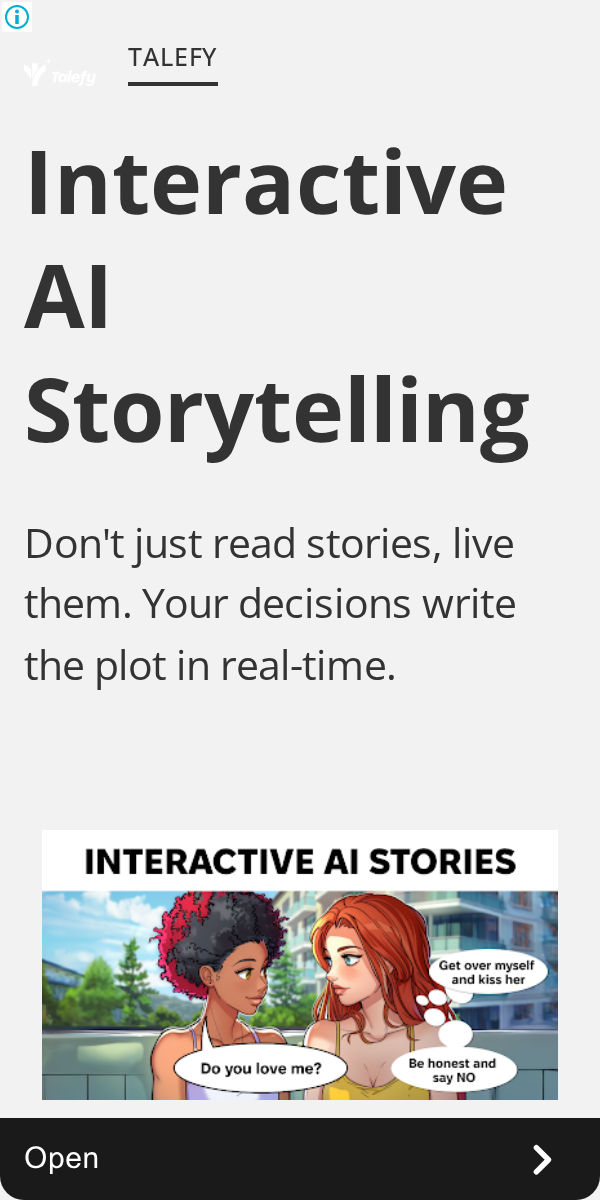
- Visual: A light gray background with a small blue 'i' icon in the top left corner, and the word "TALEFY" underlined in black text. Below it, the word "Talefy" in a white, stylized font with a small white bird-like logo. Text: "TALEFY" and "Interactive AI Storytelling".
- CTA / offer
- Open
- Audience
- Individuals interested in interactive entertainment and AI, evidenced by the phrases "Interactive AI Storytelling" and "Your decisions write the plot in real-time."
Why it works. A branding-first asset pairing the app icon with the category label, aimed at readers scanning search results for name recognition.
Headline and sub-headline: "Interactive AI Storytelling" followed by "Don't just read stories, live them. Your decisions write the plot in real-time." Run a simple icon-plus-category-label creative to build recall before testing message-driven variants.
- Running
- 94 days (longevity = it's converting)
- Hook
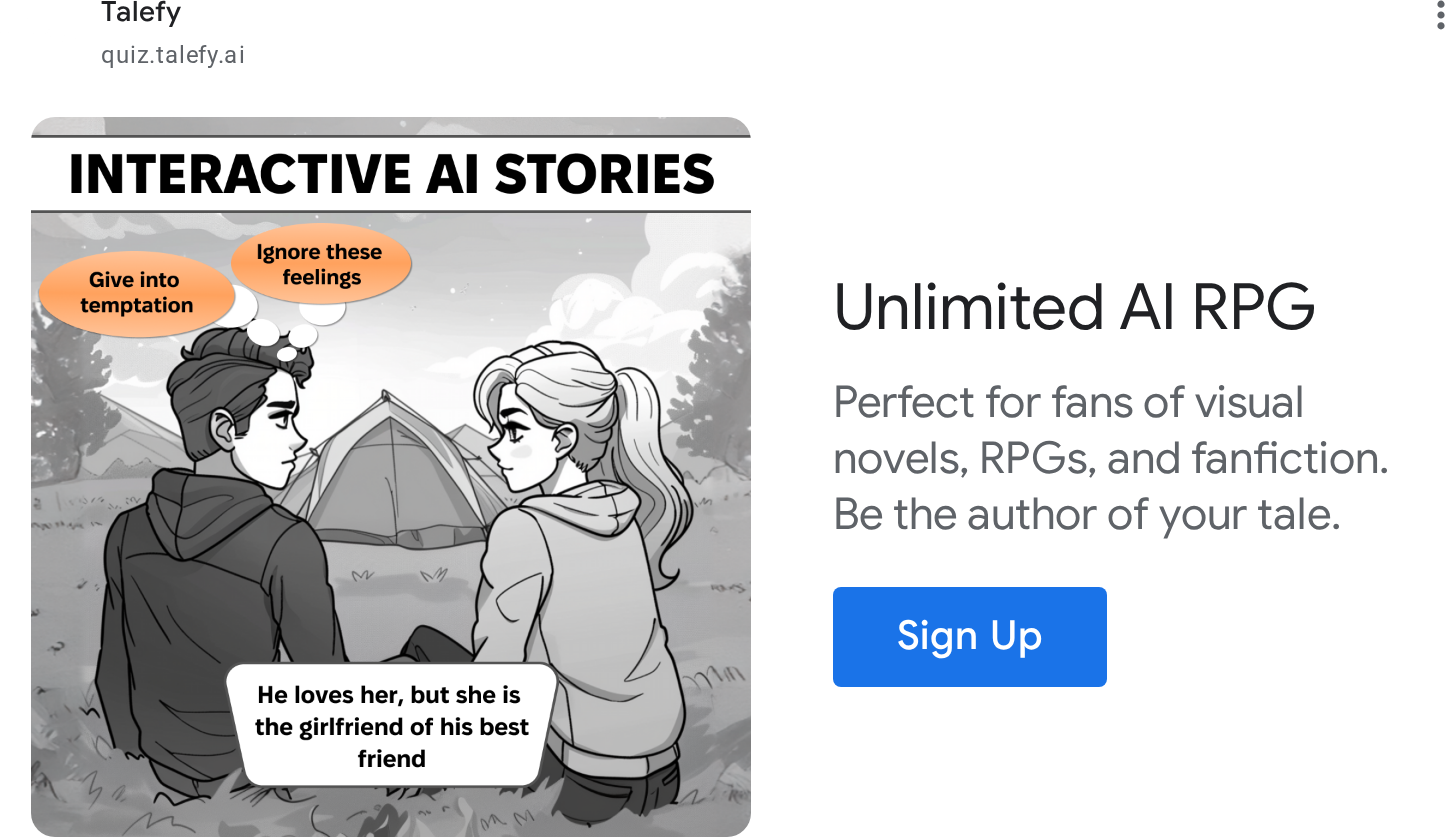
- Visual: A black and white illustration of a man and a woman sitting outdoors near a tent, with thought bubbles above the man's head. On-screen text: "Talefy", "quiz.talefy.ai", "INTERACTIVE AI STORIES", "Give into temptation", "Ignore these feelings".
- CTA / offer
- Sign Up
- Audience
- Fans of "visual novels, RPGs, and fanfiction" as stated in the ad copy, and those interested in interactive storytelling.
Why it works. Turns the interactive-choice mechanic itself into the ad by showing a couple's dilemma with two tappable-feeling options.
Presenting a moral dilemma with clear choices within the creative itself, as shown by the thought bubbles "Give into temptation" and "Ignore these feelings" over an illustration of a man and woman. Illustrate one relatable two-option dilemma from your own product and caption each option as literal on-screen text.
Show 6 more exhibits
- Running
- 72 days (longevity = it's converting)
- Hook
- Visual: A man with white hair and a black suit holds a thin rod, looking at a woman with curly brown hair and a black blindfold, wearing a white shirt and red tie. On-screen text: "Talefy quiz.talefy.ai"
- CTA / offer
- Visit Site
- Audience
- Individuals interested in fantasy, role-playing, interactive stories, or magical themes, indicated by the imagery and the phrase 'School of Magical Stories'.
Why it works. Uses an ambiguous, high-tension fantasy image (blindfolded woman, man with a rod) with only the brand name, betting the visual alone drives curiosity clicks.
Mysterious and evocative imagery (visual: man with white hair, woman with blindfold, holding a rod). Test a single dramatic, unexplained image with just your logo overlaid, no headline, to see if visual intrigue alone earns clicks.
- Running
- 67 days (longevity = it's converting)
- Hook
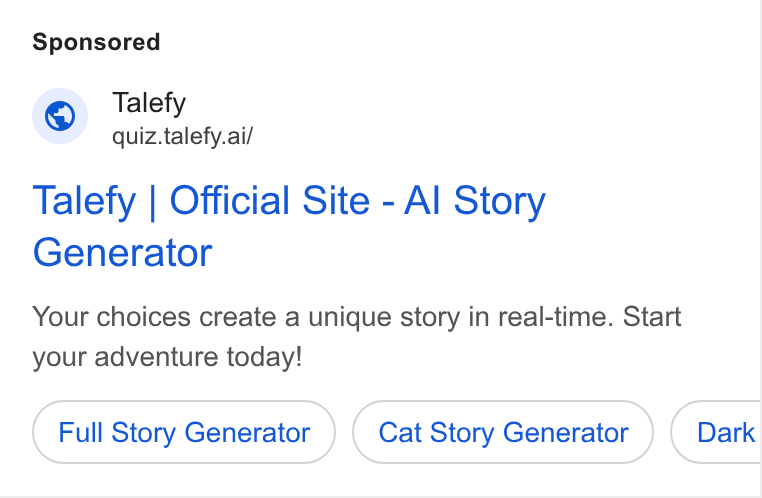
- Sponsored Talefy quiz.talefy.ai/ Talefy | Official Site - AI Story Generator
- CTA / offer
- Start your adventure today!
- Audience
- Individuals interested in interactive storytelling, AI applications, and creative writing, indicated by the 'AI Story Generator' and 'Your choices create a unique story' text.
Why it works. A search-ad title built for intent-matching, reassuring legitimacy to readers actively searching for AI story tools.
Clear headline and sub-headline: 'Talefy | Official Site - AI Story Generator' and 'Your choices create a unique story in real-time. Start your adventure today!' Include Official Site in your search ad title when your category has copycat apps, to reduce click hesitation.
- Running
- 131 days (longevity = it's converting)
- Hook
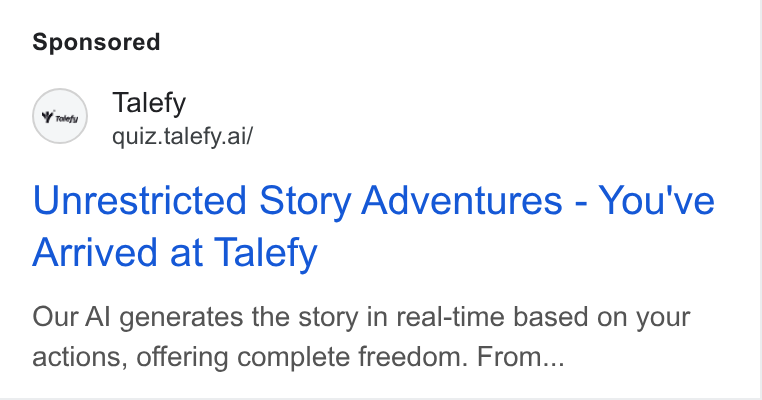
- Visual: The word "Sponsored" at the top, followed by a small circular logo with "Talefy" written inside, and the text "Talefy" and "quiz.talefy.ai/". Below this, the blue headline "Unrestricted Story Adventures - You've Arrived at Talefy".
- Audience
- People interested in interactive storytelling and AI-powered games, indicated by the text "AI generates the story" and "Story Adventures".
Why it works. Leads with a freedom-from-restriction promise aimed at readers who feel other story apps censor or limit them.
Lead with a bold, benefit-driven headline: "Unrestricted Story Adventures - You've Arrived at Talefy". Name the specific limitation your competitors impose and promise your product removes it directly in the headline.

- Hook
- On-screen text: "Step into a Harry Potter world where you decide what happens". Visual: A man with white hair, wearing a dark, ornate suit, sitting on a dark, ornate chair. A chat bubble appears with text: "I wanna hear your beg real sweet for me. I really want to taste you."
- Audience
- The explicit mention of "Harry Potter world" and the characters "Draco" and "Hermione" clearly targets fans of the Harry Potter series, particularly those interested in fanfiction or alternative romantic pairings within that universe. The suggestive dialogue targets an audience interested in romantic or mature interactive storytelling.
Why it works. Pairs a nostalgic franchise setting with a spicy, out-of-character chat line to show Harry Potter fans the app writes mature, personalized romance scenes.
Opening with a bold, suggestive character dialogue at 0:00: "I wanna hear your beg real sweet for me. I really want to taste you." Open with your story's most provocative line of character dialogue, matched to a setting your audience already loves.

- Hook
- 0:00-0:03, a young woman with long brown hair, wearing a grey coat over a white shirt and striped tie, looks directly at the camera with a serious expression. Text overlay reads: "I'm Hermione and I want to tell you my story."
- Audience
- Fans of the Harry Potter universe (specifically 'Dramione' fan fiction), individuals interested in dramatic romance stories, and those who enjoy interactive narrative games.
Why it works. Uses a first-person address from a known Harry Potter character to signal the app lets fans role-play inside canon relationships, not just read generic fiction.
Character-driven narrative hook (0:00-0:03): "I'm Hermione and I want to tell you my story." Have your AI character introduce itself by name and promise to share its own story directly to camera.

Who amplifies them
Amplification splits cleanly into three tiers. The brand runs its own accounts (@TalefyApp on X, @talefy_app on Instagram and TikTok). Founder Stanislav Mamaiev, Founder & CEO, posted personally on LinkedIn about winning "Best Traction" at a Warsaw startup competition, framing traction itself as the company's pitch. A small cluster of unaffiliated creators, @thebandwillis, @masssugumusic, @oceanalleyband, @oneheartisok, and @baby.meyy, independently reposted the same "so hard to lose when in love" romance-drama template tagged to Talefy, each drawing low engagement individually but together suggesting a trend or sound got picked up beyond the brand's own posting. No named subreddit or community presence surfaced in the evidence.
07 Organic & video
The organic content engine: the videos, creator posts, and community presence earning attention without paid spend.
The brand's own TikTok and X posts favor genre-specific teaser hooks over feature announcements. The best-performing tracked clip, posted 2025-08-12, opens with "Not just a story, an interactive journey into your favorite magic worlds with Talefy!" and drew 2,090 engagements, well above the January-2025-era clips that mostly sat in single digits. A January 2025 X post took a stat-drop, build-in-public angle instead of a hook: "Talefy is: 31,750 active users in the last 7 days, 199 characters, 53 series and 57 stories," and pulled 54 likes, more than most of the account's feature-update tweets. On TikTok, the recurring format is a text-overlay narrative montage: a costumed or animated character paired with a first-person or cliffhanger caption ("I'm Hermione and I want to tell you my story," "Beware, looks can be deceiving"), the same pattern that shows up in the paid "School of Magical Stories" creative above.
08 Affiliate & partners
How the brand turns creators and partners into a tracked, variable-cost acquisition channel, and how the program is structured.
Talefy launched an in-app referral program via its own X account in July 2024 ("Invite friends, play more and enjoy"), a user-to-user invite loop rather than a paid creator-affiliate structure. There is no TikTok Shop listing, no Rewardful/PartnerStack link, and no ambassador-recruitment post in the evidence, so the small creator wave described above reads as organic trend participation rather than a commissioned affiliate army.
09 The playbook
The channels are not separate. They are one system where each stage feeds the next. Here is the read, then the plays to run tomorrow.
The inferred playbook
Talefy's growth motion runs on a rival-alternative SEO wedge and a scattered social footprint, propped up by a large but now-dormant paid chapter and a lightweight referral loop.
the "character ai alternatives" comparison post and its #1/#2 keyword rankings let Talefy intercept a better-known competitor's switcher-intent audience without ad spend, the clearest working lever in the current evidence.
roughly 200 Google ads ran hard from August 2025 to January 2026 but sit at zero active as of 2026-07-30, so paid contributes little to the acquisition mix.
Dig deeper+4▾
the July 2024 in-app referral program and the organic creator reposts substitute for a formal affiliate program, but neither is instrumented as a scaled channel in the evidence.
the free tier's 100 monthly Taleys funnels into Premium tiers priced at $19.99, $26.99, and $46.99 (per App Store listings, still framed as beta pricing) plus à la carte credit packs from $1.99 to $10.99, and the $29 blended ARPU across 872 subscribers lands between the two lower tiers.
Google Play and App Store reviews describe bugs that erase paid credits and a login mismatch between web purchases and the app itself, a real leak against a subscriber base whose ARPU depends on those same paid credits staying intact.
the Taleys-to-paid conversion rate off the free tier, the referral program's invite-to-paid conversion, and any spend or compensation behind the TikTok creator reposts.
Rank on a rival's alternative searches
The proofTalefy's single "best character-ai-alternatives" blog post ranks #1 for "character ai alternatives" and #2 for "talk to ai characters," pulling in switcher-intent visitors searching for a substitute to a better-known competitor.
The adaptationIdentify the single dominant incumbent in your own category and publish one long, specific "[incumbent] alternatives" comparison page reviewing five to eight real options, including your own product, rather than a generic feature list, since that exact query pattern carries high buying intent against comparatively low competition next to the incumbent's own brand terms. Start by drafting the page around the literal phrase "[incumbent] alternatives," publishing it on your own domain, and submitting it through Search Console.
Cost: $0 · Time to signal: months · Works pre-PMF: yes, provided your product genuinely belongs on that alternatives list.
Reuse one visual hook across paid and organic
The proofTalefy's mentor-and-blindfolded-student "School of Magical Stories" image ran across its longest Google ads while TikTok creators independently riffed on the same Harry-Potter-adjacent framing in organic clips.
The adaptationPick one recognizable trope from your own niche, build a static ad and a short organic clip around the identical headline and visual hook, and post the clip first for free before spending on the image. Start by drafting one headline shared by both formats, posting the clip first, and only paying to run the static version once the clip's organic engagement confirms the hook lands.
Cost: $0 · Time to signal: days · Works pre-PMF: yes.
Route paid clicks to a quiz, not the homepage
The proofTalefy's longest-running Google ads (up to 133 days) send clicks to a dedicated quiz.talefy.ai lander instead of the main site, a lighter-friction entry point ahead of the app itself.
The adaptationBuild a 3-5 question quiz-style lander for your own category (a "which [X] fits you" format) as the destination for a paid ad instead of a homepage or pricing page, since answering a question commits the visitor before you ask for an email. Start by building the quiz on a free tool, pointing one ad at it, and comparing signup rate against sending the same traffic straight to your homepage.
Cost: under $500 · Time to signal: weeks · Works pre-PMF: yes, provided there's a real segmentation question worth asking.
Name the audience's unspoken objection, not your features
The proofTalefy's "Unrestricted Story Adventures" headline speaks directly to the content-filter frustration AI-roleplay users have with mainstream chat apps rather than describing what the product does.
The adaptationFind the single biggest emotional objection your target user has with the closest incumbent, not a missing feature, and write one ad or landing headline that names it verbatim instead of describing your own product. Start by pulling the recurring complaint phrase from your own or the incumbent's negative reviews and using that exact phrase as the headline.
Cost: $0 · Time to signal: days · Works pre-PMF: yes.
Seed one remixable format to a handful of small creators
The proofFive unaffiliated small TikTok accounts (@thebandwillis, @masssugumusic, @oceanalleyband, @oneheartisok, @baby.meyy) independently reposted the same romance-drama template tagged to Talefy, spreading beyond the brand's own account without a visible paid or affiliate arrangement.
The adaptationPackage one specific piece of your product (a character, scenario, or before/after) into a short remixable format, a caption pattern or a specific line of dialogue, and send it to five or six small creators in your niche who already post that format, asking only for a tag rather than a scripted sponsorship. Start by finding those creators through a hashtag search in your niche, sending them the template plus one example clip, and offering free product access for one post.
Cost: under $500 · Time to signal: weeks · Works pre-PMF: conditional, it works best once you have at least one scenario or character genuinely worth remixing. Not transferable at an earlier stage: Talefy's ~200-ad Google library and dedicated quiz-subdomain infrastructure required real ad spend and dev resources a pre-revenue founder won't have yet, and its referral program only works once there's an existing paying user base to seed invites from.
You just read how Talefy does it. Tomorrow it is someone else.
Every morning we take one company that is actually growing and break down where its customers come from: the ads still running after a year, the channel doing the real work, and the play you can run this week.
Systemaic · directional intelligence. Traffic, spend, and reach figures are SimilarWeb-style estimates and qualitative reads of public data, not audited numbers. Built on real public receipts.
// teardowns with a similar GTM motion
sources & receipts (15)
Live ad libraries: google ad library
Researched facts: Talefy was founded in 2023 in the United States and is categorized as an AI-Powered Intera · Legal operating entity behind Talefy is AIceberg Labs, Inc., incorporated in Delaware, wit · Talefy's founder and CEO is Stanislav Mamaiev: Stanislav Mamaiev, Founder & CEO · RocketReach's org data lists Stanislav Mamaiev as Founder/CEO of Talefy plus two other nam · Talefy is a small team, per RocketReach's headcount estimate: ~12 employees · Talefy's Android app (com.talefyaiapp) has been downloaded 22 thousand times and has been · Talefy's iOS app is distributed by AIceberg Labs, Inc. across iPhone, Mac (Apple Silicon), · TrustMRR (Stripe-API-verified revenue tracker) lists Talefy's trailing 30-day revenue: $23 · TrustMRR's founder-level aggregate page for the Talefy account shows lifetime revenue and · ProvenMRR (a competing revenue-verification aggregator) shows different MRR and customer-c · Talefy's content library size is consistently described across its own site and app store · A hands-on third-party review describes Talefy's core interaction model as distinct from c
Community threads: Google Play (developer response to reviews): Google Play users report the app freezing/for · Apple App Store (developer response to review): An App Store reviewer paying roughly $30/m
Traffic, spend, and revenue figures are estimates as noted in the report; the links above are the primary public artifacts.