- 01Co-author content with practitioners your buyers already follow
- 02Turn domain-expert angels into buyer-facing proof on your pricing page
- 03Publish one flat-rate entry tier to pipeline future enterprise upsells
- 04Seed your partner program with advisors in your buyer's trust chain, not end users
01 Snapshot
The one-glance read on who they are and how they grow. Each point is verifiable from the receipts above.
Sequence (sequencehq.com) is a B2B quote-to-revenue platform unifying configure-price-quote (CPQ), billing, and revenue recognition for high-growth SaaS, fintech, and AI companies, backed by a $20M Series A closed December 2025.
Founder-led, with customer acquisition driven by serial-exit credibility and CFO/RevOps operator-network referrals.
100+ customers and $1B+ in annual invoice volume automated as of the December 2025 Series A announcement; approximately 20,000 estimated monthly visits as of May 2026 (the latest estimate month).
Three LinkedIn ads active as of July 2026 all run the "Sequence 2.0" product announcement, concentrating paid reach on the B2B finance buyer's home platform.
Sequence's growth runs on the serial-exit credibility of co-founders Riya Grover (CEO) and Eamon Jubbawy, which earns warm CFO/RevOps introductions and drives a 59.8% direct-traffic share, a durable structure nearly impossible to manufacture without comparable founder history.
02 How it unfolded
The order the channels came online. Sequence is strategy: what they did first, and what they layered on once demand existed.
03 Traffic & channel mix
Estimated demand, the channel split behind it, and the keywords and referrers doing the work. Directional modeling, not audited analytics.
Traffic sources
Top search keywords
| Keyword | Volume | Weight | CPC |
|---|---|---|---|
| sequence series a | 400 | - | |
| sequence | 58k | $1.56 | |
| sequence ai | 440 | $6.44 | |
| sequqnce ai billing | 160 | - | |
| sequence company nyc | 160 | - |
Closest competitors by audience
Sequence drew an estimated 30,000 monthly visits in March 2026 and roughly 20,000 by May 2026, the latest month of traffic data, a 33.6% slide over those 3 months. The most likely explanation is normalization from the press-driven traffic spike that accompanied the December 2025 Series A announcement, though the evidence does not confirm the driver and the trend warrants watching.
Direct traffic at 59.8% dominates the mix, consistent with buyers who discover Sequence via advisor referrals or operator Slack communities and arrive at the site having already decided to evaluate. Organic search contributes 23.6%, referrals 9.7%, social organic 4.2%, and Gen AI channels 2.8%.
The keyword evidence reinforces the brand-first picture: every top-ranked term is branded ("sequence company" at position 1, "sequence ai" at position 1, "sequence pricing" at position 2, "sequence startup" at position 3). Category-intent queries that a CFO actively shopping for billing software would run are absent from the evidence. The broad term "sequence" draws approximately 57,600 web-wide monthly searches, but the overwhelming majority of that demand is unrelated to the company.
Closest traffic-overlap competitors include getsequence.io, a personal finance automation product sharing the brand name and creating persistent search confusion, and saasoptics.com, now absorbed into Maxio, a direct category peer in the SaaS billing space.
04 Organic content
The specific pages earning their organic search traffic, and the pattern behind why they rank. Adapt the format, not the topic.
The organic footprint is almost entirely navigational. SEO-tool keyword tracking attributes an estimated 211 monthly organic visits to the five top pages, with the homepage capturing the large majority and the pricing and about pages splitting most of the remainder. (The 23.6% organic share in the channel mix implies a larger all-in organic total, roughly 4,700 visits; the two figures come from different measurement tools, and the keyword-tracked count covers only the search clicks the tool can attribute to specific pages.) Two blog posts round out the top five: one that frames Stripe positively (a credibility-by-association angle toward the dominant incumbent) and one announcing the Series A. The pattern is a company ranking for its own name across the core conversion pages, investing nothing in content designed to pull in buyers who have not already heard of Sequence. For a platform competing against Chargebee, Maxio, and Stripe Billing, this surface creates no organic discovery beyond buyers already searching by brand.
Top pages by organic traffic
05 Channel map
Not traffic share. How much weight the growth system actually puts on each channel, with a one-line read on the role it plays.
What drove growth
06 The motions doing the work
For founder-led SaaS the breakdown shifts from ads to traction: where the first users came from, how the founder grows it in the open, and the compounding organic surface.
Sequence's earliest customers came through co-founder relationships and operator networks, with no public launch moment traceable in the evidence.
Co-founder Eamon Jubbawy previously co-founded Onfido, an AI identity verification company acquired by Entrust for $650M in 2024, where he served as President. Co-founder and CEO Riya Grover previously founded Feedr, a corporate food-tech platform sold to Compass Group. These exits gave both co-founders pre-existing access to CFO-tier decision-makers before Sequence existed, compressing what would otherwise be a years-long credibility-building stage into day-one warm introductions.
The December 2025 Series A brought in angel investors who hold CFO titles at Decagon, Klaviyo, and Wise alongside institutional backers Andreessen Horowitz (a16z), 645 Ventures (lead), Firstminute Capital, and Passion Capital. The CFO angels function as buyer-facing proof: people with the exact title Sequence is selling to have personally bet on the problem.
Dig deeper+2▾
Before the Series A closed, Sequence co-produced a "Principles of Revenue Management" content series in 2024 with Kyle Poyar, a SaaS pricing practitioner, and Gokul Rajaram, a widely-followed operator and investor. The series positioned Sequence inside the reading diet of the finance operator audience before the company's traction became public.
The December 2025 close carried the headline metrics: 100+ customers (including Cognition, Bridge, Runway, and incident.io, among others visible at sequencehq.com/customers), $1B+ in annual invoice volume automated, and approximately 10x ARR growth over roughly 10 months. Those numbers drove the traffic spike whose unwinding the decline charted in Traffic & Channel Mix most likely reflects.
Riya Grover, co-founder and CEO, is Sequence's primary public voice, and LinkedIn is the platform where that activity shows up most clearly in the evidence.
A Grover LinkedIn post announcing the approximately 10x ARR growth figure put the company's headline metric directly in front of the CFO and RevOps operators who follow her, and Series A press coverage carried the same figure onward, amplifying the signal within the exact buyer community Sequence is selling to. For enterprise B2B at this price point, one milestone post reaching the right 500 practitioners delivers more pipeline than a broad content calendar at ten times the volume.
The "Principles of Revenue Management" series with Poyar and Rajaram (detailed in Launch & Traction) is the most differentiated build-in-public move in the evidence. By attaching the Sequence brand to content published under trusted practitioners' names, the company earned distribution inside an audience that had no prior reason to read Sequence's own content.
Dig deeper+1▾
The evidence points to LinkedIn as the single platform where founder-led activity translates into buyer-community reach. No evidence of high-cadence personal posting on X exists for either co-founder in connection with this company, and no Reddit activity tied to sequencehq.com is present in the scraped data.
The SEO surface is branded and thin, as Organic Content establishes; the strategic question is whether the current motion compounds or stays flat.
Sequence holds top organic positions for its own name but has not built the comparison or alternative pages that would intercept buyers shopping the category. A competitor building "Chargebee alternative" or "CPQ for SaaS" pages could pull those buyers before Sequence enters their consideration set. The blog runs milestone announcements rather than functioning as a search surface.
The referral and partner program at sequencehq.com/partners is the most structurally important owned-channel investment in the evidence. For enterprise billing, fractional CFOs, RevOps agencies, and accounting firms sit directly in the buyer's trust chain; a referred deal from any of these advisors closes faster and at lower acquisition cost than any inbound content play, making early partner-program investment a rational bet over SEO for a company at this stage and price point.
Dig deeper+1▾
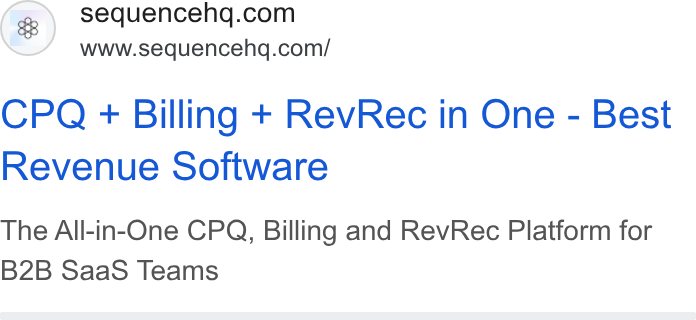
Three LinkedIn ads are active as of July 2026, all running the Sequence 2.0 announcement. A single Google text ad, which the creative evidence shows carried the hook "CPQ + Billing + RevRec in One" alongside the self-proclaimed label "Best Revenue Software" (the company's own marketing claim, not independently verified), ran for 16 days in April 2026 and is no longer active. Across both platforms, the paid motion is a product-moment push to a defined audience, not sustained demand generation or category-keyword capture.
07 Paid ads
This founder-led SaaS also runs paid acquisition. Here are the live ads doing the work, each with the X-ray and a play you can adapt.
- Running
- 16 days (longevity = it's converting)
- Hook
- The image displays a small circular icon with a geometric pattern, next to the text "sequencehq.com" and "www.sequencehq.com/". Below this, in large blue text, is "CPQ + Billing + RevRec in One - Best Revenue Software".
- Audience
- B2B SaaS Teams, indicated by the explicit mention "B2B SaaS Teams" at the bottom of the ad.
Why it works. Targets finance leads scanning search results who are juggling separate CPQ, billing and RevRec tools and signals one platform can replace all three.
Headline stating core functionality and benefit: "CPQ + Billing + RevRec in One - Best Revenue Software" List the 2-3 tools your product replaces directly in your search headline, then pair it with a superlative claim like Best X Software.
08 The playbook
The channels are not separate. They are one system where each stage feeds the next. Here is the read, then the plays to run tomorrow.
The inferred playbook
Sequence's acquisition loop starts in the co-founders' relationship networks, converts through CFO-community word-of-mouth, and closes on a direct inbound motion that leaves no content trail for external analysis.
The co-founders' exits and the CFO-tier angel roster create an initial audience of finance and RevOps practitioners who have pre-existing reasons to trust Sequence's product judgment. This is a structural starting advantage, not a repeatable acquisition channel a later-stage operator can build from scratch.
The website functions as a validation tool for buyers who arrive pre-sold. The published Growth tier at $799/mo for companies under $1M ARR creates a self-qualification path for early-stage inbound; the bespoke Core tier ($1-10M ARR) and Scale tier ($10M+ ARR) above it are structured to expand with customer revenue, converting small early-stage deals into larger ones as customers grow.
Dig deeper+3▾
Each named customer logo and the invoice-volume figures cited in the Snapshot feed the same credibility loop: every proof point makes the next enterprise sales conversation easier in a CFO community where social proof travels through relationships.
The absence of any category SEO surface means Sequence is invisible to buyers who run a search before asking their network. A competitor building comparison content would intercept those buyers before they reached the founder-network referral stage.
Free-to-paid conversion across the three pricing tiers, churn, CAC, and blended ARPU for the bespoke Core and Scale segments.
Co-author content with practitioners your buyers already follow
The proofSequence co-produced the "Principles of Revenue Management" series in 2024 with Kyle Poyar and Gokul Rajaram, two practitioners with large followings among CFO and RevOps operators. The series reached Sequence's target buyer segment via existing practitioner readership rather than through Sequence's own content audience.
The adaptationIdentify 2-3 writers, analysts, or community operators your target buyer already follows. Propose a co-authored research piece where you contribute proprietary data or a framework and they contribute their distribution. You reach an audience that has no reason to discover your content directly; they get material their readers value. Start by identifying one practitioner, finding the data angle only you can bring (an internal benchmark, an anonymized pattern from your customer base, a framework drawn from your product's specific use cases), and pitching a specific question with their name on the output.
Cost: $0 · Time to signal: months · Works pre-PMF: conditional (a practitioner will only co-author if your product thesis is credible enough to attach their name to; having two or three reference customers helps make the pitch)
Turn domain-expert angels into buyer-facing proof on your pricing page
The proofSequence's Series A angel investors include CFOs from Decagon, Klaviyo, and Wise. These names in the funding announcement signal to a prospective CFO buyer that people holding their title have personally evaluated the product and backed the category.
The adaptationWhen raising any round, target one or two angels who hold the exact job title you are selling to, not only for the check but for the credibility the association transfers. Surface them on your pricing page or about page with their company affiliation. Start by reviewing your current cap table and advisor list: if any existing angels or advisors hold the title of your target buyer, find a natural place to display their company affiliation in a way that reads as endorsement rather than investor disclosure.
Cost: $0 · Time to signal: weeks (to update the site once the angel is on board) · Works pre-PMF: conditional (requires at least one named domain-expert angel holding the buyer's title)
Publish one flat-rate entry tier to pipeline future enterprise upsells
The proofSequence's Growth tier is priced at $799/mo and capped at companies under $1M ARR. A startup billing $600K can self-qualify and buy without a discovery call, then cross naturally into the bespoke Core tier as it grows, turning an early-stage self-serve customer into a warm expansion deal.
The adaptationIf your core motion is bespoke enterprise, publish one named, flat-rate tier bounded by a hard size ceiling so smaller companies can self-qualify and land without consuming your sales team's time. The ceiling does the qualification work; the price does the anchoring. Start by identifying where your current enterprise customers were 12-18 months before they became a good fit, then price the entry tier to serve companies at that earlier stage, with terms that make upgrading the natural next step as they grow.
Cost: $0 · Time to signal: weeks · Works pre-PMF: conditional (requires a product stable enough for self-serve deployment without intensive onboarding)
Seed your partner program with advisors in your buyer's trust chain, not end users
The proofSequence runs a referral and partner program at sequencehq.com/partners, targeting the advisors who sit in CFOs' decision process: fractional CFOs, RevOps consultants, and implementation specialists who shape the shortlist before a buyer ever reaches your site.
The adaptationFor B2B SaaS with a committee-driven buying cycle, the highest-converting referral partners are external advisors your buyers consult before shortlisting vendors. A fractional CFO who recommends your platform to three portfolio companies delivers three warm deals. Start by examining your existing customers' LinkedIn profiles to identify the consultants and advisors in their professional networks. Reach out to those advisors with a simple flat-fee referral arrangement and get the first two or three referrals through manual agreements before building infrastructure.
Cost: $0 to initiate, referral fee on closed deals · Time to signal: months · Works pre-PMF: conditional (requires at least two reference customers whose results give advisors something credible to point to)
Run a job-title-targeted LinkedIn push for your next major product milestone
The proofSequence's three active LinkedIn ads as of July 2026 all promote the Sequence 2.0 launch on the one platform where the company's finance-buyer persona spends professional attention, a concentrated product-moment push rather than broad awareness spray.
The adaptationWhen shipping a major product update, run a 2-4 week LinkedIn campaign targeted by job title and company revenue band at the specific persona you are selling to. LinkedIn's job-function and seniority filters can reach "Head of Finance" or "VP Operations" at companies in your target size range for a defined spend. Start by defining the three job titles you most want to reach, writing one ad that names the specific problem the update solves for that person, and testing a $500-1,000 budget against that tight audience before scaling.
Cost: under $500 to test · Time to signal: weeks · Works pre-PMF: conditional (requires a product update specific enough to make a credible announcement to practitioners; a generic "we launched" message will not resonate with a CFO audience) Not transferable at an earlier stage: The 60% direct-traffic share underpinning Sequence's acquisition loop traces directly to the serial-exit credibility of its co-founders, a structural advantage a first-time founder cannot manufacture. The co-authored content play, the partner-seeding play, and the named entry tier all transfer at any stage with no prior exits required; the domain-expert angel play requires at least one relevant angel on the cap table, which is harder to secure without some early traction to show.
You just read how Sequence does it. Tomorrow it is someone else.
Every morning we take one company that is actually growing and break down where its customers come from: the ads still running after a year, the channel doing the real work, and the play you can run this week.
Systemaic · directional intelligence. Traffic, spend, and reach figures are SimilarWeb-style estimates and qualitative reads of public data, not audited numbers. Built on real public receipts.
// teardowns with a similar GTM motion
sources & receipts (8)
Live ad libraries: linkedin ad library · google ad library
Launch archives: Hacker News: Moderna mRNA sequence released to GitHub [pdf] · Hacker News: 13-Year-Old Makes Solar Power Breakthrough by Harnessing the · Hacker News: SSH Escape Sequences · Hacker News: Sequence diagrams, the only good thing UML brought to softwa · Hacker News: Swimlanes.io – generated editable sequence diagrams · Hacker News: Oxide Computer Company: Initial boot sequence
Traffic, spend, and revenue figures are estimates as noted in the report; the links above are the primary public artifacts.