- 01Build a seasonal-moment council, not just a campaign
- 02Turn unsolicited creator praise into a coded ad
- 03Run a pop-up as a content shoot, not a sales channel
- 04Ship a physical object that outlives the transaction
01 Snapshot
The one-glance read on who they are and how they grow. Each point is verifiable from the receipts above.
Adaptogen and magnesium-infused sparkling waters and "Zero Proof" mocktails (Recess Mood) positioned as a calm alternative to alcohol and caffeine, backed by a $30M Series B led by CAVU Consumer Partners in October 2025 (per public reporting).
Creator-led and organic-led, with no visible paid-ad footprint.
~94,615 monthly site visits (+15% over the last 3 months) as of July 2026, a 159,997-follower owned Instagram account, and distribution reported at roughly 18,000 retail doors as of October 2024 (per public reporting).
Recess's organic engine is really a branded-search moat, its homepage alone captures 88% of tracked organic traffic because years of earned-media-driven UGC, not content SEO, taught people to search "recess" directly.
02 How it unfolded
The order the channels came online. Sequence is strategy: what they did first, and what they layered on once demand existed.
03 Traffic & channel mix
Estimated demand, the channel split behind it, and the keywords and referrers doing the work. Directional modeling, not audited analytics.
Traffic sources
Top search keywords
| Keyword | Volume | Weight | CPC |
|---|---|---|---|
| recess | 78k | $1.35 | |
| recess drink | 3.8k | $0.82 | |
| recess drinks | 2.6k | $0.83 | |
| recess beverages | 760 | - | |
| recess hemp drink | 290 | - |
Closest competitors by audience
Recess pulls an estimated 94,615 monthly visits, up 15% over the last 3 months. Search Organic leads the mix at 51.4%, Direct traffic follows at 20%, and Affiliate at 12.9% rounds out the top three; the rest, display ads, email, referrals, AI-assistant referrals, and paid and organic social combined, totals under 16%. The 20% direct share paired with a 78,020/month search volume for the bare term "recess" points to real brand recall built through years of earned media rather than a paid-acquisition habit. The next-highest ranked terms, "recess drink" (3,800/mo) and "recess drinks" (2,620/mo), are still branded searches, not category terms like "non-alcoholic beverage," confirming demand here is name-driven. Among the listed competitors, thezeroproof.com is the closest direct rival in the zero-proof mocktail space, drinklmnt.com is an adjacent, much larger wellness-hydration brand that signals the aspirational ceiling of the category, and impossibrew.co.uk shows the category has international non-alcoholic-beer competition outside the US.
04 Organic content
The specific pages earning their organic search traffic, and the pattern behind why they rank. Adapt the format, not the topic.
Recess's organic footprint is thin on content and thick on brand: the homepage alone pulls an estimated 51,909 organic visits a month, 88% of all their tracked organic traffic, with the next four pages (the Zero Proof shop, the "find-your-recess" product finder, the Mood shop, and the shop-all collection) splitting a combined 6% or less. There is no blog, comparison-page, or glossary pattern here, every one of their top five ranked keywords ("recess," "recess drink," "recess mood," etc.) is a branded term. This is a navigational-search pattern, not a content-marketing engine: people already know the name and type it in, and the "find-your-recess" quiz page is the one true product-discovery tool doing SEO work beyond brand terms.
Top pages by organic traffic
05 Channel map
Not traffic share. How much weight the growth system actually puts on each channel, with a one-line read on the role it plays.
What drove growth
06 The creative doing the work
Each exhibit shows the actual asset, an X-ray of why it works, a status, and a play you can adapt. This is the heart of the teardown.
No Meta, Google, or TikTok ad-library summary surfaced for takearecess.com in this pull, no active-ad count, no long-running "proven winner" creative to deconstruct. That absence tracks with the brand's history: platform restrictions on advertising hemp-derived products through much of Recess's early life reportedly pushed it toward an organic, creator-UGC-first acquisition model instead of paid media. The eight ad-creative breakdowns collected in this evidence set are all tagged as organic UGC, not paid placements, so they're deconstructed in Organic & Video below rather than here. Use the live Meta and Google links above to check current paid activity directly, since a library this quiet can start running ads at any time.
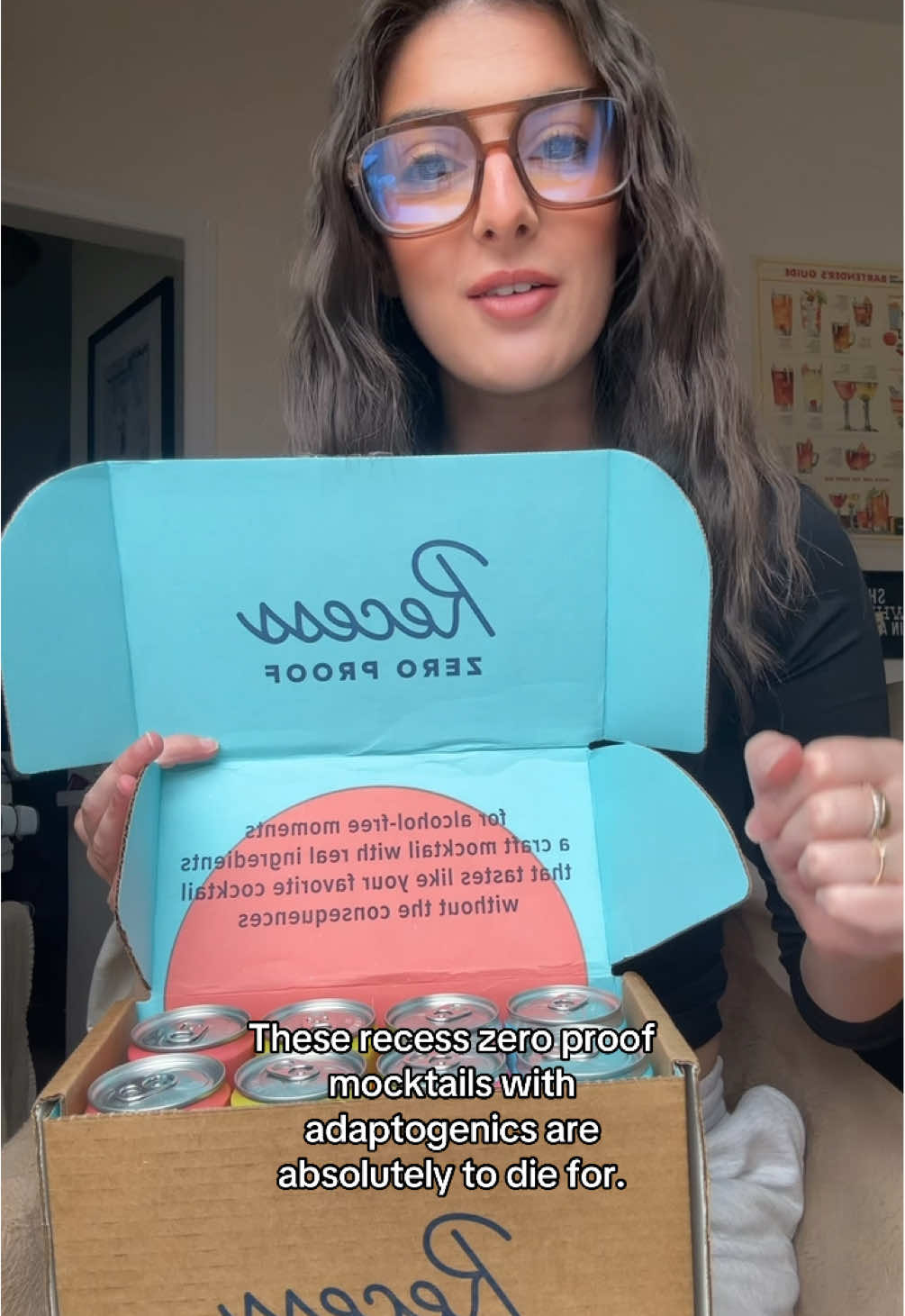
- Hook
- "If you're also a beverage girly," a woman with long wavy brown hair and glasses holds a brown cardboard box with text that is upside down.
- Audience
- The phrase "beverage girly" and the discussion of non-alcoholic options signal a target audience interested in sophisticated, alcohol-free drink alternatives.
Why it works. Uses an unboxing addressed to one self-identified persona to build anticipation around flavor variety before the taste test.
Direct audience address and problem identification (0:00-0:03): "If you're also a beverage girly," Open with "If you're also a [niche identity]," to name your exact customer persona before revealing the product.
product demo
- Hook
- Visual: A close-up shot of the red wheel of a shopping cart, moving from left to right across a blue surface. Audio: Upbeat, light music begins.
- Audience
- Individuals seeking non-alcoholic beverage options that mimic popular cocktails, indicated by 'CRAFT MOCKTAIL PARTY PACK' and '0% ABV' and the 'made with real ingredients that tastes like your favorite cocktail without the consequences' text.
Why it works. Opens on an unusual cart-wheel close-up to plant the product inside a specific retail trip, cueing shoppers where to find it on shelf.
Visual product placement in a recognizable retail context (0:01-0:02, 0:07-0:09, 'COSTCO WHOLESALE' sign). Show your product inside a recognizable retailer's cart or shelf to borrow that retailer's trust and prompt an in-store purchase.
UGC talking-head
- Hook
- A woman in a light pink hoodie is holding a glass with ice, an orange slice, and a drink, looking surprised. A can of 'Recess mood orange vanilla' is on the counter. On-screen text reads: "Mocktail for the summer ✨".
- Audience
- Individuals interested in healthy lifestyle choices, mocktails, and mood-enhancing beverages. The phrase "healthy girl era" and focus on 'mood' and 'focus' signals this.
Why it works. Pairs a surprised-reaction unboxing with a seasonal mocktail label so a non-alcoholic can reads as a summer indulgence.
Unboxing and immediate product focus (0:03-0:06): "Recess just sent me their full sampler pack. And I immediately grabbed the new orange vanilla flavor." Overlay a simple season-specific label like "Mocktail for the summer" on your product shot to reposition it for a seasonal occasion.
Show 1 more exhibit
- Reach
- 13 upvotes · 14 comments · r/sparklingwater
A community is already discussing this in r/sparklingwater. Show up there authentically and answer the thread before a competitor does.
Who amplifies them
The creator roster here is a genuine third-party ecosystem, not brand-account activity: @Mikaela (34,450-engagement TikTok, the clear top performer), @success_sofistory (magnesium/adaptogens framing tagged #MomsofTikTok), and @beingthebestashleyicanbe (sober-friend-group framing) all post unprompted-style UGC. One post from a TikTok account handled @nickiminaj carries the tag #recesspartner but only pulled 18 engagements, far too low to be the globally-famous artist of the same name, more likely a coincidental handle or a small creator, though the #recesspartner tag itself suggests Recess runs some kind of informal creator-partner tagging convention. Creator @itsalyzea openly asked "not a sponsor please give me free drinks," a sign of organic fan pull rather than a paid relationship. On the brand's own Instagram, it credits creator @itsdiorgalarza in a repost of a Recess Mood sampler reel. On Reddit, the amplification is a single organic mention in r/sparklingwater, not a seeded community campaign.
07 Organic & video
The organic content engine: the videos, creator posts, and community presence earning attention without paid spend.
The dominant, best-performing format across the creative breakdowns is the UGC talking-head: a creator holding a can, speaking straight to camera with a curiosity or relatable-problem hook. Mikaela's clip is the standout by a wide margin, 34,450 engagements on a straightforward "25% link in bio too btw" caption tagged #mocktail #recessdrink #adaptogens #nonalcoholicdrink. The brand's own Instagram reel announcing the Costco "zero proof party pack" expansion pulled a modest 158 engagements, tying content directly to the retail milestone. Lower down the pack, creator beingthebestashleyicanbe (31 engagements) frames the drinks as a way to "please everyone in the friend group" who isn't drinking, echoing the relatable-problem hook pattern seen across the set (a nurse-and-mom framing, an "out of office" framing). Notably, there's no owned TikTok account in this evidence, on that platform Recess shows up almost entirely through other people's cameras, not its own.
08 Affiliate & partners
How the brand turns creators and partners into a tracked, variable-cost acquisition channel, and how the program is structured.
No formal affiliate or referral platform (Rewardful, PartnerStack, TikTok Shop) is detectable in the homepage or social evidence, the owned-site scrape shows only links out to Instagram and X. The #recesspartner hashtag on one creator's TikTok post points to an informal creator-tagging convention rather than a structured, trackable ambassador program. That gap is notable given the traffic mix classifies 12.9% of visits as affiliate-driven, a mechanism not visible anywhere in the evidence collected, folded into the gap line below rather than guessed at here.
09 The playbook
The channels are not separate. They are one system where each stage feeds the next. Here is the read, then the plays to run tomorrow.
The inferred playbook
Recess converts years of earned-media brand-building into branded search that lands almost entirely on its own homepage, with unpaid creator UGC as the ongoing top-of-funnel and no visible paid acquisition underneath it.
The homepage capturing 88% of organic traffic and every top-ranked keyword being a branded term (covered above) means demand here is name-recognition-driven, not built by ranking generic category content. Press coverage has quoted founder Benjamin Witte describing the brand's surrealist visual identity as intentionally "making fun of millennial culture and millennial branding" specifically to generate earned media instead of paid reach, which lines up with a search profile built almost entirely on people typing the brand name.
With no paid-ad library and no owned TikTok presence, the entire top-of-funnel outside Instagram runs through unaffiliated creators like the 34,450-engagement Mikaela clip referenced above, a cheap but less controllable engine than paid media.
Dig deeper+2▾
Roughly 18,000 retail doors and a 2025 Costco club-channel debut (per public reporting) sit entirely outside what the 94,615 monthly site visits can explain, meaning the DTC traffic and organic numbers in this teardown likely capture a minority of total company revenue, most of it is happening on shelves this data can't see.
current paid-ad spend or active-ad count, the mechanism behind the 12.9% affiliate-channel traffic share, the DTC-versus-wholesale revenue split, and any subscriber/repeat-purchase rate for the Subscribe & Save program.
Build a seasonal-moment council, not just a campaign
The proofRecess launched a "Dry January Council," an interest group explicitly built to accelerate growth of an already-existing seasonal behavior rather than run a one-off January promo.
The adaptationPick the one seasonal behavior your product already rides (a New Year reset, back-to-school, tax season) and stand up a small owned property around it, a named council or guide page on your own site, not a single social post, so it can be linked back to every year. Start by writing a one-page manifesto for that seasonal moment and posting it from your brand account tagged into the hashtag already trending that month.
Cost: $0 · Time to signal: weeks · Works pre-PMF: yes, provided the seasonal behavior is one your product credibly serves.
Turn unsolicited creator praise into a coded ad
The proofa Recess brand tweet reposted an unpaid mention with "Recess did not pay for this incredible 'endorsement,' but we'll take it," paired with a fresh discount code.
The adaptationSet up a saved search for your brand name on X and TikTok, and the moment an unpaid creator says something quotable, repost it from your brand account within a day with a unique code tied to that mention, turning a stranger's compliment into a trackable acquisition post at zero production cost. Start this month by screenshot-reposting the single best unprompted mention you can find with its own code.
Cost: $0 · Time to signal: days · Works pre-PMF: yes.
Run a pop-up as a content shoot, not a sales channel
The proofRecess's 2021 NYC pop-up gave away free product and a companion zine tied to a "re-entering society" cultural moment, built for brand content rather than revenue.
The adaptationBook one weekend at a local market, coworking lobby, or shared space, bring a small batch of free samples, and require nothing from recipients but a tagged post to receive one, treating the whole event as raw social content rather than a sales event. Start by booking a single Saturday slot and capping it at 100 samples.
Cost: under $500 · Time to signal: days · Works pre-PMF: yes, provided the product is good enough that a stranger will post about a free sample unprompted.
Ship a physical object that outlives the transaction
The proofRecess shipped a free zine with every drink order, giving customers a shareable artifact beyond the product itself.
The adaptationDesign one small, photogenic insert (a foldable card, a sticker sheet, a mini guide) themed to your brand's voice and drop it into your next batch of orders, aiming for something a customer wants to photograph during unboxing. Start with a single-sheet insert run of 200 units.
Cost: under $500 · Time to signal: weeks · Works pre-PMF: yes.
Make the giveaway mechanic recruit a plus-one
The proofa 2024 Recess giveaway asked entrants to tag one travel buddy in the comments to enter, naming five winners, expanding reach through each entrant's own network without paid boosting.
The adaptationStructure your next giveaway so the entry mechanic requires tagging exactly one specific other person, not "tag three friends," keeping the ask low-friction while still doubling impressions per entrant. Start with a small giveaway capped at a handful of winners to keep the cost near zero.
Cost: $0 · Time to signal: days · Works pre-PMF: yes. Not transferable at an earlier stage: the retail-distribution scale (18,000+ doors, the Costco club-channel debut) and the $30M Series B war chest behind Recess's current motion assume leverage a pre-seed founder won't have. Every play above is drawn from the year Recess had none of that.
You just read how Recess does it. Tomorrow it is someone else.
Every morning we take one company that is actually growing and break down where its customers come from: the ads still running after a year, the channel doing the real work, and the play you can run this week.
Systemaic · directional intelligence. Traffic, spend, and reach figures are SimilarWeb-style estimates and qualitative reads of public data, not audited numbers. Built on real public receipts.