- 01Turn a real technical decision into an HN post
- 02Relaunch the same product until it lands
- 03Build one page that names the incumbent
- 04Kill your most common objection in public
01 Snapshot
The one-glance read on who they are and how they grow. Each point is verifiable from the receipts above.
A Kubernetes-based PaaS that deploys apps into a customer's own AWS, GCP, or Azure account, aimed at startups and AI companies, closed a $20M Series A in January 2026.
Founder-led, run through Hacker News posts under the founders' own names and a standing Y Combinator distribution deal.
~22,146 estimated monthly visits as of 2026-07-08; $20M Series A led by FirstMark Capital, announced January 27, 2026; 8 open roles as of 2026-07-08.
As of 2026-07-08, one active Google ad has been running since 2026-05-20, pairing a "Blue/Green Deployments" feature screenshot against plain brand-logo creative.
Porter's growth is structurally tied to Y Combinator, born to solve a problem the founders saw inside their own YC batch and still recruiting through a stacked free-usage deal offered to every new YC cohort, a channel no non-YC competitor can copy directly.
02 How it unfolded
The order the channels came online. Sequence is strategy: what they did first, and what they layered on once demand existed.
03 Traffic & channel mix
Estimated demand, the channel split behind it, and the keywords and referrers doing the work. Directional modeling, not audited analytics.
Traffic sources
Top search keywords
| Keyword | Volume | Weight | CPC |
|---|---|---|---|
| porter dev | 330 | - | |
| the portal software platform nyc | 150 | - | |
| porter devops | 140 | - | |
| porter pricing | 300 | - | |
| porter.run cli | 60 | - |
Closest competitors by audience
Porter draws an estimated ~22,146 monthly visits, down 24.8% over the last three months as of 2026-07-08. Direct traffic dominates the mix at 72.9%, with Search Organic a distant second at 19.3%; the remainder, split across email, display ads, referrals, and social, totals under 8% combined and none of those individually clears 3%. The heavy direct share, paired with the fact that their top organic page is the product login itself (see below), points to a traffic base skewed toward existing users returning to the app rather than fresh prospects arriving cold. The keywords they rank and bid for are almost entirely branded: "porter dev" (330 searches/mo), "porter pricing" (300/mo), and "porter devops" (140/mo), meaning most measurable search demand comes from people who already know the Porter name rather than category-level "Kubernetes PaaS" shoppers. Among the closest competitors, render.com runs the identical "simpler than raw Kubernetes, cheaper than Heroku" pitch that Porter's own comparison content targets directly; northflank.com is a newer Kubernetes-native PaaS chasing the same technical buyer, evidence the niche has gotten more crowded since Porter's 2021 debut; and vercel.com is a broader platform most startups also evaluate, though it competes more on frontend and edge use cases than Porter's own-cloud Kubernetes angle.
04 Organic content
The specific pages earning their organic search traffic, and the pattern behind why they rank. Adapt the format, not the topic.
Porter's organic footprint is small and lopsided: one page, the dashboard login itself, absorbs the vast majority of measured organic-search visits, which reads as existing customers navigating back into the product rather than new-visitor discovery. The one page doing real top-of-funnel work is a direct render-vs-heroku comparison post, part of a thin content set that otherwise includes an origin-story post and a "what is Heroku" explainer. The pattern is narrow and migration-specific rather than broad blogging: they rank for terms like "render deploy" and "render hosting" because the content names a specific rival by name and targets people already in a switching mindset, not generic developer-tool searches.
Top pages by organic traffic
05 Channel map
Not traffic share. How much weight the growth system actually puts on each channel, with a one-line read on the role it plays.
What drove growth
06 Who they’re hiring
Open roles read like a roadmap: the functions they’re staffing show where the company is investing next and what stage it’s at.
8 open roles
07 The motions doing the work
For founder-led SaaS the breakdown shifts from ads to traction: where the first users came from, how the founder grows it in the open, and the compounding organic surface.
Porter's real breakout wasn't its formal launch, it was a follow-up blog post that hit Hacker News on its own two years later.
Porter's founders, Trevor Shim, Justin Rhee (now CEO), and Alexander Belanger (who has since left to found Hatchet, an unrelated company), mentioned a Product Hunt launch on 2021-03-24, then posted "Launch HN: Porter (YC S20), Open-source Heroku in your own cloud" on 2021-04-30, pulling 239 points and 74 comments.
on 2022-04-27, Justin Rhee posted "Why companies move off Heroku (besides the cost)" to Hacker News under his own name, and it hit 275 points and 225 comments, outperforming the original launch and becoming Porter's biggest traffic event in the evidence.
Dig deeper+2▾
between 2022 and 2023 the team kept returning to the same theme on Hacker News: "Migrate from Heroku," "The Heroku Migration Program," "Migrating Postgres from Heroku to RDS," "Does the world need another Heroku?", each a smaller repost of the same positioning rather than a new launch.
on 2024-03-27, Trevor Shim and Justin Rhee returned with "Porter Cloud, a PaaS you can eject," explicitly referencing their original 2021 launch inside the post itself, drawing 15 points, a modest but visible relaunch-until-it-sticks move.
Porter's public voice runs through the founders personally rather than a large following or a company account.
the founder's X account has just 463 followers and posts only around concrete moments, the Product Hunt mention, the HN launch, the funding close, and a 2023-08-10 thread on repositioning Porter for seed-stage founders that drew 662 views.
the highest-leverage public writing is Justin Rhee's engineering posts published straight to Hacker News under his own name, reaching far more people than the X account ever has.
Dig deeper+1▾
every social post in the evidence is tagged to a founder, so the narrative is personal even though a separate company X account exists.
Search organic is a real but secondary channel at 19.3% of traffic, built on a handful of narrow, high-intent pages rather than a broad blog.
the render-vs-heroku page covered above is the clear template, a small content set aimed at migration and comparison intent instead of category-wide developer-tool terms.
as of 2026-07-08, Porter runs 9 total Google ads with only 1 active (first shown 2026-05-20, ~49 days active), rotating between plain brand-logo awareness ("Porter," "porter.run") and blunt value claims like "Deploy Anything, Anywhere" and "Platform as a Service, Reimagined," with one execution surfacing a Blue/Green Deployments feature shot. No Meta or TikTok ad activity appears in the evidence, so the paid budget reads as protecting branded search rather than generating new demand.
08 Paid ads
This founder-led SaaS also runs paid acquisition. Here are the live ads doing the work, each with the X-ray and a play you can adapt.
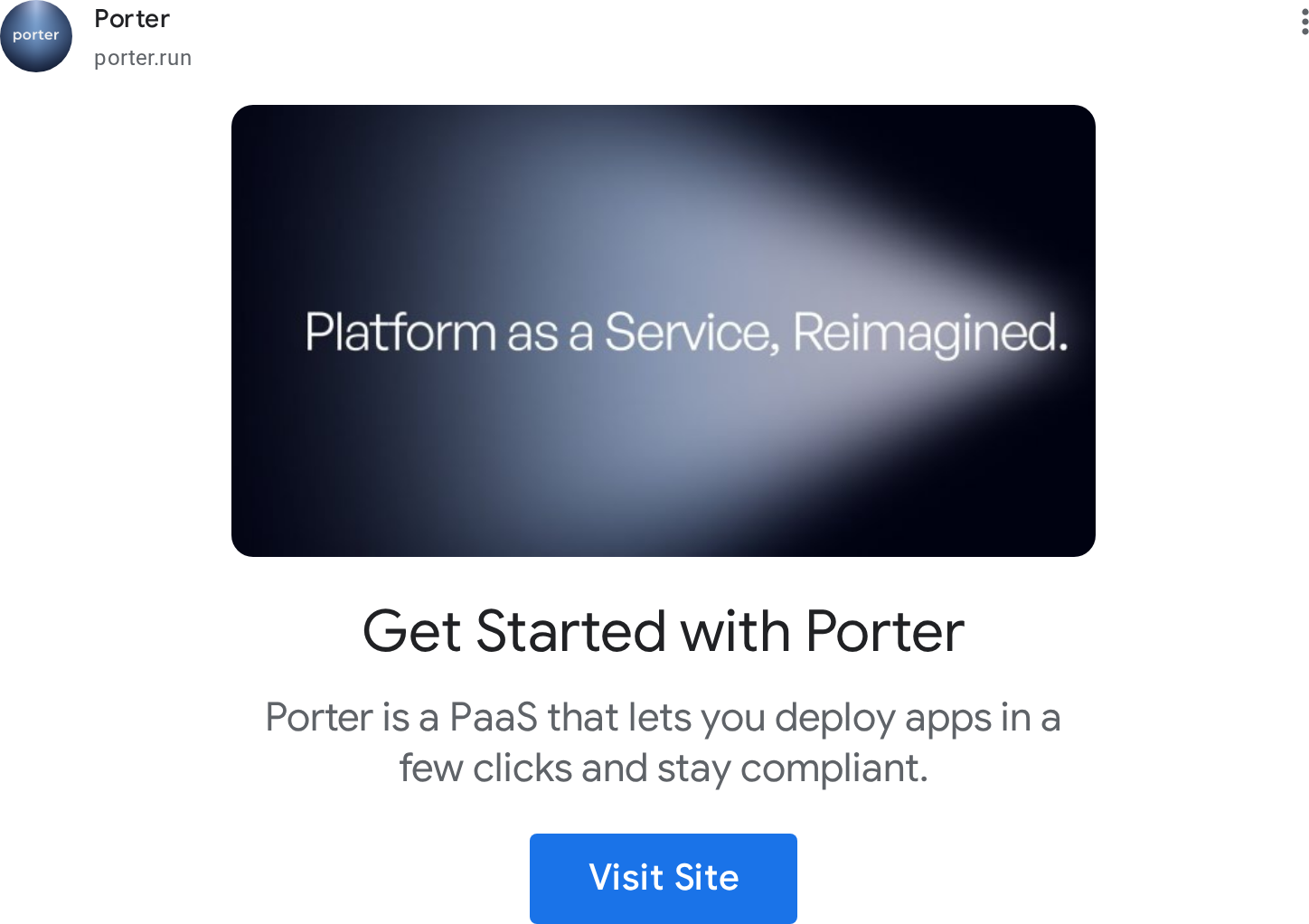
- Running
- 144 days (longevity = it's converting)
- Hook
- Visual: A dark blue circular logo with the word "porter" in white, next to the text "Porter" and "porter.run". Below this, a large rectangular image with a dark gradient background and white text that reads "Platform as a Service, Reimagined.".
- CTA / offer
- Visit Site
- Audience
- Developers, IT professionals, or businesses looking for app deployment solutions, indicated by terms like "PaaS", "deploy apps", and "compliant".
Why it works. Positions Porter against legacy PaaS incumbents by claiming the category needed reinventing, which speaks to teams frustrated with Heroku's limits.
Headline with a bold claim: The large image prominently displays "Platform as a Service, Reimagined.". Name your product as the reimagined version of a category buyers already trust, stating the shift you made instead of listing features.
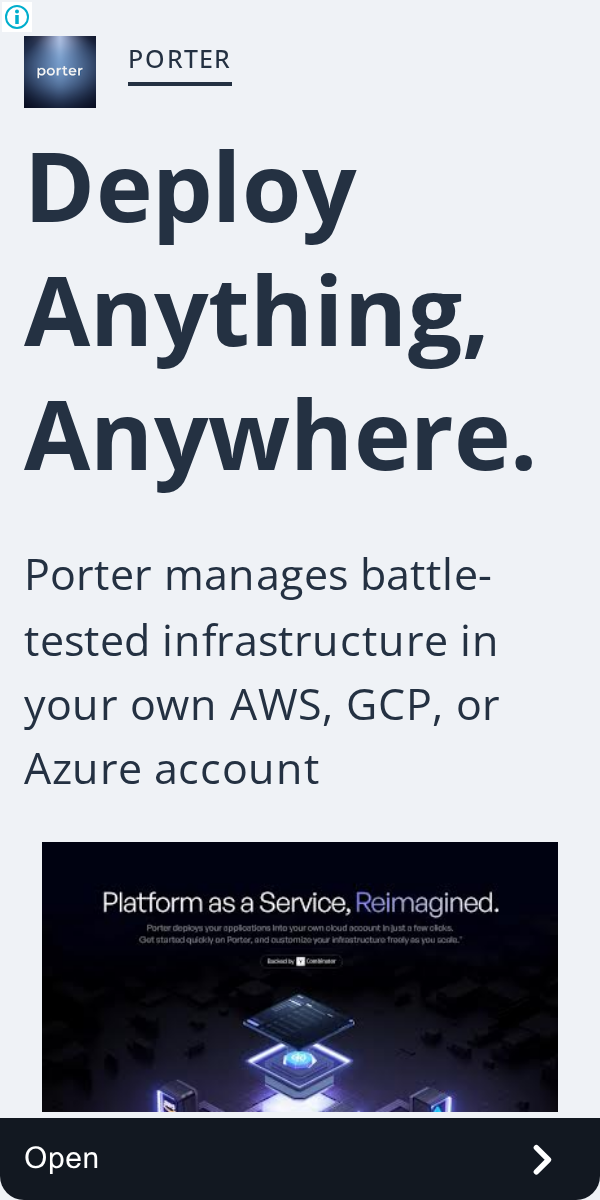
- Running
- 88 days (longevity = it's converting)
- Hook
- "Deploy Anything, Anywhere." displayed in large, dark blue text on a light blue background, with a small logo and the word "PORTER" above it.
- CTA / offer
- Open
- Audience
- The mention of "AWS, GCP, or Azure account" and "Platform as a Service" targets developers, DevOps engineers, or technical founders familiar with cloud infrastructure.
Why it works. Answers the two biggest objections technical buyers raise, app compatibility and cloud lock-in, in one line large enough to read at a glance.
The headline "Deploy Anything, Anywhere." is prominently displayed in a large, dark blue font. Compress your product's two biggest objection-killers into one short absolute claim and set it as the largest text in the creative.
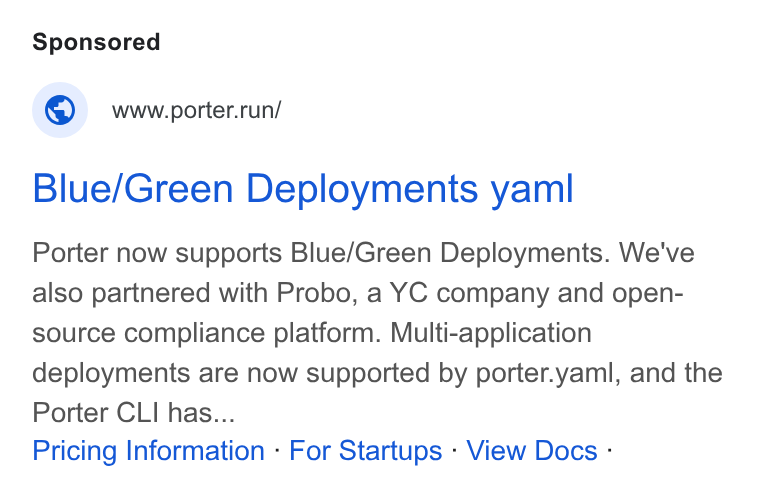
- Running
- 148 days (longevity = it's converting)
- Hook
- Sponsored www.porter.run/ Blue/Green Deployments yaml
- Audience
- Software developers, DevOps engineers, or technical founders interested in deployment strategies and infrastructure as code, indicated by terms like 'Blue/Green Deployments', 'yaml', 'porter.yaml', and 'Porter CLI'.
Why it works. Targets the precise technical search term platform engineers type into Google, meeting them mid research instead of interrupting a scroll.
Lead with a technical feature in the headline: 'Blue/Green Deployments yaml' Pull the exact technical term your buyers search, not your internal feature name, and use it verbatim as your search ad headline.
09 The playbook
The channels are not separate. They are one system where each stage feeds the next. Here is the read, then the plays to run tomorrow.
The inferred playbook
Porter's loop starts on Hacker News, converts mostly existing users through the dashboard, and still leans on Y Combinator more than any built content or ad engine.
Hacker News posts under the founders' own names produced the two biggest traffic spikes in the evidence, the original launch and the 2022 migration post, an unpaid, founder-labor channel rather than a paid or brand one.
Porter was built to solve a Kubernetes problem the founders saw inside their own YC S20 batch, and it still offers every new YC cohort a stacked deal (up to $50k in Porter credits, on top of YC's own cloud credits), a standing acquisition channel no non-YC competitor can replicate.
Dig deeper+3▾
the highest-traffic organic page is the dashboard login itself, and the 8 open roles as of 2026-07-08 skew almost entirely toward engineering with a single growth hire, an engineering-heavy mix that implies investment in product depth ahead of a built-out demand-generation function.
no public MRR or revenue figure is verified; grounded in the $20M Series A, the $6/GB RAM plus $13/vCPU metered pricing, and that engineering-heavy hiring, a reasonable estimate lands in the low-to-mid single-digit millions in annual recurring revenue.
free-to-paid conversion, churn, CAC, blended ARPU across metered usage.
Turn a real technical decision into an HN post
The proofJustin Rhee's Heroku op-ed, the 275-point post covered above, is Porter's clearest example of this working.
The adaptationPick one real, specific decision from your own build, a migration you made, a tool you dropped, a cost you cut, and write it as a first-person technical narrative, then submit it to Hacker News yourself under your personal account rather than a company account. The mechanism: the front page rewards a concrete, opinionated engineering story over a generic product pitch, so the post has to read as a war story, not marketing copy.
Cost: $0 · Time to signal: days · Works pre-PMF: yes, provided the story is genuinely specific; a vague "we built X" post will not catch.
Relaunch the same product until it lands
The proofPorter's 2024 return to Hacker News, explicitly referencing its original 2021 launch, covered above, shows the mechanic.
The adaptationIf an early launch fizzled, don't treat it as closed. Wait for a real product change, new packaging, a meaningful feature, then resubmit to the same channel and openly reference the earlier attempt; readers respond to visible progress more than a "fresh" story that hides the history. First step: list every past launch attempt and what changed since each one, then pick the channel where the first attempt got the most traction and go back to it.
Cost: $0 · Time to signal: weeks · Works pre-PMF: conditional, only once there's a real product change to justify the return, not a cosmetic reskin.
Build one page that names the incumbent
The proofPorter's render-vs-heroku comparison page, its top organic performer covered above, is the working example.
The adaptationInstead of a generic "best tools for X" roundup, write a single page that names your closest, most-searched competitor directly in the URL and title, built around the specific reasons someone would switch. First step: pull the one competitor your prospects mention most in sales calls or forums, and write the page a switcher would want. The mechanism: comparison-intent searches convert better than category searches because the searcher has already decided to leave something, they just need the destination.
Cost: $0 · Time to signal: weeks · Works pre-PMF: yes, provided you have a credible switching story against that competitor.
Kill your most common objection in public
The proofTrevor Shim's X thread telling seed-stage founders who assumed Porter was "only for growth-stage companies" that it was built for them too, covered above, is a direct example.
The adaptationIdentify the single most common reason a qualified prospect talks themselves out of trying your product, too early, too small, too complex, then build one page that directly names and rebuts that objection, and drive your existing channels to it instead of your generic homepage. First step: pull the last ten "not ready yet" replies from sales calls or support chats, find the pattern, and write the page around it, then share it as a thread from your own account. The mechanism: a page built around a named objection converts skeptics who would bounce off generic marketing copy because it answers the doubt they already have.
Cost: $0 · Time to signal: weeks · Works pre-PMF: yes, provided you already have enough prospect conversations to know the real objection, not a guessed one.
Give the product away inside one high-density cohort
The proofPorter's YC-cohort free-usage deal, covered above, is this exact mechanic already working for them.
The adaptationIdentify one cohort you already have real access to and unusual trust in, an accelerator, an alumni network, a niche community you're already a member of, and offer that group a meaningfully generous, time-boxed free deal instead of a public discount code. First step: message the organizer of that cohort directly and ask to be the go-to tool for its next batch. The mechanism: a free deal targeted at a dense, high-trust group compounds through word of mouth inside that group, while a public discount code just erodes margin.
Cost: $0 to under $500 · Time to signal: weeks · Works pre-PMF: yes, and works especially well pre-PMF since it trades revenue for concentrated early usage and feedback. Not transferable at an earlier stage: the YC-cohort free-usage deal specifically assumes a YC pedigree most early readers don't have yet; start with Play 1 and Play 3, which need only a real story and a keyboard.
You just read how Porter does it. Tomorrow it is someone else.
Every morning we take one company that is actually growing and break down where its customers come from: the ads still running after a year, the channel doing the real work, and the play you can run this week.
Systemaic · directional intelligence. Traffic, spend, and reach figures are SimilarWeb-style estimates and qualitative reads of public data, not audited numbers. Built on real public receipts.
// teardowns with a similar GTM motion
sources & receipts (7)
Live ad libraries: google ad library
Launch archives: Hacker News: Why companies move off Heroku (besides the cost) · Hacker News: Show HN: Porter Cloud – PaaS with an eject button · Hacker News: Launch HN: Porter (YC S20) – Open-source Heroku in your own · Hacker News: The USS William D. Porter: The Unluckiest Ship in WWII · Hacker News: Bits from the Debian GNU/Hurd porters · Hacker News: Zimki, the world's first Platform as a Service that belonged
Traffic, spend, and revenue figures are estimates as noted in the report; the links above are the primary public artifacts.