- 01Relaunch until it lands
- 02Rank yourself into your own top 10
- 03Publish the decision, not the announcement
- 04Screenshot the competitor's invoice
01 Snapshot
The one-glance read on who they are and how they grow. Each point is verifiable from the receipts above.
An open-source, Rust-based observability platform (logs, metrics, traces) sold as a cheaper Elasticsearch/Datadog/Splunk alternative, now backed by a $10M Series A closed around April 2026.
Launch-led and community-led, with a paid demand-generation layer added post-Series A.
~90,842 monthly visits (-1.9% over the last 3 months) as of 2026-07-09; 18,000+ GitHub stars per public reporting from mid-2026; a $10M Series A (Nexus Venture Partners, Dell Technologies Capital) on top of a 2022 seed, ~$13.6M disclosed total; 8 of 23 active Google ads and a sampled ~149-ad LinkedIn library as of 2026-07-09.
As of 2026-07-09, OpenObserve is testing a vendor-lock-in-vs-neutrality split-image ad and a Datadog-bill-shock infographic on Google, alongside new Kubernetes-webinar creative variants on LinkedIn.
Its most durable channel is a Hacker News habit, a breakout Show HN launch plus years of founder engineering posts, while the newer paid experiments still account for barely 1.1% of total traffic (0.3% paid search + 0.8% paid social).
02 How it unfolded
The order the channels came online. Sequence is strategy: what they did first, and what they layered on once demand existed.
03 Traffic & channel mix
Estimated demand, the channel split behind it, and the keywords and referrers doing the work. Directional modeling, not audited analytics.
Traffic sources
Top search keywords
| Keyword | Volume | Weight | CPC |
|---|---|---|---|
| openobserve | 6.7k | $3.30 | |
| openoobserve offer free training on their platform ? | 320 | - | |
| best monitoring system open source | 240 | - | |
| open source observability | 420 | - | |
| openobserve windows install | 200 | - |
Closest competitors by audience
OpenObserve draws roughly 90,842 monthly visits, down 1.9% over the last 3 months, a modest number for a company that just closed a $10M Series A. Direct traffic leads at 50.1% of the mix, typical of a technical, self-serve product whose users bookmark the app or docs rather than search a brand term, followed by Search Organic at 30.5%, the listicle engine described below, and Email at 6%, likely trial-onboarding and nurture sequences. The rest, referrals, social organic, generative-AI referrals, social paid, and search paid, together total under 13%.
On keywords, "openobserve" itself pulls 6,690 monthly searches, brand demand likely fed by its Hacker News and GitHub exposure; "open source observability" adds 420, the category term its listicles are built to capture; and "best monitoring system open source" adds 240, a buyer still comparing options. Among the named competitors, signoz.io is the closest like-for-like open-source rival competing on the same "OSS alternative" pitch, observeinc.com is a similarly-named commercial competitor that could cause brand confusion in search, and opentelemetry.io shows up not as a rival but as the instrumentation standard OpenObserve integrates with, an integration dependency rather than competition.
04 Organic content
The specific pages earning their organic search traffic, and the pattern behind why they rank. Adapt the format, not the topic.
OpenObserve's organic traffic concentrates in "Top 10" category listicles ("Top 10 AIOps Platforms," "Top 10 Open-Source Monitoring Tools") rather than product pages, and both rank #1-#2 for the exact category terms ("aiops platform," "aiops platforms") a buyer searches before picking a vendor. The pattern is a self-referential roundup: the post targets broad, undecided-buyer demand, then includes OpenObserve as one option inside its own ranking rather than forcing a hard sell. It likely ranks because comparison content matches search intent better than a features page does, and it compounds because each listicle keeps earning traffic without repeat spend.
Top pages by organic traffic
05 Channel map
Not traffic share. How much weight the growth system actually puts on each channel, with a one-line read on the role it plays.
What drove growth
06 The motions doing the work
For founder-led SaaS the breakdown shifts from ads to traction: where the first users came from, how the founder grows it in the open, and the compounding organic surface.
The growth story traces to one breakout Hacker News moment that took several tries to land, followed by a second visibility wave tied to its funding news.
Three unofficial posts about OpenObserve appeared on Hacker News between 2023-06-05 and 2023-06-09 from other users, each earning 1-7 points, before founder Prabhat Sharma's own "Show HN: OpenObserve, Elasticsearch/Datadog alternative" post on 2023-06-11 broke through with 198 points and 97 comments, framed around its "140x lower storage cost" claim versus Elasticsearch.
An October 2024 submission ("OpenObserve: Observability platform for logs, metrics, traces, analytics") reached 85 points and 66 comments, showing the open-source engineering angle can still pull front-page attention well after the original launch.
Dig deeper+2▾
OpenObserve went live on Product Hunt in April 2026 per its own YouTube announcement, and the $10M Series A hit Hacker News weeks later on 2026-04-29/30, giving the raise its own visibility spike distinct from the original 2023 launch.
Sharma kept submitting engineering write-ups under his own name in the years between, a licensing explainer (2024-01), an SSO-tax essay (2024-09), a Rust performance piece (2026-03), none matching the original launch's reach but sustaining a steady trickle of developer attention.
Prabhat Sharma's build-in-public motion runs almost entirely through long-form technical writing distributed on Hacker News, not a high-frequency personal social feed.
Sharma authored the original Show HN launch plus four follow-up posts in his own name, a licensing explainer, an SSO-tax essay, a Rust write-up, and the Series A announcement, making Hacker News his primary build-in-public surface.
His X account carries 252 followers across 140 posts, but only three individual posts appear in the evidence (2023-2024), each amplifying a feature or blog post rather than sharing metrics or lessons; his LinkedIn carries a larger 9,549 followers with no organic posts captured.
Dig deeper+2▾
None of the Reddit threads are brand or founder posts. They are third-party discovery and criticism, including the r/opensource thread noted above calling out the open-core paywall on RBAC/SSO.
The company's LinkedIn presence now shows up mostly as paid ads carrying the "OpenObserve" or "Promoted by OpenObserve" byline rather than founder posts, suggesting the build-in-public motion is handing off to a marketing function as the team scales post-raise.
The compounding engine is a self-referential listicle strategy paired with a programmatic ad-to-landing-page matrix.
The Top 10 AIOps and Top 10 open-source monitoring posts covered above capture broad category demand while positioning OpenObserve inside its own ranking, a cheaper way to earn a look than bidding on a competitor's brand term.
The Google creative set points to dedicated landing pages for Azure monitoring, GCP monitoring, database monitoring, and a Datadog-alternative page, each matched to its own SEM keyword, a content map a reader could mine for topic ideas.
Dig deeper+2▾
The site runs a partner/affiliate program at openobserve.ai/partners/, recruiting resellers or referral partners rather than paying creators, a B2B-appropriate variant of an affiliate motion.
True active ad counts stand at 8 of 23 Google ads and a sampled 24 of a roughly 149-ad LinkedIn library as of 2026-07-09, with the longest-running Google ad active about 58 days. The top infographic, "Cut your Observability bill by up to 90%," and a newer Datadog-bill-shock creative both target cost-conscious Datadog/Elasticsearch switchers directly, demand generation aimed at a competitor's install base rather than brand-term defense.
07 Paid ads
This founder-led SaaS also runs paid acquisition. Here are the live ads doing the work, each with the X-ray and a play you can adapt.
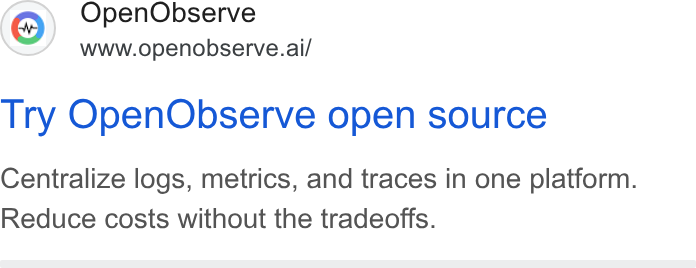
- Running
- 58 days (longevity = it's converting)
- Hook
- Visual: A circular logo with a green, red, and blue waveform on a white background, next to the text "OpenObserve" and "www.openobserve.ai/". Below this, in large blue text, is "Try OpenObserve open source".
- CTA / offer
- Try OpenObserve open source
- Audience
- Individuals or organizations seeking to "Centralize logs, metrics, and traces in one platform" and "Reduce costs without the tradeoffs," indicating a technical audience concerned with operational efficiency and budget.
Why it works. Turns the product's open-source license into the primary offer rather than a footnote, appealing directly to engineers wary of proprietary lock-in.
Headline as a direct call to action and product offering: "Try OpenObserve open source" If part of your product is free or open source, make that the headline offer instead of burying it under a feature list.
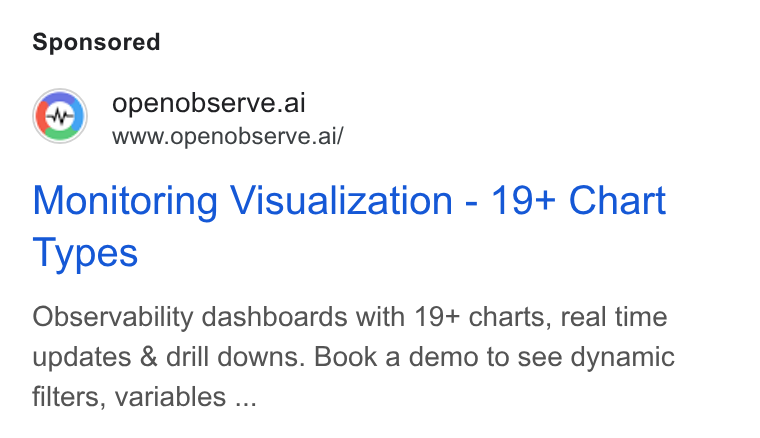
- Running
- 37 days (longevity = it's converting)
- Hook
- Sponsored openobserve.ai www.openobserve.ai/ Monitoring Visualization - 19+ Chart Types
- CTA / offer
- Book a demo
- Audience
- Individuals or teams involved in data monitoring, visualization, and observability, indicated by terms like "Monitoring Visualization," "Observability dashboards," and "real time updates & drill downs."
Why it works. Uses an oddly specific feature count instead of a vague 'powerful visualizations' claim, which reads as more credible to technical buyers comparing tools.
Headline with specific feature count: "Monitoring Visualization - 19+ Chart Types" Count an actual feature (chart types, integrations, data sources) in your product and lead your ad headline with that exact number.
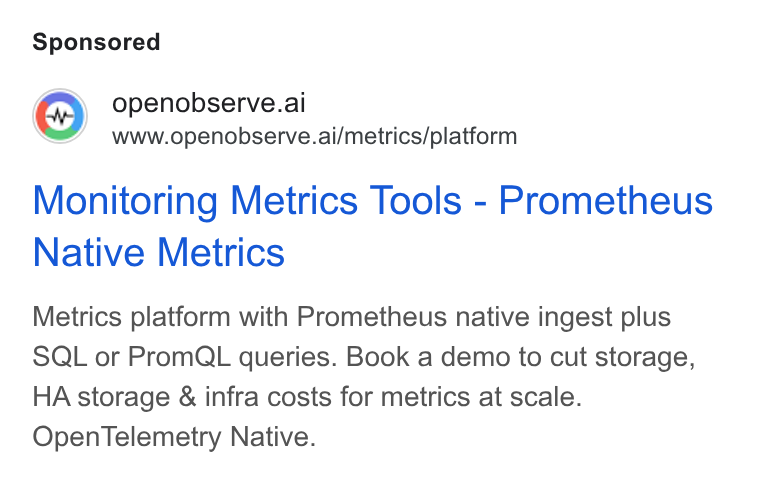
- Running
- 31 days (longevity = it's converting)
- Hook
- Visual: The word "Sponsored" at the top, followed by a small icon with a waveform and the text "openobserve.ai" and "www.openobserve.ai/metrics/platform". Below this, the headline "Monitoring Metrics Tools - Prometheus Native Metrics" is displayed in blue text.
- CTA / offer
- Book a demo
- Audience
- Targets technical professionals or companies dealing with metrics monitoring, specifically those using or considering Prometheus and OpenTelemetry, indicated by phrases like "Prometheus Native Metrics", "PromQL queries", and "OpenTelemetry Native".
Why it works. Targets engineers already committed to Prometheus by promising native compatibility instead of a rip-and-replace, lowering switching friction in the headline itself.
Clear problem/solution headline: "Monitoring Metrics Tools - Prometheus Native Metrics" If your product is compatible with a popular open standard your buyers already use, put that compatibility in the headline, not just the feature list.
Show 3 more ads
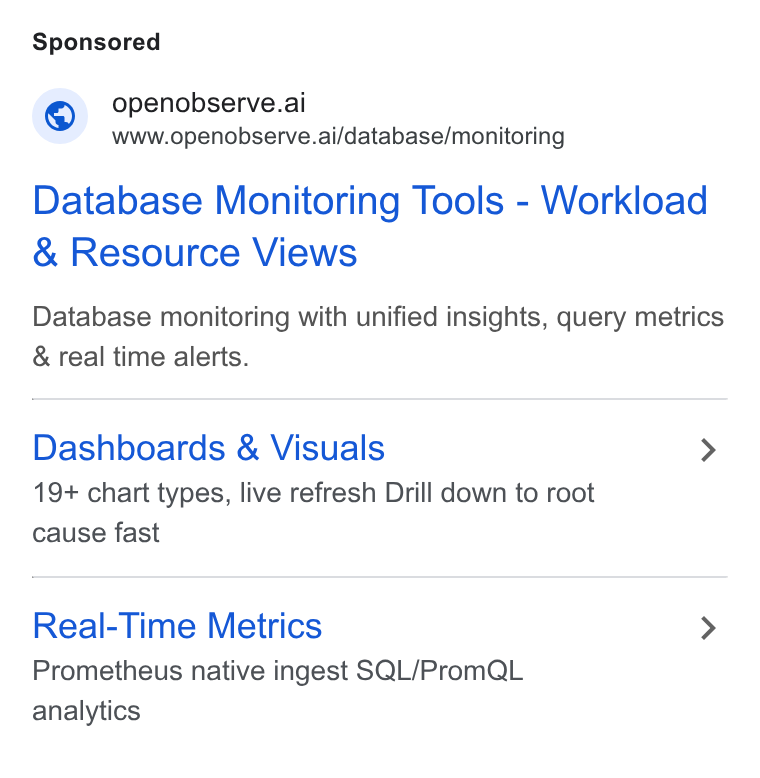
- Running
- 31 days (longevity = it's converting)
- Hook
- Sponsored openobserve.ai www.openobserve.ai/database/monitoring Database Monitoring Tools - Workload & Resource Views
- Audience
- The ad targets IT professionals or developers responsible for database management, indicated by terms like 'Database Monitoring Tools', 'Workload & Resource Views', 'query metrics', 'real time alerts', 'Prometheus native ingest SQL/PromQL analytics'.
Why it works. Targets a narrower search intent than general observability by naming the database monitoring subcategory and the two views buyers look for.
Headline clearly states the product's core function and benefit: 'Database Monitoring Tools - Workload & Resource Views'. Split a broad feature into a narrower, named subcategory ad so searchers with that specific need see themselves matched instead of a generic pitch.
- Running
- 31 days (longevity = it's converting)
- Hook
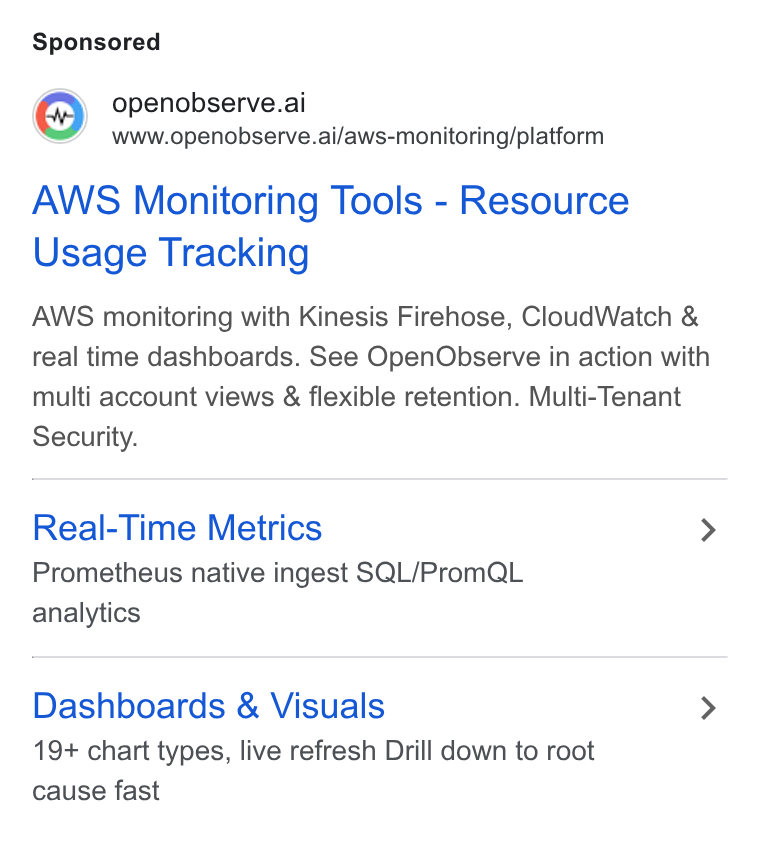
- Sponsored openobserve.ai www.openobserve.ai/aws-monitoring/platform AWS Monitoring Tools - Resource Usage Tracking
- Audience
- The ad targets IT professionals, developers, or operations teams managing AWS infrastructure, indicated by keywords like "AWS monitoring," "Kinesis Firehose," "CloudWatch," "Prometheus native ingest," "SQL/PromQL analytics," and "Multi-Tenant Security."
Why it works. Mirrors the searcher's exact stack (AWS) and use case in the headline so the ad only draws in-market clicks from that specific buyer segment.
Directly addresses a common pain point in the headline: 'AWS Monitoring Tools - Resource Usage Tracking'. Write a separate ad per cloud platform your buyers run on, naming that platform and one concrete capability in the headline.
- Running
- 12 days (new — still being tested)
- Hook
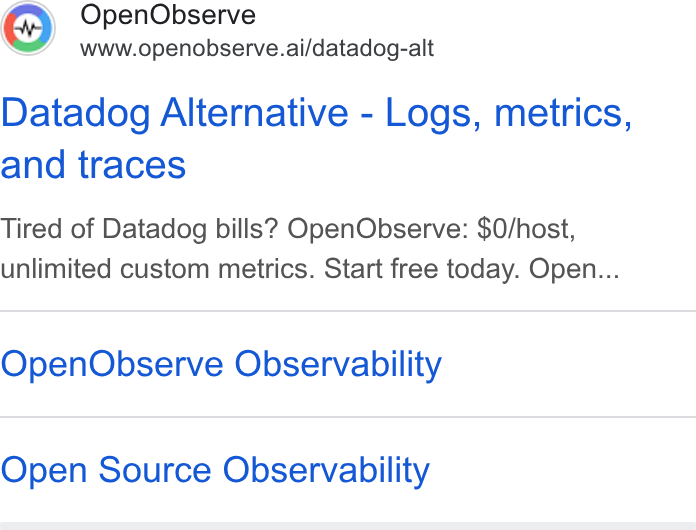
- OpenObserve logo and text "OpenObserve www.openobserve.ai/datadog-alt Datadog Alternative - Logs, metrics, and traces"
- CTA / offer
- Start free today.
- Audience
- Individuals or companies currently using Datadog or similar observability platforms, indicated by 'Datadog Alternative' and 'Tired of Datadog bills?'.
Why it works. Captures competitor branded search traffic from Datadog users shopping for a cheaper switch, listing the exact three data types they already track.
Direct competitor targeting and problem agitation: The headline states "Datadog Alternative - Logs, metrics, and traces" and the body text asks "Tired of Datadog bills?". Run a search ad on your top competitor's brand name paired with the word alternative, and list the exact features a switcher needs to confirm parity.
08 The playbook
The channels are not separate. They are one system where each stage feeds the next. Here is the read, then the plays to run tomorrow.
The inferred playbook
The loop starts with a developer hitting a cost-savings claim on Hacker News or in search, then converting through a self-serve install rather than a sales call.
The Elasticsearch-cost comparison that won the original launch is the same claim reused in the listicles and the newer Datadog-bill ad, one message carried across every surface.
Google ads drop self-serve visitors directly onto dedicated openobserve.ai landing pages for a free trial, while most LinkedIn ads route to a HubSpot-hosted page (na2.hubs.ly) built around Kubernetes-troubleshooting webinars, a slower, gated lead-capture funnel aimed at enterprise buyers. No public MRR or ARR figure exists; given usage-based pricing, a stated 6,000+ organizations on the platform, and the $10M Series A closed in April 2026, revenue likely sits in the low millions of dollars annually, an estimate, not a confirmed figure.
Dig deeper+3▾
The Hacker News habit and the listicle content are durable assets that keep earning attention without repeat spend, while the Kubernetes-webinar and Datadog-switcher ad tests are the newer, spend-dependent layer added since the raise.
The open-core criticism visible on Reddit, RBAC and SSO gated behind the paid Enterprise tier, is a real drag on the self-serve loop for any team that hits production security requirements before it hits the ingestion cap, with no visible content addressing that objection directly.
free-to-paid conversion rate, churn, CAC, and a precise current employee count.
Relaunch until it lands
The proofThree unofficial Hacker News posts died quietly in early June 2023 before Sharma's own Show HN post landed 198 points and 97 comments six days later, covered in Launch & Traction above.
The adaptationDraft your own Show HN post around the single sharpest, most quantifiable claim your product makes, a cost multiple, a speed multiple, time saved. Watch how a first quiet attempt lands in the comments, then resubmit with a tighter title and the strongest angle once you've absorbed that feedback. A title that states a concrete number consistently outperforms one that states a category, so each attempt is a chance to find which number lands.
Cost: $0 · Time to signal: days · Works pre-PMF: yes, provided the product already has a working demo or install a stranger can try within minutes of clicking through.
Rank yourself into your own top 10
The proofOpenObserve's own "Top 10 AIOps Platforms" and "Top 10 Open-Source Monitoring Tools" posts are its two highest-earning organic pages and rank #1-#2 for the category terms themselves.
The adaptationWrite the roundup post a buyer in your category is already searching for, review competitors honestly, and include your own product as one entry, not the forced winner. Publish it on your own blog so the ranking equity accrues to you. A roundup captures someone who hasn't picked a vendor yet, a far larger pool than someone already searching your brand name.
Cost: $0 · Time to signal: months · Works pre-PMF: yes, though it takes months to rank, so pair it with a faster channel while it climbs.
Publish the decision, not the announcement
The proofSharma's recurring Hacker News posts, a licensing explainer, an SSO-tax essay, a Rust performance write-up, kept pulling modest but real attention years after the original launch, per Build in Public above.
The adaptationPick a real decision you made building your product, a license choice, a pricing model, a technical trade-off, and write the reasoning down as a standalone post, not a changelog entry. Submit it wherever your technical buyers already read. A decision-with-reasoning post signals competence to a technical buyer in a way a feature announcement never does, earning attention even without a launch moment behind it.
Cost: $0 · Time to signal: weeks · Works pre-PMF: yes.
Screenshot the competitor's invoice
The proofA newer Google ad tests a real Datadog bill graphic reading "$60,820.30, OVER BUDGET" against OpenObserve's own pitch, a sharper version of the cost-shock angle described in Content & SEO Engine above.
The adaptationIf your product saves money against a well-known incumbent, build one ad or landing page around a specific, believable dollar figure rather than a vague percentage claim, and bid it against the incumbent's brand name in search. A specific number lets the reader do the math against their own bill instantly, which a percentage claim never does. Caveat: only run this if you can substantiate the number. An invented or unverifiable figure is a fast way to lose credibility with the exact buyer you're trying to win.
Cost: under $500 · Time to signal: days · Works pre-PMF: conditional, you need a competitor with well-known pricing and an audience already paying that bill.
Give away enough to prove it, gate enough to get paid
The proofOpenObserve's self-hosted tier is free up to 50GB/day of ingestion with RBAC and SSO gated behind the paid Enterprise license, the same packaging line that drew the open-core criticism noted in Build in Public above.
The adaptationSet your free ceiling at the volume where a real production team, not a hobbyist, starts to feel it, so the upgrade trigger is growth, not a feature ambush. Be explicit in your own docs about which features sit behind the paid tier before someone integrates deeply enough to be upset later. Gate the compliance and access-control features that only start to matter once a team is already dependent on the product, not the features a new user needs on day one, so the model converts instead of alienating.
Cost: $0 · Time to signal: months · Works pre-PMF: conditional, you need enough infrastructure to actually meter usage and enforce a ceiling, which usually means a working product already. Not transferable at an earlier stage: the Series A-backed ad spend, the sampled ~149-ad LinkedIn library, and the HubSpot-gated webinar funnel require a funded team and an existing enterprise pipeline. Everything else, the Hacker News habit, the self-inclusion listicle, and the free-tier packaging, is available to a solo founder from day one.
You just read how OpenObserve does it. Tomorrow it is someone else.
Every morning we take one company that is actually growing and break down where its customers come from: the ads still running after a year, the channel doing the real work, and the play you can run this week.
Systemaic · directional intelligence. Traffic, spend, and reach figures are SimilarWeb-style estimates and qualitative reads of public data, not audited numbers. Built on real public receipts.
// teardowns with a similar GTM motion
sources & receipts (8)
Live ad libraries: linkedin ad library · google ad library
Launch archives: Hacker News: Unveiling OpenObserve, the High-Performance, Cloud-Native Pl · Hacker News: Show HN: OpenObserve – Elasticsearch/Datadog alternative · Hacker News: XDrain in Rust – 40x faster than in Python · Hacker News: OpenObserve Raises $10M Series A · Hacker News: Bloom Filter Trick Reduces 170 Object-Storage Reads to One ( · Hacker News: What are Apache, GPL and AGPL licenses – misconceptions, lie
Traffic, spend, and revenue figures are estimates as noted in the report; the links above are the primary public artifacts.