- 01Build a free tool page that ranks
- 02Cold-pitch the person who already owns your exact audience
- 03Run named-account ads that speak to the specific company, not the category
- 04Prioritize API customers who have a consumer-facing viral moment coming
01 Snapshot
The one-glance read on who they are and how they grow. Each point is verifiable from the receipts above.
AI product photo editing (background removal, AI backgrounds, ghost mannequin, AI fashion models) for e-commerce sellers plus a B2B API for marketplace platforms, with 300M registered users and Mercari, Netflix, and Warner Bros. among named API customers.
Dual-motion, consumer-led freemium (organic search + paid mobile install) running in parallel with enterprise API (LinkedIn account-based marketing targeting marketplace product managers).
~19.5M estimated monthly visits, ~$94M ARR (Sacra end-2024 estimate), 5B images processed annually, and a $19M Series A raised in November 2022 after 40M app downloads.
"In the early days, many people initially thought Photoroom was 'only' a background removal app. What they didn't understand is that the segmentation task is the core computer vision..." (quote cuts off in the source), Matthieu Rouif, co-founder and CEO.
As of 2026-07-04, Photoroom launched 10 new Google creatives across text and image formats in the final two weeks of June and early July, suggesting an active creative rotation on the search channel.
A single free-tool page captures ~2.37M organic visits per month by ranking #2 for terms with 10M+ combined monthly global searches, turning anonymous high-intent visitors into the registered user base that sustains a 40.9% direct traffic share.
02 How it unfolded
The order the channels came online. Sequence is strategy: what they did first, and what they layered on once demand existed.
03 Traffic & channel mix
Estimated demand, the channel split behind it, and the keywords and referrers doing the work. Directional modeling, not audited analytics.
Traffic sources
Top search keywords
| Keyword | Volume | Weight | CPC |
|---|---|---|---|
| photoroom | 687k | $0.30 | |
| background remover | 3.8M | $0.35 | |
| remove background | 2.5M | $0.28 | |
| remove bg | 3.4M | $0.28 | |
| quitar fondo | 1.2M | $0.19 |
Top referring sites
Closest competitors by audience
Photoroom draws an estimated ~19.5M monthly visits, with a -4.4% trend over the last 3 months, mild softening at a very large base. The channel mix is dominated by two forces: organic search at 44.2% and direct at 40.9%.
Organic search is almost entirely captured by free-to-use tool pages (detailed in Organic Content below). Direct traffic at 40.9% reflects strong brand recall among existing users who return to the app without a search, the natural consequence of 300M registered users who have logged in before and come back directly. Social organic (6.7%) and referrals (3.3%) follow. Referrals arriving from remove.bg suggest users comparison-shopping between the two closest competitors; Shopify.com as a referral source reflects the Shopify integration pulling in traffic from merchant workflows. The rest of the mix, display, email, paid social, and affiliate, totals under 4%.
Paid search at 1.9% is the telling number: given a ~6,000-ad Google library, that small paid share tells you the dominant motion is organic capture at scale, not paid demand generation. The keywords anchor the story: "background remover" (3.8M monthly global searches), "remove bg" (3.4M), "remove background" (2.5M), and "quitar fondo" (1.2M, Spanish-language demand), Photoroom holds #2 positions across all of them.
04 Organic content
The specific pages earning their organic search traffic, and the pattern behind why they rank. Adapt the format, not the topic.
Photoroom's organic strategy is a concentrated bet on free-utility tool pages targeting the highest-volume action keywords in their category. The pattern across the top pages is identical: a page named after the user action, wrapping a working free tool in SEO-friendly copy, placed at a URL like /tools/background-remover. The background remover page alone accounts for roughly 80% of the traffic across their five highest-traffic pages at approximately 2.37M visits per month, though that is only about 27% of all organic search traffic. The next four pages, change background color, remove object from photo, white background, and the homepage, collectively account for the remaining ~20% of that five-page set.
The reason this holds its rankings: a free tool that delivers instant value on the page earns genuine dwell time and return signals that sustain positions far better than content-only pages can. The user lands, uses the product without signing up, and either converts or leaves, but the page earns its #2 placement because the behavioral signals are real. The strategic logic is using the SEO surface as a top-of-funnel sampling mechanism that lets millions of users experience the product before any paywall appears.
- https://www.photoroom.com/tools/background-remover (~2,366,985 organic visits/mo, ~80% of these five top pages)
- https://www.photoroom.com/tools/change-background-color (~200,951 organic visits/mo, ~6.8% of these five top pages)
- https://www.photoroom.com/ (~153,426 organic visits/mo, ~5% of these five top pages)
- https://www.photoroom.com/tools/remove-object-from-photo (~120,457 organic visits/mo, ~4% of these five top pages)
- https://www.photoroom.com/tools/white-background (~103,360 organic visits/mo, ~3.5% of these five top pages)
Top pages by organic traffic
05 Channel map
Not traffic share. How much weight the growth system actually puts on each channel, with a one-line read on the role it plays.
What drove growth
06 The motions doing the work
For founder-led SaaS the breakdown shifts from ads to traction: where the first users came from, how the founder grows it in the open, and the compounding organic surface.
Photoroom's first users came from a single cold tweet aimed at Gary Vaynerchuk in February 2020, validated by a later Hacker News post, and amplified by a viral API embedding in summer 2023 that proved the enterprise use case to the market.
On February 22, 2020, Matthieu Rouif cold-tagged @garyvee on X with a direct pitch: "I made PhotoRoom, an app that can massively help your hustling followers. Create an eBay listing with white background in one tap. Please RT an entrepreneur." The tweet earned 2,636 likes and 395 retweets, seeding the e-commerce reseller audience that became Photoroom's earliest users. The company reported $1M ARR and 50% month-over-month growth within months of launch, and reached approximately $20M ARR on only $2M of invested capital before the Series A.
The single clear Hacker News breakout was a July 2021 "Show HN: AI Background Remover" post (handle vvoyer) that reached 102 points and 36 comments, enough to indicate near-front-page reach. Most other HN submissions from the team are ML and infrastructure engineering posts: a CoreML benchmarks post scored 64 points, while TRTorch optimization and Rust collaboration features posts scored under 10 points, but together they built a visible technical footprint for an API-minded audience.
Dig deeper+2▾
In summer 2023, Warner Bros. embedded the Photoroom API into a Barbie selfie-poster generator that was shared over 1 million times. Matthieu Rouif quoted Warner Bros. EVP of Worldwide Digital Marketing Cameron Curtis: "PhotoRoom shattered all expectations by seamlessly integrating user photos into captivating Barbie movie posters." Republic Records was later named as a customer building with Photoroom's API in a March 2024 tweet. Each of these integrations functioned as a distribution event for the API, reaching audiences no enterprise sales motion could replicate directly.
The November 2022 Series A (40M downloads, 7M MAU, $19M raised) was the public proof point for a growth arc that had started with a no-budget influencer @mention two years earlier.
Matthieu Rouif (co-founder and CEO) is the primary public-facing voice, but his X following at 10,532 is modest for a company at this scale, the outsized early distribution came from one precisely targeted cold pitch, not a pre-built audience.
The February 2020 Gary Vee tweet worked because the product-to-audience fit was exact: a white-background eBay tool pitched directly to the person who owns the eBay-reseller audience. Matthieu had only a small personal following at the time; the 395 retweets came from Gary Vee's reach, not his own. This is the mechanism worth examining, not the follower count.
Eliot Andres (co-founder and CTO, 1,610 X followers) and other team members post engineering content on Hacker News, ML inference optimization, A/B testing LLMs at scale, Rust-based collaboration, CoreML benchmarks. These posts have mixed reach, a CoreML benchmarks post scored 64 points while the TRTorch and Rust posts scored under 10, but collectively they maintain a credible technical presence that enterprise API prospects encounter when they research the company.
Dig deeper+1▾
Matthieu's February 2026 AMA in r/photoroom (5 score, 28 comments) was a direct Q&A with existing users on product direction, AI strategy, and the Shopify integration. It reached the existing community rather than driving new acquisition, and r/Depop (a 2021 self-post scoring 4 points) was the earlier targeted-community play, placing the tool where the target users already gathered.
Organic search at 44.2% of ~19.5M monthly visits is Photoroom's largest single acquisition channel, and the free-tool page structure described in Organic Content above is its engine.
The mechanism is sampling at scale: a free, working tool earns genuine behavioral signals that sustain top-two rankings for 2-4M monthly search volume terms, which deliver pre-qualified buyers who already need the outcome. The conversion from visitor to registered user happens inside the free session, making this the top of the entire freemium funnel.
Korean-language Google ads and Spanish Meta ads ("La app que hace tus Reels", "Convierte cualquier foto en AI Reel"), combined with the "quitar fondo" keyword presence in organic rankings, point to a deliberate multilingual expansion layer. A base of 300M registered users is built partly by owning the same high-intent queries across multiple languages, not just in English.
Dig deeper+4▾
~240 Google ads surfaced in a sampled set as of 2026-07-04 (not a confirmed full active-ad count) from a ~6,000-ad library; the longest-running active ads (~400 days) target product photography and background removal queries, sitting as a branded/high-intent capture layer on top of the organic rankings rather than generating new demand. The late-June 2026 launch of new image-format ads alongside fresh text variants suggests an active creative rotation experiment.
Meta video ads drive App Store and Google Play installs with Ghost Mannequin and AI Reel generation as the two persistent proven angles, running on Facebook, Instagram, Audience Network, Messenger, and Threads. Spanish-language variants confirm active LatAm install testing.
A separate motion entirely. The core formats are: a "How do you ensure your sellers list good product images?" open question leading with Mercari, Amazon, and Depop logos; a "The pitch to your manager" before/after product image creative; and a Mercari testimonial from Nick Pittoni (Consumer Product Lead) stating the API "processes high single-digit million images monthly for our sellers, without impacting the listing experience." The performance figures cited in these ads, 93% lower editing costs, 56% higher sell-through rates, 13% higher average selling price, are Photoroom's own advertised claims, not independently verified numbers. As of 2026-07-04, 20 LinkedIn ads are active.
In March 2024, Matthieu Rouif announced a 90% cut to $0.02/image, explicitly naming developer accessibility as the goal and citing Netflix, Warner Bros., and Audi as existing customers. A pricing floor that low removes the procurement barrier for individual developers to begin testing real volume.
07 Paid ads
This founder-led SaaS also runs paid acquisition. Here are the live ads doing the work, each with the X-ray and a play you can adapt.
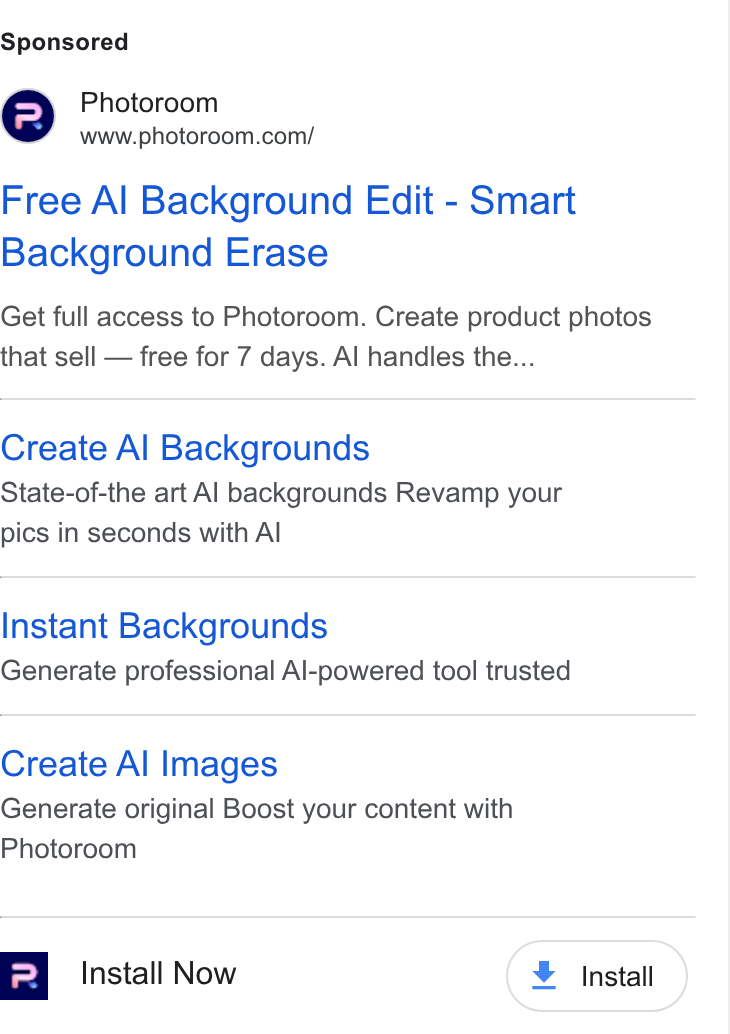
- Running
- 400 days (longevity = it's converting)
- Hook
- Visual: The word "Sponsored" at the top, followed by the Photroom logo, company name "Photoroom", and website "www.photoroom.com/". Text: "Free AI Background Edit - Smart Background Erase"
- CTA / offer
- free for 7 days
- Audience
- Individuals or businesses who need to create product photos, revamp images, or generate AI images, indicated by phrases like "Create product photos that sell" and "Boost your content".
Why it works. Matches the literal search query for background removal with a free-tool promise, converting high-intent search traffic for Photoroom's core feature.
Headline with clear benefit and keyword: "Free AI Background Edit - Smart Background Erase" Mirror your searcher's exact phrase in the headline and lead with 'Free' if a no-cost tier exists.
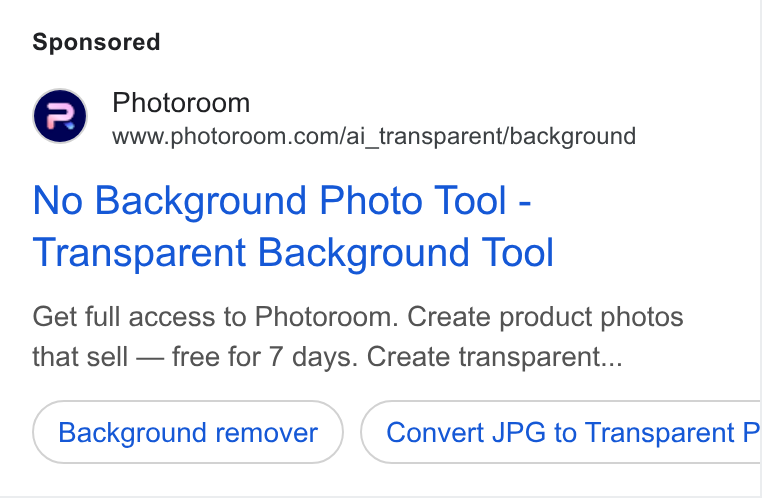
- Running
- 344 days (longevity = it's converting)
- Hook
- Sponsored Photoroom www.photoroom.com/ai_transparent/background No Background Photo Tool - Transparent Background Tool
- CTA / offer
- free for 7 days
- Audience
- Individuals or businesses needing to quickly and easily remove photo backgrounds or create transparent images, indicated by the tool's description and suggested use for 'product photos'.
Why it works. Targets the transparent-background use case for product shots and stickers with keyword-dense copy built for search match, not scroll appeal.
Directly state the problem and solution in the headline: "No Background Photo Tool - Transparent Background Tool" Write two headline variants using the different phrasings your customers search for the same task.

- Running
- 344 days (longevity = it's converting)
- Hook
- Sponsored Photoroom www.photoroom.com/ai_transparent/background Free Background Eraser Tool - Remove Background from Photo
- CTA / offer
- Free Background Eraser Tool - Remove Background from Photo. Get full access to Photoroom. Create product photos that sell — free for 7 days.
- Audience
- Individuals or businesses needing to quickly and easily edit product images, indicated by 'Make product images pop with transparent cutouts' and 'Create product photos that sell'.
Why it works. Broad-match copy for first-time searchers who don't yet know Photoroom exists, using generic task language over the brand name.
Headline clearly states the core benefit and tool: 'Free Background Eraser Tool - Remove Background from Photo'. Keep at least one ad running plain generic-task wording for buyers who don't know your product category by name yet.
Show 3 more ads

- Running
- 312 days (longevity = it's converting)
- Hook
- 광고 (Ad) text at the top left, Photoroom logo and name with "www.photoroom.com/" below it, followed by the blue text "포토룸 AI 사진 편집기 - 빠른 투명 PNG 생성기" (Photoroom AI Photo Editor - Fast Transparent PNG Generator).
- CTA / offer
- Install Now / 설치
- Audience
- Individuals who edit photos and need to create transparent PNGs or edit backgrounds, indicated by the product's core functionality.
Why it works. Localizes the transparent-PNG offer for Korean searchers with native search phrasing rather than a translated headline.
Headline directly addresses a common user need: "포토룸 AI 사진 편집기 - 빠른 투명 PNG 생성기" (Photoroom AI Photo Editor - Fast Transparent PNG Generator). Localize headlines by rewriting for how locals actually search, not by machine-translating your English headline.
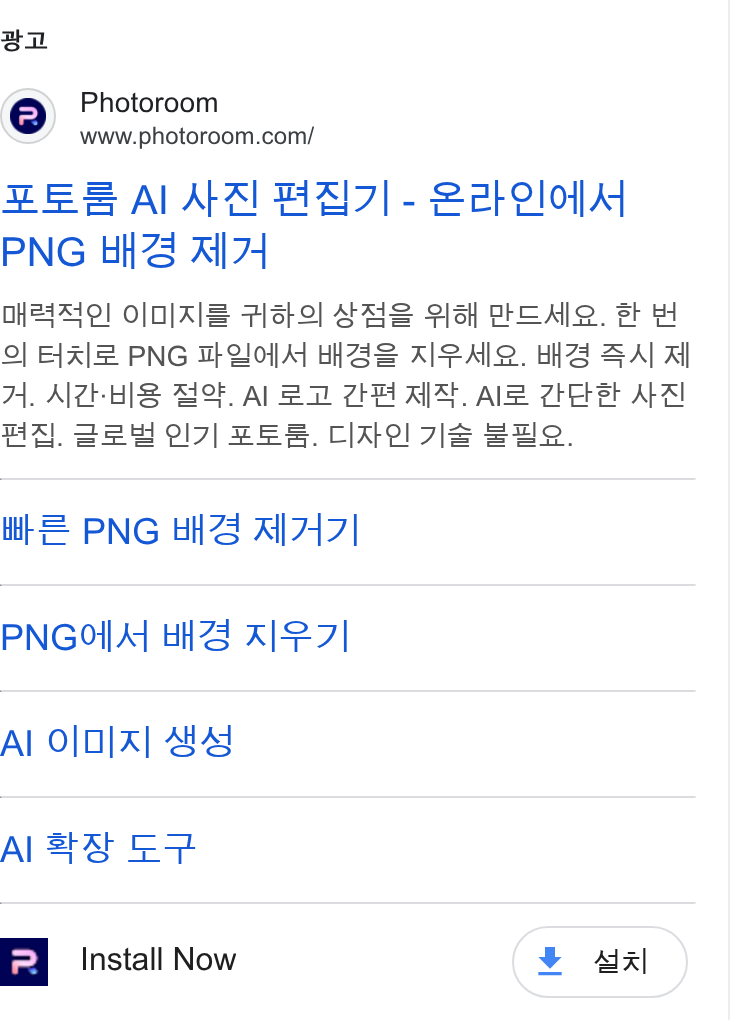
- Running
- 312 days (longevity = it's converting)
- Hook
- 광고 (Ad) text at the top left corner, followed by a purple square icon with a white 'P' inside, then 'Photoroom' and 'www.photoroom.com/'. Below that, the headline '포토룸 AI 사진 편집기 - 온라인에서 PNG 배경 제거' (Photoroom AI Photo Editor - Remove PNG Background Online).
- CTA / offer
- Install Now / 설치 (Install)
- Audience
- Individuals or small business owners who need to edit images, specifically removing backgrounds, quickly and easily without design skills. Evidenced by '귀하의 상점을 위해 만드세요' (Make it for your shop) and '디자인 기술 불필요' (No design skills required).
Why it works. Runs the AI photo editor and online PNG background removal offer for Korean searchers with local phrasing rather than translated copy.
Headline directly states the core problem and solution: '포토룸 AI 사진 편집기 - 온라인에서 PNG 배경 제거' (Photoroom AI Photo Editor - Remove PNG Background Online). Give each target language its own keyword-driven headline instead of one master ad translated across markets.
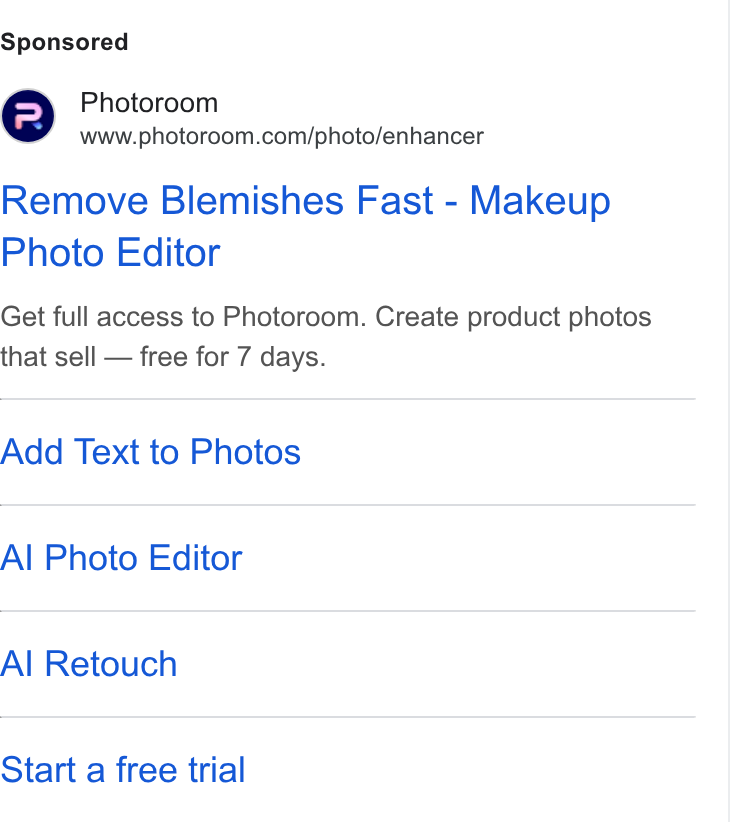
- Running
- 311 days (longevity = it's converting)
- Hook
- Sponsored Photoroom www.photoroom.com/photo/enhancer Remove Blemishes Fast - Makeup Photo Editor
- CTA / offer
- Get full access to Photoroom. Create product photos that sell — free for 7 days.
- Audience
- Individuals interested in photo editing, particularly for makeup and product photography, indicated by 'Remove Blemishes Fast - Makeup Photo Editor' and 'Create product photos that sell'.
Why it works. Carves a beauty-and-portrait niche out of general photo editing, competing for a different keyword set than the background-removal ads.
Headline directly addresses a pain point and offers a solution: "Remove Blemishes Fast - Makeup Photo Editor". Split one broad product into niche-specific ads (skin, product shots, logos) so each headline matches a narrower search intent.
08 The playbook
The channels are not separate. They are one system where each stage feeds the next. Here is the read, then the plays to run tomorrow.
The inferred playbook
Photoroom runs two parallel acquisition loops that serve different buyers and rarely cross: a consumer loop compounding on organic search and mobile install, and an enterprise loop targeting marketplace platforms through LinkedIn ABM and API adoption.
A user searching "remove background" or "background remover" lands on a free tool page ranking #2 organically, uses the tool without a gate, encounters the freemium upsell for exports or advanced features, and some fraction convert to paid Pro or Max tiers (pricing not disclosed in available data) via paywalls that Photoroom reported improving 50%+ through Superwall A/B testing in 2022. Returning users drive the 40.9% direct traffic share as the registered base compounds.
LinkedIn ABM targets marketplace product managers at named platforms with problem-agitation copy around seller friction and image quality at scale, leading to API trials at $0.02/image, then expanding with platform usage volume. The Mercari relationship, processing high single-digit millions of images monthly, is the anchor case study across the entire enterprise creative library.
Dig deeper+3▾
The Warner Bros. Barbie selfie generator (1M+ shares) shows that an API embedded inside a high-traffic consumer moment can be a distribution event, and Republic Records was later named as a Photoroom API customer. Each API customer who builds a consumer-facing UGC mechanic becomes a potential acquisition channel for the API business itself.
One tool page drives roughly 80% of the traffic across their top five pages, and about 27% of all organic search. There is no visible affiliate or partner program, no open-source project for developer adoption beyond blog posts, and no community-led motion beyond a small brand subreddit. The growth is highly search-dependent at the consumer level.
Free-to-paid conversion rate, subscription churn, blended ARPU, API contract sizes.
Build a free tool page that ranks
The proofPhotoroom's background remover tool page earns an estimated 2.37M organic visits per month, ranking #2 for terms drawing 2-5M global monthly searches. The tool is free, fully functional on the page, and serves as the primary top-of-funnel sampling mechanism for the freemium conversion.
The adaptationIdentify the highest-volume action keyword in your category, the thing people search when they want to do the outcome your product enables, and build a free, working web tool at a URL structured around that term. The tool does not need to be full-featured; it needs to deliver the core value in a single session without requiring a signup. The mechanism: a functional free tool earns real dwell time and behavioral return signals that sustain high organic rankings, because the user satisfaction is genuine. Start by identifying what search terms the top-ranked organic pages in your category target, find the one with the highest volume that your product directly addresses, then build a single-function tool that delivers on it. Once you rank, the organic traffic is pre-qualified, those visitors already need the outcome and arrived looking for it.
Cost: under $500 only if you can route inference through your existing model or a third-party API (e.g. a vendor inference endpoint); materially more if you must stand up your own GPU inference, storage, and CDN · Time to signal: months · Works pre-PMF: conditional (the tool must genuinely work; a broken free tier earns low dwell time and will not hold rankings)
Cold-pitch the person who already owns your exact audience
The proofMatthieu Rouif's February 2020 cold tweet to @garyvee earned 2,636 likes and 395 retweets and seeded the e-commerce reseller wave that drove $1M ARR, at a time when Matthieu had only a small personal following. The reach came from Gary Vee's reseller audience, not Matthieu's own following.
The adaptationMap the single creator, newsletter writer, or community moderator who has already aggregated the exact buyer you want, resellers, productivity operators, indie hackers, Shopify merchants, whatever fits, and write one specific pitch that names the problem their audience faces and shows your product solving it in one clear sentence. The pitch earns attention because the fit is genuine and the framing is precise; a vague "thought you might find this interesting" is ignored. First step: identify the three people whose audiences match your target customer most closely, draft a pitch under 80 words with a working product demo link, and send it cold. One well-fitted @mention outperforms months of posting to your own follower base.
Cost: $0 · Time to signal: days · Works pre-PMF: yes
Run named-account ads that speak to the specific company, not the category
The proofPhotoroom's LinkedIn ad program names Mercari, Amazon, Depop, Walmart, Instacart, and Grubhub directly in headlines, "Mercari processes millions of seller images monthly with Photoroom's API. For Walmart, that could mean higher-quality listings across every category.", and uses a single Mercari quote from Nick Pittoni as the social proof anchor across at least a dozen ad variants. The longest-running active ads in this program have been running for ~106 days as of 2026-07-04.
The adaptationIf you have one anchor customer your target prospects will recognize, build a named-account LinkedIn campaign that addresses the next ten companies you want to close by name, using your anchor customer as proof. The copy structure is: "[Anchor customer] solves [their version of the problem] with [your product]. For [target company], that could mean [the same result in their specific context]. Worth a conversation?" The specificity earns attention from people who are otherwise ad-blind on LinkedIn because they see their own company's name and context. First step: pick your strongest customer result, get one attributed quote from a named contact, and write five variants each addressed to a different named target account.
Cost: dedicated budget or hire · Time to signal: weeks · Works pre-PMF: no (requires at least one named, recognizable reference customer)
Prioritize API customers who have a consumer-facing viral moment coming
The proofWarner Bros. embedded the Photoroom API in a Barbie selfie-poster generator that was shared over 1 million times in summer 2023. Republic Records was also named as a Photoroom API customer in a March 2024 tweet. Warner Bros.'s consumer-facing campaign became a distribution event for the API at no extra cost to Photoroom.
The adaptationWhen selling an API or infrastructure product, score your pipeline not just by contract size but by whether the potential customer has a consumer-facing campaign, product launch, or seasonal activation planned. A customer who builds a user-generated-content mechanic on top of your API becomes a distribution event; a customer who uses your API quietly in a back-end workflow does not. First step: filter your current pipeline for companies with upcoming consumer campaigns or launches in the next six months and prioritize those conversations, pitch them explicitly on embedding your product inside that moment, not just on operational efficiency.
Cost: $0 (the API deal itself is the investment) · Time to signal: months · Works pre-PMF: no (requires a reliable API that enterprise customers can trust in a high-traffic consumer moment)
Announce a dramatic price cut to capture developer adoption volume
The proofIn March 2024, Matthieu Rouif publicly announced a 90% cut to Photoroom's API price, down to $0.02/image, explicitly naming developer accessibility as the goal. The announcement named existing customers (Netflix, Warner Bros., Audi) to signal the API was already proven at scale, then opened the door to the long tail of developers who couldn't previously justify the cost.
The adaptationIf your API or infrastructure product has per-unit pricing, identify the price point where a developer can run a meaningful test, 1,000 to 10,000 units, for under $50 without needing budget approval. That threshold is where individual developers can start without involving procurement, which dramatically expands the top of the enterprise funnel. A publicly announced cut (not a quiet discount) generates its own developer-community attention. First step: calculate your current per-unit cost structure at high volume, find the lowest price that still makes sense at scale, set that as your new entry price, and announce the change with existing customer names as proof of production-readiness.
Cost: $0 (a pricing decision) · Time to signal: weeks · Works pre-PMF: conditional (an unreliable API at a low price just produces more unhappy users at higher volume; the reliability must already be there) Not transferable at an earlier stage: the named-account LinkedIn ABM (Play 3) and the viral API moment play (Play 4) both require an existing, recognizable reference customer before the mechanic works, the entire Photoroom LinkedIn creative runs on the Mercari relationship, and without an equivalent anchor, the ads are generic. The $94M ARR scale and the $19M Series A raise also underpin the paid acquisition loops in ways a pre-Series A team cannot replicate. Plays 1, 2, and the price-cut mechanic transfer cleanly at any stage and require no existing audience or budget.
You just read how Photoroom does it. Tomorrow it is someone else.
Every morning we take one company that is actually growing and break down where its customers come from: the ads still running after a year, the channel doing the real work, and the play you can run this week.
Systemaic · directional intelligence. Traffic, spend, and reach figures are SimilarWeb-style estimates and qualitative reads of public data, not audited numbers. Built on real public receipts.
// teardowns with a similar GTM motion
sources & receipts (8)
Live ad libraries: linkedin ad library · google ad library
Launch archives: Hacker News: So you want to rent an NVIDIA H100 cluster? 2024 Consumer Gu · Hacker News: Show HN: AI Background Remover · Hacker News: CoreML Benchmark for the iPhone 14 Pro · Hacker News: Show HN: Use PhotoRoom for Free · Hacker News: Picking a state library for a React app used by millions and · Hacker News: Make Stable Diffusion up to 100% faster with Memory Efficien
Traffic, spend, and revenue figures are estimates as noted in the report; the links above are the primary public artifacts.