- 01Ship narrow, then post the spec
- 02Quantify the milestone, don't gesture at it
- 03Get listed inside a bigger builder's stack
- 04Seed a working demo in a builder community
01 Snapshot
The one-glance read on who they are and how they grow. Each point is verifiable from the receipts above.
Enterprise text-to-speech and emerging speech-to-speech voice API (Mist, Arcana, Coda) automating phone calls for Mayo Clinic, Dialpad, Upstart, and Asurion, handling nearly 100M calls/month as of the July 2026 Series A.
Founder-led / launch-led, with a light paid-search overlay and no consumer or creator motion.
$24M Series A (M13-led, announced July 15, 2026, ~$29.5M total disclosed) and ~34,862 monthly visits (+3.9% over the last 3 months) as of July 19, 2026.
In a March 2026 post, founder Lily Clifford said Rime had "doubled our revenue over the past 3 months + 4x'd daily usage."
A new video creative under the Rime Labs, Inc. Google ads account went live July 15, 2026 and was still serving as of the observation date.
Every model release becomes a founder X post with a hard spec, which converts into partner-platform integrations (Vapi, Together AI, Daily) instead of a mass-audience play.
02 How it unfolded
The order the channels came online. Sequence is strategy: what they did first, and what they layered on once demand existed.
03 Traffic & channel mix
Estimated demand, the channel split behind it, and the keywords and referrers doing the work. Directional modeling, not audited analytics.
Traffic sources
Top search keywords
| Keyword | Volume | Weight | CPC |
|---|---|---|---|
| rime ai | 1.0k | $6.25 | |
| ai voice generator | 152k | $0.63 | |
| text to voice | 54k | $0.31 | |
| text to speach | 9.8k | $0.55 | |
| rime tts | 370 | - |
Closest competitors by audience
Rime draws an estimated ~34,862 monthly visits across all channels, up 3.9% over the last 3 months. Search Organic leads the mix at 41.1%, with Direct and Referrals tied at 23.3% each, an unusually even three-way split for a company this early into paid demand generation. Paid search adds another 7.9%; the rest, organic social, AI-assisted search, and email, totals under 5% combined.
The keyword picture shows a company chasing category demand rather than resting on its own name: "ai voice generator" pulls ~152,000 searches a month and "text to voice" pulls ~53,600, dwarfing the ~1,020 monthly searches for "rime ai" itself, meaning almost all the addressable demand sits in generic terms Rime has to compete for rather than brand recall it already owns. Among the named competitors, speechmatics.com is a direct rival in speech AI, pyannote.ai is an adjacent specialist in speaker diarization rather than a full TTS competitor, and daily.co shows up as a "competitor" in the traffic tool despite being an actual distribution partner, Rime's models are natively integrated into Daily's Pipecat voice-AI stack.
04 Organic content
The specific pages earning their organic search traffic, and the pattern behind why they rank. Adapt the format, not the topic.
Rime's top organic pages skew toward technical, developer-facing content rather than broad-audience blog posts: the homepage carries the large majority of organic visits, and the next-highest pages are resource posts on conversational-design mechanics (back-channeling as a strategy, designing voice prompts) plus a docs page on voice selection. The pattern reads as content written for engineers evaluating a TTS API, not top-of-funnel demand capture, which tracks with Rime ranking for its own branded queries. This is a narrow, credibility-building content set rather than a programmatic SEO play, it likely ranks because there is little competition for these specific conversational-AI-design queries, not because of scale.
Top pages by organic traffic
05 Channel map
Not traffic share. How much weight the growth system actually puts on each channel, with a one-line read on the role it plays.
What drove growth
06 The motions doing the work
For founder-led SaaS the breakdown shifts from ads to traction: where the first users came from, how the founder grows it in the open, and the compounding organic surface.
Rime's traction shows up in small technical-community mentions and a steady model-release cadence rather than one breakout launch moment.
Arcana's launch was submitted to Hacker News by someone outside the company (narner) and reached 15 points and 2 comments in April 2025, outperforming Clifford's own Show HN for Mist v2 five months earlier, which reached 5 points and 1 comment.
The clearest outside validation came from a 2023 Show HN thread posted by Vocode's founder, who credited Rime's TTS specifically because it trains on real conversation rather than podcast or audiobook narration, with Clifford confirming the collaboration directly in the comments.
Dig deeper+1▾
Absent a single viral moment, the visible inflection points are Rime's own model releases, Mist v2 in February 2025, Arcana in April 2025, Mist v3 in April 2026, and Coda in May 2026, each landing near a funding or partnership announcement rather than a launch-day spike.
Lily Clifford, Rime's co-founder and CEO (she started the company in 2022 with Brooke Larson and Ares Geovanos), carries essentially all of Rime's build-in-public voice; the brand's own X handle shows no independent posting activity in the evidence.
Every major release ships as a Clifford post anchored to a hard number, Arcana's 200ms time-to-first-token claim, Mist v3's roughly 40ms time-to-first-byte, and the Stripe-based billing rollup for Rime Teams, each pulling modest but real engagement in the range of 8-27 likes and 425-3,530 views.
In March 2026, Clifford broke from the launch-recap format to post a revenue update in her own words, "doubled our revenue over the past 3 months + 4x'd daily usage," a rare instance of a founder attaching a real multiplier instead of vague momentum language.
Dig deeper+1▾
Her November 25, 2025 post about a partner's call volume drew 105,435 views against a typical 200-3,500 views on her other posts, a jump the public record does not explain.
Search organic is Rime's largest channel at 41.1% of estimated traffic, fed by a small, deliberately narrow set of developer- and conversational-design-focused pages rather than a broad content operation.
The ranking pages are docs and conversational-design resources aimed at engineers evaluating a TTS provider, consistent with its branded-term rankings covered above, and there is no evidence of a programmatic or comparison-page strategy layered on top.
The homepage links only to Rime's X and LinkedIn profiles, with no partner or referral program visible in the evidence, so distribution rests on the content and integration surface rather than a paid-referral network.
Dig deeper+1▾
The real Google ad footprint is 33 total ads with 8 active as of July 19, 2026 (the longest-running active text ad has run about 60 days), using bold-claim headlines like "AI voices with personality, Real Human TTS" and "Try For Free, Text to Audio API, Built For Enterprise," aimed at the ~152,000-monthly-search "ai voice generator" query rather than the tiny ~1,020-search "rime ai" term, which reads as demand generation into the category rather than brand-term defense.
07 Paid ads
This founder-led SaaS also runs paid acquisition. Here are the live ads doing the work, each with the X-ray and a play you can adapt.
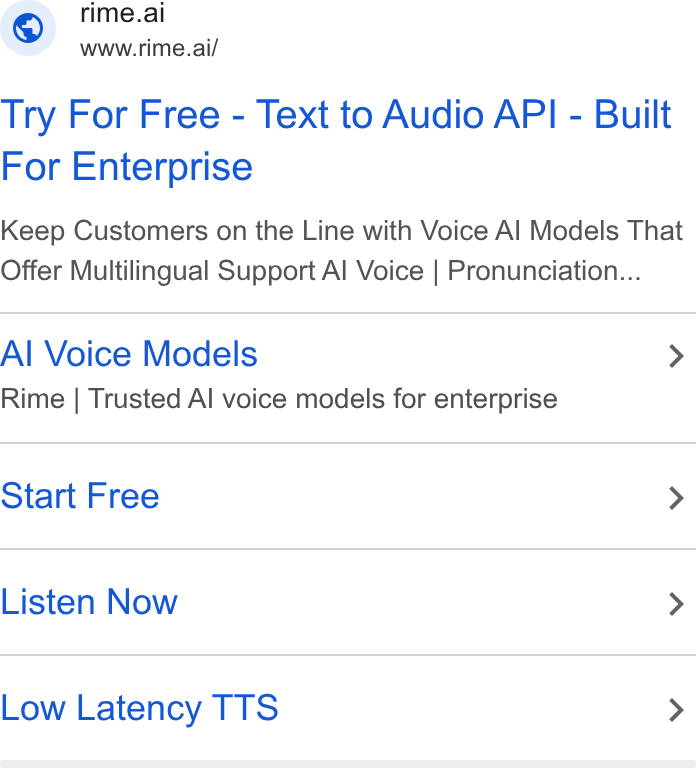
- Running
- 60 days (longevity = it's converting)
- Hook
- rime.ai www.rime.ai/ Try For Free - Text to Audio API - Built For Enterprise
- CTA / offer
- Try For Free
- Audience
- The phrases 'Built For Enterprise', 'AI Voice Models', and 'Trusted AI voice models for enterprise' clearly target businesses and professionals looking for advanced AI solutions.
Why it works. Bundles a free offer with the enterprise buyer label so the ad self-selects for procurement-ready teams, not hobbyists.
Prominent value proposition and offer in the headline: 'Try For Free - Text to Audio API - Built For Enterprise' Fold your free offer and your target segment into one headline line, e.g. 'Try [product] Free, Built For [segment].'
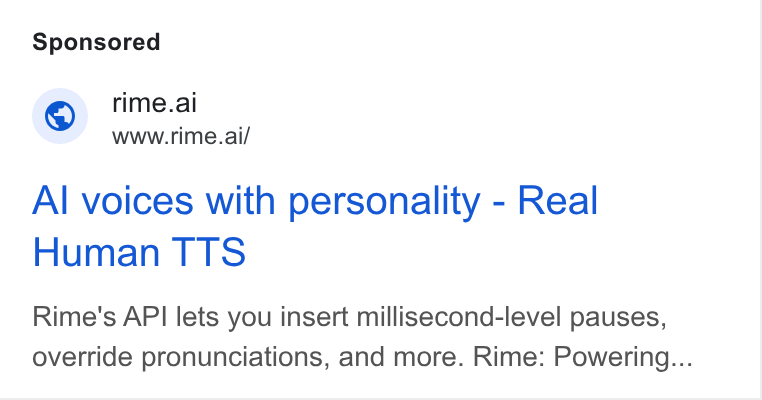
- Running
- 109 days (longevity = it's converting)
- Hook
- Sponsored rime.ai www.rime.ai/ AI voices with personality - Real Human TTS
- Audience
- The mention of "API" and "TTS" targets developers, content creators, and businesses interested in advanced voice technology.
Why it works. Leads with the one differentiator buyers comparing TTS vendors care about (does it sound human) right in the search headline.
Headline with a bold claim: "AI voices with personality - Real Human TTS" Put your single most distinct feature as a direct claim in your headline, worded the way a buyer would search for it.
08 The playbook
The channels are not separate. They are one system where each stage feeds the next. Here is the read, then the plays to run tomorrow.
The inferred playbook
Rime's loop starts with a model-release announcement on Clifford's X feed, converts through integration partnerships and direct enterprise sales, and compounds through the small set of docs and conversational-design pages that rank for developer-intent search.
Partnerships with Vapi, Together AI, Daily's Pipecat, SLNG, and Regal.ai each get a dedicated launch post and place Rime's models inside other builders' distribution, likely the primary path from awareness to trial for a usage-based API.
The Starter tier runs $0.05 per 1,000 characters with 3,000 free minutes to start and 20 concurrent generations, while Enterprise is custom with unlimited concurrency, SLAs, and HIPAA/SOC 2, a two-step ladder from self-serve trial to negotiated contract.
Dig deeper+2▾
At ~34,862 monthly visits and 3,829 founder followers as of the observation date, Rime's visible content and social footprint is small relative to its funding and nearly 100M monthly call volume, implying most enterprise demand comes through partnerships and direct sales rather than the public content or social surface.
Rime's Starter-to-Enterprise conversion rate, per-account contract value across its enterprise customers, and churn among named accounts (Mayo Clinic, Dialpad, Upstart, Asurion) are not disclosed.
Ship narrow, then post the spec
The proofEvery Rime release, from Arcana's 200ms time-to-first-token to Mist v3's ~40ms time-to-first-byte, ships as a founder X post anchored to one hard number rather than a feature list.
The adaptationPick the single metric that best proves your product works (latency, accuracy, time saved) and post it every time you ship, even a small update, using the exact number and the exact unit, not a rounded-off claim. Start by drafting the post before you finish the feature, so shipping and announcing happen the same day.
Cost: $0 · Time to signal: days · Works pre-PMF: yes
Quantify the milestone, don't gesture at it
The proofClifford's one growth-focused post didn't say "growing fast," it said revenue doubled over three months and usage quadrupled, a specific multiplier that reads as evidence rather than hype.
The adaptationThe next time you hit a real inflection point, post the actual multiplier (2x revenue, 3x signups, 50% faster onboarding) over its actual time window, not a vague trend line. Write it down the day you notice the number, before the instinct to round it into marketing language sets in.
Cost: $0 · Time to signal: days · Works pre-PMF: yes, provided the multiplier is real and you can show your math if asked
Get listed inside a bigger builder's stack
The proofRime's integrations with Vapi, Together AI, and Daily's Pipecat each became a dedicated announcement, putting its models inside other companies' distribution instead of building a standalone audience.
The adaptationIdentify the two or three larger platforms your target customer already builds on, then build the smallest possible integration or plugin for one of them and ask to be added to their public directory or partner list. Post about the integration the day it goes live, framed around what it lets the other platform's users do, not around your own product.
Cost: $0 to under $500 · Time to signal: weeks · Works pre-PMF: conditional, only once you have a working integration, not just a pitch
Seed a working demo in a builder community
The proofA third-party developer's Show HN post using Rime's TTS in a live phone demo outperformed Rime's own launch post, 15 points versus 5, because it showed the product working inside someone else's project.
The adaptationInstead of writing about your own product, build a small working demo that uses it inside someone else's popular open-source tool or framework, then post that demo (not a company announcement) to the relevant technical community. Lead with the working link, exactly as the Vocode collaboration did.
Cost: $0 · Time to signal: weeks · Works pre-PMF: yes, conditional on the demo being genuinely usable, not a screenshot
Bid on the category term, not your own name
The proofRime's active Google ads target "ai voice generator"-class queries pulling ~152,000 monthly searches, while its own brand term draws roughly 1,020, so the paid budget goes toward category demand rather than defending traffic it likely already gets for free.
The adaptationOnce you have a landing page that converts, check the search volume for your own brand name versus the generic category term a buyer would type before they know you exist, and put your first ad dollars against the generic term with a specific, bold claim in the headline, not a brand-safe tagline. Start with a small daily budget and one headline variant so you can measure cost per signup before scaling it.
Cost: under $500 · Time to signal: weeks · Works pre-PMF: conditional, only once conversion tracking exists to measure whether the spend is working Not transferable at an earlier stage: the integration listings with Vapi, Together AI, and Daily assume Rime already has enterprise-grade infrastructure and a sales team ready to close the accounts those integrations surface. A pre-PMF founder can get listed the same way but should not expect the same enterprise pull until the product can back it up.
You just read how Rime does it. Tomorrow it is someone else.
Every morning we take one company that is actually growing and break down where its customers come from: the ads still running after a year, the channel doing the real work, and the play you can run this week.
Systemaic · directional intelligence. Traffic, spend, and reach figures are SimilarWeb-style estimates and qualitative reads of public data, not audited numbers. Built on real public receipts.
// teardowns with a similar GTM motion
sources & receipts (28)
Live ad libraries: google ad library
Launch archives: Hacker News: Juice’s RIME antenna successfully unjammed · Hacker News: Rime of the Ancient Mariner (1834) · Hacker News: Introducing Arcana: AI Voices with Vibes · Hacker News: Show HN: Rime.co – Never miss an update · Hacker News: 'Slimy Rimes': Donne's Contagious London · Hacker News: Show HN: Rime.co - AI-based website building platform
Researched facts: Rime raised a $24 million Series A funding round: $24M Series A, led by M13 Ventures, with · Morgan Blumberg (Partner at M13) joined Rime's Board of Directors as part of the Series A: · Rime previously raised a $5.5 million seed round: Seed round led by Unusual Ventures, with · Rime was founded in 2022: Founders: Lily Clifford (CEO, ex-Stanford computational linguist · Rime's monthly call volume and customer base: Rime's speech models carry more than 100 mil · Rime achieved 3x price-performance gains on healthcare workloads via Oracle Cloud Infrastr · Rime's TTS models are natively hosted on Together AI's co-located voice pipeline: Integrat · Rime partnered with SLNG to deploy its Arcana V3 model globally: Partnership delivers prod · Regal.ai partnered with Rime to offer four Rime voices in production for enterprise contac · Rime is natively integrated into Daily Bots / Pipecat, an open-source voice AI cloud: Rime · Rime rolled out a new three-tier pricing model: Starter, Growth, and Enterprise: Starter f · Rime announced the new pricing structure in a dedicated post: "Today, we're rolling out an
Milestone sources: 2025-02: Rime launches Mist v2, a major update to its flagship TTS model adding Spanish su · 2025-04: Rime open-sources Rimecaster, a speaker representation model trained on its propr · 2025-04-24: Rime launches Arcana, billed as its most realistic spoken-language TTS model, · 2026-02-04: Rime launches Arcana v3, a flagship TTS model with 120ms latency and multiling · 2026-04-06: Rime releases Mist v3, a production TTS engine with roughly 40ms p90 time-to-f · 2026-05-15: Together AI begins hosting Rime's Mist v3 TTS models on dedicated infrastructu · 2026-05-19: Rime launches Coda, a dual-decoder flagship TTS model with 600+ voices across
Community threads: Hacker News: Vocode's founder credited rime.ai's TTS for an AI-podcast demo, specifically · Hacker News: On Rime's own Show HN post for the Mist v2 speech model, a commenter pushed b
Traffic, spend, and revenue figures are estimates as noted in the report; the links above are the primary public artifacts.