- 01Build a City-by-City Content Ladder
- 02Post Milestones From Your Own Name
- 03Trade Integrations for Referral Traffic
- 04Gate Complex Pricing Behind a Conversation
01 Snapshot
The one-glance read on who they are and how they grow. Each point is verifiable from the receipts above.
AI-plus-human permit management software for contractors and developers, having powered over $20 billion in construction value across 7,000+ jurisdictions as of December 2025.
Paid-led, running hundreds of ad variations simultaneously across Google, Meta, and LinkedIn on top of a search-organic-dominant traffic base.
A $54M Series B closed December 2025 (~$91M raised across three rounds), ~47,127 monthly visits (+20.7% over the last 3 months), and a 74-ad Google library with 17 still active as of 2026-07-09.
As of 2026-07-09, fresh test batches are live on Google (a June 2026 text-ad wave) and LinkedIn (a batch of undated, just-launched creative), alongside a Meta batch built around a "stop reactive compliance" hook.
PermitFlow bids on jurisdiction-named search intent directly, running Google ad creative headlined by individual cities like Troutdale, Kissimmee, and Savannah rather than one generic brand campaign.
02 How it unfolded
The order the channels came online. Sequence is strategy: what they did first, and what they layered on once demand existed.
03 Traffic & channel mix
Estimated demand, the channel split behind it, and the keywords and referrers doing the work. Directional modeling, not audited analytics.
Traffic sources
Top search keywords
| Keyword | Volume | Weight | CPC |
|---|---|---|---|
| permitflow | 8.8k | $6.61 | |
| permit flow | 2.9k | $6.58 | |
| permitflow careers | 970 | - | |
| what does csc plan intake mean constrution sub permits | 610 | - | |
| requirements for new construction in hernando county florida | 460 | - |
Closest competitors by audience
PermitFlow draws an estimated ~47,127 monthly visits, up 20.7% over the last 3 months. Search Organic is the dominant channel at 51%, Direct follows at 34.3%, and Referrals sit at 6.3%; the rest, paid search, email, organic social, AI referrals, affiliate, and paid social, totals under 9%. The heavy direct share is notable for a B2B platform selling to named enterprise builders, consistent with returning logins from existing project teams rather than pure brand-recall traffic. The 6.3% referral share lines up with the site's own affiliate/partner program and its integration partnership with construction-tech platform TraceAir, both funneling traffic in rather than search or social.
On keywords, the branded terms "permitflow" (8,850 searches/mo) and "permit flow" (2,880 searches/mo) dwarf everything else they rank for, showing a search graph still mostly built on people who already know the name. The one non-branded keyword in evidence, "requirements for new construction in Hernando County Florida" (460 searches/mo), is the more instructive one: it shows the hyper-local, jurisdiction-specific demand PermitFlow's SEO and paid search both chase. Among named competitors, permitplace.com and permithunt.com are direct point-solution rivals in the same permit-automation niche, while assignar.com is a broader construction-workforce and compliance platform that signals an adjacent, overlapping buyer rather than a head-to-head competitor.
04 Organic content
The specific pages earning their organic search traffic, and the pattern behind why they rank. Adapt the format, not the topic.
The top organic pages split between the branded homepage (~3,608 visits/mo, by far its single biggest organic page) and a set of blog posts built around specific local permit guides and adjacent software-category terms, not general permitting content. "Wichita building permit" is a city-specific how-to guide, while "construction accounting software" and "subcontractor management software" are category pages competing for searches from contractors evaluating adjacent tools, not permitting specifically. This is a hub-and-spoke content play: hyper-local, low-competition permit guides capture long-tail geo queries (the same city-by-city pattern visible in their paid search ads), while the software-category pages intercept buyer-intent traffic from people already shopping a construction-software stack, both cheaper to rank for than a head-on "permit software" term.
Top pages by organic traffic
05 Channel map
Not traffic share. How much weight the growth system actually puts on each channel, with a one-line read on the role it plays.
What drove growth
06 The motions doing the work
For founder-led SaaS the breakdown shifts from ads to traction: where the first users came from, how the founder grows it in the open, and the compounding organic surface.
PermitFlow's traction shows up as a funding-and-logos trail rather than a single viral launch spike.
Co-founders Francis Thumpasery (CEO) and Samuel K. Lam (CTO) started the company in 2021 and ran it through Y Combinator's Winter 2022 batch, then closed a $5.5M seed round in May 2023 led by Initialized Capital, the same investor that reappears in every funding round since.
At its $31M Series A in February 2024, the company said it had helped permit over 5,000 housing units, the first hard usage figure to surface in press.
Dig deeper+2▾
CEO Francis Thumpasery's "TurboTax for construction permitting" description, coined in that same funding coverage, became the recurring press hook still used to describe the company through its Series B (source).
a creator recap of the Series B repeated the company's own claims of eliminating "90% of administrative drag" and cutting timelines 60%, marketing figures echoed from the company rather than independently verified. It named reference customers directly: Lennar, Amazon, IKEA, and Brookfield Properties.
PermitFlow's build-in-public voice runs through CTO Samuel Lam's personal accounts, not a dedicated brand social presence.
Lam's LinkedIn draws 17,497 followers against 1,911 on X across 100 posts as of 2026-07-09, and both bios tie directly to PermitFlow and his CTO title, making his personal accounts the company's primary social channel.
Lam's December 2025 post announcing the Series B, "We're building the AI workforce for construction," pulled 2,664 views and 6 likes on his X account (only 100 total posts), a reach modestly ahead of its 1,911 followers even as likes stayed in single digits.
Dig deeper+1▾
no distinct posting activity surfaced for the brand's own X account beyond the homepage link to it, so the funding narrative and technical positioning ride on Lam's name recognition instead of a company-run account.
Organic search carries more than half of PermitFlow's traffic, and its three ad libraries function as a parallel volume experiment stacked on top of that base.
the local-jurisdiction blog pattern threads directly into paid search. PermitFlow effectively runs the same "city plus permit" template across both organic content and ad creative, so a new market gets a matching blog page and a matching ad instead of a one-off campaign.
the site runs a dedicated partners program at permitflow.com/partners, recruiting integration and referral partners such as the TraceAir tie-up noted above, a B2B channel-partnership motion aimed at other construction-tech vendors that shows up as a measurable 0.7% of total traffic.
Dig deeper+1▾
despite three simultaneous ad libraries running hundreds of variants, paid channels pull only about 3.3% of total traffic (3.2% search, 0.1% social), so the heavy testing cadence reads as demand-generation experimentation still finding its channel, well short of a proven paid-acquisition engine.
07 Paid ads
This founder-led SaaS also runs paid acquisition. Here are the live ads doing the work, each with the X-ray and a play you can adapt.
- Running
- 17 days (longevity = it's converting)
- Hook
- "This is hard work, right?" spoken as a man in a grey hoodie walks through an open-plan office.
- CTA / offer
- "Book a Demo >"
- Audience
- Construction professionals dealing with permitting, indicated by the text "Construction's AI Workforce" and the mention of "manual processes" for getting a "permit."
Why it works. A founder-to-camera line that validates the viewer's frustration before pitching, borrowing credibility from shared experience.
Dynamic footer value-props (0:00-0:10) Have your founder open on camera with a question that only has one honest answer, then pivot into the fix.

- Running
- 280 days (longevity = it's converting)
- Hook
- Visual: The word "Sponsored" at the top, followed by a logo with a 'P' and the text "Permitflow". Text: "Request a Demo Today - Permit Services for You"
- CTA / offer
- Request a Demo Today
- Audience
- High-volume contractors, indicated by the phrase "software built for high-volume contractors."
Why it works. Front-loads the CTA, Request a Demo Today, ahead of the offer, pushing warm searchers straight into the funnel.
Clear call to action in the headline: "Request a Demo Today - Permit Services for You" Test leading your headline with the action you want instead of burying the CTA at the end.
- Running
- 422 days (longevity = it's converting)
- Hook
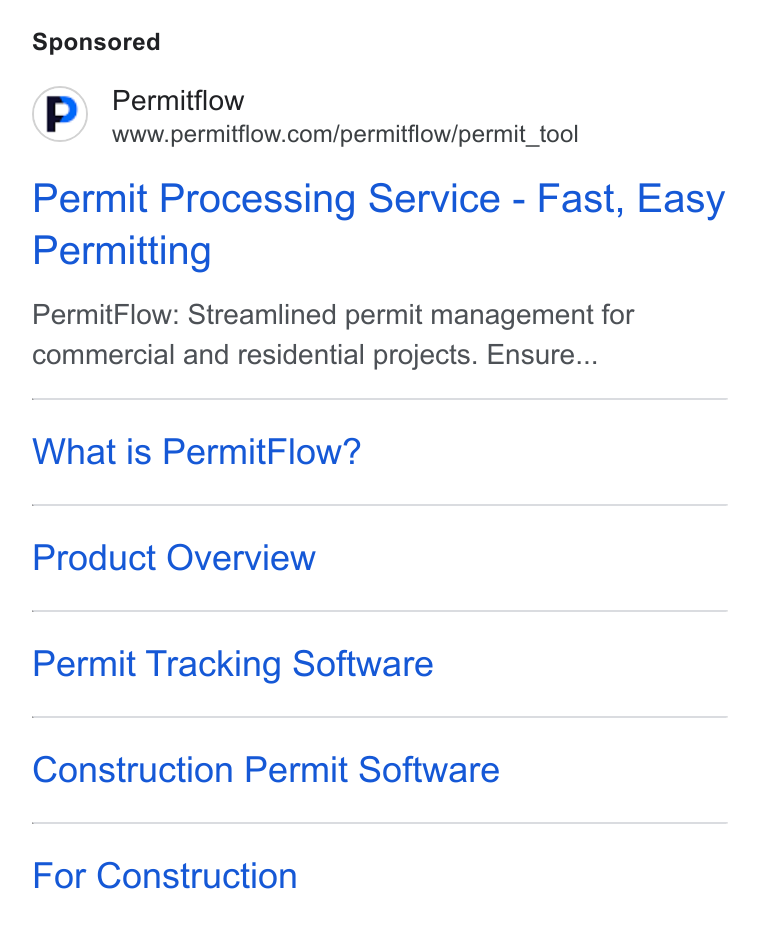
- Sponsored Permitflow www.permitflow.com/permitflow/permit_tool Permit Processing Service - Fast, Easy Permitting
- Audience
- Individuals or businesses involved in commercial and residential construction projects, indicated by the description 'Streamlined permit management for commercial and residential projects' and the subsequent links like 'Construction Permit Software'.
Why it works. Leads with the two adjectives contractors most want attached to paperwork, fast and easy, directly in the headline.
Headline with core benefit: 'Permit Processing Service - Fast, Easy Permitting' Pick the two adjectives your buyer wants most for a tedious task and put both in your headline back to back.
Show 3 more ads

- Running
- 89 days (longevity = it's converting)
- Hook
- "Build Faster with AI-Powered Permitting" with a close-up of a person's legs and feet on a roof, with the PermitFlow logo visible in the upper left.
- CTA / offer
- Talk to an Expert
- Audience
- Professionals involved in construction or building projects who deal with permitting, indicated by the imagery of a person on a roof and the text about 'permitting' and 'building'.
Why it works. Pairs the AI-powered claim with a concrete outcome, building faster, and a roofline visual that puts the buyer in the scene.
Headline stating a direct benefit: "Build Faster with AI-Powered Permitting". Attach your AI or automation claim to a visible speed outcome instead of stating the feature by itself.
- Running
- 287 days (longevity = it's converting)
- Hook
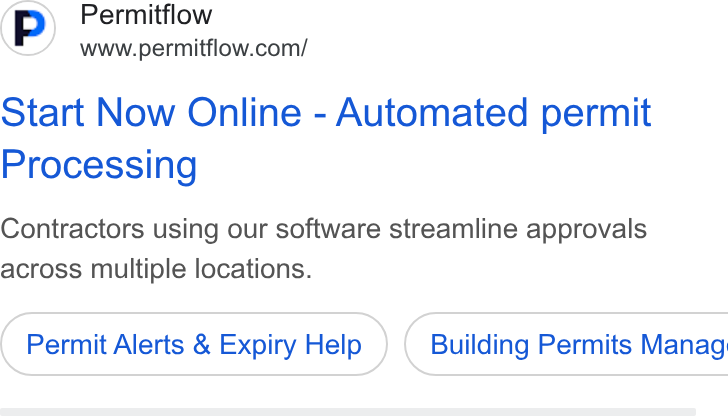
- Permitflow www.permitflow.com/ Start Now Online - Automated permit Processing
- Audience
- Contractors are explicitly mentioned as the target audience, with the text 'Contractors using our software streamline approvals across multiple locations.'
Why it works. Targets high-intent searchers with an instant-action promise plus the automation angle that differentiates it from manual filing.
Headline benefit statement: The ad leads with 'Start Now Online - Automated permit Processing'. Lead search headlines with a start-now action verb paired with the one word that names your core differentiator.
- Running
- 276 days (longevity = it's converting)
- Hook
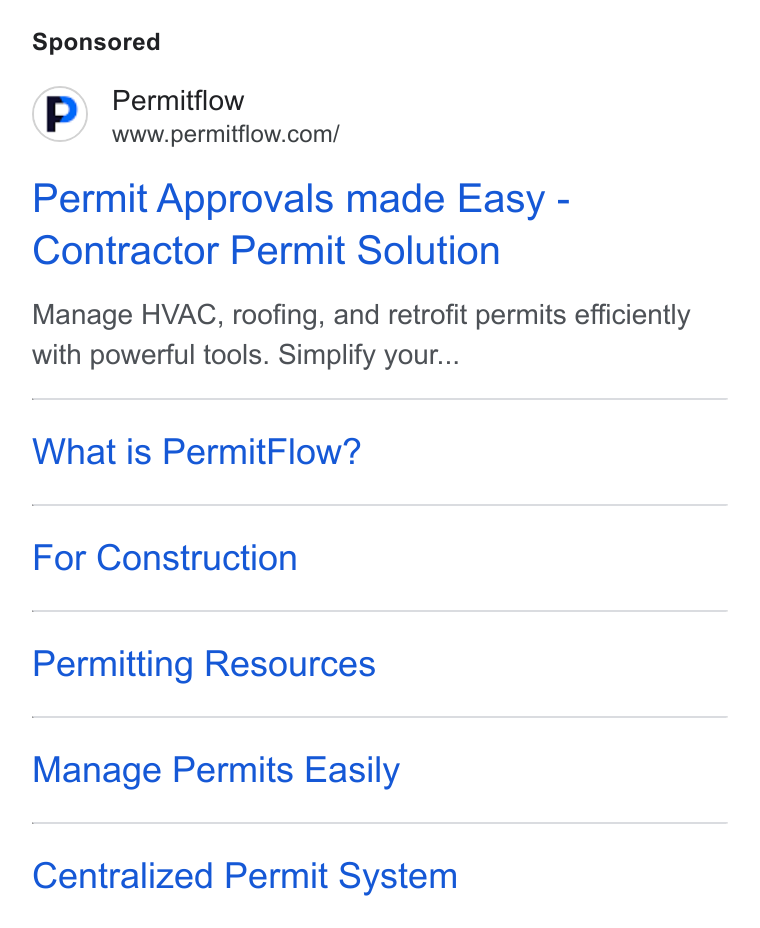
- Sponsored Permitflow P www.permitflow.com/ Permit Approvals made Easy - Contractor Permit Solution
- Audience
- Contractors, specifically those dealing with HVAC, roofing, and retrofit permits, indicated by the text "Contractor Permit Solution" and the description of managed permits.
Why it works. Names the exact bureaucratic bottleneck, approvals, that contractors resent, then claims it solved in one word, easy.
Headline directly addresses a pain point and offers a solution: "Permit Approvals made Easy - Contractor Permit Solution" Identify the single workflow step that causes your buyer the most complaints, then promise that specific step is easy.
08 The playbook
The channels are not separate. They are one system where each stage feeds the next. Here is the read, then the plays to run tomorrow.
The inferred playbook
The loop runs on demo-gated enterprise sales layered over an organic-plus-paid demand engine, not a self-serve signup flywheel.
the geo-templated blog pages and city-named paid ads generate awareness among contractors researching a specific jurisdiction, while branded search ("permitflow," "permit flow") captures people who already know the name.
every ad in evidence points to "Book a Demo" language, and pricing is quoted per project instead of published, so the funnel behaves like enterprise software sold by account teams rather than a free-trial product-led motion.
Dig deeper+3▾
the partners program, integration tie-ups, and a press framing that has carried across three funding rounds keep feeding referral traffic and brand search without incremental ad spend.
there is no visible self-serve trial, no public community, and no repeatable earned-launch mechanism in evidence, so growth depends on sales capacity and ad budget scaling together instead of a channel that compounds on its own.
sales-cycle length, win rate, churn, CAC, and published pricing tiers.
Build a City-by-City Content Ladder
The proofPermitFlow's Wichita-style local permit guides mirror the same city-named ad pattern noted in the Snapshot, doubling up organic and paid on identical geographic intent.
The adaptationList the 10 to 20 highest-intent geographic or vertical variants of your core problem, a city, an industry, a job title, and publish one dedicated page per variant, each pointed at a single conversion action. Start with the three variants your current customers ask about most, write those pages first, and route your next small paid-search test at the same terms so organic and paid validate each other instead of running blind. Narrow, low-competition variants rank and convert faster than one broad head term, and a matching ad confirms the intent is real before you scale the page count.
Cost: $0 · Time to signal: months · Works pre-PMF: yes
Post Milestones From Your Own Name
The proofLam's own funding-announcement post outperformed his follower count on an account with only 100 total posts, covered above.
The adaptationWhen you hit a real milestone, funding, a customer win, a hard usage number, post it from your personal account with the specific figures and named partners instead of only from the brand account. First step: draft one post the next time you have a real number to share, tag the people or investors involved by name, and publish it before the brand account does.
Cost: $0 · Time to signal: days · Works pre-PMF: yes
Trade Integrations for Referral Traffic
The proofPermitFlow's partners program and its TraceAir integration announcement, both covered above, turn a complementary tool's own audience into referral traffic without ad spend.
The adaptationList three to five tools your ideal customer already pays for that touch your product's workflow, and pitch each one a lightweight integration or referral arrangement they can announce to their own list. First step: email one partnerships contact with a one-page pitch naming the specific workflow overlap.
Cost: $0 to under $500 for a simple integration · Time to signal: weeks · Works pre-PMF: conditional, it lands best once you have at least one reference customer the partner can point to
Gate Complex Pricing Behind a Conversation
The proofPermitFlow publishes no fixed price tiers, quoting per project instead, and every ad in evidence routes to a demo request rather than a checkout page.
The adaptationIf your offering genuinely varies by customer complexity, resist publishing a flat price table and instead route pricing behind a short qualifying form, so every lead becomes a scoped conversation instead of a bounce off sticker shock. First step: replace a public price page with a three-question qualifying form that routes to a call.
Cost: $0 · Time to signal: weeks · Works pre-PMF: conditional, only helps when pricing truly varies by project; forcing a demo gate on a simple flat-rate product just adds friction Not transferable at an earlier stage: the three parallel ad libraries and the $91M in venture funding behind them assume a budget and sales team most readers won't have yet. Adapt the content and partner mechanics, not the paid-media scale.
You just read how PermitFlow does it. Tomorrow it is someone else.
Every morning we take one company that is actually growing and break down where its customers come from: the ads still running after a year, the channel doing the real work, and the play you can run this week.
Systemaic · directional intelligence. Traffic, spend, and reach figures are SimilarWeb-style estimates and qualitative reads of public data, not audited numbers. Built on real public receipts.
// teardowns with a similar GTM motion
sources & receipts (5)
Live ad libraries: meta ad library · linkedin ad library · google ad library
Launch archives: Hacker News: PermitFlow (YC W22) Hiring Founding Software Engineers (Remo · Hacker News: PermitFlow (YC W22) – Hiring Senior Engineers to Automate Pe
Traffic, spend, and revenue figures are estimates as noted in the report; the links above are the primary public artifacts.