- 01Hire a technical SEO specialist before publishing more content
- 02Build one free tool per month as a compounding backlink asset
- 03Run programmatic SEO on the [niche] + [your product category] keyword matrix
- 04Switch to a credit-card-required short trial instead of a free tier or no-card trial
01 Snapshot
The one-glance read on who they are and how they grow. Each point is verifiable from the receipts above.
An investor database and fundraising CRM letting startup founders filter and directly email 110,000+ angel investors and VCs, priced at $59/month (Solo, annual) to $199/month (Premium, annual) with a 3-day credit-card-required trial.
SEO-led, with Meta paid social layered on to diversify acquisition.
Publicly reported $26,057 MRR across 344 active paying subscribers ($76 blended ARPU), down from ~$32,945 gross volume the co-founder disclosed for July 2025; site draws an estimated 56,280 monthly visits.
Co-founder Rashid Khasanov mapped the acquisition arc publicly: "$0 to $2K: PH, subreddits, directories; $2K to $20K: SEO, blogs, free tools, pSEO; $20K to $30K: All of the above plus FB ads; $30K to $100K: Scaling FB ads (in progress)."
The SEO engine that drove this business to ~$33K MRR laid the foundation, and the team is now layering paid Meta acquisition on top to keep scaling.
02 How it unfolded
The order the channels came online. Sequence is strategy: what they did first, and what they layered on once demand existed.
03 Traffic & channel mix
Estimated demand, the channel split behind it, and the keywords and referrers doing the work. Directional modeling, not audited analytics.
Traffic sources
Top search keywords
| Keyword | Volume | Weight | CPC |
|---|---|---|---|
| angel investors cambodia | 420 | - | |
| oil and gas angel investors | 420 | - | |
| angelmatch | 160 | $3.96 | |
| battery materials angel investor | 210 | - | |
| angel match | 140 | $2.80 |
Closest competitors by audience
Estimated ~56,280 monthly visits, with a 33.7% decline over the observed period. The marketing channel breakdown: Search Organic 61.8%, Direct 17.1%, Referrals 9.2%, Social Organic 4.7%, Email 3.6%, Display Ads 1.6%, Gen AI 1.5%, Social Paid 0.4%.
Organic search is overwhelmingly the traffic engine, which means every point of ranking ground lost hits revenue almost immediately. The 17.1% direct share suggests reasonable brand recall among repeat visitors and existing subscribers. Referrals at 9.2% likely reflects the backlink footprint from free tools being shared across startup communities and roundup content.
The keyword profile confirms a long-tail, programmatic discovery strategy: "angel investors cambodia" (420 searches/month across the whole web), "oil and gas angel investors" (420 searches/month), "battery materials angel investor" (210 searches/month). These are niche sector-plus-location combinations, not high-volume head terms, which is exactly what a programmatic page-template approach is designed to own. Closest traffic competitors include foundingteams.ai, angelinvestmentnetwork.us, openvc.app, and funded.com.
04 Organic content
The specific pages earning their organic search traffic, and the pattern behind why they rank. Adapt the format, not the topic.
The top organic pages fall into three distinct formats: free interactive tools (a pre-money/post-money valuation calculator, an elevator pitch generator), programmatic investor-category pages (e.g. investors by market sector, including a restaurants page), and startup fundraising glossary entries (e.g. "advisory equity"). The pattern is hub-and-spoke: utility tools attract inbound links and rank on transactional queries from founders who need to calculate dilution or generate a pitch structure, while programmatic pages capture long-tail combinations no single article could rank for comprehensively, and glossary terms serve early-funnel definitional searches.
These pages work because they answer specific, task-level search intent. A founder arriving at a valuation calculator is closer to buying an investor-database tool than a founder reading a generic fundraising blog post, which makes the organic surface both a discovery channel and a conversion signal.
Top pages by organic traffic
05 Channel map
Not traffic share. How much weight the growth system actually puts on each channel, with a one-line read on the role it plays.
What drove growth
06 The motions doing the work
For founder-led SaaS the breakdown shifts from ads to traction: where the first users came from, how the founder grows it in the open, and the compounding organic surface.
The early user base came from Product Hunt, startup subreddits, and directory listings, confirmed by the founder's own public account, not from a single breakout launch moment.
The "educated_panda" account submitted Angel Match and related content across at least seven instances from 2019 to 2026, covering angles from "50K investor database" to free tools like the Elevator Pitch Generator and Burn Rate Calculator. Every submission landed at 1-4 points. Hacker News was never where traction materialized.
The Funding Goal Calculator tool trended at #4 on Product Hunt in January 2026, and prior versions of the core product (Angel Match 3.0) have also launched there. These functioned as acquisition spikes rather than a sustained growth driver.
Dig deeper+2▾
Per Rashid Khasanov's public breakdown, the $0 to $2K MRR phase was driven by Product Hunt, subreddits, and directory submissions; those channels plateaued and the team shifted to SEO, free tools, and programmatic content to push past $20K MRR.
Khasanov publicly named the hire of a dedicated technical SEO specialist as the pivotal move when the business was stuck at $2K-$3K MRR; the jump to $20K+ followed. ---
Rashid Khasanov is the sole public face of the company, running a build-in-public presence on X at @Rashidkhasanov (1,394 followers) with a focus on operational specifics over personal narrative.
The posts that surface in the evidence are precise and operational: a July 2025 customer acquisition breakdown (25% Facebook ads, 75% SEO, $32,945 gross volume), ad spend changes ($130/day scaled to $180/day on Facebook plus $50/day to an agency), and a trial-format experiment that landed on a credit-card-required 3-day trial with a self-disclosed 30%+ conversion rate. This level of detail builds credibility with a founder audience that can verify the logic.
The most-engaged post in the evidence is the $0-to-$30K MRR acquisition map (7 likes, 720 views, 2 retweets on a 1,394-follower account), suggesting that sequential, stage-by-stage tactical breakdowns outperform generic advice for this audience.
Dig deeper+1▾
At 1,394 followers, the personal audience is small relative to the acquisition results; the build-in-public content functions as a credibility layer and backlink source rather than a primary acquisition channel. Specific subreddit-level engagement data for Khasanov or the brand is not visible in the public evidence available. ---
Organic search at 61.8% of traffic makes the SEO and content engine the single most important growth asset, and shoring it up the single biggest priority.
The valuation calculator, elevator pitch generator, burn rate calculator, and dilution calculator each serve double duty: ranking on transactional queries and earning organic backlinks from startup media and newsletters that curate useful tools. Khasanov's own public prescription is "build 1 free tool per month for 12 months, launch each on PH, IH, startup directories, subreddits. You'll get lots of backlinks, boost domain authority and build a compounding traffic engine that will drive consistent growth."
The /investors/by-market/[sector] structure generates hundreds of low-competition pages from a single template, capturing niche queries like "oil and gas angel investors" or "restaurant investors" that no hand-written article could cover at scale. This is the engine behind the long-tail keyword profile visible in the traffic data.
Dig deeper+2▾
Startup fundraising glossary entries (e.g. "advisory equity") provide a third organic layer targeting definitional searches from early-stage founders, a segment that converts at higher rates because they are actively researching fundraising.
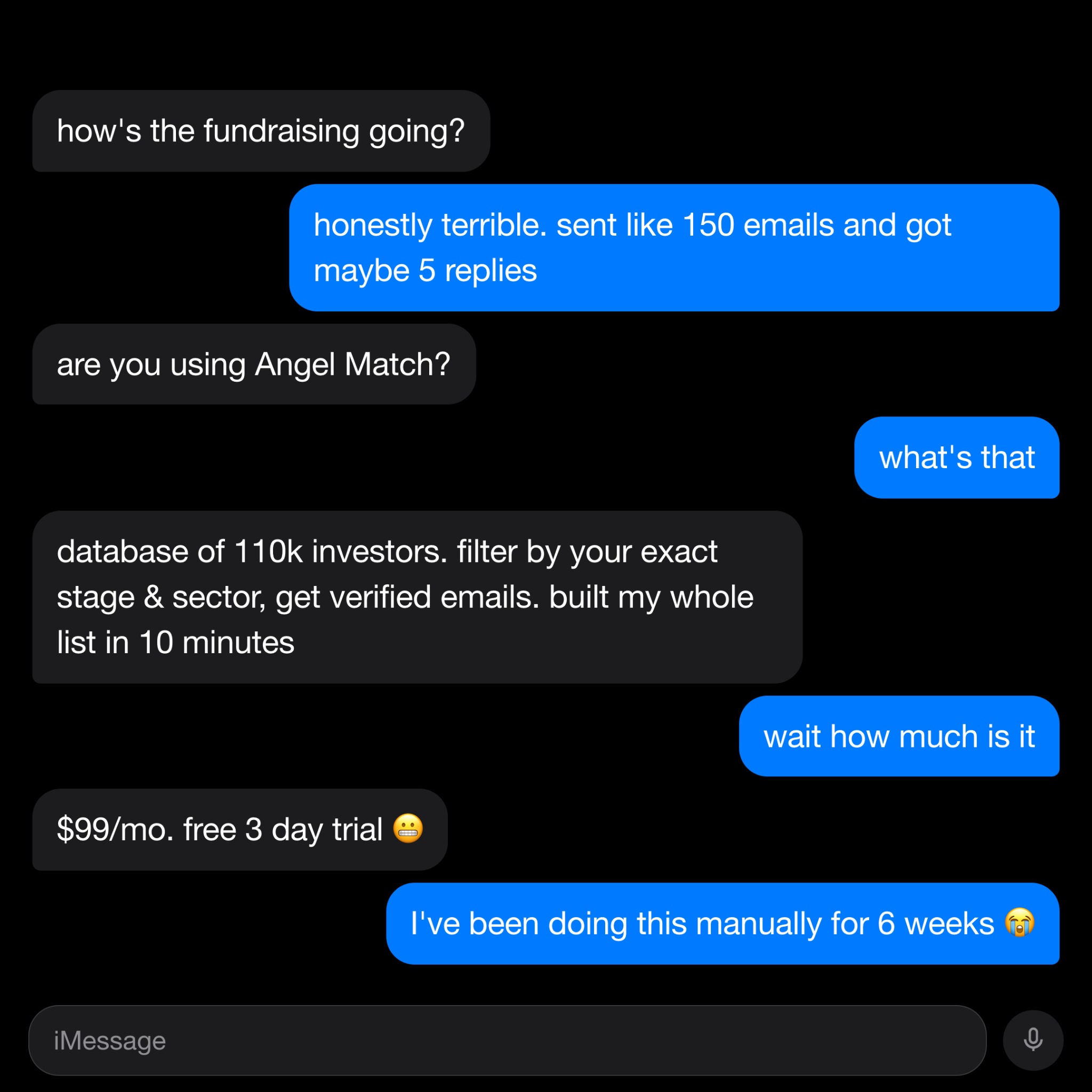
As of 2026-07-02, the active Meta campaign has run continuously since April 2026. The creative strategy is problem-agitation throughout: the longest-running ad formats include a fake-text-message static image ("honestly terrible. sent like 150 emails and got maybe 5 replies"), a UGC talking-head video opening with "Raising money for my startup was...", and a direct bold-claim image ("110,000+ Angels and VCs at Your Fingertips"). A newer test batch uses a "Things I wasted money on before finding what works" strikethrough list format, naming a $5K/month fundraising advisor as the losing alternative. The motion is demand generation targeting founders actively in a raise, not brand-term defense. Google ads are not active (0 of the 3 ads in the library are live as of 2026-07-02). No affiliate or referral program is visible in the public evidence. Free-to-paid conversion rate: 30%+ on the credit-card-required 3-day trial, per the founder's own disclosure; not visible in external data. ---
07 Paid ads
This founder-led SaaS also runs paid acquisition. Here are the live ads doing the work, each with the X-ray and a play you can adapt.
- Running
- 76 days (longevity = it's converting)
- Hook
- "STRUGGLING TO FIND INVESTORS FOR YOUR STARTUP?" + Black and white footage of a woman looking stressed at a desk.
- CTA / offer
- "SIGN UP NOW AT ANGELMATCH.IO!"
- Audience
- Startup founders actively fundraising ("FOR YOUR STARTUP").
Why it works. Pairs the precise task founders are stuck on with visibly stressed black-and-white footage, then resolves it with a product demo showing the database in action.
Black and white 'pain' footage (0:00-0:06) Ask your audience's precise internal question in bold on-screen text before you show any product screen.
- Running
- 76 days (longevity = it's converting)
- Hook
- "Raising money for my startup was overwhelming until I found AngelMatch.io" spoken by a woman in a brown t-shirt and blue jeans standing in a room with two grey doors.
- CTA / offer
- Access to a database of over 110,000 investors with filtering and tracking tools.
- Audience
- Startup founders currently 'fundraising' or 'raising money for my startup'.
Why it works. A founder speaks in her own voice about fundraising overwhelm resolving the moment she found Angel Match, giving skeptical seed-stage founders a peer proof point instead of a claim.
Problem-Agitation Opening (0:00 - 'overwhelming') Have a real customer name the exact pain word they used before buying, then the exact moment your product fixed it, in one unbroken line.
- Running
- 76 days (longevity = it's converting)
- Hook
- "HOW MUCH TIME HAVE YOU WASTED" + animation of a man looking up at a blue background.
- CTA / offer
- "SIGN UP TODAY AT ANGELMATCH.IO!"
- Audience
- Founders seeking capital ("SEARCHING FOR INVESTORS", "GROWING YOUR BUSINESS", "MISSED FUNDING OPPORTUNITIES")
Why it works. Frames the ask around hours lost to manual investor research, a founder's scarcest resource next to capital, then resolves it with a UI walkthrough proving the automated version.
Agitating Opportunity Cost at 0:00: 'searching for investors instead of growing your business?' Ask your audience how many hours the manual version of your task costs them before you ever name the task itself.
Show 3 more ads
- Running
- 70 days (longevity = it's converting)
- Hook
- "STARTUP FOUNDERS" text overlay over a person with blonde hair and a headset looking at a laptop and papers.
- CTA / offer
- "START YOUR 3 DAY TRIAL TODAY"
- Audience
- Startup founders (explicitly named at 0:00) who are currently fundraising.
Why it works. Uses a direct audience label plus a database walkthrough to filter for founders and prove feature depth in one creative.
Direct Audience Call-out (0:00 - "STARTUP FOUNDERS") Open with the exact two-word label of your buyer in large text, then walk through your product's specific features.
- Running
- 75 days (longevity = it's converting)
- Hook
- how's the fundraising going? (text message from sender) honestly terrible. sent like 150 emails and got maybe 5 replies (text message from receiver)
- CTA / offer
- $99/mo. free 3 day trial
- Audience
- Founders or individuals involved in fundraising, indicated by the conversation about 'fundraising' and 'investors'.
Why it works. Dramatizes a private text exchange with a brutally specific reply rate to mirror the exact frustration of cold outreach fundraising.
Lead with a relatable problem: The first message asks, "how's the fundraising going?" and the reply states, "honestly terrible. sent like 150 emails and got maybe 5 replies." Stage a two-text exchange where the reply reveals a specific, painful ratio, like emails sent versus replies, instead of a vague complaint.
- Running
- 2 days (new — still being tested)
- Hook
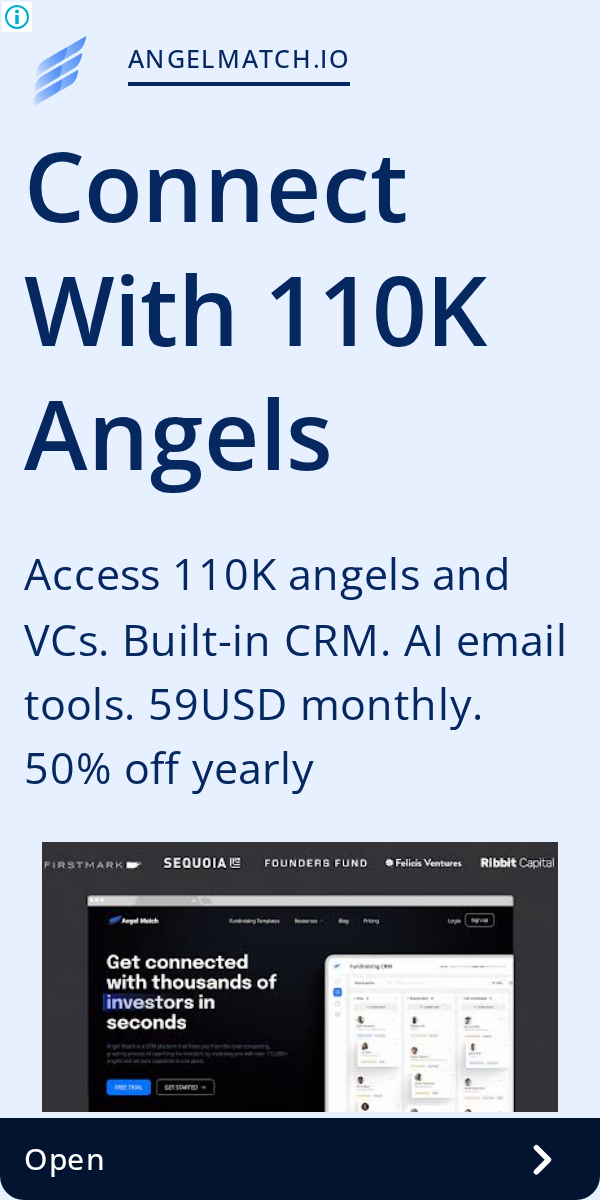
- Visual: A light blue background with a blue winged logo and the text "ANGELMATCH.IO" underlined. Below it, large blue text reads "Connect With 110K Angels".
- CTA / offer
- 59USD monthly. 50% off yearly. CTA: "FREE TRIAL", "GET STARTED", "Open"
- Audience
- Entrepreneurs and founders seeking investment, indicated by the terms "Angels", "VCs", "investors", and the platform name "ANGELMATCH.IO".
Why it works. Leads with a specific database size to signal a scale advantage over manually networking for investor intros.
Headline with a large, specific number: "Connect With 110K Angels" State your inventory size as a specific round number in the headline instead of a soft claim like 'lots of options'.
08 The playbook
The channels are not separate. They are one system where each stage feeds the next. Here is the read, then the plays to run tomorrow.
The inferred playbook
Angel Match grew on a compounding SEO asset and free-tool link bait, layered Meta ads as an accelerant at the $20K MRR mark, and is now in a meaningful revenue contraction as the organic foundation shrinks.
From roughly $2K to ~$33K MRR, the machine was programmatic SEO on investor-by-sector pages, free calculators and generators earning backlinks, and glossary content capturing early-funnel search intent, anchored by a technical SEO specialist hire as the pivotal unlock.
Meta ads were added at the $20K+ stage and scaled to $230/day by July 2025 (the last disclosed figure), accounting for 25% of new customer acquisition by July 2025, against 75% still coming from SEO. The paid layer amplified organic, it did not replace it. The publicly reported $26,057 MRR sits below the ~$32,945 gross volume Khasanov disclosed for July 2025, and below the ~$35,600-$37,300 range cited in third-party aggregators for 2025. With organic search driving 61.8% of visits, revenue tracks search rankings with almost no lag. The path from the 2025 peak to the current figure is not explained in public sources, but the traffic-to-revenue correlation is direct.
Dig deeper+1▾
Paying to acquire customers while the organic foundation erodes creates a leaky-bucket dynamic where customer acquisition cost rises as free traffic falls. The key missing signal is whether the SEO decline is a recoverable algorithm adjustment or a structural loss of programmatic page authority to better-resourced competitors. ---
Hire a technical SEO specialist before publishing more content
The proofAngel Match's MRR was stuck below $3K for roughly four years despite publishing content. Khasanov named the inflection directly: "One of the best decisions we made was hiring a technical SEO expert when we were stuck at $2K-$3K MRR. You can publish all the content you want, but if it's not properly optimized, indexed or structured, you won't rank and your app won't grow." The jump from ~$2K to $20K+ MRR followed that hire.
The adaptationIf your SaaS is producing content without someone auditing index coverage, crawl budget, internal linking, and structured data, the content is likely underperforming for structural reasons you can't write your way out of. Before commissioning more articles, run a technical audit on what you already have: check Google Search Console for pages that exist but are not indexed, identify canonical errors, and fix site structure first. Start with a one-time technical audit before any content investment. The mechanism is that distribution failures masquerade as content quality problems; fixing the infrastructure makes every future piece of content more effective.
Build one free tool per month as a compounding backlink asset
The proofAngel Match's highest-traffic organic pages are free calculators and generators (valuation calculator, elevator pitch generator, burn rate calculator). These tools earn backlinks from startup media and roundup content passively over time, boosting domain authority across all pages. Khasanov's public prescription: "Build 1 free tool per month for 12 months. Launch each on PH, IH, startup directories, subreddits. You'll get lots of backlinks, boost domain authority and build a compounding traffic engine."
The adaptationIdentify the 3-5 calculations or decision frameworks your target customer does in a spreadsheet or by asking in community forums. Build a simple browser-based version of the most common one first. Publish it to Product Hunt, Indie Hackers, and the 2-3 subreddits where your audience is active, framed as a free tool, not a product launch. Repeat monthly. Start by finding one forum thread where your audience describes doing a calculation manually, then build exactly that calculator. The mechanism is that free utilities earn editorial links from newsletters and guides passively over time, compounding domain authority in a way that blog posts rarely do. Caveat: backlink authority compounds over 6-18 months; this play requires sustained execution, not a single launch.
Run programmatic SEO on the [niche] + [your product category] keyword matrix
The proofAngel Match's /investors/by-market/[sector] pages capture queries like "oil and gas angel investors" (420 searches/month) and "restaurant angel investors" at low competition that no single hand-written article could cover comprehensively. These long-tail pages collectively drive a meaningful share of organic discovery and are nearly impossible for a competitor to replicate manually.
The adaptationMap the two-axis matrix your target audience searches: [use case or job-to-be-done] + [industry, location, stage, or company type]. Build one template page that populates cleanly for each intersection. For a hiring tool, this might be "software engineer job description for [industry]" pages; for an accounting tool, "bookkeeping for [business type]" pages. Start by confirming 10-20 combinations with 50-500 searches/month via any keyword tool, then build the template to generate 50-200 pages at once. The mechanism: you capture long-tail demand that no individual competitor bothers to serve, and each page reinforces the domain's topical authority in the category.
Switch to a credit-card-required short trial instead of a free tier or no-card trial
The proofKhasanov tested multiple trial formats and shared the results publicly: removing the free plan ("didn't work"), a 7-day no-credit-card trial ("didn't work"), and a 3-day credit-card-required trial ("worked best"). The disclosed trial-to-paid conversion rate is 30%+. He also noted that the card requirement filters out bots, scrapers, and low-intent signups, producing a cleaner real churn signal.
The adaptationIf your SaaS runs a free tier or a no-card trial with a conversion rate below 15-20%, run a structured experiment: require a credit card at signup and shorten the trial window to 3-5 days. Measure conversion rate and first-month churn against the baseline, not signup volume (which will fall). The mechanism is that removing friction at signup often imports noise rather than buyers; a modest barrier self-selects for purchase intent and improves the quality of the cohort, not just the quantity.
Lead paid ads with the prospect's own words, not product features
The proofAngel Match's longest-running Meta ads (76 days active as of 2026-07-02) share a single creative strategy: they open with the customer's frustration in the customer's exact language. The fake-text-message format ("honestly terrible. sent like 150 emails and got maybe 5 replies"), the UGC-style talking-head video opening with "Raising money for my startup was...", and the search-bar format showing "why do investors never reply" all mirror language founders have already used in real conversations. The product appears only after the problem is fully established.
The adaptationBefore writing any ad copy, collect 15-20 verbatim quotes from your target customers describing their problem: pull from support tickets, forum posts, app store reviews, or sales-call notes. Identify the 2-3 phrases that appear repeatedly. Use those exact phrases as your ad hook, in one of three formats that work without high production cost: a fake-text-message screenshot, a direct-to-camera video opening with the phrase as a question, or a static image with the phrase as large text. Start by testing the same problem statement across all three formats against one another. The mechanism is that mirroring the customer's own language bypasses the "this is an ad" filter faster than any invented creative hook, because the audience recognizes their own frustration before they register that they are being sold to.
You just read how Angel Match does it. Tomorrow it is someone else.
Every morning we take one company that is actually growing and break down where its customers come from: the ads still running after a year, the channel doing the real work, and the play you can run this week.
Systemaic · directional intelligence. Traffic, spend, and reach figures are SimilarWeb-style estimates and qualitative reads of public data, not audited numbers. Built on real public receipts.
// teardowns with a similar GTM motion
sources & receipts (8)
Live ad libraries: meta ad library · google ad library
Launch archives: Hacker News: Angel Match is a database of 50k investors to raise your cap · Hacker News: We've built the largest database of investors online · Hacker News: Examples of successful pitch decks for raising capital: Face · Hacker News: Fundraising Readiness · Hacker News: Calculate founder dilution across funding rounds · Hacker News: Burn Rate Calculator
Traffic, spend, and revenue figures are estimates as noted in the report; the links above are the primary public artifacts.