- 01Turn a round-number milestone into a traction post
- 02Reuse one customer number across every surface
- 03Reposition before you relaunch, not after
- 04Build a ranking page for your category's biggest generic search term
01 Snapshot
The one-glance read on who they are and how they grow. Each point is verifiable from the receipts above.
Open source AI chat and enterprise search (Slack, Drive, Confluence, Salesforce, GitHub connectors) built by Y Combinator W24 grads Yuhong Sun and Chris Weaver, monetized via a $20/user/month Business tier on top of a free, self-hostable open-core project.
Founder-led and launch-led, anchored by open source developer adoption rather than brand marketing.
~428,431 estimated monthly visits; a 254-point, 160-comment Launch HN front-page hit on 2025-11-25; and a $10M seed round (Khosla Ventures, First Round Capital) closed in March 2025.
As of 2026-07-13, Onyx runs 5 active LinkedIn ads pitching AI-in-higher-education use cases, a buyer vertical distinct from its core enterprise-search customer base.
Nearly every public growth moment, the seed round, the GitHub star milestone, the Launch HN thread, was created and amplified from co-founder Yuhong Sun's personal, sub-600-follower X account rather than any brand channel or paid campaign.
02 How it unfolded
The order the channels came online. Sequence is strategy: what they did first, and what they layered on once demand existed.
03 Traffic & channel mix
Estimated demand, the channel split behind it, and the keywords and referrers doing the work. Directional modeling, not audited analytics.
Traffic sources
Top search keywords
| Keyword | Volume | Weight | CPC |
|---|---|---|---|
| onyx | 198k | $0.77 | |
| onyx ai | 6.0k | $3.33 | |
| best open source llm | 6.0k | $3.21 | |
| best open source models | 2.3k | $3.28 | |
| llm benchmark | 19k | $2.88 |
Top referring sites
Closest competitors by audience
Onyx pulls an estimated 428,431 monthly visits, but that figure is down 37.6% over the trailing three months as of 2026-07-13, a decline the public data doesn't explain and one worth watching given the product relaunch and HN launch that preceded this window. Search organic dominates the mix at 57.4%, direct traffic is a large second at 28.8% (consistent with a technical audience that bookmarks or types the URL directly), and referrals add another 7%. The rest, social organic, AI-assistant referrals, email, and paid social, totals under 7% combined. Their brand term "onyx" carries a massive 198,300 monthly searches, but that volume is diluted by unrelated products sharing the name (e-readers, a defunct digital bank, a Clojure library); more telling is "llm benchmark" at 19,160 searches/month and "best open source llm" at 6,020/month, both categories where Onyx has built dedicated ranking pages. Top referrers include kagi.com, a privacy-focused search engine popular with technical users, and huggingface.co, the open source ML community hub that lines up with Onyx's developer base; strander.work is a smaller, less identifiable referral source. Of the named competitors, shakudo.io and lyzr.ai read as adjacent enterprise AI/agent platforms competing for the same buyer budget, while openlm.ai signals overlap specifically in the open source LLM tooling niche Onyx's leaderboard content targets.
04 Organic content
The specific pages earning their organic search traffic, and the pattern behind why they rank. Adapt the format, not the topic.
Onyx's top organic pages are almost entirely ranking and benchmark content, not product pages: the llm-leaderboard and open-llm-leaderboard pages alone account for over 40% of its top-five organic traffic, alongside a "best-llm-for-coding" comparison page. This is a programmatic-adjacent content pattern, tables and rankings built once and refreshed periodically, that ranks for high-volume, evergreen category terms ("llm benchmark," "best open source llm") rather than for the Onyx product name itself. It works because LLM-curious searchers doing general research land on a page owned by an open source AI company, giving Onyx a plausible, non-salesy entry point into an audience that is its exact developer/technical ICP.
Top pages by organic traffic
05 Channel map
Not traffic share. How much weight the growth system actually puts on each channel, with a one-line read on the role it plays.
What drove growth
06 The motions doing the work
For founder-led SaaS the breakdown shifts from ads to traction: where the first users came from, how the founder grows it in the open, and the compounding organic surface.
Onyx's real breakout came over a year and a half after its YC batch, when a repositioned relaunch was followed by a front-page Hacker News thread.
the project originally shipped as open source under the name Danswer; co-founder Yuhong Sun tweeted crossing 10,000 GitHub stars in August 2024 and shared his own lessons on driving open source traction, evidence that early growth came from developers finding and self-hosting the tool, not from sales outreach.
in September 2025 Sun announced Onyx was "relaunching as THE entry point to GenAI at work" with a revamped website, explicitly framed as a response to talking to "hundreds of users" the prior month.
Dig deeper+2▾
two months later, on 2025-11-25, the "Launch HN: Onyx (YC W24), Open-source chat UI" post from co-founder Chris Weaver hit 254 points and 160 comments, Onyx's only true front-page HN result and its clearest single traffic-driving event on record.
dozens of unrelated Hacker News stories over the past decade also use "Onyx" (a Clojure framework, e-ink tablets, an SGI supercomputer, a shuttered digital bank), which structurally caps how much brand-term search and HN search actually reaches this specific company.
Onyx's build-in-public motion runs almost entirely through one person: co-founder Yuhong Sun's personal X account, not a branded company presence.
Sun's account (574 followers, 121 posts) is where every headline moment gets published, YC graduation and product launch in July 2024 (29,427 views), the 10,000-GitHub-star milestone in August 2024, a 2024 year-end recap citing a team of 8 and a self-reported "116x Revenue" figure in January 2025, and the $10M seed announcement in March 2025, his highest-reach post at 41,182 views.
beyond funding and star counts, Sun shared a September 2025 post crediting a two-week documentation overhaul (built with Mintlify) with an immediate 3x lift in engagement, showing the account also carries operational wins, not only milestones.
Dig deeper+1▾
onyx_dot_app is linked from the homepage but has no independent posting activity in evidence, meaning essentially all owned-audience distribution runs through Sun's individual voice rather than a company channel.
Search organic is Onyx's single largest channel at 57.4% of total visits, and it's fed by a small set of ranking pages (the leaderboard pages covered above) rather than by a broad content library.
benchmark and leaderboard formats stay rankable for volatile, high-volume generic terms like "llm benchmark" (19,160 searches/month) with periodic data refreshes instead of constant new writing, a low-maintenance way to keep capturing category-level search demand.
the free, self-hostable core product (the original Danswer project) functions as its own acquisition surface, developers self-host for free and graduate into the $20/user/month Business tier or custom Enterprise deals once they need SSO, RBAC, or managed hosting.
Dig deeper+2▾
kagi.com and huggingface.co among top referrers point to discovery through developer- and AI-native surfaces rather than mainstream press.
the 6 Google ads (all inactive as of 2026-07-13) mixed plain brand-capture display units with two comparison hooks, "Self-Hosted Glean Alternative, Trusted by Ramp and Nebius" and "Copilot Too Pricey? Try Onyx," while the 5 active LinkedIn ads are testing a fresh higher-education vertical, both read as bets alongside the organic engine rather than replacements for it.
07 Paid ads
This founder-led SaaS also runs paid acquisition. Here are the live ads doing the work, each with the X-ray and a play you can adapt.
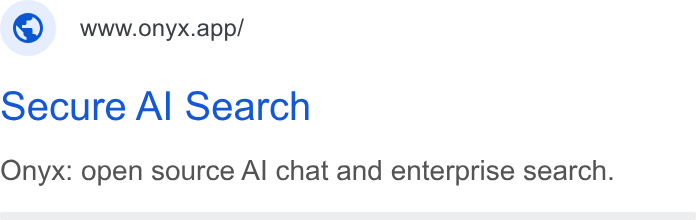
- Running
- 21 days (longevity = it's converting)
- Hook
- www.onyx.app/ with a globe icon to its left.
- Audience
- Businesses or individuals concerned with data security and utilizing AI for search and chat, indicated by 'Secure AI Search' and 'enterprise search'.
Why it works. Directly state the product's core benefit and function to inform and attract users interested in secure AI solutions.
Displaying the website URL prominently at the top: 'www.onyx.app/' Always include your primary website URL clearly visible at the top of your static ad creatives.
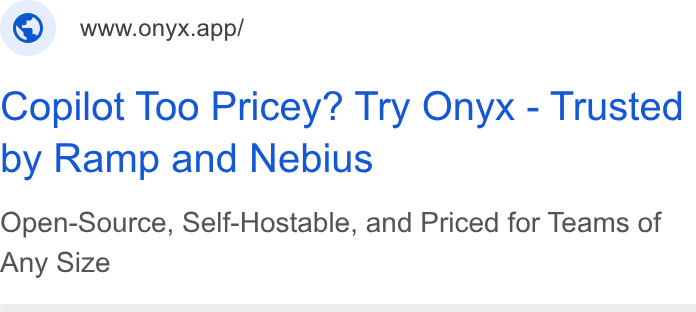
- Running
- 13 days (new — still being tested)
- Hook
- www.onyx.app/ Copilot Too Pricey? Try Onyx - Trusted by Ramp and Nebius
- Audience
- Developers, engineering managers, or team leads who use or are considering AI coding assistants like Copilot, indicated by the direct mention of 'Copilot' and 'Teams'.
Why it works. This creative uses a direct comparison and value proposition to attract users dissatisfied with a competitor's pricing, aiming to convert them to an open-source, self-hostable alternative.
Headline directly addresses a competitor's pain point: "Copilot Too Pricey? Try Onyx - Trusted by Ramp and Nebius" Identify a common pain point or objection related to a leading competitor in your niche, and address it directly in your headline, immediately followed by a credible endorsement or unique selling proposition.
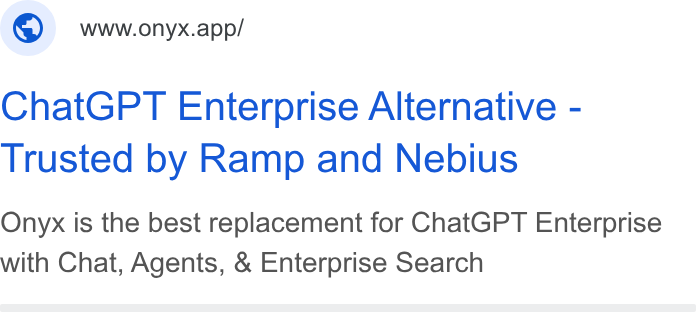
- Running
- 13 days (new — still being tested)
- Hook
- www.onyx.app/ and a blue globe icon.
- Audience
- The mention of "ChatGPT Enterprise Alternative" and being "Trusted by Ramp and Nebius" signals that the target audience is businesses or professionals currently using or considering ChatGPT Enterprise, and who are familiar with or trust the mentioned companies.
Why it works. This creative uses social proof and a direct comparison to a well-known competitor to establish credibility and position Onyx as a superior alternative for enterprise-level AI solutions.
The headline states "ChatGPT Enterprise Alternative - Trusted by Ramp and Nebius". If your product is used by recognizable brands, feature their names prominently in your headline or opening statement to immediately establish credibility. For B2B, this is often more effective than generic testimonials.
Show 3 more ads
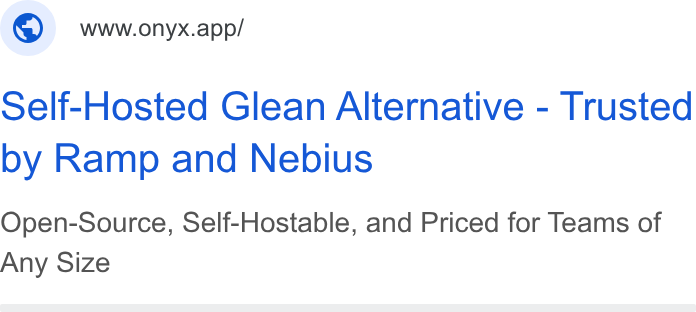
- Running
- 13 days (new — still being tested)
- Hook
- www.onyx.app/ with a blue globe icon to its left, followed by the headline "Self-Hosted Glean Alternative - Trusted by Ramp and Nebius"
- Audience
- Businesses or teams looking for self-hosted software alternatives, specifically mentioning 'Glean Alternative' and 'Teams of Any Size'. The names 'Ramp and Nebius' suggest a B2B audience familiar with tech companies.
Why it works. Positioning a self-hosted software as a credible, flexible, and cost-effective alternative to a known competitor, leveraging social proof to attract B2B customers.
Headline with social proof: "Self-Hosted Glean Alternative - Trusted by Ramp and Nebius" If you have well-known customers, feature their names prominently in your primary headline or hook to instantly convey credibility and reduce skepticism.
- Running
- 13 days (new — still being tested)
- Hook
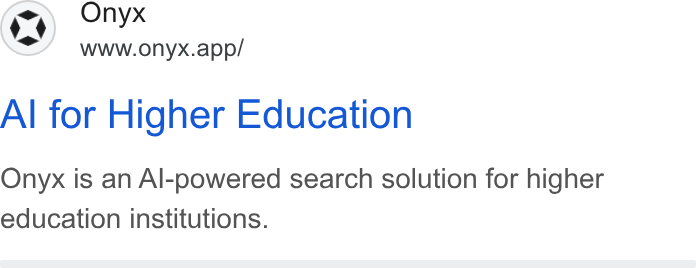
- "Onyx" and a circular logo with a black, geometric design on a white background, followed by "www.onyx.app/"
- Audience
- The text "AI for Higher Education" and "Onyx is an AI-powered search solution for higher education institutions." directly targets administrators or decision-makers within higher education.
Why it works. Directly state the product's purpose and target audience to attract relevant institutional clients seeking AI-powered solutions.
Headline stating core benefit: The large blue text "AI for Higher Education" is prominently displayed. Use a large, distinct font and color for your primary value proposition, ensuring it directly addresses your target audience's industry or core problem.
- Running
- 10 days (new — still being tested)
- Hook
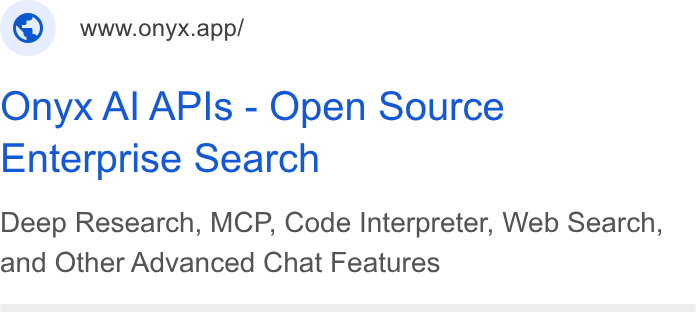
- "www.onyx.app/" with a globe icon next to it, followed by "Onyx AI APIs - Open Source Enterprise Search"
- Audience
- The terms "AI APIs," "Open Source," "Enterprise Search," "Deep Research," "Code Interpreter," and "Web Search" signal a target audience of developers, IT professionals, and businesses looking for advanced AI-driven search and development tools.
Why it works. Directly state product features and benefits to attract a technically-minded audience seeking advanced AI solutions.
Headline with core product and benefit: "Onyx AI APIs - Open Source Enterprise Search" Ensure your ad's main headline immediately communicates your product's core function and its most significant advantage to your target user.
08 The playbook
The channels are not separate. They are one system where each stage feeds the next. Here is the read, then the plays to run tomorrow.
The inferred playbook
Onyx's loop starts with a free, self-hosted open source tool that developers adopt on their own, and converts when a team's usage outgrows what the free tier can support.
the open-core GitHub project pulls in technical users at zero cost; the upgrade trigger is operational, needing SSO, RBAC, or managed hosting, which is exactly what the $20/user/month Business tier and custom Enterprise plan sell.
Sun's own August 2025 post cites Ramp using Onyx to answer over 200,000 questions via Slack and 1 million queries across all channels, the same "Trusted by Ramp and Nebius" claim resurfaces directly in Google ad copy, one proof point doing duty as both social post and ad headline.
Dig deeper+2▾
the live LinkedIn push into higher-education AI use cases signals Onyx testing a second buyer persona alongside its core enterprise-search ICP, running in parallel rather than replacing the core motion.
Onyx's self-hosted-to-paid conversion rate, current MRR or ARR, and current GitHub star count (public figures for the repo disagree, ranging from roughly 18,000 to a claimed 23,000+) are not confirmed anywhere in this evidence.
Turn a round-number milestone into a traction post
The proofYuhong Sun's August 2024 tweet marking 10,000 GitHub stars doubled as a public breakdown of what actually drove that open source traction.
The adaptationThe next time your own product crosses a round-number milestone, whether it's stars, installs, waitlist signups, or free users, write a post that names the exact number and walks through the two or three specific tactics that got you there, then publish it on the platform where your technical audience already is. Start by drafting the post as soon as you're within striking distance of the milestone so it goes out the same week you cross it.
Cost: $0 · Time to signal: days · Works pre-PMF: yes, provided you have a genuine milestone and specific tactics to name, a vague "we're growing" post won't carry the same weight.
Reuse one customer number across every surface
The proofOnyx's founder-reported Ramp usage stat, 200,000+ Slack questions and 1 million+ queries, shows up verbatim in a founder tweet and again as the headline claim in Google ad creative.
The adaptationPull the single most concrete usage number your best customer generates (support tickets closed, hours saved, queries answered) and deploy that exact number, unchanged, in a founder post, a one-line case study, and any ad or landing page headline you run. Start by asking your best customer for one hard usage metric this month, then write the three pieces of copy around that one number instead of three different pitches.
Cost: $0 · Time to signal: days · Works pre-PMF: yes, provided you already have at least one active customer generating a real usage number.
Reposition before you relaunch, not after
The proofOnyx spent September 2025 rewriting its positioning and website after talking to "hundreds of users," then landed its front-page Hacker News moment two months later under the new framing rather than at its original YC launch.
The adaptationIf your initial launch fizzled, don't just repost the same pitch, run a batch of customer or user conversations first, rewrite your one-line positioning based on what you hear, update your landing page to match, and only then attempt a fresh launch post under the new framing. Start by scheduling five user calls this month specifically to ask what almost made them not use the product.
Cost: under $500 · Time to signal: weeks · Works pre-PMF: conditional, this works only if you have an existing product and audience to relaunch to, and a repeat self-promotional launch post carries real platform-policy risk if it isn't clearly framed as a genuine relaunch.
Build a ranking page for your category's biggest generic search term
The proofOnyx's llm-leaderboard and open-llm-leaderboard pages alone drive over 40% of its top organic traffic by targeting "llm benchmark," a 19,160-searches-per-month generic term, not its own brand name.
The adaptationIdentify the single highest-volume generic comparison or ranking query in your category (not your brand name), build one evergreen ranking or "best X" page targeting it, and commit to refreshing the data on a fixed schedule rather than writing new pages. Start by pulling search volume for your category's top 3 generic terms and building the page for whichever one you can credibly rank a comparison table for for.
Cost: under $500 · Time to signal: weeks · Works pre-PMF: yes, this can be built before you have paying customers since it targets category demand, not your own brand. Not transferable at an earlier stage: Onyx's Launch HN front-page result and its $10M seed round both depend on advantages, an existing open source following and YC-network credibility, that a reader starting from zero won't have; adapt the relaunch-timing and content mechanics above, not the assumption that a launch post alone will replicate that result.
You just read how Onyx does it. Tomorrow it is someone else.
Every morning we take one company that is actually growing and break down where its customers come from: the ads still running after a year, the channel doing the real work, and the play you can run this week.
Systemaic · directional intelligence. Traffic, spend, and reach figures are SimilarWeb-style estimates and qualitative reads of public data, not audited numbers. Built on real public receipts.
// teardowns with a similar GTM motion
sources & receipts (8)
Live ad libraries: linkedin ad library · google ad library
Launch archives: Hacker News: Self-Hosted LLMs Tier List · Hacker News: The rise of E Ink Tablets and Note Takers: reMarkable 2 vs O · Hacker News: Onyx is violating the Linux kernel's license, refuses to rel · Hacker News: SGI's $250,000 Graphics Supercomputer from 1993 – Onyx Reali · Hacker News: Launch HN: Onyx (YC W24) – Open-source chat UI · Hacker News: The Onyx Programming Language
Traffic, spend, and revenue figures are estimates as noted in the report; the links above are the primary public artifacts.