- 01Pair a no-waitlist launch with an instant unlock
- 02Space launches across distinct moments instead of one shot
- 03Turn one real customer outcome into a dual-purpose case study
- 04Mine your own launch thread as free product research
01 Snapshot
The one-glance read on who they are and how they grow. Each point is verifiable from the receipts above.
Agentic AI video editing software (a node-based canvas plus a timeline editor) for agencies and media teams, riding YC Winter 2025 momentum.
Founder-led, launch-led: growth concentrates in co-founder and CEO Adish Jain's own launch and funding posts, not paid or creator campaigns.
~77,600 monthly visits (-2.2% over the last 3 months) as of 2026-07-26, a 582K-view founder launch post, a 148-point Launch HN, and a reported $3.8M seed round.
Mosaic's funnel runs on Jain manufacturing a new viral moment (a launch, a raise, an API drop) every few months rather than a compounding search or content asset base.
02 How it unfolded
The order the channels came online. Sequence is strategy: what they did first, and what they layered on once demand existed.
03 Traffic & channel mix
Estimated demand, the channel split behind it, and the keywords and referrers doing the work. Directional modeling, not audited analytics.
Traffic sources
Top search keywords
| Keyword | Volume | Weight | CPC |
|---|---|---|---|
| mosaic motion | 11k | $0.15 | |
| mosaic | 138k | $1.70 | |
| mosaic ai | 5.1k | $4.18 | |
| agentic video editing | 700 | - | |
| mosaic motion ai | 610 | - |
Closest competitors by audience
Mosaic pulls an estimated ~77,600 monthly visits, down 2.2% over the last 3 months. Two channels are nearly tied for the top spot: Search Organic at 46.1% and Direct at 45.6%, meaning almost as many people type the URL or a bookmark straight in as arrive via search, a pattern consistent with a brand still running on launch-driven name recognition rather than a broad keyword footprint. The rest, social organic, referrals, display ads, and email, together total under 9% of traffic.
On keywords, "mosaic ai" pulls ~5,100 monthly searches, a high-intent query, though the term is muddied by Databricks' unrelated "Mosaic AI" product, so a share of that volume likely isn't theirs to capture, while "agentic video editing" carries only 700 monthly searches, showing the category term they're trying to define is still tiny. "Mosaic motion" draws ~10,600 monthly searches but is ambiguous demand that may include unrelated "Mosaic Motion" products, not confirmed as theirs.
The closest competitors named are hippovideo.io, an established video-creation platform competing for the same "AI editing" search terms; snapy.ai and elai.io, both AI avatar/video generation tools chasing overlapping demand. None of the three appear as referral sources, only as adjacent competitors for the same keyword space.
04 Organic content
The specific pages earning their organic search traffic, and the pattern behind why they rank. Adapt the format, not the topic.
Mosaic's organic footprint is thin and concentrated: the homepage itself carries the large majority of organic visits, meaning most of the ranking value sits on brand-term queries ("mosaic," "mosaic ai") rather than a built content library. The one non-homepage asset earning traffic is a customer case study page, showing the format that's starting to work is proof-of-outcome storytelling tied to a named user rather than top-of-funnel educational content. A near-brand-name keyword ("easy slice ai") also ranks, suggesting some of that traffic comes from people already familiar with a specific customer story rather than cold category search.
Top pages by organic traffic
05 Channel map
Not traffic share. How much weight the growth system actually puts on each channel, with a one-line read on the role it plays.
What drove growth
06 The motions doing the work
For founder-led SaaS the breakdown shifts from ads to traction: where the first users came from, how the founder grows it in the open, and the compounding organic surface.
Mosaic's traction came from two back-to-back public moments, a viral founder thread and a front-page Hacker News launch, months apart, not from paid acquisition or a single big-bang event.
Jain's October 1, 2025 tweet announcing "the agentic video editor" with a no-waitlist public beta and an instant "comment MOSAIC for 1,000 free credits" hook pulled 582K+ views, 4,523 likes, and 2,139 replies, the single largest traffic-generating event visible in the evidence.
Seven weeks later, the Launch HN post on November 19, 2025 reached 148 points and 134 comments, pulling in technical, skeptical scrutiny the X audience hadn't provided, including a competing chat-first video tool builder publicly congratulating Mosaic and comparing notes on chat-UX latency.
Dig deeper+2▾
A March 2, 2026 tweet announced Mosaic "live on Product Hunt," framed as a quieter re-introduction after weeks of shipping canvas, motion graphics, and avatar features, rather than the primary launch moment.
Hacker News commenters flagged concrete gaps, chat-UX latency versus the canvas approach, a lack of seed/temperature controls for non-determinism, missing EDL export for professional pipelines, and a landing page one commenter called "non-scrollable, dark, fixed content pane with loads of flickering images," feedback the founders engaged with directly in the thread.
Adish Jain personally carries almost all of Mosaic's public narrative, using his own X account as the primary channel and LinkedIn as a secondary, more enterprise-facing audience.
Jain's X account (@_adishj) has 5,210 followers across ~5,989 posts and is where every major company milestone (the public beta launch, the API opening, the seed round) gets announced first, well ahead of the brand account.
The April 7, 2026 seed announcement ($3.8M) led with named partnerships, TubeScience (described as Meta's largest ad-creative partner) and a News Corp pilot, rather than investor-focused language, pulling 371 likes and ~53,000 views.
Dig deeper+2▾
An August 18, 2025 "open letter" accusing a rival's product manager of misrepresenting herself to access Mosaic's private beta drew 99 likes and 18,386 views, an unusual public-conflict move that doubled as a credibility signal.
Jain's LinkedIn profile carries 16,402 followers, a larger but less frequently sampled audience likely skewing toward the agency and enterprise buyers Mosaic sells to, distinct from the more technical X following. No Reddit presence from the founder or brand is visible in the evidence, so Mosaic's build-in-public motion runs entirely through X and LinkedIn, not community forums.
Search Organic and Direct traffic are running neck-and-neck as Mosaic's two largest channels, but the owned-content base behind that split is still small.
The dominant organic page is the homepage itself (the pattern covered in Organic Content above), meaning the current SEO position rests on brand recognition from the launch moments rather than a built topic cluster.
The EasySlice case study is the only secondary content page earning meaningful traffic, suggesting the content strategy so far is "publish a customer win" rather than a systematic blog or comparison-page program.
Dig deeper+2▾
Only 2 Google text ads have ever run, both now stopped (0 active as of 2026-07-26), with copy like "Mosaic: Edit Smarter, Faster" and "Faster Edits, Better Videos," functioning to capture branded search rather than to generate new demand.
A third-party review lists Mosaic's tiers as Creator, Pro, and Enterprise on top of a free trial and a monthly AI-credit system, but exact dollar prices for each tier are not publicly listed, limiting how precisely a reader can benchmark against it.
07 Paid ads
This founder-led SaaS also runs paid acquisition. Here are the live ads doing the work, each with the X-ray and a play you can adapt.
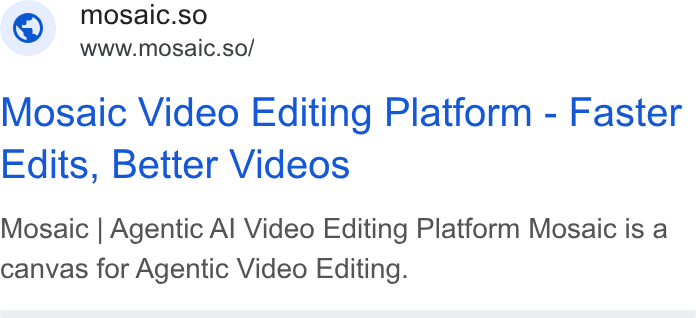
- Running
- 105 days (longevity = it's converting)
- Hook
- mosaic.so www.mosaic.so/ Mosaic Video Editing Platform - Faster Edits, Better Videos
- Audience
- Professionals or enthusiasts involved in video production, indicated by terms like 'Video Editing Platform' and 'Agentic AI Video Editing'.
Why it works. This creative uses a direct-response headline and a concise description to inform potential users about the product's core benefit and functionality, aiming to drive traffic to their website.
Headline stating a clear benefit: 'Mosaic Video Editing Platform - Faster Edits, Better Videos' Lead with a headline that clearly articulates the primary, quantifiable benefit your product offers to the user, focusing on speed and quality improvements.
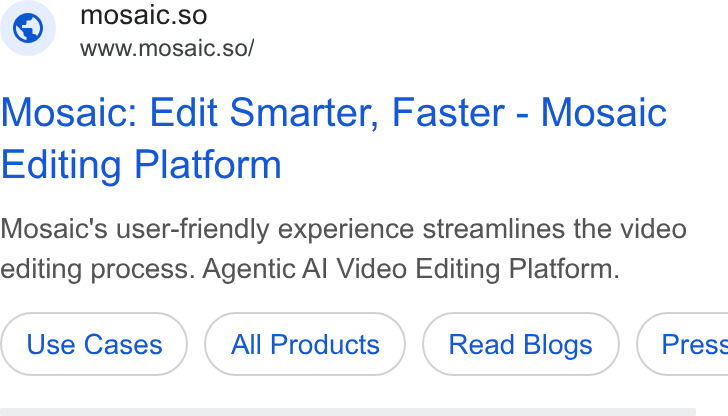
- Running
- 105 days (longevity = it's converting)
- Hook
- mosaic.so www.mosaic.so/ Mosaic: Edit Smarter, Faster - Mosaic Editing Platform
- Audience
- Video editors, content creators, or businesses looking for AI-powered video editing solutions, indicated by the text "Agentic AI Video Editing Platform" and the buttons "Use Cases", "All Products", "Read Blogs", "Press".
Why it works. Direct response ad using a search result format to present a clear value proposition and call to action for users seeking video editing solutions.
Headline with a strong benefit statement: "Mosaic: Edit Smarter, Faster - Mosaic Editing Platform" Craft a headline that immediately communicates the primary benefits of your product, focusing on how it makes the user's life easier or better.
08 The playbook
The channels are not separate. They are one system where each stage feeds the next. Here is the read, then the plays to run tomorrow.
The inferred playbook
Mosaic's loop starts with a founder-generated spike on X or Hacker News, converts a slice of that attention into named enterprise pilots, and has not yet built a compounding organic layer to carry traffic between spikes.
The October 2025 X launch and the November 2025 Launch HN are still the two largest attention events in the evidence, with no evidence of a third channel (paid, creator, or SEO) contributing comparable volume.
The EasySlice case study and named partnerships (TubeScience, News Corp) suggest a direct-outreach or inbound-to-sales motion is layered on top of the self-serve credit signup, not pure product-led virality.
Dig deeper+2▾
With only three organic pages earning any traffic and the homepage carrying the vast majority of it, there is little owned content accumulating between launch moments, so top-of-funnel depends on Jain generating a new newsworthy event rather than search compounding on its own.
credit-consumption-to-paid-plan conversion on the AI-credit system, per-seat or expansion revenue among named enterprise pilots like TubeScience, and the actual dollar pricing behind the reported Creator/Pro/Enterprise tiers.
Pair a no-waitlist launch with an instant unlock
The proofJain's October 2025 X thread offered public beta access with no waitlist and a comment-to-claim reward (1,000 free credits for commenting "MOSAIC"), driving 582K+ views.
The adaptationOpen your own product's next public release the same way: post from your personal account, remove any signup friction, and attach one concrete, instantly deliverable reward tied to a single visible action (a comment, a reply, a DM with a keyword) so the incentive is claimable in seconds, not after a form fill.
Cost: $0 · Time to signal: days · Works pre-PMF: yes
Space launches across distinct moments instead of one shot
The proofMosaic launched publicly on X in October 2025, followed with a Launch HN in November 2025 (148 points), then resurfaced on Product Hunt in March 2026, three separate beats over five months rather than one release.
The adaptationMap your own roadmap for the next two or three genuinely new hooks (a feature, an integration, a funding milestone) and commit each to a different platform's audience instead of announcing everything at once, so each community sees a fresh reason to pay attention.
Cost: $0 · Time to signal: weeks · Works pre-PMF: conditional, only works if each relaunch carries an actual new hook; recycling the same announcement across platforms reads as spam.
Turn one real customer outcome into a dual-purpose case study
The proofMosaic's EasySlice case study is its second-highest organic page, and named wins like TubeScience anchor its funding announcement as proof points, not just logos.
The adaptationShip one detailed write-up of your best existing customer result, with a specific number and their name attached, publish it as its own page rather than a testimonial blurb, and link it from both your homepage and your next public update so it works as an SEO asset and a sales leave-behind simultaneously.
Cost: under $500 · Time to signal: weeks · Works pre-PMF: conditional, requires at least one customer willing to be named with a real number.
Mine your own launch thread as free product research
The proofHacker News commenters pushed Mosaic on chat-UX latency, missing seed/temperature controls, and absent EDL export, friction the founders engaged with directly in the thread.
The adaptationWhenever you post a launch or update, reply publicly to the sharpest critical comments instead of only the praise, and convert the two or three most substantive objections into a visible, dated roadmap note so the same critics see you acted on their specific complaint.
Cost: $0 · Time to signal: days · Works pre-PMF: yes
Lead funding or partnership news with named beneficiaries, not gratitude
The proofMosaic's April 2026 seed announcement opened with specific customer names (TubeScience, News Corp) instead of investor thank-yous, and outperformed the founder's typical post engagement.
The adaptationWhen you have real news to announce, whether a raise, a partnership, or a milestone, structure the first two sentences around who benefits and what changed for them, saving any thanks to backers for the end of the post, and publish it from a personal founder account rather than the company handle.
Cost: $0 · Time to signal: days · Works pre-PMF: conditional, needs an actual raise or partnership worth announcing; forcing this format onto routine updates will feel hollow. Not transferable at an earlier stage: the enterprise case-study play and the funding-announcement play both assume a named paying customer or a real raise already exists, so a pre-revenue reader should start with the no-waitlist launch offer and the public-feedback mining play, which need neither.
You just read how Mosaic does it. Tomorrow it is someone else.
Every morning we take one company that is actually growing and break down where its customers come from: the ads still running after a year, the channel doing the real work, and the play you can run this week.
Systemaic · directional intelligence. Traffic, spend, and reach figures are SimilarWeb-style estimates and qualitative reads of public data, not audited numbers. Built on real public receipts.
// teardowns with a similar GTM motion
sources & receipts (8)
Live ad libraries: google ad library
Launch archives: Hacker News: The story, as best I can remember, of the origin of Mosaic a · Hacker News: Map of Space Invader Mosaics in Paris · Hacker News: Roman mosaic floor found under Italian vineyard · Hacker News: A 5.7 Terapixel Mosaic of the Surface of Mars · Hacker News: 25 years ago today, NCSA Mosaic 1.0 was released · Hacker News: Databricks Strikes $1.3B Deal for Generative AI Startup Mosa
Community threads: Hacker News: A builder of a competing chat-first video-editing tool (chatoctopus.com) reac
Traffic, spend, and revenue figures are estimates as noted in the report; the links above are the primary public artifacts.