- 01Turn revenue milestones into a public story
- 02Lead with the price-consolidation math
- 03Nudge existing customers to annual before chasing new ones
- 04Let affiliates fund the paid-search budget you can't
01 Snapshot
The one-glance read on who they are and how they grow. Each point is verifiable from the receipts above.
An all-in-one AI platform bundling GPT, Claude, Gemini and 50+ models for individuals, teams and agencies, bootstrapped and on pace to repeat 2025's 100% year-over-year growth.
Founder-led build-in-public growth, reinforced by an affiliate-funded paid-search layer rather than a brand-run ad account.
$2M lifetime revenue as of June 30, 2026, ≈111,600 monthly visits, 25,365 founder X followers, and 11 of 33 Google ads active as of July 16, 2026.
"Officially the fastest-growing SaaS I've ever built. $0-$6.6k MRR in less than 90 days," Dustin Stout posted in June 2023.
Magai's own Meta ad account began testing agency-focused privacy and cost-consolidation messaging in June 2026, alongside newer Google Search text-ad variants as of July 16, 2026.
Growth compounds through Stout's serialized, dollar-specific MRR posts building a followable story, while third-party affiliates, not Magai's own account, fund most of the Google Search presence.
02 How it unfolded
The order the channels came online. Sequence is strategy: what they did first, and what they layered on once demand existed.
03 Traffic & channel mix
Estimated demand, the channel split behind it, and the keywords and referrers doing the work. Directional modeling, not audited analytics.
Traffic sources
Top search keywords
| Keyword | Volume | Weight | CPC |
|---|---|---|---|
| magai | 11k | $1.52 | |
| magai.co | 960 | - | |
| magai ai | 740 | $0.78 | |
| whats the ai site that has all the models for one price | 250 | - | |
| wells fargo atm still work after hours? | 170 | - |
Top referring sites
Closest competitors by audience
Magai draws an estimated ≈111,600 monthly visits, down 21% over the last 3 months. Direct traffic leads at 35.4%, matched almost exactly by search organic at 34.4%, with referrals a distant third at 9.4%, a mix that reads as an audience returning by habit or brand memory rather than one built by category-level search demand. The rest, paid search, display ads, AI-assistant referrals, organic social, email and paid social, together total under 21%. The keywords they rank and bid for are almost entirely their own name: magai (≈11,000 searches/month), magai.co (960/month) and magai ai (740/month), confirming most of that organic and paid share is people already looking for Magai specifically rather than generic "AI tools" demand. Their one named referrer, aitoptools.com, is an AI-tool directory listing rather than a partnership, a small aggregator trickle. Among close competitors, multiple.chat and chathub.gg compete directly in the same all-in-one multi-model aggregator category, while 1min.ai sits in the same low-price, high-model-count niche, evidence Magai operates in a crowded "AI wrapper" field rather than owning it alone.
04 Organic content
The specific pages earning their organic search traffic, and the pattern behind why they rank. Adapt the format, not the topic.
Magai's top organic pages skew toward AI-education explainers rather than product or comparison pages. Alongside the homepage (~766 organic visits/month, by far the largest single page), the next four ranking pages are beginner-level explainers on generative AI images, adaptive versus static AI, monitoring AI systems for ethical compliance, and which AI tools can generate images, each pulling roughly 60-100 visits/month. The pattern is a glossary-style explainer strategy: broad, low-competition definitional queries a small content team can rank for without competing head-on on crowded "best AI tool" comparison terms. It likely ranks because these terms carry thin competition and clear search intent, letting a domain already trusted for anything branded "Magai" pick up adjacent long-tail traffic cheaply instead of outranking incumbents on head terms.
Top pages by organic traffic
05 Channel map
Not traffic share. How much weight the growth system actually puts on each channel, with a one-line read on the role it plays.
What drove growth
06 The motions doing the work
For founder-led SaaS the breakdown shifts from ads to traction: where the first users came from, how the founder grows it in the open, and the compounding organic surface.
Magai's early traction runs entirely through the founder narrating his own revenue in public, not through a launch platform.
No Product Hunt or credible Hacker News launch evidence exists in the record. The traceable trail starts May 4, 2023, when Stout introduced the product to his existing X audience, then reported $0 to $6,600 MRR in under 90 days by June 30, 2023.
By July 9, 2023 he announced $8,000 MRR as "purely organic growth, zero ads," then after a stall, announced in March 2024 a plan to push from $27,000 to a $100,000 MRR target by hiring a dev team and a professional influencer, followed by a first $40,000 MRR month that August.
Dig deeper+2▾
The public numbers escalate from an over-$114,000 two-week stretch cited when the team grew from one person to six in April 2025, to $1M ARR with 50,000+ users by July 10, 2025, to $2M in lifetime revenue as of June 30, 2026, each milestone re-announced as its own press moment.
A business-story account, Starter Story, later repackaged the founding arc on Instagram ("First day: $1K... $100K/month"), pulling roughly 6,000 engagements, evidence the origin story became shareable content independent of the founder's own posts. That "$100K/month" is Starter Story's shorthand for the 2025-2026 run rate the founder himself put at "nearly $100K/month" in October 2025, a later and larger figure than the $57,000 August 2024 month, not a contradiction of it.
Dustin Stout treats his personal X account, not the brand's @heymagai handle, as Magai's core distribution channel, dropping raw revenue numbers as they happen.
Every major milestone becomes a standalone post, from $6,600 MRR in 90 days (June 2023) to $8,000 MRR (July 2023) to a first $40,000 MRR month (August 2024) to over $57,000 in total August sales, all from the personal @DustinWStout account rather than the company page.
He explains the operating decisions inside the same threads, the March 2024 plan to 4x MRR by "hiring people better than me," and the September 2024 tactic of nudging monthly subscribers onto yearly plans, turning growth tactics into public case studies as he runs them.
Dig deeper+2▾
The same persona surfaces on Instagram under his own handle with a v3-launch teaser, and the Starter Story feature covered above outperformed his typical X post (a handful of dozens of likes) by a wide margin, suggesting earned retellings of his story travel further than his owned posts.
The homepage also links a LinkedIn profile, but no LinkedIn post activity was captured, so that channel's contribution can't be sized here.
Search organic ties with direct as Magai's largest traffic channel, and the pages earning it are educational explainers, not comparison pages, while a network of third parties appears to be running paid search on the brand's behalf.
The beginner AI-explainer pages covered above earn incremental long-tail traffic alongside a homepage that dominates the mix.
The 33 total Google ads pulled (11 active as of July 16, 2026) are bought under advertiser names like HERA SEO SRL, SoVisual.co LLC, and individual names, not "Magai" itself, consistent with the Rewardful affiliate program linked from magai.co/affiliates recruiting marketers who bid on branded and generic AI-tool terms and route to magai.co for commission.
Dig deeper+2▾
Top-ranking keywords are almost entirely the brand itself, magai, magai.co, magai ai, meaning the organic and affiliate-paid mix largely captures demand people already searched for by name rather than generating new category demand.
Magai's own Meta ad account, distinct from the affiliate-run Google ads, shows only 2 active ads as of July 16, 2026, both started in June 2026 with agency-focused, data-privacy and cost-consolidation messaging, a small defensive test rather than a scaled paid channel.
07 Paid ads
This founder-led SaaS also runs paid acquisition. Here are the live ads doing the work, each with the X-ray and a play you can adapt.
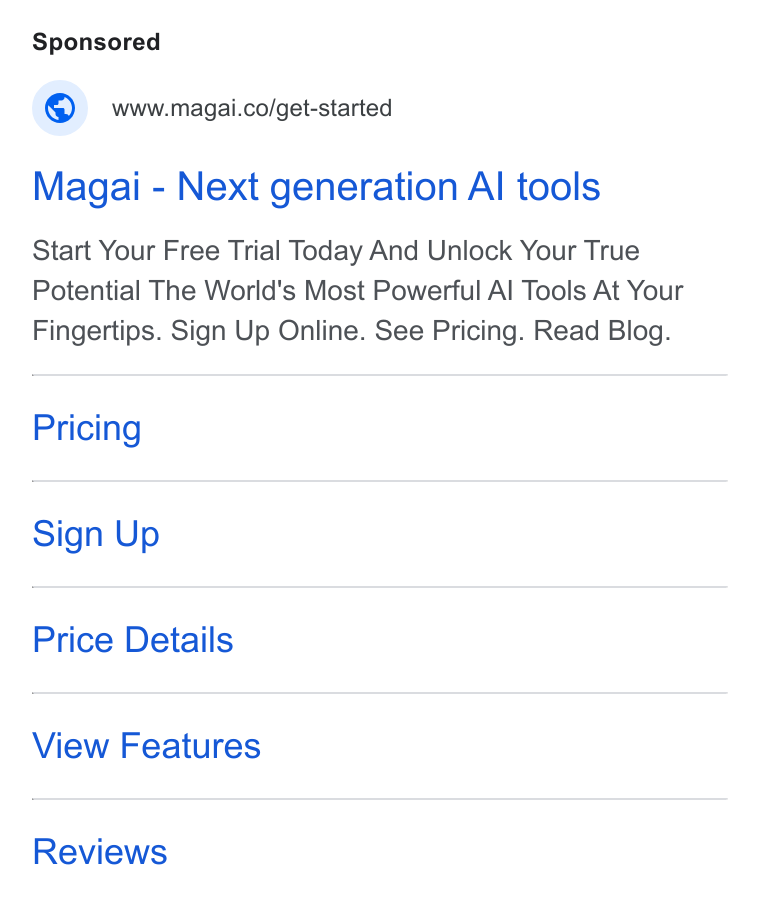
- Running
- 987 days (longevity = it's converting)
- Hook
- Sponsored www.magai.co/get-started Magai - Next generation Al tools
- CTA / offer
- Start Your Free Trial Today
- Audience
- The phrase "Unlock Your True Potential" and the focus on "Powerful AI Tools" targets individuals or businesses looking for advanced solutions to enhance productivity or capabilities.
Why it works. Frames existing AI tools as legacy technology, nudging comparison shoppers to see Magai as the upgrade path.
Headline with a bold claim: "Magai - Next generation Al tools" Position your product against the status quo by calling incumbent tools outdated rather than only listing your own features.

- Running
- 546 days (longevity = it's converting)
- Hook
- Visual: A sponsored ad for Magai, showing the company logo, website, and the headline "Magai - All The Best AI Products".
- Audience
- Individuals or businesses interested in AI tools and looking for a consolidated platform, indicated by the mention of various AI models like "ChatGPT, Claude, Gemini, Perplexity, Leonardo, Dall-E" and "Over 16 Large Language Models".
Why it works. Sells the platform as a pre-vetted shortcut for buyers overwhelmed by the number of AI tools on the market.
Headline clearly states the core value proposition: "Magai - All The Best AI Products". If your product bundles or curates other tools, sell the time saved on evaluation, not just the access itself.

- Running
- 216 days (longevity = it's converting)
- Hook
- Magai, www.magai.co/, Smarter AI for Every Creator - Try Magai AI for Creators - Boost Workfl...
- CTA / offer
- Try Magai AI for Creators
- Audience
- Creators, indicated by the phrases 'Every Creator', 'Magai AI for Creators', and 'platform for creators'.
Why it works. Positions Magai as a universal tool for any creator type, widening the qualified audience beyond a single AI use case.
Headline with a strong benefit and call to action: 'Smarter AI for Every Creator - Try Magai AI for Creators - Boost Workfl...' Swap your headline's audience noun for the broadest accurate category your product serves, e.g. 'for every marketer' instead of naming one persona.
Show 3 more ads

- Running
- 142 days (longevity = it's converting)
- Hook
- Visual: The word "Sponsored" at the top left, followed by a small square icon with a stylized 'M' in purple, orange, and blue, next to the text "Magai" and "www.magai.co/". Below this, in large blue text, is "Magai - All-In-One AI Platform".
- Audience
- Individuals or businesses who generate AI content and need tools for organization, accessibility, and security, indicated by the ad copy "keep all your AI generated content organized, accessible, and secure."
Why it works. Targets users juggling multiple separate AI subscriptions by branding Magai as the single consolidated platform replacing them.
Clear, benefit-driven headline: "Magai - All-In-One AI Platform" Lead your headline with your product's category positioning (e.g. 'all-in-one') if consolidation is a real, provable claim for your buyers.
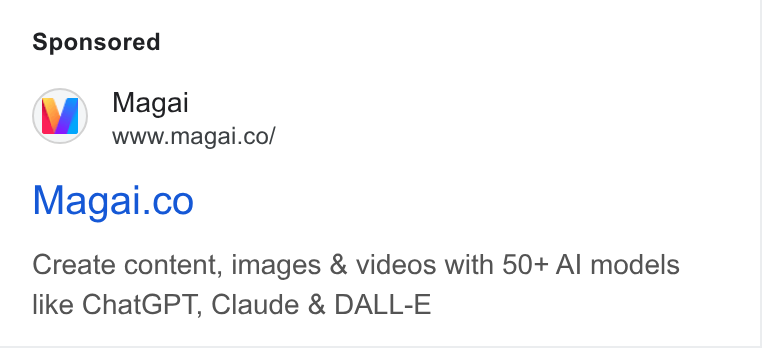
- Running
- 95 days (longevity = it's converting)
- Hook
- Sponsored ☑ Magai www.magai.co/ Magai.co Create content, images & videos with 50+ Al models like ChatGPT, Claude & DALL-E
- Audience
- Individuals or businesses looking to streamline content creation using advanced AI tools, indicated by the mention of "50+ AI models like ChatGPT, Claude & DALL-E".
Why it works. Search ad for founders comparing AI subscriptions; naming ChatGPT, Claude and DALL-E by name captures brand-search intent Magai doesn't own.
Highlighting a large number of AI models and popular names: "Create content, images & videos with 50+ Al models like ChatGPT, Claude & DALL-E" List the specific competitor tools your product replaces or wraps, plus an exact model count, right in your search ad headline.
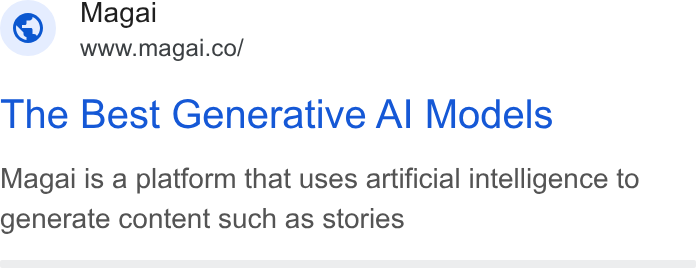
- Running
- 273 days (longevity = it's converting)
- Hook
- Magai, www.magai.co/, The Best Generative AI Models
- Audience
- Individuals or businesses interested in AI content generation, indicated by the headline 'The Best Generative AI Models' and the description of Magai as an AI content platform.
Why it works. Appeals to users evaluating raw model quality rather than platform features, a different search intent than the all-in-one pitch.
Headline with a strong claim: 'The Best Generative AI Models' Test a model-quality headline against your platform-breadth headline to see which search intent converts better for your product.
08 The playbook
The channels are not separate. They are one system where each stage feeds the next. Here is the read, then the plays to run tomorrow.
The inferred playbook
Magai's loop starts with Stout's public number-dropping, converts on a flat entry price against fragmented AI subscriptions, and compounds through affiliate-bought search rather than owned paid media.
The founder's X milestone posts and earned features like the Starter Story repost function as the top of funnel, with no scaled paid brand-awareness spend visible in the evidence.
A simple wedge, one $20/month Standard plan (versus a $40/month Pro tier at 3x usage and a $200/month Ultra tier at 15x usage) replacing "$20 for ChatGPT, $20 for Claude, $20 for Gemini" per the June 2026 Meta ad copy, converts on price-consolidation logic. No $0 tier exists in the pricing evidence, so this is paid-trial, not freemium.
Dig deeper+3▾
The Rewardful affiliate program is the structural growth lever, letting third parties fund their own Google Search campaigns against magai.co, which is why 33 distinct Google advertisers show up in the ad library despite Magai running just 2 ads of its own on Meta.
Direct traffic (35.4%) and branded search (34.4%) together account for most of the ≈111,600 monthly visits, while non-branded organic content is limited to a handful of explainer posts pulling under 100 visits each, leaving little demand generation beyond the audience Stout already built.
the commission economics behind the Rewardful program funding those 33 Google advertisers, a current churn rate (last discussed publicly as "high" in mid-2024), and the revenue split across the $20/$40/$200 tiers that would show whether growth comes from new logos or Pro/Ultra upgrades.
Turn revenue milestones into a public story
The proofStout posts each MRR jump as it happens, $6,600 in under 90 days in June 2023, $8,000 the next month, a first $40,000 month in August 2024, each tied to a specific decision he made (a hire, a pricing nudge).
The adaptationPost your own next revenue milestone from your personal account the moment you hit it, and pair the number with the one operational change that caused it. Use the same before-to-after-plus-cause structure Stout uses: "$X to $Y because I did Z."
Cost: $0 · Time to signal: weeks · Works pre-PMF: yes
Lead with the price-consolidation math
The proofMagai's June 2026 Meta ad opens with the buyer's actual costs, "$20 for ChatGPT. $20 for Claude. $20 for Gemini. Another $30 for image generation. That's $110+ a month," before pitching one $20/month plan.
The adaptationOpen your landing page or first outbound message with the exact monthly arithmetic of the 3-4 tools your prospect already stitches together to do what you do in one, then put your single price against that total. The specific dollar sum is what makes it land; a vague "save money" claim will not.
Cost: $0 · Time to signal: days · Works pre-PMF: yes
Nudge existing customers to annual before chasing new ones
The proofStout credited an over-$57,000 August directly to pushing monthly subscribers onto yearly plans, posting "SaaS Founders, if you're not nudging people to upgrade from Monthly to Yearly plans... do it!"
The adaptationAdd a specific annual-upgrade prompt at your product's natural renewal or usage-limit moment, an in-app banner or a renewal-week email offering a fixed discount for switching to yearly, and track the cash pulled forward in that first billing cycle the way Stout measured it against his monthly total.
Cost: $0 · Time to signal: weeks · Works pre-PMF: conditional, only once you already have paying monthly subscribers to convert
Let affiliates fund the paid-search budget you can't
The proofMagai's own Meta account runs just 2 ads as of July 16, 2026, yet 33 separate Google advertisers, third-party names like HERA SEO SRL and SoVisual.co LLC, bid on Magai and AI-tool terms and route to magai.co through its Rewardful program.
The adaptationSet up a commission-only affiliate program and personally recruit a handful of niche marketers or agencies in your category to run their own search or content campaigns for a cut of what they close, instead of building an in-house paid-search budget first. Expect a real ramp before affiliates find a working keyword set; this is not a fast channel.
Cost: under $500 · Time to signal: months · Works pre-PMF: conditional, needs a live paying product with a commission worth an affiliate's time Not transferable at an earlier stage: the affiliate-funded Google Search presence and the Starter Story-style earned feature both depend on Magai already having a paying product and a public revenue story compelling enough for third parties to bet on. A brand-new founder should run play 1 first to build that story before expecting play 4 to work.
You just read how Magai does it. Tomorrow it is someone else.
Every morning we take one company that is actually growing and break down where its customers come from: the ads still running after a year, the channel doing the real work, and the play you can run this week.
Systemaic · directional intelligence. Traffic, spend, and reach figures are SimilarWeb-style estimates and qualitative reads of public data, not audited numbers. Built on real public receipts.
// teardowns with a similar GTM motion
sources & receipts (9)
Live ad libraries: meta ad library · google ad library
Launch archives: Hacker News: Autofac by Phillip K. Dick (Galaxy Magaine Nov. 1955) (1955)
Researched facts: Magai surpassed $2 million in lifetime revenue as a fully bootstrapped company: $2,000,000 · Magai reached $1 million in Annual Recurring Revenue (ARR): $1,000,000 ARR, with 50,000+ u · Magai founder stated the company hit $1 million in lifetime sales 32 months after inceptio · Magai grew its team from a solo operation to six people: Team size: 6 (up from 1), as of A · Magai's annual revenue grew from $267.6K (2023) to $588.1K (2024) with a one-person team: · Magai founder Dustin W. Stout previously built a career in digital marketing/social media
Traffic, spend, and revenue figures are estimates as noted in the report; the links above are the primary public artifacts.