- 01Ship a branded attribution into your free tier's public output
- 02Hand-deliver a prospect's output to them as your sales demo
- 03Email featured customers to turn a spotlight into a reshare event
- 04Make your user-generated public pages indexable and let creator search demand accumulate
01 Snapshot
The one-glance read on who they are and how they grow. Each point is verifiable from the receipts above.
Liinks is a freemium link-in-bio platform (Starter at $5/month, Pro at $12/month, with a free tier) for creators and small businesses, publicly reporting ~$30,496 MRR across 5,296 active paying subscriptions as of June 2026.
Viral-loop-led, with persistent brand-term paid search as a secondary defensive channel.
~510,711 estimated monthly visits, up 25.5% over the trailing three months; 29 active Google ads as of 2026-06-29; founder Charlie Clark holds 10,444 X followers.
Clark described his earliest acquisition strategy as personally rebuilding each prospect's link page before asking for a sign-up, making the product's value immediate and tangible before any commitment (source).
The primary growth engine is structural, not tactical: a "Made with Liinks" attribution on every free-tier page turns the creator user base into a compounding organic referral machine, and social organic has become the single largest traffic source at 34.8% as a result.
02 How it unfolded
The order the channels came online. Sequence is strategy: what they did first, and what they layered on once demand existed.
03 Traffic & channel mix
Estimated demand, the channel split behind it, and the keywords and referrers doing the work. Directional modeling, not audited analytics.
Traffic sources
Top search keywords
| Keyword | Volume | Weight | CPC |
|---|---|---|---|
| liinks | 1.6k | $2.91 | |
| legend of winning | 5.7k | - | |
| kunshikitty video | 0 | - | |
| liink | 27k | $2.14 | |
| fayedawnx | 1.3k | - |
Top referring sites
Closest competitors by audience
~510,711 estimated monthly visits, up 25.5% over the trailing three months. The marketing channel mix is led by Social Organic at 34.8%, followed by Direct at 25.6% and Social Paid at 25.3%; Display Ads contribute 4.5%, Search Organic 4%, Referrals 3.8%, Search Paid 1.2%, Email 0.5%, Affiliate 0.3%, and Gen AI 0.1%.
The Social Organic dominance (34.8%) maps directly to the product's structural referral loop: every Liinks page carries a branded attribution link, and each time a creator shares their bio link on Instagram or TikTok, their audience encounters the platform. The 25.3% Social Paid share is striking given Liinks LLC does not appear to run paid social campaigns; this volume almost certainly arrives from Liinks users who boost their own content or run paid promotions pointing to their personal liinks.co profile pages, meaning the user base acts as an inadvertent paid acquisition surface for the platform.
Search Organic and Search Paid together account for roughly 5.2% of traffic, consistent with a platform whose growth runs through social distribution rather than search-intent content.
Top keywords in the web-wide demand pool include "liink" (26,540 total monthly searches across the web), "liinks" (1,600 total monthly searches), and creator-name queries such as "fayedawnx" (1,250 total monthly searches). Top referring domains include tryst.link, msn.com, and carlcox.com. Closest competing destinations in the traffic data include linktr.ee, lnk.to, and gplinks.com.
04 Organic content
The specific pages earning their organic search traffic, and the pattern behind why they rank. Adapt the format, not the topic.
Liinks' organic search traffic (approximately 3,870 visits per month across its top pages) comes almost entirely from user profile pages at liinks.co/[username] that rank passively for creator-name queries, not from any editorial or programmatic content Liinks itself produces. The pattern is platform-as-host SEO: a creator publishes their Liinks page, shares it widely across social channels, and the resulting signals help the liinks.co subdirectory URL surface in search when their audience looks them up by name. The dominant example is the profile of a creator known as fayedawnx, whose page ranks at the top position for multiple variants of her name and drives the majority of the platform's estimated organic traffic, illustrating how a single popular user with an existing audience can generate sustained search discovery for the host platform at zero content cost.
Top pages by organic traffic
05 Channel map
Not traffic share. How much weight the growth system actually puts on each channel, with a one-line read on the role it plays.
What drove growth
06 The motions doing the work
For founder-led SaaS the breakdown shifts from ads to traction: where the first users came from, how the founder grows it in the open, and the compounding organic surface.
The initial acquisition story was manual before it was mechanical: Clark hand-built the earliest cohort through personal outreach and a friction-free free tier, then a structural badge loop took over once the user base reached critical mass.
Clark launched on Product Hunt on 2020-02-26 with the title "Free landing page for your links, with super powers," earning 169 upvotes and 23 comments; no simultaneous Hacker News or Reddit launch is visible in public data from that period.
Before any automated channel, Clark personally rebuilt individual prospects' link pages as working demos and delivered them before asking for a sign-up, making the value concrete and the switching decision effortless (source).
Dig deeper+2▾
The free tier was designed to eliminate the switching cost from Linktree, the established incumbent link-in-bio platform, making early adoption zero-risk for creators already using a competitor (source).
Once creator adoption scaled, the "Made with Liinks" attribution on every free page began compounding into organic referrals, and social organic ultimately grew to represent 34.8% of estimated monthly traffic.
Charlie Clark (Charlie Clark, 10,444 X followers) has publicly documented Liinks milestones, but Liinks-specific content has thinned as the product runs more autonomously and his public output is split with a separate design project.
Liinks-relevant posts in evidence include an April 2026 announcement of a free background-image generator shipped to the platform (89 likes, 8,711 views) and a June 2025 note disclosing that Clark was allocating roughly 2-3 hours per week to the product at that time; both show a warm but modest audience for Liinks-specific content.
The interview reveals a secondary amplification tactic: Liinks notified featured customers that they had been spotlighted, creating a natural reason for those creators to reshare the recognition to their own followers (source).
Dig deeper+1▾
No Reddit build-in-public presence, active LinkedIn content, or sustained community cadence specific to Liinks is visible in the evidence; the product relies on its structural referral loop rather than ongoing founder-led distribution.
Liinks' organic search footprint is small by design: user-generated profile pages do the passive ranking work, Google Search ads handle direct-intent capture, and no editorial content program compounds either surface.
User profile pages at liinks.co/[username] rank for creator-name queries entirely without Liinks' editorial involvement; the platform captures search demand that already exists for its most popular users, a zero-cost compounding surface that scales automatically as the user base adds well-known creators.
As of 2026-06-29, 29 active Google ads point to the liinks.co domain, with Liinks LLC's own creatives running continuously since October 2021; the consistent hooks ("One Page for All Your Links," "One Link for All Your Content," "Start Your 14-Day Free Trial") target searchers who have already decided to find a link-in-bio solution, making this defensive demand capture rather than demand generation; paid search represents 1.2% of total traffic; no Liinks-attributed Meta social ads are active, and two ads appearing in the Meta library from a similarly named entity are from an unrelated Spanish-language sports apparel business.
Dig deeper+1▾
No affiliate, partner, or referral program is visible in public data; free-to-paid conversion rate, churn, and CAC are also not visible in public data.
07 Paid ads
This founder-led SaaS also runs paid acquisition. Here are the live ads doing the work, each with the X-ray and a play you can adapt.
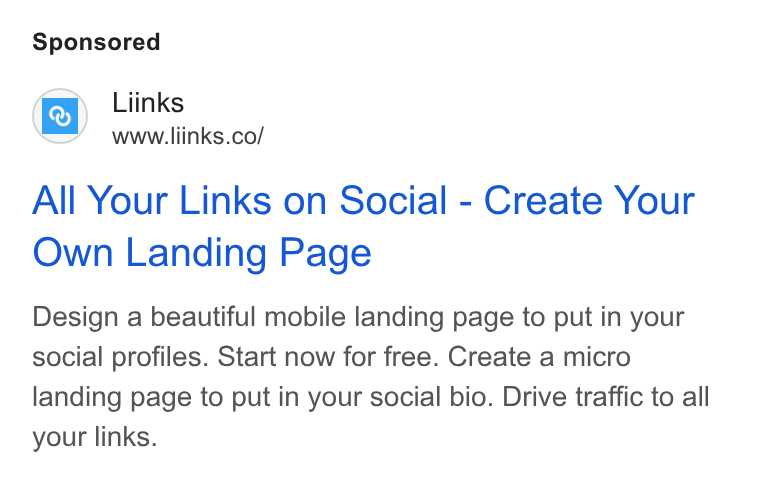
- Running
- 1706 days (longevity = it's converting)
- Hook
- Sponsored Liinks www.liinks.co/ All Your Links on Social - Create Your Own Landing Page
- CTA / offer
- Start now for free.
- Audience
- Individuals or businesses who use social media for promotion and need a consolidated way to share multiple links, indicated by phrases like "social profiles" and "social bio."
Why it works. Emphasizes owning a personal landing page rather than renting space on someone else's platform, which matters to creators wary of lock-in.
Headline directly states the problem and solution: "All Your Links on Social - Create Your Own Landing Page" Name the specific asset your user ends up owning, a page, a profile, a file, rather than describing the feature in the abstract.
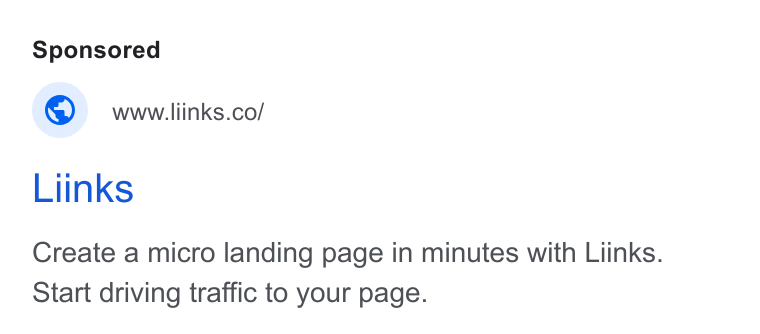
- Running
- 1617 days (longevity = it's converting)
- Hook
- Sponsored www.liinks.co/ Liinks Create a micro landing page in minutes with Liinks. Start driving traffic to your page.
- CTA / offer
- Create a micro landing page in minutes with Liinks. Start driving traffic to your page.
- Audience
- Entrepreneurs, small business owners, or content creators who need a quick and easy way to build a landing page and drive traffic, as indicated by the phrases "micro landing page in minutes" and "driving traffic to your page."
Why it works. States a specific time-to-value figure, then hands the reader the very next action, moving them from setup to traffic in two short lines.
Clear and concise headline: "Liinks" Quantify how fast your product delivers value in minutes or hours, then follow with the next concrete action the user should take.
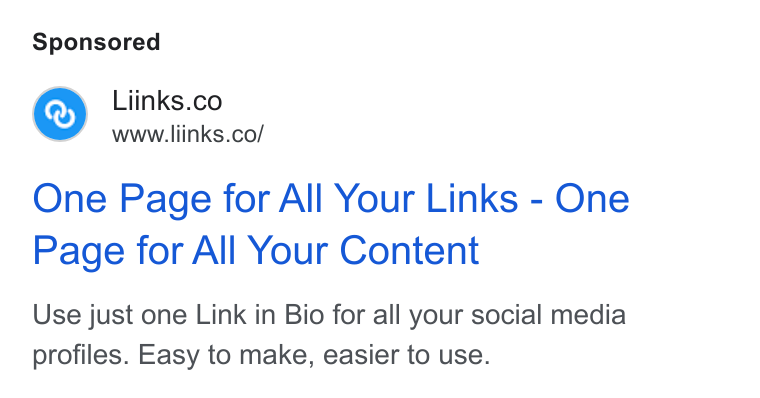
- Running
- 1582 days (longevity = it's converting)
- Hook
- One Page for All Your Links - One Page for All Your Content
- Audience
- Content creators, social media users, and businesses who manage multiple online profiles, indicated by the phrase "Link in Bio for all your social media profiles."
Why it works. Hammers the same consolidation promise against two objects, links and content, so creators juggling both see themselves solved in one line.
Headline stating a clear benefit: "One Page for All Your Links - One Page for All Your Content" State your core benefit twice back to back, each time paired with a different object your users are trying to consolidate.
Show 3 more ads
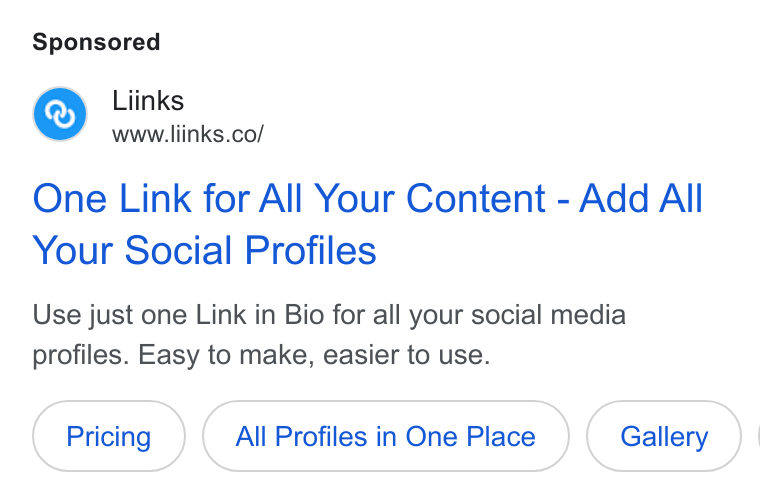
- Running
- 1581 days (longevity = it's converting)
- Hook
- Visual: The word "Sponsored" at the top, followed by a blue icon with a white intertwined link symbol, then the brand name "Liinks" and its URL "www.liinks.co/". Below this is the headline "One Link for All Your Content - Add All Your Social Profiles".
- Audience
- Individuals or businesses with multiple social media profiles who need a simplified way to share their content, indicated by phrases like "One Link for All Your Content" and "Add All Your Social Profiles".
Why it works. Combines the core benefit with the concrete first action a new user takes, so the headline doubles as an onboarding instruction.
Headline directly addresses a common pain point: "One Link for All Your Content - Add All Your Social Profiles". After stating your core benefit, name the exact first action a new user needs to take, in the same line.
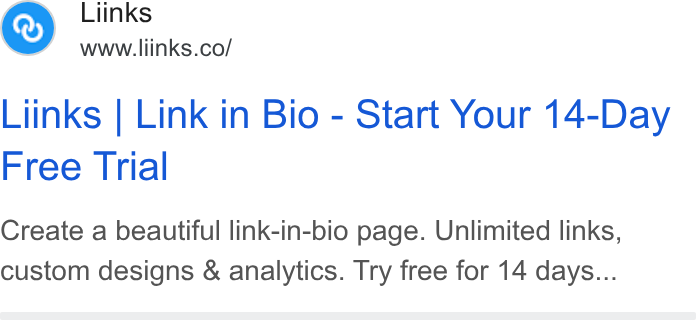
- Running
- 88 days (longevity = it's converting)
- Hook
- The image displays a blue square icon with two interlocking white chain links. To the right of the icon, the text "Liinks" is visible, followed by "www.liinks.co/". Below this, the headline "Liinks | Link in Bio - Start Your 14-Day Free Trial" is shown in blue text.
- CTA / offer
- Start Your 14-Day Free Trial
- Audience
- Individuals or businesses looking to consolidate their online presence, indicated by the phrase "Link in Bio" and the offer to "Create a beautiful link-in-bio page."
Why it works. A branded search headline that swaps vague 'free trial' language for an exact 14-day window, cutting hesitation for comparison shoppers.
Prominent headline stating a key benefit and a free trial: "Liinks | Link in Bio - Start Your 14-Day Free Trial" Replace 'free trial' in your headline with the exact number of days so searchers know precisely what they get before clicking.
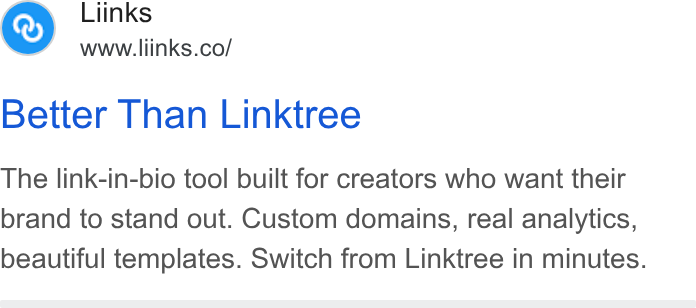
- Running
- 56 days (longevity = it's converting)
- Hook
- "Liinks" and "www.liinks.co/" with a blue circular logo containing two interlocked chain links.
- Audience
- Creators who want their brand to stand out, indicated by the phrase "The link-in-bio tool built for creators who want their brand to stand out."
Why it works. Targets shoppers already evaluating a rival link-in-bio tool, positioning Liinks as the direct switch for that specific audience.
Direct competitor comparison: "Better Than Linktree" If you can back it up, name your closest competitor directly in an ad aimed at people already searching for that competitor.
08 In their own words
Pulled from interviews and community sessions. The quotes are the angle; the takeaway is what to do with it.
Charlie Clark - How a solo founder took a side project from an idea to $300k+ ARR product! ↗Sharath Kuruganty · 336 views · 64 min▶ View source“I would find you know artists or influencers or whatever who either were using link tree or another um service or or not using any and I would either like try to rebuild their page using links or like build them what I think would be a good page for them and like be like hey I I did this for you like do you want to start using it”
Expand
Charlie grew Liinks primarily through unscalable manual outreach — personally rebuilding prospects' pages to demo the product — combined with a free plan that made switching from Linktree frictionless. Over four years he layered in an automated 'you're featured' customer-showcase loop that drove organic sharing, while the built-in viral loop of the 'made with Liinks' link in creators' bios compounded distribution without paid spend.
“I have like a customers page on the website so like I'll I'll send them an email it's all automated but like if if I see a profile I like I'll I'll send them an email and be like hey you're featured and like so then they'll be excited they're featured and they'll often like post about it so like I get some good organic traffic that way”
“there's just some something about these Lincoln bio tools that sort of have this inherent viral loop I guess which is like you see it because it's in people's bio and like the more people have it”
“being able to say like hey I've got like a free version of this tool that does a lot of the same things um and you can like make your page look nicer that was pretty like a pretty easy set”
“I think a lot of the companies that did struggle are companies that you know either raised um some VC or you know didn't really have the resources to like keep building and growing the thing luckily you know and I think one of the reasons why I've always wanted to build things is like because I'm able to and I I have I feel like I can sort of build projects”
Do the unscalable work first: manually rebuild a prospect's page inside your own tool and send it to them as a gift — it proves value instantly and removes all switching friction before you ask for anything.
Start free to seed your viral loop: a free plan gets your URL into creators' bios at scale, which is itself your distribution channel; monetize after the loop is spinning.
Automate a 'you're featured' email: scan for users with strong profiles, auto-email them that they're showcased on your customers page — they share it out of pride, generating organic traffic without ad spend.
Stay bootstrapped through downturns: no VC pressure meant Charlie could survive the 2022-23 creator-economy contraction that killed funded competitors by simply maintaining steady, slow growth without needing hyper-scale.
Reuse infrastructure across projects: Charlie recycled components and architecture from his prior project (Visual) to ship the Liinks MVP in weeks — prior failed projects are R&D, not sunk costs.
09 The playbook
The channels are not separate. They are one system where each stage feeds the next. Here is the read, then the plays to run tomorrow.
The inferred playbook
Liinks grows through a self-reinforcing structural loop backstopped by persistent paid search, with founder-led distribution having receded as the engine became self-sustaining.
Every free-tier Liinks page carries a "Made with Liinks" attribution link, turning the creator user base into a continuous organic referral surface; social organic at 34.8% of estimated monthly visits is the measurable output of this loop.
The free tier neutralizes the cost of leaving Linktree, and early concierge demos (source) seeded the initial paying cohort that then activated the badge loop at scale.
Dig deeper+2▾
Google Search ads have run continuously since October 2021 on category keywords, capturing bottomed-funnel intent without generating new demand; the longevity of the creatives signals a positive return on a low-maintenance channel.
Content SEO, comparison pages, an integration directory, and community-led growth are all structurally absent; the product grows through social distribution, and any founder trying to replicate the engine needs a user base that shares their output publicly.
Ship a branded attribution into your free tier's public output
The proofEvery Liinks page carries a "Made with Liinks" attribution link, and social organic is the platform's single largest traffic channel at 34.8% of an estimated 510,000 monthly visits; the interview confirms the badge was a deliberate design choice from early in the product's development.
The adaptationIf your product generates a public-facing artifact (a form, a landing page, a shared report, a booking link, a portfolio), add a design-consistent "Made with [Your Tool]" attribution linking to your homepage as a default for free-tier users, with removal available on a paid plan so the badge doubles as an upgrade incentive; start by shipping it to existing free-tier public output pages before building any other distribution channel. Why it works: your users promote you to their audiences every time they share the output, and those audiences already trust the creator doing the sharing, so the click-through intent is warm rather than cold.
Hand-deliver a prospect's output to them as your sales demo
The proofClark personally rebuilt individual prospects' Liinks pages as working demos and sent them over before asking for any commitment, generating the initial paying cohort from pure manual effort.
The adaptationIdentify 10-20 potential customers whose current public output (a Linktree page, a portfolio, a contact section, a scheduling link) can be rebuilt using your own tool, then send them the live result unprompted and without asking for anything first; the first step is finding a segment whose current state is visibly inferior and whose output format maps cleanly to what your tool produces. Caveat: this is an early-stage 1-to-50 tactic, not a scalable motion; it works at the stage where seeding a first paying cohort is the priority, not after you have hundreds of customers. Why it works: it eliminates the "show me in my own context" objection before it forms, and the done-for-you delivery makes the gap between their current state and your tool's output impossible to ignore.
Email featured customers to turn a spotlight into a reshare event
The proofLiinks notified featured users that they had been spotlighted as customer showcases, which prompted those creators to reshare the recognition to their own audiences, layering organic word-of-mouth on top of the badge loop.
The adaptationStart a recurring "featured user" post on X or LinkedIn, pick customers who already have a real following, then DM or email them a direct link to the post; the first step is identifying 5 active customers with engaged audiences and publishing one showcase per week for a month to establish the cadence. Caveat: the reshare only generates meaningful reach if the featured users have their own distribution; prioritize customers with active social presences over power users who are quiet online. Why it works: you give the customer a reason to share something that reflects positively on them, so the reshare is motivated by their own interest rather than loyalty to you.
Make your user-generated public pages indexable and let creator search demand accumulate
The proofLiinks' top organic pages are user profile pages (liinks.co/[username]) that rank for creator-name queries without any editorial effort by Liinks; one creator profile alone drives the majority of the platform's estimated 3,870 monthly organic visits, entirely passively.
The adaptationAudit whether your product's public-facing output pages (profiles, published documents, shared results, portfolio pages) are crawlable by search engines and carry accurate title tags reflecting the user's name or content title; the first step is running "site:yourdomain.com/[your-user-path-prefix]" to confirm indexing, then checking your robots.txt and meta-tag settings for accidental crawler blocks; no content creation is required, only the removal of barriers preventing your existing user pages from being discovered. Why it works: you borrow search demand that already exists for your users by name, converting their audiences into platform discovery at zero marginal cost, and the surface compounds automatically as your user base adds well-known creators.
Run category-keyword search ads from day one and maintain the same creative for years
The proofLiinks LLC has run Google Search ads continuously since October 2021, with the longest-running creative at approximately 1,706 days as of 2026-06-29; the hooks remain consistent ("One Page for All Your Links," "One Link for All Your Content," "Start Your 14-Day Free Trial"), and the paid search channel still delivers approximately 6,000 intent-driven monthly visits at 1.2% of total traffic.
The adaptationIdentify 2-3 non-branded category keyword phrases where the searcher has already decided to find a solution in your category (not just researching the problem), write one direct benefit-first ad per phrase, set a modest daily budget, and let them run without rotation; the first step is listing the 3 phrases your ideal customer would type when they were about to sign up for a competitor, not when they were first learning the category existed. Why it works: bottomed-funnel searchers have already done the work of deciding to buy; the ad only needs to win the name-recognition race, and long-running creatives accumulate Quality Score advantages that lower cost-per-click over time without additional investment.
You just read how Liinks does it. Tomorrow it is someone else.
Every morning we take one company that is actually growing and break down where its customers come from: the ads still running after a year, the channel doing the real work, and the play you can run this week.
Systemaic · directional intelligence. Traffic, spend, and reach figures are SimilarWeb-style estimates and qualitative reads of public data, not audited numbers. Built on real public receipts.
// teardowns with a similar GTM motion
sources & receipts (2)
Live ad libraries: google ad library
Founder interviews: Charlie Clark - How a solo founder took a side project from an idea to
Traffic, spend, and revenue figures are estimates as noted in the report; the links above are the primary public artifacts.