- 01Answer the confused-user question first
- 02Conquest ads on competitor-evaluation moments
- 03Pitch your own founder-decision story
- 04Get profiled by the trade press your buyer already trusts
01 Snapshot
The one-glance read on who they are and how they grow. Each point is verifiable from the receipts above.
Web-based, no-download live scoring, tournament management, registration and payments software for golf courses and tournament organizers, at roughly 150 paying golf courses.
Founder-led and organic-content-led, with trade-press and conference amplification rather than any paid-social or creator engine.
~25,753 estimated monthly visits (+211.7% over the last 3 months) as of 2026-07-26; revenue reportedly around $30K-40K/month (~$350K ARR) as of a July 2026 podcast account; 4 of 16 total Google search ads still active as of 2026-07-26.
The moat is a set of golf-scoring-format glossary pages that already own the #1 ranking for the exact confused-golfer searches ("calcutta golf," "shamble golf"), paired with search ads that conquest the incumbent's own brand terms rather than build a new audience from scratch.
02 How it unfolded
The order the channels came online. Sequence is strategy: what they did first, and what they layered on once demand existed.
03 Traffic & channel mix
Estimated demand, the channel split behind it, and the keywords and referrers doing the work. Directional modeling, not audited analytics.
Traffic sources
Top search keywords
| Keyword | Volume | Weight | CPC |
|---|---|---|---|
| ryder cup team composition in terms of game play complementary | 310 | - | |
| how to assemble a 100 entry bracket | 180 | - | |
| live tourney | 100 | - | |
| american quota system golf scoring | 90 | - | |
| golfgenius tournament | 80 | - |
Closest competitors by audience
Live Tourney draws an estimated ~25,753 monthly visits, up +211.7% over the last 3 months. Traffic is dominated by Direct at 58.6%, consistent with returning tournament organizers and players going straight to a bookmarked scoring link rather than searching fresh each time, followed by Search Organic at 21.2%, the payoff of the blog's format-explainer pages, and Referrals at 9.4%. The rest, email and paid search, adds another 10.8% combined.
On keywords, the branded term "live tourney" pulls only about 100 searches/month, a modest but real signal of direct brand-name lookups, while "golfgenius tournament" (80 searches/month) shows they are also positioned to catch people actively searching for the category incumbent, Golf Genius. The higher-volume terms, "ryder cup team composition in terms of game play complementary" (310/month) and "how to assemble a 100 entry bracket" (180/month), are format/logistics questions rather than brand searches, the same demand their glossary pages are built to catch.
Their closest named competitors are golfgenius.com, the entrenched legacy tournament-software incumbent their ad copy directly targets, challonge.com, a general-purpose bracket tool that competes for the same "how to assemble a bracket" search intent, golfstatus.com, a golf-specific rival chasing the same course/league buyer, and 18birdies.com, a consumer golf GPS-and-scoring app whose brand term their ad fleet also conquests.
04 Organic content
The specific pages earning their organic search traffic, and the pattern behind why they rank. Adapt the format, not the topic.
The blog's top pages are all golf-format explainers, "what is a calcutta," "ryder cup format and scoring," "shamble in golf," "skins game rules," and "golf scoreboard explained," and the pattern is consistent: plain-language answers to the exact question a confused golfer or tournament organizer types into Google before they've even chosen scoring software. That intent is low-competition and high-clarity, which is why the pages already hold the #1 ranking for their target terms (calcutta golf, golf calcutta, shamble golf, what does e mean in golf) The strategic read: because the glossary terms map directly onto tournament formats Live Tourney's own product scores, the content isn't generic golf blogging, it's a pre-sell for the exact use case the software solves.
Top pages by organic traffic
05 Channel map
Not traffic share. How much weight the growth system actually puts on each channel, with a one-line read on the role it plays.
What drove growth
06 The motions doing the work
For founder-led SaaS the breakdown shifts from ads to traction: where the first users came from, how the founder grows it in the open, and the compounding organic surface.
Live Tourney's traction reads as a slow trade-world build rather than a single launch spike, from a first live test on a real round of golf to conference and press presence four years later.
The product was tested live during an actual round of golf in June 2022, then formalized into a paid SaaS in early 2023; the founder has said it reached roughly $3K in monthly revenue shortly after launch and grew to about $18K for the month of January 2024.
Live Tourney exhibited at the Golf Business Conference 2026, co-located with the PGA Show in Orlando, putting the product directly in front of the golf-course and pro-shop buyers who make the purchase decision.
Dig deeper+2▾
An independent golf-technology review site run by a golf consultancy profiled Live Tourney as a modern, cheaper alternative to legacy tournament software, calling it "beyond genius," while a Club Resort Business editor filmed a talking-head video from the PGA Show floor referencing the platform.
A podcast account of founder Matt Robinson leaving his engineering job at Meta to run Live Tourney full time, with the business then reportedly at $30K-40K/month across 150 courses, was syndicated by multiple outlets in July 2026, giving the company a press footprint well beyond its own channels.
The "build in public" work here runs through one person's LinkedIn and a single high-leverage press placement, not a recurring personal-posting cadence.
Matt Robinson's 2,285-follower LinkedIn bio recounts the specific founding trigger, a head pro rejecting the incumbent's tournament software, directly matching the product's positioning, distinct from the comparatively dormant brand Instagram.
A syndicated recap of Robinson's podcast interview quoted him saying "My heart tells me to go all in on this thing... I do see a path forward to this being a really, really legitimate, great business," describing the exit conversation with his manager as feeling "like a breakup."
Dig deeper+1▾
rather than a steady drumbeat of personal posts, the visibility spike came from one podcast booking picked up by outlets covering founder-exit stories, a single-event amplification strategy rather than an ongoing content habit.
The organic-search motion is a compounding glossary strategy, backed by a small, persistent search-ad fleet that conquests the category incumbent's name rather than builds new demand.
Beyond the individual pages covered above, the broader bet is treating golf scoring-format confusion as a content category in itself, meaning every new tournament format (a new betting game, a new bracket style) is a plausible next #1-rankable page.
Live Tourney announced a partnership with Lightspeed Commerce in December 2025, syncing tournament management with a course's existing point-of-sale roster and tee-sheet system, a distribution lever that folds the product into software courses already run rather than requiring a fresh purchase decision, and a plausible contributor to the 9.4% referral traffic share.
Dig deeper+1▾
the true ad library holds 16 ads with 4 active as of 2026-07-26; the ad library's text ads carry messages like "Outsmarting Golf Genius" and "18Birdies Alternative - Live Scoring," bidding directly into competitor-evaluation moments such as the "golfgenius tournament" search term, while the one image-format test from mid-2025 has since stopped running.
07 Paid ads
This founder-led SaaS also runs paid acquisition. Here are the live ads doing the work, each with the X-ray and a play you can adapt.
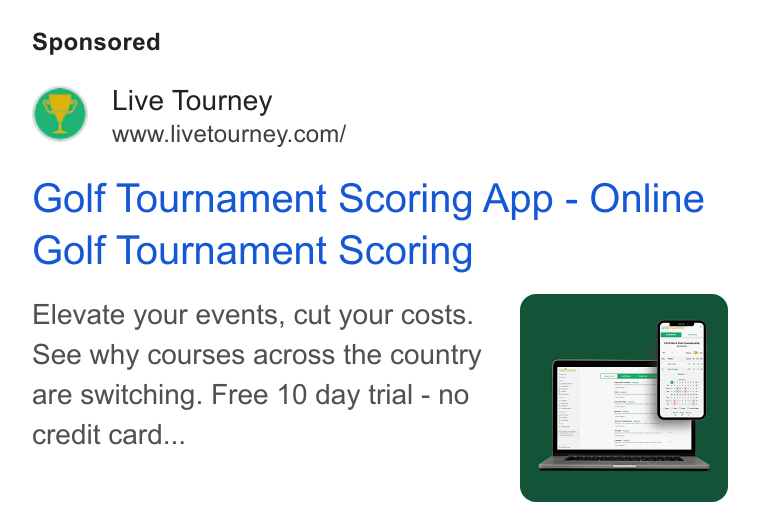
- Running
- 578 days (longevity = it's converting)
- Hook
- Visual: The word "Sponsored" at the top left, followed by a green circular logo with a gold trophy, and the text "Live Tourney" and "www.livetourney.com/".
- CTA / offer
- Free 10 day trial - no credit card...
- Audience
- The phrases "Golf Tournament Scoring App" and "Elevate your events, cut your costs" target golf course managers, event organizers, or individuals involved in running golf tournaments.
Why it works. A direct-response ad promoting a golf tournament scoring app, using a clear value proposition and a risk-free trial to acquire new users.
Headline clearly states the product and its primary function: "Golf Tournament Scoring App - Online Golf Tournament Scoring". Ensure your ad's headline explicitly names your product and its core function, making it instantly clear to your ideal customer what you offer.
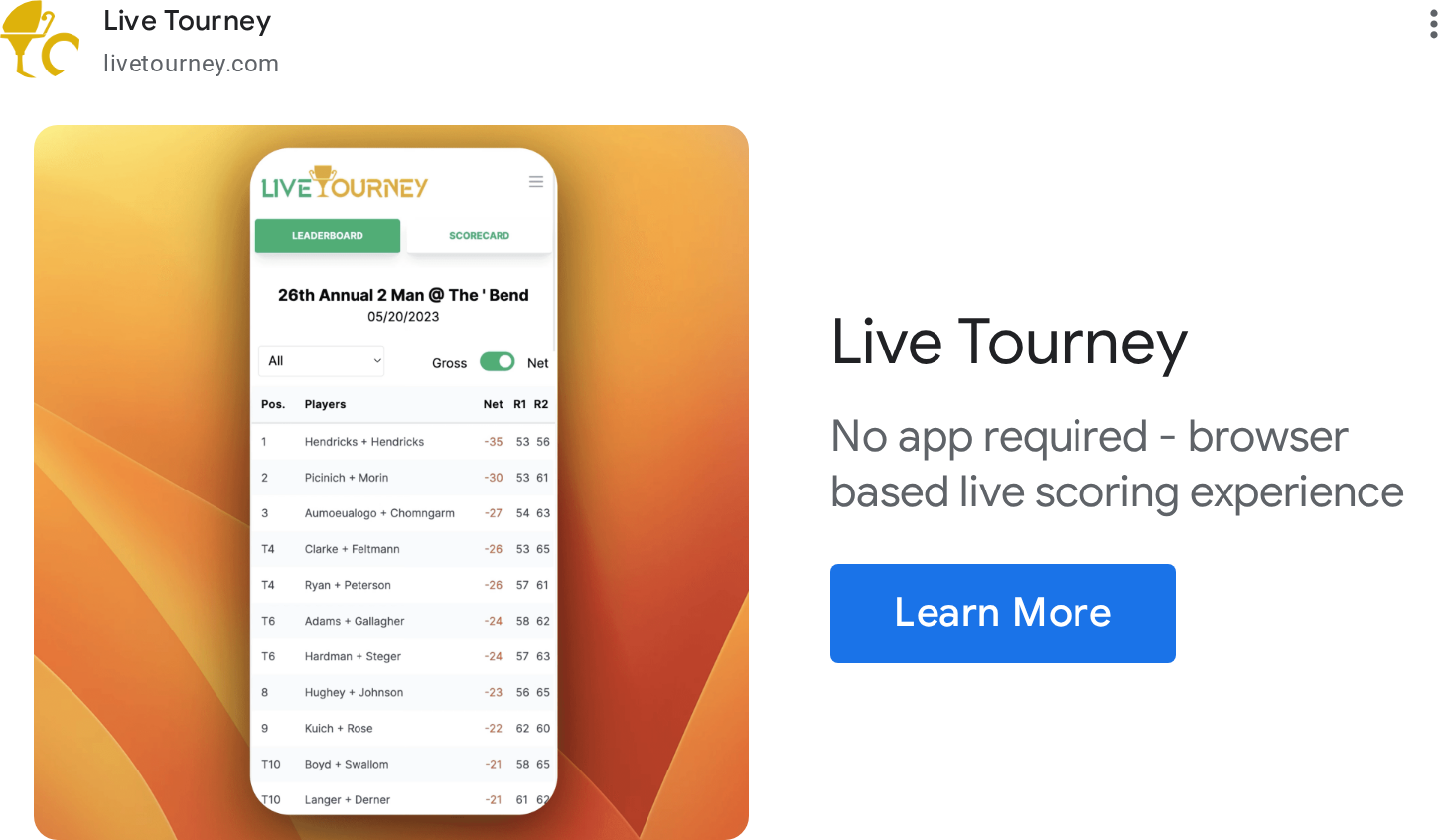
- Running
- 715 days (longevity = it's converting)
- Hook
- Visual of a mobile phone displaying a golf leaderboard with the text "Live Tourney" and "livetourney.com" above it. The phone screen shows "26th Annual 2 Man @ The 'Bend" and a list of players with their scores.
- CTA / offer
- Learn More
- Audience
- Golf tournament organizers and participants, indicated by the golf-themed branding and the display of a golf tournament leaderboard.
Why it works. Demonstrate the core product functionality and highlight a key benefit to attract users looking for an easy-to-use golf scoring solution.
Product demonstration via screenshot: The ad displays a mobile phone screen showing a live golf tournament leaderboard with player names and scores. For a software product, use a clear, high-fidelity screenshot or short video clip of the most impactful feature as the primary visual in your ad creative.
- Running
- 487 days (longevity = it's converting)
- Hook
- Sponsored Live Tourney www.livetourney.com/
- CTA / offer
- Book a demo today to learn more.
- Audience
- Individuals or organizations using 'Golf Genius' software, indicated by the phrase 'Golf Genius alternative'.
Why it works. Direct response ad using a clear value proposition and call to action to acquire leads from users seeking alternatives to a known competitor.
Directly addressing a competitor: "The simple and modern Golf Genius alternative." (on-screen text) If you have a direct competitor, explicitly state your product as an 'alternative' and highlight a key differentiator (e.g., 'simpler', 'faster', 'cheaper') in your primary ad copy.
Show 3 more ads
- Running
- 412 days (longevity = it's converting)
- Hook
- Sponsored Live Tourney www.livetourney.com/ 18Birdies Alternative - Live Scoring Golf App
- CTA / offer
- Free 10 day trial
- Audience
- Golf course operators, event organizers, or individuals involved in golf event management, indicated by 'Elevate your events, cut your costs' and 'See why courses across the country are switching'.
Why it works. Direct competitor comparison and cost-saving value proposition with a free trial to acquire new users for a golf scoring app.
Direct competitor call-out in headline: '18Birdies Alternative - Live Scoring Golf App' If you have a clear competitive advantage, name your competitor directly in your ad headline to attract their dissatisfied users.
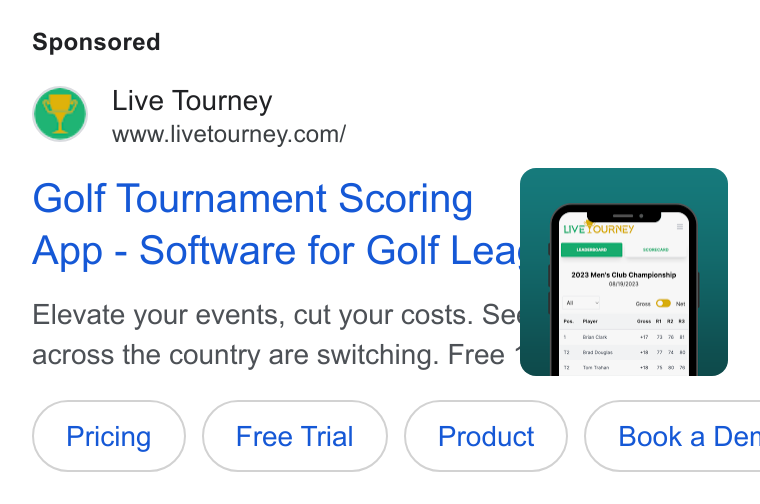
- Running
- 411 days (longevity = it's converting)
- Hook
- Sponsored ad with a green circular logo featuring a gold trophy, text 'Live Tourney' and 'www.livetourney.com/', followed by a blue headline 'Golf Tournament Scoring App - Software for Golf Lea'.
- CTA / offer
- Free Trial
- Audience
- Golf tournament organizers and golf league administrators, indicated by the headline 'Golf Tournament Scoring App - Software for Golf Lea' and the visual of a golf leaderboard.
Why it works. Direct response ad using problem/solution framing and a clear call to action to acquire new users for golf tournament software.
Headline directly addresses a specific need: 'Golf Tournament Scoring App - Software for Golf Lea' Start your ad with a headline that clearly names the specific problem your product solves for your target customer.
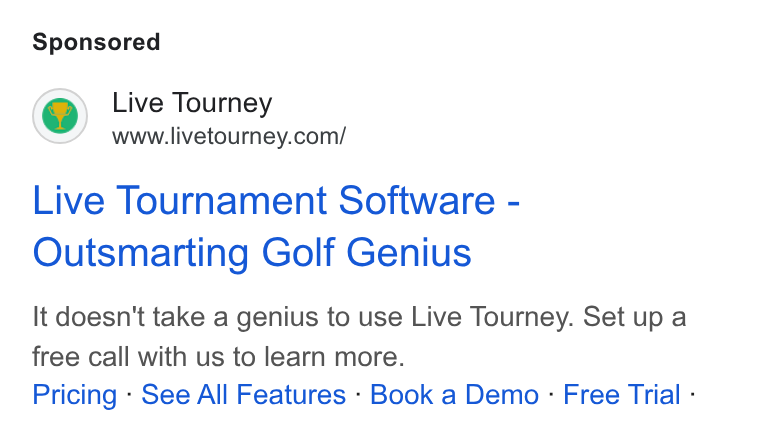
- Running
- 271 days (longevity = it's converting)
- Hook
- Sponsored Live Tourney www.livetourney.com/ Live Tournament Software - Outsmarting Golf Genius
- CTA / offer
- Set up a free call with us to learn more.
- Audience
- Golf tournament organizers or individuals involved in managing golf events, indicated by "Live Tournament Software" and "Outsmarting Golf Genius."
Why it works. A direct-response ad promoting golf tournament software by highlighting ease of use and competitive advantage to drive demo requests and free trials.
Headline with a bold, competitive claim: "Live Tournament Software - Outsmarting Golf Genius." Use a headline that directly challenges a known competitor or a common problem in your industry, positioning your product as the superior solution.
08 The playbook
The channels are not separate. They are one system where each stage feeds the next. Here is the read, then the plays to run tomorrow.
The inferred playbook
Attention starts in the golf-course buying committee's world, converts on a dead-simple flat annual price, and compounds through content and a growing integration surface.
trade conferences like the Golf Business Conference, competitor-conquesting search ads bidding into Golf Genius and 18Birdies evaluation moments, and long-tail scoring-format searches landing on the glossary pages.
a single $2,700/year flat plan with unlimited events and a 10-day free trial requiring no credit card, paired with a category-defection pitch aimed at buyers already fatigued with the incumbent's cost and complexity.
Dig deeper+3▾
the format-glossary content, where the calcutta page alone is their single biggest organic entry point, plus the Lightspeed integration that embeds Live Tourney into a course's existing software stack.
no evidenced pro-shop or organizer referral/affiliate program distinct from the vendor integration, and no organic social distribution beyond one founder's LinkedIn.
the trial-to-paid conversion rate off the 10-day free trial, the annual renewal rate across the roughly 150 paying courses (the make-or-break number for a flat annual-fee model with no monthly tier), and how much of the 58.6% direct traffic share is returning tournament players scanning a live-scoring link versus new buyers navigating straight to the pricing page.
Answer the confused-user question first
The proofTheir calcutta rules page ranks #1 for its target term and alone pulls an estimated 676 organic visits a month, its single largest organic landing page.
The adaptationMine your own support tickets or sales calls for the exact plain-language question your prospects ask when they don't understand a term in your category, write a 600-800 word page that answers it before it pitches anything, and link to your product only in the last third. Start by drafting that one page this week; the mechanism is answering the confusion first, not the volume of pages.
Cost: $0 · Time to signal: weeks · Works pre-PMF: yes
Conquest ads on competitor-evaluation moments
The proofTheir ad library runs messages like "Outsmarting Golf Genius" and "18Birdies Alternative," bidding directly into the roughly 80 monthly searches for their main incumbent's product name.
The adaptationIdentify the specific incumbent your prospects are actively comparing you against, then run one small search campaign bidding on "[competitor] alternative" queries pointed at a page naming the exact complaint switchers have. Start with a single ad group at $20-30 a day rather than a broad brand campaign; the specificity of the objection is what makes the ad convert, not the spend.
Cost: under $500 · Time to signal: weeks · Works pre-PMF: conditional, only works once you know the specific objection switchers have against the incumbent, guessing at it wastes the spend.
Pitch your own founder-decision story
The proofA syndicated podcast recap of the founder's decision to leave Meta for the business, with a specific revenue number attached, got picked up by multiple outlets beyond his own following.
The adaptationDraft a three-sentence pitch built around your own specific number and decision moment (the month you hit a real milestone, or the day you decided to quit a job) and send it cold to two or three podcasts or newsletters that cover bootstrapped software founders. Start writing that pitch now; the exact number is what gets you booked, not the polish.
Cost: $0 · Time to signal: weeks · Works pre-PMF: conditional, needs a genuine milestone or decision moment to be worth a booking, not just an existing product.
Get profiled by the trade press your buyer already trusts
The proofAn independent golf-technology review site profiled Live Tourney as a cheaper, simpler alternative to the incumbent, calling it "beyond genius."
The adaptationIdentify the 2-3 niche review or trade sites your specific buyer vertical already reads, not general tech press, and pitch them directly for a head-to-head comparison against the incumbent you're positioned against. Start by emailing one such site a free account and the one-line pitch: simpler, cheaper alternative to [incumbent].
Cost: $0 · Time to signal: weeks · Works pre-PMF: yes
Show up at the one event your buyer attends
The proofLive Tourney exhibited at the Golf Business Conference, co-located with the PGA Show, the same room where golf-course and pro-shop buyers already gather.
The adaptationFind the single trade conference or association meeting your buyer attends every year and get in front of them there, even as a walking attendee rather than a paid exhibitor. Start by messaging the organizer about a demo table or speaking slot for the next event; in-person credibility with a trade buyer compounds faster than cold outbound to the same audience.
Cost: under $5k · Time to signal: months · Works pre-PMF: conditional, only pays off if your buyer is genuinely a conference-going trade audience rather than a consumer. Not transferable at an earlier stage: the trade-conference exhibitor slot and any paid conquest-ad spend both assume enough revenue to justify travel or ad budget, and the founder-story podcast placement only works once there is a real milestone or decision moment to pitch, not before.
You just read how Live Tourney does it. Tomorrow it is someone else.
Every morning we take one company that is actually growing and break down where its customers come from: the ads still running after a year, the channel doing the real work, and the play you can run this week.
Systemaic · directional intelligence. Traffic, spend, and reach figures are SimilarWeb-style estimates and qualitative reads of public data, not audited numbers. Built on real public receipts.
// teardowns with a similar GTM motion
sources & receipts (8)
Live ad libraries: google ad library
Milestone sources: 2022-06-07: Live Tourney is tested live for the first time during a real round of golf · 2024-01: Live Tourney hits roughly $18k in revenue for the month (up from ~$3k MRR at laun · 2025-12-02: Live Tourney and Lightspeed Commerce announce a partnership/integration syncin · 2026-01: Live Tourney appears as a featured exhibitor/participant at the Golf Business Con · 2026-07: Founder Matt Robinson leaves his job as a senior engineer at Meta to run Live Tou
Community threads: Podcast recap (BigGo Finance, syndicating Starter Story): Founder Matt Robinson (ex-Meta A · Trade review site (Golf Course Technology Reviews): Independent-leaning golf-tech review p
Traffic, spend, and revenue figures are estimates as noted in the report; the links above are the primary public artifacts.