- 01Time your launch to land inside someone else's press
- 02Put the founder's story on the product, not just the About page
- 03Give each creator a trackable code, not a generic link
- 04Book a demo day at the exact store carrying your product
01 Snapshot
The one-glance read on who they are and how they grow. Each point is verifiable from the receipts above.
Premium Sichuan chili crisp, chili oil, and a newer instant-noodle line sold direct-to-consumer and through Target, Whole Foods, and Costco, under founder Jing Gao.
Creator-led, propped up by a dominant branded organic-search base.
~99,548 monthly visits (+30.3% over the last 3 months) as of 2026-07-14, 142,189 Instagram followers, and a $12M Series B closed in March 2023.
Only two Google ads are active as of 2026-07-14, an image and a text creative each under three weeks old, a fresh wave following a much longer historical run.
Their single biggest amplification event was not an ad or an owned post, it was an unpaid creator reaction video to a copycat controversy that outdrew everything in their paid library combined.
02 How it unfolded
The order the channels came online. Sequence is strategy: what they did first, and what they layered on once demand existed.
03 Traffic & channel mix
Estimated demand, the channel split behind it, and the keywords and referrers doing the work. Directional modeling, not audited analytics.
Traffic sources
Top search keywords
| Keyword | Volume | Weight | CPC |
|---|---|---|---|
| fly by jing | 15k | $0.56 | |
| flybyjing | 2.8k | $0.56 | |
| mapo tofu vegetarian | 1.9k | $0.93 | |
| chop suey | 70k | $0.72 | |
| fly by jing original sichuan chili crisp vegan crispy hot sauce | 320 | - |
Closest competitors by audience
The site draws roughly 99,548 estimated monthly visits, up 30.3% over the last 3 months. Search organic dominates at 45.5% of traffic, backed by direct (16.8%) and email (17.1%), a combination that points to a warmed, repeat-visitor base more than new discovery, consistent with a retention program like their reported Tastemaker Club subscription. Search paid (7.9%) and affiliate (6.9%) add secondary contribution; referrals, Gen AI, and both social channels together total under 6%. Their own brand name pulls the most telling keyword demand: "fly by jing" (14,590 searches/month) and "flybyjing" (2,780/month) show people searching for them directly, while "chop suey" shows 69,710 searches/month, a generic Chinese-food term in their category that no specific Fly By Jing page was identified ranking for. Among the closest competitors, redhousespice.com is a recipe-content site rather than a direct product rival, eatlittlesesame.com is a closer Asian-American DTC condiment competitor, and theramenbae.com is a noodle-focused site directly relevant now that Fly By Jing has entered the noodle category.
04 Organic content
The specific pages earning their organic search traffic, and the pattern behind why they rank. Adapt the format, not the topic.
Their top organic pages skew toward bottom-funnel, branded destinations: the homepage (35.3% of organic traffic), the chili crisp product page (13%), and the shop collection page (5.6%) capture demand from people who already know the brand, which lines up with their #1 organic rankings for every branded term ("fly by jing," "fly by jing sichuan chili crisp," "fly by jing noodles"). The one exception is a single glossary-style explainer, a "dumplings vs. potstickers vs. wontons" post pulling roughly 802 visits/month, their only real top-of-funnel content asset built around a generic category question rather than their own name. The pattern reads as a content strategy that mostly defends branded search rather than a broad SEO acquisition engine, with one educational page doing the work of net-new discovery.
Top pages by organic traffic
05 Channel map
Not traffic share. How much weight the growth system actually puts on each channel, with a one-line read on the role it plays.
What drove growth
06 The creative doing the work
Each exhibit shows the actual asset, an X-ray of why it works, a status, and a play you can adapt. This is the heart of the teardown.
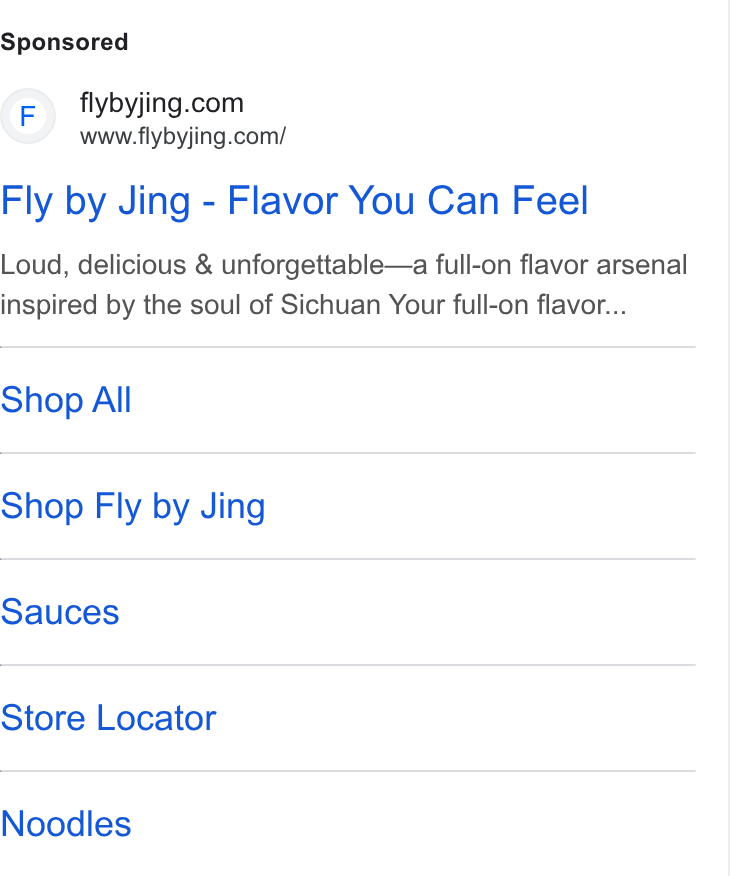
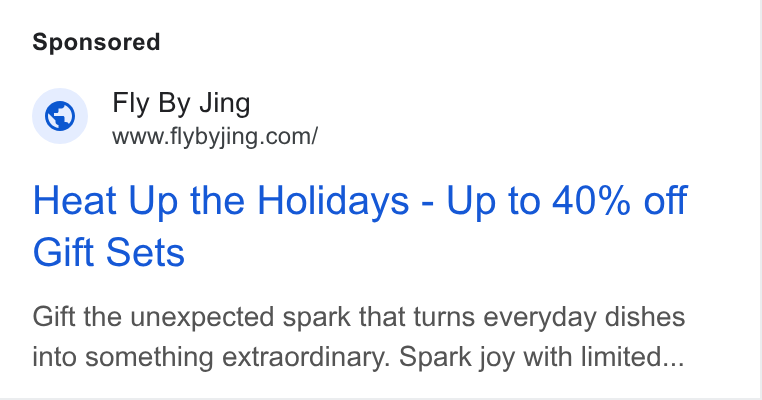
Fly By Jing's Google ad library holds 12 analyzed ads as of 2026-07-14, but only 2 are active, an image ad and a text ad, 16 and 14 days old respectively, so neither has cleared the runway needed to call it a proven winner. The real longevity signal sits in ads that have since stopped: a text ad ran 133 days (October 2025 to March 2026) and an image ad ran 469 days (April 2024 to July 2025) before lapsing, evidence of a brand willing to fund search ads for long stretches, then pause, rather than run an always-on campaign.
Two headline creatives from the library illustrate the current style:
Hook: "Heat Up the Holidays, Up to 40% off Gift Sets" Why it works: A seasonal deadline plus a steep percentage discount turns a $12-16 jar into a low-friction gift-bundle purchase rather than an everyday grocery ask. Run this play: Bundle your own product into a themed multi-pack around a seasonal moment and lead the ad with the percentage off, not the product name.
Hook: "Fly by Jing, Flavor You Can Feel" Why it works: A sensory tagline substitutes for a discount, banking on the brand's own #1 organic ranking for its name to convert already-warm searchers rather than pitching cold traffic. Run this play: Once you already own top organic rankings for your brand name, test a one-line sensory tagline against your product-name-only ads for retargeting warm searchers.
With nothing in the active set past 16 days, the paid search motion reads as a fresh restart rather than a tuned evergreen funnel. The strongest proof of what actually works longest sits in the lapsed 469-day and 133-day runs, whose specific creative isn't available to inspect.
- Running
- 133 days (longevity = it's converting)
- Hook
- Sponsored F flybyjing.com www.flybyjing.com/ Fly by Jing - Flavor You Can Feel
- CTA / offer
- Shop All
- Audience
- Individuals interested in bold, unique food flavors, specifically those inspired by Sichuan cuisine, indicated by the description 'inspired by the soul of Sichuan'.
Why it works. Uses a sensory tagline to differentiate from competitor search ads that just list product names, appealing to shoppers scanning for flavor intensity.
Headline with sensory appeal: 'Fly by Jing - Flavor You Can Feel' Write a search ad headline that translates your core benefit into a physical sensation claim instead of a plain product descriptor.
- Running
- 12 days (new — still being tested)
- Hook
- Sponsored Fly By Jing www.flybyjing.com/ Heat Up the Holidays - Up to 40% off Gift Sets
- CTA / offer
- Up to 40% off Gift Sets
- Audience
- Individuals looking for holiday gifts, specifically those interested in food-related items or unique culinary experiences, as indicated by "Heat Up the Holidays" and "Gift Sets" and the brand name "Fly By Jing".
Why it works. Targets holiday gift shoppers with a clear discount ceiling on gift sets, giving search users a concrete reason to click during a high-intent season.
Headline with discount and holiday theme: "Heat Up the Holidays - Up to 40% off Gift Sets" For seasonal search ads, pair a holiday-specific headline with your maximum discount percentage tied to a named product bundle.
- Running
- 26 days (longevity = it's converting)
- Hook
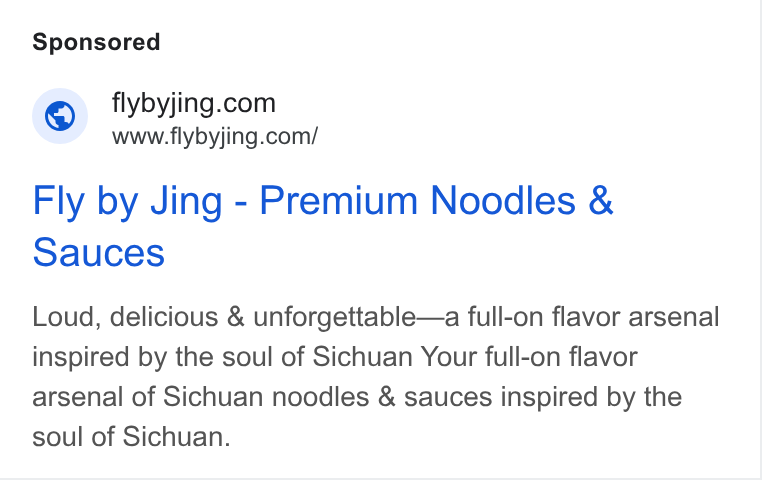
- Sponsored flybyjing.com www.flybyjing.com/ Fly by Jing - Premium Noodles & Sauces
- Audience
- Individuals interested in gourmet food and specific regional cuisines, indicated by the mention of "Sichuan noodles & sauces" and "Premium Noodles & Sauces."
Why it works. Captures broader category searches for noodles and sauces beyond just chili crisp, widening the net of search intent this ad can match.
Directly stating the product category and brand name: "Fly by Jing - Premium Noodles & Sauces" Add a secondary search ad headline that names your product category broadly, not just your hero SKU, to catch adjacent search queries.
Show 3 more exhibits
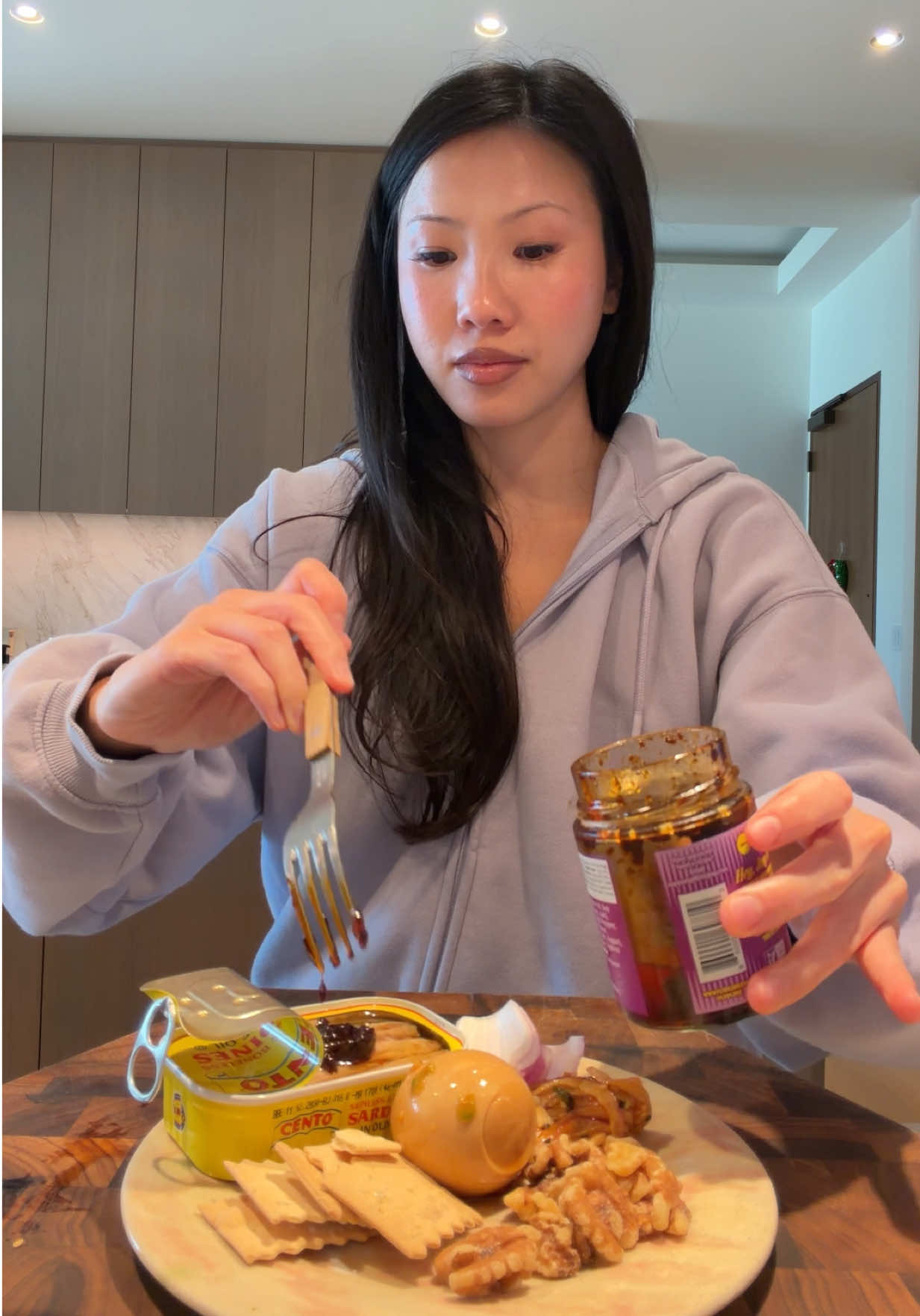
- Hook
- "quick snack plate" text overlay, a woman in a light purple hoodie opens a clear rectangular container filled with a reddish-brown, saucy dish with noodles and vegetables.
- Audience
- Individuals interested in quick, flavorful, and somewhat unconventional snack ideas, likely those who appreciate Asian-inspired flavors and gourmet pantry staples.
Why it works. Shows the product folded into an everyday snack occasion rather than a full meal, widening when viewers picture using it.
Showcasing product versatility with diverse pairings (0:22-0:29): The creator explicitly adds 'Fly By Jing oil' to sardines, crackers, and onions, after already having it with marinated eggs and noodles. Label your demo with a modest, everyday occasion like 'quick snack,' then reveal a more elaborate result than the label implies.
Who amplifies them
Amplification is almost entirely third-party creators rather than the brand's own account. Softboyid made the founder-feature video referenced above, Albert Cho drove the largest single spike with his reaction to the Laoganma copycat controversy, and sal munchies is a repeat mukbang poster through mid-2026. On the affiliate side, Mochi Mukbang and juliesbeautybyreview both post under TikTok Shop tags, functioning as seller-affiliates rather than pure fans. Jing Gao herself appears as the subject of creator content (softboyid's founder-feature video) rather than posting from a verified personal account of her own. No subreddit or community forum activity surfaced.
07 Organic & video
The organic content engine: the videos, creator posts, and community presence earning attention without paid spend.
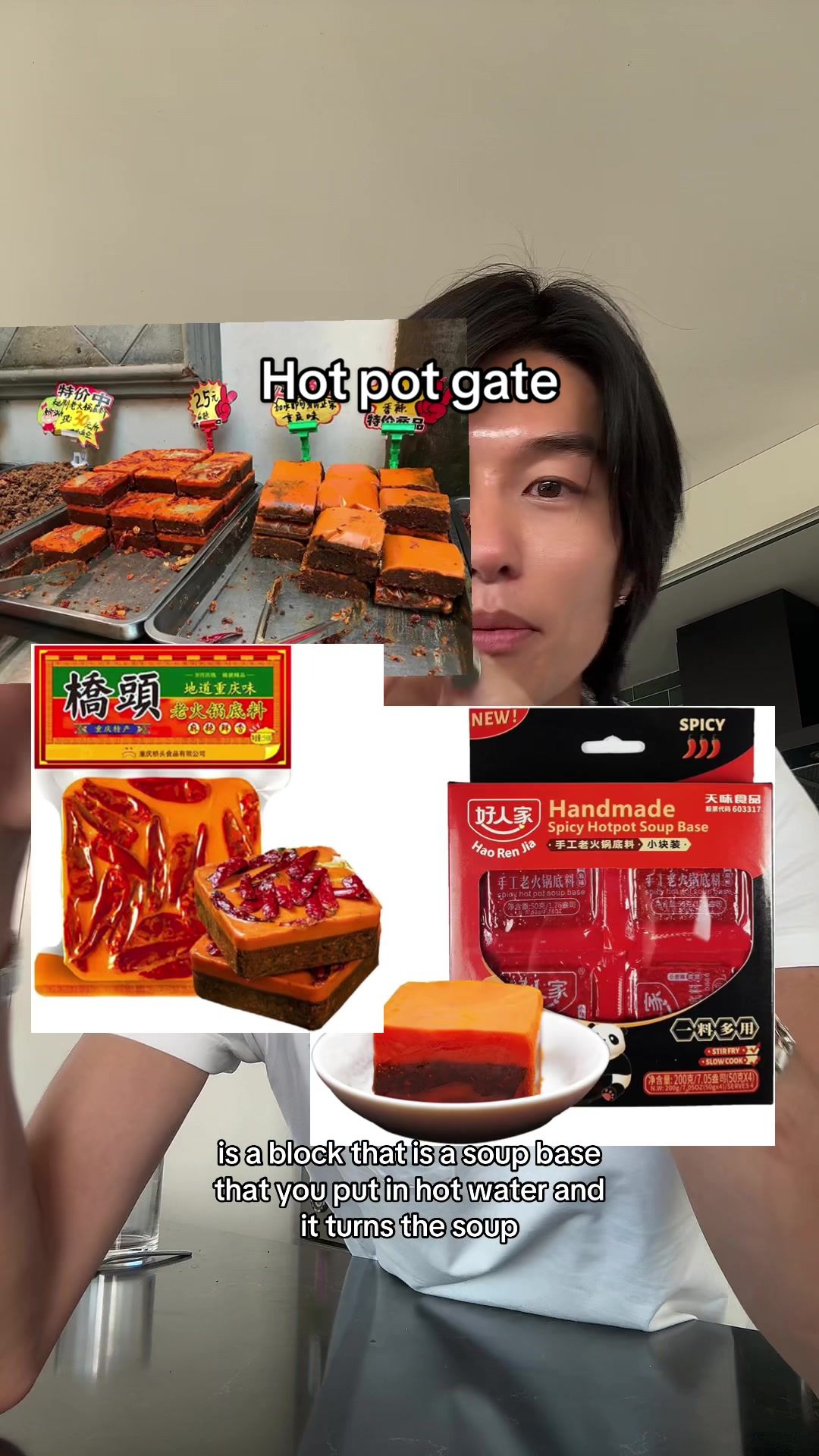
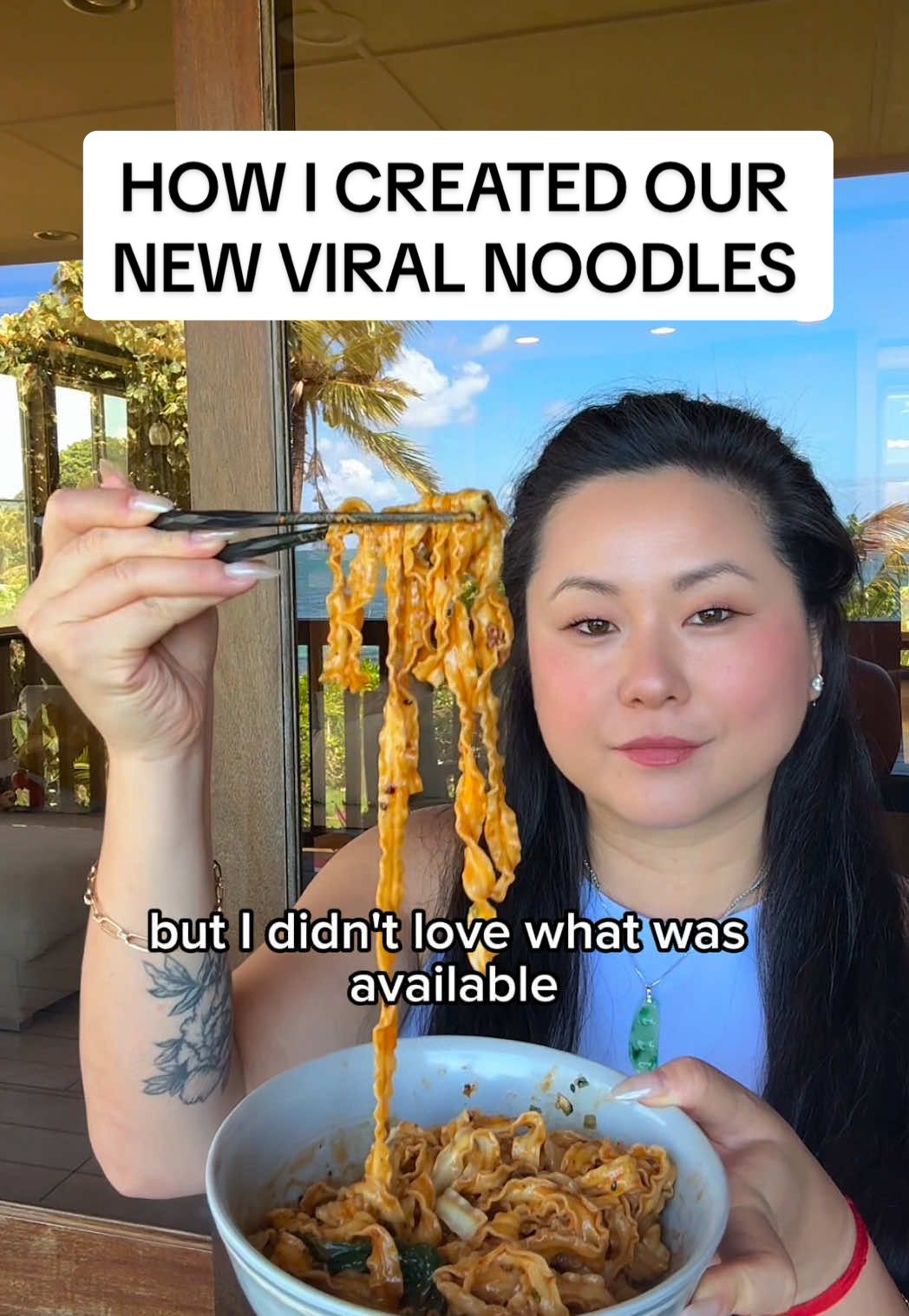
The single biggest organic moment came from a copycat controversy: creator Albert Cho's reaction video, "My thoughts on Logan and Fly By Jing," pulled 2,618,182 in engagement on 2026-02-08, responding to accusations that a rival brand (nicknamed "Logan" by TikTok, referring to competitor Laoganma) copied Fly By Jing's "hot pot bomb" product. Founder-adjacent content also performs well: creator softboyid's video, "How our founder @Jing, Fly By Jing created our new viral noodles," drew 205,051 engagement on 2025-12-03, and creator sna's "TikTok exclusive fly by jing instant noodle bundle" post drew 76,989 on 2025-10-28. Beyond those three, a dozen more posts sit in the roughly 500 to 100,000 engagement range, mostly mukbang and taste-test formats, with repeat creators like sal munchies posting multiple times through July 2026. The mukbang/reaction format is what performs consistently, and the copycat-controversy reaction produced the single largest spike by a wide margin.
08 Affiliate & partners
How the brand turns creators and partners into a tracked, variable-cost acquisition channel, and how the program is structured.
The detected program runs through TikTok Shop, not a named platform like Rewardful or PartnerStack. Creator Mochi Mukbang posts a personal discount code ("mochi.mukbang7" for 10% off), and juliesbeautybyreview tags posts with TikTok Shop deal hashtags across multiple videos, both signs of a live creator-affiliate mechanic with per-creator tracking. The owned site's link evidence shows only social profile links (TikTok, Instagram), with no dedicated referral or partner-program page detected.
09 The playbook
The channels are not separate. They are one system where each stage feeds the next. Here is the read, then the plays to run tomorrow.
The inferred playbook
Fly By Jing's loop runs on a branded-search moat built by years of press, converted through product pages that already rank first for the brand's own name, and amplified by unpaid creator content, including a copycat controversy that outperformed anything in their paid ad library.
They hold #1 organic rankings for every branded term, and search organic already supplies 45.5% of total traffic, meaning the content engine's real job is defending the name rather than winning net-new demand.
Scheduled Costco roadshow demo dates posted to Instagram turn in-store sampling into a content and inventory-availability signal at the same time.
Dig deeper+3▾
The Laoganma copycat conversation snowballed into the single biggest engagement event in the evidence, a scale no paid ad or brand post approached, showing their strongest current lever is community-defended authenticity, not owned media.
The active Google library covered above shows spend that gets dialed up and down rather than run continuously, a supplementary channel layered on top of the organic base rather than the primary engine. No public revenue figure is independently verified in the evidence; the retail footprint and the $12M Series B point to an eight-figure ARR order of magnitude, an estimate, not a confirmed number.
the DTC-versus-retail revenue split following the brand's reported 2025 shift toward retail, the Tastemaker Club subscription's attach or retention rate, exact per-unit pricing on flybyjing.com itself, and the TikTok Shop affiliate commission or attach rate.
Time your launch to land inside someone else's press
The proofFly By Jing's 2018 Sichuan Chili Crisp Kickstarter fully funded within its first day, blowing past a $35K goal on the back of coordinated launch-day press.
The adaptationLine up one or two press or newsletter placements to publish the exact day you open your own waitlist, crowdfunding page, or store, so readers arriving from that coverage land on a live conversion page instead of a "coming soon" screen. Pitch a niche trade newsletter or blogger two to three weeks ahead and ask for an embargo that matches your launch day, mirroring the same-day coordination that got Fly By Jing funded in a day.
Cost: $0 · Time to signal: weeks · Works pre-PMF: yes.
Put the founder's story on the product, not just the About page
The proofFly By Jing's brand redesign put the founder's personal story directly onto packaging and is described as a second major growth inflection point.
The adaptationRewrite your packaging, product page, or first customer email around the founder's specific personal reason for building the product, not generic brand copy, since a distinctive personal story is what a creator or journalist can actually repeat. Start by rewriting one asset, your product page hero copy, this way and watch whether time-on-page or email replies shift.
Cost: $0 · Time to signal: weeks · Works pre-PMF: yes.
Give each creator a trackable code, not a generic link
The proofTheir TikTok Shop creators run personal promo codes, such as Mochi Mukbang's 10%-off code, rather than a shared discount link.
The adaptationSet up a simple affiliate system, even a spreadsheet with unique codes, for any creator willing to post organically about your product, and offer a 10% code matching Fly By Jing's rate so performance is attributable per creator. Reach out to three to five micro-creators in your niche this way and double down on whichever code actually converts.
Cost: $0 to under $500 · Time to signal: weeks · Works pre-PMF: yes.
Book a demo day at the exact store carrying your product
The proofFly By Jing posts specific Costco roadshow dates by store and city, tying content directly to where shoppers can taste and buy the product.
The adaptationIf you have even one retail placement, book a single sampling day, post the specific store name and date about a week ahead, and treat the event itself as content, mirroring the store-and-date specificity in Fly By Jing's own roadshow posts. This only works once you have secured shelf space somewhere; it is not a substitute for getting into a store in the first place.
Cost: under $500 · Time to signal: days to weeks · Works pre-PMF: conditional, only once at least one retail door is secured.
Build one explainer page for the question people ask before they know your brand
The proofA single glossary-style post explaining the difference between dumplings, potstickers, and wontons is their only real non-branded organic asset, pulling in demand from a generic term unrelated to their own name.
The adaptationIdentify the one broad "X vs. Y" confusion in your own category that people search before they've ever heard of your brand, write a single authoritative 800-1,200 word explainer, and link it straight into your product page, rather than building a large content farm. Publish that one page first and track whether it starts pulling non-branded search traffic within a few months.
Cost: $0 · Time to signal: months · Works pre-PMF: yes. Not transferable at an earlier stage: the broad retail placement across Target, Whole Foods, and Costco, and a single creator video reaching 2.6 million people organically, are outcomes of years of press, funding, and distribution built since the brand's 2018 launch. A pre-PMF founder should adapt the underlying mechanics, press-timed launches, story-driven packaging, trackable creator codes, in-store demos, and one explainer page, not expect the same scale of reach on day one.
You just read how Fly By Jing does it. Tomorrow it is someone else.
Every morning we take one company that is actually growing and break down where its customers come from: the ads still running after a year, the channel doing the real work, and the play you can run this week.
Systemaic · directional intelligence. Traffic, spend, and reach figures are SimilarWeb-style estimates and qualitative reads of public data, not audited numbers. Built on real public receipts.
// teardowns with a similar GTM motion
sources & receipts (1)
Live ad libraries: google ad library
Traffic, spend, and revenue figures are estimates as noted in the report; the links above are the primary public artifacts.