- 01Launch every spinoff separately
- 02Ship a free standalone utility
- 03Tie your content to whatever tool is trending
- 04Bid on the incumbent's name, backed by a real comparison page
01 Snapshot
The one-glance read on who they are and how they grow. Each point is verifiable from the receipts above.
An open-source-core API that turns any website into clean, LLM-ready data for AI agents and developer workflows.
Organic-led open-source virality, amplified by three co-founders building in public across X and YouTube.
≈1.48M monthly visits (-1.8% over the last 3 months), 125,000+ GitHub stars and 1,000,000+ developers as of 2026, up from 43,000+ stars and 350,000+ developers at their $14.5M Series A (August 2025).
As of 2026-07-10, Firecrawl is running new Google search ads under different advertiser names with generic "AI Web Scraping API" and "Website Crawl Tools" headlines.
Firecrawl compounds open-source GitHub virality with founders repeatedly loosening the paywall, most going free with no signup required, letting the product spread as free infrastructure inside other tools' workflows.
02 How it unfolded
The order the channels came online. Sequence is strategy: what they did first, and what they layered on once demand existed.
03 Traffic & channel mix
Estimated demand, the channel split behind it, and the keywords and referrers doing the work. Directional modeling, not audited analytics.
Traffic sources
Top search keywords
| Keyword | Volume | Weight | CPC |
|---|---|---|---|
| firecrawl | 321k | $2.54 | |
| firecrawl api | 12k | $6.19 | |
| firecrawl mcp | 18k | $4.07 | |
| apify | 954k | $0.83 | |
| firecrawl api key | 5.7k | $6.44 |
Top referring sites
Closest competitors by audience
Firecrawl draws an estimated ≈1.48M monthly visits, down 1.8% over the last 3 months. Direct traffic dominates at 45.5%, consistent with a developer audience typing the URL straight from documentation or word of mouth, followed by Search Organic at 36% (the site's blog and glossary pages doing real work) and Referrals at 6%. Search Paid sits at 3.8%, a modest but deliberate spend given the active Google ad footprint documented below; the rest, Gen AI, Email, Display, and Social Paid, together total under 5%.
The keyword footprint is dominated by their own brand term, firecrawl (≈320,600 searches/mo), alongside feature-specific demand like firecrawl mcp (18,300 searches/mo) reflecting the Model Context Protocol integration wave, and they're also bidding into apify (≈953,600 searches/mo), the market leader's brand term, which explains the "Apify Alternative" ad creative below. Top referrers are substack.com (newsletter/content cross-posting into their developer audience), ahrefs.com (SEO researchers and tool-comparison traffic), and zhihu.com (a Chinese Q&A platform, consistent with the notable volume of Chinese-language creator content on TikTok). Their closest named competitors are apify.com (the incumbent they position directly against in paid search), tavily.com (a search-API rival name-checked in a "Firecrawl vs. Tavily" ad), and scraperapi.com (a legacy scraping-as-a-service player in the same commodity tier).
04 Organic content
The specific pages earning their organic search traffic, and the pattern behind why they rank. Adapt the format, not the topic.
Their top organic pages split between the homepage capturing brand-term traffic and a comparison-style tutorial, "list crawling with Python, BeautifulSoup, Scrapy vs. Firecrawl," which alone pulls a fifth of their organic traffic by positioning the hosted API against the DIY libraries developers already know. The remaining pages follow the same playbook at smaller scale: a "best open source web crawler" roundup and a glossary entry defining proxy web scraping, both classic long-tail, definitional SEO plays aimed at developers still evaluating options. The pattern is comparison and category-education content that intercepts searches someone is choosing a scraping approach, which is also why they hold #1 rankings for both their own brand term and category terms like "web scraping api."
Top pages by organic traffic
05 Channel map
Not traffic share. How much weight the growth system actually puts on each channel, with a one-line read on the role it plays.
What drove growth
06 The motions doing the work
For founder-led SaaS the breakdown shifts from ads to traction: where the first users came from, how the founder grows it in the open, and the compounding organic surface.
Their traction did not come from one big-bang launch but from a long tail of individually launched tools on Hacker News, where the community's own derivative builds eventually outscored the founders' original post.
Caleb Peffer posted the first Show HN for "an API to turn entire websites into Markdown" on 2024-04-16 (23 points), three days after another user had already submitted the tool unprompted (16 points), a sign the concept had pull before the founders' own post went up.
Instead of treating April 2024 as the only shot, the team kept shipping and separately launching spinoffs: a search tool called Firesearch (14 points), an llms.txt generator (28 points, November 2024), a CLI (March 2026), and a webhook-on-change tool (May 2026), turning launch into a recurring motion rather than a single event.
Dig deeper+2▾
The single highest-scoring Firecrawl-related Hacker News post was not a founder submission. A third-party developer's Show HN for "Firecrawl-Simple," a stripped-down self-hosting fork, hit 35 points in November 2024, evidence the open-source repo had become popular enough that outsiders were building and launching on top of it.
Caleb Peffer framed the road to Firecrawl as one of repeated failure, posting in December 2024 that "it only took six products, countless prototypes, and years of failure" to get there, a reference to the team's earlier pivots before this product found traction.
All three co-founders run their own X accounts as the company's real public voice, using milestones, hiring calls, and physical stunts to hold attention across three overlapping follower bases rather than one shared handle.
Eric Ciarla, Nicolas Camara, and Caleb Peffer (follower counts covered above) each post from a personal handle instead of a shared company account, so the "brand" voice is effectively three founders posting in parallel.
Caleb Peffer's Series A announcement in August 2025 pulled 500 likes and 116,973 views, and Nicolas Camara's June 2026 "free again" post (referenced above) did even better, showing that funding or pricing news, not routine updates, is what breaks out of their normal engagement.
Dig deeper+2▾
Nicolas Camara announced $10k+ in open-source bounties in September 2025 to pull outside contributors into the codebase, and Eric Ciarla later posted in February 2026 that he was hiring someone to run their technical user community, called Firestarters, and "keep our affiliate program humming," turning ad hoc founder outreach into a dedicated role.
Nicolas Camara's December 2025 post about the Firecrawl logo appearing on San Francisco buses turned a paid placement into an organic-feeling milestone post, inviting followers to reply with photos rather than just announcing the buy.
Organic search is roughly a third of total traffic (covered above), and the content investment splits between the compounding blog and glossary pages already covered and a free-standing tool built purely to earn links.
The llms.txt Generator, a free micro-tool at its own subdomain that turns any site into an LLM-ready text file, was launched as its own Show HN (covered above) rather than folded into a blog post, letting it attract links and mentions on its own rather than needing to rank as a page on the main site.
The vs.-Tavily positioning already noted in the competitor list lives entirely in paid search creative, alongside "Firecrawl vs. Exa" and "Apify Alternative," not on any of their top five organic pages, suggesting those head-to-head arguments are being tested as ads ahead of any organic comparison content.
Dig deeper+2▾
Firecrawl runs a public affiliate program at firecrawl.dev/affiliates, and Eric Ciarla's hiring post names ongoing recruitment of "top ambassadors" and keeping the program active, tying the multilingual TikTok creator wave documented earlier to a formal, incentivized referral structure rather than pure spontaneous UGC.
The active Google ad footprint (detailed above) splits between generic brand-capture text ads on their own name and the comparison creative above, so the paid budget is defending the branded term and catching shoppers mid-evaluation rather than trying to generate cold demand.
07 Paid ads
This founder-led SaaS also runs paid acquisition. Here are the live ads doing the work, each with the X-ray and a play you can adapt.
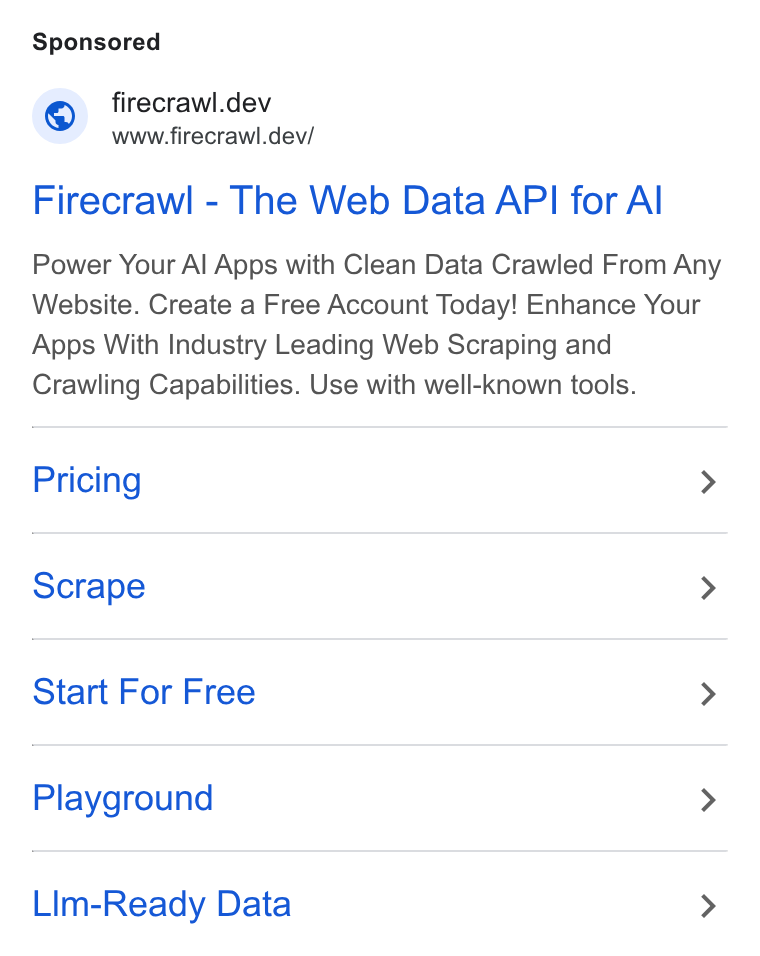
- Running
- 301 days (longevity = it's converting)
- Hook
- firecrawl.dev www.firecrawl.dev/ Firecrawl - The Web Data API for Al Power Your Al Apps with Clean Data Crawled From Any Website. Create a Free Account Today! Enhance Your Apps With Industry Leading Web Scraping and Crawling Capabilities. Use with well-known tools.
- CTA / offer
- Create a Free Account Today!
- Audience
- The mention of "Al Apps," "Web Scraping," "Crawling Capabilities," and "Llm-Ready Data" targets developers, data scientists, or businesses building AI-powered applications.
Why it works. Stacks multiple CTAs (free account, industry-leading claim, named integrations) into one search ad to catch developers at different stages of intent.
Headline stating core benefit: "Firecrawl - The Web Data API for Al" Layer your headline (who it's for), a benefit line (what pain it removes), and a low-friction CTA (free account) into one ad.
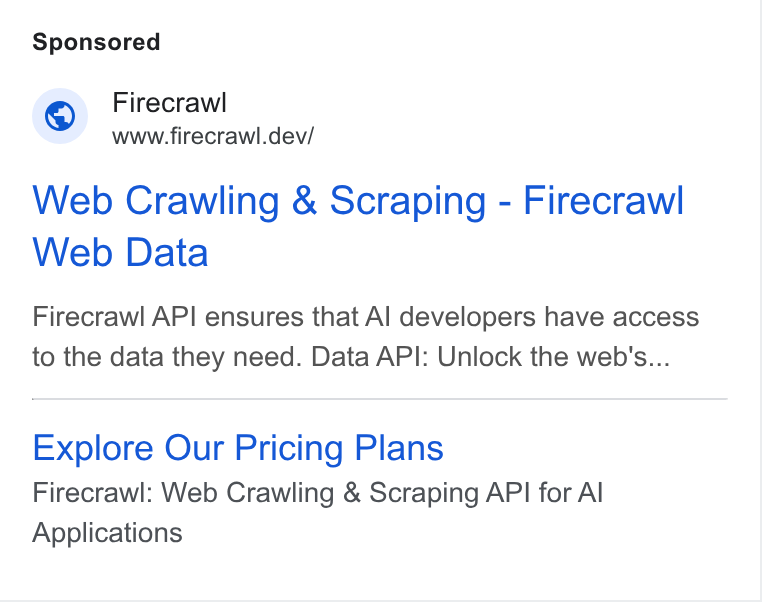
- Running
- 126 days (longevity = it's converting)
- Hook
- Sponsored Firecrawl www.firecrawl.dev/ Web Crawling & Scraping - Firecrawl Web Data
- CTA / offer
- Explore Our Pricing Plans
- Audience
- AI developers, indicated by 'Firecrawl API ensures that AI developers have access to the data they need' and 'Firecrawl: Web Crawling & Scraping API for AI Applications'.
Why it works. Firecrawl matches its ad headline to the literal search query (web crawling and scraping), capturing high-intent developer searches with zero friction.
Clear problem/solution headline: 'Web Crawling & Scraping - Firecrawl Web Data' Mirror the exact phrase your buyer types into Google as your headline, then add your brand name right after it.
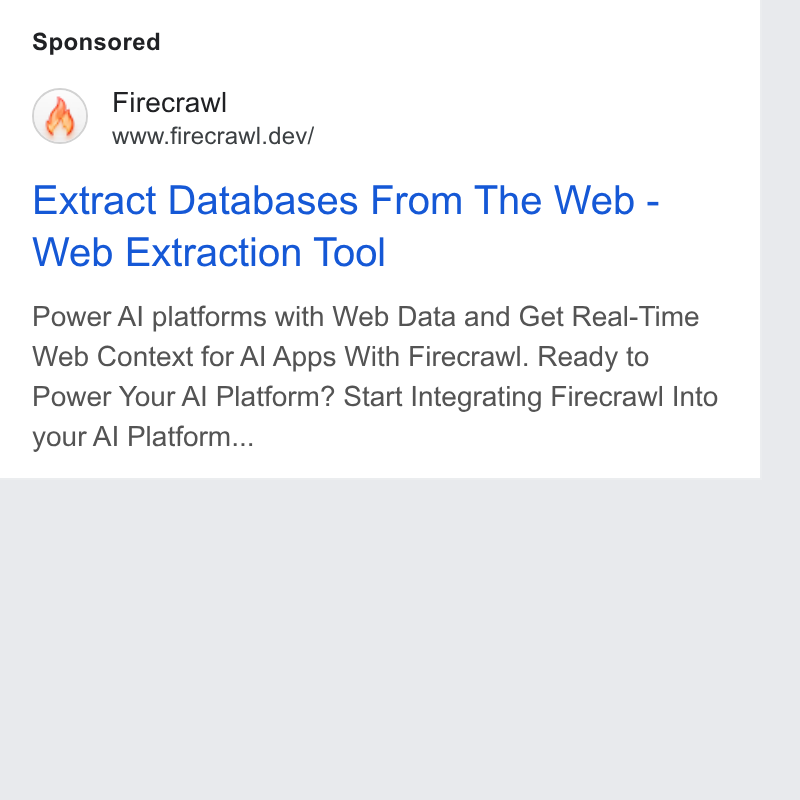
- Running
- 112 days (longevity = it's converting)
- Hook
- Sponsored Firecrawl www.firecrawl.dev/ Extract Databases From The Web - Web Extraction Tool
- CTA / offer
- Start Integrating Firecrawl Into your Al Platform...
- Audience
- AI platform developers or businesses needing web data for AI applications, indicated by phrases like "Power AI platforms" and "Integrate Firecrawl Into your AI Platform."
Why it works. Targets searchers typing extraction-specific queries by promising structured database output, a more concrete outcome than generic scraping copy.
Headline directly states the problem and solution: "Extract Databases From The Web - Web Extraction Tool." Swap generic data language for the exact output format your buyer is trying to get out of the raw source.
Show 3 more ads
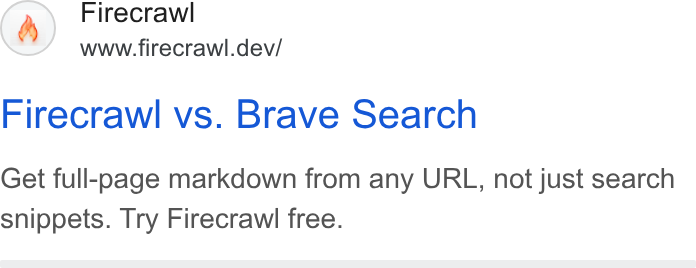
- Running
- 83 days (longevity = it's converting)
- Hook
- "Firecrawl vs. Brave Search" as a blue headline, with a small flame icon and "Firecrawl" and "www.firecrawl.dev/" above it.
- CTA / offer
- Try Firecrawl free.
- Audience
- Individuals interested in web crawling, data extraction, or alternative search technologies, indicated by the specific product names and technical terms like 'full-page markdown' and 'URL'.
Why it works. Extends the vs-competitor pattern to a more mainstream name, likely pulling in searchers who know Brave Search but not yet Firecrawl.
Direct comparison in headline: 'Firecrawl vs. Brave Search' Include at least one vs-ad against a more recognizable name in your space, even if it's not your closest direct competitor.
- Running
- 81 days (longevity = it's converting)
- Hook
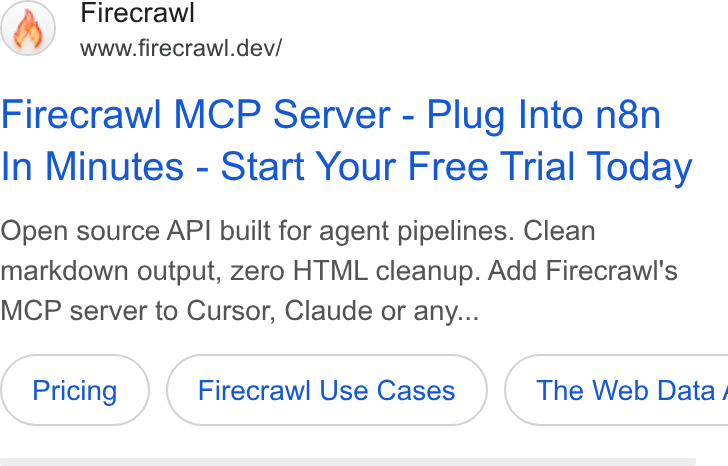
- Firecrawl MCP Server - Plug Into n8n In Minutes - Start Your Free Trial Today
- CTA / offer
- Start Your Free Trial Today
- Audience
- Developers and businesses using n8n, Cursor, or Claude, indicated by the specific tool mentions and technical language like "API built for agent pipelines" and "markdown output."
Why it works. Speaks directly to n8n users evaluating MCP integrations, promising a fast setup and a free trial to lower the risk of trying something new.
Headline with a clear, time-bound benefit and a call to action: "Firecrawl MCP Server - Plug Into n8n In Minutes - Start Your Free Trial Today" If your product plugs into a specific tool your buyer already uses, name that tool and the setup time in your headline.
- Running
- 81 days (longevity = it's converting)
- Hook
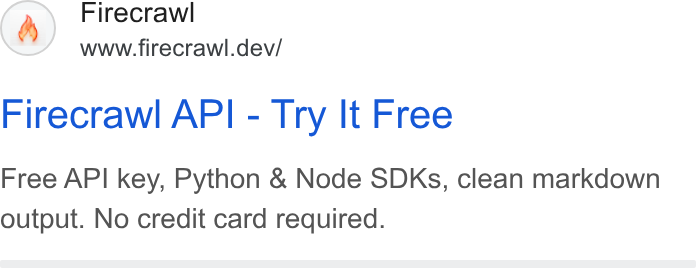
- "Firecrawl API - Try It Free" as a blue headline, below a small icon of a flame and the text "Firecrawl www.firecrawl.dev/".
- CTA / offer
- Free API key, Python & Node SDKs, clean markdown output. No credit card required.
- Audience
- Developers or technical users, indicated by 'API', 'Python & Node SDKs', and 'markdown output'.
Why it works. Strips the ad down to just the API name and a free trial, aimed at bottom-funnel searchers who just need a reason to click now.
Prominently display a free offer: "Firecrawl API - Try It Free" and "Free API key... No credit card required." Test a stripped-down headline with only your product name plus a free, no-commitment CTA against your longer variants.
08 The playbook
The channels are not separate. They are one system where each stage feeds the next. Here is the read, then the plays to run tomorrow.
The inferred playbook
The loop starts on GitHub and Hacker News, gets amplified by three founders' personal followings, and converts through a self-serve free tier rather than any sales motion.
Attention starts at the open-source GitHub repository and its recurring Show HN launches (detailed above), with a stable self-hosted fork and dozens of AI-agent tutorial videos on the official YouTube channel keeping the project visible to developers who never see an ad.
With a $0 tier at 1,000 credits and paid usage tiers from $16/mo, developers can hit the API inside whatever tool they already use (n8n, Claude Code, MCP clients) before ever paying, and the June 2026 move to no-signup-required free usage (referenced above) pushes that trial point even earlier.
Dig deeper+3▾
GitHub stars, tutorials tied to whatever agent framework is trending, and creator TikTok content in six-plus languages all compound with little added founder effort, since each new integration becomes another surface where someone finds Firecrawl while solving an unrelated problem.
Firecrawl has not published MRR or revenue. Grounding an estimate in its usage-based pricing (a free tier through $16 Hobby, $83 Standard, and $333 Growth, plus higher-usage and custom Enterprise tiers above that), roughly 48 employees per third-party trackers, and $16.2M in total disclosed funding, a reasonable order-of-magnitude estimate lands in the low seven-figure ARR range. Treat this as a directional estimate, not a confirmed figure.
free-to-paid conversion rate, churn, and CAC.
Launch every spinoff separately
The proofFirecrawl co-founder Eric Ciarla ran about four separate Show HN product launches over about two years (covered above) rather than treating their April 2024 debut as the only shot.
The adaptationPull a narrow, single-purpose piece out of what you are building, a converter, a CLI, a small generator, and launch it on its own under its own name rather than saving every feature for one big release. Each small launch reaches people who missed the last one, so the launch cadence itself becomes a recurring acquisition channel instead of a single moment.
Cost: $0 · Time to signal: days · Works pre-PMF: yes
Ship a free standalone utility
The proofThe llms.txt Generator, covered above, is a free micro-tool at its own subdomain that Firecrawl built and launched independently of the core product.
The adaptationBuild a small free tool that solves one sliver of the problem your paid product solves fully, host it at its own URL with no signup wall, and let it exist as a standalone thing people share without necessarily mentioning your main offering. The mechanism: an ungated free tool earns backlinks and word-of-mouth a gated product page never will, and some share of its users graduate to the paid product once they hit its limits.
Cost: $0 · Time to signal: weeks · Works pre-PMF: yes
Tie your content to whatever tool is trending
The proofThe creator videos above pair Firecrawl with whichever AI agent tool has attention, Claude Code, n8n, MCP clients, rather than pitching Firecrawl on its own.
The adaptationIdentify the two or three tools your target user has already adopted and is searching tutorials for, then publish short how-to content framed around that tool with your product as the missing piece, instead of content that assumes your product is the draw on its own. Repeat the same angle each time a new trending tool shows up in your category.
Cost: under $500 · Time to signal: weeks · Works pre-PMF: conditional, only if your product genuinely plugs into tools your audience already searches for; it does little for a standalone product with no integration story.
Bid on the incumbent's name, backed by a real comparison page
The proofThe comparison ads above bid on Tavily, Exa, and Apify by name to intercept people already evaluating those tools.
The adaptationPick the one or two incumbents your prospects already search for by name, build an honest comparison page rather than just an ad, and put a small daily budget behind bidding on that competitor's brand term pointing straight to it. Caveat: some ad platforms restrict competitor-name bidding, and it only works once an incumbent audience already exists to compare you against, so treat it as demand capture, not demand creation.
Cost: under $500 · Time to signal: weeks · Works pre-PMF: conditional, needs an established incumbent in the category to bid against.
Turn unpaid fans into a formal affiliate line
The proofFirecrawl's affiliate program, referenced above, now has a dedicated hire behind it after the founders noticed a wave of unprompted creator videos already promoting the product.
The adaptationOnce a handful of people start making unprompted content about your product, whether a review, a tutorial, or a comparison, reach out individually and offer them a simple revenue share or discount code before building any formal program. Formalize a page and outreach cadence only after a few of those relationships prove people will actually convert off their links.
Cost: $0 to start, dedicated budget or hire once it scales · Time to signal: months · Works pre-PMF: no, it depends on already having organic creator mentions to recruit from. Not transferable at an earlier stage: the three-founder simultaneous build-in-public presence, the competitor-bid comparison play, and the affiliate hire all assume either multiple co-founders each with their own following or an existing base of organic mentions and traffic to recruit from and defend, neither of which exists before a product has real usage.
You just read how Firecrawl does it. Tomorrow it is someone else.
Every morning we take one company that is actually growing and break down where its customers come from: the ads still running after a year, the channel doing the real work, and the play you can run this week.
Systemaic · directional intelligence. Traffic, spend, and reach figures are SimilarWeb-style estimates and qualitative reads of public data, not audited numbers. Built on real public receipts.
// teardowns with a similar GTM motion
sources & receipts (7)
Live ad libraries: google ad library
Launch archives: Hacker News: Show HN: Firecrawl-Simple – Stable fork of Firecrawl optimiz · Hacker News: Show HN: Llms.txt Generator – Turn websites into a text file · Hacker News: Show HN: API to turn entire websites into Markdown · Hacker News: Show HN: From SERP to LLM-Ready Data Markdown in Seconds wit · Hacker News: Scaling an AI scraping service to 300k requests a day · Hacker News: Show HN: A CLI to scrape, search, and interact with the web
Traffic, spend, and revenue figures are estimates as noted in the report; the links above are the primary public artifacts.